on Uncle Sam
pp. 33-34 · Read in the full issue
A critical eye on Uncle Sam
For those in the community interested in Pacific affairs, Giff Johnson is a well known figure in Honolulu. Giff is an occasio nal contributor to PIM, but locally he is far better known for his role in the Micronesian Support Committee (MSC). In 1975, Giff was one of MSC’s founders, and ever since, he has been one of the main driving forces behind the or ganisation. In recent years, Dar lene Keju, a citizen of the Marshall Islands, also became an ardent supporter and worker for MSC. About 50 other volunteers have helped staff the MSC office and assist with its publishing program.
At the time of MSC’s found ing, there was no organised group in the U.S. which served as an advocate for the interests of the citizens of the U.S. Trust Territory, especially with regard to their effort to determine their own political future. To present its viewpoints, MSC initiated a newsletter, Bulletin, which appeared two or three times most years. As Giff recalls those early days, MSC wanted the Bulletin to accomplish a couple of things: (1) publish informa tion not generally available in the islands on military, environ mental, nuclear, and human rights issues; (2) inform an international audience about concerns of Micronesians and their efforts to deal wkh the U.S. government, e.g., the attempts of Palauans to prevent the U.S. military from acquiring access to their lands, and Mar shallese attempts to gain con cessions from the U.S. at the Kwajalein Atoll Missile Range.
In 1983, MSC launched a second publication, Pandanus Periodical, and five issues appeared within the first year.
The function of Pandanus Periodical is different from the Bulletin. It reports upon coun tries and territories south of the Equator and what they are doing with regard to political and economic development and environmental issues. It is hoped that such information will suggest alternatives and
stimulate discussion in Mic ronesia.
The MSC played a key role in the organisation and sponsorship of the third Nuc lear-Free Pacific Conference which was held in Hawaii in 1980. (The first conference was held in Fiji in 1975, and the second on Ponape in 1978.
The title of the conference was changed to the Nuclear-Free and Independent Pacific Con ference upon the occasion of the fourth meeting in Vanuatu last year). Out of the 1980 affair, there emerged two new organisations, the Pacific Con cerns Resource Center and the U.S. Nuclear-Free Pacific Net work.
The Pacific Concerns Re source Center (PCRC) is Hon olulu-based and was formed to strengthen the nuclear-free Pacific movement and the efforts of Pacific and Pacific rim peoples to achieve self-de termination. The PCRC facili tates the dissemination of in formation, develops educatio nal resources, and co-ordinates actions and fund-raising. It is affiliated with regional offices in Vanuatu, Palau, New Zealand, Australia, and the U.S. It pub
lishes the Pacific Bulletin, and articles have appeared on such topics as nuclear dumping, the plight of the people of East Timor, Maori protests against injustices they have suffered, Indonesian activities in West Irian, etc.
According to Giff Johnson, the U.S. Nuclear-Free Pacific Network has quite recently changed its name to the more manageable handle of the U.S.
Pacific Network (USPN). It is mainland-based with offices in San Francisco and Washington, D.C. USPN began its own newsletter, Update, in Febru ary/March of this year and June saw the appearance of issue number two. About 90 per cent of its content is concerned with Micronesian affairs but articles have appeared on politics in the Philippines (for a reason made obvious below), the use of now uninhabited Kaho’olawe Island in Hawaii as a military bombing site and firing range, and the indigenous Indian peoples of North, Central, and South America. While supporting the notion of nuclear-free Pacific, the USPN Washington office is mainly concerned to educate members of the U.S. Congress and officialdom about the Trust Territory, particularly the provi sions of the Compact of Free Association that have been accepted by the people of the Federated States of Micronesia and the Republic of the Mar shall Islands, and are pending
A View from Honolulu
for the citizenry of the Republic of Palau. Giff reports that while USPN is not opposed to the compacts as such, it does raise serious reservations and objec tions about those provisions which guarantee the U.S. milit ary privileges in the islands and the discharge of American re sponsibilities concerning radiological contamination of the northern Marshall Islands.
It appears that Giff Johnson and Darlene Keju have found time for things other than some of the pressing problems of the Pacific. They were married on her home atoll of Wotje in the summer of 1982, and they now plan to leave Honolulu to take up residence in the Marshalls, most likely at Majuro.
As the functions of the parent
Robert C. Kiste looks at the Pacific
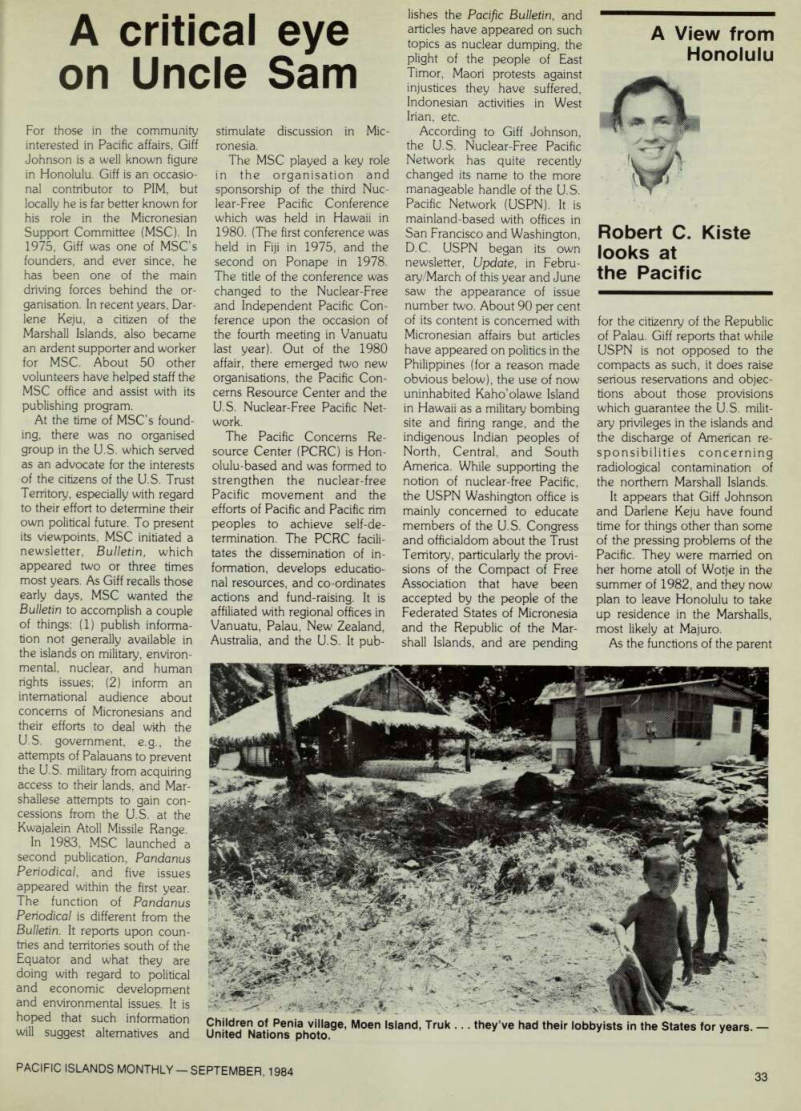
Children of Penia village, Moen Island, Truk . . . they’ve had their lobbyists in the States for years.
United Nations photo.
MSC and its offspring PCRC and USPN have began to over lap, and as the Johnsons have recently announced their de parture from the local scene, MSC will fade into history and be allowed to join the ranks of the dinosaurs. The Bulletin will also become extinct, but the relatively new Pandanus Periodical will be taken over by the PCRC. Its Pacific Bulletin will be continued, and thus PCRC will have two publica tions. MSC files, resource materials, slide presentations, and other information have been turned over to the two younger bodies.
The PCRC and the USPN are now the two main organisa tions in the U.S. that are pri marily self-appointed advocate groups concerned with the wel fare and future of American Micronesia, nuclear issues in the Pacific, and to some extent other contemporary issues in the region. A brief look at the staffs of the two is informative.
In Hawaii, the PCRC office has four main players. Sister Sanday Galazin of the Mary knoll order has been with
PCRC since its founding. Mr Kalama Akamine and Ms.
Puanani Fernadez are of Hawaiian descent and both have been active in a campaign to halt the abuse of Kaho’olawe. Carol Emaurois, a citizen of Palau, is currently a graduate student in public health at the Univesity of Hawaii. PCRC’s address is P.O.
Box 27692, Honolulu, Hawaii, 96827.
USPN’s San Francisco office also has four staffers who seem to be the most active. Ingrid Kircher is an Austrian citizen who got involved in the nuclear free movement in Vanuatu in 1983. Cindy (Cynthia Z.) Bid dlecomb served as a Methodist intern with the Pacific Confer ence of Churches in Suva in the early 1980 s. She travelled widely and Lotu Pasifika Pro ductions published her study Pacific Tourism: Contrasts in Values and Expectations. Bryan McKown is a law student work ing for a local San Francisco firm. Chad Myers is a member of PCRC’s international steer ing committee and was in volved in the 1980 and 1983
nuclear-free confrences.
The USPN office in Washing ton, D.C. looks espcially in teresting, and it is apparently composed of two people.
Glenn Alcalay is a former Peace Corps Volunteer who served on Utirik Atoll. The people of Utirik were one of two Marshallese communities exposed to radiological fallout from a 1954 nuclear test at Bikini Atoll.
Alcalay returned to Utirik for his Ph.D. research in anthropolo gy, and he is much concerned to see that the U.S. takes full responsibility for the consequ ences of its nuclear test prog ram in the Marshalls. Walden Bello is a Filipino citizen with a Ph.D. in sociology from Prince ton University. Bello is also director of the Washington based Congress Task Force of the Philippine Solidarity Net work, and he is co-author of Logistics of Repression and De velopment Debacle: The World Bank in the Philippines.
USPN’s address is: 942 Market Street, Room 711, San Francis co, California, 94102.
MSC was and PCRC and USPN are now concerned with,
write about, and seek to publicise issues that are sensi tive, and, in some cases, embarrassing (rightfully so) to the U.S. Obviously, they are critics of U.S. policies and ac tions in the Pacific. The stances that they take are somewhat predictable given their value orientations, but their criticisms are relatively mild. They could come on much stronger when they address such problems as the radiological contamination in the Marshalls and the living conditions of Marshallese work ers at the Kwajalein Atoll missile range. At least some U.S. offi cials find the organisations ex tremely irritating, and they charge that their staffers are so committed to island causes that there is a loss of some objectiv ity. Be this as it may, it is an understatement to say that the PCRC and USPN have a very great uphill battle. Many of the issues they raise should be brought to the attention of the public, but for most Americans events in the Pacific are not burning issues, and there is no reason to suggest that they ever
will be.
Robert C. Kiste.