questions
pp. 31-32 · Read in the full issue
Bikinians On Maui?
The unanswered questions
Two months ago, the possibility of the people of Bikini atoll moving to Hawaii was made very real. About 30 of the islanders, mostly women, travelled to Hawaii to look at the land parcel that their leaders are interested in buying.
It was an unusual group most of the women had never been outside the Marshall Is lands. Yet there they were in their rented tourist mini-buses, driving over the Hawaiian is land of Maui looking at beachfront acreage worth over $2 million. Dressed as they were in their bright “Mother Hubbard’’-inspired dresses, the Bikinians represented a curious contrast to the easy sophistica tion of Maui.
By all accounts, the Bikinians enjoyed what they saw on Maui and in the other parts of the Hawaiian Islands that they toured. (In fact, the most memorable stop for the group was the Polynesian Cultural Center on Oahu, the Mormon
Notes from the North
Church-run tourist attraction that showcases Polynesian peo ples in their traditional settings.
The women of Bikini were reportedly thrilled by what they saw.) However, among the people not so thrilled by the Bikinians’ visit was a small but perhaps
Floyd K.
Takeuchi on Micronesia
growing segment of the native Hawaiian population.
Shortly after new stories appeared in Hawaii news papers about the Bikinians’ tour, a letter to the editor of The Honolulu Advertiser criticised the possibility of the Microne sians moving to Hawaii.
The letter was not blatant, but the point was clear: why should the native Hawaiians, some of whom want the United States government to agree to monetary redress for suppor ting the overthrow of the Hawaiian monarchy, let an other Pacific Island group take more Hawaiian land using U.S.-supplied funds to do it?
Regardless of the rightness of the redress issue, such concerns are real in Hawaii and must be a factor in the Bikinians’ deci sion to resettle (albeit “tempor arily”) in Hawaii. (See PIM, May 1983).
The sensitivity of the issue is such that Hawaii Governor George Ariyoshi has asked one of his personal assistants to be his administration’s point man with the Bikinians. The aide has been spending the past few months trying to leam as much as he can about the potential newcomers.
Beyond the local political im
plications of the move, the governor is concerned about the impact as many as 800 or so Bikinians might have on state and country services, in cluding education and welfare.
The situation is this: the Biki nians want the United States’ permission to use part of a $2O-million plus resettlement trust fund to purchase the Maui land. The original law limited the islanders to using the money only for moves within the Marshall Islands. They would develop the parcel with town homes and necessary road and sewer improvements required by Maui county zoning codes.
But Maui would not replace Kili island, which has served as their “temporary” home since the late 19405. Many, perhaps most, of the Bikinians would move to Maui but they want to keep title to Kili in addition to the Ejit island in Majuro atoll where others reside. What they would have is three “tempor ary” homes.
In addition, they want the U.S. to clean up Bikini itself. A scientific panel has determined that it is a possibility, but would require either extensive soil re moval or new topsoil to cover the radioactive ground. Regard less, the clean-up alone would
be very expensive. If the Enewetak improvements are any indication, that three-year effort took $lOO million in the late 19705.
Will the Bikinians get it all?
Surprisingly, the U.S. Con gress has given the islanders a very tentative “yes”. The House of Representatives sub committee directly concerned with the Bikinians’ welfare has said, in effect, we will consider all possibilities. Nothing has been removed as an option.
However, in a diplomatic backstep, the committee has also said it would not act on the Bikinians’ request to use their resettlement trust fund for the Maui purchase until the U.S.- Marshalls Free Association Compact is acted upon. That could still take place by the end of the year, but delaying action by some House of Representa tive committee staffers seems certain to make 1985 passage more likely.
In a related move, the House has also requested that the Interior Department send a team to Hawaii to test the waters. Two high-ranking offi cials are scheduled to arrive in Hawaii in November for what probably will be a week-long session.
Thus the coming weeks may
be crucial for the Bikinians’ hopes to have a Hawaiian homestead.
But beyond the political and fiscal considerations in the Marshall Islands and in the United States there is a difficult cultural issue at stake; what impact would there be on the Bikinians if they moved to Hawaii?
It seems clear that nearly 40 years after being forced to relocate, the myth of the return to Bikini is far stronger than the reality of people actually wan ting to resettle their “promised land”.
Given the attractions to be had on Maui, are younger Bikinians, for instance, really going to be interested in living on a cleaned-up Bikini that does not have fast-food re staurants, television, cars, dis cos, or a relatively uninhibited lifestyle?
Are parents really going to want to put their children on a Bikini which may have only a small elementary school and no secondary education opportu nities? Or would they rather have the option of sending their children to free American public schools?
Can an island culture built around small land masses, a community living in close pro ximity and a homogeneous population, thrive on an ethnically and culturally diverse island that is as large as the entire Trust Territory land mass?
And an issue for the Marshal lese and residents of Hawaii: would the Bikinians be willing to submit themselves to Maui and Hawaii laws?
These are not inconsequen tial considerations. The Bikini leadership apparently believes it can control the situation and give its people the best of both worlds. Perhaps. But even in their nomadic existence of the past four decades, the Bikinians have never been tested as they will if they move to Maui.
It would not only be a move without precedent, it would be a decision which could have irrevocable consequences. If everyone involved understands this and accepts the “risks”, then fine. But it is not clear at least at this point that situa tion now exists. Hoyd K.
Takeuchi.
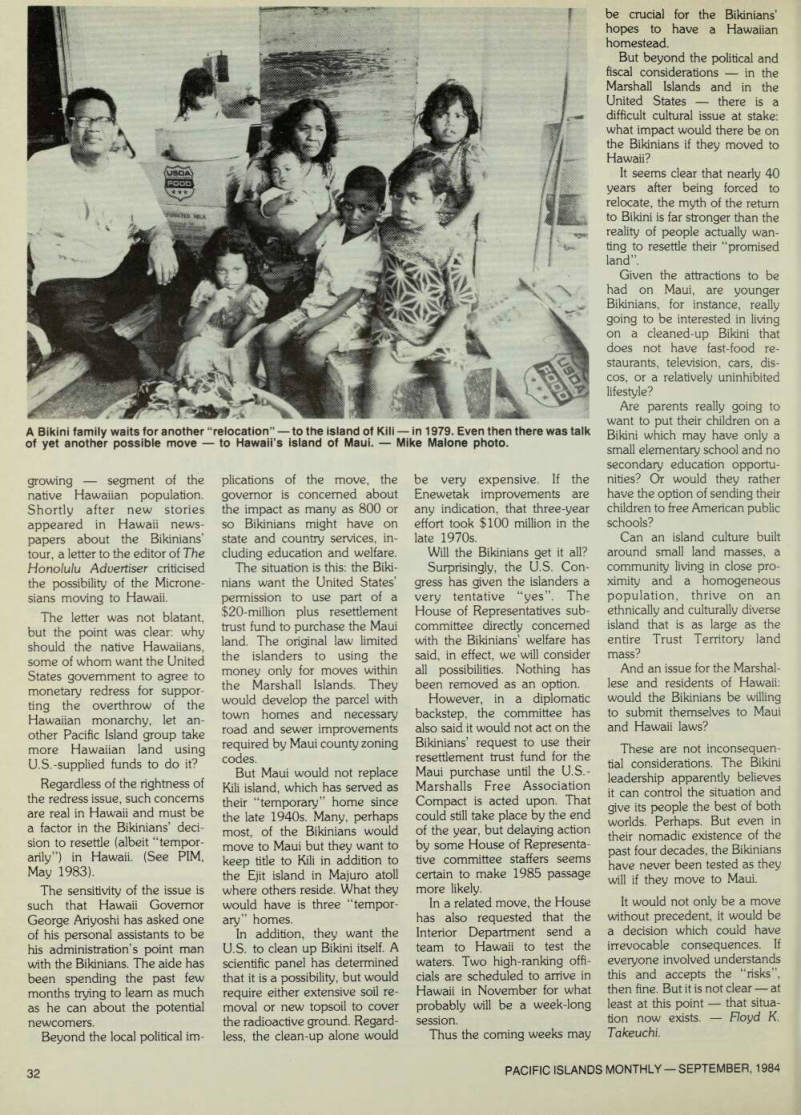
A Bikini family waits for another “relocation” - to the island of Kili - in 1979. Even then there was talk of yet another possible move - to Hawaii’s island of Maui. - Mike Malone photo.