The changed face
pp. 29-31 · Read in the full issue
Fisheries
The changed face of Port Olry
Port Olry is a large, rambling village on the north-east coast of Santo, which has seen much turmoil and depression. Its population is split between 20 per cent “man pies” and 80 per cent immigrants from Big Bay, on Santo’s north coast. Many of the local people were involved in the 1980 troubles, leaving a legacy of resentment from neighboring villages. The defeat then of the Nagriamel separatist movement left the village in a backwater, politically; its geog raphic position, 50 kilometres from the port of Luganville, and far from any booming deve lopment, left it in a backwater, economically.
This has changed over the past 18 months, with the estab lishment of the village fishing co-operative, Association blong Remre.
The village now has a fleet of 12 small speedboats, being purchased on loan by indi
vidual workers in the village with money earned from their own fishing. On the boats, each employing two crew, in addi tion to the owner-captain, the fish are gutted and put on ice immediately after catching. In the village, some are kept for family use, some are sold pri vately, but most of the fish are sold to the co-op. There, they are cleaned thoroughly and stored in the coolroom, which Remre Association purchased with a 10 per cent cash pay ment, a 40 per cent bank loan and a 50 per cent aid grant.
Earnings from the fishing en terprise have been so impress ive that this loan could be repaid now, though a meeting decided that as this would leave the co-op with very little capital, only two-thirds should be re paid, leaving the remainder for another two years.
The volume of the catch is also impressive; in the first nine
Report from Vanuatu
months of operation the co operative produced 15,624 kilos of fish, worth nearly two million vatu. The reselling of the fish, and management of the books, is undertaken through Remre’s manager, Petro Rite; the profits are distributed to the 100 share-holders in the village, including children, The direct cash flow is au gmented by indirect earnings associated with the co-op, such as those of the truck owners who transport the fish to Luganville, and increased pro fits at the village store.
But economic gain is not the only benefit of the co-operative.
Julie-Ann Ellis
More fish is being eaten in the village, as 10 per cent of the catch stays in Port Olry, with good effect on general nutri tion. Villagers, who previously fished almost exclusively on the nearby reefs, are coming to know more about their exten sive offshore fishing areas, with a greater incentive to explore them; this knowledge is shared so that everyone can benefit. (Research is currently under way to determine maximum sustainable yields.) Money is also being put into capital im provements in other fields, such as fencing to make gardening and beef-raising more com patible.
In all, Port Olry’s Association blong Remre has been a re sounding, and even startling, success. Yet Port Olry had tried twice before, unsuccessfully, to set up just such a fishing co operative.
What made the difference this time was the Ministry of Agriculture, Forestry and Fisheries’ Village Development Program. Working within an overall framework of the de sirability of increasing the fish supply to urban areas, and of developing village economies, the VFDP has overseen the setting up of 18 such projects, and more are planned.
The VFDP offers training in fishing techniques often vil lage fishers are experienced in reef fishing, but not deep-water fishing and boat and engine maintenance, utilising the skills of British and Canadian fishing experts. In Port Olry, for exam ple, Joan and Neil Crysler, Vancouver salmon fishers, have been resident for a year as advisors to Remre.
The VFDP also lays down the ground rules for acceptable marketing of the fish the immediate chilling of fish after catching being an example of this.
But the VFDP does not handle the marketing. This is left to two linked companies, both government-owned Port-Vila Fisheries Ltd and Santofish. The fish from Port Olry is transported to Santo; along with catches from other VFDP projects it is inspected by John Lee, the manager of Santofish, who estimates that he pays out 200,000vt in a good week.
Some of the fish is then
retailed at Santofish, which has 15 cubic metres of chill storage and ice-making facilities, but the bulk of the catch is sent on to the larger urban population at Vila.
There, at Natai (like Santo fish, a Japanese-funded marketing outlet), with its chill storage, frozen storage and blast freezer, it enters the retail, wholesale and, recently, export markets.
Natai, in the 15 months since it was established, has captured 90 per cent of Vila’s retail trade, and can also boast, in the words of John Nicholson, the New Zealand manager, of “sup plying the cream of the Pacific” to the luxury cruiser Princess Mahsuri, as well as to major hotels and restaurants.
This is all to the top end of the market. As costs of labor, transport and power are high, the price of fish sold by Natai is also high. The one big shortcoming of the whole fishing scheme is that it has not yet solved the problem of sup plying the lower end of the urban market at affordable prices.
The high costs also mean that the export market is for quality produce, not for canning or processing, as only top quality fish are economic. Fortunately, top quality fish is available, including local delights such as coconut crab (in fact a kind of lobster), and specialities for overseas markets, such as ika jimi snapper, which must be killed and packed in an ice and salt-water slurry on board ship.
A presentation box of ika jimi was taken to Japan’s Prime Minister Nakasone by Prime Minister Lini this year, in ack nowledgment of Japanese aid for, and interest in, Vanuatu’s fishing industry.
Exporting is going ahead to Noumea, and trial consign ments have gone to Melbourne, Sydney and Tokyo. Delays at customs frustrated the first com mercial shipment to Australia, but the client, undeterred, has reordered, and it is hoped these problems are now resolved.
Meanwhile, at the other end of the long road from Port Olry to the markets of the world, the daily small-scale fishing in that one village alone can, on a good day, catch enough fish to supply the whole of Vila.
Julie-Ann Ellis.
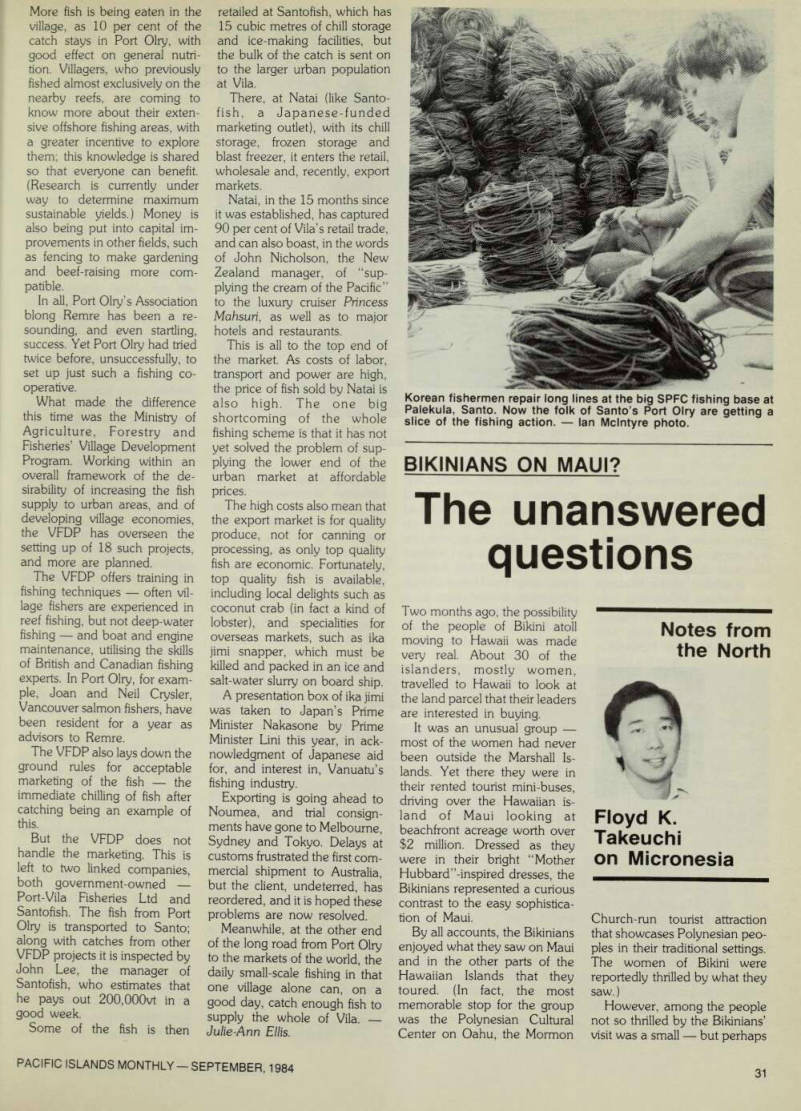
Korean fishermen repair long lines at the big SPFC fishing base at Palekula, Santo. Now the folk of Santo’s Port Olry are getting a slice of the fishing action. - Ian Mclntyre photo.