“Tiurai” cherry
pp. 27-29 · Read in the full issue

Two bites of the “Tiurai” cherry
Since as far back as 1881 the French national day of July 14, called simply Tiurai (July) by the Polynesians, and often “Bastille Day” by foreigners (but never by the French themselves), has been the major event of the year in Tahiti, giving rise to week-long festivities, with exciting dance displays, himene choral performances, and sports contests such as canoe-racing, foot races, spear-throwing, and so on.
Regrettably, but no doubt inevitably, over recent decades this once genuine folk festival has taken on an increasingly professional and commercial character, until today it is predominantly geared to the tastes of paying European onlookers, most of whom are not “real” tourists at all, but French military personnel, government officials, businessmen and settlers,
together with their families (PIM Sept. ’B2 p 24). . .
The Tiurai festivities this year were 9> ven ane '"’ Political st Responsible for this was the present strongman, majority ader and head of the local government Council Gaston Flosse ; ) vho s V ddenl P decided to celebra ‘ e his comfortable '1 C ‘° I V at th « P°' ls on June 17 (PIM Aug. p 23) by organising a spec , ial i l nau 9 ural parade two weeks ahead of Jul P 14 The Polynesian name he chose for the new exercise in pageantry was Hiva vaeuae (“Foot company”), the idea being that people would come running to the event spon taneously from all over the island. The chosen date of June 29 again had great political significance, for this was the date in 1880 when the last
Postmark Papeete
Tahitian king, Pomare V, ceded to France “forever” most of the islands which today make up French Polynesia.
Or this at least is how the event has traditionally been presented by the long line of French admirals, governors, and high commissioners who since then have ruled the for-
mer kingdom, henceforth re duced to a colony.
The truth is rather different.
To begin with, Pomare V did not own the two islands of Tahiti and Moorea which he signed away in exchange for an annual pension of 60,000 francs. They belonged to the inhabitants, represented by the ruling families of 22 separate “kingdoms,” of which Pomare was the undisputed ruler of only one.
Of the 21 chiefs apart from Pomare, only nine turned up at the French Residence on June 29, 1880, to sign the deed of cession which High Commis sioner Chesse had prepared.
Undeterred, he ordered 11 stooges on the government payroll to add their names to the document before sending it off to Paris for speedy ratifica tion by the French Parliament.
Modem historians eventually dug up documents in French colonial archives revealing how the hoax was perpetrated. In consequence the French Gov ernment was obliged to aban don the quite elaborate plans it had been making to celebrate the 1980 centenary of the take over (PIM Aug. ’BO pi 08).
Incidentally, this greatly dis pleased Gaston Flosse. He was in opposition in the Territorial Assembly at the time, and was counting on Pomare’s name and the deed of cession to rally all the pro-French groups in the territory around him in the struggle he was then waging to stop the territory’s dangerous slide towards independence.
Although times had changed, and Flosse himself since he came to office has often been accused of striving for eventual independence, he still, in June 1984, found it politically expe
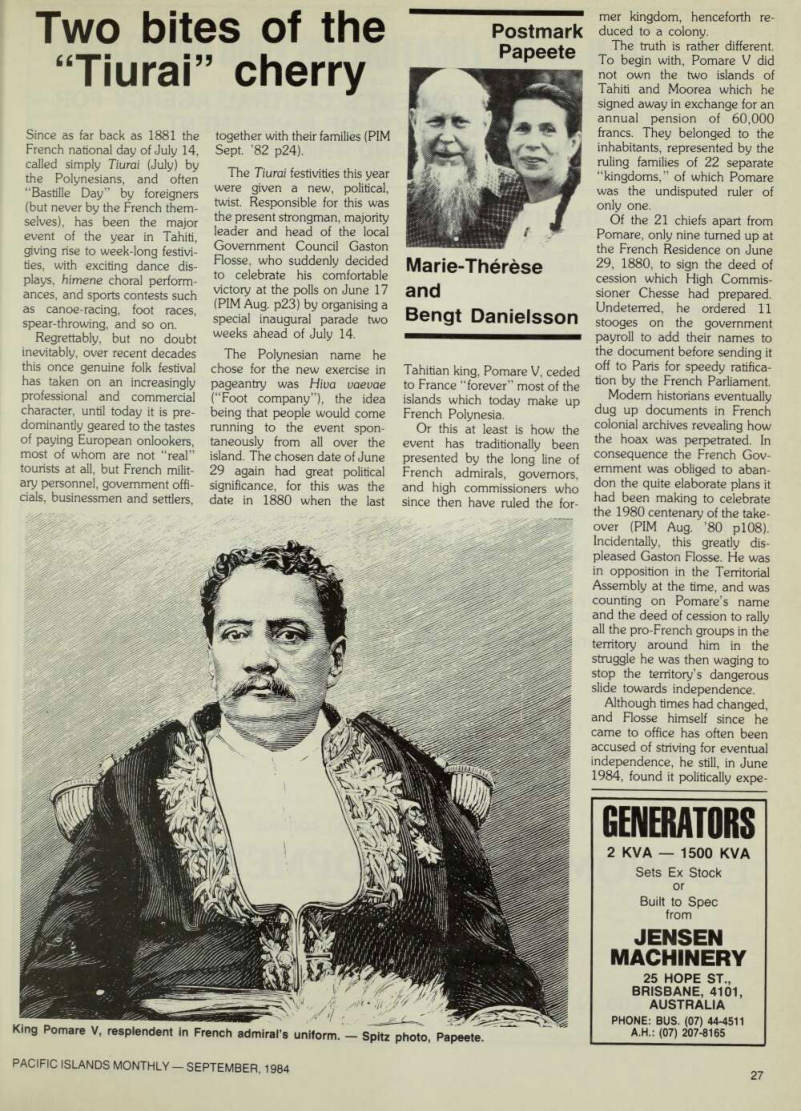
King Pomare V, resplendent in French admiral’s uniform. - Spitz photo, Papeete.
Marie-Therese and Bengt Danielsson
dient to cling to King Pomare and his aura.
What a mistaken move it was became clear not long after June 29 dawned; the early morning “thanksgiving” cere mony at Pomare’s tower-like mausoleum outside Papeete described by the French painter Paul Gauguin, who attended the funeral in 1891, as “an affront to the natural beauty of the site” attracted no more than 20 people, practically all of them descendants of the king.
The most “conspicuous” absentee was Gaston Flosse himself, who a few days before had felt it imperative that he fly off to Paris on the thankless mission of trying to persuade the French Government to grant him a little more power, at least in economic matters (PIM Jun. p 32).
When the royal victory par ade got under way a few hours later along Avenue General de Gaulle in central Papeete, an even more important defection from the “Foot company” be came apparent: there was no beauty queen to preside over the affair, as happens at all Tiurai pageants. The reason was simple: the ’B4 Miss Tahiti had not yet been elected, so the spectacle had all the savor of a salad without dressing.
An even more important blow to the proceedings was the flat refusal of the Protestant and Catholic churches, to which 90 per cent of Polynesian belong, to allow contingents of their faithful to take part in the parade, because it smacked too much of party politicking.
The French military could not take part in the affair instead of, or in addition to, the national day parade a fortnight later. So, the only folk left to march to the greater glory of the dead king, and the very much alive Vice- President Gaston Flosse, were the members of the territory’s numerous sports, cultural, and handicrafts groups, which reg ularly receive generous sub sidies from the local Govern ment Council (this year’s figure was a whopping CFP6OO mil lion, or aobut SAS million). In fact, this policy of handouts to political groups was initiated by local politicians long before Gaston Flosse came to power.
But whatever the official jus tifications offered for the policy, there is no doubt that those
who receive the subsidies tend to show their gratitude at the polls.
July 14, the day of the real Tiurai parade, dawned wet and gloomy and, as in metropolitan France, the parade in Papeete was fundamentally dedicated to the glory of the French armed forces. Although 800 uni formed men took part 10 per cent of the total number in the territory and the foreign legionnaires employed their usual slow 80-steps-a-minute marching style, it took the few units only about a quarter of an hour to march past, and smartly salute, the nuclear-tests admiral from the CEP, the high com missioner, and the returned Vice-President Gaston Flosse, who sat side by side on the reviewing stand.
What saved the day for the wretched spectators was the colorful “tail” of carnival-type floats, plus a charming Miss Tahiti in a trilby, which brought proceedings to a close.
The seven participating cultu ral groups had chosen apparently widely varying themes, but in fact they had the common denominator of reflec ting contemporary everyday concerns of the inhabitants of these islands.
The first group consisted of recent forlorn immigrants from the Tuamotus they likened themselves to wandering sandpipers, with no nests of their own in Tahiti.
A large float carried a dozen elderly women, demonstrating various traditional handicrafts which today in many instances represent their sole means of survival in a harsh, European style economic environment.
Yet another float showed a touching scene of young Vahines initiating a newly ar rived Frenchwoman into the secrets of the way of life in this earthly paradise of Tahiti.
Last but not least was a huge float filled with Tahitian revel lers, singing, dancing, eating
and drinking, totally forgetful of their daily miseries and prob lems.
When the fun was over and the balance sheet drawn up, Flosse’s decision to split the traditional Tiurai parade in two seemed less justified than ever.
The real Pomare parade was not the first, but the second.
Not only because the last king of Tahiti was an honorary admi ral in the French navy, and loved to show up on occasions like this in his gold-braided naval uniform especially if he could hobnob with some real French admirals. But also be cause he was such a merry monarch, who spent most of his short life (he died at 52) in a sort of perpetual Tiurai revelry.
Perhaps even more so after he was awarded his truly royal pension in 1880, a well-earned reward for his ready co-opera tion in establishing the tight colonial rule which, in all its essential respects, is still in force
today.
Marie-Therese and
Bengt Danielsson.