the month
pp. 25-26 · Read in the full issue
I. F. splits: To boycott or not?
Four of New Caledonia’s Inde pendence Front (I F) parties have decided to boycott and obstruct the forthcoming Territorial Assembly elections.
Following an extraordinary convention of the I F, from which the LKS party has with drawn (see below), the UC, UPM, FULK and PSC parties have decided to exert them selves to render the results of the September elections in valid.
The elections are planned by the French Government to usher in a period of five years’ internal autonomy for the terri tory, with an act of self-de termination to follow in 1989.
The I F had submitted its own propositions to the French Parliament for independence in 1986 and for substantial electoral reform for the referen dum on independence. These propositions were rejected by the French Parliament and in stead the autonomy plans pas sed. While the I F did not spell out the methods for disputing the territorial elections, its lead ers have recently spoken of occupying polling booths, steal ing or destroying ballot boxes, etc., and, in a hardening of position, the I F is to meet shortly to form a Kanak Na tional Liberation Front (KNLF) and set up a provisional gov ernment to lead the country to independence.
A short press statement issued after the convention on July 28 said the I F would pull out of government institutions in New Calendonia step by step and set up its own parallel organisations for governing the country.
The statement said the KNLF meeting would determine a new strategy to win the inde pendence struggle. Following the meeting one of the I F
held in New Caledonia in De cember.
Speaking to the press after their conference UPM leaders said the I F had made too many concessions and that the time had come to break off the dialogue with France. “We can not continue to work in a situation that’s not clear,” UPM president Edmond Nekiriai said. “This type of situation will lead to violence. We’ve adopted a parliamentary strategy over the past three years, but now we must go beyond that and the French Government must know it.
We’ve called on other races to join us in the independence movement but we can see there’s been almost no one.”
One of the main features of the I F’s hardening of position is their increasing sense of isola tion from organisations they felt were partners. UC leader Jean- Marie Tjibaou accused the French Socialist Party of dishonesty in having supported the Kanak people’s right to self-determination in 1979, and in having recognised last July (at the round table discussions) the “innate and active right to independence of the Kanak people”. “Yet not one Socialist Party member of the French Parliament had the courage to
leaders, Eloi Machoro, said the I F would do all in its power to prevent the French autonomy plans going ahead. He added the front would take any help it could get from overseas, includ ing the Soviet Union.
The I F convention had been preceded by a special conference of the largest I F party, the UC, which had opted for the boycott and provisional government strategy. UC had also called on all pro-independ ence mayors to fly the Kanak flag above their town halls from September 24, the anniversary date of French annexation of New Caledonia in 1853.
Another independence party, the UPM, had also held a conference in July to determine their position on a new strategy.
The conference, held at Oundji, decided to boycott the elec tions, to ensure their disruption, and to progressively quit gov ernment institutions. UPM also voted for a boycott of the Festival of Pacific Arts to be
Noumea Notebook
stand up and defend that right, ” he said.
This disillusionment also ex tends to the Australian Labor Party, whose foreign affairs minister told the July ALP conference that in his view France was making progress towards a free act of self determination, and that the South Pacific Forum would be unlikely to call for the listing of New Caledonia’s case with the United Nations Decolonisation Committee. UC Secretary- General Eloi Machoro told the UC conference, to loud ap plause, that the Australian sup port for France was motivated “by fear of problems with their
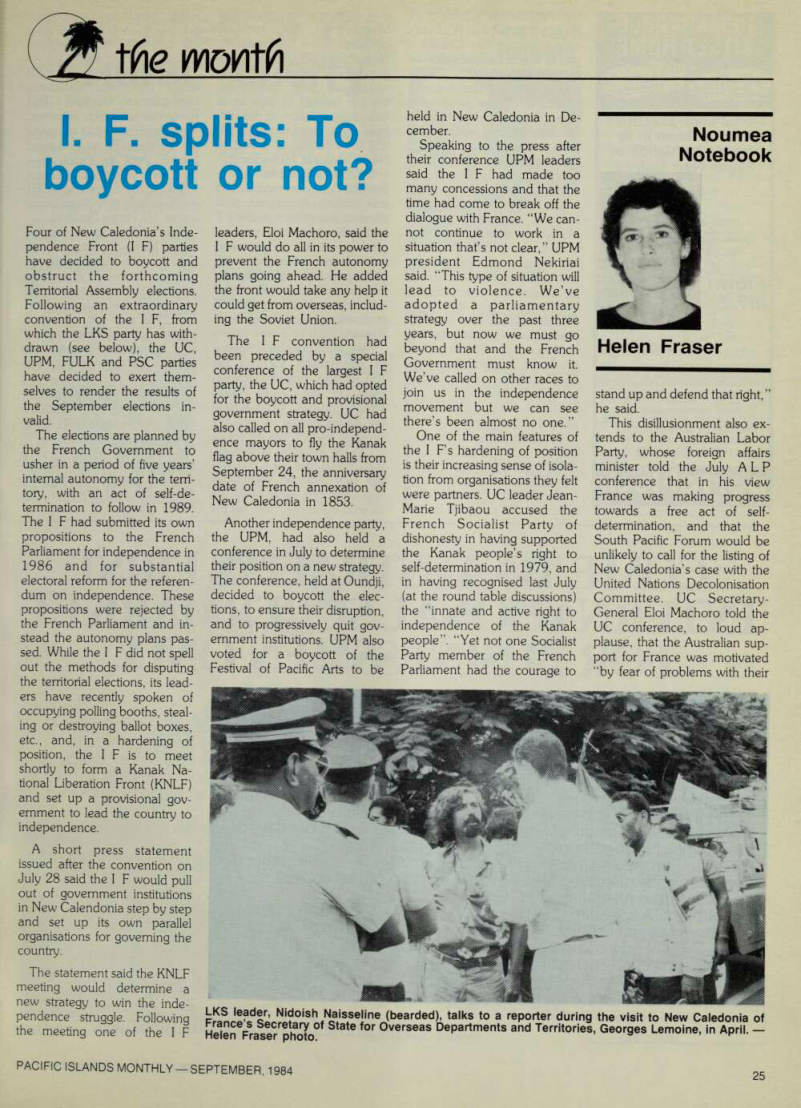
LKS leader, Nidoish Naisseline ( bearded ), talk s a reporter during the visit to New Caledonia of France's Secretary of State for Overseas Departments and Territories, Georges Lemoine, in April.- Helen Fraser photo.
Helen Fraser
own indigenous people.” Mr Machoro added that Australia’s only interest in New Caledonia was its fear of destabilisation on its doorstep.
Machoro said after the con ference that if the senior part ners of the Forum, Australia and New Zealand, continued to support France the I F would seek support elsewhere, such as at the summit of non-aligned countries, or Cuba.
The feeling of isolation of the I F was summed up by Mr Machoro at a political rally held on French National Day, July 14. Speaking beneath the Kanak flag at the tribal area of La Conception near Noumea, Mr Machoro said that if the French Government was not prepared to decolonise New Caledonia, the Kanak people would do it themselves. “We can count only on ourselves,” he told the meeting.
The decision of LKS, the second largest party in the I F, to leave after the I F conven tion of July 28 has brought many questions and internal I F matters to the surface. LKS leader Nidoish Naisseline told newsmen his party left the I F
over differences on strategy and because too many internal problems were not resolved.
He said the LKS felt that before going ahead with a boycott and withdrawal from institutions, the I F needed to look at its lack of organisation, its depend ence on finance from overseas, and the influence on it held by New Caledonia businessmen.
On the first point Mr Naisse line said the lack of organisation was evident in that since its creation five years ago the I F had not elaborated a common platform, had no common strategy, had created no com mon grass roots sections, and that basically the I F existed only as a product for export and in situations where there are no Kanaks.
“We exist only by reference to non-Kanaks, such as the RPCR, the French Govern ment, or the South Pacific Forum,” he said. “In the eyes of the Kanak people we are five separate parties, not an I F.”
On the question of finance, the LKS alleges the I F is 100 per cent financed from over seas, although each party has its own resources. “We tell the
Kanak people they must count on themselves but we don’t set the example,” Mr Naisseline said.
On the third point the LKS allege that New Caledonia businessmen Gaspard (Bill) Ravel has too much influence.
Mr Naisseline cited as an exam ple the blockade set up against French ships by Papua New Guinean waterside workers following the September 1981 assassination of independence leader Mr Pierre Declercq.
The PNG blockade against two of Mr Ravel’s Sofrana Line ships was lifted after a telegram was sent from an I F member acting at Mr Ravel’s request, Mr Naissseline said. He summed up: “We are not against a boycott of the elections, so long as it is well prepared, and we are sure we have no more cards to play.”
Meanwhile uncertainty exists in Noumea as to whether the elections will be held as sche duled in September, or whether the French Government will postpone them until 1985 and use the time to try and sort things out with the I F.
Helen Fraser.