Sepik project helps dam
p. 37 · Read in the full issue
Papua New Guinea
Sepik project helps dam the canned-fish tide
Despite a cornucopia of indigenous food tropical fruits, green vegetables, root crops, wild game on larger islands, fish and shellfish almost everywhere the diets of Pacific islanders are deteriorating. Malnutrition is a growing menace.
Although there is no known shortage of local staple food anywhere in the South Pacific, enormous quantities of food are imported.
The reasons why islanders are eating differently from their forbears range from complex changes in the societies, to simple changes in tastes. But the cost is heavy, both financial ly and nutritionally.
Papua New Guinea, the re gion’s largest country, spends nearly as much money to im port food as petroleum. Along with it, the country has unwit tingly imported problems: many of the new foods are nutritionally inferior to the traditional ones they replace.
Government health officials estimate that Papua New Gui neans get only 80 per cent of the food energy they need.
They rate malnutrition as a major cause of infant and child deaths, and of stunted learning ability among children.
None of the food newcomers is more pervasive or more ironic than imported canned fish. Although surrounded by vast seafood resources and a net exporter of fish to other parts of the world, the South Pacific region supplies less than half of its own domestic de mand. All the island countries import canned fish, mostly mackerel from Japan. Its popu larity makes it one of the fastest-moving items in trading stores. To islanders unencum bered by its less-visible disad vantages, canned fish is a god send easier than fresh or dried fish to transport, store, serve, and often cheaper as well.
This canned-fish tide can, however, be pushed back. It’s happening, in a small way, here in PNG.
One of the last places on earth to be explored by Euro peans, the country took quickly
PETER STUART, an information officer with the Manila-based Asian Development Bank (ADB), reports from Angoram, Papua New Guinea, on the encouraging results of an ADB fisheries deve lopment project on PNG’s mighty Sepik River.
to this type of Western conveni ence food. Canned fish swiftly became 70 per cent of all the fish consumed, but now may be beginning to ebb.
The battle for the palates of Papua New Guineans starts here in the north of the country.
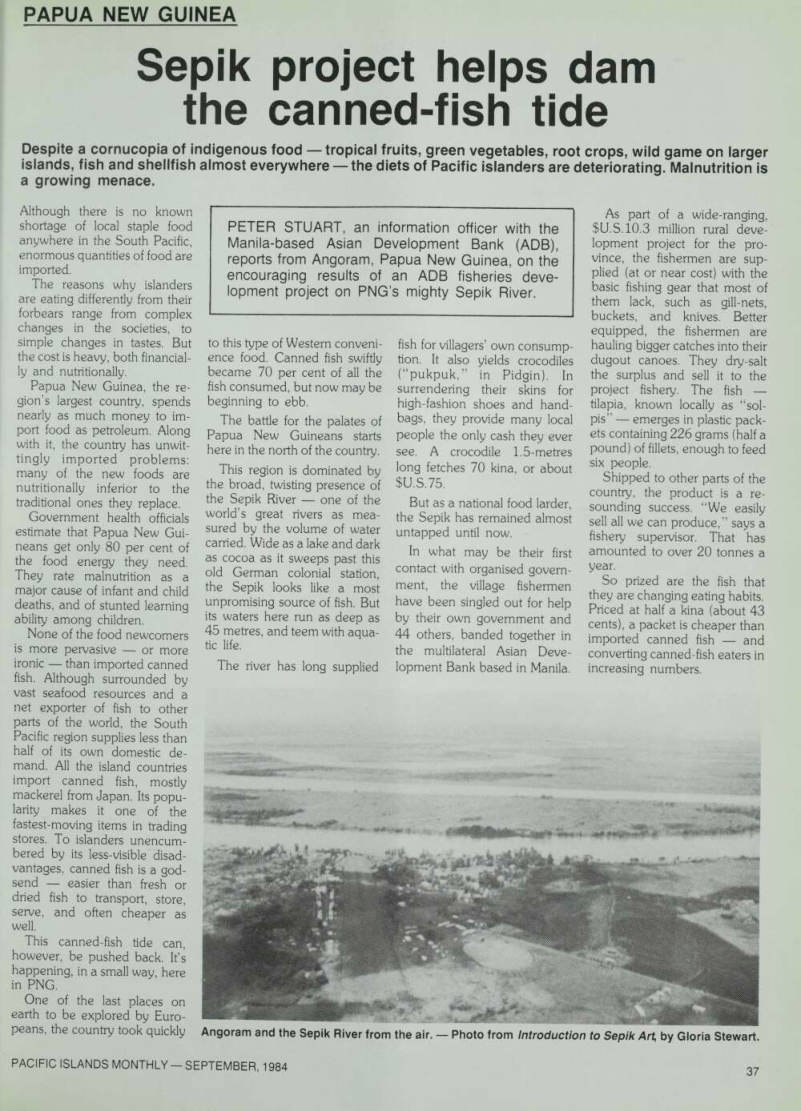
This region is dominated by the broad, twisting presence of the Sepik River one of the world’s great rivers as mea sured by the volume of water carried. Wide as a lake and dark as cocoa as it sweeps past this old German colonial station, the Sepik looks like a most unpromising source of fish. But its waters here run as deep as 45 metres, and teem with aqua tic life.
The river has long supplied
fish for villagers’ own consump tion. It also yields crocodiles (“pukpuk,” in Pidgin). In surrendering their skins for high-fashion shoes and hand bags, they provide many local people the only cash they ever see. A crocodile 1.5-metres long fetches 70 kina, or about 5U.5.75.
But as a national food larder, the Sepik has remained almost untapped until now.
In what may be their first contact with organised govern ment, the village fishermen have been singled out for help by their own government and 44 others, banded together in the multilateral Asian Deve lopment Bank based in Manila.
As part of a wide-ranging, $U.5.10.3 million rural deve lopment project for the pro vince, the fishermen are sup plied (at or near cost) with the basic fishing gear that most of them lack, such as gill-nets, buckets, and knives. Better equipped, the fishermen are hauling bigger catches into their dugout canoes. They dry-salt the surplus and sell it to the project fishery. The fish tilapia, known locally as “sol pis” emerges in plastic pack ets containing 226 grams (half a pound) of fillets, enough to feed six people.
Shipped to other parts of the country, the product is a re sounding success. “We easily sell all we can produce,” says a fishery supervisor. That has amounted to over 20 tonnes a year.
So prized are the fish that they are changing eating habits.
Priced at half a kina (about 43 cents), a packet is cheaper than imported canned fish and converting canned-fish eaters in increasing numbers.
Angoram and the Sepik River from the air. - Photo from Introduction to Sepik Art, by Gloria Stewart.