The great hope:
p. 18 · Read in the full issue
a malaria vaccine
Treatment of malaria has so far been mainly with suppressants which, in the case of drugs like Fansidar, prohibit the breeding of the malaria parasite in a victim’s system until the infec tion dies out, literally of old age and lack of new population. But a vaccine to prevent the out break in the first place has so far eluded science Now, however, there is hope of a breakthrough. Scientists at the PNG Institute of Medical Research in Madang are cautiously optimistic. They have much work yet to do, and many tests before a workable vaccine is produced. But if they do manage to produce the means of immunising whole *Pneumonia and other respira tory diseases such as TB, are top of the killer HsU with the various forms of diarrhoea second.
populations their success will rank with the conquest of small pox and polio as a service to mankind.
For decades malaria has been one of the three* major killer diseases in Papua New Guinea. Today it remains in that position, despite a massive control program culminating in the spending of millions of kina, and the deploying of hundreds of spraymen since the late sixties. The battle is still on, but it is not being won.
Health authorities in Port Moresby have admitted that as time goes by it is becoming more and more difficult to combat malaria. Drastic cuts have been ordered by govern ment in malaria control funding and staffing, leaving only a skeleton staff to carry out spraying programs.
But, despite this sort of gloom, hopes are high among
staff of the PNG Institute of Medical Research branch at the northern town of Madang.
They think they may be on the track of an anti-malarial vac cine.
Staff of the Madang branch , in collaboration with experts from five Australian institutes have been working on deve lopment of a vaccine for some time and hope they can start field testimg by 1989. The genetic engineering research is headed by Dr Michael Alpers.
Live malaria parasites are obtained from blood taken from affected humans. These are then multiplied in flasks in Madang and also sent to labor atories in Australia for extrac tion of the genetic material needed to produce antigenes.
The scientists now have isolated and grown more than 200 types of malarial antigenes and have begun testing them for suitability in the production of an anti-malarial vaccine. The final decision on which vaccine will be used will be made at an international level. ”We still have not decided which antigenes to use, but we are encouraged by the results so far,” said Dr Alpers. ”We are continuing to evaluate the re sults, and already there are signs of potentially suitable anti genes.”
If a suitable vaccine is found the second stage of the project will begin with massive field testing. Dr Alpers explained that such trials would require huge amounts of money, staff and, of course, volunteers to take the vaccine and then expose them selves to malarial infection. In the initial stages humans would not be used. This stage of the testing would be entered only after a vaccine had been pro duced which satisfied the stan dard requirements for safety.
Similar work is now in train in the United States, said Dr Alpers and, if the Madang unit, with its Australian associates, managed to produce a vaccine it would be sent all over the
world for further evaluation.
But, until this still hopeful project succeeds, malaria will continue as a major problem for the people of Papua New Guinea. This year the govern ment set aside 3 million to combat the disease. As a sum of money it is reasonably large, but it represents less than one kina for every member of the PNG population, and is one million kina less than the pre vious year’s budget.
Health authorities say bluntly that malaria is “now not to be regarded lightly.” Despite the chopping of their funds they remain keen to get their eradication program on to a better footing, and extend it beyond the one-third of the total population area which is all that could be treated last year.
Not all the trouble was shor tage of funds or staff. Last year 400,000 people received only one cycle of spraying while many missed out all together because land owners refused to cooperate.
Government figures say that in 1982 a total of 109,306 cases of malaria were identified all over PNG. In 1983 there was an increase of nearly 18,000 in that figure. No reliable figures are available of the number of deaths resulting from these in fections, but they were prob ably considerable. Nor do these figures purport to cover the entire population, for many of the more remote areas were not checked at all. The north coast of the country is more mala rious than the rest of the coun try but, fortunately is somewhat easier to reach.
Last year a study team from the World Health Organisation visited PNG to survey anti malaria efforts and, since then, the program has been under the joint control of the health and the finance departments.
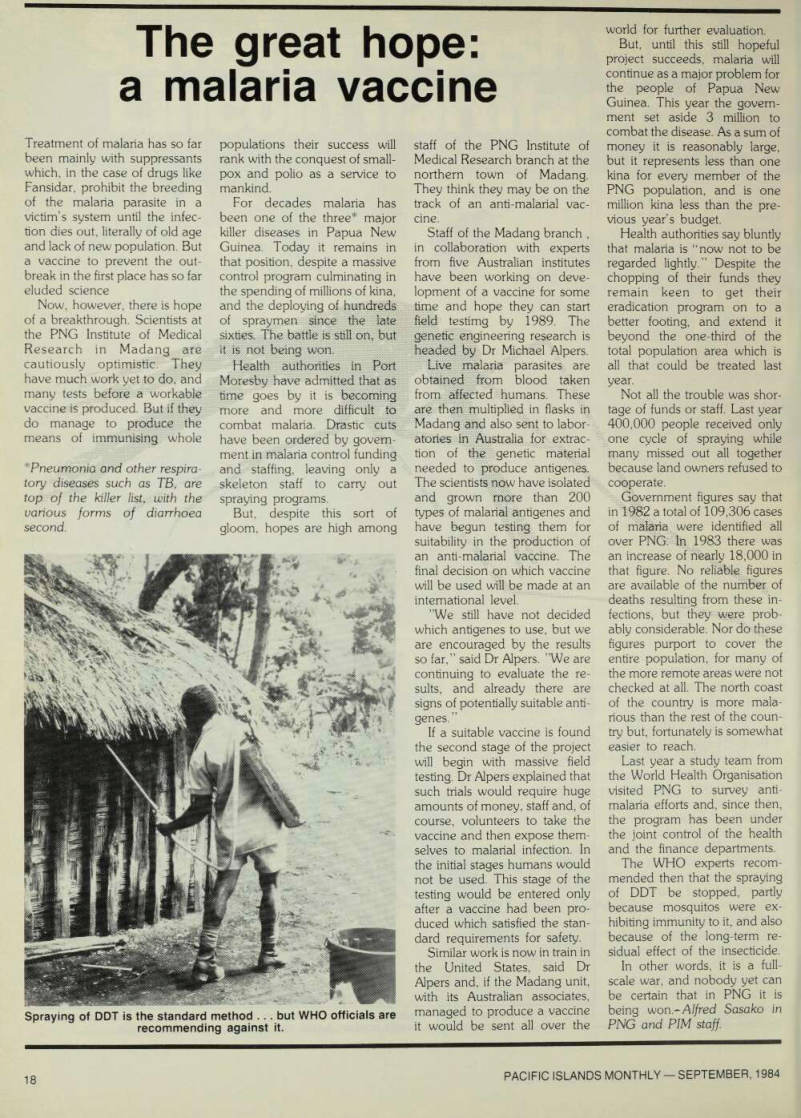
The WHO experts recom mended then that the spraying of DDT be stopped, partly because mosquitos were ex hibiting immunity to it, and also because of the long-term re sidual effect of the insecticide.
In other words, it is a full scale war, and nobody yet can be certain that in PNG it is being won -Alfred Sasako in PNG and PIM staff.
Spraying of DDT is the standard method . . . but WHO officials are recommending against it.