The precautions
pp. 15-17 · Read in the full issue
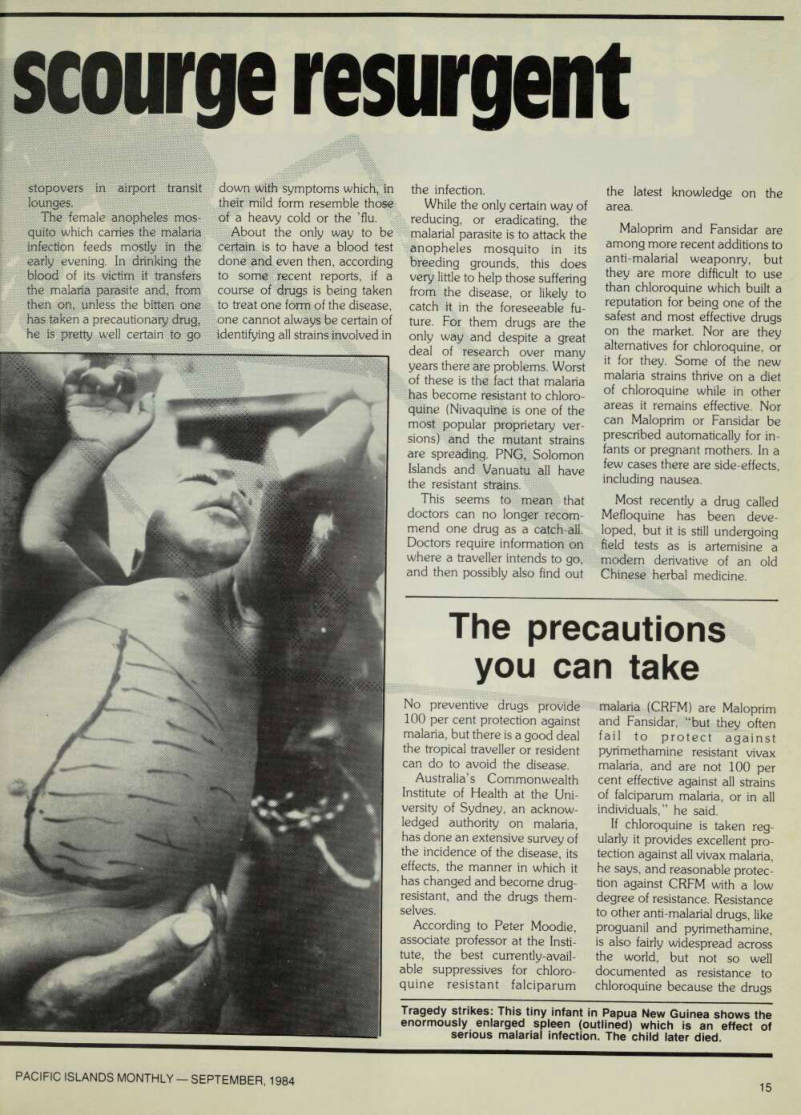

you can take
No preventive drugs provide 100 per cent protection against malaria, but there is a good deal the tropical traveller or resident can do to avoid the disease.
Australia’s Commonwealth Institute of Health at the University of Sydney, an acknowledged authority on malaria, has done an extensive survey of the incidence of the disease, its effects, the manner in which it has changed and become drugresistant, and the drugs themselves - According to Peter Moodie, associate professor at the Institute, the best currently-available suppressives for chloroquine resistant falciparum
malaria (CRFM) are Maloprim and Fansidar, “but they often fail to protect against pyrimethamine resistant vivax malaria, and are not 100 per cent effective against all strains of falciparum malaria, or in all individuals,” he said, If chloroquine is taken reg ularly it provides excellent pro tection against all vivax malaria, he says, and reasonable protec tion against CRFM with a low degree of resistance. Resistance to other anti-malarial drugs, like proguanil and pyrimethamine, is also fairly widespread across the world, but not so well documented as resistance to chloroquine because the drugs
are not used for the treatment of attacks of malaria.
“Pyrimethamine alone is not recommended anywhere as a preventive drug, but proguanil is still useful.
“Amodiaquine appears to be a marginally better drug than chloroquine, and may be effec tive when chloroquine resist ance first appears,” Dr Moody said.
“Except in some parts of Thailand and Indochina, quinine is still an efficient drug for achieving rapid clinical cure in falciparum malaria, but is unsuitable for prophylaxis be cause an effective preventive dose causes side effects. In adequate, or irregular, preven tive doses are believed to be largely responsible for the occurrence of blackwater fever. ”
Dr Moodie and the Institute recommend precautions as fol lows; **Adult travellers to all malarious areas should take chloroquine or amodiaquine, 2 tablets weekly, if there is any risk at all of exposure to malar ia. Children’s doses should be the nearest practical fraction above 5 mg per kg. Chloro quine is also available as a syrup for children. quine or amodiaquine should be started 2 weeks before arri val in the malaria zone, and should continue for four weeks after leaving it. ** Those ex posed to chloroquine-resistant falciparum malaria should take one tablet of Maloprim or Fan sidar in addition to chloroquine, starting at the beginning of exposure, and continuing for four weeks after the risk is over. ** People, including long-term residents, exposed to malaria, but only intermittently exposed to CRFM should take chloro quine continuously, but add Maloprim or Fansidar during and for four weeks after CRFM exposure. ** Anyone taking Maloprim or Fansidar for more than eight weeks on end should have a full blood count six to eight weeks after commencing these drugs. Both drugs have some side-effects which, although rarely found, are se rious, Dr Moodie says.
Non-life-threatening side
effects, such as nausea and headaches, were moderately common with both Maloprim
and Fansidar. but in rare cases the drugs had caused aplastic anaemia and agranulocytosis.
“The incidence of such se rious-side effects is very low if recommended doses are not exceeded and do not outweigh the risks of malaria morbidity or mortality, even in pregnancy and early infancy, where chlor oquine resistance is a known hazard.
“Individuals have been known to develop severe agra
nulocytosis as early as after five weekly single tablets of Malop rinry and the same probably applies to Fansidar,” he said.
“Travelers on short trips into CRFM regions, for whom Maloprim or Fansidar is indi cated because of their expo sure. should not, and need not, commence these drugs until immediately before departure.
They should seek advice in the event of an unexplained infec tion, particularly a sore throat.”
Everyone in malarial areas should take precautions against mosquito bites, particularly after dusk. Nets, mosquito re pellants, coils and other methods should all be used. No preventive drug provides 100 per cent protection. A doctor’s advice should be sought for any course of protection or treat ment, and if the doctor is not sure, he can always ask the Commonwealth Institute of Health.
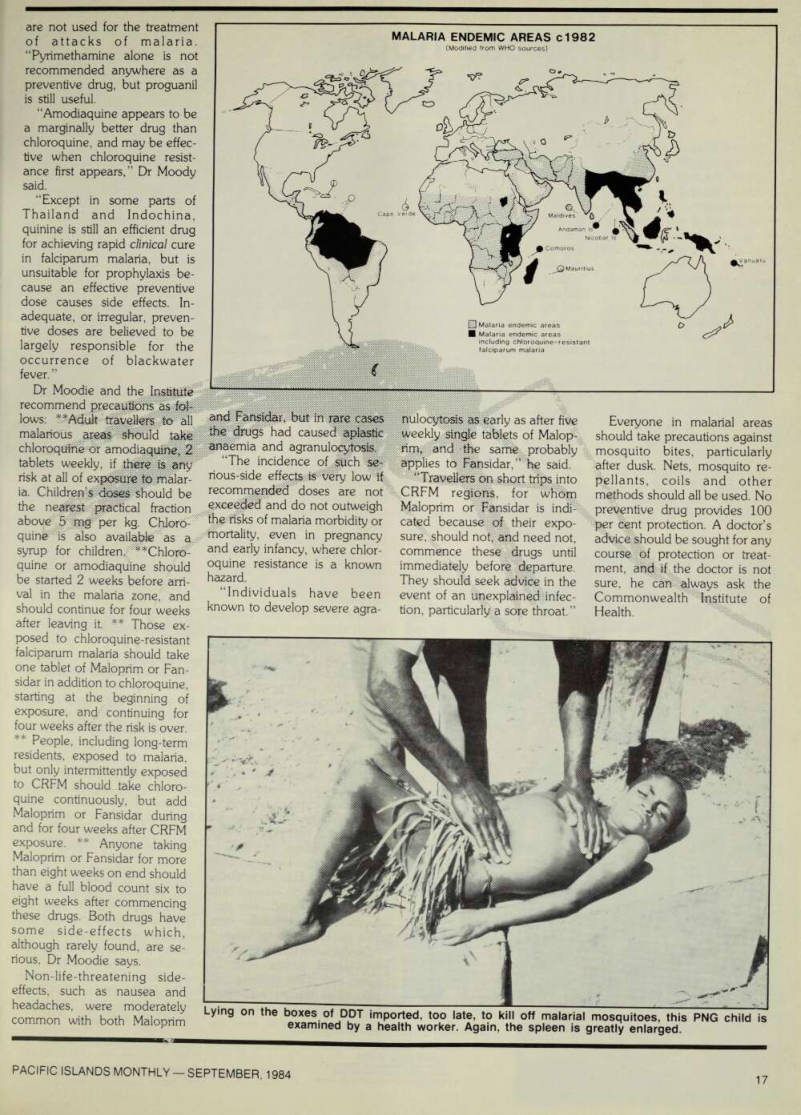
Malaria Endemic Areas C 1982
(Modified from WHO sources)
Lying on the boxes of DDT imported, too late, to kill off malarial mosquitoes, this PNG child is examined by a health worker. Again, the spleen is greatly enlarged.