MALARIA—The scourge resurgent
pp. 14-15 · Read in the full issue
Malaria, a scourge for centuries wherever men have tried to open up tropical countries, was thought to have been largely contained in the Pacific. Vigorous assaults, particularly during the Second World War, on the breeding grourtds of the anopheles mosquito seemed to have brought the problem close to eradication. Now it is on the rise again and is particularly prevalent in some Pacific countries.
You never forget malaria ... and often it doesn’t forget you.
The fever can run for a month on end and reduce a fine healthy body to skin and bone. If drugs are not given to push back its attack it can suck out a human life as swiftly, surely and painfully as any other micro-killer lurking in the hot places of the earth.
About seven million cases of malaria are now reported to the World Health Organisation every year and the figure is regarded as woefully short of drawing an accurate picture of malaria’s current grip upon the world. Often doctors do not recognise the symptoms; more often nobody is there to report the attack. In Africa, south of the Sahara, at least five million cases are estimated to occur annually.
Even in Australia, declared malaria-free by the WHO in 1981, health authorities fear malaria may return as an ende mic disease if action is not taken. The problems are seve ral, among them lack of educa tion among Australia’s other wise firfst-class medical fraterni ty in identifying malaria and treating it properly, and early enough. Commonwealth health officials have begun a campaign on this with a series of articles in medical journals and a program of lectures to doctors.
Travel also increases the risk of contracting malaria, and most travellers these days do not take sufficient precautions.
Pacific people, forever on the move, run particular risk not only of catching the disease, but of spreading it in much the same way as a particularly
virulent strain was brought into South Vietnam during the war by porters trekking down the so-called Ho Chi Minh trail.
They were bitten by mosquitos in the hills and infected, then other mosquitos down in the Mekong Delta bit the porters and so the parasite spread.
Malaria itself is also changing.
Drug-resistant strains have de veloped apparently because those who take prophylactic drugs often do not take them long enough. It is the same kind of pattern which produced drug-resistant mutations of venereal diseases to spread through South-East Asia and elsewhere.
This latter factor has been an important cause Of the resurg ence of malaria in the seventies in countries where, in the six ties, it had been all but eradi cated. But most Australians who caught malaria did so in the south-western Pacific, a fact ominious for the Pacific.
Of the 497 malaria cases notified in Australia in 1981, 300 were contracted in the Pacific, 164 in Asia and 23 in Africa. Of the Pacific total 239 were from Papua New Guinea, 64 from Indonesia, 50 from the Solomons and 44 from India.
But, if one looks at the figures more analytically, the scene changes. On the basis of cases reported per 1000 travellers, Solomon Islands took the top spot with 12.3, PNG was next with 4.4, followed by India with 2.7 almost the same as Vanuatu with 2.4. In other words, the south-west Pacific was more risky for travellers, at least so far as malaria was concerned.
Fiji, and New Caledonia, are free from malaria. The infected islands are PNG, the Solomons
and Vanuatu and of those the first two are considerably more malaria-active than Vanuatu. in south-east Asia Hongkong and Singapore are free of the disease, largely because of stringent precautions taken by the British colonists and, later, the Singapore government In Lee Kuan Yew’s tough little island-state inspectors regularly raid residences looking for mos quito breeding-grounds which include such often over-looked corners as the water-filled pans in which pot plants stand, the water-filled cores of large leafy plants and stagnant puddles at waterpoints.
All are vigorously sprayed, and the householder chastised for being so irresponsibly anti social. It might not be the Pacific way, but it gets rid of mosquitoes.
Incidence of the disease has not increased very greatly in either Papua-New Guinea or Vanuatu, but the rise in the Solomons has been little short of dramatic. Now, on a very much smaller population, the Solomons records about 61,000 cases annually, a ten fold increase since 1976, and, despite the much smaller popu lation, getting into the same raw-figure league as PNG.
At least a part of the problem among tourists and visitors to the Pacific’s malarial areas is simple ignorance, or lack of thought. Polynesian Airlines makes a responsible point of advising its passengers heading for Vanuatu or the Solomons that malaria is about. They also keep in touch with medical developments.
Some tourists seem to think that because they are sitting in a modern and plush resort hotel,
or strolling the streets of a charming and well-organised town, that they are not at risk.
In fact some travellers have caught malaria on one-hour
stopovers in airport transit lounges.
The female anopheles mosquito which carries the malaria infection feeds mostly in the early evening. In drinking the blood of its victim it transfers the malaria parasite and, from then on, unless the bitten one has taken a precautionary drug, he is pretty well certain to go
down with symptoms which, in their mild form resemble those of a heavy cold or the ’flu, About the only way to be certain is to have a blood test done and even then, according to some recent reports, if a course of drugs is being taken to treat one form of the disease, one cannot always be certain of identifying all strains involved in
the infection.
While the only certain way of reducing, or eradicating, the malarial parasite is to attack the anopheles mosquito in its breeding grounds, this does very little to help those suffering from the disease, or likely to catch it in the foreseeable fu ture. For them drugs are the only way and despite a great deal of research over many years there are problems. Worst of these is the fact that malaria has become resistant to chloro quine (Nivaquine is one of the most popular proprietary ver sions) and the mutant strains are spreading. PNG, Solomon Islands and Vanuatu all have the resistant strains.
This seems to mean that doctors can no longer recom mend one drug as a catch-all.
Doctors require information on where a traveller intends to go, and then possibly also find out
the latest knowledge on the area.
Maloprim and Fansidar are among more recent additions to anti-malarial weaponry, but they are more difficult to use than chloroquine which built a reputation for being one of the safest and most effective drugs on the market. Nor are they alternatives for chloroquine, or it for they. Some of the new malaria strains thrive on a diet of chloroquine while in other areas it remains effective. Nor can Maloprim or Fansidar be prescribed automatically for in fants or pregnant mothers. In a few cases there are side-effects, including nausea.
Most recently a drug called Mefloquine has been deve loped, but it is still undergoing field tests as is artemisine a modern derivative of an old Chinese herbal medicine.
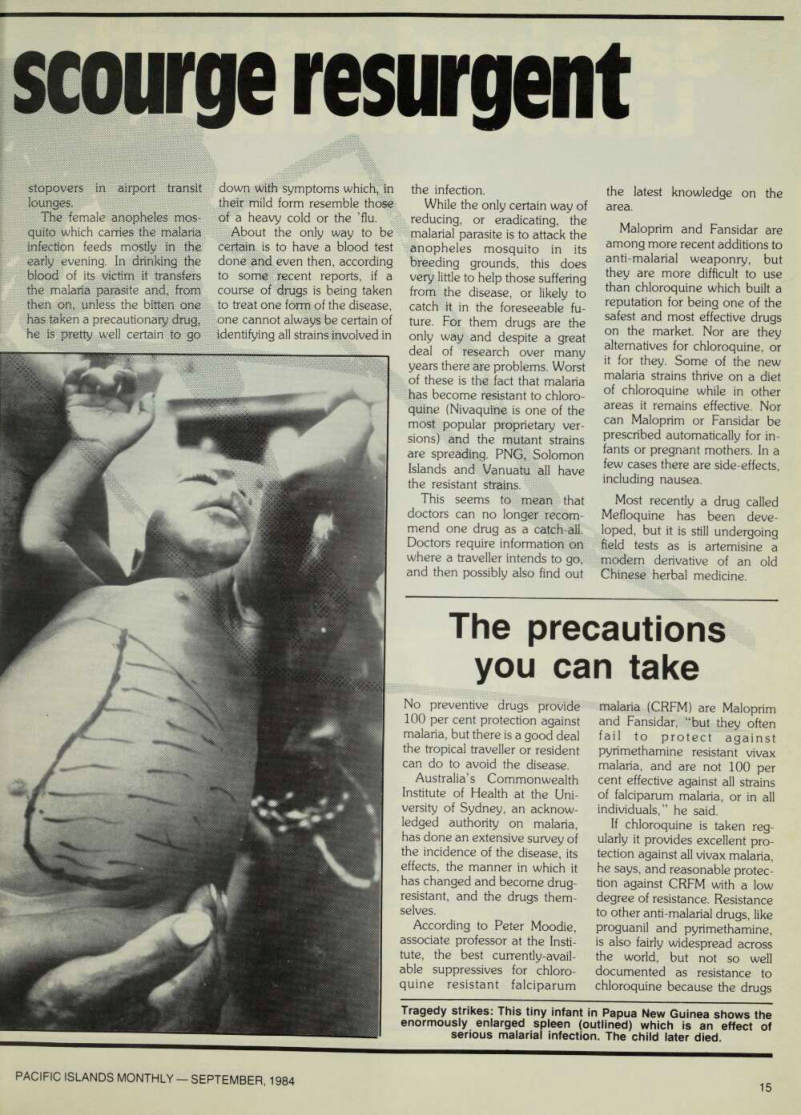
Tragedy strikes: This tiny infant in Papua New Guinea shows the enormously enlarged spleen (outlined) which is an effect of serious malarial infection. The child later died.