Jousting with French
p. 11 · Read in the full issue
nuclear admiral
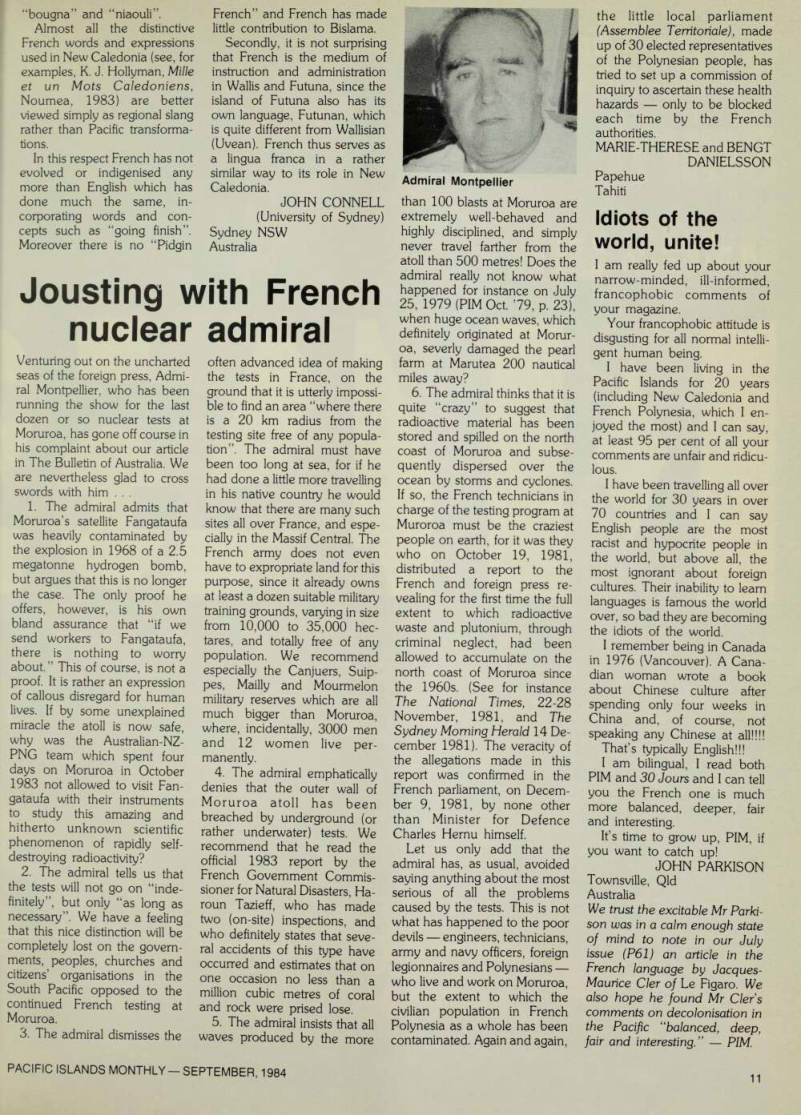
Venturing out on the uncharted seas of the foreign press, Admiral Montpellier, who has been running the show for the last dozen or so nuclear tests at Moruroa, has gone off course in his complaint about our article in The Bulletin of Australia. We are nevertheless glad to cross swords with him ... 1. The admiral admits that Moruroa s satellite Fangataufa was heavily contaminated by the explosion in 1968 of a 2.5 megatonne hydrogen bomb, but argues that this is no longer the case. The only proof he offers, however, is his own bland assurance that “if we send workers to Fangataufa, there is nothing to worry about. This of course, is not a proof. It is rather an expression of callous disregard for human lives. If by some unexplained miracle the atoll is now safe, why was the Australian-NZ- PNG team which spent four days on Moruroa in October 1983 not allowed to visit Fangataufa with their instruments to study this amazing and hitherto unknown scientific phenomenon of rapidly self-
destroying radioactivity?
2. The admiral tells us that the tests will not go on “indefinitely”, but only “as long as necessary”. We have a feeling that this nice distinction will be completely lost on the governments, peoples, churches and citizens’ organisations in the South Pacific opposed to the continued French testing at Moruroa. 3. The admiral dismisses the
often advanced idea of making the tests in France, on the ground that it is utterly impossi ble to find an area “where there is a 20 km radius from the testing site free of any popula tion”. The admiral must have been too long at sea, for if he had done a little more travelling in his native country he would know that there are many such sites all over France, and espe cially in the Massif Central. The French army does not even have to expropriate land for this purpose, since it already owns at least a dozen suitable military training grounds, varying in size from 10,000 to 35,000 hec tares, and totally free of any population. We recommend especially the Canjuers, Suip pes, Mailly and Mourmelon military reserves which are all much bigger than Moruroa, where, incidentally, 3000 men and 12 women live per manently. 4. The admiral emphatically denies that the outer wall of Moruroa atoll has been breached by underground (or rather underwater) tests. We recommend that he read the official 1983 report by the French Government Commis sioner for Natural Disasters, Ha roun Tazieff, who has made two (on-site) inspections, and who definitely states that seve ral accidents of this type have occurred and estimates that on one occasion no less than a million cubic metres of coral and rock were prised lose. 5. The admiral insists that all waves produced by the more
than 100 blasts at Moruroa are extremely well-behaved and highly disciplined, and simply never travel farther from the atoll than 500 metres! Does the admiral really not know what happened for instance on July 25, 1979 (PIM Oct. 79, p. 23), when huge ocean waves, which definitely originated at Morur oa, severly damaged the pearl farm at Marutea 200 nautical miles away? 6. The admiral thinks that it is quite “crazy” to suggest that radioactive material has been stored and spilled on the north coast of Moruroa and subse quently dispersed over the ocean by storms and cyclones.
If so, the French technicians in charge of the testing program at Muroroa must be the craziest people on earth, for it was they who on October 19, 1981, distributed a report to the French and foreign press re vealing for the first time the full extent to which radioactive waste and plutonium, through criminal neglect, had been allowed to accumulate on the north coast of Moruroa since the 19605. (See for instance The National Times, 22-28 November, 1981, and The Sydney Morning Herald 14 De cember 1981). The veracity of the allegations made in this report was confirmed in the French parliament, on Decem ber 9, 1981, by none other than Minister for Defence Charles Hernu himself.
Let us only add that the admiral has, as usual, avoided saying anything about the most serious of all the problems caused by the tests. This is not what has happened to the poor devils engineers, technicians, army and navy officers, foreign legionnaires and Polynesians who live and work on Moruroa, but the extent to which the civilian population in French Polynesia as a whole has been contaminated. Again and again,
the little local parliament (Assemblee Territorial), made up of 30 elected representatives of the Polynesian people, has tried to set up a commission of inquiry to ascertain these health hazards only to be blocked each time by the French authorities.
Marie-Therese And Bengt
Danielsson
Papehue Tahiti
Idiots of the
world, unite!
I am really fed up about your narrow-minded, ill-informed, francophobic comments of your magazine.
Your francophobic attitude is disgusting for all normal intelli gent human being.
I have been living in the Pacific Islands for 20 years (including New Caledonia and French Polynesia, which I en joyed the most) and I can say, at least 95 per cent of all your comments are unfair and ridicu lous.
I have been travelling all over the world for 30 years in over 70 countries and I can say English people are the most racist and hypocrite people in the world, but above all, the most ignorant about foreign cultures. Their inability to leam languages is famous the world over, so bad they are becoming the idiots of the world.
I remember being in Canada in 1976 (Vancouver). A Cana dian woman wrote a book about Chinese culture after spending only four weeks in China and, of course, not speaking any Chinese at all!!!
That’s typically English!!!
I am bilingual, I read both PIM and 30 Jours and I can tell you the French one is much more balanced, deeper, fair and interesting.
It’s time to grow up, PIM, if you want to catch up!
John Parkison
Townsville, Qld Australia We trust the excitable Mr Parti san was in a calm enough state of mind to note in our Ju/y issue (P6l) an article in the French language by Jacques- Maurice Cler of Le Figaro. We also hope he found Mr Cler’s comments on decolonisation in the Pacific “balanced, deep,
fair and interesting/’
Pim
Admiral Montpellier