Micronesia “master
pp. 10-11 · Read in the full issue
plan” or no?
Floyd K. Takeuchi argues in his article “The case of the tree that walked” (PIM, March 1984) that the U.S. has no “master plan” for Micronesia, that the Solomon report offered “policy recommendations” which were “fairly predictable stuff,” and that the recommendations were not followed anyway owing to some unnamed incapability on
Reviewer was
a gender-bender
I very much appreciate D. S.
Long’s review of my book of short stories “La ’a mo Vha Sun and Rain”, PIM July 1984.
One major point in his in terpretation that I feel must be corrected is that I am a he not a “she”.
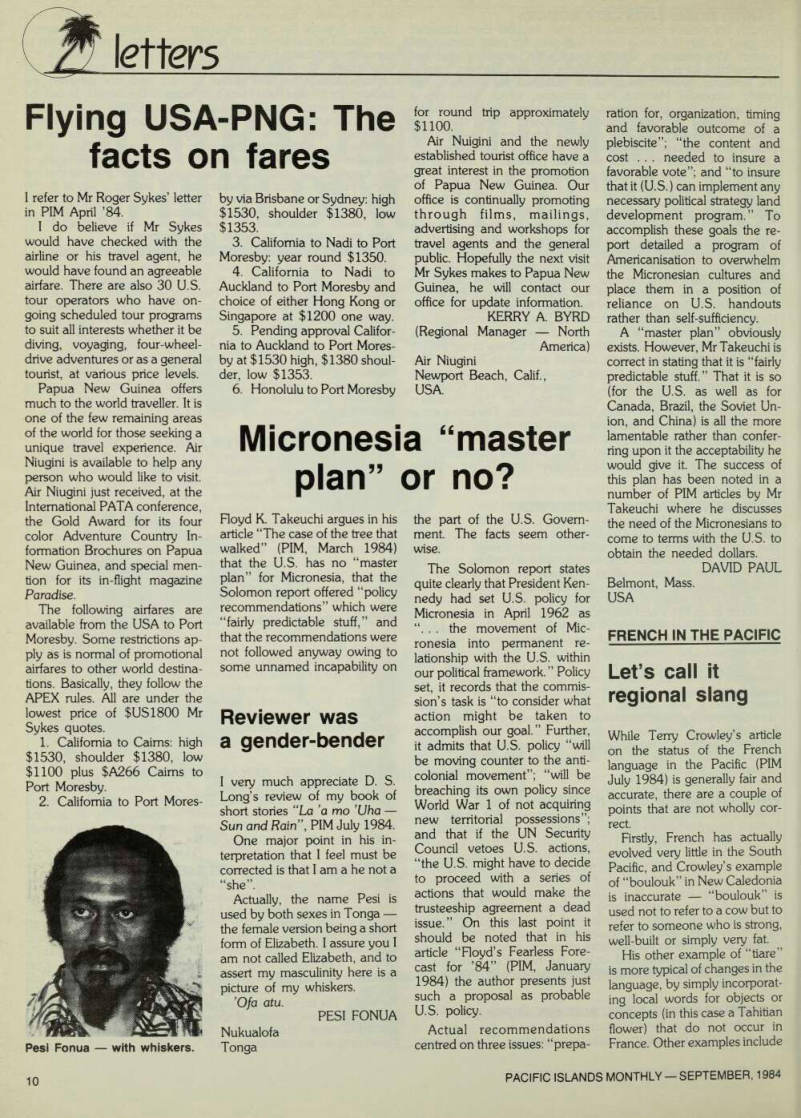
Actually, the name Pesi is used by both sexes in Tonga the female version being a short form of Elizabeth. I assure you 1 am not called Elizabeth, and to assert my masculinity here is a picture of my whiskers. ’Ofa atu.
Pesi Fonua
Nukualofa Tonga
the part of the U.S. Govern ment. The facts seem other wise.
The Solomon report states quite clearly that President Ken nedy had set U.S. policy for Micronesia in April 1962 as . . the movement of Mic ronesia into permanent re lationship with the U.S. within our political framework. ” Policy set, it records that the commis sion’s task is “to consider what action might be taken to accomplish our goal.” Further, it admits that U.S. policy “will be moving counter to the anti colonial movement”; “will be breaching its own policy since World War 1 of not acquiring new territorial possessions”; and that if the UN Security Council vetoes U.S. actions, “the U.S. might have to decide to proceed with a series of actions that would make the trusteeship agreement a dead issue.” On this last point it should be noted that in his article “Floyd’s Fearless Fore cast for ’B4” (PIM, January 1984) the author presents just such a proposal as probable U.S. policy.
Actual recommendations centred on three issues: “prepa
ration for, organization, timing and favorable outcome of a plebiscite”; “the content and cost . . . needed to insure a favorable vote”; and “to insure that it (U.S.) can implement any necessary political strategy land development program.” To accomplish these goals the re port detailed a program of Americanisation to overwhelm the Micronesian cultures and place them in a position of reliance on U.S. handouts rather than self-sufficiency.
A “master plan” obviously exists. However, Mr Takeuchi is correct in stating that it is “fairly predictable stuff.” That it is so (for the U.S. as well as for Canada, Brazil, the Soviet Un ion, and China) is all the more lamentable rather than confer ring upon it the acceptability he would give it. The success of this plan has been noted in a number of PIM articles by Mr Takeuchi where he discusses the need of the Micronesians to come to terms with the U.S. to obtain the needed dollars.
David Paul
Belmont, Mass.
Usa
French In The Pacific
Let’s call it
regional slang
While Terry Crowley’s article on the status of the French language in the Pacific (PIM July 1984) is generally fair and accurate, there are a couple of points that are not wholly cor rect.
Firstly, French has actually evolved very little in the South Pacific, and Crowley’s example of “boulouk” in New Caledonia is inaccurate “boulouk” is used not to refer to a cow but to refer to someone who is strong, well-built or simply very fat.
His other example of “tiare” is more typical of changes in the language, by simply incorporat ing local words for objects or concepts (in this case a Tahitian flower) that do not occur in France. Other examples include
“bougna” and “niaouli”.
Almost all the distinctive French words and expressions used in New Caledonia (see, for examples, K. J. Hollyman, Mille et un Mots Caledonians, Noumea, 1983) are better viewed simply as regional slang rather than Pacific transforma tions.
In this respect French has not evolved or indigenised any more than English which has done much the same, in corporating words and con cepts such as “going finish”.
Moreover there is no “Pidgin
French” and French has made little contribution to Bislama.
Secondly, it is not surprising that French is the medium of instruction and administration in Wallis and Futuna, since the island of Futuna also has its own language, Futunan, which is quite different from Wallisian (Uvean). French thus serves as a lingua franca in a rather similar way to its role in New Caledonia.
John Connell
(University of Sydney) Sydney NSW Australia