rural Vanuatu
p. 20 · Read in the full issue
“Killer” strains in rural Vanuatu
Malaria, which was once taken as part of normal living in Vanuatu, causing widespread anaemia and general poor re sistance to disease, has in re cent years become something more immediately threatening.
The upsurge of the ’’killer” variety of the disease, Plasmo dium falciparum, which is resis tant to chloroquin, has tight ened its grip on the country.
This fact was highlighted by the death earlier this year of Celestine Tamata, a politician and community leader well known throughout Vanuatu, but deaths generally through out the population seem to have increased.
Falciparum strains formerly had a reported incidence of 20 per cent while the less lethal Plasmodium vivax accounted for the remaining 80 per cent of cases. The proportions now seem to be reversed. Whereas vivax does not cause death, though it weakens resistance to other complications, falciparum can cause epileptic-type fits, abortion, coma and death.
Moreover, the actual number of reported cases is rising. In 1982, 11,197 cases of malaria of all types were reported; in 1983 the figure was over 19,000. Although this is part of a general regional rise in the incidence of malaria, and does
not come near the virtually epidemic proportions reached in the Solomons, nor the large numbers in PNG’s much bigger population, the rise is very serious. Not only is it a major health problem (to use the words of the Ministry of Health’s malaria unit), but it poses an economic threat be cause of its psychological effect upon potential tourists.
However, this grim picture needs to be modified by noting that malaria in Vanuatu is, generally speaking, confined to certain areas mostly dictated by topography and rainfall pat terns. o Some islands, such as Ton gariki, are almost completely free of the scourge. Others have small known pockets of malar ia. On Efate, for example, Port Vila is free of both vivax and falciparum, although the vil lages of Mele and Maat, only 10 kilometres away, and Tagabe and Blacksands on the outskirts of Vila, are some of the worst affected areas of the country.
The counter-attack, under the general auspices of the department of preventative medicine, combines laboratory services, public education and spraying with DDT. Mass drug administration is also being considered. The malaria control
program has received wide sup port Overseas aid, in particular from the World Health Or ganisation, has provided per sonnel working in both research and active control. Government departments, other than Pre ventative Medicine, have also been pressed into service; the Vanuatu Mobile Force, for ex ample, assisted in carrying out the spraying program.
Support has also come from the general community. Vila’s Rotary and Kiwanis clubs have given money for supply and repair of spraying equipment, and village communities have been mobilised by chiefs and other leaders to cut under growth and clear larva-harbor ing rubbish and puddles.
Campaigns have been directed at specific areas targets for 1984 are Maevo, Ambae, South Pentecost, Ambrym, Malo, Epi, Banks and Torres, and, on Efate, Mele, Maat and Blacksands. In addi tion the Vila campaign is about to intensify.
It is a very long-term struggle, and in the short term the aim must be simply to control malaria, not try to eradicate it.
However, acting malaria super visor, James Yaviong, says that progress is being made, albeit slowly. ”We are cleaning up the Tagabe river and working to gether with the Vila municipal ity, we are extending spraying operations which we hope, should be completed by the end of this year, before the start of another peak transmission season. ” Julie-Ann Ellis.
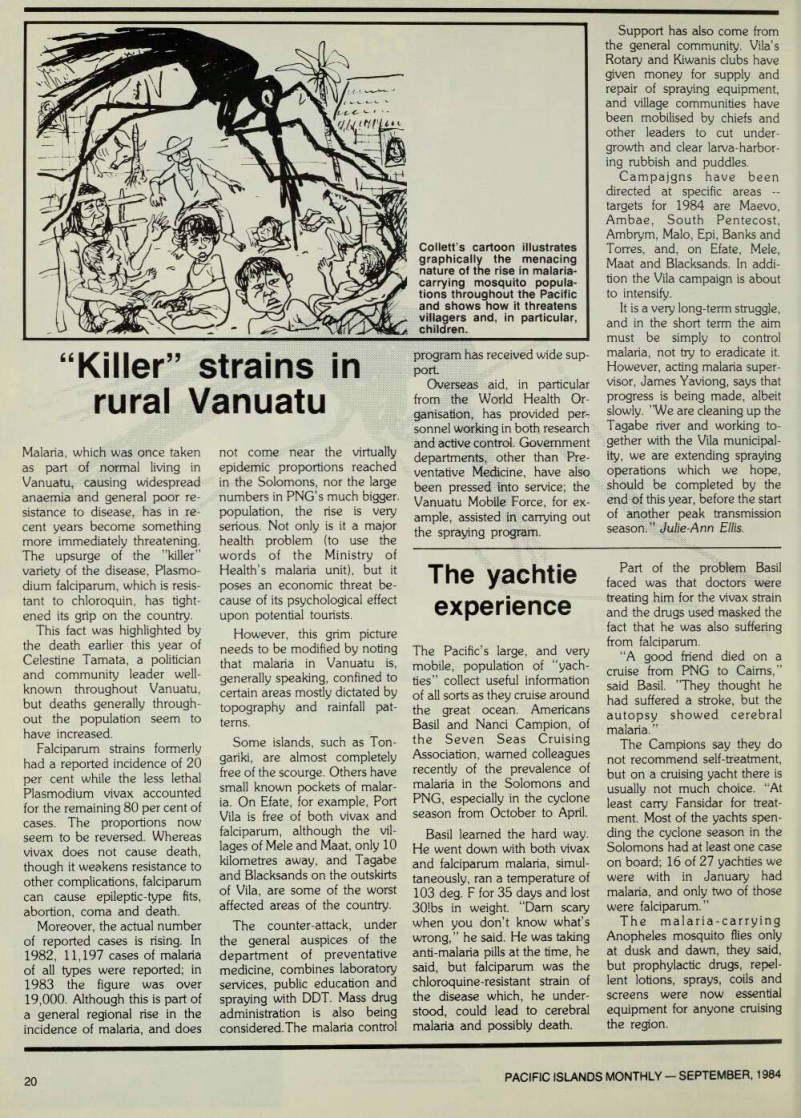
Collett’s cartoon illustrates graphically the menacing nature of the rise in malaria carrying mosquito popula tions throughout the Pacific and shows how it threatens villagers and, in particular, children.