tropicalities
pp. 55-56 · Read in the full issue
I have this terrific idea for a Pacific island business venture, and since I cannot use it, I will share it with you.
It’s a family-sized business; it will not make you a millionaire, but it should provide a steady income as you move, at your own pace, from island to island.
The idea is environmentally sound, it also saves energy and makes the landscape more attractive. It will bring new income to the islands while utilising a renewable resource.
The business while not without problems, will support you as you cruise among the islands on your own vessel, and, happily for you, it is a monopo ly or will be at first.
The untapped, renewable re source litters many of the is lands of the soon-to-be former U.S. Trust Territory, of Amer ican Samoa and elsewhere, and is not valued by the residents despite its potential. The bonanza consists of empty alu minium beer and soda cans. To the best of our knowledge, there are no systems in place in much of the Pacific for recycling the cans. (Similar opportunities abound in the smaller islands of the Caribbean.) Why is this stuff valuable? It takes considerably less energy to produce a pound of alumi nium from used cans than it does from bauxite. Further, for reasons that are not totally clear to me, the aluminium industry is much more enlightened than, say, the glass or paper indus tries about recylcing. As a re sult, a shipper with substantial quantities of flattened cans (a couple of dozen tons) can sell them, in the United States, for as much as 48 US cents a pound. Smaller quantities are purchased at lower prices. (Compare that rate to the price for used newsprint in the States, about 30 to 60 US cents per hundred pounds.) These happy, macro-level economic facts produce happy results at the neighborhood level. From my second storey office overlooking an interesting but messy street scene in
DAVID S. NORTH reports from Washington on his idea for a lucrative, family-sized business which is just crying out to be born in and around the Pacific Islands.
Here’s a great new business idea, just for you...
Washington, DC, I watch one of the neighbors walk to the supermarket every morning, carrying two bags full of empties. I assume that he gets four or five US dollars for what must be 20 pounds of the stuff. (The local store pays 24 US cents a pound.) And though the area is marred by empty beer and liquor bottles and the detri tus from McDonald’s across the street, there are no empty alu minium cans; they have all been harvested by 9 a.m. If there is a little money to be made by teenagers and others in my neighborhood, where the cans are gathered daily, think what one could do on an island where the stuff has never been collected!
The idea started to take shape a year ago when I attended a conference of US and Mexican migration special ists (my field) in an unlikely place, the lovely little port of LaPaz in Baja California (Mex ico). The streets were almost paved with preflattened alumi nium cans. (That’s good, for they ship better that way.) I was reminded of the idea last winter during a trip through the US Virgins and adjacent Caribbean islands; numerous aluminium cans marred the landscape, even in the neat, Dutch-owned half of St. Martin (the French have the not-so-neat other half of the island). The idea came to full bloom on my last trip to New Zealand and Australia.
Here is how it would work.
First you would make sure of your market. The price varies from time to time; it was about 34 US cents a pound (in large lots, delivered to the US Main land) about a year ago; later it rose to 56 US cents and then slipped back to 48 US cents.
Because of high energy costs in Japan, scrap delivered there usually sells for more than it does in the States (and, as a matter of fact, more than 60 per cent of the States’ exports of scrap cans go to Japan). Home bound Japanese ships using the Panama Canal often pause to onload Central America’s scrap
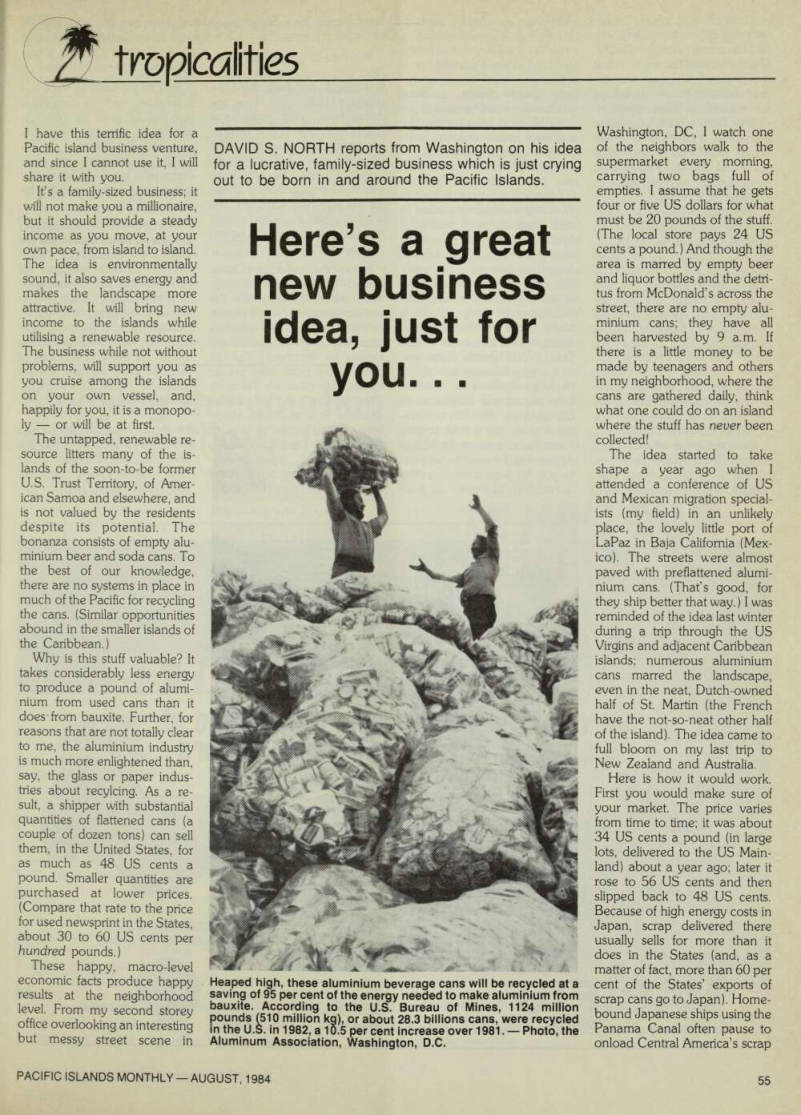
Heaped high, these aluminium beverage cans will be recycled at a saving of 95 per cent of the energy needed to make aluminium from bauxite. According to the U.S. Bureau of Mines, 1124 million pounds (510 million kg), or about 28.3 billions cans, were recycled in the U.S. in 1982, a 10.5 per cent increase over 1981. - Photo, the Aluminum Association, Washington, D.C.
aluminium and similar trans shipping opportunities must ex ist elsewhere in the Pacific.
Other markets can be found at the Reynolds aluminium recyc ling plants in Hawaii as well as in Australia’s aluminium in dustry. As you make your plans remember that empties weigh about two-thirds of an ounce each and that 20 crushed cans occupy about as much space as a paperback novel.
Next you would need to buy or lease the right kind of ship, one at least 65 to 80 feet in length. It should be large enough to sail from island to island, have quarters for you and your family, and contain enough cargo space (it does not have to be rectangular) to take at least 25 tons of squashed cans. You would also need at least primitive cargo-moving equipment and a small shred der, a piece of machinery about the size of a small car. The shredder converts the cans into a compact mass of aluminium scrap. (With these cans you worry more about space than weight.) Further, and this would
let me out, you would have to know how to handle such a vessel in the Pacific, and enjoy that kind of life. I am told that a schooner would be a particu larly good choice, because windpower could be get from island to island, usifsg the auxiliary motor only in port. (After all, there is no rush.) A third (and optional) step can be handled in Sydney, Canberra, New York or here in Washington. You may want to look around for a source of seed money or, better, a con tinuing subsidy. The US or Australian overseas aid agen cies, or one of the major found ations (e.g. Ford or Rockefel ler), might be intrigued with a clean, non-exploitive source of additional revenue for these Third World islands. If you are, or have, a talented tax lawyer perhaps you can find a loophole in the Australian or US tax laws. The US Govern ment gives tax breaks to strip miners who butcher the hills of Appalachia for coal why not to you for your energy-saving, beautifying business? At least
there should be a fast write-off to depreciate the ship.
With these preparations be hind you, you fly ahead to the first island, convince the gov ernment that what you are doing is a good thing, and perhaps to give you a cent or two per pound for removing the debris. You will need to publicise what you are doing and build an appropriate image for the activity. Clearly you will want to stress the island’s pride in its beauty and not the notion of scavenging.
Once the collections have started, you bring in the ship, work out a technique for the fast screening of cans, because neither you nor the recycling plant want steel cans (what the British so accurately call tin cans). You must also set an appropriate price for the cans.
Then you proceed from island to island, at your leisure, absor bing the sunshine as you fill your veseel. Then it is the long haul to Hawaii, Japan or Aus tralia (or a shorter trip to some trans-shipment point where you
will be paid US $24,000 for your 25 tons of scrap if the price is 48 US cents a pound; if you trans-ship it would be less).
You might want to work out a sideline, such as carrying a hull full of soda or beer (in aluminium cans, of course) as you sail to Samoa, Fiji or Tonga. In this way you carry cargo both ways and renew the supply of potential empties for your next trip.
We do not have hard data on the rate at which these cans are used in the islands, but if each of the 32,000 residents of American Samoa, for example, consumes only a couple of cans a week (ignoring the thirsty tourists, for the moment) that adds up to 115,000 cans a month, or two and half tons of empties. What we have in mind could be a nice life’s work.
David S. North.
Mr North, an avid non-sailor, is director of the Center for Labor and Migration Studies of the New Trans Century Founda tion, Washington, D.C.