Maoris in the Klondike gold rush
p. 57 · Read in the full issue
Connecting Hawaiians with Alaska and northern Canada is not as outlandish as one may think at first. The arctic region has not been so distant for the natives of the Hawaiian Islands just as it is not for the Kolea, or American Golden Plover.
From their first appearance in 1788, until the middle of the 19th century, Hawaiians came to the northwest coast, especial ly as unskilled laborers for the fur companies. The Hudson’s Bay Company employed the “Kanakas” as voyagers, lumbermen and seamen; and, further north, the Russian- American Company, too, em
ployed people from the Hawaiian Islands. “South Sea Whaling”, reaching its zenith in the ’4os and ’sos of the last century, was another, more appropriate opportunity for the Hawaiians and other Polyne sians at that time to come to the North Pacific area.
As almost everyone in the world seemed to take part in the Klondike Gold Rush, it is no wonder therefore that even a group of Maoris from New Zealand were at Sheep Camp in 1898: “A pot-pourri of cu rious shelters sprang up at Sheep Camp. A group of Maoris, fresh from New Zea
land, put up strange huts of wattles, to keep out the winds ...” (Pierre Berton, The Klon dike Fever, 1960, p. 248).
Sheep Camp was a tempor ary camp for miners travelling the Dyea Trail, a short but very demanding route to the headwaters of the Yukon. The 27 km trail from Dyea to Chilkoot Pass climbed 1140 metres, and gave rise to supply camps at Canyon City and Sheep Camp. Some reports claim that there were over 1000 people there in the winter of 1897-98, near the head of Taiya River, 19 km north of Dyea, in an area frequented by mountain sheep.
Thus there were two good reasons for the Polynesian na tives of New Zealand to come to Sheep Camp . . . However, why leave a country dominated by sheep farming to visit sheep several thousand kilometres
away? The “gold connection” therefore seems to be more likely, as Maori people did take part in New Zealand’s gold mining activities earlier that century. What is more relevant however, the Maori people sup plied colonists, and urban areas, with timber, food, and grain from earliest times on a commercial basis.
Furthermore, for 100 years before 1898, Maori people were travelling on whaling, sea ling, missionary, and explora tion ships to Pacific and Indian Ocean rim countries, and through Europe and the United States; many sent letters home.
Many tribal groups had their own trading vessels from the 1850 s onwards. It would not be beyond them to be in Alaska by the 1890 s.
What then happened to the group of Maoris later on? Some cemetery, or letter, or family book of elders may tell us the snow and the sea could not.
W. Wilfried Schuhmacher.
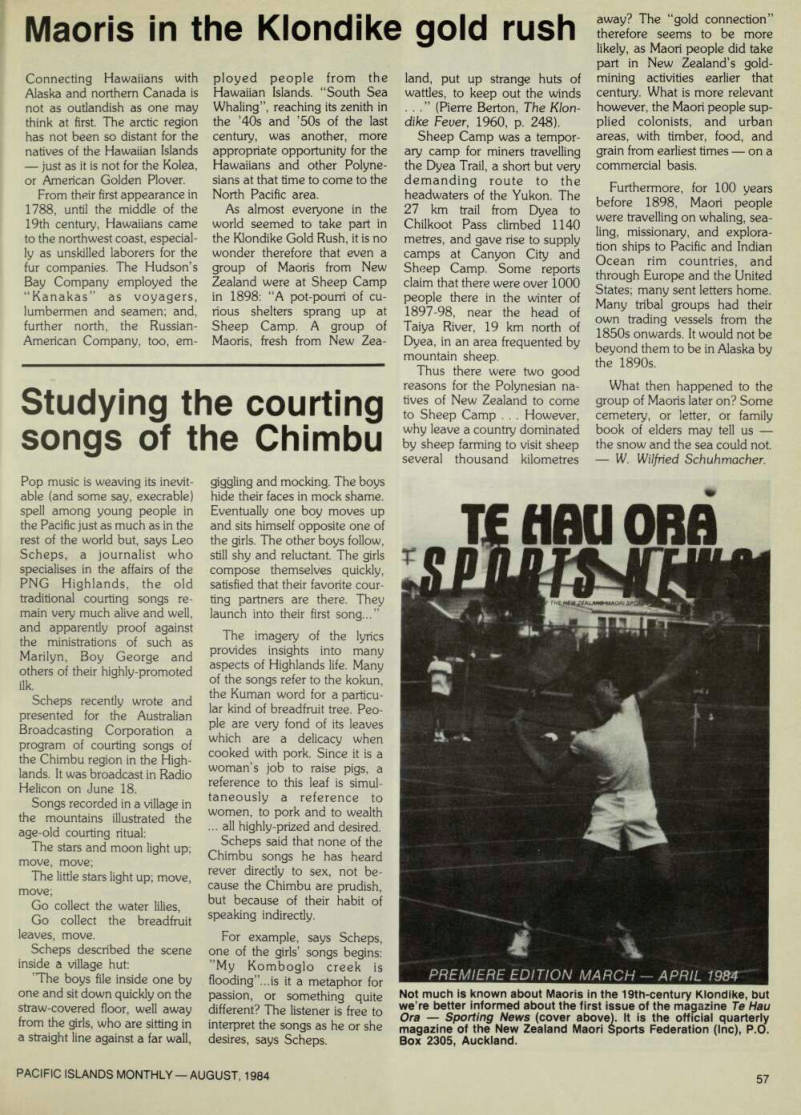
Not much is known about Maoris in the 19th-century Klondike, but we’re better informed about the first issue of the magazine Te Hau Ora Sporting News (cover above). It is the official quarterly magazine of the New Zealand Maori Sports Federation (Inc), P.O.
Box 2305, Auckland.