people
pp. 53-54 · Read in the full issue
President Reagan has announced his intention to nominate Paul Fisher Gard ner, a career member of the U.S. foreign service, as ambas sador to Papua New Guinea and Solomon Islands, succeed ing Ms Virginia Schafer who is retiring from the foreign service.
Mr Gardner will take up his duties in Port Moresby upon senate confirmation of the nomination.
Gardner, a minister-counsel lor, began his career as an English teacher at Asherton High School in Asherton, Tex as, in 1953-54, and served as a first lieutenant in the U.S. air force 1954-56.
In 1956 he entered the U.S. foreign service as an intelli gence analyst in the Depart ment of State. He was consular officer in Tananarive, Madagas car, from 1959 to 1961 and political officer in Vientiane, Laos, from 1961 to 1963.
Gardner studied Indonesian at the Foreign Service Institute in 1963 and 1964 and for the next four years served as politi cal officer in Jakarta, and from 1968 to 1971 he was Indone sian desk officer at the State Department.
In 1972 he returned to Southeast Asia as counsellor for political-military affairs in Phnom Penh and in 1974 went to Ankara as counsellor for mutual security.
Then, in 1976, he was reas signed to Jakarta as counsellor for political affairs and in 1978 became deputy chief of mission there until 1981. Since then he has been director of regional affairs in the State Depart ment’s Bureau of East Asian and Pacific Affairs.
Gardner studied for his bachelor of arts degree at the University of Texas where he graduated in 1952 and where he took his master of arts degree in 1956. In 1952 and 1953 he attended the Univer sity of Bordeaux in France. He speaks both French and In donesian. He was born on October 31, 1930, in San Anto nio, Texas. U.S. Information Agency
On-the-spot research into issues facing women in Solo mon Islands and Vanuatu was the July business of Louise Webb and Mary Dickie.
These two active members of the Women and Development Network of Australia (WADNA) visited Honiara, Malaita and Gizo in the Solomons, and the islands of Santo and Malakula in Vanuatu.
After attending a conference on women and development due to be held in Port-Vila in mid-August, they are set to return to Sydney, via Fiji, to wards the end of the month.
Federated States of Micronesia President Tosiwo Nakayama attended the 19th convention in Yokohama, Japan, of the Nanyo Gunto Kyokai, an or ganisation of Japanese people who lived in Micronesia and others who have links with Micronesia. President Nakayama, whose father was born in Yokohama, visited Crown Prince Akihito and had discussions at Tokai University on his request for aid to establ ish maritime training schemes in the FSM, and with executives of Taiyo Fishing Company on de veloping FSM fisheries.
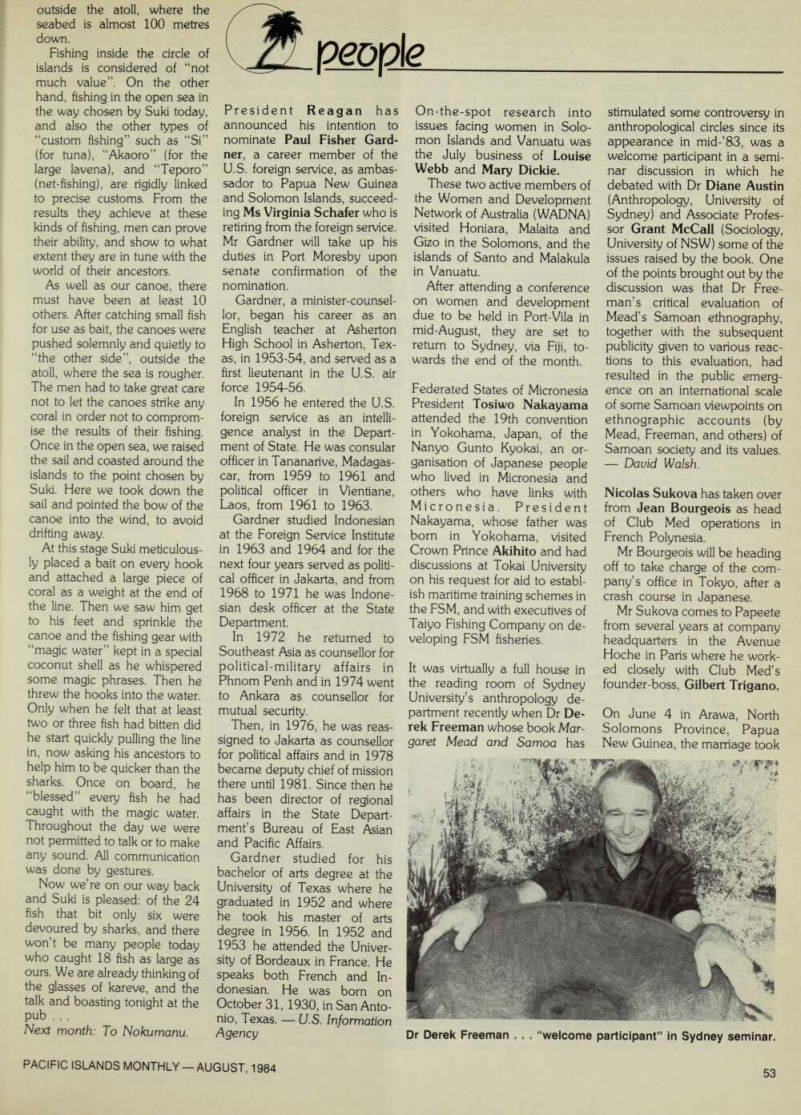
It was virtually a full house in the reading room of Sydney University’s anthropology de partment recently when Dr De rek Freeman whose book Mar garet Mead and Samoa has
stimulated some controversy in anthropological circles since its appearance in mid-’B3, was a welcome participant in a semi nar discussion in which he debated with Dr Diane Austin (Anthropology, University of Sydney) and Associate Profes sor Grant McCall (Sociology, University of NSW) some of the issues raised by the book. One of the points brought out by the discussion was that Dr Free man’s critical evaluation of Mead’s Samoan ethnography, together with the subsequent publicity given to various reac tions to this evaluation, had resulted in the public emerg ence on an international scale of some Samoan viewpoints on ethnographic accounts (by Mead, Freeman, and others) of Samoan society and its values.
David Walsh.
Nicolas Sukova has taken over from Jean Bourgeois as head of Club Med operations in French Polynesia.
Mr Bourgeois will be heading off to take charge of the com pany’s office in Tokyo, after a crash course in Japanese.
Mr Sukova comes to Papeete from several years at company headquarters in the Avenue Hoche in Paris where he work ed closely with Club Med’s founder-boss, Gilbert Trigano.
On June 4 in Arawa, North Solomons Province, Papua New Guinea, the marriage took
Dr Derek Freeman . . . “welcome participant” in Sydney seminar.
place of Ruth Vatoa Saovana (also known as Ruth Kovoho), Viles Tok Pies Skul Co-ordina tor for the North Solomons Province Education Depart ment, who recently returned from the East West Center in Hawaii, and Dr Matthew Spriggs, assistant professor of anthropology at the University of Hawaii. Best man was North Solomons Provincial Premier, Leo Hannett, K.C.M.G.
Rumor around the North Paci fic has it that Mayor Jacklick of Ebeye spent a night in the cooler not so long ago after police stopped him driving fast around the island. They alleged he had been drinking. The Mayor is said to have com mended the police next day, saying he was just testing them.
They passed the test, he said.
Air Niugini’s new general manager is Masket langalio.
He succeeds J. J. Tauvasa who has taken up a senior post with the Shell Company.
Mr langalio, 35, was bom in Wapenamanda, Enga Pro
vince, and holds a degree in economics from the University of Papua New Guinea.
For 13 years he served with the P.N.G. Development Bank where he rose to the rank of managing director and deputy chairman before he resigned in 1981.
Among his other duties Mr langalio has served several years on the boards of the P.N.G. National Broadcasting Commission, the National In vestment Development Authority, and the P.N.G. In vestment Authority. He was a member of the National Airline Commission, equivalent to the board of directors of Air Niugi ni, between 1978 and 1980.
Robert C. Braun, of Pullman, Washington State in the U.S.A., is concerned about the lack of veterinary facilities in the Paci fic. Some countries are well served and others very poorly.
In industrialised countries, says Braun, there is also a problem simply because mod em vets seem to gravitate to the cities where looking after pets and small animals is easier, and
more profitable, than tramping around farmyards and fields.
Braun is in the throes of producing a survey of Pacific veterinarian needs and re sources and asks that anyone with information, and views on the subject contact him at: B-2 Valley Crest Village, Pullman, Washington, WA 99-163.
Anyone who feels very strongly about it all might like to telephone him in the U.S. at (509) 334-230.
Satellites hang over the Pacific linking its islands with the rest of the world through space age technology, and yet the ancient methods of communication re main very much in use. Captain Chris Coy, who recently retired after 23 years of service with the China Navigation Com pany, a Swire Group company out of Hong Kong, spent many years working with crews re cruited from Papua New Guinea. His last ship was the MS Papuan Chief, trading be tween Australia and PNG. Few of his men came from the main towns, having their homes in the villages along the shores of
the China Strait, the Trobriand Islands and around Cape Vogel. The ship did not call in these areas, but the crewmen, using basic methods, still man aged to say “hello” to their families and friends.
“As we approached and tran sited the straits and reefs we would blow a long blast on the ship’s whistle,” wrote Captain Coy. “Within minutes the coast would come alive with flashing lights. In daytime mirrors are hastily taken on deck by the men to catch the sun’s rays and return greetings in the same manner as they were sent. At night there were a few torches and the odd lamp swinging on the foreshore.
“In a rather isolated part of the reef-studded water to the east of the Papuan mainland is a passage called the Raven Channel. A lone canoe always waited there for us to receive a letter from one of our sailors to his brother ashore . . . dropped in a plastic bag as we slipped through. I don’t know how long the canoe waited if ever we failed to keep our four-week schedule. ”