Life with the family (the living
pp. 51-53 · Read in the full issue
and the dead) at Amotu
Heading eastward, the Pettini brothers, Roberto and M arCo) this month discover the islands of Papua New ° t uinea ' S aSma ". 9 roa P; and in particular discover the stran 9 e relationship existing there between the living and their departed relatives.
Once upon a time there was a man called Popua.
He was bom and raised in the Samoan Islands, but he liked to sail and to discover new islands. One day he filled his canoe to the brim with coconuts and left home. When he reached the Tasman Islands, at that time covered with sand and deserted, he decided to plant the only coconut left in his canoe the rest had been lost in a typhoon. When the tree began to bear fruit, Popua went to get a wife and brought her here. Then, after siring a few children, he left again. He planted more coconuts, took more wives and had other children also in the Mortlock, in the Carteret and in the Fead Islands, where eventually he died, very old . . .
This legend explains the ori gin of these islands and the reason why their inhabitants have light skin color, language and many customs in common.
Here we are then, in the Tasman Islands, a coral atoll group at the eastern end of Papua New Guinea, right above the sea border with the Solomon Islands a place and a story that for a long time we have wanted to experience.
“Tahata Taureka!” (Good morning.) Taheu Pais is the headmaster of the school, born and raised here in the Tasmans, married to a Mary from Ontong Java, and he is our brother friend from the moment we set foot on the island. People like him are as vital as bread for anyone arriving suddenly and from far away, and Pais in fact is friendly and open, so much so that you feel at home barely 14 hours after you’ve arrived, There are 32 Tasman Is lands. They are of all shapes and sizes: Long, short, or as small as cake cups. . . They are all coral islands and are com pletely covered with coconut palms. In the way they are placed, it seems that they were put there by a giant child, who, sitting on the beach, built sever al sand heaps all around him, without moving too far from his mother. Only one island is inhabited there is a village
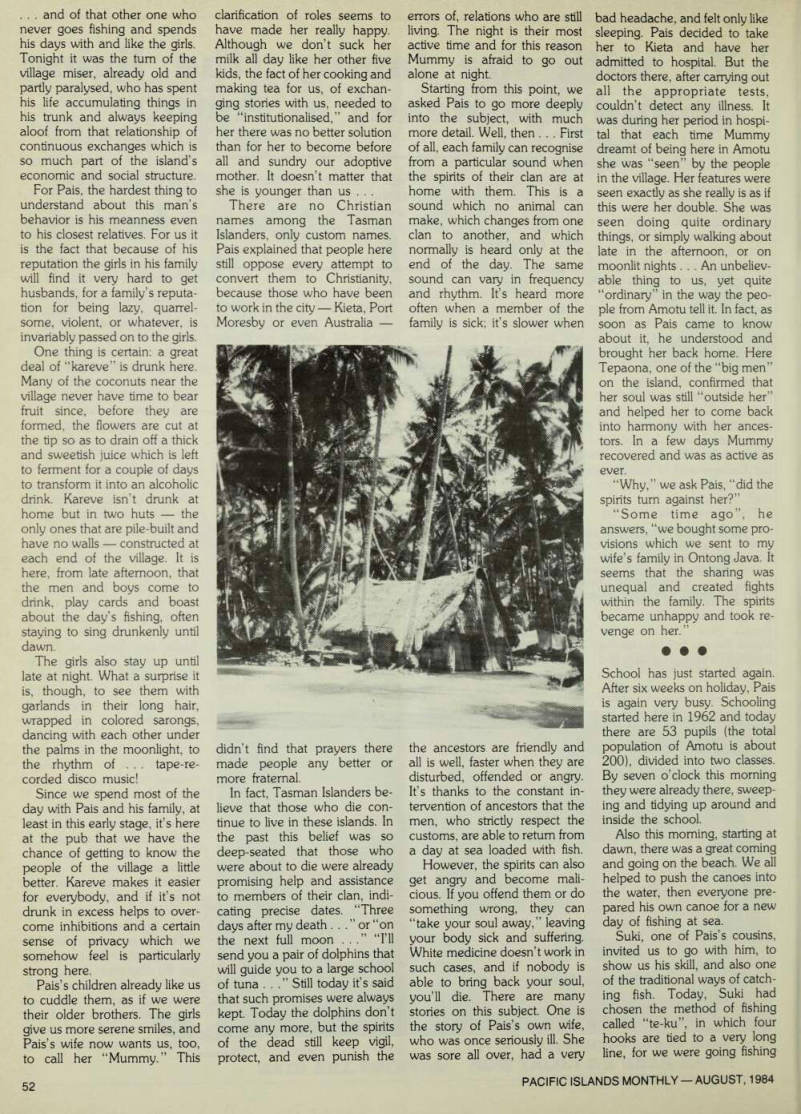
called Amotu, consisting of four parallel rows of huts, all alike.
These are built right on the sand and have a rectangular ground-plan, with a floor of solidified ash (for easy sweep ing), and two doors that face each other from opposite walls.
Inside there are no raised floors or dividing walls, and apart from the sleeping mats everything is inserted between the sticks of the roof. At the two ends of the village there are many outrigger canoes, each with its own name, parked on the beach and pointing to the sea, like cannons. Since only coconut and pandanus trees grow in the Tasman Islands, where does the wood for the canoes come from? It’s ex plained to us that there is a certain time of year when these beautiful gifts are brought here by the current from the island of Bougainville, over 300 km away. These currents... if they
followed only a slightly different course, these islands would probably still be deserted.
Tasman Islanders are of mix
ed Melanesian-Folynesian
blood. We notice immediately that they have much larger bodies than most Melanesians, all their teeth are white with no betel stains (the nuts don’t grow here), and they maintain the custom of tattooing. While the men have only a few tattoo bands on the forehead and little fishes on the forearms, women are tattooed all over the lower belly, and on the buttocks and thighs down to the knees. It takes at least three weeks to complete this very painful job, which is carried out by other women immediately after a girl’s first menstruation, for de coration, and also to show that she has reached the age of marriage.
Today we went with Pais to dive for trochus shells. Corals, brightly colored fish, shells and starfish among the underwater channels ... for hours we did nothing but plunge underwater, come up and go down again.
Again and again, as if in a slow-motion replay, we saw Pais look behind every coral, pry into every possible hiding place and swim quickly from one to the other. We returned to Amotu with a full bag. With a hook we pulled out the shell fish, that here are eaten raw or roasted on charcoal, and put the shells back in the bag. In Kieta they will raise 35 toea (about 45 cents) per kilo. But their eventual destination is Japan and their final use is to become buttons.
Thinking about their fate, today I decided to leave at least the baby trochus so they could live a little longer . . .
The village is a complete little world. To know it takes time; to get the character of each indi vidual into focus would take maybe a lifetime. Pais had already told us the story of that rather reserved and silent character, hopelessly in love
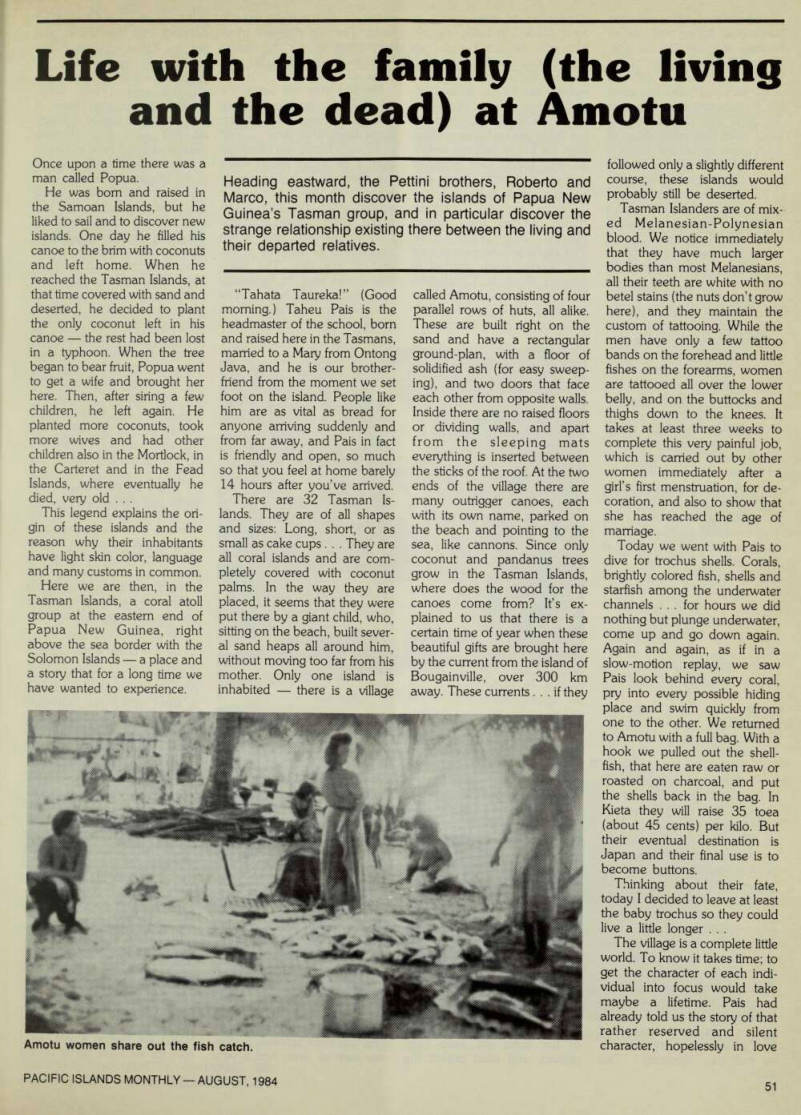
Amotu women share out the fish catch.
. . . and of that other one who never goes fishing and spends his days with and like the girls.
Tonight it was the turn of the village miser, already old and partly paralysed, who has spent his life accumulating things in his trunk and always keeping aloof from that relationship of continuous exchanges which is so much part of the island’s economic and social structure.
For Pais, the hardest thing to understand about this man’s behavior is his meanness even to his closest relatives. For us it is the fact that because of his reputation the girls in his family will find it very hard to get husbands, for a family’s reputa tion for being lazy, quarrel some, violent, or whatever, is invariably passed on to the girls.
One thing is certain: a great deal of “kareve” is drunk here.
Many of the coconuts near the village never have time to bear fruit since, before they are formed, the flowers are cut at the tip so as to drain off a thick and sweetish juice which is left to ferment for a couple of days to transform it into an alcoholic drink. Kareve isn’t drunk at home but in two huts the only ones that are pile-built and have no walls constructed at each end of the village. It is here, from late afternoon, that the men and boys come to drink, play cards and boast about the day’s fishing, often staying to sing drunkenly until dawn.
The girls also stay up until late at night. What a surprise it is, though, to see them with garlands in their long hair, wrapped in colored sarongs, dancing with each other under the palms in the moonlight, to the rhythm of ... tape-re corded disco music!
Since we spend most of the day with Pais and his family, at least in this early stage, it’s here at the pub that we have the chance of getting to know the people of the village a little better. Kareve makes it easier for everybody, and if it’s not drunk in excess helps to over come inhibitions and a certain sense of privacy which we somehow feel is particularly strong here.
Pais’s children already like us to cuddle them, as if we were their older brothers. The girls give us more serene smiles, and Pais’s wife now wants us, too, to call her “Mummy.” This
clarification of roles seems to have made her really happy.
Although we don’t suck her milk all day like her other five kids, the fact of her cooking and making tea for us, of exchan ging stories with us, needed to be “institutionalised,” and for her there was no better solution than for her to become before all and sundry our adoptive mother. It doesn’t matter that she is younger than us . . .
There are no Christian names among the Tasman Islanders, only custom names.
Pais explained that people here still oppose every attempt to convert them to Christianity, because those who have been to work in the city Kieta, Port Moresby or even Australia
didn’t find that prayers there made people any better or more fraternal.
In fact, Tasman Islanders be lieve that those who die con tinue to live in these islands. In the past this belief was so deep-seated that those who were about to die were already promising help and assistance to members of their clan, indi cating precise dates. “Three days after my death . . . ” or “on the next full moon ...” “I’ll send you a pair of dolphins that will guide you to a large school of tuna ...” Still today it’s said that such promises were always kept. Today the dolphins don’t come any more, but the spirits of the dead still keep vigil, protect, and even punish the
errors of, relations who are still living. The night is their most active time and for this reason Mummy is afraid to go out alone at night.
Starting from this point, we asked Pais to go more deeply into the subject, with much more detail. Well, then . . . First of all, each family can recognise from a particular sound when the spirits of their clan are at home with them. This is a sound which no animal can make, which changes from one clan to another, and which normally is heard only at the end of the day. The same sound can vary in frequency and rhythm. It’s heard more often when a member of the family is sick; it’s slower when
the ancestors are friendly and all is well, faster when they are disturbed, offended or angry.
It’s thanks to the constant in tervention of ancestors that the men, who strictly respect the customs, are able to return from a day at sea loaded with fish.
However, the spirits can also get angry and become mali cious. If you offend them or do something wrong, they can “take your soul away,” leaving your body sick and suffering.
White medicine doesn’t work in such cases, and if nobody is able to bring back your soul, you’ll die. There are many stories on this subject. One is the story of Pais’s own wife, who was once seriously ill. She was sore all over, had a very
bad headache, and felt only like sleeping. Pais decided to take her to Kieta and have her admitted to hospital. But the doctors there, after carrying out all the appropriate tests, couldn’t detect any illness. It was during her period in hospi tal that each time Mummy dreamt of being here in Amotu she was “seen” by the people in the village. Her features were seen exactly as she really is as if this were her double. She was seen doing quite ordinary things, or simply walking about late in the afternoon, or on moonlit nights ... An unbeliev able thing to us, yet quite “ordinary” in the way the peo ple from Amotu tell it. In fact, as soon as Pais came to know about it, he understood and brought her back home. Here Tepaona, one of the “big men” on the island, confirmed that her soul was still “outside her” and helped her to come back into harmony with her ances tors. In a few days Mummy recovered and was as active as ever.
“Why,” we ask Pais, “did the spirits turn against her?”
“Some time ago”, he answers, “we bought some pro visions which we sent to my wife’s family in Ontong Java. It seems that the sharing was unequal and created fights within the family. The spirits became unhappy and took re venge on her.” • • • School has just started again.
After six weeks on holiday, Pais is again very busy. Schooling started here in 1962 and today there are 53 pupils (the total population of Amotu is about 200), divided into two classes.
By seven o’clock this morning they were already there, sweep ing and tidying up around and inside the school.
Also this morning, starting at dawn, there was a great coming and going on the beach. We all helped to push the canoes into the water, then everyone pre pared his own canoe for a new day of fishing at sea.
Suki, one of Pais’s cousins, invited us to go with him, to show us his skill, and also one of the traditional ways of catch ing fish. Today, Suki had chosen the method of fishing called “te-ku”, in which four hooks are tied to a very long line, for we were going fishing
outside the atoll, where the seabed is almost 100 metres down.
Fishing inside the circle of islands is considered of “not much value”. On the other hand, fishing in the open sea in the way chosen by Suki today, and also the other types of “custom fishing” such as “Si” (for tuna), “Akaoro” (for the large lavena), and “Teporo” (net-fishing), are rigidly linked to precise customs. From the results they achieve at these kinds of fishing, men can prove their ability, and show to what extent they are in tune with the world of their ancestors.
As well as our canoe, there must have been at least 10 others. After catching small fish for use as bait, the canoes were pushed solemnly and quietly to “the other side”, outside the atoll, where the sea is rougher.
The men had to take great care not to let the canoes strike any coral in order not to comprom ise the results of their fishing.
Once in the open sea, we raised the sail and coasted around the islands to the point chosen by Suki. Here we took down the sail and pointed the bow of the canoe into the wind, to avoid drifting away.
At this stage Suki meticulous ly placed a bait on every hook and attached a large piece of coral as a weight at the end of the line. Then we saw him get to his feet and sprinkle the canoe and the fishing gear with “magic water” kept in a special coconut shell as he whispered some magic phrases. Then he threw the hooks into the water.
Only when he felt that at least two or three fish had bitten did he start quickly pulling the line in, now asking his ancestors to help him to be quicker than the sharks. Once on board, he “blessed” every fish he had caught with the magic water.
Throughout the day we were not permitted to talk or to make any sound. All communication was done by gestures.
Now we’re on our way back and Suki is pleased: of the 24 fish that bit only six were devoured by sharks, and there won’t be many people today who caught 18 fish as large as ours. We are already thinking of the glasses of kareve, and the talk and boasting tonight at the pub . . .
Next month: To Nokumanu.