a glittering prize
p. 41 · Read in the full issue
Tourism planners eye a glittering prize
“Regional co-operation” is probably the favorite phrase of Pacific Islands representatives.
It was no surprise, therefore, to hear it being frequently used at the June 5 meeting of the Tourism Council of the South Pacific in Sydney.
In this case the goal of that co-operation is $2.8 million, an amount offered by the Euro pean Economic Community to assist in developing tourism in the region. One delegate de scribed it as “an unbelievably large sum, given the budgets that we usually work with.”
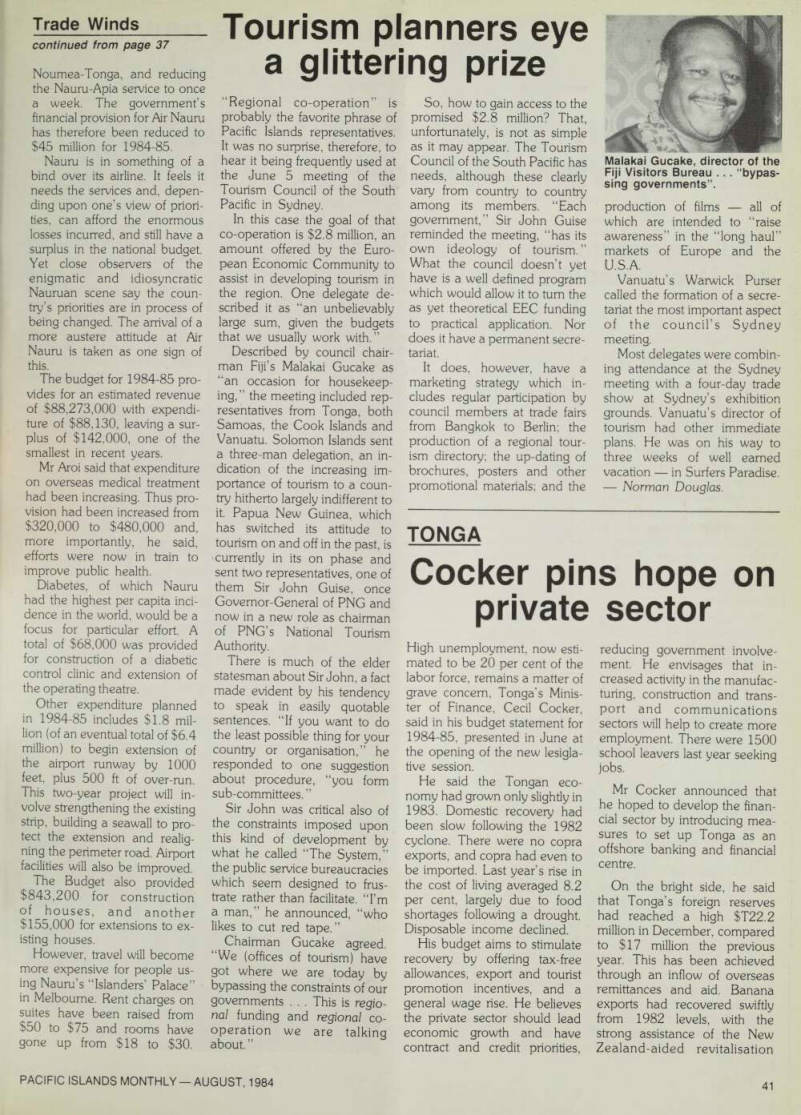
Described by council chair man Fiji’s Malakai Gucake as “an occasion for housekeep ing,” the meeting included rep resentatives from Tonga, both Samoas, the Cook Islands and Vanuatu. Solomon Islands sent a three-man delegation, an in dication of the increasing im portance of tourism to a coun try hitherto largely indifferent to it. Papua New Guinea, which has switched its attitude to tourism on and off in the past, is ■currently in its on phase and sent two representatives, one of them Sir John Guise, once Governor-General of PNG and now in a new role as chairman of PNG’s National Tourism
Authority.
There is much of the elder statesman about Sir John, a fact made evident by his tendency to speak in easily quotable sentences. “If you want to do the least possible thing for your country or organisation,” he responded to one suggestion about procedure, “you form sub-committees. ”
Sir John was critical also of the constraints imposed upon this kind of development by what he called “The System,” the public service bureaucracies which seem designed to frus trate rather than facilitate. “I’m a man,” he announced, “who likes to cut red tape.”
Chairman Gucake agreed.
“We (offices of tourism) have got where we are today by bypassing the constraints of our governments . . . This is regio nal funding and regional co operation we are talking about. ”
So, how to gain access to the promised $2.8 million? That, unfortunately, is not as simple as it may appear. The Tourism Council of the South Pacific has needs, although these clearly vary from country to country among its members. “Each government,” Sir John Guise reminded the meeting, “has its own ideology of tourism. ”
What the council doesn’t yet have is a well defined program which would allow it to turn the as yet theoretical EEC funding to practical application. Nor does it have a permanent secre tariat.
It does, however, have a marketing strategy which in cludes regular participation by council members at trade fairs from Bangkok to Berlin; the production of a regional tour ism directory; the up-dating of brochures, posters and other promotional materials; and the
production of films all of which are intended to “raise awareness” in the “long haul” markets of Europe and the
U.S.A.
Vanuatu’s Warwick Purser called the formation of a secre tariat the most important aspect of the council’s Sydney meeting.
Most delegates were combin ing attendance at the Sydney meeting with a four-day trade show at Sydney’s exhibition grounds. Vanuatu’s director of tourism had other immediate plans. He was on his way to three weeks of well earned vacation in Surfers Paradise.
Norman Douglas.
Malakai Gucake, director of the Fiji Visitors Bureau ... “bypas sing governments”.