Tight belts at Air Nauru
pp. 37-41 · Read in the full issue
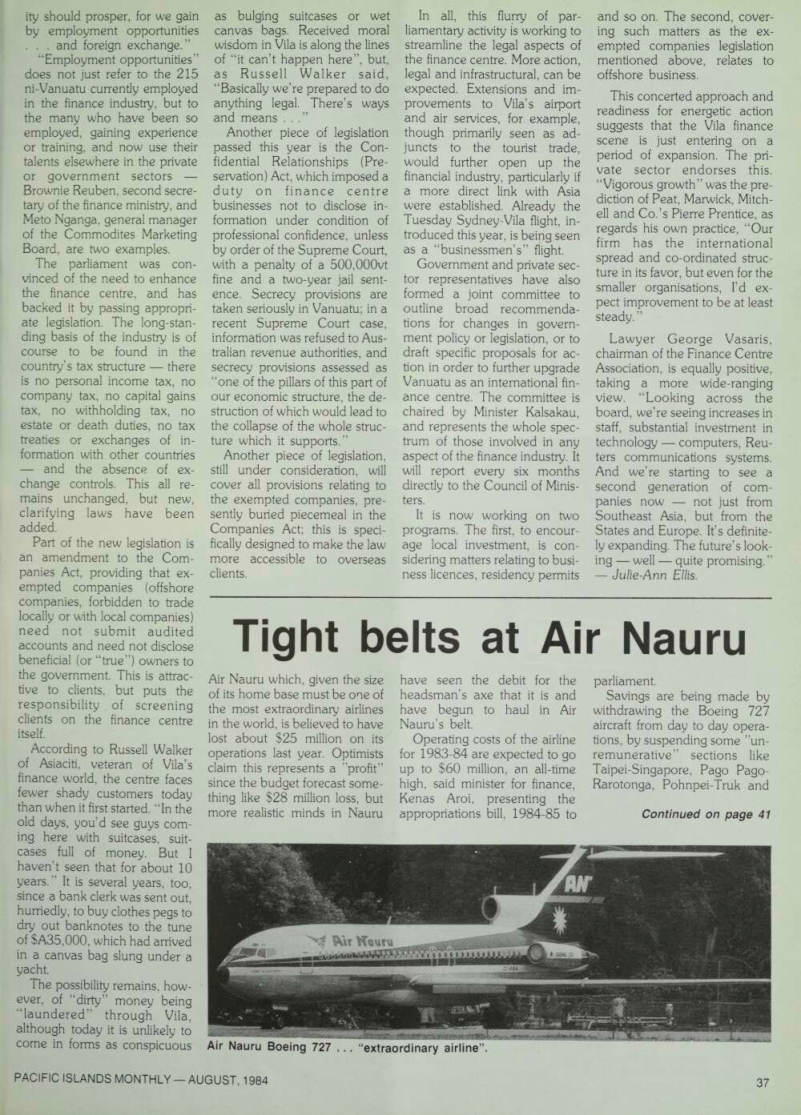



Air Nauru which, given the size of its home base must be one of the most extraordinary airlines in the world, is believed to have lost about $25 million on its operations last year. Optimists claim this represents a ’’profit” since the budget forecast some thing like $2B million loss, but more realistic minds in Nauru
have seen the debit for the headsman’s axe that it is and have begun to haul in Air Nauru’s belt.
Operating costs of the airline for 1983-84 are expected to go up to $6O million, an all-time high, said minister for finance, Kenas Aroi, presenting the appropriations bill, 1984-85 to
parliament.
Savings are being made by withdrawing the Boeing 727 aircraft from day to day opera tions, by suspending some ”un remunerative” sections like Taipei-Singapore, Pago Pago- Rarotonga, Pohnpei-Truk and
Continued on page 41
Air Nauru Boeing 727 ... “extraordinary airline”.
Noumea-Tonga, and reducing the Nauru-Apia service to once a week. The government’s financial provision for Air Nauru has therefore been reduced to $45 million for 1984-85.
Nauru is in something of a bind over its airline. It feels it needs the services and, depen ding upon one’s view of priori ties, can afford the enormous losses incurred, and still have a surplus in the national budget.
Yet close observers of the enigmatic and idiosyncratic Nauruan scene say the coun try’s priorities are in process of being changed. The arrival of a more austere attitude at Air Nauru is taken as one sign of this.
The budget for 1984-85 pro vides for an estimated revenue of $88,273,000 with expendi ture of $88,130, leaving a sur plus of $142,000, one of the smallest in recent years.
Mr Aroi said that expenditure on overseas medical treatment had been increasing. Thus pro vision had been increased from $320,000 to $480,000 and, more importantly, he said, efforts were now in train to improve public health.
Diabetes, of which Nauru had the highest per capita inci dence in the world, would be a focus for particular effort. A total of $68,000 was provided for construction of a diabetic control clinic and extension of the operating theatre.
Other expenditure planned in 1984-85 includes $l.B mil lion (of an eventual total of $6.4 million) to begin extension of the airport runway by 1000 feet, plus 500 ft of over-run.
This two-year project will in volve strengthening the existing strip, building a seawall to pro tect the extension and realig ning the perimeter road. Airport facilities will also be improved.
The Budget also provided $843,200 for construction of houses, and another $155,000 for extensions to ex isting houses.
However, travel will become more expensive for people us ing Nauru’s “Islanders’ Palace” in Melbourne. Rent charges on suites have been raised from $5O to $75 and rooms have gone up from $lB to $3O.