trade winds
pp. 35-37 · Read in the full issue

Port-Vila’S Booming Finance Centre
Are the days of suitcases and clothes pegs gone for good?
When the Helsal 11, chartered and renamed Spirit of Vanuatu, glided in triumph to Port-Vila’s seawall after winning the first Sydney-Port-Vila yacht race in June, she was flying Vanuatu’s colors and also sporting the logo of the Asiaciti Trust Com pany. The fluttering logo indi cated not only sponsorship, but also the growing importance of Vanuatu’s Vila-based finance industry.
Though still small compared with European or Caribbean centres, Vila’s financial centre is moving steadily ahead this year, under the impetus of active government promotion and private sector organisation.
The industry sprang from small beginnings in 1971, when the first legislation was passed providing for special banking, trust company, insurance and companies law, including provi sion for exempted companies covered by strict security provi sions.
Some natural advantage has helped growth from that begin ning. Vanuatu’s time zone is convenient for operations for Australia and Southeast Asia, and is compatible with New York market times, so that closing prices on the New York Stock Exchange are known im mediately during office hours in Vila. Vila’s early morning start gives it a competitive edge on Hong Kong offices, and a sub stantial part of Vila’s business comes from there.
Other advantages have come from the industry itself. Excel lent communications facilities now exist, and a solid professio nal infrastructure has been built up. For a small town, six in ternational banks working at retail level, a half-dozen trust companies operating locally,
and several legal firms and accounting firms make a formidable array.
After a slight check during and after the independence troubles, while clients and in vestors reassured themselves of the coutnry’s political stability, the industry has come alive
again. It is a major economic force in the country, though still a long way behind the agricultural export industries as a foreign money earner. Over 1000 companies are incorpo rated here, representing billions of dollars in assets. Govern ment revenues from company
registrations and other fees is around SUSI million annually, or approximately 4 per cent of total revenues.
“It is in all our interests,”
Finance Minister Kalpokor Kal sakau declared to parliament in this year’s budget speech, “that this sector of commercial activ-
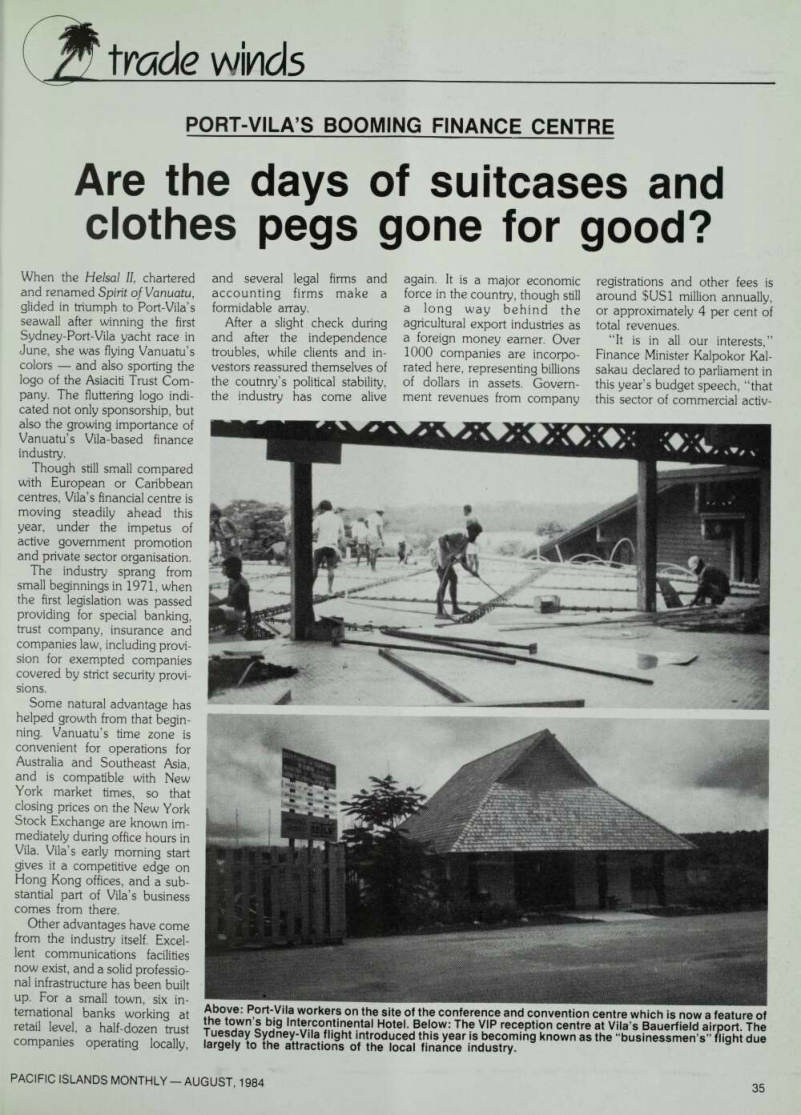
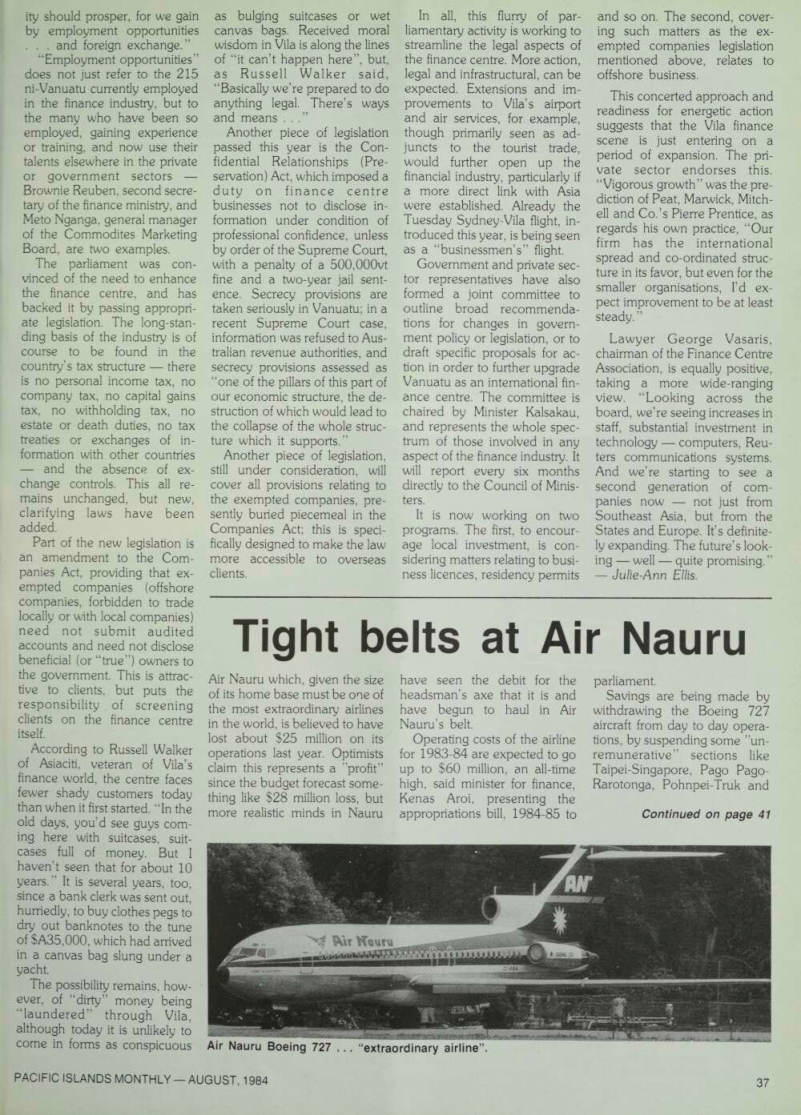
Above: Port-Vila workers on the site of the conference and convention centre which is now a feature of the town s big Intercontinental Hotel. Below: The VIP reception centre at Vila’s Bauerfield airport. The T uesday Sydney-Vila flight introduced this year is becoming known as the “businessmen’s” flight due largely to the attractions of the local finance industry.
ity should prosper, for we gain by employment opportunities . . . and foreign exchange.”
“Employment opportunities” does not just refer to the 215 ni-Vanuatu currently employed in the finance industry, but to the many who have been so employed, gaining experience or training, and now use their talents elsewhere in the private or government sectors Brownie Reuben, second secre tary of the finance ministry, and Meto Nganga, general manager of the Commodites Marketing Board, are two examples.
The parliament was con vinced of the need to enhance the finance centre, and has backed it by passing appropri ate legislation. The long-stan ding basis of the industry is of course to be found in the country’s tax structure there is no personal income tax, no company tax, no capital gains tax, no withholding tax, no estate or death duties, no tax treaties or exchanges of in formation with other countries and the absence of ex change controls. This all re mains unchanged, but new, clarifying laws have been added.
Part of the new legislation is an amendment to the Com panies Act, providing that ex empted companies (offshore companies, forbidden to trade locally or with local companies) need not submit audited accounts and need not disclose beneficial (or “true”) owners to the government. This is attrac tive to clients, but puts the responsibility of screening clients on the finance centre itself.
According to Russell Walker of Asiaciti, veteran of Vila’s finance world, the centre faces fewer shady customers today than when it first started. “In the old days, you’d see guys com ing here with suitcases, suit cases full of money. But I haven’t seen that for about 10 years.” It is several years, too, since a bank clerk was sent out, hurriedly, to buy clothes pegs to dry out banknotes to the tune of $A35,000, which had arrived in a canvas bag slung under a yacht.
The possibility remains, how ever, of “dirty” money being “laundered” through Vila, although today it is unlikely to come in forms as conspicuous
as bulging suitcases or wet canvas bags. Received moral wisdom in Vila is along the lines of “it can’t happen here”, but, as Russell Walker said, “Basically we’re prepared to do anything legal. There’s ways and means ...”
Another piece of legislation passed this year is the Con fidential Relationships (Pre servation) Act, which imposed a duty on finance centre businesses not to disclose in formation under condition of professional confidence, unless by order of the Supreme Court, with a penalty of a 500,000vt fine and a two-year jail sent ence. Secrecy provisions are taken seriously in Vanuatu; in a recent Supreme Court case, information was refused to Aus tralian revenue authorities, and secrecy provisions assessed as “one of the pillars of this part of our economic structure, the de struction of which would lead to the collapse of the whole struc ture which it supports.”
Another piece of legislation, still under consideration, will cover all provisions relating to the exempted companies, pre sently buried piecemeal in the Companies Act; this is speci fically designed to make the law more accessible to overseas clients.
In all, this flurry of par liamentary activity is working to streamline the legal aspects of the finance centre. More action, legal and infrastructural, can be expected. Extensions and im provements to Vila’s airport and air services, for example, though primarily seen as ad juncts to the tourist trade, would further open up the financial industry, particularly if a more direct link with Asia were established. Already the Tuesday Sydney-Vila flight, in troduced this year, is being seen as a “businessmen’s” flight.
Government and private sec tor representatives have also formed a joint committee to outline broad recommenda tions for changes in govern ment policy or legislation, or to draft specific proposals for ac tion in order to further upgrade Vanuatu as an international fin ance centre. The committee is chaired by Minister Kalsakau, and represents the whole spec trum of those involved in any aspect of the finance industry. It will report every six months directly to the Council of Minis ters.
It is now working on two programs. The first, to encour age local investment, is con sidering matters relating to busi ness licences, residency permits
and so on. The second, cover ing such matters as the ex empted companies legislation mentioned above, relates to offshore business.
This concerted approach and readiness for energetic action suggests that the Vila finance scene is just entering on a period of expansion. The pri vate sector endorses this.
“Vigorous growth” was the pre diction of Peat, Marwick, Mitch ell and Co.’s Pierre Prentice, as regards his own practice, “Our firm has the international spread and co-ordinated struc ture in its favor, but even for the smaller organisations, I’d ex pect improvement to be at least steady. ”
Lawyer George Vasaris, chairman of the Finance Centre Association, is equally positive, taking a more wide-ranging view. “Looking across the board, we’re seeing increases in staff, substantial investment in technology computers, Reu ters communications systems.
And we’re starting to see a second generation of com panies now not just from Southeast Asia, but from the States and Europe. It’s definite ly expanding. The future’s look ing well quite promising. ”
Julie-Ann Ellis.