the everyday
pp. 31-33 · Read in the full issue
Marrying art and the everyday
Artists from the Cook Islands, Fiji, Kiribati, New Caledonia, Solomon Islands, Tonga, Vanuatu, Wallis and Futuna and Western Samoa met at the Michoutouchkine/Pilioko Foundation near Port-Vila re cently for a fortnight’s hard work and exchange of ideas.
The workshop was sponsored by the University of the South Pacific and South Pacific Crea tive Arts Society, and hosted by Nikolai Michoutouchkine and Aloi Pilioko at their own studio gallery complex.
On arrival at the workshop, I was met by Rarotongan Nga Teariki, who explained that the 23 participants were taking it in turns to guide visitors around.
Was this a distraction from his own work? Nga’s reply gave an early clue to the nature of the workshop. “No. It’s all valuable and I want some day to have a gallery of my own.” This readiness to view his guiding stint as training in public rela tions, necessary in the back ground of an artist, was the first indication of a general hard headedness among participants about their own professional futures. Recognising that the Pacific is not in general rich enough to allow for govem
ment-or patron-sponsored artists, they were preparing themselves to promote their art as a vital part of daily life. Nga continued, on the subject of the whole workshop, “It’s a full training for a professional life.
We are discovering re discovering our traditional life, and it becomes the basis of our art.”
This was a major emphasis of the group that Pacific life was worthy of an artist’s attention, and, side by side with that, that art must be seen as part of daily life.
To some extent, these emph ases come from the two hosts, whose gallery is a stunning jumble of old canoe prows, pandanus roots, medieval icons, masks, their own recent work, pottery, industrial relics ... all attesting to a conviction that art is not just a commodity for sale, or for critical apprecia tion, but is in every pure ex pression of daily reality. Their own work has in recent years turned more and more to functional art, ranging from mu rals to soft furnishings to clo thing, so that it is experienced in the midst of everyday life, and not in a rareified critical atmos phere.
Report from Vanuatu
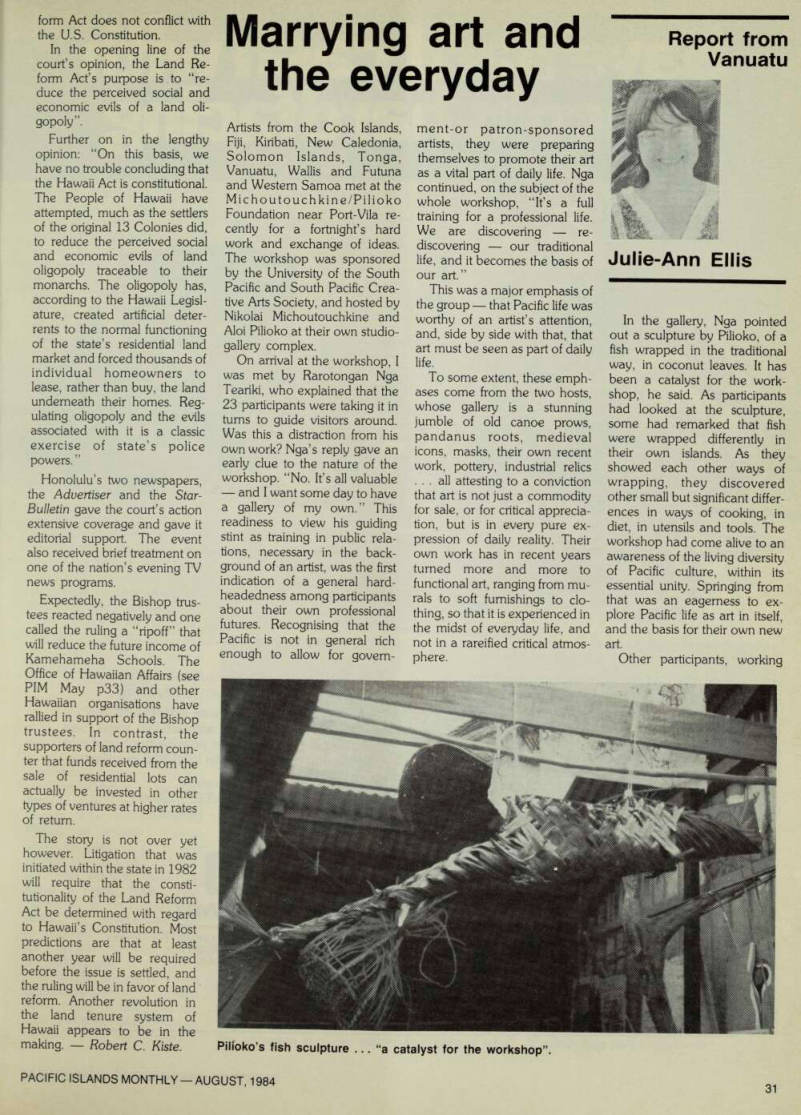
In the gallery, Nga pointed out a sculpture by Pilioko, of a fish wrapped in the traditional way, in coconut leaves. It has been a catalyst for the work shop, he said. As participants had looked at the sculpture, some had remarked that fish were wrapped differently in their own islands. As they showed each other ways of wrapping, they discovered other small but significant differ ences in ways of cooking, in diet, in utensils and tools. The workshop had come alive to an awareness of the living diversity of Pacific culture, within its essential unity. Springing from that was an eagerness to ex plore Pacific life as art in itself, and the basis for their own new art.
Other participants, working
Julie-Ann Ellis
Pilioko’s fish sculpture ... “a catalyst for the workshop”.
individually in places they had chosen themselves around the rambling garden and studio complex, to suit their own needs, endorsed this view of the relationship between cul ture and art.
It was reflected, for example, in the subject matter and com position of a series of drawings by Timothy Dautei, from Fiji, which depicted traditional scenes, using Western techni ques. Some were experimental, using techniques suggested by other participants, drawings solely in vertical lines, and drawings using gestalt effects.
Some were sketches of ethnographic as well as artistic value of the custom healer Mabol Mundoro from Pente cost in Vanuatu, who had de monstrated massage to the workshop. Her healing, Timothy explained, was just as much art as his record of it.
Tongan artist Vaka Polea was working on his own in a small shelter overlooking the sea. “I chose this place because no one will disturb you. I can settle down here and develop my own ideas. ” Without the rest of the workshop? “Oh, no. I’m learning all the time from all the participants, from Pilioko and Nikolai.” Learning what? Too much to put into words, apparently, a bemused grin flashed between Vaka and Nga.
“Ah . . . how to fix the price!”
Eddie Deading, from the Solomons, spoke of the several new approaches to art he had learned from fellow partici pants, although he stressed that he. was “perfecting my own style, which is for me and no one else”. He was also aware of learning which could affect his professional future “I hope after the workshop to have an entirely new concept of my career. I’ve learned from Pilioko an entirely different style, the idea of a low-cost gallery” and was keen to work out ways to make that future a reality. “Art in the Solomons is nearly ignored.
Artists need governments, not to teach art in schools, but to show art is an important part of life and culture.”
Art in daily life was not just a catchphrase; sessions covered many forms of functional art, such as fabric design, house decoration and jewellery-mak
ing. Professional artists, such as Ka.Ty Deslandes from France, now teaching in Vanuatu, and sculptor and jewellery maker Emmanuel Watt, took part in activities, adding their own con tribution to the overall under standing of how art is part of community life.
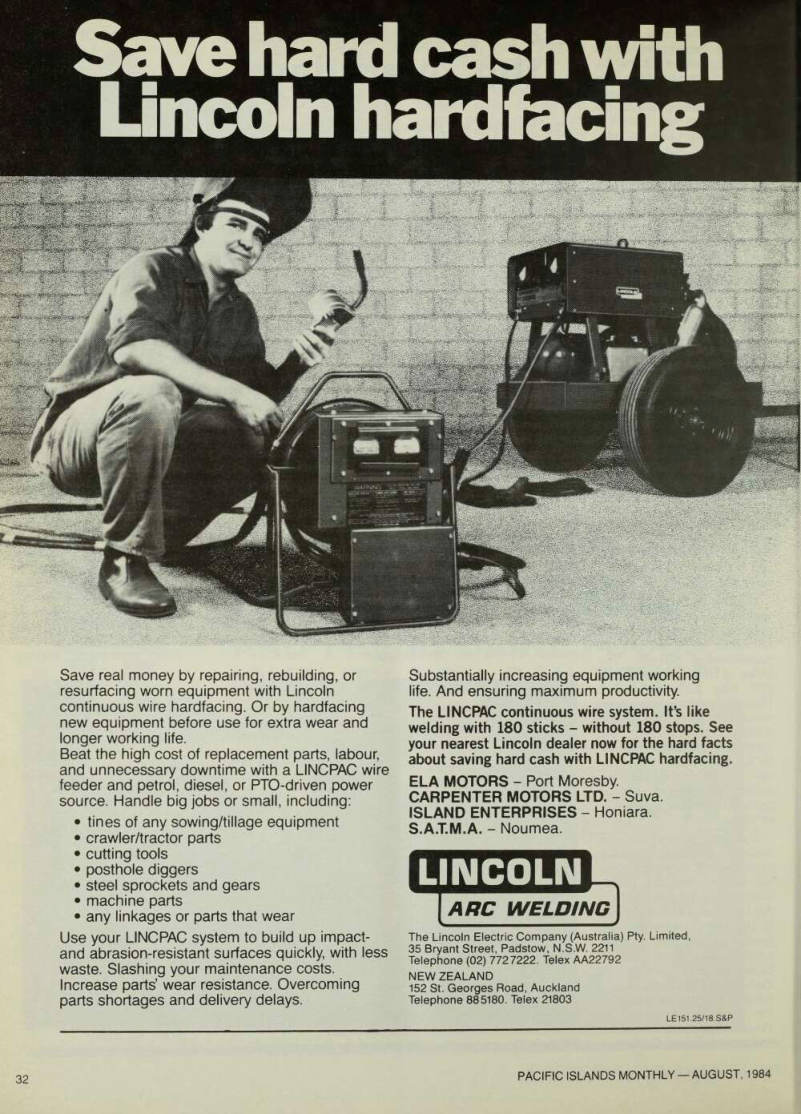
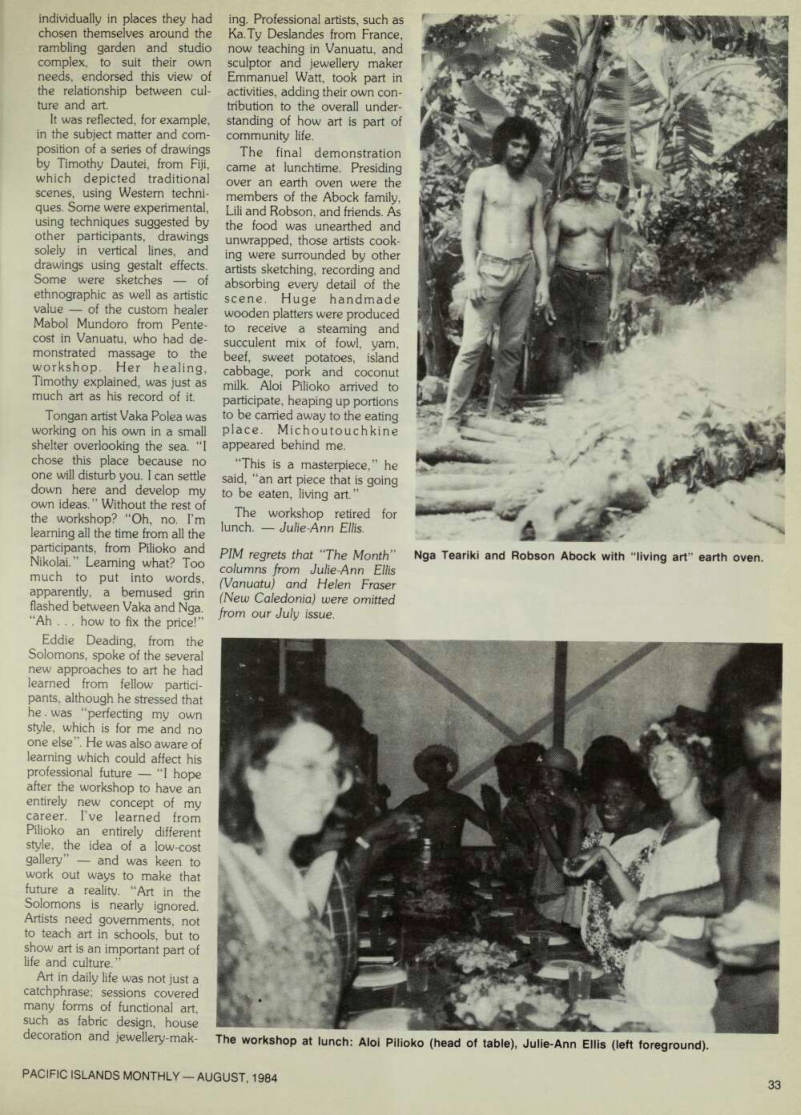
The final demonstration came at lunchtime. Presiding over an earth oven were the members of the Abock family, Lili and Robson, and friends. As the food was unearthed and unwrapped, those artists cook ing were surrounded by other artists sketching, recording and absorbing every detail of the scene. Huge handmade wooden platters were produced to receive a steaming and succulent mix of fowl, yam, beef, sweet potatoes, island cabbage, pork and coconut milk. Aloi Pilioko arrived to participate, heaping up portions to be carried away to the eating place. Michoutouchkine appeared behind me.
“This is a masterpiece,” he said, “an art piece that is going to be eaten, living art.”
The workshop retired for
lunch.
Julie-Ann Ellis.
PIM regrets that ‘The Month” columns from Julie-Ann Ellis (Vanuatu) and Helen Fraser (New Caledonia) were omitted from our Ju/y issue.
Nga Teariki and Robson Abock with “living art” earth oven.
The workshop at lunch: Aloi Pilioko (head of table), Julie-Ann Ellis (left foreground).