Hawaii land: A revolution ahead?
pp. 29-31 · Read in the full issue

revolution ahead?
Authority over land has always been the object of competition in the Pacific Islands, and as Gavan Daws has aptly stated in his Shoal of Time: A History of the Hawaiian Islands “land was power because it was the source of life”.
Prior to King Kamehameha’s political unification of the Hawaiian Islands, competing paramount chiefs warred over the control of land and people.
During and after Kame hameha’s rise to sovereignty, the size of the American and European community in Hawaii grew swiftly and substantially.
The scope of the competition for land increased; ever thoughtful of their commercial interests, the foreigners brought pressure to gain secure rights to land, and they managed to help bring about the Great Mahele or land division in the mid- 19th century.
Crown lands were establish ed for the reigning monarch, one of Kamehameha’s succes sors. The chiefs themselves were allowed to gain fee simple titles to lands they had pre viously administered for the king. Another category of land became government land, and the common people were also allowed to buy small plots. For a short time, the king and chiefs did well for themselves, but, for the most part, commoners who never had any notions about secure rights to land soon lost their stake in the game. Shortly thereafter and to further com plicate things, foreigners were allowed to purchase land, their ultimate goal all along. By the end of the century, foreigners
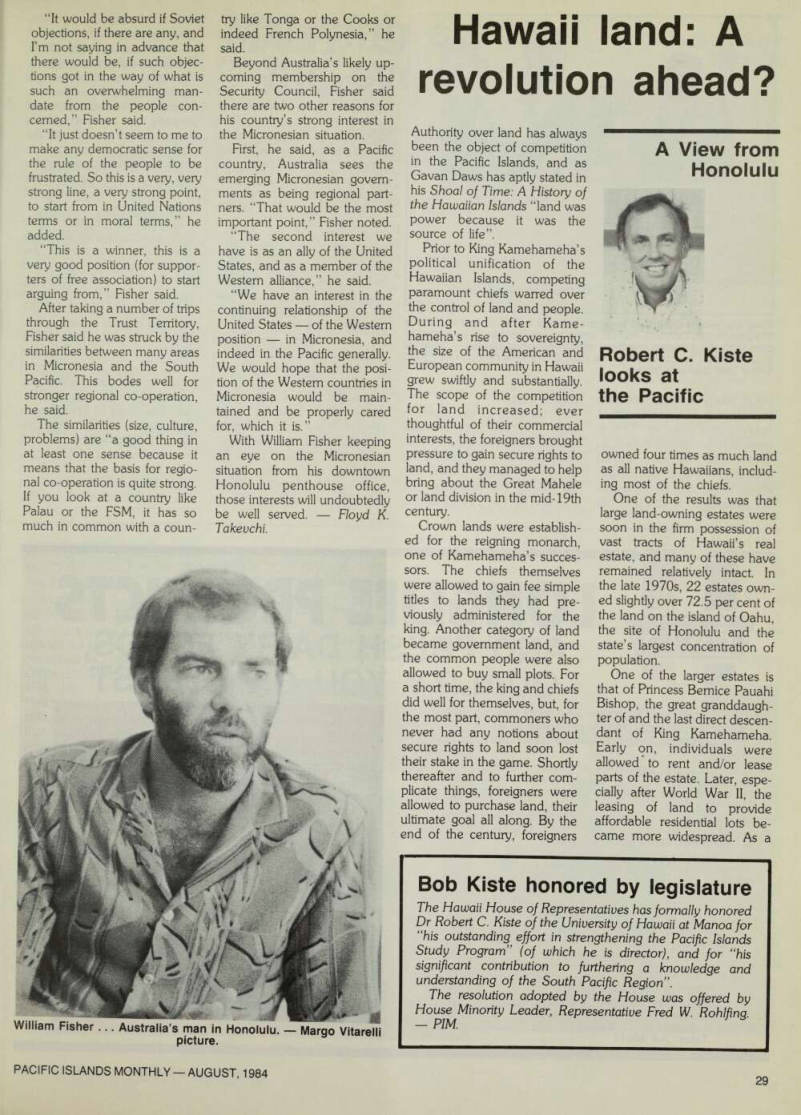
A View from Honolulu
owned four times as much land as all native Hawaiians, includ ing most of the chiefs.
One of the results was that large land-owning estates were soon in the firm possession of vast tracts of Hawaii’s real estate, and many of these have remained relatively intact. In the late 19705, 22 estates own ed slightly over 72.5 per cent of the land on the island of Oahu, the site of Honolulu and the state’s largest concentration of population.
One of the larger estates is that of Princess Bernice Pauahi Bishop, the great granddaugh ter of and the last direct descen dant of King Kamehameha.
Early on, individuals were allowed to rent and/or lease parts of the estate. Later, espe cially after World War 11, the leasing of land to provide affordable residential lots be came more widespread. As a
Robert C. Kiste looks at the Pacific
result, many homeowners own their homes but not the land upon which they sit. This is quite counter to the American dream that everyone should own his own land and house, Many residences in Honolulu are located on holdings of the
Bishop Estate, At the time of her death in 1884, Princess Bernice willed that her lands and the proceeds from them be managed for the benefit of native Hawaiians, particularly the founding and support of the Kamehameha
Schools, one for boys and one for girls. Contrary to popular belief, the Bishop Museum named after Princess Bernice is not supported by the estate.
The holdings of the latter are managed by a five-member board of trustees, first appointed by Princess Bernice herself and later by the Hawaii Supreme Court. Today, the estate holds about 15 per cent of the land on Oahu and close to eight per cent of the land in the entire state.
Since World War 11, and especially since 1959 when statehood was achieved, home owners have brought consider able political pressure to bear for land reform and the break up of the large estates. On May 30 of this year, the United States Supreme Court issued a unanimous decision (eight to 0) which potentially has great con sequences for all the large estates and Hawaii’s home owners. A few points of history help illuminate that decision.
In 1967, Hawaii’s Land Re form Act was passed by the state legislature, and it allowed the state to use the power of
eminent domain to condemn leasehold residential lots and sell them to the actual residents.
The large estates immediately objected by arguing that the legislation would in effect re quire one private owner to sell property to another private owner, and that eminent do main can only be exercised in cases where it is clear that the action is in the overall public interest, e.g., the creation of parks, highways, etc.
In 1978, the Bishop Estate filed a suit against the state government questioning the constitutionality of the Land Reform Act. In the following year, the federal district court in Honolulu ruled that the 1967 Act was indeed constitutional.
The Bishop estate appealed the decision to a higher federal court. The U.S. 9th Circuit Court of Appeals judged the Land Reform Act unconstitutio nal. The State of Hawaii took the case to the U.S. Supreme Court in Washington, D.C. It was the outcome of that litiga tion that was announced on May 30 when the Supreme Court ruled that the Land Re
King Kamehameha II (left foreground) and his suite in 1824 at the Theatre Royal, London. He had come to ask George IV how best to deal with the growing numbers of Europeans in Hawaii - Original by J. W. Gear, reproduced in The People from the Horizon, by Philip Snow and Stefanie Waine.
form Act does not conflict with the U.S. Constitution.
In the opening line of the court’s opinion, the Land Re form Act’s purpose is to “re duce the perceived social and economic evils of a land oli gopoly”.
Further on in the lengthy opinion: “On this basis, we have no trouble concluding that the Hawaii Act is constitutional.
The People of Hawaii have attempted, much as the settlers of the original 13 Colonies did, to reduce the perceived social and economic evils of land oligopoly traceable to their monarchs. The oligopoly has, according to the Hawaii Legisl ature, created artificial deter rents to the normal functioning of the state’s residential land market and forced thousands of individual homeowners to lease, rather than buy, the land underneath their homes. Reg ulating oligopoly and the evils associated with it is a classic exercise of state’s police powers. ”
Honolulu’s two newspapers, the Advertiser and the Star- Bulletin gave the court’s action extensive coverage and gave it editorial support. The event also received brief treatment on one of the nation’s evening TV news programs.
Expectedly, the Bishop trus tees reacted negatively and one called the ruling a “ripoff” that will reduce the future income of Kamehameha Schools. The Office of Hawaiian Affairs (see PIM May p 33) and other Hawaiian organisations have rallied in support of the Bishop trustees. In contrast, the supporters of land reform coun ter that funds received from the sale of residential lots can actually be invested in other types of ventures at higher rates of return.
The story is not over yet however. Litigation that was initiated within the state in 1982 will require that the consti tutionality of the Land Reform Act be determined with regard to Hawaii’s Constitution. Most predictions are that at least another year will be required before the issue is settled, and the ruling will be in favor of land reform. Another revolution in the land tenure system of Hawaii appears to be in the
making.
Robert C. Kiste.