Australia looks
pp. 28-29 · Read in the full issue
to the north
Since the end of World War 2, Micronesia has been the preserve of the United States.
Indeed, until the early 19605, it took a special security check for any outsider to enter the Trust Territory, including U.S. citi zens.
But the movement toward decolonisation over the past decade has given the Microne sian islands a higher regional and international profile, and, in the process, has increased interest by other countries in Trust Territory developments.
One of the most dramatic examples of this new-found interest is the loans made to the republics of Palau and the Marshall Islands by a British group so that the islands could purchase new electrical gen erating equipment. The fact that both Micronesian govern ments appear unable to make their payments without a con siderable American bail-out which may not be as forthcom ing as the Islanders and British might have hoped is indica tive of the risks outsiders take in rushing headlong into the Micronesian scene.
A more promising, and long lasting, relationship appears to be forming between the freely associated states (Palau, the Marshalls and the Federated States of Micronesia) and Aus tralia. Long a “South Pacific” country in outlook, Australia in the past year or so has begun to look seriously at establishing an active post-trusteeship relation
ship with the emerging states.
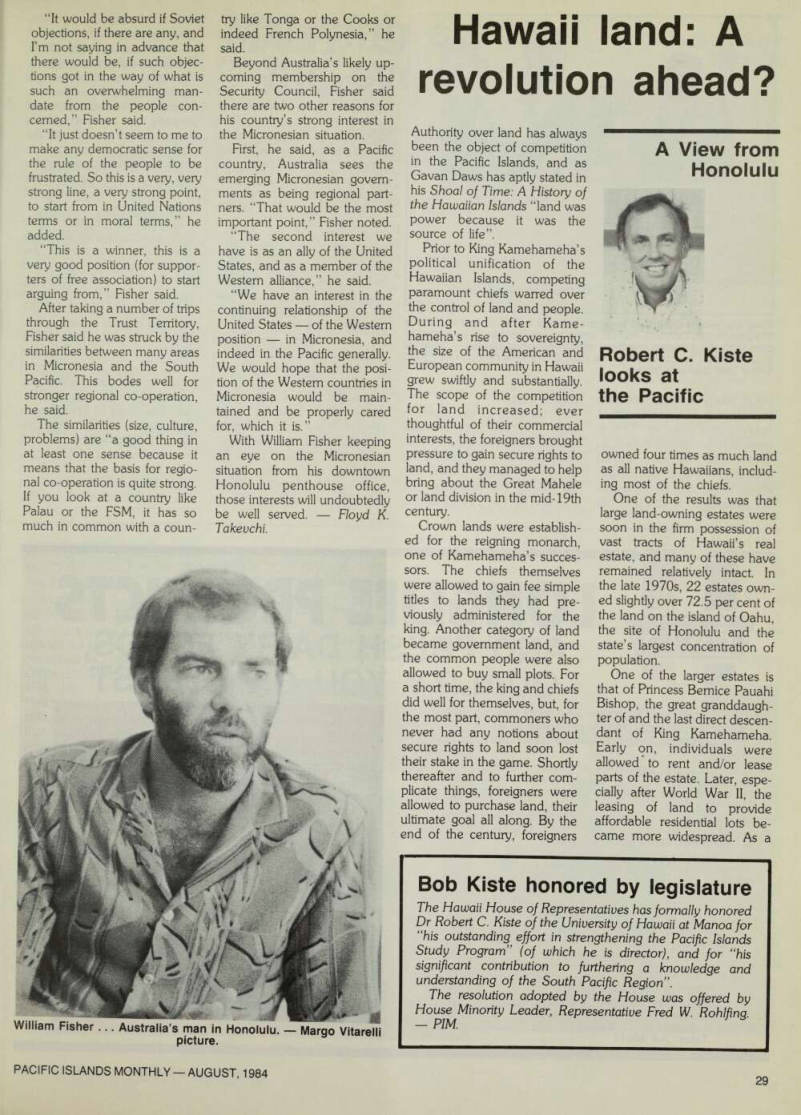
The best indication of Can berra’s new northward view was the appointment last year of diplomat William Fisher as Australia’s Honolulu-based consul-general. Not only is Fisher one of his country’s most astute observers of the con temporary Pacific, his mandate was to aggressively pursue an expanded relationship with the Micronesian governments.
Previously most of Australia’s official dealings with the Trust Territory were handled through its High Commission on Nauru.
Honolulu was for the most part out of the picture, although Fisher’s predecessor began to take an increasingly active in terest in Micronesian affairs shortly before being sent to the embassy in Paris.
In a recent interview with PIM, Fisher spoke of Australia’s attitude toward developments in Micronesia and what role his country might play as the final chapter of U.S. decolonisation is written.
Without hesitation, Fisher is strongly supportive of the free association agreements that the “lower three” (FSM, Palau and the Marshalls) have chosen.
“We look forward to the complete achievement” of de colonisation, Fisher said. “I think the outstanding thing one would have to say about the protracted negotiations which have gone on is that the prin ciple which has been kept up permost in the minds of the
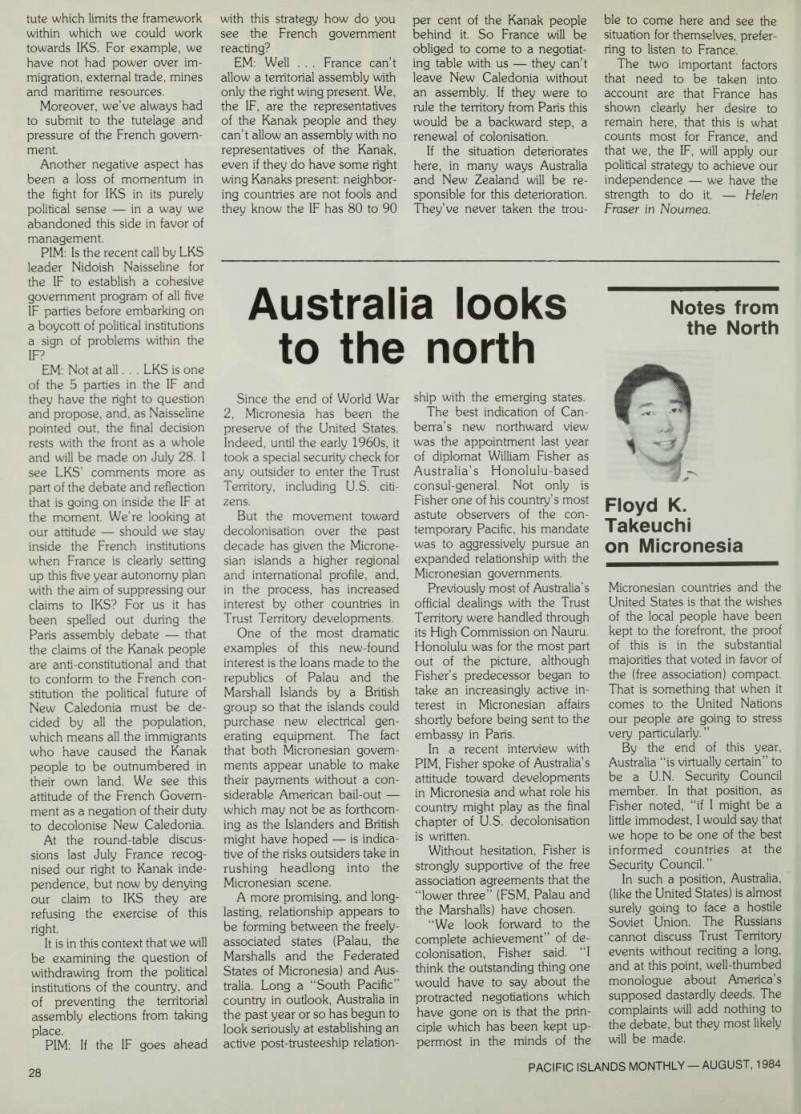
Notes from the North
Micronesian countries and the United States is that the wishes of the local people have been kept to the forefront, the proof of this is in the substantial majorities that voted in favor of the (free association) compact.
That is something that when it comes to the United Nations our people are going to stress very particularly.”
By the end of this year, Australia “is virtually certain” to be a U.N. Security Council member. In that position, as Fisher noted, “if I might be a little immodest, 1 would say that we hope to be one of the best informed countries at the Security Council.”
In such a position, Australia, (like the United States) is almost surely going to face a hostile Soviet Union. The Russians cannot discuss Trust Territory events without reciting a long, and at this point, well-thumbed monologue about America’s supposed dastardly deeds. The complaints will add nothing to the debate, but they most likely will be made.
Floyd K.
Takeuchi on Micronesia
“It would be absurd if Soviet objections, if there are any, and I’m not saying in advance that there would be, if such objec tions got in the way of what is such an overwhelming man date from the people con cerned,” Fisher said.
“It just doesn’t seem to me to make any democratic sense for the rule of the people to be frustrated. So this is a very, very strong line, a very strong point, to start from in United Nations terms or in moral terms,” he added.
“This is a winner, this is a very good position (for suppor ters of free association) to start arguing from,” Fisher said.
After taking a number of trips through the Trust Territory, Fisher said he was struck by the similarities between many areas in Micronesia and the South Pacific. This bodes well for stronger regional co-operation, he said.
The similarities (size, culture, problems) are “a good thing in at least one sense because it means that the basis for regio nal co-operation is quite strong.
If you look at a country like Palau or the FSM, it has so much in common with a coun
try like Tonga or the Cooks or indeed French Polynesia,” he said.
Beyond Australia’s likely up coming membership on the Security Council, Fisher said there are two other reasons for his country’s strong interest in the Micronesian situation.
First, he said, as a Pacific country, Australia sees the emerging Micronesian govern ments as being regional part ners. “That would be the most important point,” Fisher noted.
“The second interest we have is as an ally of the United States, and as a member of the Western alliance,” he said.
“We have an interest in the continuing relationship of the United States of the Western position in Micronesia, and indeed in the Pacific generally.
We would hope that the posi tion of the Western countries in Micronesia would be main tained and be properly cared for, which it is.”
With William Fisher keeping an eye on the Micronesian situation from his downtown Honolulu penthouse office, those interests will undoubtedly
be well served.
Floyd K.
Takeuchi.
William Fisher ... Australia’s man in Honolulu. Margo Vitarelli picture.