on Impetus
pp. 26-28 · Read in the full issue
Front worries on Impetus
June 30 saw the end of the mandate of New Caledonia’s Territorial Assembly, a closure marked by the rejection by the assembly of an Independence Front draft plan for a general social security cover for New Caledonians. The project, of which the first step was general health cover, was rejected on the assembly’s last sitting day when the IP’s coalition partner, the FNSC, abstained from vot ing. The anti-independence Re publican Party, the RPCR, and one FNSC member voted against the project.
Speaking to PIM after the assembly’s finish, which is also
the end of two years of IF FNSC rule in the government council, and with the IF about to decide upon a new political strategy, leading IF figure Eloi Machoro reviewed IF gains and possible changes of action.
PIM: Why does the IF see 1984 as the crucial year in the history of the Kanak people?
EM; 1984 is crucial for the question of the Kanak people: if the IF and its political actions do not survive past 1984 the strug gle of the Kanak people is finished.
You have all the French parties, the right wing and centre parties here, all working to ensure that 1985 will see a decline of the Kanak people and their struggle for Kanak socialist independence (IKS).
If the statute of autonomy (proposed by the French gov ernment) goes ahead you will have the integration gradually but inexorably, of the Kanak people into a European model of life.
Later in July my party, Union Caledonienne, will hold a spe cial conference to review our strategy, and the week follow ing all five parties of the IF are
Noumea Notebook
meeting in a convention. We need to revise our relations with the French government, with the French socialist and com munist parties.
For the moment we are still talking to the government from within the framework of the institutions, but we need to know if it is necessary to con tinue working within the institu tions or to leave them.
With the adoption by the National Assembly of the autonomy statute, the changes to the Territorial Assembly, and all the accompanying debates, we can see clearly that there is no party, no government, which will dare to stand up in the assembly to say that the Kanak people are justified in their claim to independence, in their specificity as a people . . . and that no party or govern ment will support the Kanak people in these claims.
Immediately after the vote of the National Assembly in Paris our spokesman on foreign rela tions, Yann Uregei, went to the United Nations to talk with South Pacific Forum countries.
There it is still the same there are three small countries who give us unconditional support (Papua New Guinea, Solo mons, Vanuatu), but the major ity of the Forum countries don’t want to take a decision, don’t want to seize the occasion (of the French rejection of our proposals) to get New Caledo nia listed with the UN Decol onisation Committee.
Even if the Forum takes a decision in August it will be too late for the UN, and New Caledonia’s case will be put off until 1985. This makes it seven years that the Forum has been stalling on the question countries are busy sending the
question back to the Kanak people, they don’t want to concern themselves with our case. For us they are the same as the French groups at the assembly in Paris we have no support anywhere except for the three neighbors, and so it is up to us to decolonise here, all alone.
PIM: Have the IP’s two years as the senior partner in the government council been a positive experience?
EM: It certainly hasn’t been a waste of time, we’ve had the experience of government, of power, of management in the institutions at the level of daily management. We always said we’d use the institutions to advance IKS. And it’s because of this line of action that Union Caledonienne leader Pierre De clercq was assassinated in 1981.
If the direction of territorial affairs has not allowed us to act openly to instal IKS, it did permit us to take measures favorable to the territory, to its inhabitants and to the Kanaks.
In particular, we’ve developed the interior and the islands, we’ve made clear that the riches of the territory belong to it and must be managed by it.
With the mines and energy sector we’ve tried to instal territorial running of mines and energy but we haven’t always succeeded.
We instituted income tax and we’ve tried to decrease, or at least stabilise, indirect taxes, and to use resources to imple ment an overall policy.
Our policy has always been that the needs of the territory should be covered by the terri tory, and if there’s not enough money, resources have to be created.
We’ve put pressure on the French state to pay land reform office, ODIL (Office for the Development of the Interior and the Islands), cultural office these things the French state should pay for, it is what is owed as a result of colonisation.
For social measures, health etc, the state must pay the cost of her own public servants.
PIM: What have been the negative aspects of the past two years?
EM: Our actions have been limited because of our link with the FNSC we have also been blocked by the Territory’s sta
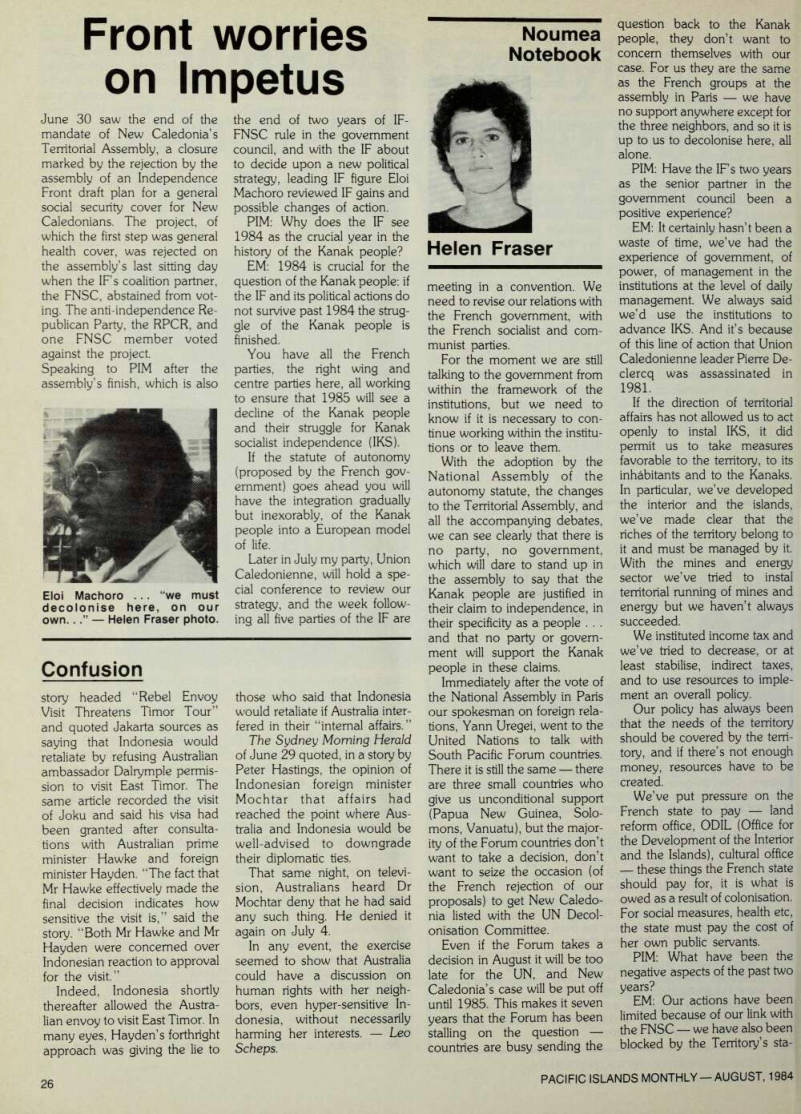
Eloi Machoro ... “we must decolonise here, on our own..." — Helen Fraser photo.
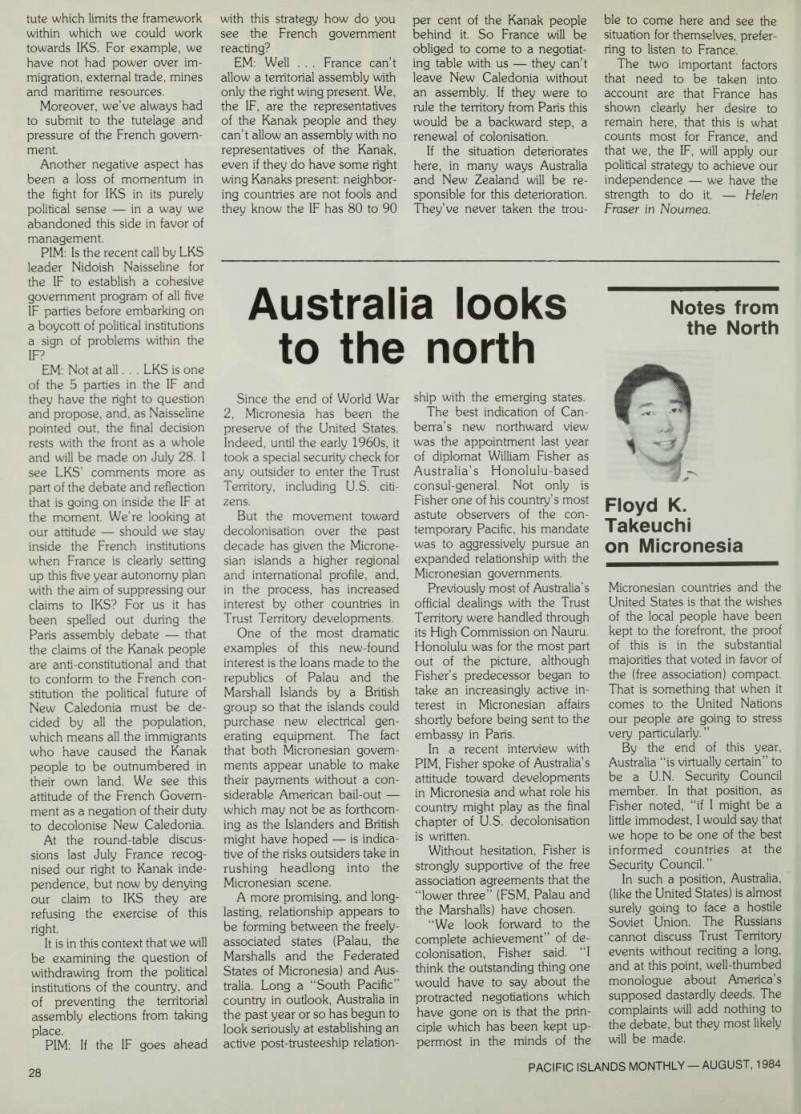
Helen Fraser
tute which limits the framework within which we could work towards IKS. For example, we have not had power over im migration, external trade, mines and maritime resources.
Moreover, we’ve always had to submit to the tutelage and pressure of the French govern ment.
Another negative aspect has been a loss of momentum in the fight for IKS in its purely political sense in a way we abandoned this side in favor of management.
PIM: Is the recent call by LKS leader Nidoish Naisseline for the IF to establish a cohesive government program of all five IF parties before embarking on a boycott of political institutions a sign of problems within the IF?
EM: Not at all. . . LKS is one of the 5 parties in the IF and they have the right to question and propose, and, as Naisseline pointed out, the final decision rests with the front as a whole and will be made on July 28. I see LKS’ comments more as part of the debate and reflection that is going on inside the IF at the moment. We’re looking at our attitude should we stay inside the French institutions when France is clearly setting up this five year autonomy plan with the aim of suppressing our claims to IKS? For us it has been spelled out during the Paris assembly debate that the claims of the Kanak people are anti-constitutional and that to conform to the French con stitution the political future of New Caledonia must be de cided by all the population, which means all the immigrants who have caused the Kanak people to be outnumbered in their own land. We see this attitude of the French Govern ment as a negation of their duty to decolonise New Caledonia.
At the round-table discus sions last July France recog nised our right to Kanak inde pendence, but now by denying our claim to IKS they are refusing the exercise of this right.
It is in this context that we will be examining the question of withdrawing from the political institutions of the country, and of preventing the territorial assembly elections from taking place.
PIM: If the IF goes ahead
with this strategy how do you see the French government reacting?
EM: Well . . . France can’t allow a territorial assembly with only the right wing present. We, the IF, are the representatives of the Kanak people and they can’t allow an assembly with no representatives of the Kanak, even if they do have some right wing Kanaks present; neighbor ing countries are not fools and they know the IF has 80 to 90
per cent of the Kanak people behind it. So France will be obliged to come to a negotiat ing table with us they can’t leave New Caledonia without an assembly. If they were to rule the territory from Paris this would be a backward step, a renewal of colonisation.
If the situation deteriorates here, in many ways Australia and New Zealand will be re sponsible for this deterioration.
They’ve never taken the trou
ble to come here and see the situation for themselves, prefer ring to listen to France.
The two important factors that need to be taken into account are that France has shown clearly her desire to remain here, that this is what counts most for France, and that we, the IF, will apply our political strategy to achieve our independence we have the
strength to do it.
Helen
Fraser in Noumea.