Confusion on image
pp. 25-26 · Read in the full issue
with Indons
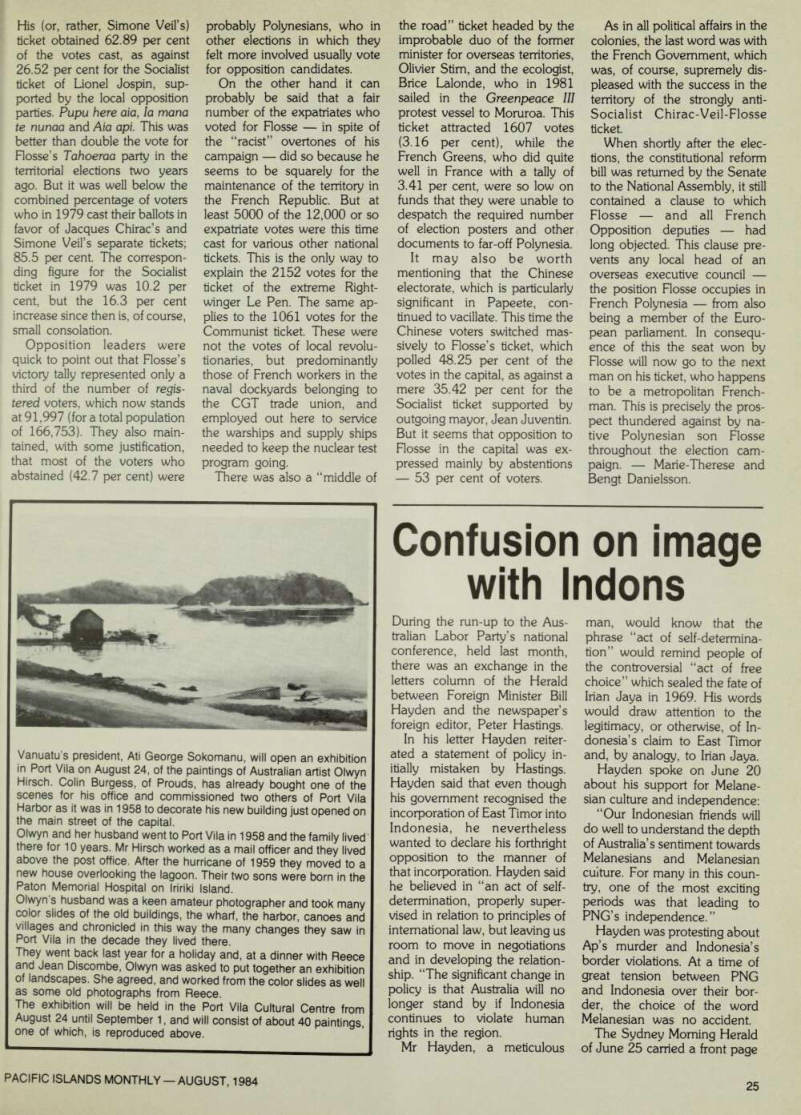
Vanuatu's president, Ati George Sokomanu, will open an exhibition in Port Vila on August 24, of the paintings of Australian artist Olwyn Hirsch. Colin Burgess, of Prouds, has already bought one of the scenes for his office and commissioned two others of Port Vila Harbor as it was in 1958 to decorate his new building just opened on the main street of the capital.
Olwyn and her husband went to Port Vila in 1958 and the family lived there for 10 years. Mr Hirsch worked as a mail officer and they lived above the post office. After the hurricane of 1959 they moved to a new house overlooking the lagoon. Their two sons were born in the Paton Memorial Hospital on Iririki Island.
Olwyn’s husband was a keen amateur photographer and took many color slides of the old buildings, the wharf, the harbor, canoes and villages and chronicled in this way the many changes they saw in Port Vila in the decade they lived there.
They went back last year for a holiday and, at a dinner with Reece and Jean Discombe, Olwyn was asked to put together an exhibition of landscapes. She agreed, and worked from the color slides as well as some old photographs from Reece.
The exhibition will be held in the Port Vila Cultural Centre from August 24 until September 1, and will consist of about 40 paintings, one of which, is reproduced above.
During the run-up to the Aus tralian Labor Party’s national conference, held last month, there was an exchange in the letters column of the Herald between Foreign Minister Bill Hayden and the newspaper’s foreign editor, Peter Hastings.
In his letter Hayden reiter ated a statement of policy in itially mistaken by Hastings.
Hayden said that even though his government recognised the incorporation of East Timor into Indonesia, he nevertheless wanted to declare his forthright opposition to the manner of that incorporation. Hayden said he believed in “an act of self determination, properly super vised in relation to principles of international law, but leaving us room to move in negotiations and in developing the relation ship. “The significant change in policy is that Australia will no longer stand by if Indonesia continues to violate human rights in the region.
Mr Hayden, a meticulous
man, would know that the phrase “act of self-determina tion” would remind people of the controversial “act of free choice” which sealed the fate of Irian Jaya in 1969. His words would draw attention to the legitimacy, or otherwise, of In donesia’s claim to East Timor and, by analogy, to Irian Jaya.
Hayden spoke on June 20 about his support for Melane sian culture and independence: “Our Indonesian friends will do well to understand the depth of Australia’s sentiment towards Melanesians and Melanesian culture. For many in this coun try, one of the most exciting periods was that leading to PNG’s independence.”
Hayden was protesting about Ap’s murder and Indonesia’s border violations. At a time of great tension between PNG and Indonesia over their bor der, the choice of the word Melanesian was no accident.
The Sydney Morning Herald of June 25 carried a front page
Confusion
story headed “Rebel Envoy Visit Threatens Timor Tour” and quoted Jakarta sources as saying that Indonesia would retaliate by refusing Australian ambassador Dalrymple permis sion to visit East Timor. The same article recorded the visit of Joku and said his visa had been granted after consulta tions with Australian prime minister Hawke and foreign minister Hayden. “The fact that Mr Hawke effectively made the final decision indicates how sensitive the visit is,” said the story. “Both Mr Hawke and Mr Hayden were concerned over Indonesian reaction to approval for the visit.”
Indeed, Indonesia shortly thereafter allowed the Austra lian envoy to visit East Timor. In many eyes, Hayden’s forthright approach was giving the lie to
those who said that Indonesia would retaliate if Australia inter fered in their “internal affairs.”
The Sydney Morning Herald of June 29 quoted, in a story by Peter Hastings, the opinion of Indonesian foreign minister Mochtar that affairs had reached the point where Aus tralia and Indonesia would be well-advised to downgrade their diplomatic ties.
That same night, on televi sion, Australians heard Dr Mochtar deny that he had said any such thing. He denied it again on July 4.
In any event, the exercise seemed to show that Australia could have a discussion on human rights with her neigh bors, even hyper-sensitive In donesia, without necessarily
harming her interests.
Leo
Scheps.