French Polynesian
pp. 23-25 · Read in the full issue

the month
The most European French Polynesian
The only noticeable change in French Polynesia, brought about by the Socialist election victories in 1981, is one of style and method. Civil liberties are better upheld. The numerous police snoopers employed by previous regimes to spy on political opponents and critics of the nuclear tests have been reassigned to less objectionable tasks. Some corrupt civil ser vants have been sent back to France. Magistrates show greater independence. And above all there is much greater freedom of expression on radio and TV.
Like all other overseas de partments and territories, French Polynesia is still consid ered “an integral part of the French Republic”. This means, among other things, that the islanders enjoy the doubtful privilege of being allowed to take part in all French national elections and referendums.
In 1979, they were even offered the opportunity of pre senting candidates for the new ly created European parliament in Strasbourg. Quite under standably, local participation in these pointless elections has always been low.
However, when the time came in June this year to renew the 434-seat European parlia ment, there was a new local twist which considerably in creased public interest.
The dynamic Tahoerra majority leader and vice-presi dent of the local government council, Gaston Flosse, who is a follower of the French national conservative RPR party boss Jacques Chirac, could proudly announce that he had been nominated to slot number 20 on the national conservative ticket headed by Giscard d’E staing’s former welfare Minister, Simone Veil. As her ticket was
expected to win about half of the 81 French seats at stake, Flosse was virtually home and hosed as the first Polynesian to take a seat in Strasbourg. The fact that in 1979 he had waged a bitter campaign against Simone Veil because she had dared to venture on a slight liberalisation of the archaic French abortion laws, did not seem to bother either partner.
As in France itself the real issues the future of Europe and the Common Market were in all the overseas territor ies rapidly overshadowed by strictly local problems and quar rels.
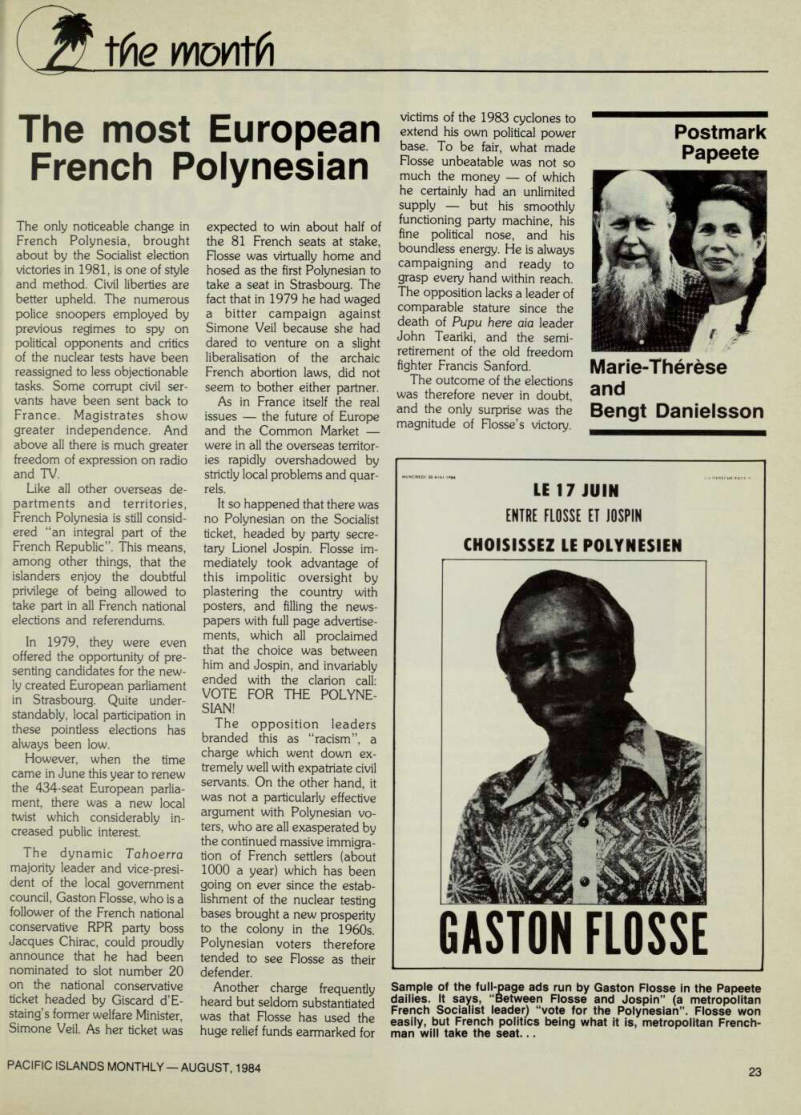
It so happened that there was no Polynesian on the Socialist ticket, headed by party secre tary Lionel Jospin. Flosse im mediately took advantage of this impolitic oversight by plastering the country with posters, and filling the news papers with full page advertise ments, which all proclaimed that the choice was between him and Jospin, and invariably ended with the clarion call:
Vote For The Polyne
Sian!
The opposition leaders branded this as “racism”, a charge which went down ex tremely well with expatriate civil servants. On the other hand, it was not a particularly effective argument with Polynesian vo ters, who are all exasperated by the continued massive immigra tion of French settlers (about 1000 a year) which has been going on ever since the estab lishment of the nuclear testing bases brought a new prosperity to the colony in the 19605.
Polynesian voters therefore tended to see Flosse as their defender.
Another charge frequently
heard but seldom substantiated was that Flosse has used the huge relief funds earmarked for
victims of the 1983 cyclones to extend his own political power base. To be fair, what made Flosse unbeatable was not so much the money of which he certainly had an unlimited supply but his smoothly functioning party machine, his fine political nose, and his boundless energy. He is always campaigning and ready to grasp every hand within reach.
The opposition lacks a leader of comparable stature since the death of Pupa here aia leader John Teariki, and the semi retirement of the old freedom fighter Francis Sanford.
The outcome of the elections was therefore never in doubt, and the only surprise was the magnitude of Flosse’s victory.
Postmark Papeete
Marie-Therese and Bengt Danielsson
His (or, rather, Simone Veil’s) ticket obtained 62.89 per cent of the votes cast, as against 26.52 per cent for the Socialist ticket of Lionel Jospin, sup ported by the local opposition parties. Pupa here aia, la mana te nunaa and Aia api. This was better than double the vote for Flosse’s Tahoeraa party in the territorial elections two years ago. But it was well below the combined percentage of voters who in 1979 cast their ballots in favor of Jacques Chirac’s and Simone Veil’s separate tickets; 85.5 per cent. The correspon ding figure for the Socialist ticket in 1979 was 10.2 per cent, but the 16.3 per cent increase since then is, of course, small consolation.
Opposition leaders were quick to point out that Flosse’s victory tally represented only a third of the number of regis tered voters, which now stands at 91,997 (for a total population of 166,753). They also main tained, with some justification, that most of the voters who abstained (42.7 per cent) were
probably Polynesians, who in other elections in which they felt more involved usually vote for opposition candidates.
On the other hand it can probably be said that a fair number of the expatriates who voted for Flosse in spite of the “racist” overtones of his campaign did so because he seems to be squarely for the maintenance of the territory in the French Republic. But at least 5000 of the 12,000 or so expatriate votes were this time cast for various other national tickets. This is the only way to explain the 2152 votes for the ticket of the extreme Right winger Le Pen. The same ap plies to the 1061 votes for the Communist ticket. These were not the votes of local revolu tionaries, but predominantly those of French workers in the naval dockyards belonging to the CGT trade union, and employed out here to service the warships and supply ships needed to keep the nuclear test program going.
There was also a “middle of
the road” ticket headed by the improbable duo of the former minister for overseas territories, Olivier Stim, and the ecologist, Brice Lalonde, who in 1981 sailed in the Greenpeace 111 protest vessel to Moruroa. This ticket attracted 1607 votes (3.16 per cent), while the French Greens, who did quite well in France with a tally of 3.41 per cent, were so low on funds that they were unable to despatch the required number of election posters and other documents to far-off Polynesia.
It may also be worth mentioning that the Chinese electorate, which is particularly significant in Papeete, con tinued to vacillate. This time the Chinese voters switched mas sively to Flosse’s ticket, which polled 48.25 per cent of the votes in the capital, as against a mere 35.42 per cent for the Socialist ticket supported by outgoing mayor, Jean Juventin.
But it seems that opposition to Flosse in the capital was ex pressed mainly by abstentions 53 per cent of voters.
As in all political affairs in the colonies, the last word was with the French Government, which was, of course, supremely dis pleased with the success in the territory of the strongly anti- Socialist Chirac-Veil-Flosse ticket.
When shortly after the elec tions, the constitutional reform bill was returned by the Senate to the National Assembly, it still contained a clause to which Flosse and all French Opposition deputies had long objected. This clause pre vents any local head of an overseas executive council the position Flosse occupies in French Polynesia from also being a member of the Euro pean parliament. In consequ ence of this the seat won by Flosse will now go to the next man on his ticket, who happens to be a metropolitan French man. This is precisely the pros pect thundered against by na tive Polynesian son Flosse throughout the election cam
paign.
Marie-Therese and
Bengt Danielsson.