safety
pp. 58-59 · Read in the full issue
Vanuatu
Govt. strives for inter-island shipping safety
On Tuesday, February 7, the inter-island vessel MV Lebon chugged into Port-Vila harbor loaded or, overloaded with 324 passengers, 229 over her legal limit. Many of them were schoolchildren, returning to start the first term of the new school year. If the overload had led to any mishap there would have been previous little to help these children MV Lebon carried precisely 95 lifejackets.
However, waiting at the wharf that day were Har bormaster D. J. Enever, and Director of Ports and Marine, Captain Walls, accompanied by several policemen to help count the disembarking passengers.
In this way the government signalled that the bad old days of lax safety standards on inter island travel in Vanuatu are over. The company which owns MV Lebon faces court action and suspension of the ship’s safety survey certificate, under the Shipping Regulations Amendment Act, passed last July.
Of course, there were ship ping regulations, based on Brit ish safety standards, under the condominium, and up until the passing of the July act. But they were not enforceable, and had the status of recommendations rather than laws. Safety-con scious harbormasters at Vila and Luganville have told some shipowners that repairs to their
vessels were necessary, or that their crews were insufficiently trained. But they have had to watch helplessly as the ships continued trading unchanged.
Accidents occurred which were in part, at least, attributable to poor marine safety.
Inter-island shipping is the arterial system of archipelagic Vanuatu, carrying copra from, and imported goods to, the 90 per cent of the population who live away from the two major port towns. Before independ ence the trade was dominated by Co-operative ships and in ternationally owned ships, which enforced safety stan dards voluntarily, with only a few locally owned ships operat ing. However, since independ ence more locally owned com panies have been entering the trade. It is in part the competi tion between these ships for cargo that has sent some of them in search of higher profits through overloading.
But the introduction of en forceable standards is not easy.
“The situation’s always been there ... it’s been going on so long people take it to be the norm,” Mr Enever said. “It’s a question of education.” Mr Enever also pointed out that pleasure craft, still exclusively expatriate-owned, will also be facing a crackdown under the new regulations, especially re garding certification of seamen.
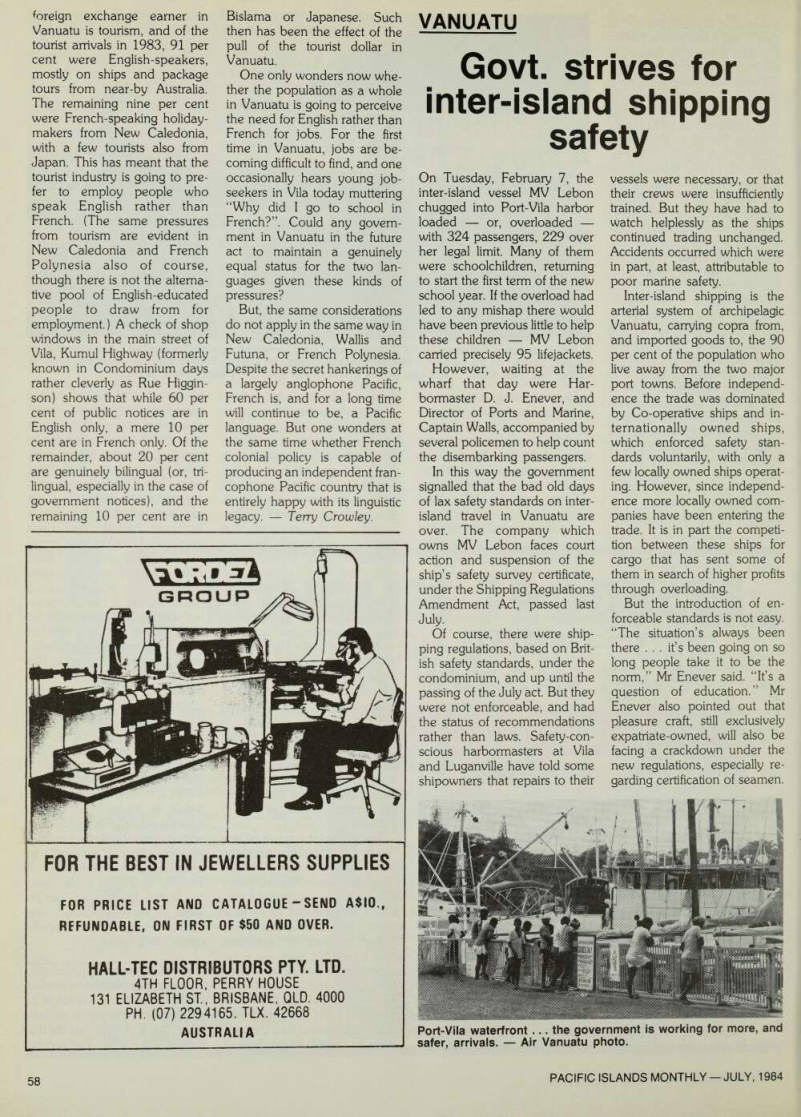
Port-Vila waterfront ... the government is working for more, and safer, arrivals. Air Vanuatu photo.
Under the new regulations, a system of spot checks will be instituted. Equipment, repairs and qualifications of the crew, as well as overloading, will all be inspected. The spot checks will be limited, as facilities and staff are only available at the two major ports, Vila and Luganville. It is possible that unscrupulous operators could still overload on trips between other islands.
Not all deficiencies can be rectified overnight. The training of the crew members, for inst ance, is taking place gradually at the Marine Training School (see PIM, January, 1984) where masters’ and engineers’ certificates are offered. Some ships have been granted temporary dispensation from the regulations, where experi enced but unqualified seamen have not yet been able to attend courses at the school.
In spite of the relatively gen tle implementation of govern ment policy, local shipowners are unhappy about the new stringency, which, as it cuts down on overloading and in sists on proper maintenance, will cut into profits. A press release from the local shipown ers’ organisation, announcing a rise in the Port-Vila-Santo passenger price from 2500vt to 3700vt (approximately $A25 to $A37), specifically named Mr Enever and the crackdown on overloading as causing the in crease.
However, this Shipping Reg ulation Amendment Act is itself only an interim measure, de signed to fill the gap until the introduction of the Merchant Shipping Act, now in prepara tion. Other measures planned to improve inter-island shipping are the building of medium-size wharves at island regional centre ports, a program of beaconing and reef-blasting to improve passages into rural harbors, marking of isolated reefs, further support for marine training, and the placing of lighthouses at strategic land marks.
The arterial system of inter island shipping is being main tained and upgraded not only for safety’s sake but for econo mic and socio-political reasons.
But . . . “Safety, that’s our big thing,” says Mr Enever, “And
it’s a full-time job.”.
Julie-
Ann Ellis in Port-VUa.