bring suicide rate down?
pp. 59-60 · Read in the full issue
Western Samoa
Does a “trickling up” idea bring suicide rate down?
DENNIS OLIVER, a former training officer with the YMCA in Western Samoa, writes on the dramatic decline in the country’s suicide rate over the past couple of years from a high point of 49 in 1981, to 35 in 1982, to only 20 last year. Mr Oliver was closely involved with the Suicide Study Group, a community body set up in mid-1981 in Western Samoa to tackle the problem, and has already contributed to RIM a progress report on its work (Nov ’B2 pl 5). He is also the author of a book on development strategies, Trickling Up (reviewed by Sandra Rennie in RIM Mar p 36). In the accompanying article he describes how certain key ideas outlined in this book were put into effect by the Suicide Study Group.
What were the facts uncovered by Western Samoa’s Suicide Study Group when it began its work in June 1981?
It found that suicides had increased from six in 1970 to 23 in 1976, and had reached a high point of 49 in 1981. It also found that 50 to 60 per cent of all suicides in the country were committed by young men from 15 to 24 years old.
This made the rate of suicide among young Samoan men 94 per 100,000 (figure adjusted in relation to actual numbers), three times higher than the highest figure published by the World Health Organisation in its annual statistics.
The group also found that the weedicide paraquat was the vehicle of death in 60 to 80 per cent of all cases, that in 40 per cent of all cases the apparent triggering event was a scolding by the victim’s parents, and that of the 360 villages in Samoa, 260 had not had a suicide in the previous 10 years, and that 50 per cent of all suicides had taken place in 19 villages.
One member of the Suicide Study Group disclosed the fact that in the four most suicide prone villages the ratio of matai (chiefs) to commoners was 1 to 1.6, whereas the national ratio of matai to commoners was 1 to 12 in 1981, and 1 to 24 in 1961.
It was decided to mount a public awareness campaign to bring the problem into the open for community debate, with the
following provisos; 1. There was to be no attempt to offer explanations as to the causes of the problem; 2. There was to be no attempt to offer solutions to it.
The public awareness cam
paign, conducted over a period of three weeks, including eight radio programs in both the Samoan and English lan guages, and 182 column inches of articles and reports in both languages in eight local news papers.
Not once in the course of all those words did any of the study group offer theories of explanation or remedy.
The question “What is caus ing it?” was constantly asked by newspaper reporters and radio interviewers, but the temptation to appear masterful and to “have the answers” was always resisted.
The belief which made the study group keep their ideas to themselves was that the energy created by worry about the
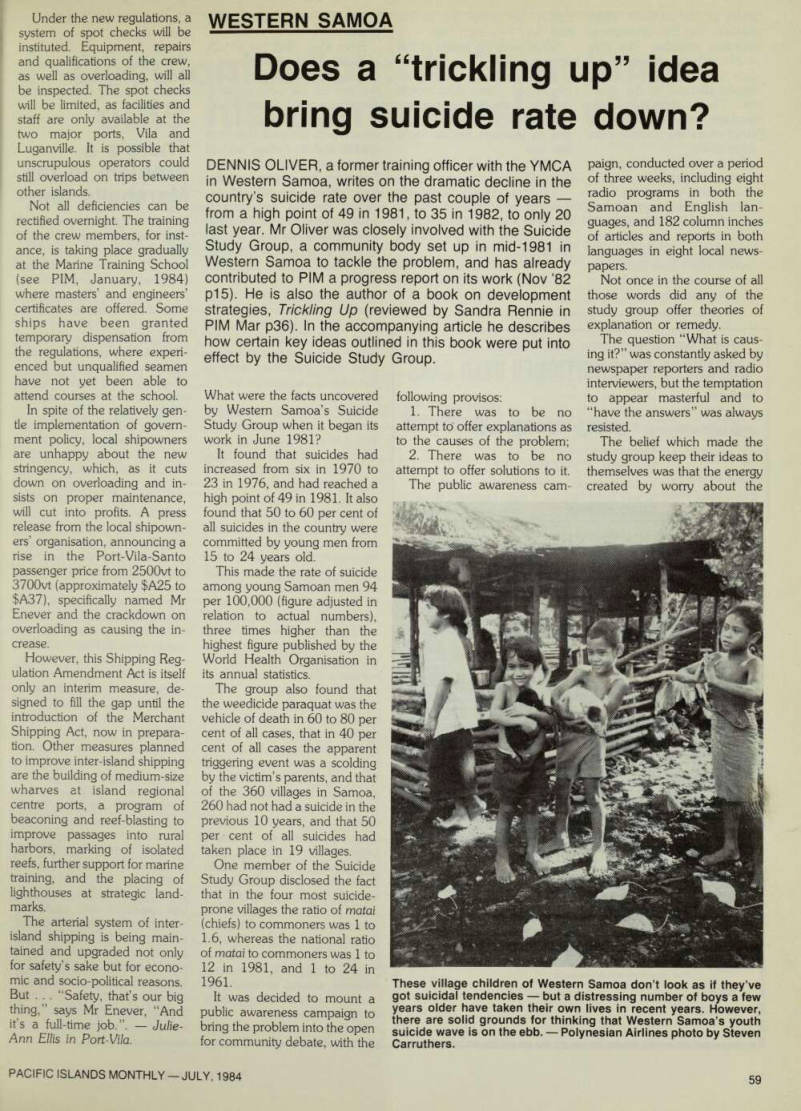
These village children of Western Samoa don’t look as if they’ve got suicidal tendencies but a distressing number of boys a few years older have taken their own lives in recent years. However, there are solid grounds for thinking that Western Samoa’s youth suicide wave is on the ebb. Polynesian Airlines photo by Steven Carruthers.
causes of the problem would translate itself into attempts to formulate remedies. The only people with the power to ex ecute remedies were the people directly affected by the prob lem. These included family members and village leaders in places where -the suicides were taking place.
Put another way, if the study group attempted to put up explanations, analysis and pre scriptions and the group had some expertise in psychiatry and sociology no matter how scientifically brilliant their theories might have been, they had no power over the lives of the village people which could
match the power the people had over their own lives.
What were the results of this strategy?
Dividing each year into blocks of three four-month periods, the pattern of number of suicides for 1981-83 inclu sive in Western Samoa looks like this: 1981: 1, 14; 2, 19; 3, 16.
Total 49. 1982: 1, 14; 2,6; 3, 15.
Total 35. (The second third of this year covered the period of the Suicide Study Group’s campaign.) 1983: 1, 12; 2,5; 3, 3. Total 20. (The second third of this year saw the introduction of a
YMCA community worker. See below.) From May 1983 the YMCA of Western Samoa employed a community worker who spent the rest of the year initiating discussions in 26 villages aimed at encouraging the people to wrestle with the local history of suicide and its causes, and to design remedies for the future.
Following the example of the study group, he did not ex pound theories or prescribe solutions. But nor did he allow simplistic theories to go unchal lenged, or let people get away with placing all the blame on others.
Most often the plans made were not written down with goals and deadlines. Nor is there any documentary evi dence to prove that the solu tions they prescribed were in fact directly responsible for the dramatic “cure”.
What is known is that sales of paraquat declined dramatically, and that in all likelihood para quat held in stock in the villages is now more carefully locked away than before.
It is worth noting that the study group strategy was based on two value positions outlined in my book Trickling Up A Strategy for Deulopment Where the People at the Bottom Matter Most (published by Lotu Pasifi ka Productions, and reviewed in PIM March 1984, p 36).
These were: “We believe that the community people know their problems and know the solutions that will work better than others know them. ” And: “We believe that the main actors that make the plan and work the action should be the people with the problem.”
If the Suicide Study Group had adopted a “Trickle Down” approach, they would have ap plied for a grant from W.H.O. which would in all probability have appointed an overseas expert or two in sociology and/ or psychiatry. The expert would have written several amazingly scientific papers to explain the subtle causation factors and the prescription of integrated multi disciplinary strategies required to “cure” the problem. But the people would not have been involved, except as spectators or reviewers of somebody else’s thought processes.
Perhaps one other value position described in Trickling
Up highlights the difference be tween the two strategies: “We believe that too much help is a bad thing, and that people should only be helped to be come more self-reliant.” De nnis Oliver.
There’s a
problem in the
Marshalls too
Suicide is the leading cause of death among Marshall Island males between the ages of 15 and 24, according to statistics compiled by a recent workshop on the subject About 80 per cent of the victims are unmar ried, most had jobs or were students. Their educational level also seemed reasonably high. About 90 per cent went at least to the sixth grade in school and 25 per cent finished high school.
About half the suicides gave some indication of their inten tion, and 20 per cent had at least one prior attempt on their records, the report said.
In 25 per cent of cases recorded since 1979 in the Marshall Islands, suicide victims had at least one family member or close friend who had also committed suicide. Almost all of them drank alcohol, but very few were found to have had a history of serious alcohol abuse.
Much more significant, said the report, were quarrels with elder members of the family or prob lems related to girl friends.
Speaking during the work shop Alfred Capelle said there was no word for suicide in Marshallese until the Japanese introduced the term ’’kilaba.”
Dr Neil Palafox agreed with other speakers that parental guidance in teenage years, and a careful adherence to family and cultural traditions, were important in preventing the sort of condition which led to suicide. Personality disorders leading to acute depression were blamed for many Marshal lese suicides and could be noticed by associates of poten tial victims through such signs as loss of appetite, refusal to talk, insomnia, or continual re ferences to going on a long trip.
All seemed to be disguised appeals for attention from those around the victim, said the speakers.