Pacific language
pp. 55-58 · Read in the full issue

tropicalities
The future of French as a Pacific language
Dr TERRY CROWLEY, co-ordinator of the University of the South Pacific’s languages centre in Port-Vila, exam ines the prospects of the French language in the Pacific of the future. While emphasising the credentials of French as a genuine Pacific lingua franca, he sees problems arising from the past failure of French colonial administra tions to develop French-medium tertiary education in the region.
To most Pacific Islanders, and to most Australians and New Zealanders also, it is easy to forget that English is not the only lingua franca of the Pacific.
The French have had a history of colonial interests in the Paci fic as long as the British and their Australian and New Zea land offshoots, and they have left their linguistic mark in the fact that today there are territor ies such as New Caledonia and French Polynesia that seem as indubitably and irreversibly francophone (or, French speaking) as Solomon Islands or Cook Islands are anglophone (or, English speaking).
To be sure though, the num ber of Pacific Islanders who can be reached through French is far smaller than the number of people who can be reached through English. The total population of New Caledonia, Wallis and Futuna, French Polynesia, and half of Vanuatu (more about that later) totals only 362,000, while the anglophone population of the Pacific totals more than four and a half million. This repre sents more than a twelve-fold difference in favor of English. In fact, French comes a rather distant third in the international language stakes in the Pacific when we consider Neo-Melane sian, which reaches probably more than two and a quarter million people in Papua New Guinea, Solomon Islands and Vanuatu that makes this language six times the size of French in terms of numbers of speakers in the Pacific.
English and French both have unquestioned status as world languages (which Neo- Melanesian does not). United Nations organisations such as WHO and UNESCO for exam ple, operate in both languages.
So too does the Pacific’s South Pacific Commission, which is tiny by comparison. It could be argued that the Pacific is too small to allow both languages to remain. The existence of two major world languages among so few people only serves to divide Pacific Island nations, whose challenges and problems are otherwise really rather simi lar. In fact, there is a dip lomatically unexpressed hope that seems to be evident in much of the anglophone Pacific that the French language (and the people who brought it) might simply “go away”. This hope has certainly been fuelled by a traditional Australian and New Zealand hostility to French colonialism in what they per ceive to be “their” areas of influence, and this hostility has produced a distinct antipathy towards the language. In Aus tralia, for instance, though French is the most widely taught second language, it is taught badly, and it is taught as a European language, rather than as a Pacific language (which it also undeniably is). (Though, to be fair, Radio Australia does broadcast for a short time each day to its francophone neighbors.) But, people should not forget the fact that French has as long a history as English in the Pacific, and if time alone were an indication, then both have an equal claim to status. The French language has become a Pacific language, and there are now even new Pacific varieties of French that have evolved differently from the French of France. A “vache” in New Caledonia is known as a “boulouk” (from English “bul lock”), and a “tiare” is a flower that nobody from France would recognise by that name. French has, in short, become “indige
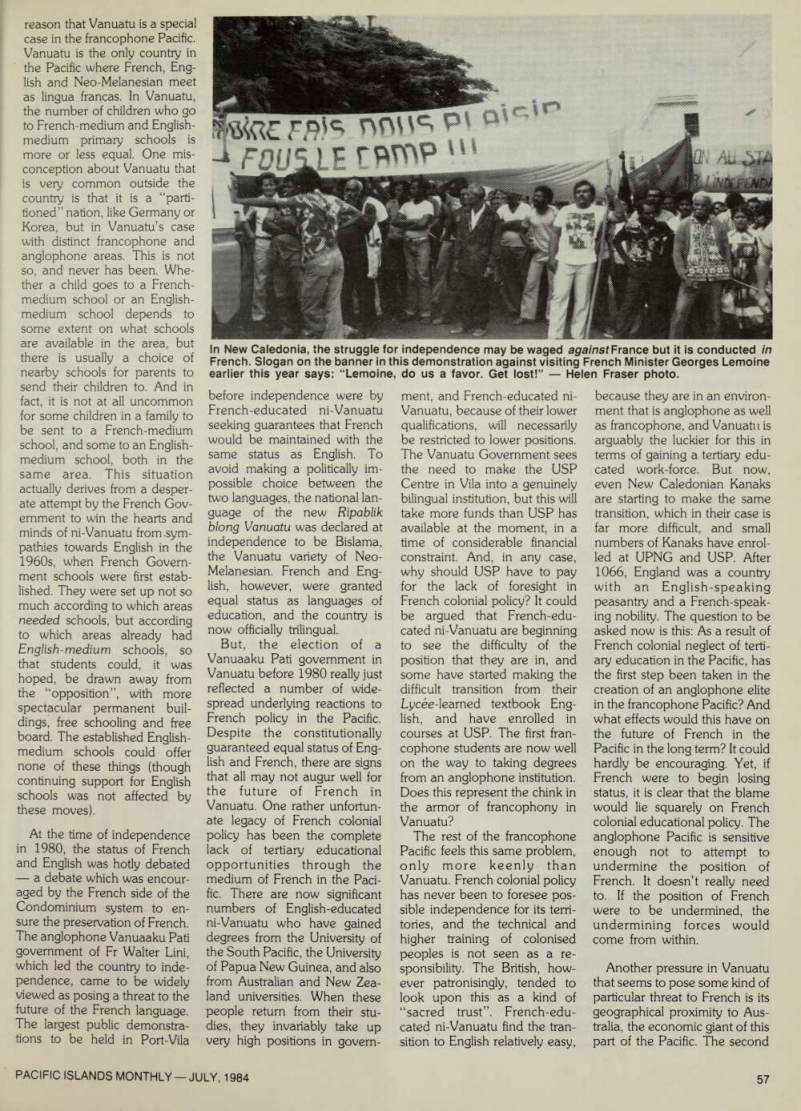
Port-Vila, June 25, 1977: the biggest demonstration in Vanuatu’s run-up to independence was in support of retaining the status of French. Nabanga photo, reproduced in Jeremy MacClancy’s To Kill a Bird with Two Stones.
nised”, just as English has, and is regarded as a genuine language of the Pacific, along with other recently introduced languages such as English, Neo- Melanesian and Fiji Hindi.
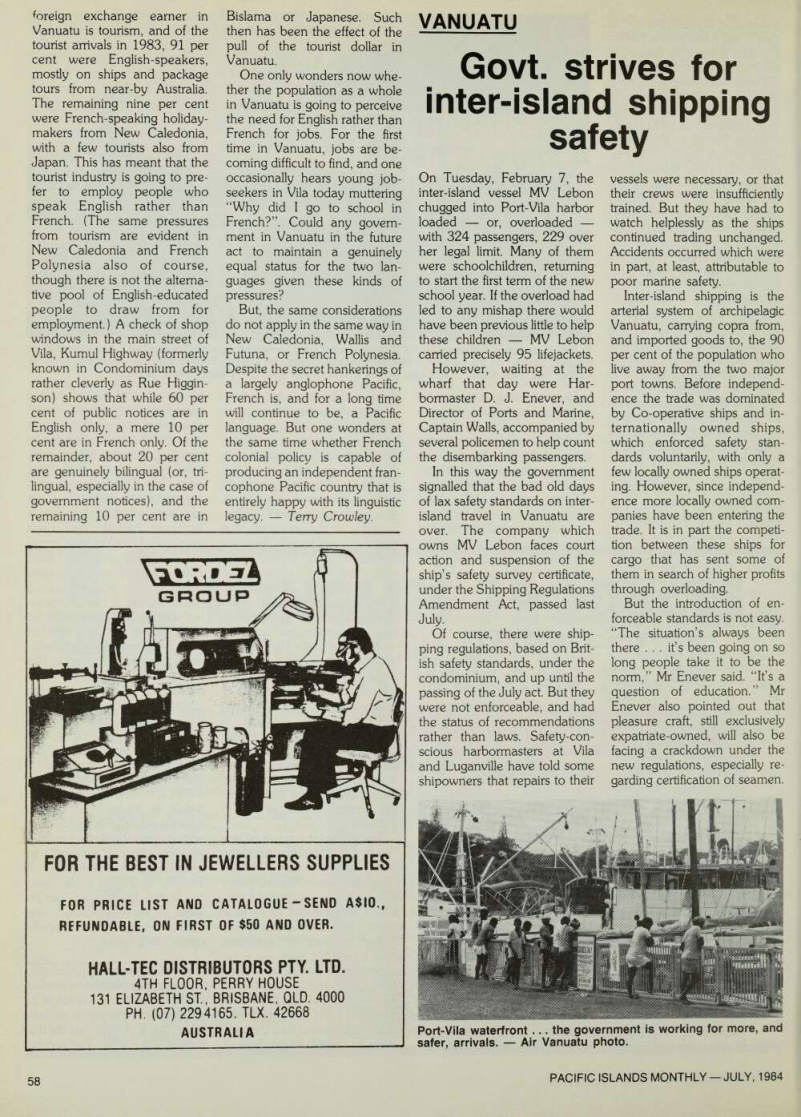
Just as the status of English has changed little vis-a-vis Pacific vernaculars after independence, so too could we expect to see little change in the status of French in relation to vemaculars in any French territory that might gain independence from France in the future. Despite the high level of hostility between Kanaks in New Caledonia and the ethnic European “Caldoches”, French is the only language that links the Melanesian speakers of the 28 indigenous Kanak languages. The struggle for independence is conducted against France, but in French. It is interesting to note that at the time that France annexed New Caledonia in 1853, a variety of Bislama was widely spoken, but this was quickly eliminated by French missionaries and replaced as a lingua franca with French. If Bislama had survived to the present (as it has in Vanuatu), then it is quite possible that
French would have had a much less certain future in New Cale donia than it does today, The situation in the Polyne sian territories of Wallis and Futuna and French Polynesia is somewhat different, in that there are practical indigenous alternatives to French. In tiny Wallis and Futuna, where the question of independence nev er seems to be raised, French policy has been to use French as the only language of educa tion (as is true also in the rest of the francophone Pacific). This has produced a younger gen eration that is quite fluent in French, though this is to the disquiet of some of the older people who see in this a danger to the future of the Wallisian language. The danger is not seen as the French language alone however. Colonial French educational policy has always been to teach French culture along with the language, and it seems that this policy has been quite successfully im plemented in Polynesia. The danger, therefore, is that French educational policy aims to produce French men and women, who happen to look
like Pacific Islanders. As a result of the disquiet that has been expressed about the success of this policy in Wallis and Futuna, there has been a resurgence recently in loyalty to the vernacular, and now, Wallisian has equal status with French on the local radio station, and Wallisian is taught as a subject in junior high school (though it is not used as a medium of instruction, even in primary school). Wallisians living in New Caledonia (who number rather more than their compatriots in Wallis and Futuna itself) have even started their own vernacu lar community newspaper. De spite this resurgence in vernacular pride, however, there is no questioning of the wider importance of French among Wallisians and Futu nans. It is seen as the only door to the outside world, and to money-earning jobs in an eco nomy that has become totally dependent on France.
In French Polynesia, French does not have the sole claim to lingua franca status in the terri tory. Apart from Tahitian, which claims about 100,000 speakers, there are six other
much smaller Polynesian lan guages spoken. Among Polyne sians who speak these seven different Polynesian languages, it is in fact Tahitian rather than French that is used as a lingua franca. There is considerable loyalty among Polynesians to Tahitian as a symbol of their Polynesian identity. A Tahitian Academy has been established, with the aim of developing the Tahitian language so that it will continue to be a useful means of communicating in the mod ern world. There is a distinct feeling among speakers of Tahi tian that their language should be kept “pure” of French borrowings, in much the same way as the French Academy in Paris battles against “impure”
English borrowings. As in Wallis and Futuna, however, Tahitians still see the learning of French in school as the only means of acquiring good jobs in town.
Just as with English in the remainder of the Pacific, money easily buys loyalty to an origin ally colonial language, and this is a loyalty that cannot easily be shaken off.
So far, I have ignored Vanuatu, and this is for the
reason that Vanuatu is a special case in the francophone Pacific.
Vanuatu is the only country in the Pacific where French, Eng lish and Neo-Melanesian meet as lingua francas. In Vanuatu, the number of children who go to French-medium and English medium primary schools is more or less equal. One mis conception about Vanuatu that is very common outside the country is that it is a “parti tioned” nation, like Germany or Korea, but in Vanuatu’s case with distinct francophone and anglophone areas. This is not so, and never has been. Whe ther a child goes to a French medium school or an English medium school depends to some extent on what schools are available in the area, but there is usually a choice of nearby schools for parents to send their children to. And in fact, it is not at all uncommon for some children in a family to be sent to a French-medium school, and some to an English medium school, both in the same area. This situation actually derives from a desper ate attempt by the French Gov ernment to win the hearts and minds of ni-Vanuatu from .sym pathies towards English in the 19605, when French Govern ment schools were first estab lished. They were set up not so much according to which areas needed schools, but according to which areas already had English-medium schools, so that students could, it was hoped, be drawn away from the “opposition”, with more spectacular permanent buil dings, free schooling and free board. The established English medium schools could offer none of these things (though continuing support for English schools was not affected by these moves).
At the time of independence in 1980, the status of French and English was hotly debated a debate which was encour aged by the French side of the Condominium system to en sure the preservation of French.
The anglophone Vanuaaku Pati government of Fr Walter Lini, which led the country to inde pendence, came to be widely viewed as posing a threat to the future of the French language.
The largest public demonstra tions to be held in Port-Vila
before independence were by French-educated ni-Vanuatu seeking guarantees that French would be maintained with the same status as English. To avoid making a politically im possible choice between the two languages, the national lan guage of the new Ripablik blong Vanuatu was declared at independence to be Bislama, the Vanuatu variety of Neo- Melanesian. French and Eng lish, however, were granted equal status as languages of education, and the country is now officially trilingual.
But, the election of a Vanuaaku Pati government in Vanuatu before 1980 really just reflected a number of wide spread underlying reactions to French policy in the Pacific.
Despite the constitutionally guaranteed equal status of Eng lish and French, there are signs that all may not augur well for the future of French in Vanuatu. One rather unfortun ate legacy of French colonial policy has been the complete lack of tertiary educational opportunities through the medium of French in the Paci fic. There are now significant numbers of English-educated ni-Vanuatu who have gained degrees from the University of the South Pacific, the University of Papua New Guinea, and also from Australian and New Zea land universities. When these people return from their stu dies, they invariably take up very high positions in govem
ment, and French-educated ni- Vanuatu, because of their lower qualifications, will necessarily be restricted to lower positions.
The Vanuatu Government sees the need to make the USP Centre in Vila into a genuinely bilingual institution, but this will take more funds than USP has available at the moment, in a time of considerable financial constraint. And, in any case, why should USP have to pay for the lack of foresight in French colonial policy? It could be argued that French-edu cated ni-Vanuatu are beginning to see the difficulty of the position that they are in, and some have started making the difficult transition from their Lycee-learned textbook Eng lish, and have enrolled in courses at USP. The first fran cophone students are now well on the way to taking degrees from an anglophone institution.
Does this represent the chink in the armor of francophony in Vanuatu?
The rest of the francophone Pacific feels this same problem, only more keenly than Vanuatu. French colonial policy has never been to foresee pos sible independence for its terri tories, and the technical and higher training of colonised peoples is not seen as a re sponsibility. The British, how ever patronisingly, tended to look upon this as a kind of “sacred trust”. French-edu cated ni-Vanuatu find the tran sition to English relatively easy,
because they are in an environ ment that is anglophone as well as francophone, and Vanuatu is arguably the luckier for this in terms of gaining a tertiary edu cated work-force. But now, even New Caledonian Kanaks are starting to make the same transition, which in their case is far more difficult, and small numbers of Kanaks have enrol led at UPNG and USF. After 1066, England was a country with an English-speaking peasantry and a French-speak ing nobility. The question to be asked now is this: Asa result of French colonial neglect of terti ary education in the Pacific, has the first step been taken in the creation of an anglophone elite in the francophone Pacific? And what effects would this have on the future of French in the Pacific in the long term? It could hardly be encouraging. Yet, if French were to begin losing status, it is clear that the blame would lie squarely on French colonial educational policy. The anglophone Pacific is sensitive enough not to attempt to undermine the position of French. It doesn’t really need to. If the position of French were to be undermined, the undermining forces would come from within.
Another pressure in Vanuatu that seems to pose some kind of particular threat to French is its geographical proximity to Aus tralia, the economic giant of this part of the Pacific. The second
In New Caledonia, the struggle for independence may be waged against France but it is conducted in French. Slogan on the banner in this demonstration against visiting French Minister Georges Lemoine earlier this year says: “Lemoine, do us a favor. Get lost!” Helen Fraser photo.
foreign exchange earner in Vanuatu is tourism, and of the tourist arrivals in 1983, 91 per cent were English-speakers, mostly on ships and package tours from near-by Australia.
The remaining nine per cent were French-speaking holiday makers from New Caledonia, with a few tourists also from Japan. This has meant that the tourist industry is going to pre fer to employ people who speak English rather than French. (The same pressures from tourism are evident in New Caledonia and French Polynesia also of course, though there is not the alterna tive pool of English-educated people to draw from for employment.) A check of shop windows in the main street of Vila, Kumul Highway (formerly known in Condominium days rather cleverly as Rue Higgin son) shows that while 60 per cent of public notices are in English only, a mere 10 per cent are in French only. Of the remainder, about 20 per cent are genuinely bilingual (or, tri lingual, especially in the case of government notices), and the remaining 10 per cent are in
Bislama or Japanese. Such then has been the effect of the pull of the tourist dollar in Vanuatu.
One only wonders now whe ther the population as a whole in Vanuatu is going to perceive the need for English rather than French for jobs. For the first time in Vanuatu, jobs are be coming difficult to find, and one occasionally hears young job seekers in Vila today muttering “Why did Igo to school in French?”. Could any govern ment in Vanuatu in the future act to maintain a genuinely equal status for the two lan guages given these kinds of pressures?
But, the same considerations do not apply in the same way in New Caledonia, Wallis and Futuna, or French Polynesia.
Despite the secret hankerings of a largely anglophone Pacific, French is, and for a long time will continue to be, a Pacific language. But one wonders at the same time whether French colonial policy is capable of producing an independent fran cophone Pacific country that is entirely happy with its linguistic
legacy.
Terry Crowley.