Transnational corporations
pp. 51-52 · Read in the full issue

in the islands context
Losing Control . . . Towards an Understanding of Trans national Corporations in the Pacific Islands context. By James E. Winkler, Published by Pacific Conference of Chur ches, Lotu Pasifika Produc tions, 1982, Suva, 82 pages.
This book addresses the central question of what impact are transnational corporations (TCs) having upon economic and political decisions in the Pacific and aims at stimulating further debate and understan ding of the problem.
Winkler argues that the world economic system, in which TCs are leading actors, threatens to get completely off the rails, bedevilled by recurring crises of one form or another e.g. shortage of a strategic raw material, hyper-inflation, high and rising rates of unemploy ment, inadequate foreign aid, and increasing impoverishment of the Third World.
International capitalism (no less than international social ism) shows no signs of respon ding to cries of developing countries for the creation of a new International Economic Order based on the principle of
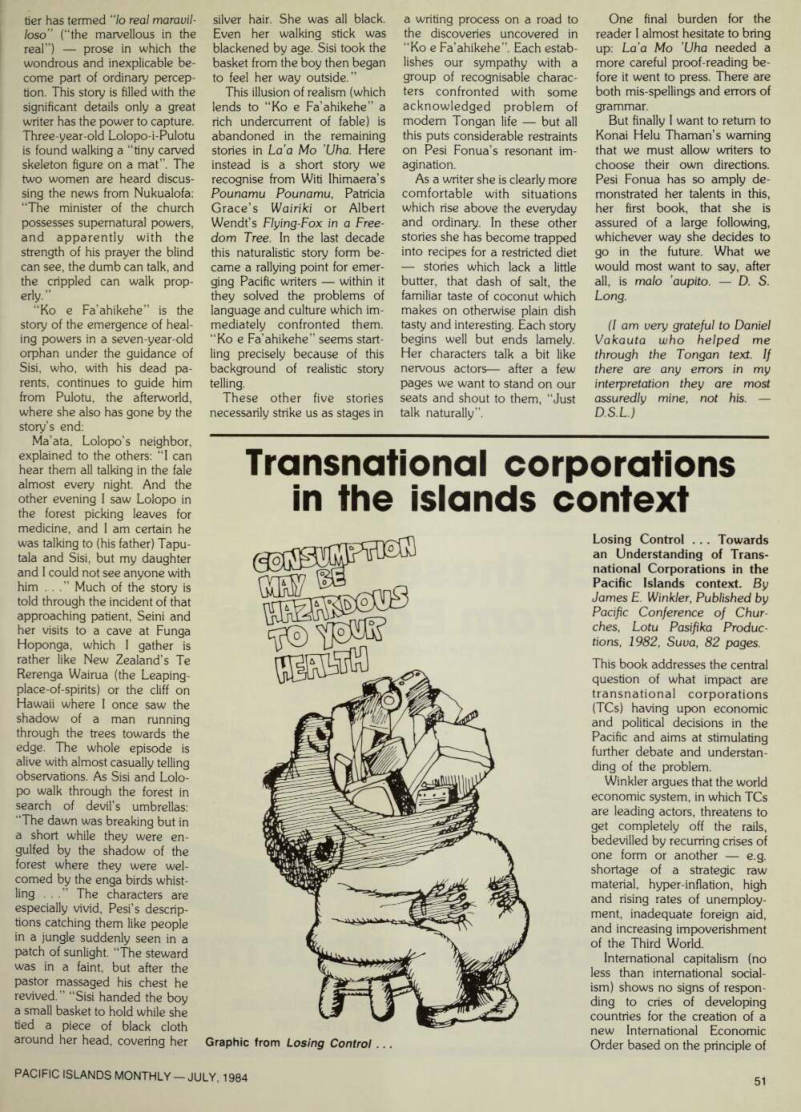
Graphic from Losing Control .. .
social justice. Pacific Island countries, many of which have only recently won political inde pendence, are losing control over the key aspects of their economic life under continuing pressure from the volatile and impersonal international eco nomy. There is little hope for them unless national leaders begin to open their eyes and re-examine some of the basic assumptions underlying current development policies and prog rams as part of a process of developing more appropriate formulas for development.
Such is the principal theme developed by Winkler in this small book which has the distinction of being the first book to come out devoted specifically to the subject of TCs in the South Pacific context.
The work is timely, for TCs and their impact on the region are receiving increasing attention from Pacific Island leaders who see in TCs a potential for promoting economic deve lopment on one hand, and a capacity for exploiting them on the other. Yet, as Bishop Jabez Bryce points out in the fore word. ”... many of us do not
quite understand the structure and complexity of this whole phenomenon” (i.e. TCs in the Pacific Islands). A ministerial round table conference recently held in Apia on the subject of TCs and the developing Pacific Island countries, organised by ESCAP and UNCTC, is evi dence of attempts to come to grips with such issues. (And it might be noted that the Pacific islands Development Program, East-West Center, Honolulu, is researching in this field under mandate from a group of Paci fic Island leaders.) Winkler deals with his subject in a lively, simple and popular style which makes for easy reading. A great deal of ground is covered both global and regional and his perspective is that of a concerned human being I was going to say “churchperson” troubled by the injustices and imperfections of the world economic system and their moral and humanita rian consequences. It is not, however, a balanced account of the subject. For example, Wink ler does not discuss the reasons why TCs have risen to such prominence over time, or
examine their positive contribu tions if any. The latter issue is touched upon in passing in only a single paragraph on page 21.
In Chapter 1 (there are only four chapters), Winkler deals with the TC as a modern phenomenon, focusing on the characteristics behind its rapid global expansion. These char acteristics are well-known, but two in particular are somewhat alarming: their important part in a larger global trend towards a greater concentration of wealth and power, and (prepare to go into a cold sweat!) their tenden cy to align themselves with local elites; politicians, civil servants, intellectuals, property owners, businessmen who see in TCs a powerful vehicle for promot ing their own positions and influence.
Hardly less disturbing is the claim that the position of TCs is constantly being reinforced by advertising and media flows and even foreign aid thus enabling them to extend their influence throughout the whole fabric of local societies. All part of “losing control” not only economically but socially, given the part they play in creating
such social ills as rapid urbanisation, crime, unemploy ment and disintegration of fam ily life.
Closer to home, Winkler, in Chapter 2, is concerned with the Pacific as an area of interest for the great powers econo mically, strategically and mili tarily and then discusses particular fields where TCs have been prominent. I found the sections on the two Pacific trading giants Burns Philp W. R. Carpenter of most interest, especially the outline of the way local subsidiaries of the former have recently been ac tive in extending their range of activities by takeovers. By vir tue of size and the diversity of services provided, these two companies are powerfully placed to influence all facets of island life.
The natural wealth of the South Pacific region is the sub ject of Chapter 3 wealth in form of on-shore mining., fisheries, forestries, tropical agriculture and seabed mine rals, and, on the darker side, as a “dumping ground for mediocre products as well as a nuclear and tourist playground”