books
pp. 49-51 · Read in the full issue
A Tongan short story writer’s talents amply demonstrated
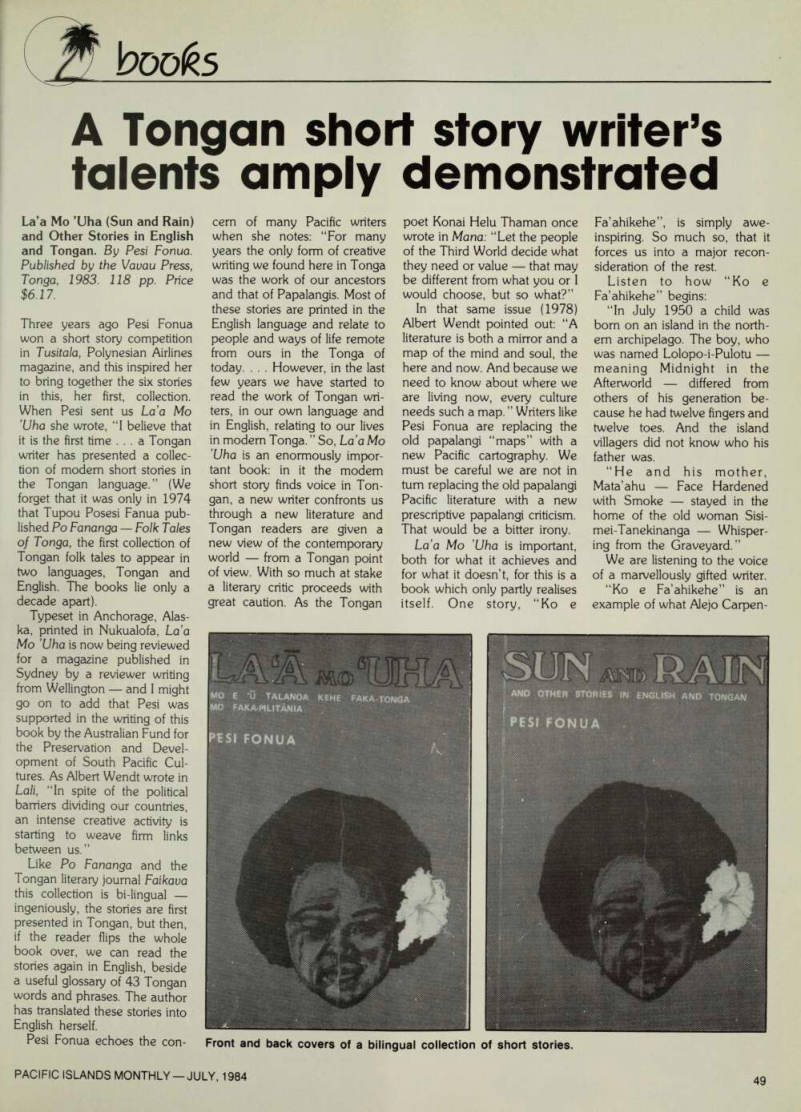
La’a Mo ’Uha (Sun and Rain) and Other Stories in English and Tongan. By Pesi Fonua.
Published by the Vauau Press, Tonga, 1983. 118 pp. Price $6.17.
Three years ago Pesi Fonua won a short story competition in Tusitala, Polynesian Airlines magazine, and this inspired her to bring together the six stories in this, her first, collection.
When Pesi sent us La’a Mo Vha she wrote, “I believe that it is the first time ... a Tongan writer has presented a collec tion of modem short stories in the Tongan language.” (We forget that it was only in 1974 that Tupou Posesi Fanua pub lished Po Fananga Folk Tales of Tonga, the first collection of Tongan folk tales to appear in two languages, Tongan and English. The books lie only a decade apart).
Typeset in Anchorage, Alas ka, printed in Nukualofa, La’a Mo Vha is now being reviewed for a magazine published in Sydney by a reviewer writing from Wellington and I might go on to add that Pesi was supported in the writing of this book by the Australian Fund for the Preservation and Devel opment of South Pacific Cul tures. As Albert Wendt wrote in Lali, “In spite of the political barriers dividing our countries, an intense creative activity is starting to weave firm links between us.”
Like Po Fananga and the Tongan literary journal Faikaua this collection is bi-lingual ingeniously, the stories are first presented in Tongan, but then, if the reader flips the whole book over, we can read the stories again in English, beside a useful glossary of 43 Tongan words and phrases. The author has translated these stories into English herself.
Pesi Fonua echoes the con
cern of many Pacific writers when she notes: “For many years the only form of creative writing we found here in Tonga was the work of our ancestors and that of Papalangis. Most of these stories are printed in the English language and relate to people and ways of life remote from ours in the Tonga of today. . . . However, in the last few years we have started to read the work of Tongan wri ters, in our own language and in English, relating to our lives in modem Tonga. ” So, La’a Mo ’Uha is an enormously impor tant book: in it the modem short story finds voice in Ton gan, a new writer confronts us through a new literature and Tongan readers are given a new view of the contemporary world from a Tongan point of view. With so much at stake a literary critic proceeds with great caution. As the Tongan
poet Konai Helu Thaman once wrote in Mana: “Let the people of the Third World decide what they need or value that may be different from what you or I would choose, but so what?”
In that same issue (1978) Albert Wendt pointed out: “A literature is both a mirror and a map of the mind and soul, the here and now. And because we need to know about where we are living now, every culture needs such a map. ” Writers like Pesi Fonua are replacing the old papalangi “maps” with a new Pacific cartography. We must be careful we are not in turn replacing the old papalangi Pacific literature with a new prescriptive papalangi criticism.
That would be a bitter irony.
La’a Mo Vha is important, both for what it achieves and for what it doesn’t, for this is a book which only partly realises itself. One story, “Ko e
Fa’ahikehe”, is simply awe inspiring. So much so, that it forces us into a major recon sideration of the rest.
Listen to how “Ko e Fa’ahikehe” begins: “In July 1950 a child was bom on an island in the north ern archipelago. The boy, who was named Lolopo-i-Pulotu meaning Midnight in the Afterworld differed from others of his generation be cause he had twelve fingers and twelve toes. And the island villagers did not know who his father was.
“He and his mother, Mata’ahu Face Hardened with Smoke stayed in the home of the old woman Sisi mei-Tanekinanga Whisper ing from the Graveyard.”
We are listening to the voice of a marvellously gifted writer.
“Ko e Fa’ahikehe” is an example of what Alejo Carpen-
Front and back covers of a bilingual collection of short stories.
tier has termed “/o real marauil loso” (“the marvellous in the real”) prose in which the wondrous and inexplicable be come part of ordinary percep tion. This story is filled with the significant details only a great writer has the power to capture.
Three-year-old Lolopo-i-Pulotu is found walking a “tiny carved skeleton figure on a mat”. The two women are heard discus sing the news from Nukualofa: “The minister of the church possesses supernatural powers, and apparently with the strength of his prayer the blind can see, the dumb can talk, and the crippled can walk prop erly.”
“Ko e Fa’ahikehe” is the story of the emergence of heal ing powers in a seven-year-old orphan under the guidance of Sisi, who, with his dead pa rents, continues to guide him from Fulotu, the afterworld, where she also has gone by the story’s end: Ma’ata, Lolopo’s neighbor, explained to the others; “I can hear them all talking in the fale almost every night. And the other evening I saw Lolopo in the forest picking leaves for medicine, and I am certain he was talking to (his father) Tapu tala and Sisi, but my daughter and I could not see anyone with him ...” Much of the story is told through the incident of that approaching patient, Seini and her visits to a cave at Funga Hoponga, which I gather is rather like New Zealand’s Te Rerenga Wairua (the Leaping place-of-spirits) or the cliff on Hawaii where I once saw the shadow of a man running through the trees towards the edge. The whole episode is alive with almost casually telling observations. As Sisi and Lolo po walk through the forest in search of devil’s umbrellas: “The dawn was breaking but in a short while they were en gulfed by the shadow of the forest where they were wel comed by the enga birds whist ling ...” The characters are especially vivid, Pesi’s descrip tions catching them like people in a jungle suddenly seen in a patch of sunlight. “The steward was in a faint, but after the pastor massaged his chest he revived.” “Sisi handed the boy a small basket to hold while she tied a piece of black cloth around her head, covering her
silver hair. She was all black.
Even her walking stick was blackened by age. Sisi took the basket from the boy then began to feel her way outside.”
This illusion of realism (which lends to “Ko e Fa’ahikehe” a rich undercurrent of fable) is abandoned in the remaining stories in La’a Mo ’Uha. Here instead is a short story we recognise from Witi Ihimaera’s Pounamu Pounamu, Patricia Grace’s Wairiki or Albert Wendt’s Flying-Fox in a Free dom Tree. In the last decade this naturalistic story form be came a rallying point for emer ging Pacific writers within it they solved the problems of language and culture which im mediately confronted them.
“Ko e Fa’ahikehe” seems start ling precisely because of this background of realistic story telling.
These other five stories necessarily strike us as stages in
a writing process on a road to the discoveries uncovered in “Ko e Fa’ahikehe”. Each estab lishes our sympathy with a group of recognisable charac ters confronted with some acknowledged problem of modem Tongan life but all this puts considerable restraints on Pesi Fonua’s resonant im agination.
Asa writer she is clearly more comfortable with situations which rise above the everyday and ordinary. In these other stories she has become trapped into recipes for a restricted diet stories which lack a little butter, that dash of salt, the familiar taste of coconut which makes on otherwise plain dish tasty and interesting. Each story begins well but ends lamely.
Her characters talk a bit like nervous actors— after a few pages we want to stand on our seats and shout to them, “Just talk naturally”.
One final burden for the reader I almost hesitate to bring up: La’a Mo ’Uha needed a more careful proof-reading be fore it went to press. There arc both mis-spellings and errors of grammar.
But finally I want to return to Konai Helu Thaman’s warning that we must allow writers to choose their own directions.
Pesi Fonua has so amply de monstrated her talents in this, her first book, that she is assured of a large following, whichever way she decides to go in the future. What we would most want to say, after
all, is malo ’aupito.
D. S.
Long.
(I am aery grateful to Daniel Vakauta who helped me through the Tongan text. If there are any errors in my interpretation they are most assuredly mine, not his. —