Trobriands — and the sweet
pp. 45-48 · Read in the full issue


sorrow of parting
ROBERTO PETTINI continues his “Melanesian Journey” by telling of the last days he and brother MARCO spent on Kiriwina Island in Papua New Guinea’s Trobriand group, and on the neighboring islands of Kawa and Sim-Sim.
May 7, 1981: We have just arrived at Kawa Island.
Talabubu tells us that we have been lucky because the wind was favorable the whole time. It sometimes takes as long as a week to reach his island from Kiriwina’s west coast. We had made the trip in three days.
It was a wonderful voyage, truly calm, relaxing and lazy. Of the three days we spent in the canoe, on the first we didn’t set off till lunchtime; on the second we left after breakfast but stop ped in the early afternoon; and this morning we left when the sun was well up and got here about four in the afternoon.
Both nights we slept on de serted islands in the middle of nowhere, one night lying on coconut palm leaves and the other on the sails. Out of the 10 canoes that left with us from the beach in Matawa, three today swung in to reach Sim-Sim island.
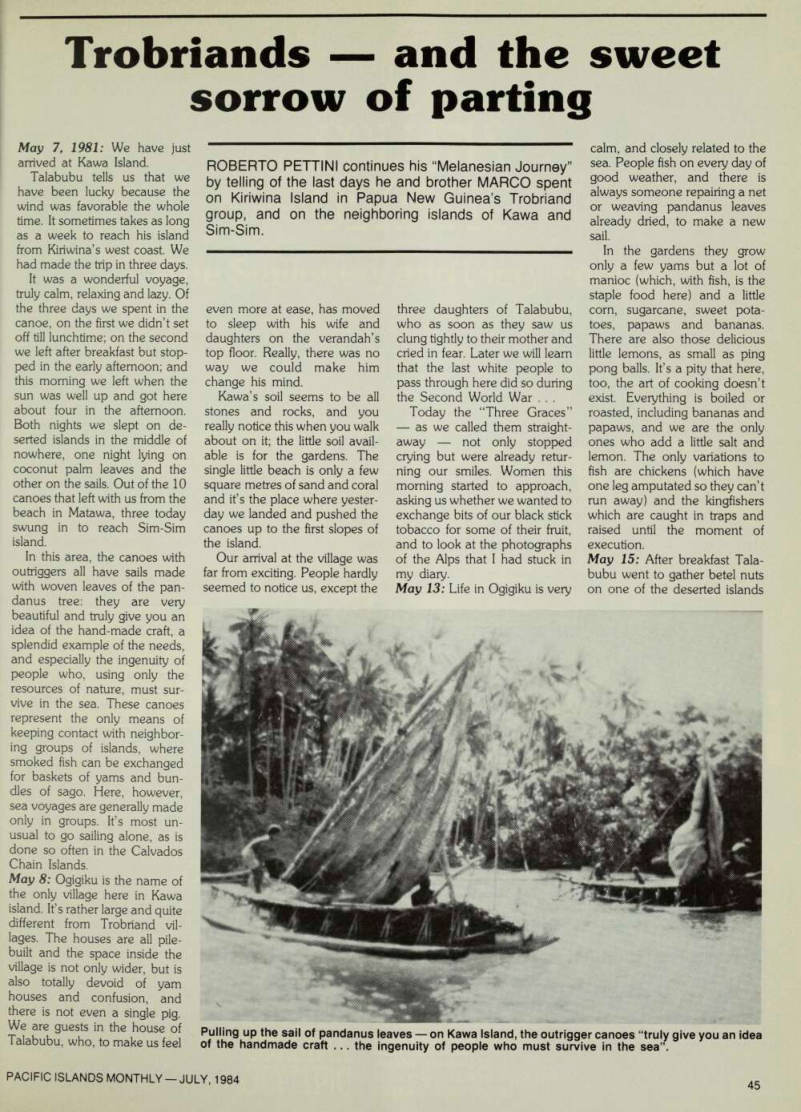
In this area, the canoes with outriggers all have sails made with woven leaves of the pan danus tree: they are very beautiful and truly give you an idea of the hand-made craft, a splendid example of the needs, and especially the ingenuity of people who, using only the resources of nature, must sur vive in the sea. These canoes represent the only means of keeping contact with neighbor ing groups of islands, where smoked fish can be exchanged for baskets of yams and bun dles of sago. Here, however, sea voyages are generally made only in groups. It’s most un usual to go sailing alone, as is done so often in the Calvados Chain Islands.
May 8: Ogigiku is the name of the only village here in Kawa island. It’s rather large and quite different from Trobriand vil lages. The houses are all pile built and the space inside the village is not only wider, but is also totally devoid of yam houses and confusion, and there is not even a single pig.
We are guests in the house of Talabubu, who, to make us feel
even more at ease, has moved to sleep with his wife and daughters on the verandah’s top floor. Really, there was no way we could make him change his mind.
Kawa’s soil seems to be all stones and rocks, and you really notice this when you walk about on it; the little soil avail able is for the gardens. The single little beach is only a few square metres of sand and coral and it’s the place where yester day we landed and pushed the canoes up to the first slopes of the island.
Our arrival at the village was far from exciting. People hardly seemed to notice us, except the
three daughters of Talabubu, who as soon as they saw us clung tightly to their mother and cried in fear. Later we will learn that the last white people to pass through here did so during the Second World War . . .
Today the “Three Graces” as we called them straight away not only stopped crying but were already retur ning our smiles. Women this morning started to approach, asking us whether we wanted to exchange bits of our black stick tobacco for some of their fruit, and to look at the photographs of the Alps that I had stuck in my diary.
May 13: Life in Ogigiku is very
calm, and closely related to the sea. People fish on every day of good weather, and there is always someone repairing a net or weaving pandanus leaves already dried, to make a new sail.
In the gardens they grow only a few yams but a lot of manioc (which, with fish, is the staple food here) and a little corn, sugarcane, sweet pota toes, papaws and bananas.
There are also those delicious little lemons, as small as ping pong balls. It’s a pity that here, too, the art of cooking doesn’t exist. Everything is boiled or roasted, including bananas and papaws, and we are the only ones who add a little salt and lemon. The only variations to fish are chickens (which have one leg amputated so they can’t run away) and the kingfishers which are caught in traps and raised until the moment of execution.
May 15: After breakfast Tala bubu went to gather betel nuts on one of the deserted islands
Pulling up the sail of pandanus leaves on Kawa Island, the outrigger canoes “truly give you an idea of the handmade craft ... the ingenuity of people who must survive in the sea”.
nearby, and we remained in the village. We strolled around and chatted here and there; then, with a group of children, we went for a wash in a little pool of rain water which you enter on tiptoe because it has a muddy bottom, hot and sticky.
Using half a coconut shell we rinsed and splashed each other, then it started to rain ... To us it has been something of a game, since soap doesn’t exist here, and wherever you sit or lie down you get dirty again.
Tonight we tried to teach Talabubu and hs nephew Moaidou to play cards, an exercise which caused a lot of laughs. Talabubu played with out understanding the rules or the logic of the game. He made funny faces but I don’t think he found it funny at all. Every time he had a Queen he said loudly that he had a “Mary” and he put it down and tried to pick up other cards ... On the other hand, what kind of Papuan would he be, to give away a “Mary” like that, without get ting something in return?
Tonight, too, at least one kilo of sugar went. As we were playing cards, mugs of scratch ed metal, cups made of coconut shells, of concave pieces of plastic, or empty cans, kept coming in empty and leaving full of piping hot tea. People
here are crazy for tea with sugar and, if we hadn’t stopped them, they would put more than four spoonfuls in every cup.
Every time a cup of tea went, Talabubu announced the name of the receiver, specifying brother, sister, father or mother according to the degree of relationship. Here, as everywhere in Melanesia, cousins are called brothers or sisters, all uncles and aunts are fathers and mothers, and the village tonight seemed to us like an enormous family, to which Marco and I are the only ones who don’t belong . . .
May 18: We are in Sim-Sim Island.
Weddings, exchanges of tobacco and nuts, the long chats between puffs of cigar ettes, so frequent among the villages in Kiriwina, take place here only between the people of Kawa and Sim-Sim. Today we are here for one of these exchanges.
The village is a little smaller than Ogigiku and instead of being on a promontory is almost at sea level, right behind a little stretch of beach and a few coconut palms. The total population is 95, as opposed to 115 in Kawa. It has the air of a place “lost in the water”, but rather than being fascinating, life here seems rather monoto nous.
From the stores of Kiriwina you see around the place a few pots, bits of calico, and pairs of wom-out shorts; someone has a primitive kerosene lamp.
Then there are the usual odd things: pieces of plastic and metal coming from God knows where and transformed into objects of local use. I saw a child, for example, going around wearing on his head half of a pilot’s radio ear phones, another playing with an old steering wheel from a car, several people wearing pieces of aluminium turned into bracelets; and here the net floats of Japanese fishing ves sels have a hole punched in them and are used as water containers.
May 22: Back in Ogigiku, I help Talabubu to scrape new panda nus leaves with a piece of pumice, then I accompany him and his wife Uagadi’ to their garden.
On the way “Tala” stops to show me the kind of leaves he uses when he fishes in the little coves on the island’s coast. To make me understand better he rips some and mashes them, showing me the juice that kills all the fish swimming within a certain radius from the point where he drops the leaves in the water. On the way both there and back, we again catch a glimpse of the big iguanas
living on this island. Just the time for a glimpse, and then we see them running off fast. They are not hunted here because nobody eats them, yet it’s their skin which makes the village drums.
As if I were a spoiled child, they prepared a seat of leaves for me, and wanted to leave me in peace and quiet chewing sugarcane while they gathered sweet potatoes and tapioca.
This time I was the one who wouldn’t be persuaded ... we returned to Ogigiku in single file, first Tala with the bush knives, then Uagadi’ with a basket of potatoes on her head, and finally me with several coconuts hanging from a stick across one shoulder. When we reached the village, Tala wanted to cross it slowly from one end to the other, to show everybody my share of the joint work. I wish it was always this easy to be made to feel so close At night, Ogigiku is lit up by a few small fires, a couple of cans filled with kerosene, and by the light of the moon which is now getting full. Tonight we danced around the slender tree that lives in the centre of the village.
There were not many of us. A few boys and girls, a couple of older people and several chil dren wearing crowns of long, narrow leaves on their heads.
Here people don’t play and dance as in Kiriwina. Instead of guitars, three drums are beaten with very few variations, the songs are one continuous monotonous ditty, and the “dance” a simple, unending walk around the tree.
May 25: Today there was a meeting of all the men in the village and it was decided to sail for Kula in about 10 days. They will go to the d’Entrecasteaux Islands, and Talabubu told us that if we want to go back to Kiriwina we must be ready to leave, or he won’t have the time to return to Kawa to go with them.
May 30: This time the trip lasted four days. The wind didn’t blow astern as it had on the way, and we had to change direction constantly to use whatever wind there was.
However, we had plenty of time to enjoy the trip and to stop whenever we liked. Tala bubu and his two nephews who had come with us didn’t lose
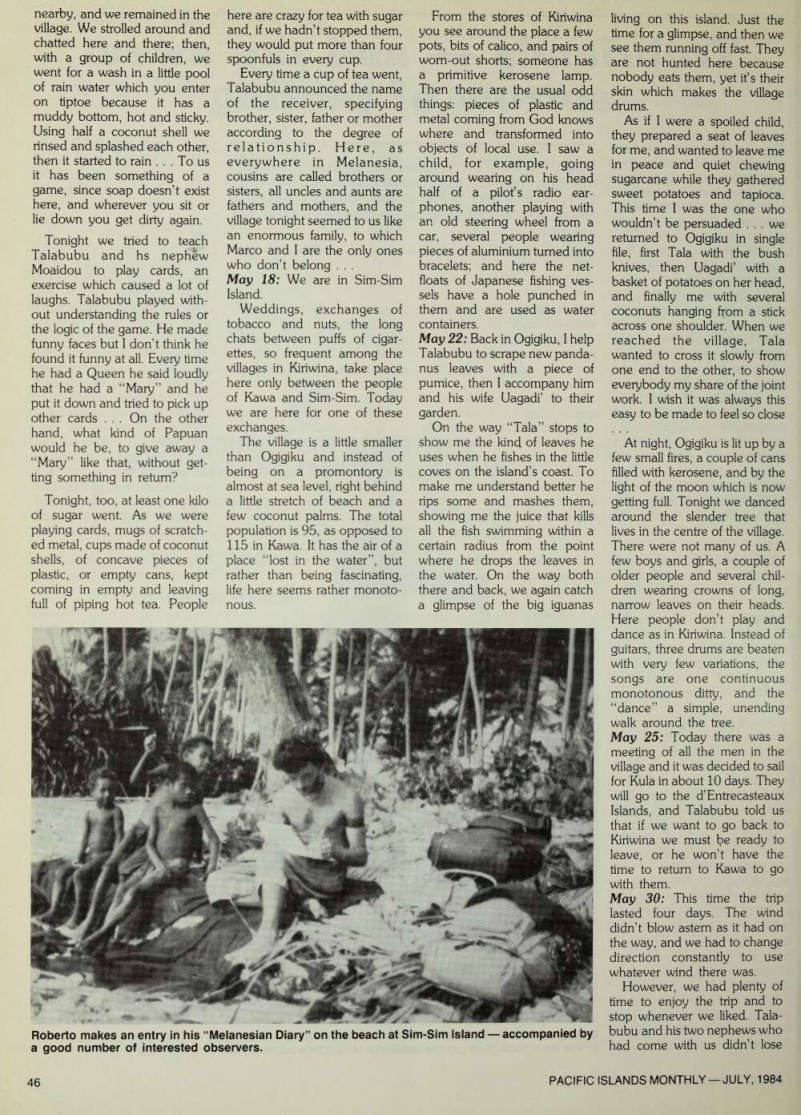
Roberto makes an entry in his “Melanesian Diary” on the beach at Sim-Sim Island accompanied by a good number of interested observers.
any chance to provide us all with food. When we stopped on a large rock covered only by grass and by birds, we saw them running and grabbing dozens of small eggs, and they cooked enormous omelettes on site. Dragging a line behind us, we were very lucky, too, with the fish. Needless to say, they often got cooked immediately on the canoe. One morning, as we were on a coral bank, Talabubu, sitting at the rudder, even managed to catch a lobs ter that was swimming past.
And we weren’t lacking for surprises; at one place in the middle of the sea the water was so shallow that we all had to get out and push the canoe walking for two hours in water that only came above our ank les. On this flooded coral reef, Talabubu took us to see the rusty wreck of an American four-engine plane from the Second World War. Before saying good-bye and separat ing, before we went on our way to Morobubuna’s village, Tala bubu took us aside and gave each of us a little bottle of magic fluid. “Spread just one drop on
a betel nut and give it to the girl you want to fall in love with you: she won’t be able to resist ... I keep using mine every time I go away from Ogigiku.”
We were really moved: our friend Tala had given us the most precious thing he had . . .
We wanted to surprise Obu labula by our sudden return and we succeeded. In a flash we found ourselves among lots of shouting, among so many hands, and once again covered by flowers.
It was very beautiful beautiful again to be among people who like to laugh, to joke and to have you with them. For the rest of the day, and for a few more days after that, we did nothing but answer the same questions: how many “vivilas” (girls) are there in Kawa and Sim-Sim, how are they, and did we sleep “under the same mosquito net” with them? It seemed as if everbody was asking us, including the women, the old people and the children.
Life in Obulabula is very pleasant again, but after being there for three more weeks we
again feel the urge to move on.
It’s funny, but at a certain point you realise that you don’t have any valid reason to stay on, unless you want to become somehow an active part of a system to which you’ll never really be able to belong. We truly don’t want to spoil our Trobriand story the first that has magically made us feel like children again, giving us the chance to enjoy this care-free part of ourselves, with no con tradiction with the fact that we are in reality young men.
June 19: Yesterday the news that we are leaving on Monday spread like wildfire, generating a procession of people coming to ask if it was really true, and to show their sadness with many “sorrys ...” and by rubbing their eyes.
Morobubuna went especially to get an extra ration of yams to cook the “mona”, the food traditionally prepared especially for this kind of occasion, when someone leaves the island, vil lage and relatives . . .
June 21: Our departure was another excuse for a big gather ing. A good part of Obulabula’s
population this morning came with us to the landing strip. For the last time we were covered with flowers; in our hair, tucked into the bracelets on our wrists.
Then, under the burning sun, we wait for the plane to arrive, all together, chewing the last betel nuts, and passing cigar ettes from one mouth to the other, as we’ve been doing all the time during the last three months . . .
This time it’s hard to be leaving, more so than we could possibly have imagined. Isoba has tears in her eyes, she wants us to sit next to her. “Martin has gone away and now you go too . . . will I see you again?” Then suddenly everybody stands up excitedly. Up there in the sky a small dot is getting steadily larger and noisier. There are a few quick glances, the last half words, then we find ourselves with seat belts fastened.
Everybody in the plane seems to be looking at us in surprise . . Our kalekos and our painted faces already seem out of place . . .
Next month: Tasman Islands.