NZ: “Blessed by nature, deeply
pp. 53-66 · Read in the full issue


divided by human nature”
New Zealand and the Pacific.
Edited by Roderic Alley. Pub lished by Westview Press Inc., 550 Central Avenue, Boulder, Colorado 80301, USA. 421 pages. ISBN 0 86531 929 4.
English price 18.75 sterling.
This book is a pleasing attempt to tackle a subject ambitious in its scope New Zealand, its relations with the Pacific and the world. “In its design,” the introduction states, “this book was based on an assumption that ... in order to know how the countries of the Pacific relate to one another, it is necessary to know what each is like. Yet equally important, in order to know what these coun tries are like, it is necessary to know how they relate.”
The first third of the volume is devoted to a reasonably comprehensive assessment of one individual country, New Zealand. Then, as a painter adds color by color to his canvas, the picture is built up to include the South Pacific, and
finally, beyond that, the wider Pacific setting.
Of the 12 contributors to the book (Roderic Alley is the edi tor) no fewer than six are
lecturers at Victoria University in Wellington, so an expert assessment of New Zealand is assured. Bearing in mind read ers who are not well acquainted with the country (what a
pleasant feature for a scholarly volume!), much essential back ground is offered on social structure, population, the eco nomy, politics and energy re sources. Unfortunately much of the statistical information is from 1971, which undercuts the sense of up-to-dateness the authors wish to convey.
One enigma, say the authors, is the ambiguity in New Zealand life: the dream of self-employ ment, and other attitudes, in a people “who might, according to certain indices, be readily identified as working class”; the separation of people according to status, privilege and income “in a society which debates the issue of equality with fervor". A picture emerges of a nation richly blessed by nature, and deeply divided by human na ture. The problems New Zea land faces have certainly not been all of her own making.
The 1974 OPEC price jump and the strains imposed on exports by Britain joining the EEC are just two of the most important external factors. But an increasing number of New Zealanders, it is claimed, now see the major source of their country’s weak economic performance as internal and therefore potentially controll able.
Some interesting perspec tives are offered on the political situation. “As an entirely pragmatic, non-doctrinaire party. National has stayed un burdened of any ideological encumbrance curbing its facility to shift ground, change policies or meet the new circumstances and challenges arising in gov ernment or on the hustings.”
The response to problems from the political executive has “lacked coherence, being in creasingly preoccupied with short-term crisis management”.
Valuable as is the back ground offered by the book’s opening chapters, the picture takes more colorful shape as the focus enlarges to foreign policy. The changing perspec tives of New Zealand’s view of the world are traced. This “re luctant nation”, bound by his tory to a distant European mother, has slowly come to recognise that the best con tribution it can make to the strength of the Western world is by helping to preserve peace and security in the Pacific.
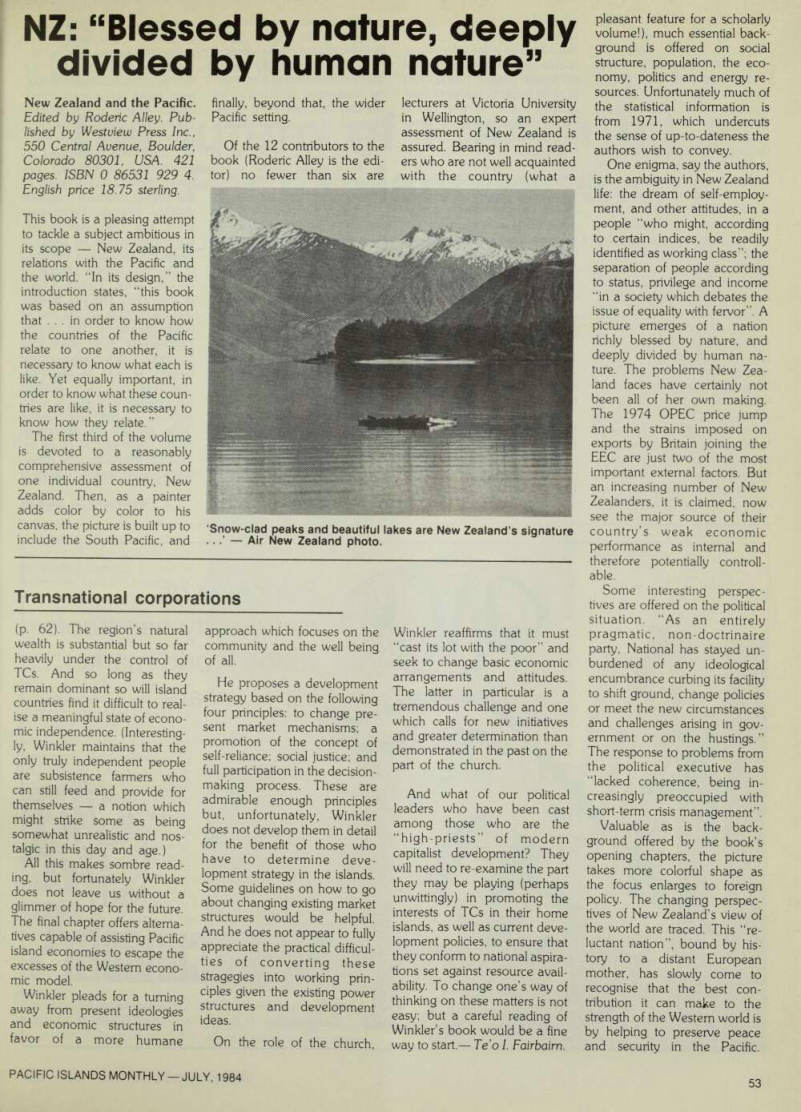
Snow-clad peaks and beautiful lakes are New Zealand’s signature .. .'— Air New Zealand photo.
Under Norman Kirk’s leader ship, “a conscious effort was made to improve New Zea land’s relations with its South Pacific neighbors. Kirk helped foster a new New Zealand identity as a Pacific Island state.” The National Party, hard-headed realists though they are (“Foreign policy is trade,” Muldoon has said), have broadly continued this trend. Furthermore, the grow ing Polynesian nature of New Zealand society provides both a severe test and an exciting opportunity: “If New Zealan ders cannot live in harmony at home, their country is unlikely to develop harmonious rela tions with the rest of the world. ”
New Zealand has found a new assertiveness which “need not be belligerent . . . New Zealand’s stature abroad can be enhanced by the assertion of an independent voice in world affairs.” Her Pacific identity is acceptable and comprehensible to the international community, as well as something with which all New Zealanders can identify.
The second third of the book deals with New Zealand’s rela
tions with the South Pacific. A sketch of the background of New Zealand rule in the region (a rule characterised by periods of “benign neglect”) leads swift ly to an in-depth survey of New Zealand’s role in the 1980 s.
Concentration is given to deve lopment assistance (60 per cent is allocated to the South Paci fic); the issue of nuclear weapons; migration; the law of the Sea; economic deve lopment and resource manage ment; trade and transport; de colonisation; and regional co operation. A whole chapter is devoted to organisations and issues in South Pacific regional ism, an admirable hitch-hiker’s guide to the galaxy of the region’s 10 main organisations.
The economies of scale vital to economic development are emphasised as the primary rationale for regional co-opera tion.
The role of the South Pacific Commission (SPC) as “a non political organisation” is en couraged. But, “despite its apparent robust health”, organ ised regionalism is not without substantial stresses. “The unit
ing effect of decolonisation may not survive the 1980 s as the basis for regional camaraderie. ”
The goal of economic deve lopment is providing a substan tial alternative motivation for working together. The deve lopment of the South Pacific Bureau for Economic Co operation (SPEC) is detailed in an illuminating chapter which covers the chief economic issues in the region.
There is the constant dilem ma of weighing a cost, in monetary terms, against a benefit which may not be quantifiable. Visions become replaced with “concern for secondary or peripheral issues”. Developments in the global arena dictate that the Pacific must “learn to ‘sprint’ before it can ‘walk’.” The re gion has “its share of experts who forget that ... the aspira tions and destiny of the region are not theirs”. And, the writer asserts, “further progress re quires that one fundamental question be answered with commitment: What is the de stiny of the peoples'and there fore countries of this region?”
New Zealand’s development assistance to the Pacific (and the quality versus quantity de bate) gets lengthy treatment. So too, as wider international rela tions come centre stage in the book’s closing chapters, does the Pacific’s links with the Euro pean Community. Lome I and II (“they have established an exemplary relationship be tween the EC and a group of developing countries”) receive detailed analysis. Pacific-wide trade and inter-relations are scrutinised, nation by nation. It all makes stimulating reading.
The penultimate chapter is devoted to the “Politics of Paci fic Security”. The lack of ade quate resources on the part of individual nations, and general vulnerability, make some kind of common defence agreement needful as well as desirable.
“Australia and New Zealand have sought (not without some despair) to steer the United States towards the recognition of the permanence of its in terests in the Pacific. The Amer icans have been unwilling
continued on page 66
pupils, in part because of an historic ambivalence towards paricipation in international activities which continues to influence both public and poli cy-maker alike. ” The imbalance of the ANZUS relationship and of that between Australia and New Zealand (“unavoid ably unequal”) adds to the strain imposed on the search for adequate co-operation in the field of security. America sees Micronesia as more important strategically than the South Pacific. “Unresolved doubts about the wisdom of reliance upon the American nuclear umbrella” will be increased dur ing the 1980 s by “an intensify ing concern amongst Pacific Islanders over the environmen tal and social consequences of nuclear programs more gener ally”. Furthermore, suggests the author, the most important security problems faced by the new states of the Pacific may be internal. But whatever differ ences there may be in their relationships with each other and on other issues, “over questions threatening the health, peace and security of the Pacific region these nations may be expected to work to gether in increasingly vocal ways”.
The final chapter, which completes the survey of in ternational relationships, is re ndered in parts almost incom prehensible by the liberal use of jargon, from which the rest of the book is mercifully free. (Who really understands the meaning of this: “A change in regime locale normally involves a different matrix of internatio nal interaction”?) But helpful angles are added by the high lighting of Japan’s growing might and the entry of China onto the Pacific stage. Japan’s ambitious proposal for an Asian/Pacific Community (a variation of Ratu Mara’s “Paci fic Way” concept?) is also dis cussed.
For those interested in the Pacific, this is an admirable book which can be highly re commended. It achieves its goal of giving a broad picture of the interlocking relationships in the region in a way which is re markably readable for a book
of this depth. The authors strive to remain objective and broadly speaking they succeed. The text is accompanied by a good number of maps. There are 30 pages of appendices full of invaluable statistical informa tion, and a remarkable bib liography running to 34 pages.
The authors are united in the conviction that New Zealand has a vital role to play in the Pacific region, a role which “stems from the totality of its economic and political relations with the countries of the region, from its expanding resource base, and from its close and well-established links within the Southwest Pacific and Aus tralia”.
This volume offers much hope for the future. There are hard decisions to be made, but the possibilities are enormous.
As in most things, it all comes down in the end to the quality of people’s lives, aims and motives. One is reminded of an old Tongan proverb; “Ke me tatau ho ngutu mo ho tuhu” (“If only our hands were as efficient as our mouths”).
Edward Peters.
Books received
Mau: Samoa’s Struggle Against New Zealand Oppression By Michael J. Field. Published 1984 by A, H. & A. W. Reed Ltd.. 68-74 Kingsford Smith Street. Wellington 3.
New Zealand. ISBN 0 589 01492 7.
Price $NZ19.95.
Factors Affecting Standards in Community Schools: A New Ireland Case Study. Educational Research Unit Report No. 46.
By Ephraim T. Apelis. Published 1984 by the Educational Research Unit. Uni versity of PNG, Box 320, University PO, NCD. Papua New Guinea. ISSN 0254 069 X. Price K 2.75.
In the Land of Strangers: A Century of European Contact with Tanna, 1774-1874.
By Ron Adams. Published 1984 by the Development Studies Centre. Australian National University. Distributed by ANU Press. PO Box 4. Canberra. Australia.
ISBN 0 86784 425 6. Price $12.00.
Melanesia: Beyond Diversity.
Volumes 1 & 2.
Edited by R. J. May and Hank Nelson.
Published 1982 by the Research School of Pacific Studies. Australian National University. PO Box 4, Canberra, Austra lia. ISBN 0 86784 045 5. Price $lO per volume.
Timor: A People Betrayed.
By James Dunn. Published 1983 by The Jacaranda Press. 65 Park Road, Milton.
Qld. 4064. ISBN 0 7016 1715 2. Price $15.95.