‘Melisa’, PNG’s
p. 41 · Read in the full issue
valued gift from the EEC
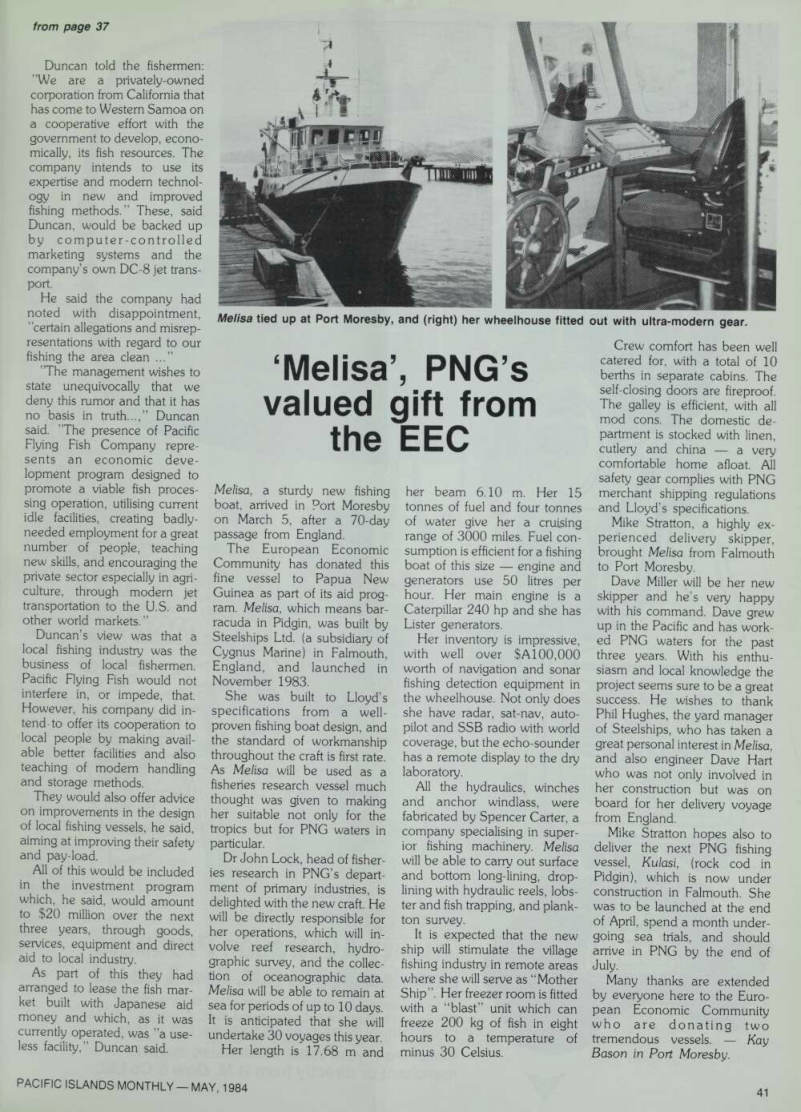
Melisa, a sturdy new fishing boat, arrived in Port Moresby on March 5, after a 70-day passage from England.
The European Economic Community has donated this fine vessel to Papua New Guinea as part of its aid program. Melisa, which means barracuda in Pidgin, was built by Steelships Ltd. (a subsidiary of Cygnus Marine) in Falmouth, England, and launched in November 1983.
She was built to Lloyd’s specifications from a wellproven fishing boat design, and the standard of workmanship throughout the craft is first rate, As Melisa will be used as a fisheries research vessel much thought was given to making her suitable not only for the tropics but for PNG waters in particular.
Dr John Lock, head of fisheries research in PNG’s department of primary industries, is delighted with the new craft. He will be directly responsible for her operations, which will involve reef research, hydrographic survey, and the collection of oceanographic data, Melisa will be able to remain at sea for periods of up to 10 days.
It is anticipated that she will undertake 30 voyages this year, Her length is 17.68 m and
her beam 6.10 m. Her 15 tonnes of fuel and four tonnes of water give her a cruising range of 3000 miles. Fuel con sumption is efficient for a fishing boat of this size engine and generators use 50 litres per hour. Her main engine is a Caterpillar 240 hp and she has Lister generators.
Her inventory is impressive, with well over SAIOO,OOO worth of navigation and sonar fishing detection equipment in the wheelhouse. Not only does she have radar, sat-nav, auto pilot and SSB radio with world coverage, but the echo-sounder has a remote display to the dry
laboratory.
All the hydraulics, winches and anchor windlass, were fabricated by Spencer Carter, a company specialising in super ior fishing machinery. Melisa will be able to carry out surface and bottom long-lining, drop lining with hydraulic reels, lobs ter and fish trapping, and plank ton survey.
It is expected that the new ship will stimulate the village fishing industry in remote areas where she will serve as “Mother Ship”. Her freezer room is fitted with a “blast” unit which can freeze 200 kg of fish in eight hours to a temperature of minus 30 Celsius.
Crew comfort has been well catered for, with a total of 10 berths in separate cabins. The self-closing doors are fireproof.
The galley is efficient, with all mod cons. The domestic de partment is stocked with linen, cutlery and china a very comfortable home afloat. All safety gear complies with PNG merchant shipping regulations and Lloyd’s specifications.
Mike Stratton, a highly ex perienced delivery skipper, brought Melisa from Falmouth to Port Moresby.
Dave Miller will be her new skipper and he’s very happy with his command. Dave grew up in the Pacific and has work ed PNG waters for the past three years. With his enthu siasm and local knowledge the project seems sure to be a great success. He wishes to thank Phil Hughes, the yard manager of Steelships, who has taken a great personal interest in Melisa, and also engineer Dave Hart who was not only involved in her construction but was on board for her delivery voyage
from England.
Mike Stratton hopes also to deliver the next PNG fishing vessel, Kulasi, (rock cod in Pidgin), which is now under construction in Falmouth. She was to be launched at the end of April, spend a month under going sea trials, and should arrive in PNG by the end of July.
Many thanks are extended by everyone here to the Euro pean Economic Community who are donating two
tremendous vessels.
Kay
Bason in Port Moresby.
Melisa tied up at Port Moresby, and (right) her wheelhouse fitted out with ultra-modern gear.