SUKUNA: “Only a couple
pp. 43-44 · Read in the full issue

books
SUKUNA: “Only a couple of rungs below God”
Fiji: The Three Legged Stool Selected Writings of Ratu Sir Lala Sukuna. Edited by Deryck Scan. Published by Macmillan Education, Lon don, 1983. ISBN O 333 34053. Price SFIS.
This volume is a sequel to Ratu Sukuna: Soldier, Statesman, Man of Two Worlds which was reviewed in the August, 1982, issue of PIM. Both are the work of Dr Deryck Scarr, senior fellow in Pacific history at the Australian National University, and were undertaken at the request of the Ratu Sir Lala Sukuna Biography Committee in Suva. The latter is to be commended for sponsoring and Dr Scarr for editing such a representative selection, and students of place and period will be grateful.
It must also be appreciated that a whole generation of young Fijians has grown up since Ratu Sukuna died and many more are still at school being taught, in the course of their studies, that language over which he attained the mastery demonstrated between the cov ers of this book. It is unfortu nate that the age group in Fiji most in need of access to the latter is the least likely to be able to afford it which poses a distribution problem for the biography committee.
It would be a work of super erogation to go over biograph ical ground already covered by the review of the first volume.
However, for the benefit of readers of this magazine who may have little or no back ground knowledge of the sub ject, Ratu Sukuna’s lifespan (1888-1958) was wholly cover ed by the colonial period in Fiji’s history. Within the limit ations thus imposed he achiev ed a position of authority throughout the islands unrival
led by any Fijian before him.
His chiefly pedigree and service record are given in the in troductory pages of the book.
Though relevant, they cannot fully explain a unique personal ity that impressed itself on colo
nial Fiji and the hearts and minds of his fellow countrymen to quote the editor, he was “only a couple of rungs below God”. In addition to all that, he had an outstanding facility of expression.
The selected writings com mence with Ratu Sukuna’s 1950 report as Talai ni Kouana (literally governor’s delegate), or secretary for Fijian affairs.
Taking a mid-century stance, it surveys the previous 50 years and their effect on the Fijian people. At the same time it serves to introduce the man and something of his philoso phy. In the subsequent pages there is inevitably a preponder ance of official reports and quotes from Hansard, for they are automatically archive material. However an eight year stint as district commis sioner Lau enabled him to develop the routine monthly diary into a literary form, illu mined with shafts of wit and humor, as well as an oblique means (since they were read at the highest level) of transmitting his views. It is surprising also how many personal letters have come to light, adding spice to the whole.
The contents, ranging in date from 1908 to 1958, amount to over 500 pages and only a brief sampling can be attempted here. Of considerable interest to most readers will be the young Oxonian’s experiences in the French Foreign Legion during World War 1. By way of con trast, not long after his return, he submits a revealing memor andum on the charismatic founder of the Viti Company, Apolosi Nawai, whose activities greatly exercised the Fiji gov ernment of the day. A 1928 speech (his own translation) to the Vunivalu and Chiefs of Bau on the thorny problem of their land grants is also notable, bearing in mirtd the circumst ances of Ratu Sukuna’s family history. He, whose father and grandfather had been the losers in that island’s feuds, approached his task “with many misgivings and with re
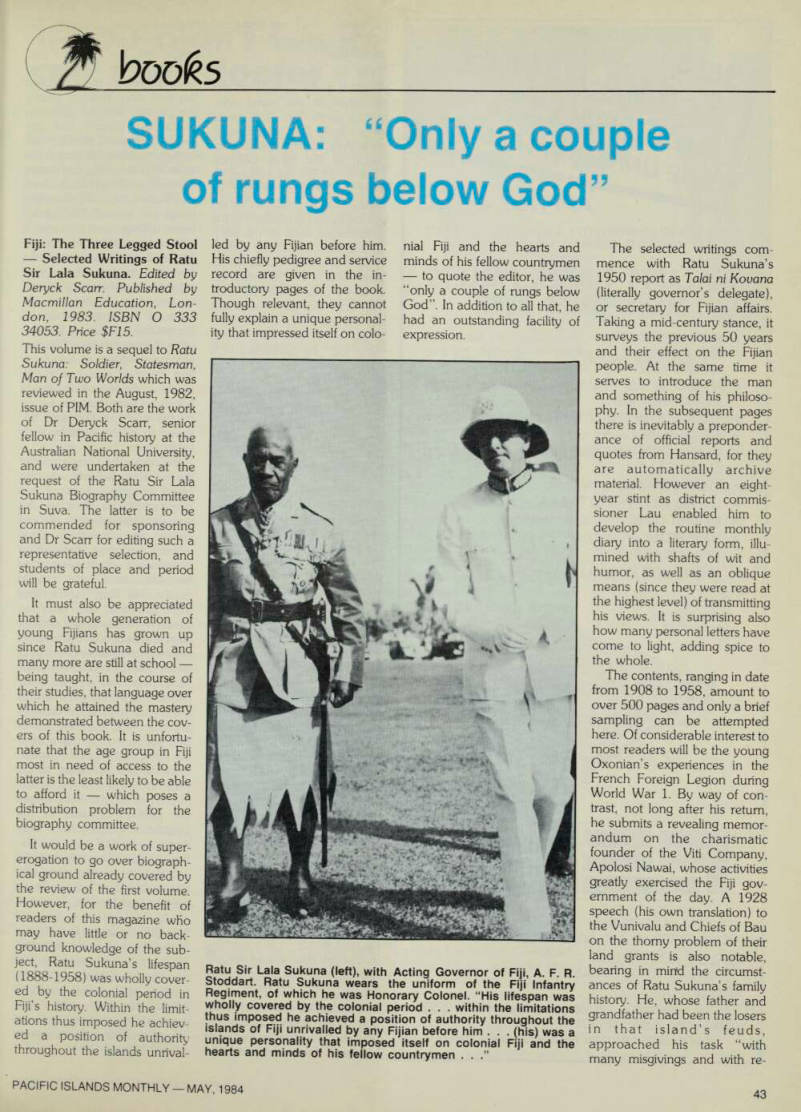
Ratu Sir Lala Sukuna (left), with Acting Governor of Fiji, A. F. R.
Stoddart. Ratu Sukuna wears the uniform of the Fiji Infantry Regiment, of which he was Honorary Colonel. “His lifespan was wholly covered by the colonial period ... within the limitations thus imposed he achieved a position of authority throughout the islands of Fiji unrivalled by any Fijian before him ... (his) was a unique personality that imposed itself on colonial Fiji and the hearts and minds of his fellow countrymen ..."
luctance”, but nevertheless faithfully discharged his re sponsibility.
His gift for conveying un palatable truths sugaring the pill while at the same time poking gentle fun is never more clearly illustrated than in an address during a social oc casion at the Suva Defence Club in 1938. His subject what the Fijians thought of Europeans! A promoter of ra cial harmony (symbolised in the three-legged stool of the title), his efforts as a mediator appear in a frustrating exchange of letters with A. D. Patel over the 1943-44 cane strike. By then the Pacific war was at its height and for him the path was plain.
“Duty is the one thing worth living for,” he declaimed in a poetic envoi to the troops embarking for the Solomons.
He was to refer again to the path of duty in an unusually blunt and somewhat bitter con tribution to a post-war debate in the Legislative Council on agricultural policy.
That there should have been a possibility of Ratu Sukuna’s devoted services being diverted elsewhere seems strange now.
His family tree, as published in this volume, confines itself to descent from three great Fiji lineages those of the Vuniva lu of Bau. the Tui Cakau of Taveuni and the Tui Nayau of Lakeba. If the latter had been taken a couple of generations further back, it would have extended to Tonga a re lationship he clearly valued and kept in repair throughout his life. Apart from that, for a much travelled and experienced man approaching middle age, pros pects in the kingdom may well have compared favorably with those in a crown colony. In a personal letter, dated January 27, 1922, he reveals the offer of a post from the premier of Tonga and indicates his own keenness to accept, “but it does not seem quite the thing to do”.
Besides, a move was already afoot to appoint him to the Native Lands Commission. In his own words “it is a roaming sort of job that should suit my turn of mind”. In ensnared him for the rest of his days.
Although he undertook other and more senior functions of government, it was as Turaga ni Veitarogi Vanua (chief of the
lands commission) that he be came personally known and respected the length and breadth of Fiji. Here was no remote figure in an ivory tower but one who, moving among the people, listened patiently, counselled quietly and de livered decisions which were comprehensible. He was at the same time acquiring an intimate knowledge of their lands, reefs and waters that only travelling rough can impart. Throughout these writings we can sense a tremendous feeling for his na tive land. This is reflected in the foreword to Moturiki: a pilot project in community devel opment. In a memorable pas sage of luminous prose he depicts the main scenic features viewed from the Bau Channel between Naigani in the north and the reef entrance in the south the legendary Daveta Levu or Great Passage, sacred to the rulers of Bau and be lieved to be haunted by their spirits.
Sophisticated cosmopolitan though Ratu Sukuna was, the blood of generations of sea kings ran in his veins and he was not unmindful of the old beliefs. He observed, albeit without comment, the natural phenomena which seemed to be associated with chiefly deaths. His diary for October 1936 describes one such oc casion a day at sea of eerie calm and heat, with the unusual appearance all around of sharks and other fish, one hammer head even allowing itself to be patted and pulled. On arrival at Lomaloma next day he receives the news that the Vunivalu of Bau has gone to join his ancest ors through the Great Passage.
In the last sad letter of the collection Ratu Sukuna writes: “lam not sorry to have to quit the post of Speaker of the Legislative Council but I truly regret having to leave the Na tive Lands Commission.” So ended a love affair that had begun 36 years before. Three months later he died at sea.
A. C. Reid* * A. C. Reid served for 33 years in the Pacific Islands, including 25 years in Fiji, where he was the last European to hold the position of Secretary for Fijian Affairs. He also spent eight years in Tonga on two separate “tours” as British Commission er and Consul.