Pacific

Islands
Monthly
Iiwa\Y#Km8Gh
American Samoa US$l.75 Australia 'ASI.SO Cook Islands NZ$l.5O Fiji F 51.50 Hawaii US$l.95 Kiribati A 51.75 Nauru A 51.75 New Caledonia CFPI 90
New Zealand NZ$2.OO Niue NZ$l75 Norfolk Island A 51.50 Papua New Guinea K 51.50 Solomon Islands 551.50 Tahiti CFP22O Tonga Pi .50 Tuvalu A 51.75
Usa Us$2 25
USTT and Guam US$l,95 Vanuatu VT1.50 Western Samoa T 2.10 ■Recommended retail price only Registered by Australia Post Publication No NBPI2IO
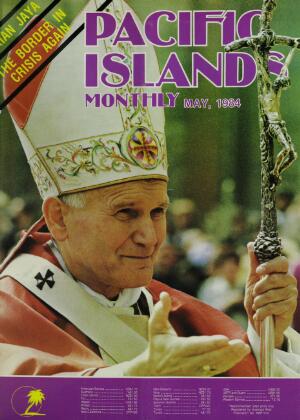
The Cover
Pope John Paul 11.
M.S.C. Archives photo.
Advertisements & other items, pp. 2-3 (2 items)
Skip into Video
Hitachi’s front-loading VT-33E(AU) makes video viewing more enjoyable without making operation more complex. Besides bidirectional Visual Search at 4 times normal speed and a convenient Freeze Frame function during playback, it incorporates a very special Skip Search feature which automatically alternates between Visual Search and Fast Forward at 10-second intervals to get to the desired scene faster than ever before. What’s more, this model comes with a handy, wired remote control unit, a 3-program/2-week preset recording timer, large multifunctional selector switches, and an Instant Recording Timer (IRT) for fuss-free programming.
Video couldn’t be more simple or more fun than the VT-33E(AU) from Hitachi. k LA aO 5 ® C . r 0® eC f Skip Search available by remote control AO aO
VMS
PAL
Ao*® c
VMS
OAQM3 , SOFT
touch OPERATE SYSTEM
I AUSS
in■ n n iu. u u < > > n
• DSC
W
0 HITACHI
•AUSTRALIA: Hitachi Sales Australia Pty., Ltd., 153 Keys Road, Moorabbin, Victoria 3189; Phone; (555) 8722 •NEW ZEALAND: AWA New Zealand Limited, Wi-neera Drive, P.O. Box 50-248, Porirua;Phone: PRO 75-069 •PAPUA NEW GUINEA: S.O. Svensson (N.G.) Ltd., P.O. Box 705, Port Moresby; Phone: 21-2111 •FIJI ISLANDS; AWA New Zealand Limited, 47 Foster Road (P.O. Box 858),Suva,Fiji; Phone: 312070 •NEW CALEDONIA: Caldis, B.P. Ml, Noumea; Phone: 26.23.50 •TAHITI: Ets Chene Alain, P.O. Box 272, Papeete; Phone: 2.88.68 •SOLOMON ISLANDS; Technique Radios Centre Ltd., P.O. Box 465, Honiara; Phone: 416
Pacific
ISLANDS
MONTHLY
Vol. 55 No. 5 May 1984
Glanville on Irian Jaya 11
The Pope’s visit 15
Tofilau Eti speaks 19
Muldoon interviewed 22
In This Issue
• BORDER CRISIS IN PAPUA NEW GUINEA lan -| 1 Glanville, formerly one of PNG’s top soldiers, reports on the new crisis which has flared up on PNG’s border with the Indonesian province of Irian Jaya. Anti- Indonesian elements in the Free West Papua (OPM) movement have become more active, refugees have fled across the border into PNG in increasing numbers and the PNG Government is faced with a cruel dilemma. • POPE JOHN PAUL II VISITS PNG, SOLOMONS 1 5 The Rev. John Garrett, noted historian of the Christian church in the South Pacific, provides fascinating insights into the background to this month’s first-ever visit by the head of the Catholic church to two of the most important countries in Melanesia. • INTERVIEW WITH TOFILAU ETI Western -IQ Samoa’s Prime Minister Tofilau Eti talks to PIM Editor 1 *
Garry Barker in Apia, saying that his government’s policies are working, and that Western Samoa has “turned the corner” on the path to economic recovery. • THE WORLD ACCORDING TO MULDOON 22 New Zealand’s Prime Minister Sir Robert Muldoon is interviewed for PIM by Floyd K. Takeuchi in Honolulu. • THE MICRONESIAN IMBROGLIO —Dr Stewart 25 Firth, of Australia’s Macquarie University, is just back from a visit to Micronesia. He offers a clear-cut and challenging viewpoint on the situation in the area, arguing in particular that things would be easier for all concerned if both sides started “calling a spade a spade.” • THE DEATH OF CAPTAIN COOK —The second c-j and concluding part of a lecture given in Sydney on 3 1 February 14, 1984, by Professor Greg Dening.
Books ".',43
Contents
Australia 14 Australian Aborigines ...9
Brunei "Z. 63
Captain Cook's Death 51 Cuba 59 Deaths 73 Easter Island 61 European Economic C’ity 41 F 'j' 43,62 Hawaii 33 Irian Jaya n Islands Press 66 Letters 9 Micronesia 25,59 New Caledonia 29 New Zealand 22
Norfolk Island 47 Pacific Report 5 Papal Visit 15
Png 11,14,15,41,46,49
People 55 Political Currents 19 PIM Subscription rates and agents ..74 Shipping Schedules 69 Solomon Islands 15 The Month 29 Tonga 45,63 Tradewinds 37 Tropicalities 61 Tuvalu 63 United States 25, 33 Vanuatu 29,31,59,61 Western Samoa 19,37 Yachts 67
Australian cover price is recommended retail only. Registered by Australia Post, publication No. NBPI2IO. Second class postage paid at Honolulu, Hawaii. Copyright Pacific Publications (Aust.) Pty. Ltd. Postmaster Hon olulu; Send address changes to PIM Hawaii, PO Box 22250. Honolulu Hawaii, 96822.
Advertisements & other items, pp. 3-4 (2 items)
Pacific Islands Monthly May, 1984
3
Founded 1930 by R. W. Robson
(USPS 952480)
Editor and Publisher Garry Barker Associate Editor Malcolm Salmon Advertising Manager Stephen Brandon Layout & Design Barry Badger Editorial Adviser John Carter A Pacific Publications production 76 Clarence Street, Sydney, 2000, GPO Box 3408, Sydney, 2001.
Cables: PACPUB Sydney.
Telex: 21242 (answers INTARAD).
Telephone: Sydney 20-231. Melbourne 63-0211.
Manager: John Berry (03) 63-0211 Ext. 1860.
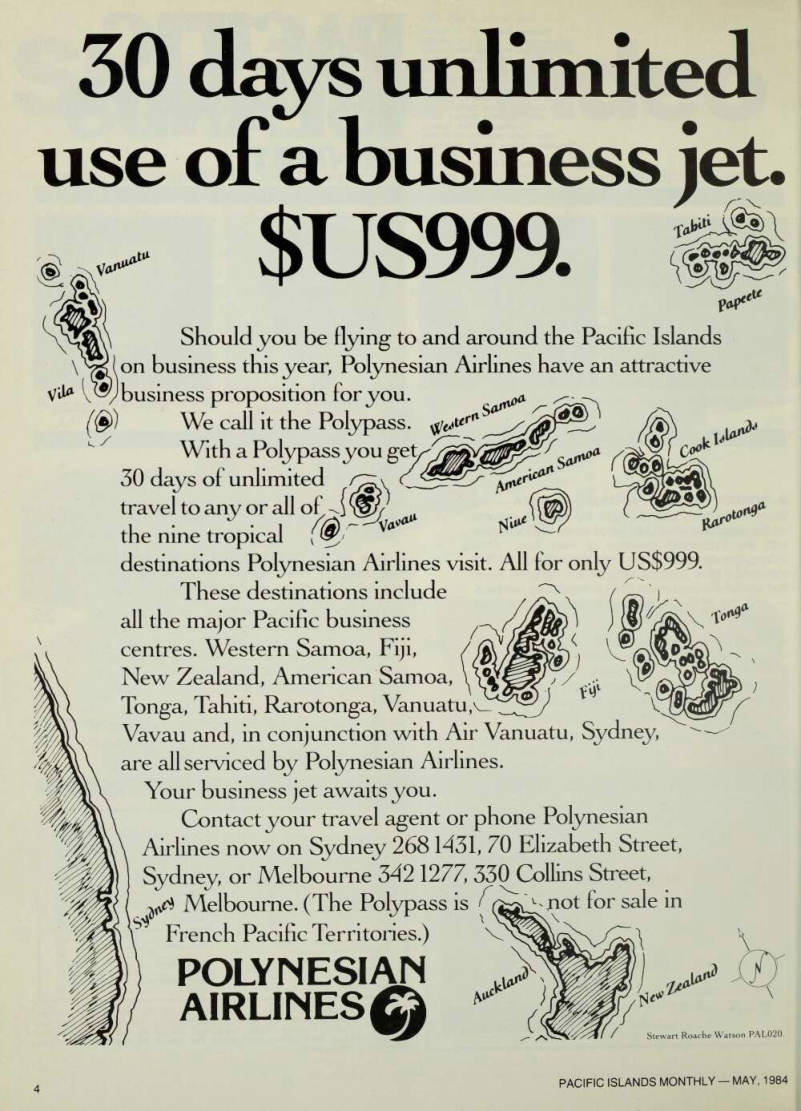
30 days unlimited
use of a business jet.
m %
SUS 999.
Should you be flying to and around the Pacific Islands on business this year, Polynesian Airlines have an attractive UP 1 G. / Co° rlc^ 1 r © NlU* business proposition tor you We call it the Polypass With a Polypass you get 30 days of unlimited travel to any or all of AV®
the nine tropical (&
destinations Polynesian Airlines visit. All for only US$999 These destinations include 7^. all the major Pacific business centres. Western Samoa, Fiji, / I New Zealand, American Samoa, y°- Tonga, Tahiti, Rarotonga, Vanuatu, Vavau and, in conjunction with Air Vanuatu, Sydney, are all serviced by Polynesian Airlines.
Your business jet awaits you.
Contact your travel agent or phone Polynesian Airlines now on Sydney 2681431, 70 Elizabeth Street, Sydney, or Melbourne 342 1277, 330 Collins Street, Melbourne. (The Polypass Is f(fekN not for sale in French Pacific Territories.) /TV
POLYNESIAN
* * o \ Stewart RoacKe Watson PALO2O.
Pim Opinion
For much of last month the diplomatic chambers of Canberra, and capitals around the Pacific, have hummed with anxious, and also sometimes angry, discussion of the Jackson Report, a document commissioned by the Hawke government to advise it on how Australia’s aid money should be spent.
The report, produced by a committee headed by the former chairman of CSR, Sir Gordon Jackson, will not be made public until May, although many of the people most concerned seem already to be remarkably well-informed on much of its contents.
What most concerns Pacific Island countries, to whom Australia’s annual handout is of prime importance, is Jackson’s recommendation that within five years aid grants be tied to specific projects or programmes. Jackson says Australia’s increasingly burdened taxpayers will begin opposing foreign aid unless there is evidence that it promotes social and economic development. They could also begin questioning the fitness of recipient governments to administer aid, and turn querulous about their general attitudes, habits and performance. Even so charismatic a figure as Bob Hawke, would be unwise to ignore such public feeling. Dealing specifically with Papua New Guinea, the Jackson Report suggests that future aid may need to be contingent upon the Port Moresby government’s ability to handle its currently very difficult law and order problems.
PNG’s prime minister, Michael Somare, who happened to be in Sydney at the time the report “leaked” to the daily press, reacted with charactistic vigor. He was, he said, “bloody angry” over what he had read of the report. “My government is seriously disturbed that there should be any change in the form of Australian aid,” he said.
Australia’s aid to PNG is in fact quite straight-forward budgetary support. The money is paid into the treasury and spent as the PNG government sees fit. It amounts to nearly $3OO million and represents more than a quarter of PNG’s total government revenue. It is also more than 30 per cent of total Australian foreign aid.
Jackson’s report to some degree revives the rather bitter argument which occurred just before PNG independence about where Australian aid should be applied, and how it should be administered. Since then it has been a basic of Australian policy that aid should not be tied, and that, thereby, any appearance of Australian interference in the affairs of its small, developing, neighbors could be avoided. It is a policy which has excited a good deal of discussion, and not a little opposition from Australians critical of the sometimes myopic, sometimes clumsy and wasteful, but also sometimes inspired workings of bureaucracy.
Very probably the Jackson report reflects a good deal of Australian public opinion or, to be somewhat more realistic, a lot of Australians not directly involved in the conduct of foreign affairs will agree with its general tenor. Australians generally feel their government should be accountable to them. It is but a small step, if it is any step at all, for them to demand an accounting of foreign aid spending. And yet, an objective look at Papua New Guinea’s performance over the last few years, shows how well it has done, even through the recent very difficult recession.
That PNG faces many very taxing problems is obvious. That Mr Somare and his government are doing something about them is also clear. Inflation is reduced, wage rates have been held and the country’s product is growing, reportedly at something like 2.5 per cent which, at this moment, puts quite a number of similar countries right into the shade.
The only real questions for any Australian to ask are: why is money put into foreign aid? and, what would be the result of a change in current practice?
Obviously there is an element of self-interest in the policy. A Papua New Guinea bankrupt and chaotic would not be to Australian advantage. Australia is itself a developing country, although vastly more prosperous than any of her neighbors.
Australian prosperity alone requires action as a good neighbor and responsible member of the Pacific community.
Pacific Report

Solomons To The Polls In November
The Solomon Islands Parliament will be dissolved in August in preparation for general elections to be held in November.
Opposition Leader Sir Peter Kenilorea had sought to have the parliamentary dissolution brought forward so that the elections could be held in August, but lacked the numbers in the House to do so. No precise dates have been fixed for either the dissolution or the elections. George Atkin in Honiara.
NEW MAYORS FOR PORT VILA , LUGANVILLE Both Luganville (Santo) and Port-Vila Vanuatu’s two urban centres have new mayors, following the annual elections in February and March. Port-Vila’s mayor is Petre Malsungai, of the Union of Moderate Parties, who was also mayor for the 1982 term. u- u Jack Tokon ’ is fr° m the Vanuaaku Party, a fact which Mr Malsungai welcomes, as vindicating his belief that party factionalism has no part in municipal affairs. Luganville’s new
mayor is Abraham Gaua, and his deputy is Mrs Leo Gete, the first woman to hold the post. Both are from the Vanuaaku Party. Their stated aims for the year are to improve the city’s roads and drainage.
Canberra Approves Torres Treaty
The House of Representatives of the Australian Parliament in April passed in all its stages legislation ratifying the Torres Strait Islands Treaty with Papua New Guinea. The treaty defines the internatio nal border between PNG and Australia which runs through the Torres Strait Islands which are part of the Australian State of Queensland. The treaty, provisionally signed in 1978, recognises cultural affinities on both sides by establishing a marine reserve in which traditional freedom of movement and, sharing of economic resources is recognised. At the wish of the Islanders, three islands close to the PNG coast Boigu, Dauan and Saibai remain part of Australia but are, effectively, island enclaves with a PNG sea
area. There are more than 70 islands and islets and, according to the 1981 census, 10,232 Torres Strait Islanders were living in Queensland and in the islands. A further 5000 live elsewhere in Australia.
Australians Deported From Solomons
One of two Australian men recently deported from Solomon Islands has been declared a prohibited immigrant. He is Ronald Edwin Warnecke, manager, who had earlier been jailed in Honiara after conviction on charges of growing Indian hemp. The other man. Snowy MacArthur, a logging operator, was expelled because of alleged “disturbances” caused by him in the area of his logging activities. At time of writing no decision had been reached as to whether he, too, would be prevented from returning to the country. George Atkin in Honiara.
Fire On Tuvalu S Niutao Island
Tuvalu’s Niutao Island, population about 900, was without medical supplies at the beginning of April following a fire which destroyed the island’s dispensary. The midnight blaze was thought to have been started when a kerosene refrigerator was blown over in strong winds.
FIJI GOVT. TO OPT OUT (HERE AND THERE) The Fiji Government is expected to “turn over various government functions to be handled by profit-minded private enterprise institutions”. Minister of Finance Mosese Qionibaravi has told an accountants’ convention in Fiji. It would be part of the government’s cost-cutting drive which will also freeze, for two years, recruitment to the 19,000-strong Public Service.
Diabetic Centre For Suva
Fiji will set up a national diabetic centre in Suva staffed by medical officers trained at specialist centres in Australia. Recent surveys have revealed that the disease is a major problem in Fiji, with an estimated 20 per cent of all hospital beds occupied by diabetics.
New Radio Series On Islands Trade
The Sydney-based South Pacific Trade Commission, headed by Commissioner Bill McCabe, has begun compiling a monthly 15-minute radio program to be supplied free to radio networks in Pacific Forum countries. The program will provide information on marketing opportunities, investment proposals, shipping and air freight schedules and trends, exchange rate fluctuations and other service information.
Coconut Cheese A Samoa Export?
Taveuni Island (Fiji) copra planter Brian Leonard, who has carried out successful experiments in making cheese from coconuts, has taken over an old dairy farm near Western Samoa’s capital, Apia, and is producing samples of the cheese for prospective buyers in Australia, New Zealand and the United States. He hopes to export about 200 tonnes of the cheese by next year. His request for help for his novel venture from the Fiji Development Bank was turned down. A dairy technologist in Australia for 15 years, Mr Leonard predicts that the manufacture of coconut cheese will revolutionise the coconut industry.
P.T.C. Calls For Papers For 85
The Pacific Telecommunications Council has issued a first call for papers for its seventh annual conference, PTC ’B5, set for Janauary 13-16, 1985, in Honolulu. The conference theme will be ' Telecommunications for Pacific Development: Towaid a Digital World. Proposals are requested for papers on topics relating to the technical, business, regulatory, user, social, and economic aspects of adapting digital technology to all areas of voice and data communications and broadcasting. Focus should be on Asia, the Pacific, and the Americas. Proposals should be submitted no later oJfo 1 J w ne 3®’ 1984, to PTC ’B5, 1110 University Avenue, Suite 3UB, Honolulu, Hawaii 96826. Notification of acceptance or non-acceptance of proposals will be made by August 1, and final manuscripts will be due in camera-ready form by November 30 For further information, contact Richard J. Barber at the address listed.
35° At Papeete Pro Independence Rally
c ra l sponsored by four small pro-independence parties in rrench Polynesia drew only about 350 people on to the streets of Papeete in March, according to a report in the local daily, Les
Nouvelles de Tahiti. Demonstrators carried banners denouncing the French presence in the territory, and the Moruroa nuclear tests.
Parties represented were the Tavini Huiraatira, led by Oscar Temaru, the Taata Tahiti Tiama of Charlie Ching, the Faatereaa Tiama O Porinetia Maohi of Tetua Mai, and the Pomare Party.
Guest speaker at the post-march rally was Yann Celene Uregei, vice-president of New Caledonia’s Territorial Assembly, and a leader of the territory’s Independence Front.
Sai2 Million To Vanuatu From Uji.
In accordance with its April 1983 promise to pay a third of the compensation for damage caused to private property on the island of Santo during the pre-independence rebellion in Vanuatu in 1980, Britain will give Vanuatu about SAI2 million to be used to meet a portion of the estimated 1000-plus claims for compensa tion. The Vanuatu Government has promised to pay one-third and France has been asked to pay the balance but has not yet responded. One of the biggest claims for compensation is by the owners of the fire-gutted coconut oil mill who are asking for $2O million. The chartered accountants Peat, Marwick, Mitchell & Co. assessed the amount of damage and presented their report to the British Government.
Nz Minister Explains Immigration Law
New Zealand’s Immigration Minister Austin Malcolm has visited a number of Pacific Island countries explaining changes to his country’s immigration laws. In Fiji, after visiting Western Samoa and Tonga. Mr Malcolm said the change was aimed at helping those who had genuine reasons for overstaying their visitor’s permit, and to penalise those who flouted the law. He said New Zealand had found its visitor permits system was being abused, and the changes were meant to keep the abuse to an absolute minimum. He added that unlike the present set-up, overstaying would not be a criminal offence under the new law, and people who had been asked to leave the country would be able to return later.
Guam Refinery Closes Amid Protests
Guam’s oil refinery, operated by Guam Oil and Refining Company Inc. (Gorco), closed down at the beginning of March for an indefinite period because of a Pentagon decision to buy military fuels for its giant base in Guam from Singapore refineries. The closure has brought vigorous protests from local users as the refinery was their major source. Price was the main reason for the Pentagon’s switch to Singapore. Gorco’s small plant cannot compete with the giant Shell and Caltex refineries in Singapore and South Korea, or achieve quantity discounts in its purchases of crude oil. U.S. President Reagan has promised to “look into” the matter.
Png To Take Tv Plunge
The Papua New Guinea Cabinet has approved the calling of tenders for establishing a commercial television service and will adopt legislation to allow its introduction next year. The independent Newcastle (Australia) station NBN3 has already submitted proposals to the PNG Government.
Palau Studies Independence Option
A bill has been tabled in Palau’s House of Delegates to create a commission to study independence as an alternative to free association with the United States as proposed in the Compact of Free Association. Negotiations between Palau and the United States have stalled on Palau’s constitutional ban on nuclear weapons or bases being allowed in the republic. The Palauans are now studying suggestions from U.S. Ambassador Fred Zeder for revising the compact.
Vega Circumnavigates Australia
The 12-metre campaign ketch Vega —or Greenpeace lII was due to start out from Sydney on April 8 on a circumnavigation of Australia. A press release from Greenpeace Australia (NSW) said; “Ostensibly, this is a speaking tour providing the public with an opportunity to see the vessel at close quarters. Educational talks and film shows will be conducted by crew members. Other, Greenpeace-style, actions are likely to keep the vessel in the public eye.” Greenpeace 111 is a veteran of three protest voyages to Moruroa Atoll, French Polynesia, site of France’s nuclear testing.
She has also taken part in protest action against whaling operations in the North Pacific.
Burns, Philp In Profit Turn Around
Bums, Philp & Co Ltd., of Sydney, made an operating net profit after tax of 5A10.749 million in the six months to December 31 last, 91 per cent higher than the profit for the corresponding period of 1982. Group sales amounted to $640,194,up 3 per cent on the corresponding period of 1982. The interim report said results from the group’s Pacific operations were disappointing and affected by differing economic conditions in the areas where the group operates and changes in the company’s businesses in Fiji and Papua New Guinea. Merchandise activities in PNG suffered from lower gross profit margins and, while automotive distribution was on budget, heavy machinery sales were low due to reduced capital investment by both business and government. Fiji operations significantly improved their contribution in extremely difficult economic conditions as a result of the restructuring of merchandise activities and improved profits from shipping, travel and motor operations. Niue, Tonga and Western Samoa performed well.
However the overall result from the South Sea Company was below that of the corresponding period due to a poor result from American Samoa. In Vanuatu the depressed economy resulted in severely reduced margins and sales but due to strong management action contribution was maintained at a satisfactory level. The directors declared an interim ordinary dividend of TVz cents per share.
Solomons To Count Heads In 86
Solomon Islands is looking for an aid donor to help finance its national census planned for 1986. The census is of particular importance to Solomon Islands where the annual population growth rate is a steep 3.4 per cent. The last census in 1976 showed a total population of 196,823 (compared with 160,998 in the 1970 census). Estimated population at the end of 1982 was 248,000, and the projection is for a population of 276,000 in 1986, 330,000 in 1991, and 476,000 in 2001. The government hopes that the 1986 census will make clear the areas in which development efforts should be concentrated to keep pace with growth in population numbers. George Atkin in Honiara.
FRENCH POLYNESIA'S 164 f 000 SOULS . . .
From 1977 to 1983 the population of French Polynesia increased by just under 27,000, according to preliminary census figures, up from 137,000 to 164,000. Distribution of people among the five island groups showed little relative change, with by far the biggest concentration of people still in the Windward/Society Islands mainly Tahiti and Moorea. . . . AND NEW CALEDONIA'S 145,000 According to figures released by New Caledonia’s Statistics Institute on the 1983 census, the population has increased to 145,000, an increase of 11,000 since 1976. Melanesians number 62,000 against 56,000 in 1976, and Europeans number 54,000, an increase of 3000. The remainder includes Wallis Islanders, Vietnamese and Indonesians. Nearly 77 per cent of the population is New Caledonia-born, a fact which will no doubt be used by opponents of the pro-independence Kanak parties.
Administrative College For New Caledonia
France’s High Commissioner in New Caledonia Jacques Roynette has opened a new administrative staff college in Noumea designed to help the territory on its way to autonomy. Seventy students in the first enrolment will do the three courses available which, as they take effect, will enable New Caledonia progressively to acquire autonomy in its administration. Mr Roynette said the centre was within the framework defined by the French Government for the development of the territory.
Micronesia: State Battles Interior
There is an ugly intramural fight going on in Washington, D.C., and the Micronesian free association compacts are caught in the middle, getting it from all sides. At one end of the town the compacts as approved with the Marshall Islands and the Federated States of Micronesia are “sitting on the president’s desk,” awaiting final formal executive branch approval. That was thought to be all but pro forma a few weeks ago. Now, however, a full-scale turf battle is underway. It is a “last one standing” fight. One needs a score card to keep up with the competitors, but essentially here is
how it is all shaping up. At one level, the State Department and the Interior Department are scrambling to be the lead agency with responsibility for Micronesia. Interior, of course, has been the traditional government department for this role. But given America’s poor record in many areas of activity, any historical claims can only hurt Interior. State, on the other hand, argues (convincingly, in many respects) that the autonomous Micronesian political entities will not be under the suzerainty of the federal government. Thus, the new states should be accorded an “independent-like” status with State Department representation. In the middle of this battle is Fred M. Zeder 11, Ronald Reagan’s personal representative to the Micronesian status negotiations.
Zeder says he has given up predicting when the negotiations will actually be completed and the compacts signed, sealed and delivered. But he has a stake in the outcome of this State-Interior fisticuffs. What Zeder wants is a separate inter-agency Office of Micronesian Affairs which would be constructed around his present abode, the Office of Micronesian Status Negotiations. Also playing prominent roles in such an office would be the Defense Department and the Department of Commerce. On that point, Zeder is quite emphatic. While the executive department types are carrying out their hit-and-run attacks, a number of congressmen have decided to get into the act too. Those who have a strong personal interest in Micronesia are balking at giving their blessing to the compacts and this despite the fact that it has taken the U.S. 14 years to get the agreements, and despite the fact also that a majority of Micronesians approve the relationship. One congress man has been talking of holding nearly 20 hearings, a mind-boggling number. In an election year, that alone would ensure delay until well into 1985. Not only that, but Zeder says a number of the lawmakers are looking for a way to get some political mileage out of the Micronesian compacts. “There are a lot of them back there scratching their heads wondering what they can get out of this,” is how Zeder puts it. As someone close to the U.S. negotiating team said, that kind of language makes Zeder’s underlings “squeeze their legs together.” What happens next? The most optimistic observer might still predict passage of the compacts late this year after the elections during a lame duck session. That probability cannot be completely discounted. But the blood and gore in Washington does not now portend swift action. Perhaps Fred Zeder put it best when he described what’s happening in Washington this way: “It’s like elephants mating. It’s done on a high level, a lot of trumpeting goes on . . . and then nothing happens for two years.” Hoyd K. Takeuchi in Honolulu.
Fiji Woos Scared Hong Kong Money
The Economic Development Board of Fiji has sent several missions to Hong Kong to see whether Fiji can benefit from the flight of capital from the British colony. The board, which is a statutory corporation charged with attracting more foreign capital to Fiji, has identified nearly $6O million worth of new investment opportuni ties. More than half are concerned with agriculture, or the processing of agricultural products.
Goodbye Ponape, Greetings Pohnpei
The final draft of the Fonape State Constitution has been signed by the draft convention delegates who approved a resolution asking Governor Resio Moses and the legislature to hold the referendum on the constitution draft on July 2. The draft changes the spelling of the place name Fonape to “Pohnpei.”
Lemoine Surprised' On Noumea Visit
France’s minister for overseas territories, Georges Lemoine, has said that Frances wishes to encourage self-determination in New Caledonia and he did not rule out the possibility of independence.
Speaking in Sydney on a brief stop-over on his journey from Noumea to Paris, Mr Lemoine said his visit to New Caledonia had been aimed at encouraging such a process. He had been surprised, he said, by the will expressed by both sides to refer to the common decisions adopted last year at a conference in France. The draft of the statute prepared for the territory will be examined by the French cabinet on May 2, and is expected to be debated by the French national assembly several weeks later. Mr Lemoine said the next territorial assembly elections in New Caledonia and the formation of a local assembly would be organised according to the new statute. He said the electoral reform now under study would be drafted according to the French constitution
Advertisements & other items, p. 6 (1 item)
of the world with us
/ h<i x/ Zjr neu seat ana 0
It’s easy to see more
Making world travel easy for you is easy for us, because we're your kind of people, and because we're flying to more of the world than ever before.
Join our direct flights to London, Honolulu and Los Angeles, Tokyo, Singapore and Hong Kong, Sydney, Melbourne, Brisbane, Hobart and Perth and throughout New Zealand.
We make world travel easy with money-saving stopovers and low-cost sightseeing.
So, tell your travel agent: "I'd rather fly Number One''.
air neui z
The Pacific’s Number One
letters

Kava benefits Australian Aborigines
I read with interest your recent report “Looking at Kava as an Export Crop” (February 1984) by Julie-Ann Ellis.
In recent years, the con sumption of kava in northeast Arnhem Land (Northern Terri tory of Australia) has experi enced a profound acceptance and expansion. It has proved not only a cash-earner for the Pacific exporters, but also for the outstation resource or ganisation located at Yirrkala (the major Aboriginal settle ment located near the bauxite mining town of Nhulumbuy).
I understand profit from its sales to outstation groups has enabled the purchase of a Toyota truck by the Resource Centre used to service the growing number of outstations. (Outstations are those home land centres in Arnhem Land which is land owned by Yolngu under the Aboriginal Land Rights Act (N.T.) 1976).
The use of kava was re portedly introduced by Fijian community workers associated with the United Church. It has displaced, or at least provided
an alternative to, alcohol and has the advantage of being a social activity without the side effects of intoxication which has, in the past, led to argu ments and deaths.
In my experience important community meetings are now preceded by the drinking of kava so that social cohesion is reinforced before the discussion of important issues.
Government understanding is yet to be fully achieved with respect to the consumption of kava. At least one senior gov ernment officer has stated that kava is a drug and therefore to be opposed. Thankfully, the Uniting Church has taken a more positive approach.
Perhaps the Pacific has more to offer us in the Territory?
Certainly kava has proven a useful contribution.
R. W. Ellis
Director, Aboriginal Sacred Sites Authority.
Darwin N.T.
Australia
Fate of the
Wphc
archives
I hope you will allow me, through your columns, to shed further light on the situation described in Dr Jim Boutilier’s recent article “Little short of a tragedy” (January 1984 issue of PIM).
The files of the Western Pacific High Commission (WPHC), which previously formed part of the Western Pacific Archives (WPA), are deemed to be British public records. This point, and its legal implications is well known to the archivist of the Solomon Islands National Archive, Mr Wale.
The background to the return of the WPHC and other records to the UK is that in 1978, with the lease of the WPA building in Fiji running out, a quick deci sion on how best to safeguard the records had to be taken.
Considerable deterioration of the records had already taken place, due to the ravages of climate and insects. No other building in the Western Pacific region was suitable for the storage of the archives, which included not just the records of the Western Pacific High Com mission but Island records from miscellaneous other sources which some of the individual governments were not in a position to take over. These
were crated and removed to Britain as an immediate step, to ensure their safekeeping and to guard against further deteriora tion. At the same time, some material from the WPA was sent to the individual govern ments of Solomon Islands, Kiri bati and Tuvalu; this consisted of their own more recent territo rial records.
In his article, Dr Boutilier quotes Bruce Burns as obser ving that it would be “little short of a tragedy” if the WPA holdings were broken up and dispersed. He goes on to com ment “sadly, that is exactly what happened”. This is not correct.
The principle of safeguarding the integrity of the archives was regarded as of paramount im portance and the records of the Western Pacific High Commis sion have not been dispersed.
The records are residing in the Foreign and Commonwealth Office from where, since the crates were opened in Septem ber 1980, all queries, whether from governments or from pri vate individuals, have been answered. Where practicable, photocopies have been pro vided. The records may soon be back in the Pacific, following a formal request for them from the Solomon Islands Govern ment. Initial legal obstacles to making a gift of these records to the Solomon Islands have been overcome and the British Gov ernment is.currently seeking the views of other governments in the Western Pacific region on this proposal.
M. S. Berthoud
Consul-General British Consulate-General Sydney, NSW Australia
Trader Bob
Re PIM December 1983: I should like to submit the follow ing lines concerning the story “Trader Bob: A Fisherman’s
Continued on page 59
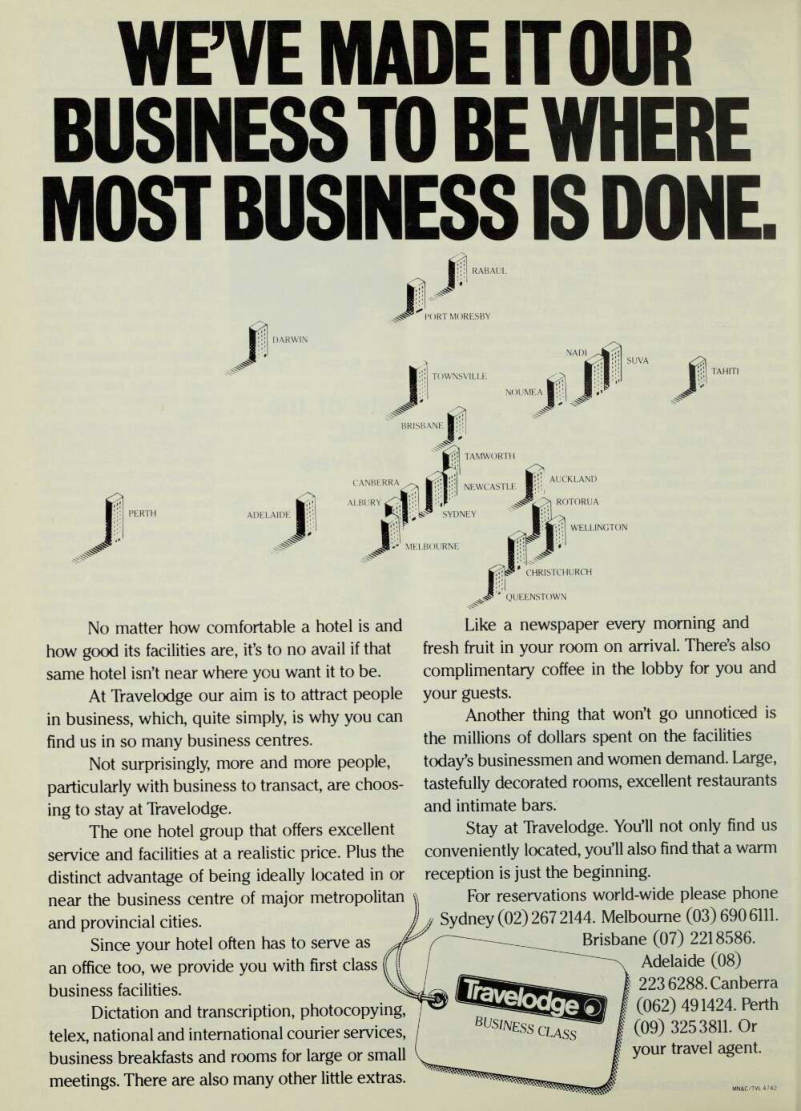
Ceremonial preparation of Kava in Fiji... the practice has spread to Australia's Arnhem land Aborigines, and has done nothing but good.
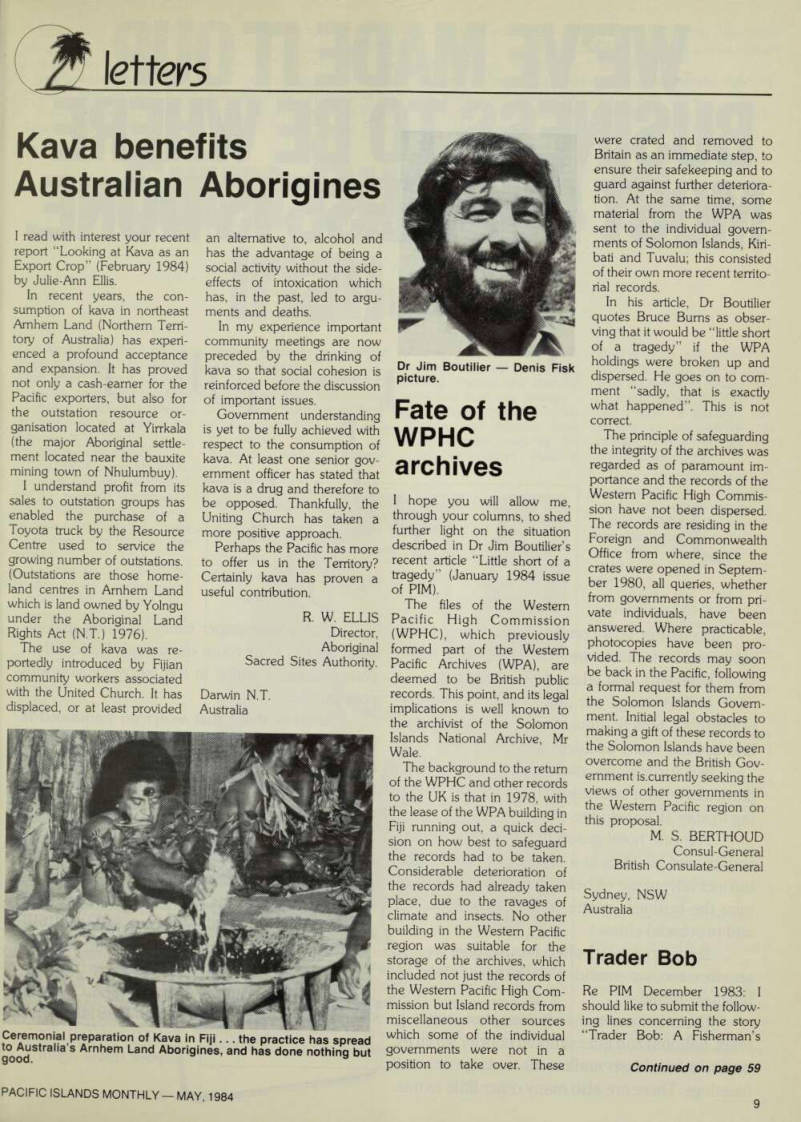
Dr Jim Boutilier - Denis Fisk picture.
Tale from the Old Condomin
ium” (p 47):
In Russell Paul’s tale Trader Bob Comes through like a fearsome slob.
Did the “uncrowned king” of Tanna Really behave in such oafish manner?
And are we long-time friends of
Pim
To be affronted by more of him?
Still, I reckon that no literary fuss Will follow from the yams of Russ.
His prose style may be !*!*!*ing quaint But Louis Becke he !*!*!*inq ain’t
Tom Dennison
Waverley, NSW Australia
Vanuatu’s
Cuban
connection
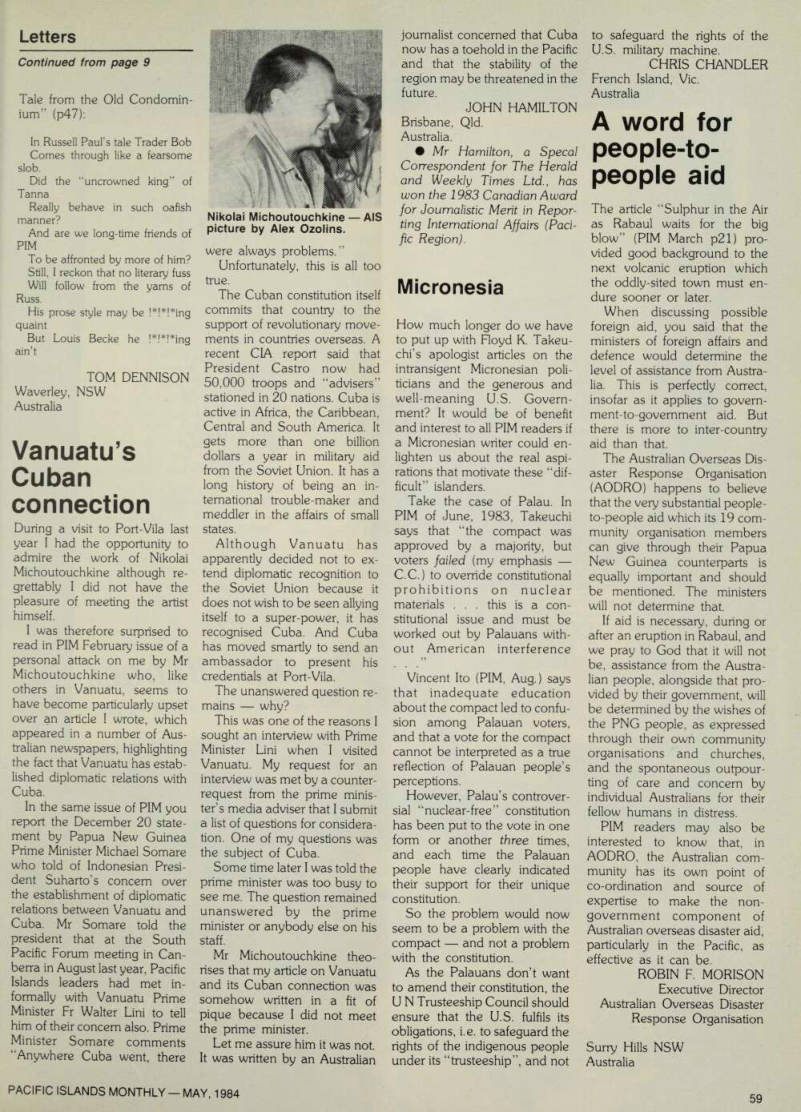
During a visit to Port-Vila last year I had the opportunity to admire the work of Nikolai Michoutouchkine although re grettably I did not have the pleasure of meeting the artist himself.
I was therefore surprised to read in PIM February issue of a personal attack on me by Mr Michoutouchkine who, like others in Vanuatu, seems to have become particularly upset over an article I wrote, which appeared in a number of Aus tralian newspapers, highlighting the fact that Vanuatu has estab lished diplomatic relations with Cuba.
In the same issue of PIM you report the December 20 state ment by Papua New Guinea Prime Minister Michael Somare who told of Indonesian Presi dent Suharto’s concern over the establishment of diplomatic relations between Vanuatu and Cuba. Mr Somare told the president that at the South Pacific Forum meeting in Can berra in August last year, Pacific Islands leaders had met in formally with Vanuatu Prime Minister Fr Walter Lini to tell him of their concern also. Prime Minister Somare comments “Anywhere Cuba went, there
were always problems.”
Unfortunately, this is all too true.
The Cuban constitution itself commits that country to the support of revolutionary move ments in countries overseas. A recent CIA report said that President Castro now had 50,000 troops and “advisers” stationed in 20 nations. Cuba is active in Africa, the Caribbean, Central and South America. It gets more than one billion dollars a year in military aid from the Soviet Union. It has a long history of being an in ternational trouble-maker and meddler in the affairs of small states.
Although Vanuatu has apparently decided not to ex tend diplomatic recognition to the Soviet Union because it does not wish to be seen allying itself to a super-power, it has recognised Cuba. And Cuba has moved smartly to send an ambassador to present his credentials at Port-Vila.
The unanswered question re mains why?
This was one of the reasons I sought an interview with Prime Minister Lini when I visited Vanuatu. My request for an interview was met by a counter request from the prime minis ter’s media adviser that I submit a list of questions for considera tion. One of my questions was the subject of Cuba.
Some time later I was told the prime minister was too busy to see me. The question remained unanswered by the prime minister or anybody else on his staff.
Mr Michoutouchkine theo rises that my article on Vanuatu and its Cuban connection was somehow written in a fit of pique because I did not meet the prime minister.
Let me assure him it was not.
It was written by an Australian
journalist concerned that Cuba now has a toehold in the Pacific and that the stability of the region may be threatened in the future.
John Hamilton
Brisbane, Qld.
Australia. • Mr Hamilton, a Specal Correspondent for The Herald and Weekly Times Ltd., has won the 1983 Canadian Award for Journalistic Merit in Repor ting International Affairs (Paci fic Region).
Micronesia
How much longer do we have to put up with Floyd K. Takeu chi’s apologist articles on the intransigent Micronesian poli ticians and the generous and well-meaning U.S. Govern ment? It would be of benefit and interest to all PIM readers if a Micronesian writer could en lighten us about the real aspi rations that motivate these “dif ficult” islanders.
Take the case of Palau. In PIM of June, 1983, Takeuchi says that “the compact was approved by a majority, but voters failed (my emphasis C.C.) to override constitutional prohibitions on nuclear materials . . . this is a con stitutional issue and must be worked out by Palauans with out American interference Vincent Ito (PIM, Aug.) says that inadequate education about the compact led to confu sion among Palauan voters, and that a vote for the compact cannot be interpreted as a true reflection of Palauan people’s perceptions.
However, Palau’s controver sial “nuclear-free” constitution has been put to the vote in one form or another three times, and each time the Palauan people have clearly indicated their support for their unique constitution.
So the problem would now seem to be a problem with the compact and not a problem with the constitution.
As the Palauans don’t want to amend their constitution, the U N Trusteeship Council should ensure that the U.S. fulfils its obligations, i.e. to safeguard the rights of the indigenous people under its “trusteeship”, and not
to safeguard the rights of the U.S. military machine.
Chris Chandler
French Island, Vic.
Australia
A word for
people-to
people aid
The article “Sulphur in the Air as Rabaul waits for the big blow” (PIM March p2l) pro vided good background to the next volcanic eruption which the oddly-sited town must en dure sooner or later.
When discussing possible foreign aid, you said that the ministers of foreign affairs and defence would determine the level of assistance from Austra lia. This is perfectly correct, insofar as it applies to govern ment-to-government aid. But there is more to inter-country aid than that.
The Australian Overseas Dis aster Response Organisation (AODRO) happens to believe that the very substantial people to-people aid which its 19 com munity organisation members can give through their Papua New Guinea counterparts is equally important and should be mentioned. The ministers will not determine that.
If aid is necessary, during or after an eruption in Rabaul, and we pray to God that it will not be, assistance from the Austra lian people, alongside that pro vided by their government, will be determined by the wishes of the PNG people, as expressed through their own community organisations and churches, and the spontaneous outpour ting of care and concern by individual Australians for their fellow humans in distress.
PIM readers may also be interested to know that, in AODRO, the Australian com munity has its own point of co-ordination and source of expertise to make the non government component of Australian overseas disaster aid, particularly in the Pacific, as effective as it can be.
Robin F. Morison
Executive Director Australian Overseas Disaster Response Organisation Surry Hills NSW Australia
Nikolai Michoutouchkine - AIS picture by Alex Ozolins.
Advertisements & other items, p. 10 (1 item)
Most Business Is Done.
WE’VE MADE IT OUR
BUSINESS TO BE WHERE
RABAUL
I §: J 1
PORT MORESBY
DARWIN
NADI
ADELAIDE
i i
SUVA
WELLINGTON
CHRISTCHURCH
QUEENSTOWN
No matter how comfortable a hotel is and how good its facilities are, it’s to no avail if that same hotel isn’t near where you want it to be.
At Travelodge our aim is to attract people in business, which, quite simply, is why you can find us in so many business centres.
Not surprisingly, more and more people, particularly with business to transact, are choosing to stay at Travelodge.
The one hotel group that offers excellent service and facilities at a realistic price. Plus the distinct advantage of being ideally located in or near the business centre of major metropolitan and provincial cities.
Since your hotel often has to serve as an office too, we provide you with first class business facilities.
Dictation and transcription, photocopying, telex, national and international courier services, business breakfasts and rooms for large or small meetings. There are also many other little extras.
Like a newspaper every morning and fresh fruit in your room on arrival. There’s also complimentary coffee in the lobby for you and your guests.
Another thing that won’t go unnoticed is the millions of dollars spent on the facilities today’s businessmen and women demand. Large, tastefully decorated rooms, excellent restaurants and intimate bars.
Stay at Travelodge. You’ll not only find us conveniently located, you’ll also find that a warm reception is just the beginning.
For reservations world-wide please phone Sydney (02) 267 2144. Melbourne (03) 690 6111.
Brisbane (07) 2218586.
Adelaide (08)
223 6288. Canberra (062) 491424. Perth (09) 3253811. Or your travel agent. a
BUSINESS
class
Irian Java

Grim Outlook in Irian Java
In a period of six weeks between mid-February and the last week of March, some 430 villagers from Irian Jaya have crossed the border into Papua New Guinea. They are fleeing from heavy fighting between OPM (Free West Papua) rebels and Indonesian troops in the provincial capital of Jayapura, and in villages up to 20km inland.
The border crossers include men, women and children, and many are suffering from malnutrition, malaria and dysentry.
There is fear on their faces, and pleas for compassion and help from their Melanesian brothers in PNG.
So far 84 male crossers have been prosecuted in the Vanimo District Court and sentenced to six weeks’ imprisonment for illegal entry into PNG. But an appeal by the Public Prosecutor’s office has temporarily stayed proceedings.
The newly-established refugee camp at Vanimo, capital of the West Sepik Province, is a pitiful scene as, despite the provision of shelter, food and competent medical care, the plight of the inmates is a dismal one of uncertainty and anxiety.
The PNG Foreign Affairs De partment has resolved that all will be returned to Indonesia except where there is evidence of their safety being in doubt and when the fighting has abated.
The decision to prosecute the border-crossers has provoked a public outcry in Papua New Guinea where feeling runs very heavily against the Indonesian annexation of the former Dutch colony and the treatment being handed down to the local population.
The clashes between the OPM rebels and Indonesian soldiers are the fiercest to date and are sure to be the forerun ner of more frequent opposition to the Indonesian Army pre sence, and the strengthening of organised defiance of Indone sian authority.
The upsurge in OPM activity is not unexpected. The depar ture overseas of the two former factional leaders, Seth Rum korem and Jacob Prai, has paved the way, for the first time, for an amalgamation of OPM forces under the leader ship of the popular, self-styled president of West Papua, Mr James Nyaro. This poses a very real threat to the security of the border area as it was the lack of cohesion in the political and fighting arms of the movement that hitherto denied it a credible
image and thus the possibility of outside support.
There is a strong chance that illegal arms could start flowing to the rebels from sympathisers in other parts of the world, and the political refugees in the Netherlands and other havens
of support for a free and inde pendent state, will be active in seeking physical and financial assistance from any sources.
Relations between Port Moresby and Jakarta have been severely upset by the crisis. Indonesian reaction
strained all semblance of credibility as for over a week after the first mass exodus from Jayapura through the PNG bor der village of Wutung, they refused to acknowledge the crossing or that there was any unrest in Jayapura.
Urgent requests by the PNG Government for information were treated with an arrogance that is fast becoming the In donesian trademark of associa tion with PNG on matters re lated to the ultra-sensitive bor der.
Indonesia finally
acknowledged the existence of two known crossers and when urgent border talks were finally agreed to, confronted the PNG Secretary for Foreign Affairs and Trade, Mr Paulias Matane, with a minor district official.
The border activity has been greeted in PNG with outrage and in many areas a certain amount of fear. One par liamentarian, Mr Gai Duwa bane, claimed that his intelli gence sources reported mas sings of Indonesian troops across the border, and an impending invasion of PNG scheduled to co-incide with the imminent eruption of the Rabaul volcanos.
The credibility of Mr Duwa bane’s intelligence sources is most questionable but the atti tude of the Indonesians towards the very genuine concerns of PNG is a major irritant to good relations and, in the minds of many Papua New Guineans gives credence to all the old reports of Indonesian ex pansionism and policies aimed
IAN GLANVILLE, who has had a long and distin guished career in the Papua New Guinea Defence Force, now writes for Pacific Islands Monthly on military and other matters. His assessment, here, of the worrying situation in Irian Jaya puts the onus squarely on Indonesia to solve a crisis on both sides of the border.
at the genocide of the Melane sians of Irian Jaya.
The revolution in Jayapura, which included efforts to raise a West Papua flag as a symbol of an avowed continuation of their struggle for freedom, ridicules Indonesian claims that they have the support of the majority of the population and that the development of the border area is proceeding peacefully and successfully.
As in Papua New Guinea, land is the source of life and the reason for being. The displace ment of millions of hectares of land to the so-called trans migration program is a source of despair and will eventually lead to a general uprising.
Taking away the genuine issue of over-crowding in Java, the transmigration and resettle ment program is nothing more than the choking forever of the Melanesian voice in that part of the world. To Papuan New Guineans who have lived for a million life-times on their ances tral lands, the fear of being confronted by an alien society along a common border de vised by white men to separate them from their kinfolk, is a very real and pervasive one.
Only six months ago the existence of an Indonesian constructed road which crossed into Papua New Guinea three times, renewed suspicions about the sincerity of Jakarta’s relations with PNG. The perso nal assurances of President Soeharto to Papua New Guinea’s Prime Minister, Mr Michael Somare, during a re cent visit to the Indonesian capital, seem now to ring with emptiness.
A large OPM base camp has been constructed recently directly across the border from the huge Ok Tedi copper and gold project, and this presages an extension of their operations to the southern part of the borderline. It is likely that their interest will be directed at the mine itself and at its staff. What is a sensitive situation at any time has all the potential of a time bomb in the future.
A greatly increased presence of Indonesian troops at bases in close proximity to the border will have a very destabilising effect on the whole area. The scenarios that could develop from OPM and Indonesian army operations are frighten ing.
On the northern borderline OPM activity recently sent PNG troops scuttling to the border area on operations against re ported OPM bases. The possibility of Indonesian pursuit of rebels across the border (which has occurred in the past), coming into contact with PNGDF soldiers is very sub stantial and could create a potentially explosive situation, taking into account the prob lems of communication, and the natural urges of the soldier ing profession.
There is no question that relations between the two countries have been soured, and what has always been a most difficult situation for PNG has been greatly exacerbated.
Public opinion in PNG has sought assurances from the government that it will assist the Irian Jayans in their struggle for independence and actively pur sue the matter in the forum of the United Nations and else where. Calls have been made for PNG to enter into defence pacts with Australia, New Zea land and the U.S.A. Govern ment and Opposition voices in parliament have asked for in creased support for the PNG
Defence Force and for the establishment of a Reserve and introduction of National Service.
For a government preoccu pied with bringing prosperity to its people, and helping create a stable and democratic society from Papua New Guinea’s di verse cultural and ethnic back ground, the leaders who sit down in Waigani must wonder indeed at the right course to follow in the face of a dilemma that promises little respite and much turbulence in the future.
To avoid disaster, Indonesia must take a new look at the situation in Irian Jaya one that takes into account compas sion for its people, as well as understanding of its geographi cal and ethnic realities.
There is need for understan ding and restraint. Indonesia must seek a genuine dialogue with the OPM and her relation ship with Papua New Guinea must move towards a genuine respect of one independent and sovereign state for another. The two countries must negotiate their bilateral relationship with mutual dignity.
Only thus can stability and peace in the region be assured
Advertisements & other items, pp. 12-13 (1 item)
What projected
new-teclmology turboprops hope to do tomorrow...
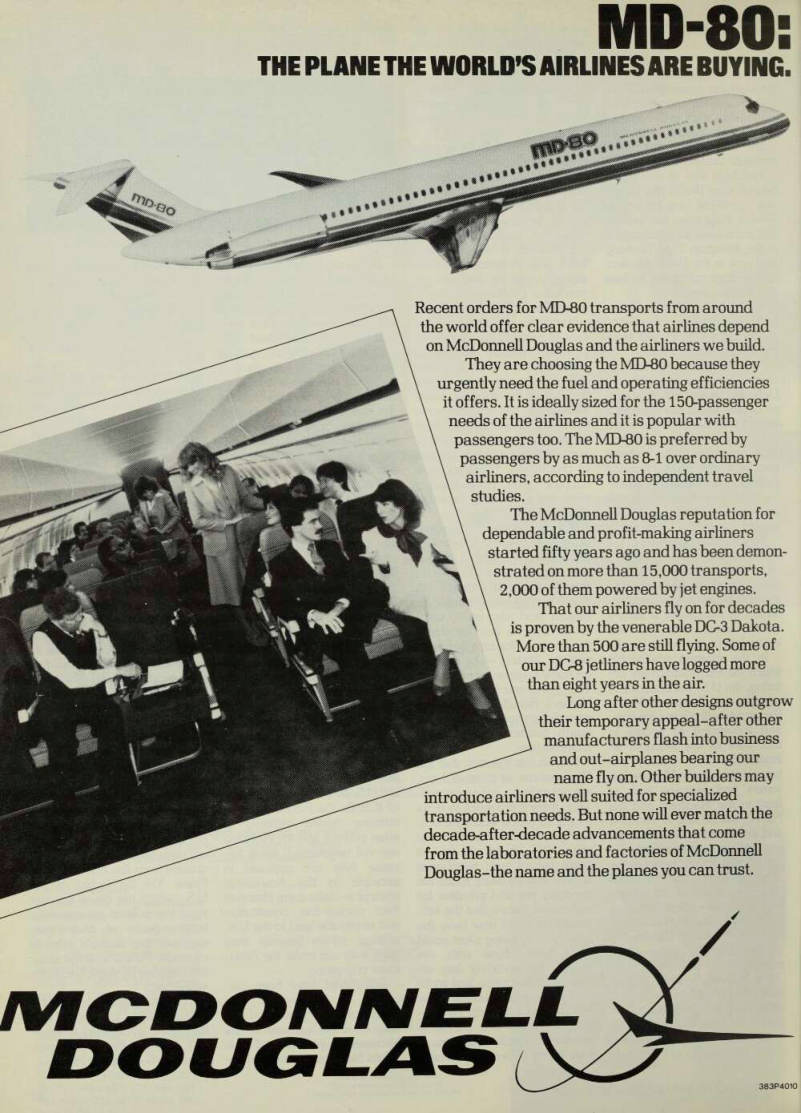
Super 748 can do
Super 748 combines up-to-the-minute flight-deck technology with an engine/airframe combination proven by nearly 4 million hours of operation and incorporating many advanced refinements. Its exceptionally low operating and maintenance costs, outstanding shortfield performance, reliability and passenger appeal have all been established in virtually every kind of short-haul operating environment.
Buying Super 748 today is a better guarantee of lower seat-mile costs than waiting years for the projected and unproven so-called new-technology 40/50-seat twin turboprops to go through their painful proving time and enter service. There is the extra reassurance that Super 748 is backed by a global service organisation which has proven its technical excellence in supporting more than 350 earlier versions of 748 flying with some 80 different operators in 50 different countries.
Super 748 the proven facts ■ operating costs of only 10.65 cents per seat-nautical mile. ■ less than 1 maintenance man-hour per flying hour. ■ outstanding airfield performance. ■ environmental noise levels already well below all existing and proposed international noise standards. ■ ability to fly multi-stop routes without refuelling. ■ pressurised, air-conditioned cabin with reclining seats and ample leg-room for 48 passengers, full cabin-service amenities, overhead luggage bins, and 6.6 cu ft of baggagehold space per passenger.
A
today
un&cjLiaiiGci in fiy&GntGGfinoiosry British Aerospace PLC, Kingston-upon-7harries, England
“Bloody Upset”
Jackson Report
“Bloody Upset” says Somare
Papua New Guinea’s view of Australia has been marked by a splash of acid lately as a result of two important documents now under consideration in Canberra.
The first of these is the Jackson Report, produced at the behest of Foreign Minister, Bill Hayden, which reviews every aspect of Australian fore ign aid. Some of its recom mendations were leaked to the “Sydney Morning Herald.”
The second is the latest Aus tralian defence policy docu ment, details of which were leaked to the “National Times,” a Sydney-based weekly. Papua New Guinea’s prime minister, Mr Michael Somare, reacted angrily to the Jackson Report.
He was, he said in Sydney,
“bloody upset” by the contents of the report.
In the decade since Papua New Guinea gained independ ence Australia has given mas sive sums to support their na tional budget. In 1984/5 it will approach $3OO million and rep resent about a third of all Australian aid spending. Most importantly, the aid has been untied and, broadly, no accounting is asked of Port Moresby.
The Jackson committee sug gests that increasingly over the next five uears, aid should be tied to specific projects, and that those projects should be super vised to see that the money is efficiently employed.
They also say that continued large-scale aid should be made
to some degree contingent upon the PNG government im proving its grip on law and order. The report is critical of PNG’s economic development and administration.
Mr Somare objects, publicly and strenuously to the sug gested changes. “The present system has worked well, the country has strengthened, we are a good contributor to the stability of the region. We have achieved a major redistribution of wealth and income, our people are acquiring a larger share of the resources and opportunities of the private sec tor and we have extended education considerably.”
“All of that has been done in 10 years, without any social upheaval. So why set the clock back?” he demanded.
He said that if aid were tied bureaucracy would grow. Civil servants would “build great empires” while they “supervise us at great expense,” and the result would be less, rather than more efficiency.
A few days later Australia was given another sharp slap by PNG’s foveign minister, Mr Rabbie Namaliu, who is cur rently also more than some what terse with Indonesia over their military actions against Free West Papaua (OPM) re bels in Irian Jaya, and the very tense situation it has caused on the border. (See page 11, this issue).
According to the “National Times” the defence review document proposes that Aus tralia bring pressure to bear on PNG to “suppress the activi ties” of OPM rebels across the border in order to reduce a potential Indonesian threat to Papua New Guinea.
Mr Namaliu sent what is believed to be a very sharp diplomatic note to Canberra and then spoke publicly about what he had told Mr Hayden.
He said his government “would not tolerate” being told by Australia, or any other fore ign government, how to deal with the Free West Papua re bels.
The Pope in Melanesia

When Pope John Paul II steps off his Alitalia jet at Port Mores by’s airport in the late afternoon of May 7, he will not be on completely strange soil.
The indefatigable flying Pon tiff in 1973, when he was a cardinal, visited Polish mis sionaries of the Society of the Divine Word in New Guinea.
According to bishops of the Catholic Episcopal Conference of the Pacific (CEPAC) who visited the Pope in Rome in February, this quick 1984 trip could easily be just a curtain raiser.
The CEPAC bishops have invited him, after he visits Can ada in 1985,t0 fly back to Rome across the Pacific and Asia and make a more ex tended visit to several countries and local Catholic churches in the Polynesian and Micronesian areas not included in his 1984 journey.
He seemed interested and willing to come. He has an instant fellow-feeling for small nations struggling to shake off cultural domination by outside powers. The first non-Italian Pope for centuries is, after all, very much a Pole.
Papua New Guinea and Solomon Islands were logical first destinations during this year’s visit. The Roman Catho lic Church has become a major social force in the life of the Pacific’s most populous coun try.
Prime Minister Michael So mare, a Roman Catholic from the Sepik, is set down to make the welcome speech at Jackson Airport. Father John Momis, for long a stormy petrel and unpre dictable force in PNG politics, along with Father Leo Hannett, might collect at least private pontifical reprimands. Both have been politically involved and aligned, in spite of current directions from Rome to priests all over the world.
Bernard Narakobi, the able lawyer who did so much to frame the Papua New Guinea constitution, is a committed, if rather off-beat, Catholic. His style of life these days differs noticeably from the atmosphere of marble halls, tiaras and biret
tas in the Vatican.
The Holy Father, always well-briefed in advance, will be no stranger to the internal positioning among the many Catholic missionary orders and congregations at work in the various dioceses of Papua New Guinea.
Beneath an over-arching uni ty, determined by loyalty to the hierarchy, the Sacred Heart missionaries, the Divine Word missionaries, the Passionists, Mariannhillers, Montfort mis sionaries, Franciscans and Capuchins are more culturally diversified in their origins and emphases than the numerous Protestant denominations.
Papua New Guinea’s nuns, whether local or from abroad, whether in teaching or social work, are almost equally dissimilar. Some have become restless in their critique of the rich, including the custodians of the wealth of the Church.
One question asked im mediately about this multi-ling ual Pope is whether he would have enough pidgin to open and close his speeches in a way that would endear him to all the wantok.
He will likely allude to one or more saintly Catholic pioneers on New Guinea terrain.
Perhaps there will be a papal accolade of some sort for Alain de Boismenu, trail-blazer of the Papuan mountains, who died in apostolic poverty in a simple hut among his people. Another might go to the controversial and brilliant mystic Marie- Therese Noblet, who bled phy sically with the wounds of Christ and founded a local order of women to work among the very poor.
He would probably mention a martyr he personally beatified last February together with 100 others from many lands. Bles sed John Mazzucconi, of the Milan Fathers, a 29 year old missionary, was slaughtered on Murua Island (Woodlark) in 1855 after earlier surviving a gruesome chapter of accidents in the Solomon Islands. Maz zucconi may now be on the road to canonisation, with the title Saint.
The program has room for such allusions. A two-hour open air mass at Port Moresby’s outdoor stadium soon after arri val is set to be followed by talks with the bishops of the Papua New Guinea-Solomons Con ference and an address to cler gy and laity in the Port Moresby Cathedral.
True to form, the schedule approved is exhausting, calling for an early morning flight on Day Two to Mount Hagen, where another open air mass was due to be concelebrated with the bishops of the High lands.
This quick sortie was predict able. The missionaries of the Divine Word (SVD) there, with many of their pioneers and predecessors, hail from the Pope’s own home Central Europe region. They have been inventive and influential the largest single Catholic force at work along the New Guinea littoral and in the Highlands.
The future of the priesthood is one of the questions always up for scrutiny when bishops from all parts of the Pacific are together.
The expatriate Catholic mis sionary workforce is now statis tically on the wane. The Roman Catholic Church nevertheless frets over being still far more expatriate in its local leadership than the Protestants.
In the parishes the problem is likely to persist. Religious voca tions have declined for both men and women in Europe and America. Pacific Islands govern ments have tightened up on work permits for expatriates.
How can an adequate priest hood, particularly, be properly trained in the consequent race against the clock?
The ideas of ascetic life, individual and solitary, spiritual ity and life-long celibacy, are strange to peoples accustomed for centuries to the sexual ex uberance and reinforcing social warmth of extended families.
Already some married men in the Pacific are in deacon’s orders. More are being trained; but as the rules stand at Rome they can never progress to
becoming full priests of the Church.
If, as is now being strongly urged by many Catholics in Africa, the celibacy rule is varied and married priests are permitted, what happens?
Many who have been celi bate priests for years will want to take wives. The shape of the Church would wobble. Mean while, a steady, though not accurately quantified, leakage from the ranks of seminarians and clergy continues. Some are permitted to be ’’secularised” and then to marry. For the bishops, the problems are con siderable.
John Paul II is expected not to budge on the celibacy issue in 1984 ... or in 1985.
Nor is he likely to shift his stand on birth control.
On other fronts the Pope is expected to renew his repeated warnings with more confidence that the faithful and the general public in the islands would be glad to hear from him.
He fully endorses the process now described by the mystify ing in-house tgerm ’’incultura tion,” which means the growth of local churches expressing themselves at all levels in local Pacific languages, customs, worship and ways of life.
If he visits Eastern and Cen tral Oceania next year he will absorb for himself a message already given to him in advance by the bishops of those areas.
They have told him that the Church of the Poor, which has become so radicalised along militant Marxist-leaning lines in the Philippines and in Central and South America, has diffe rent features on small islands separated by enormous wastes of sea.
The poor, in the frequently subsistence-affluent Pacific Is lands, have to be understood as the marginalised, the neglected, the last to get aid from abroad, the loneliest those who are either exploited or forgotten by
the big geopolitical powers with which the Pope mostly has to contend, He senses this. He might well speak out against atomic testing in the region, the domination of the orignal owners of the land by powerful colonising nations, the spoiling of the environment by waste-dumping and indust rial exploitation - and deface ment of finely-wrought cultures by floods of money and mass produced junk.
These themes could be keynoted if John Paul comes again to Oceania in 1985.
Another aspect of his agenda will also have to be the boom ing ecumenical movement. The local Roman Catholic churches in the Oceania region are in full and active membership, through their bishops’ confer ence, in the Pacific Conference of Churches. Some of the most prominent leaders among Pro testants, Anglicans and Roman Catholics are firm friends.
An advance indication of papal attitudes towards Central Oceania and the Eastern Pacific was given this year. The move came in re-allocation of the ecclesiastical structure in the United States Commonwealth of the Northern Marianas. The Pope detached the Church in Guam from the United States Conference of Bishops. He elevated Guam’s bishop to archbishop, then related his province to the Episcopal Conference of the Pacific Islands (CEPAC), bringing it into the Pacific Conference of Churches. This means Guam’s jurisdiction will now extend to the Caroline and Marshall Islands of Micronesia, which have been placed under the new archbishop. These island groups have been under heavy political and social pressures from the United States. They have, until now, been under the Archbishop of Suva and are therefore already able to be
vocal through CEPAC.
Christians generally in the Marshalls and Carolines are more restive under United States influence than their neighbors in the Northern Marianas. The bishops in the United States might well be hearing new rumblings, via Guam and direct from Rome, about islanders made radio active and homeless by testing, the progressive militarisation of the Trust Territory, and the extensive erosion of pre-Amer ican cultural heritages in the islands, When John Paul flies to spend the third day of his 1984 visit in Honiara, in the Solomon Islands, which is part of his Church’s Melanesian province along with Papua New Guinea, he will move closer to the rest of Oceania. Christians, Catholic and non-Catholic, in Polynesia and Micronesia, are now wait ing to hear about his plans for
1985.
John Garrett.
Advertisements & other items, pp. 15-16 (1 item)
Design
Order
It you suspect ® your current advertising letterheads, brochures, etc. are inadequate, then you're probably right!
For the relatively small cost of posting your liabilities to us, we will send back, within weeks, brilliant ideas tor designs and ads.
The cost of viewing our ideas is free. And if you're not impressed, the cost of returning them by mail is also provided free of course! ADDRESS ALL
CORRESPONDENCE TO
HELIOGRAPH DESIGN
GROUP, 113 GREY ST.
ST K| LDA, VICTORIA;
SUra®*
COMPACT DISC PLAYER
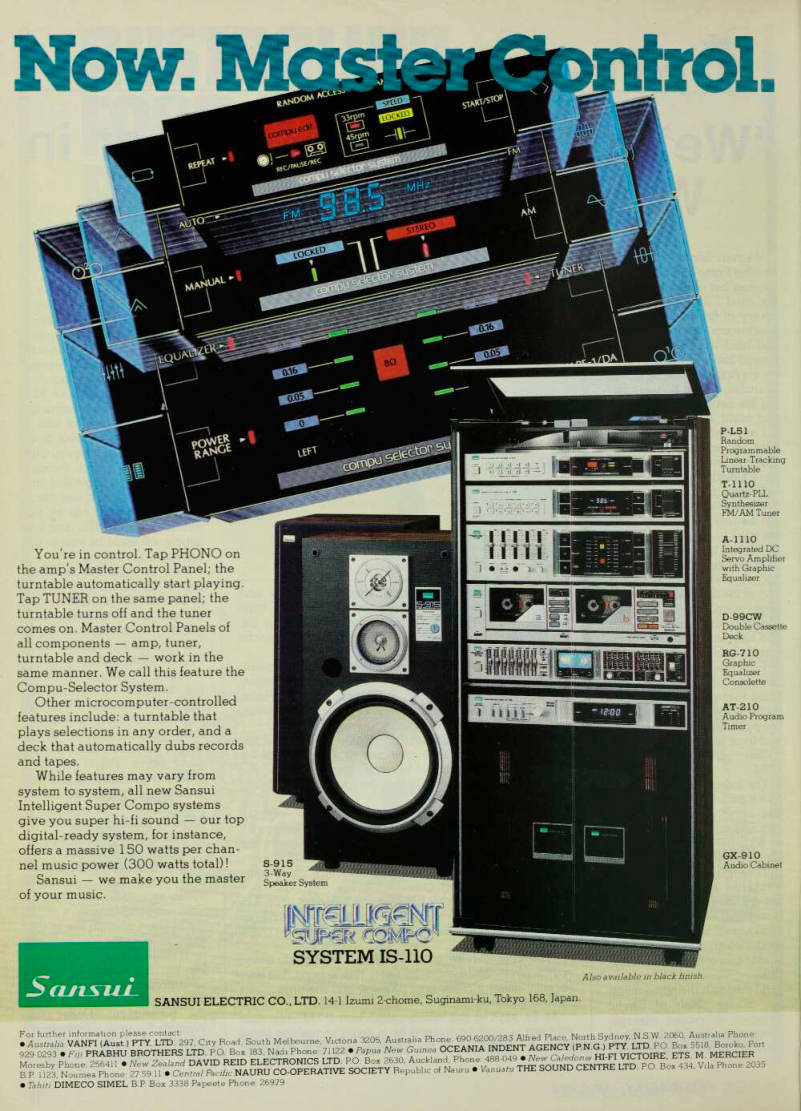
1 |C^ / vV Pioneer bring the miracle of Laser Disc technology to the new P-D7O Compact Disc player.
Now, many of the revolutionary laser-optic and digital electronic techniques first developed for our sensational Laser Disc™ brand videodisc systems are yours to enjoy in the new P-D7O Compact Disc player. Your favourite music is permanently stored in digital form on a pocket-sized disc enabling the total beauty and excitement of a live performance to be re-created in your home.
Here’s how Pioneer does it: ■ 3-spot laser beam with three sophisticated servo systems. ■ Focus parallel drive servo to improve sensitivity and quick search. ■ High-quality audio-use components and a new LSI for better sound. ■ Convenient search and random access put the fun in hi-fi.
All this, plus the always high level of Pioneer design and product reliability. After all, who else looks that far ahead. m
P-D7O
dD PIONEER
For further information, please contact: Australia: Pioneer Electronics Australia Pty. Ltd. (Incorporated in Victoria), P.O. Box 295, Mordialloc, Victoria, 3195 Tel: 580-9911 Fiji Islands: Brijlal & Company, G.P.O. Box No. 362, Suva, Fiji Islands Tel: 22258 New Zealand: Monaco Distributors Ltd., 2 Poland Road, Glenfield, Auckland, New Zealand Tel: (09) 444-9144 Norfolk Island: Burns Philp (Norfolk Island) Ltd., P.O. Box 21, Norfolk Island Vanuatu: Burns Philp (Vanuatu) Ltd., Vila, Vanuatu Nauru Island: Jacob Enterprises, P.O. Box No. 4, Republic of Nauru Tahiti: Tahiti Hi-Fi, P.O. Box 848, Papeete, Tahiti New Caledonia: Menard Pacifique Sari, B.P 3899, Noumea, New Caledonia j e |. 27*62*23 American Samoa: Transpac Corporation, P.O. Box 1477, Pago Pago, American Samoa 96799 Tel: 633-5224 . Tq .. 0 00 7 Rarotonga: South Seas International Ltd., P.O. Box 49, Rarotonga, Cook •slands Tel. 2327 Papua New Guinea: Bali Merchants Pty. Ltd., P.O. Box 6103, Boroko Tel: 254887
Pope’s Program
The high point of the Pope’s historic visit to Port Moresby will be his arrival at Mt Hagen where a crowd of at least 100,000 is expected to turn out in welcome. Originally he was to stay only in the Port Moresby area but, Archbishop Peter Kurongku insisted that the Highlands had to be included. Port Moresby has a Catholic population of about 40,000, but in the Highlands there are at least 700,000.
Months of work by Catholic administrators and church members have produced everything from travel plans arranged down to the last minute for the Pope, and all who want to see him, through official greeting lines, to stacks of T-shirts emblazoned with the message; ’’John Paul ll,mi laikim yu.”
The itinerary and arrangements are as follows-
Monday, May 7:
The Pope arrives aboard a special Italian jet airliner, due into Port Moresby’s Jackson airport at 5 pm. The official party to greet him will include the Governor- General, Sir Kingsford Dibela, the prime minister, Mr Somare, the Archbishop and other church and official dignitaries.
From the airport the Pope will be driven to the Stadium where he will celebrate Mass in the open air at 6 pm. He will leave the Stadium for the papal nunciature at 8.15 pm.
Tuesday, May 8:
At 8 am, the Pope flies from Jackson Airport to Mt Hagen, arriving at Kagamuga Airport at 9 am. He will be driven in a motorcade to the Old Golf Course where the
faithful from five Highland provinces will be gathered for open-air Mass and the Papal blessing.
The Mass is due to end at 12.15 pm. when the Pope will leave for Port Moresby, arriving at the nunciature at 1.45 pm.
At 3.45 pm he will conduct a liturgy, including a blessing of the sick, at St Joseph’s Parish, Boroko. This will be particularly significant for Father Adrian Meaney, the archdiocesan tour co-ordinator, for Boroko is his parish.
At 4.30 pm. he will meet the bishops of Papua New Guinea for 30 minutes and then go to St Mary’s Cathedral where, at 5.15 pm he will celebrate a Liturgy of the Word with bishops, priests, brothers, nuns and laity.
At 6.30 pm Pope John Paul will call on Sir Kingsford and Lady Dibela at their Residence where a large selection of dignitaries, community and business leaders will be assembled.
At 7.15 pm he will return to the nunciature for dinner with the bishops.
Wednesday, May 9:
At 8 am the Pope will leave Jackson Airport for Honiara in Solomon Islands where he will meet civic leaders, visit the prison, and celebrate an open-air Mass. He will return to Port Moresby at 8.50 pm.
Thursday, May 10:
The Pope will depart from Jackson Airport aboard his special Alitalia jet and fly to Bangkok, the final destination of his journey out of the Vatican.
Advertisements & other items, p. 18 (1 item)
good to eot...good to sell
Ask the expert who knows Australia Australian food and beverages give the consumer quality and
value. They give the importer
increased business. And there’s such a great variety available. Widely different climatic conditions enable Australia to produce some of the finest food in the world.
Australia is one of the
world’s largest suppliers of
wheat, sugar, meat, canned fruits, dried fruits, fresh fruits and dairy products. There is also strong international demand for Australian
seafoods, honey, jam,
vegetables, wines and beers.
Over 100 countries are supplied by Australia. And the list of customers is growing.
The Australian Trade Commissioner can give you details of suppliers and also advise you on ways to research or develop markets in Australia. You can contact an Australian Trade Commissioner at:
FIJI
PC. Box 1252, Suva.
Phone; 31 2844 Telex: FJ2126
PAPUA NEW GUINEA
PC. Box 9129, Hohola.
Phone: 25 9333 Telex: NE22109
NEW CALEDONIA
PC. Box 22, Noumea.
Phone: 27 2414 Telex: 087
HAWAII
Australian Consulate. 1000 Bishop Street, Hawaii, 96813, USA.
Phone; (808) 524 5050 Telex: 633128 CP & M 2 TJ. m Wa
DQO
m tD
IS] Ask the Australian Trade Commissioner
W. Samoa” - says Eti.
political currents
“We’re Turning the Corner in W. Samoa” - says Eti.
Western Samoa’s bulky and amiable Prime Minister, Tofelau Eti, has but one major idea in his mind ... the economic re covery of his small nation. His watchwords are self-reliance and hard work. When I inter viewed him in his spartan office on the Apia seafront, he quoted Churchill, saying he was offer ing his people only toil, tears and sweat. But then he chuck led and said it really wasn’t as hard as some people com plained and improvements were already notable.
Tofelau Eti’s administration does seem to have taken West ern Samoa a long way down the road to economic recovery in the last two years.
At that time the government had an overdraft of $13.2 mil lion at the national bank, owed large sums for oil, cement, cigarettes and airline services, and had twice fallen foul of the International Monetary Fund.
Today, after two quite rapid currency devaluations, and some measures which brought a good deal of grumbling from the public, the overdraft is gone and there was a surplus of $2.2 million at the beginning of 1984.
The foreign exchange debt of $13.8 million, locked in for oil and other essential commod ities and services, is now down to $5.3 million and the World Bank, which has just been in Apia looking at the books and taking the national pulse, has not only given Tofelau’s admin istration an A for effort, but has pronounced Western Samoa a model which other small third world countries should emu late.
All this, says the prime minis ter, is the result of careful attention to proper manage ment rules, which, he is quick to point out with notable relish, his
In the last 12 months, by a combination of guts, luck, and a shrewd appreciation of his own people and their abilities, Western Samoa’s prime minister, Tofelau Eti, has hauled his country much of the way out of a financial and political morass.
Since 1982 the country has had four prime ministers and three governments. In the past there was heavy spending, and little attention to the fine detail of fragile, small-country economics. Today, under Eti, things are less heady, but more stable.
In Apia Eti is not popular with some politically-active people, but he is a wise politician who knows that his power lies with the chiefs in the rural villages, and he pays great attention to them, cajoling, demanding, but always leading.
It was Tupuola Efi, aggressive, opinionated, who put Western Samoa on the international map. It is Tofelau Eti who has brought stabilisation and a plan for growth. His government seems likely to be re-elected next February and, on that basis stability, and international confidence, in W.Samoa will likely grow.
The budget is in pretty fair shape, dependent upon $25 million in aid funds, mostly from Australia and N.Z., but providing for expenditure of $85.6 million, much of it going into development.
The Public Service, which threw the country into chaos with a three-month strike in 1981, has a gripe, but was recently given a 5 per cent pay rise and their rumblings have diminished.
As Eti says in this conversation with P.1.M., his main problem is productivity, and he is doing something about that
predecessor, Tupuola Efi, seemed to ignore.
Of course, Tofelau Eti has been lucky as well as shrewd .. a powerful combination indeed.
Prices for agricultural commod ities upon which Western Samoa depends very heavily, have lately been very good. ”We had a surplus of $l4 million in our foreign exchange earnings last year,” he said.”l think that within a month or so’ we will be able to do away with the allocation system through which we have controlled im ports ... that system was intro duced seven years ago by the former government ... and our people will again be able to get the items they want.”
How stringent the allocation system has been is very evident in Samoa’s shops where empty shelves are everywhere and prices for even very basic items like toothpaste, imported from Fiji, are quite high.
Apia’s ’’coconut wireless” has developed a keen ear for the ’’cigarette rumor” which has the effect of creating long in stant queues outside shops alleged to have obtained sup plies. Burns Philp got their shipment of cigarettes just the other day ... eight cartons of them ... and the queue of hopeful smokers, or traders, stretched far down the street.
Tofelau Eti is confident he will be re-elected next Febru ary, but says there is yet much to do to consolidate Western Samoan prosperity.
His great strength lies in the grass roots of the country, and he is very conscious of this fact.
He has the attention of, and widespread support among, the village chiefs who, in fact, elect the government. Under the Western Samoan system, con firmed by a national referen dum, village chiefs hold the
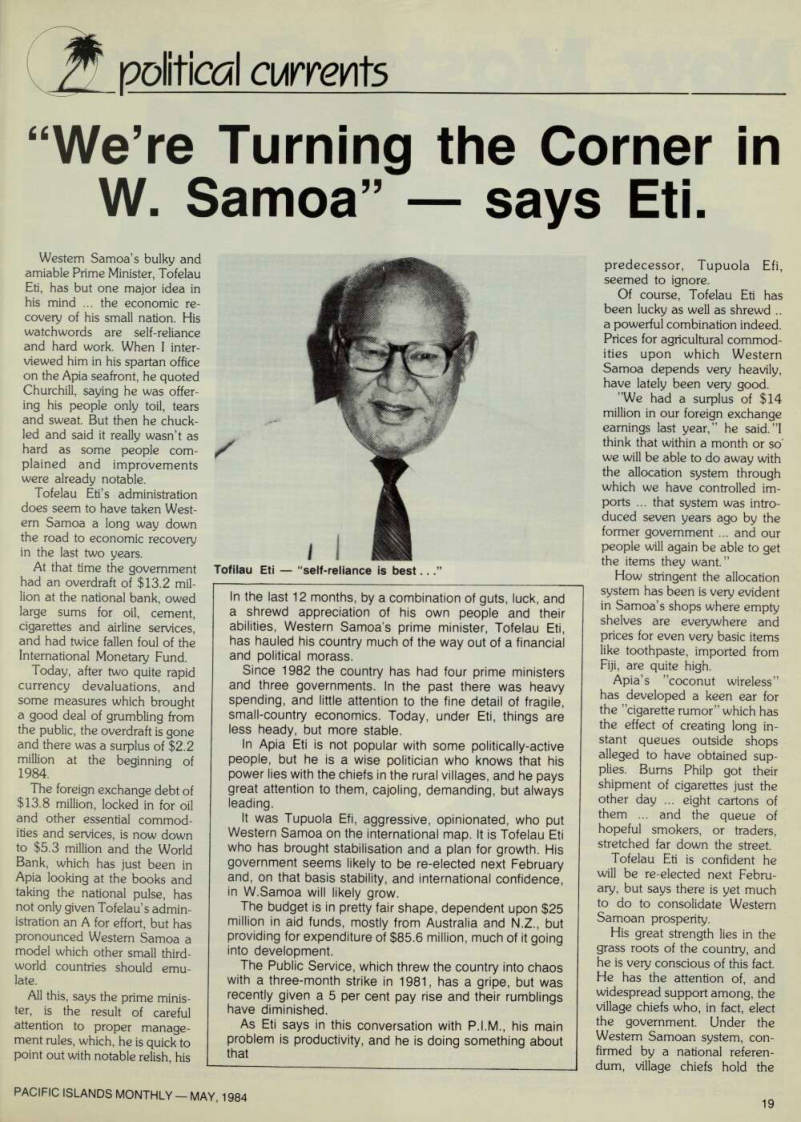
Tofilau Eti - “self-reliance is best..."
proxies of their people in na tional elections. Some say uni versal suffrage is coming, but probably slowly. Meantime the system has general public sup port and allows Tofelau Eti to manage the country’s affairs rather more easily than might otherwise be. ’’When I introduce new mea sures I always tell them they will be swallowing a pill not everyone will like,” he said. ”1 tell them that, but I also tell them WHY the hard times are necessary. The former govern ment did not want to put the house in order, but it MUST be put in order...and then things will be much, much better for everyone. ”
Samoa is currently enjoying a bonanza in prices for her goods.
Copra is now at WSs4l2 a tonne, and cocoa at WSS3SOO a tonne, both higher than they have ever been. ”Our biggest problem is pro ductivity,” the prime minister told me. ”Our farms could produce much more .. they have to produce much more. ”Our available manpower must be organised, and that is what I am doing by talking to the people and to the chiefs. ”1 want to make the country self-reliant. I don’t want everyone waiting for the teams from the agriculture department to come around to tell them what to do, and even to do it. ”So I talk to the chiefs, and I tell them there is a bill which recognises the authority of the chiefs, and they must realise that it means they have a
responsibility to their people. ’’They must not think they can just sit around and be chiefs, and do nothing,” he said with a grin.
The prime minister is a man of great enthusiasm, and he is also a very good and clever grass roots politician, for he knows his people and has not lost touch with the villages.
In the towns, especially among the young intelligentsia, he is frequently criticised for his ’’failure to overcome the coun try’s problems.” But this seems to be the impatience of youth, and the reaction of smaller groups, rather than the wide spread opinion of the country.
Among businessmen, and foreign diplomats, he is re spected and admired, and the general feeling in these areas seems to be that the country is emerging from its troubled times, and is now set on a careful, conservative, and con structive course. But there is much yet to be done.
Tofelau Eti says, with jus tification, that nobody in West ern Samoa needs a Doctor of Philosophy at their shoulder to plant a coconut. But since ’’the previous government closed the nurseries three years before we came to power, we now have to arrange supplies of planting materials from the Solomons, and perhaps even from Papua New Guinea where they have a surplus of these things,” he said. ”In another year’s time we will be back on the road to providing these things ourselves. The agriculture de
partment has started the nurseries again. ”So this year, of 1984, is for sustaining the growth we have had. Last year we stabilised things. This year, and the three years after that, if my govern ment is re-elected, will be years of growth and a return to prosperity. ’’Then, maybe, we can re value our currency. Inflation is down a little, and with hard work and organisation we can take it down further. We can get the cost of living down and return to normalcy in our eco nomy.”
The key to much, if not all, of this ... the economic turn around, and the guarded confi dence Tofelau Eti shares with his business and diplomatic community, is the expansion and development of Apia’s Faleolo Airport.
At least WS$lO million, and probably nearer WSsl4 mil lion, will be spent here up grading the strip to handle Boeing 727 and similar aircraft, and the passenger and freight loads they can carry.
Work has already started (although it has been subjected to some slight delays because of a land dispute with local villa gers), and government negotia tions are under way with Aus tralia, New Zealand and Japan about total funding.
Tofelau Eti wants the donor countries to advance their aid packages two or three years to give him the finance for the vital project.
Australia may do this. New Zealand, which bears the cost of running, maintaining and servicing the airport, may not, but will be helpful in other directions.
Bigger aircraft (though not yet, and perhaps never, any thing as big as a Boeing 747), will swell a two-way traffic of tourists in, and agricultural pro ducts out. ”1 don’t want to be too optimistic,” he said, ’’but I have my faith that if we devise things properly in our minds, if we plan and work, and get the people to cooperate, then we can be successful. ”1 don’t want my country to be an asking country all the time. I want us to be self-reliant, and we can be.”
Development of tourism is already looking up. Richard
Hadley, the millionaire Amer ican entrepreneur who, ten years ago, started the big Royal Samoan Hotel project around the point from Apia town, and then stopped it when he be came wary of Samoa’s pros pects, and could not get assur ances about development of the airport, team from the Had ley organisation was in Apia just before Christmas, 1983, and Hadley himself has now been back to talk with Tofelau Eti about resumption of work.
The project is for a 500-room hotel with, probably, a casino, which would operate entirely for tourists. Tofelau Eti is now nudging 60 years of age, but is the picture of health, is full of enthusiasm, plans, and hopes.
He believes in his people, and in the virtues of hard work and the use of traditional social systems to organise it.
But he has also learned to be cautious. ”1 have been elected since 1957,” he said. ’’But I was beaten in 1973 .. only by six votes, but beaten .. and it was because I was over-confident.
Over-confidence breeds mis takes. ”
I asked him to enumerate the problems he saw ahead of Western Samoa, and he thought carefully for a time. ”Our defence we have already discussed with Austra lia, New Zealand and the Un ited States,” he said, clearly confident of their support. ”Our people are being made aware of what they must do to be prosperous. ”Our only problem is with trade, and perhaps a little with education. ”Our debt-servicing ratio, which was at 20 per cent after the last government finished, is now back to 14 per cent of revenue, and is likely to go down still further. ”We sometimes have too much politics ... politicians who want to arouse the public and make them impatient, but it’s not really a problem. ’’There is a strong tendency of our people to migrate to New Zealand, mostly for family reasons, but some come back, too. (It is estimated that about 100,000 Samoans, including foreign-bom Samoan offspring, now live in New Zealand). ’’Samoa is a very good coun try to live in, but no-one likes it when there are economic prob
Apia Elegance ... “Vailima” the old homestead of Robert Louis Stevenson.
lems and upsets,” he said.
As for the educational prob lems he sees, much of this is connected with the hoped-for establishment of a national uni versity of Samoa.
There are probably two reasons why Tofelau Eti’s gov ernment, and some others, would like their own university.
One, clearly enough, is that they feel students of a national university would be much more ”in tune” with their home than if they went away to Fiji and returned, probably with a whole bunch of radical ideas.
The other may have to do with the fact that there is a university in the country already, run by the Congre gationalist church, the biggest church in Western Samoa, but it reportedly suffers from lack of funds. Most students go to the University of the South Pacific, based in Suva, Fiji.
USP’s agriculture faculty is, however, in Apia, and is heavily over-subscribed for 1984.
Tofelau Eti himself, associ ated as he is with the Con gregational church, would, fair ly naturally, like to see a na tional university established, but seems fairly philosophical about it.
But one move has already been made by the establish ment of a 7th form, known as the university foundation year, in Apia for 1984. This will be funded by scholarship money given by Australia and New Zealand ... money which other wise would have gone mostly to USP in Suva where, previously, most Samoan university aspir ants did their foundation year.
Tofelau Eti has received some criticism for allowing this to be done on very short notice. ”lt we keep sending our students abroad, they forget the problems we have at home,” he said. ’’They come back expecting to be spoon-fed.
Then, if a government cannot give them what they demand, there are strikes and troubles like that. ”We don’t want that sort of thing in Samoa. They have got them in Fiji .. trade unions and strikes .. but it is too early for us to have them. ’’While we are developing, we have to conserve our strength,” he said •
“I have sensed in the last months,” said Sir Robert, “that some of the island states have re thought their attitude to ANZUS which they have taken for granted in the past, and have said that while they don’t wish to be a partner in ANZUS... they are nevertheless very happy to have the ANZUS umbrella over them.
“This has come about, I believe, because there was a change of government in Aus tralia and some of the things that had been said by the Australian Labor Party when (it) was in the opposition wor ried the ANZUS partners. For tunately Mr Hawke, when he became prime minister, very quickly made it clear that he was pro-ANZUS, and a lot of things that were feared did not
eventuate.
“Inside 12 months ANZUS is back to where it was before the change in government and, be cause these issues were addres sed publicly, it is stronger than ever. Because, what it means is that as far as Australia is con cerned, regardless of who may be the government, they will be pro-ANZUS.
“But the effect of it ... this is really where I started ... is that the island states have had to think about ANZUS in a way they have not had to previous ly. They have said we like the ANZUS umbrella. Now that’s good, because it means that if there is any cooperation needed it will be forthcoming, and cooperation again would be limited to perhaps visits by American warships when they are in the area, and the kind of cooperation that has to exist
when you are an independent state and you’ve got a defence treaty that in effect covers your area. ”
“What do we mean by a nuclear-free Pacific, or a nuc lear-free South Pacific, more precisely? It is an issue that has come up in the Forum regular ly. There is no clear picture of what is meant because when we have discussed it with the Hawke government we find that there is nothing that we can put our finger on that repre sents a change from the present situation,” said Sir Robert.
“We all oppose French nuc lear testing. We all oppose nuclear testing whether it is in the South Pacific or not. That’s a firm position...
“We, and Australia, fall short of saying that we will not have American warships with nuclear propulsion in the South Pacific
because we regard that as in consistent with our membership in ANZUS. You cannot say we have got a defence treaty with the U.S. which means that the U.S. will come to our rescue if we are attacked, but they must not bring any one of 40 per cent of the American Navy ... they can only bring ships with conventional propulsion sys tems. Plainly, that would be ridiculous.
“As to nuclear weapons, the Americans will never disclose whether a ship is carrying nuc lear weapons. I accept that. The Hawke government accepts that. Why should we tell the Soviet Union precisely the capability of various ships of “The Soviet Union has ex panded its activities tremendously over recent years and established new bases ... they are very active in the Pacific ... the one thing they would dearly love to have, I believe, is a land-based pre sence in the South Pacific ... they were rebuffed, and the principal reason why they were rebuffed is the existence of the
South Pacific Forum which is very cohesive. The leaders of the island states would far soon er be members of the Forum ...than be satellites of the Soviet Union,” Sir Robert said.
“One has to be very careful here (in discussing French atti tudes on New Caledonia),” said Sir Robert. “Am I convinced they are doing the right thing? I would not use those precise words. I am satisfied with what they are doing. I believe the present French government sincerely intends to move New Caledonia to independence in the shortest possible time, and I would put a time-scale of five years on it.
“I believe that there is still a difficulty in that the independ ence movement has not yet accepted the fact that you can not have a Kanak state with everyone else as second-class citizens ... I have said ... as far as New Zealand is concerned, we could not support any indepen dent state where all of those citizens who are of French or part-French origin don’t have the same value of vote as the Melanesians.
“Now, that is in my mind the only issue of substance that is preventing a rapid movement toward independence. In other words, it is a constitution that’s required, and the way to do it is to have a mixed electorate so everyone has a vote of the same value, but you vote in such a fashion as to preserve the nationalist aspirations of the indigenous people.
“1 think independence will come. I don’t think there are any problems there. I have talked to President Mitterrand a number of times ... it is not a question of whether it will come, but when...”
Sir Robert said he thought “Vanuatu has caused some concern. There is no question about that. But I see signs of maturity in that government.
They are less strident today than they were even a year ago ... in the broader sense, although they established direct diplomatic relations with Cuba, my feeling is that it was more a gesture than anything of real substance. ”
“New Zealand is the honest broker of the Pacific. To some
extent we have a foot in both camps. We are small, but we are affluent. We earn our living from the sale of primary pro ducts, as do many Third World countries.
“When someone says to us ’the price of sugar has collapsed and our economy is in trouble,’ we understand. Because if the price of butter or wool col lapses, our economy is in trou ble.
“The reason why I am so active in (urging international monetary reform) is because we do come very much be tween the developed and deve loping world. There are no votes in this for me, because at home the people do not fully understand what it is all about.
They say the prime minister is travelling when he should be at home. But we are the go between,” Sir Robert said. “At New Delhi we were seen as that by the Commonwealth heads of government .. it was the Third World countries that wanted New Zealand to lead the reform effort because they understood that we could be an honest broker...”
Advertisements & other items, p. 20 (1 item)
Suji^uL
C 2 e(St cor^ 3 Si i
OC^O
* V 80 o.^ o.os mim T-1110 w*
D-99CW
Double Cassette Deck
lit
AT-210 Audio Program Timer GX-910 m r am You're in control. Tap PHONO on the amp's Master Control Panel; the turntable automatically start playing.
Tap TUNER on the same panel; the turntable turns off and the tuner comes on. Master Control Panels of all components amp, tuner, turntable and deck work in the same manner. We call this feature the Compu-Selector System.
Other microcomputer-controlled features include: a turntable that plays selections in any order, and a deck that automatically dubs records and tapes.
While features may vary from system to system, all new Sansui Intelligent Super Compo systems give you super hi-fi sound our top digital-ready system, for instance, offers a massive 150 watts per channel music power (300 watts total)!
Sansui we make you the master of your music.
SYSTEM IS-110
Suji^uL
Also available in black finish.
SANSUI ELECTRIC CO., LTD. 14-1 Izumi 2-chome, Suginami-ku, Tokyo 168, Japan.
For further information please contact: con som/ORR flltreH Place North Svdnev N SW. 2060, Australia Phone: SSS.’ THE SOUND CENTRE LTD. PO. Box 434, Vila Ph0„0:203 5 • Tahiti DIMECO SIMEL B.P Box 3338 Papeete Phone: 26979
"Honest Rob's Almanac
of Pacific Wisdom
Behind his heavy eyelids, New Zealand’s prime minister, Sir Robert Muldoon, views the Pacific and the world with the scepticism of a veteran politician. The former accountant knows the importance of the balance sheet, both fiscal and political.
That is why 62-year old Muldoon spent over a month in February and March circling the globe. The ostensible reason was to preach his sermon of international monetary reform ... his passion ... in France, the United Kingdom, Ireland and in the United States.
Audiences with Francois Mitterrand, Margaret Thatcher, and Ronald Reagan, gave Muldoon, and New Zealand, more coverage by the international press than either has received in many years. For example, Hobart Rowen, the Washington Post’s highly-respected economics analyst, devoted an entire column to Sir Robert’s views, saying that the stocky PM and finance minister ’’clearly enjoys his self assumed role of international gadfly” on the question of monetary reform.
Muldoon’s exhausting trip gave New Zealand higher visibility on the world scene. For a country of three million, it was a job well done.
In Honolulu Sir Robert took time to speak to Pacific Islands Monthly’s FLOYD K. TAKEUCHI. It was a wide-ranging discussion which touched upon finance, America’s role in Oceania, the nuclear issue, New Caledonia, Vanuatu, and the Soviet Union’s strategic and political interests in the islands.
Advertisements & other items, pp. 23-24 (1 item)
Technics
There’s never been a compact portable hi-fi like it. The new Technics CO9 will thrill you with its dynamic and realistic sound reproduction. With 200 watts power output, it delivers incredibly clear sound indoors or out, even at earthshaking volume levels.
“3-Dimensional” Space Display
This big music machine will turn on your eyes as well as your ears with its dramatic Space Display, a “3-dimensional” source level indicator. And when you record from any kind of input source, the Space Display acts as a peak level indicator.
1-hand Graphic Equalizer
A built-in 7-band graphic equalizer puts you behind the controls. You’re free to tailor the sound to fit the environment and your personal music tastes. You can even record tapes with special equalization. And the 4-band (FM/MW/SWI/SW2) radio gives you sharp reception of your favorite stations.
Home hi-fi too Indoors, the CO9 becomes the core of a sophisticated home entertainment center. The 2-way linear phase speakers disconnect so that you can spread them out to enjoy a wider stereo image. If you add a turntable, the Co9’s low-noise 3-stage phono EQ circuit ensures
high quality disc reproduction.
And the CD/video input terminal permits it to be connected to a CD player or VTR.
The CO9. It’s a Technics.
COS
The CO9 comes in Black (shown) or Silver
Technics
National, Panasonic and Technics are the brandnames of Matsushita Electric.
■muij'j PS® >Ji '3>!
First break on the Roncaglia OPR mill gives a higher flour release because the time factor from cereal to flour is only 7-10 secs. Using pneumatic conveying and sifting compared with traditional milling systems thus producing whiter, superior quality high yield flour.
This is only one of the many advantages of the Roncaglia OPR milling system, if you wish to know more write, telex or phone or fill in coupon and post to Roncaglia.
RONCAGUA
OPR
Officine Roncaglia S.p.A 1-41100 Modena - Italy Viale Reiter 51 /2 - Tel. (059) 21.88.99-21.85.51 -24.10.52 - Telex 213384-216089-510169 RONCALI
The Micronesian imbroglio
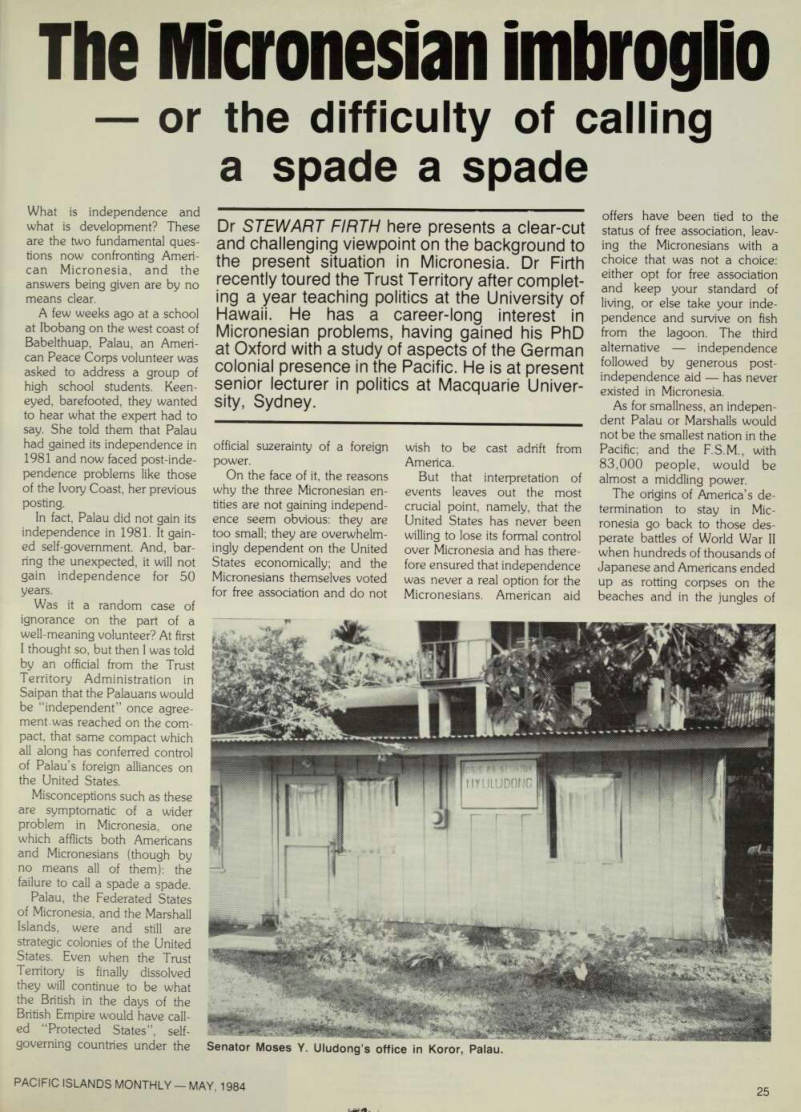
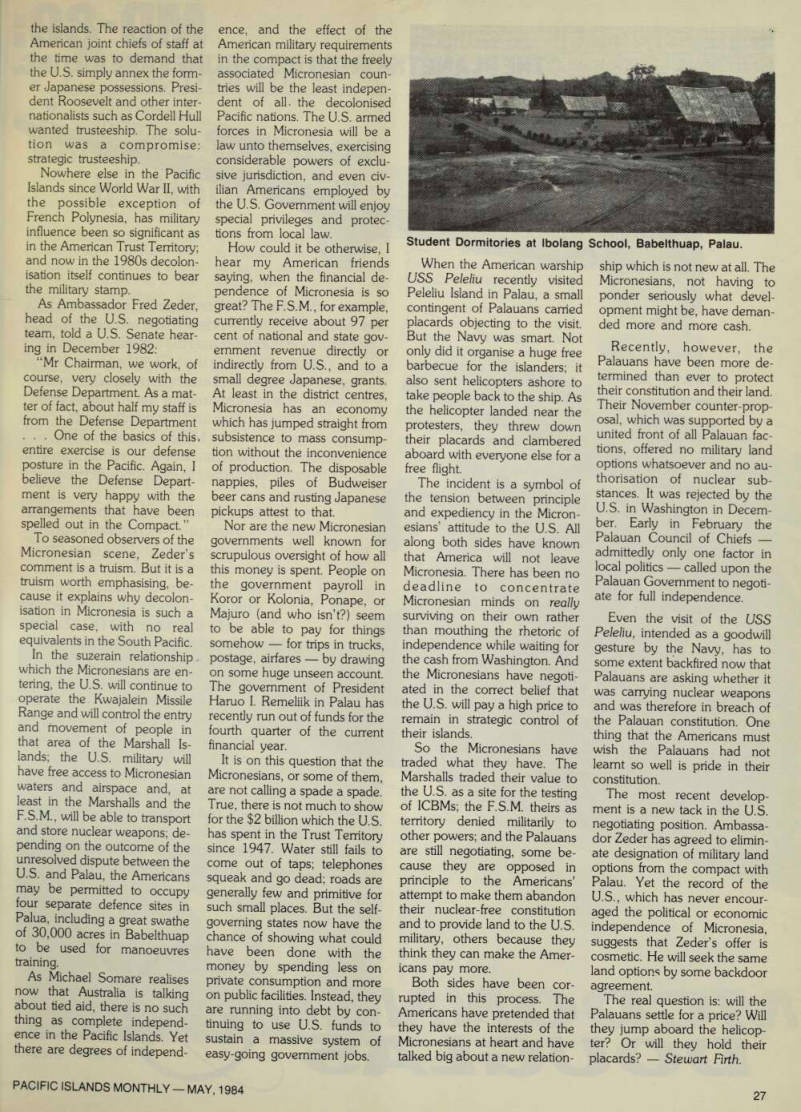
- or the difficulty of calling a spade a spade
Dr STEWART FIRTH here presents a clear-cut and challenging viewpoint on the background to the present situation in Micronesia. Dr Firth recently toured the Trust Territory after complet ing a year teaching politics at the University of Hawaii. He has a career-long interest in Micronesian problems, having gained his PhD at Oxford with a study of aspects of the German colonial presence in the Pacific. He is at present senior lecturer in politics at Macquarie Univer
sity, Sydney.
What is independence and what is development? These are the two fundamental ques tions now confronting Ameri can Micronesia, and the answers being given are by no means clear.
A few weeks ago at a school at Ibobang on the west coast of Babelthuap, Palau, an Ameri can Peace Corps volunteer was asked to address a group of high school students. Keen eyed, barefooted, they wanted to hear what the expert had to say. She told them that Palau had gained its independence in 1981 and now faced post-inde pendence problems like those of the Ivory Coast, her previous posting.
In fact, Palau did not gain its independence in 1981. It gain ed self-government. And, bar ring the unexpected, it will not gain independence for 50 years.
Was it a random case of ignorance on the part of a well-meaning volunteer? At first I thought so, but then I was told by an official from the Trust Territory Administration in Saipan that the Palauans would be “independent” once agree ment was reached on the com pact, that same compact which all along has conferred control of Palau’s foreign alliances on the United States.
Misconceptions such as these are symptomatic of a wider problem in Micronesia, one which afflicts both Americans and Micronesians (though by no means all of them): the failure to call a spade a spade.
Palau, the Federated States of Micronesia, and the Marshall Islands, were and still are strategic colonies of the United States. Even when the Trust Territory is finally dissolved they will continue to be what the British in the days of the British Empire would have call ed “Protected States”, self governing countries under the
official suzerainty of a foreign power.
On the face of it, the reasons why the three Micronesian en tities are not gaining independ ence seem obvious: they are too small; they are overwhelm ingly dependent on the United States economically; and the Micronesians themselves voted for free association and do not
wish to be cast adrift from America.
But that interpretation of events leaves out the most crucial point, namely, that the United States has never been willing to lose its formal control over Micronesia and has there fore ensured that independence was never a real option for the Micronesians. American aid
offers have been tied to the status of free association, leav ing the Micronesians with a choice that was not a choice: either opt for free association and keep your standard of living, or else take your inde pendence and survive on fish from the lagoon. The third alternative independence followed by generous post independence aid has never existed in Micronesia.
As for smallness, an indepen dent Palau or Marshalls would not be the smallest nation in the Pacific; and the F.S.M., with 83,000 people, would be almost a middling power.
The origins of America’s de termination to stay in Mic ronesia go back to those des perate battles of World War II when hundreds of thousands of Japanese and Americans ended up as rotting corpses on the beaches and in the jungles of
Senator Moses Y. Uludong’s office in Koror, Palau.
the islands. The reaction of the American joint chiefs of staff at the time was to demand that the U.S. simply annex the form er Japanese possessions. Presi dent Roosevelt and other inter nationalists such as Cordell Hull wanted trusteeship. The solu tion was a compromise: strategic trusteeship.
Nowhere else in the Pacific Islands since World War 11, with the possible exception of French Polynesia, has military influence been so significant as in the American Trust Territory; and now in the 1980 s decolon isation itself continues to bear the military stamp.
As Ambassador Fred Zeder, head of the (J.S. negotiating team, told a U.S. Senate hear ing in December 1982: “Mr Chairman, we work, of course, very closely with the Defense Department. As a mat ter of fact, about half my staff is from the Defense Department . . . One of the basics of this, entire exercise is our defense posture in the Pacific. Again, I believe the Defense Depart ment is very happy with the arrangements that have been spelled out in the Compact.”
To seasoned observers of the Micronesian scene, Zeder’s comment is a truism. But it is a truism worth emphasising, be cause it explains why decolon isation in Micronesia is such a special case, with no real equivalents in the South Pacific.
In the suzerain relationship which the Micronesians are en tering, the U.S. will continue to operate the Kwajalein Missile Range and will control the entry and movement of people in that area of the Marshall Is lands; the U.S. military will have free access to Micronesian waters and airspace and, at least in the Marshalls and the F.S.M., will be able to transport and store nuclear weapons; de pending on the outcome of the unresolved dispute between the U.S. and Palau, the Americans may be permitted to occupy four separate defence sites in Palua, including a great swathe of 30,000 acres in Babelthuap to be used for manoeuvres training.
As Michael Somare realises now that Australia is talking about tied aid, there is no such thing as complete independ ence in the Pacific Islands. Yet there are degrees of independ
ence, and the effect of the American military requirements in the compact is that the freely associated Micronesian coun tries will be the least indepen dent of all- the decolonisec Pacific nations. The U.S. armed forces in Micronesia will be a law unto themselves, exercising considerable powers of exclu sive jurisdiction, and even civ ilian Americans employed by the U.S. Government will enjoy special privileges and protec tions from local law.
How could it be otherwise, I hear my American friends saying, when the financial de pendence of Micronesia is so great? The F.S.M., for example, currently receive about 97 per cent of national and state gov ernment revenue directly or indirectly from U.S., and to a small degree Japanese, grants.
At least in the district centres, Micronesia has an economy which has jumped straight from subsistence to mass consump tion without the inconvenience of production. The disposable nappies, piles of Budweiser beer cans and rusting Japanese pickups attest to that.
Nor are the new Micronesian governments well known for scrupulous oversight of how all this money is spent. People on the government payroll in Koror or Kolonia, Ponape, or Majuro (and who isn’t?) seem to be able to pay for things somehow for trips in trucks, postage, airfares by drawing on some huge unseen account.
The government of President Haruo I. Remeliik in Palau has recently run out of funds for the fourth quarter of the current financial year.
It is on this question that the Micronesians, or some of them, are not calling a spade a spade.
True, there is not much to show for the $2 billion which the U.S. has spent in the Trust Territory since 1947. Water still fails to come out of taps; telephones squeak and go dead; roads are generally few and primitive for such small places. But the self governing states now have the chance of showing what could have been done with the money by spending less on private consumption and more on public facilities. Instead, they are running into debt by con tinuing to use U.S. funds to sustain a massive system of easy-going government jobs.
When the American warship USS Peleliu recently visited Peleliu Island in Palau, a small contingent of Palauans carried placards objecting to the visit.
But the Navy was smart. Not only did it organise a huge free barbecue for the islanders; it also sent helicopters ashore to take people back to the ship. As the helicopter landed near the protesters, they threw down their placards and clambered aboard with everyone else for a free flight.
The incident is a symbol of the tension between principle and expediency in the Micron esians’ attitude to the U.S. All along both sides have known that America will not leave Micronesia. There has been no deadline to concentrate Micronesian minds on really surviving on their own rather than mouthing the rhetoric of independence while waiting for the cash from Washington. And the Micronesians have negoti ated in the correct belief that the U.S. will pay a high price to remain in strategic control of their islands.
So the Micronesians have traded what they have. The Marshalls traded their value to the U.S. as a site for the testing of ICBMs; the F.S.M. theirs as territory denied militarily to other powers; and the Palauans are still negotiating, some be cause they are opposed in principle to the Americans’ attempt to make them abandon their nuclear-free constitution and to provide land to the U.S. military, others because they think they can make the Amer icans pay more.
Both sides have been cor rupted in this process. The Americans have pretended that they have the interests of the Micronesians at heart and have talked big about a new relation
ship which is not new at all. The Micronesians, not having to ponder seriously what devel opment might be, have deman ded more and more cash.
Recently, however, the Palauans have been more de termined than ever to protect their constitution and their land.
Their November counter-prop osal, which was supported by a united front of all Palauan fac tions, offered no military land options whatsoever and no au thorisation of nuclear sub stances. It was rejected by the U.S. in Washington in Decem ber. Early in February the Palauan Council of Chiefs admittedly only one factor in local politics called upon the Palauan Government to negoti ate for full independence.
Even the visit of the USS Peleliu, intended as a goodwill gesture by the Navy, has to some extent backfired now that Palauans are asking whether it was carrying nuclear weapons and was therefore in breach of the Palauan constitution. One thing that the Americans must wish the Palauans had not leamt so well is pride in their constitution.
The most recent develop ment is a new tack in the U.S. negotiating position. Ambassa dor Zeder has agreed to elimin ate designation of military land options from the compact with Palau. Yet the record of the U.S., which has never encour aged the political or economic independence of Micronesia, suggests that Zeder’s offer is cosmetic. He will seek the same land options by some backdoor agreement.
The real question is: will the Palauans settle for a price? Will they jump aboard the helicop ter? Or will they hold their placards? Stewart Firth.
student Dormitories at lbolang School, Babelthuap, Palau.
Advertisements & other items, pp. 26-28 (1 item)
A Memorable Exception
Hotel Shilla;
In the heart of Seoul the Hotel Shilla. surrounded by beautiful wooded gardens, renders a traditional Korean ambience
inspired by the renowned Shilla Dynasty.
A free shuttle bus runs around town every 15 minutes and to the airport 5 times daily.
With 738 suites and rooms. 16 banquet rooms and international restaurants, we offer services tailored to the needs of guests who wish to enjoy a unique and charming experience.
For Reservation: • Hotel Shilla Representative Office ‘New York: (201) 592- 6027 (collect) •Tokyo; (03) 586-7571 »Osaka: (06) 271- 7571 Odner Hotels Representative Office ‘Hong Kong; (5) 262251 •Taipei: 5515933 ‘Singapore: 2353474 ‘Bangkok: 2521181 HR! Office ‘U.S.A. (except N.Y. State); 800-223- 6800 (toll free) ‘N.Y. State: (212) 838-3110 (collect) ‘London: (01) 583-3050 ‘Paris: (6) 079-0000 ‘Frankfurt: (0611) 283345 ‘Riyadh: (01) 464-8411 •Sydney: 233-8422 *Sao Pau-
<SkiMa.
Seoul, Korea 202, 2-Ca, Jangchung-Dong, Chung-Ku. Seoul. Korea Tel: 295-3111, 3121. 3131, 3141, Cable: HOTELSHILLA C.RO Box: 7000 Telex: SHILLA K 24257. 24160 U ( c 77ic t feadmg f Wore/s of the World Represented
A )AL HOTEL SYSTEM
JOHN A. TETLIT CO.. IMC.
C»ux International Association Odner Motel Representative* Ltd lOHR
Iff
MD-80: THE PLANE THE WORLD’S AIRLINES ARE ROVING. . *** « « * * i* »» «» »»«* / *** *•»* *» * Recent orders for MD-80 transports from around the world offer clear evidence that airlines depend on McDonnell Douglas and the airliners we build.
They are choosing the MD-80 because they urgently need the fuel and operating efficiencies it offers. It is ideally sized for the 150-passenger needs of the airlines and it is popular with passengers too. The MD-80 is preferred by passengers by as much as 8-1 over ordinary airliners, according to independent travel studies.
The McDonnell Douglas reputation for dependable and profit-making airliners started fifty years ago and has been demonstrated on more than 15,000 transports, 2,000 of them powered by jet engines.
That our airliners fly on for decades is proven by the venerable DC-3 Dakota.
More than 500 are still flying. Some of our DC-8 jetliners have logged more than eight years in the air.
Long after other designs outgrow their temporary appeal-after other manufacturers flash into business and out-airplanes bearing our name fly on. Other builders may introduce airliners well suited for specialized transportation needs. But none will ever match the decade-after-decade advancements that come from the laboratories and factories of McDonnell Douglas-the name and the planes you can trust. /
MCDONNELL
the month
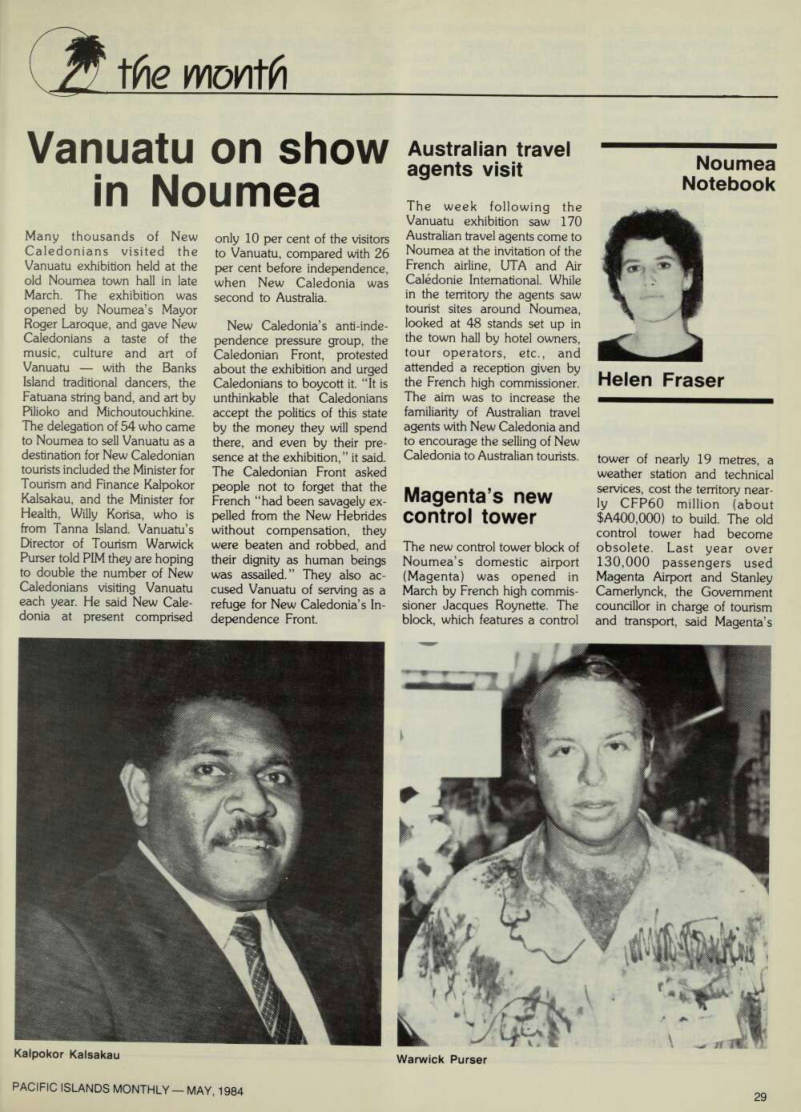

Vanuatu on show in Noumea
Many thousands of New Caledonians visited the Vanuatu exhibition held at the old Noumea town hall in late March. The exhibition was opened by Noumea’s Mayor Roger Laroque, and gave New Caledonians a taste of the music, culture and art of Vanuatu with the Banks Island traditional dancers, the Fatuana string band, and art by Pilioko and Michoutouchkine.
The delegation of 54 who came to Noumea to sell Vanuatu as a destination for New Caledonian tourists included the Minister for Tourism and Finance Kalpokor Kalsakau, and the Minister for Health, Willy Korisa, who is from Tanna Island. Vanuatu’s Director of Tourism Warwick Purser told PIM they are hoping to double the number of New Caledonians visiting Vanuatu each year. He said New Cale donia at present comprised
only 10 per cent of the visitors to Vanuatu, compared with 26 per cent before independence, when New Caledonia was second to Australia.
New Caledonia’s anti-inde pendence pressure group, the Caledonian Front, protested about the exhibition and urged Caledonians to boycott it. “It is unthinkable that Caledonians accept the politics of this state by the money they will spend there, and even by their pre sence at the exhibition,” it said.
The Caledonian Front asked people not to forget that the French “had been savagely ex pelled from the New Hebrides without compensation, they were beaten and robbed, and their dignity as human beings was assailed.” They also ac cused Vanuatu of serving as a refuge for New Caledonia’s In dependence Front.
Australian travel
agents visit
The week following the Vanuatu exhibition saw 170 Australian travel agents come to Noumea at the invitation of the French airline, UTA and Air Caledonie International. While in the territory the agents saw tourist sites around Noumea, looked at 48 stands set up in the town hall by hotel owners, tour operators, etc., and attended a reception given by the French high commissioner.
The aim was to increase the familiarity of Australian travel agents with New Caledonia and to encourage the selling of New Caledonia to Australian tourists.
Magenta’s new
control tower
The new control tower block of Noumea’s domestic airport (Magenta) was opened in March by French high commis sioner Jacques Roynette. The block, which features a control
tower of nearly 19 metres, a weather station and technical services, cost the territory near ly CFP6O million (about $A400,000) to build. The old control tower had become obsolete. Last year over 130,000 passengers used Magenta Airport and Stanley Camerlynck, the Government councillor in charge of tourism and transport, said Magenta’s
Kalpokor Kalsakau
Noumea Notebook
Helen Fraser
Warwick Purser
runway would be extended to 1500 metres later this year. This would enable the airport to develop international links with close neighbors, Mr Camer lynck said.
Yacht found
in Darwin
The 12-metre yacht Ouvea was returned to Noumea and its owners, Noumea Yacht Char ters, in March. The yacht had been stolen last September after having been chartered by New Caledonian school teacher Michel Orvoen. The yacht was recovered in Darwin in late
December and Mr Orvoen was arrested by Australian authori ties for the use of false docu ments. He had also attempted to disguise the boat. In January, Mr Orvoen was sentenced to two months jail and his extradi tion to New Caledonia was expected. A crew of three were hired in Darwin to bring the Ouvea the 3000 miles back to Noumea.
A memorable
weekend ...
Saturday, March 24 was a day of general mobilisation by the Independence Front (IF), with
15 European farms occupied and symbolic traditional - huts built on most. IF leaders told newsmen on the eve of March 24, that their aim was to make the French Government under stand their claim to Kanak independence, and their de termination to achieve it.
The leaders of the five parties said they did not intend chasing people out of New Caledonia, but wanted France to recognise the legitimacy of Kanak inde pendence.
In reply to the charge of Republican leader Jacques Laf leur that the land occupations were “Marxist terrorism” and that the IF sought to instal “Kanak Marxist Independence” in New Caledonia, Nidoish Naisseline said the IF had never claimed to be Marxist.
Mr Naisseline said this was a cynical attempt by Mr Lafleur to set non-Kanak workers against the IF by a campaign of fear. Mr Lafleur was also accused of hypocrisy in, on the one hand attacking the Australian and French governments, and on the other strengthening his commercial dealings with these governments.
Mr Lafleur and the Republi can Party’s senator in the French parliament, Dick Ukeiwe, had called on Caledo nians to mobilise on March 24, and to reply to the IF with occupations of IF leaders’ homes. The Caledonian Front had warned that if the authori ties did not do their duty and maintain respect for French law and for democratic principles, their members would do it in their place.
On March 23, the French high commissioner addressed the population as tensions appeared to be mounting. Mr Roynette said “it seemed the territory could be the scene of an agitation which threatens the security of people and property, and which puts public order at risk”.
Mr Roynette assured the population that state authorities would assume their responsibi lities and would be present at all places judged useful. The high commissioner said he was cer tain “there was still a place for measure, sang froid and reason, and that this appeal would be heard”.
The sale of alcohol was ban-
Advertisements & other items, p. 30 (1 item)
Acific
TOYOTA DATSUN MITSUBISHI MAZDA HONDA ISUZU HINO
JAPANESE RECONDITIONED USED CARS
We Export
i CniUijM
Top Quality
Quick Delivery
Please contact to:
Inter Continental ltd.
P.0.80X 194 NAKA
Economical Price 2-16-13 sakae naka-ku
NAGOYA 460 JAPAN
TELEPHONE: 052-211-5125
TELEX: 0442-4880 INCONT J
CABLE: INCONT NAGOYA
ACIFIC
CONSTRUCTION EQUIPMENT CO
introducing the Dynamic new Range of
vibrating s Pneumatic Tyred Rollers
THE RANGE
• Pacific Self-Propelled Vibrating Rollers • Single and Double Drum Types • 1.5 tonne to 16 tonne • Pacific Self-Propelled Pneumatic Type Compactors • 3 Models 16. 21. 38 tonne Ballast Weights • Pacific Landfil and Sanitary Landfil Compactors • Pacific Pneumatic Earth Borers • Pacific Road Brooms • Pacific Railway Maintenance Vehicles
DISTRIBUTORS REQUIRED
THROUGHOUT THE PACIFIC
Construction Equipment Co. 24 Salisbury Road, Hornsby NSW 2077. Phone (02) 4762666
SAL
SPLiTSSE
‘Kastom meresin’
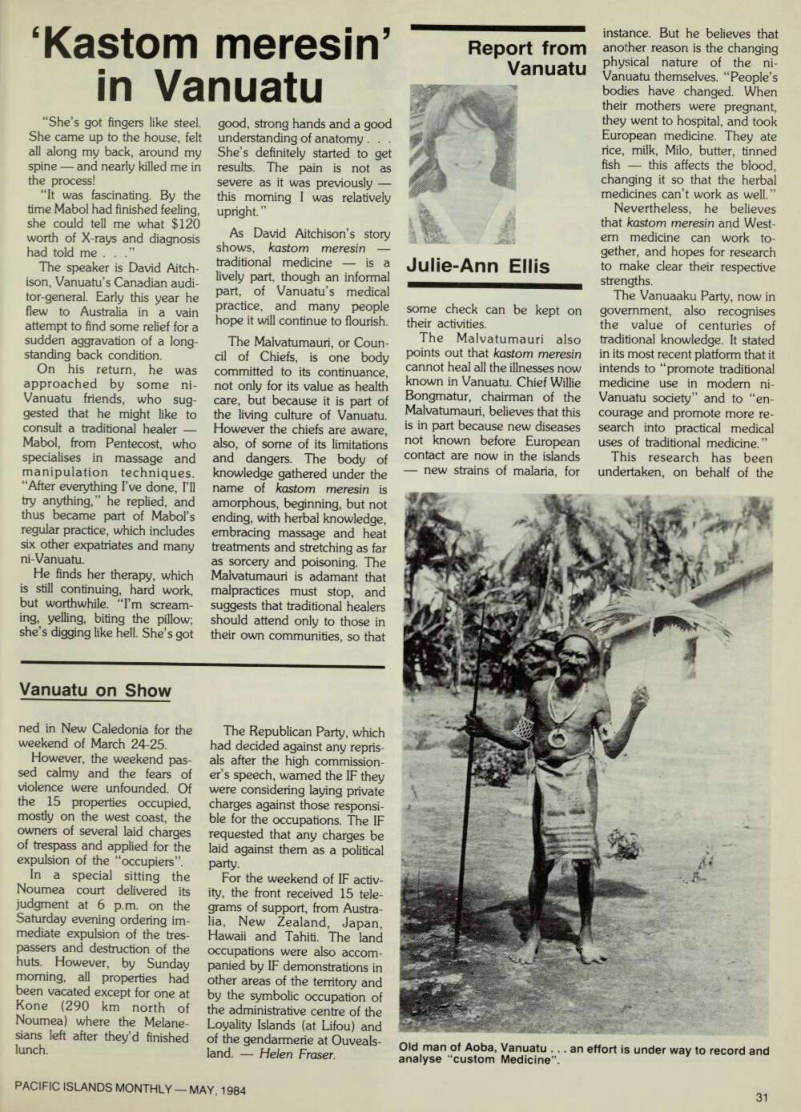
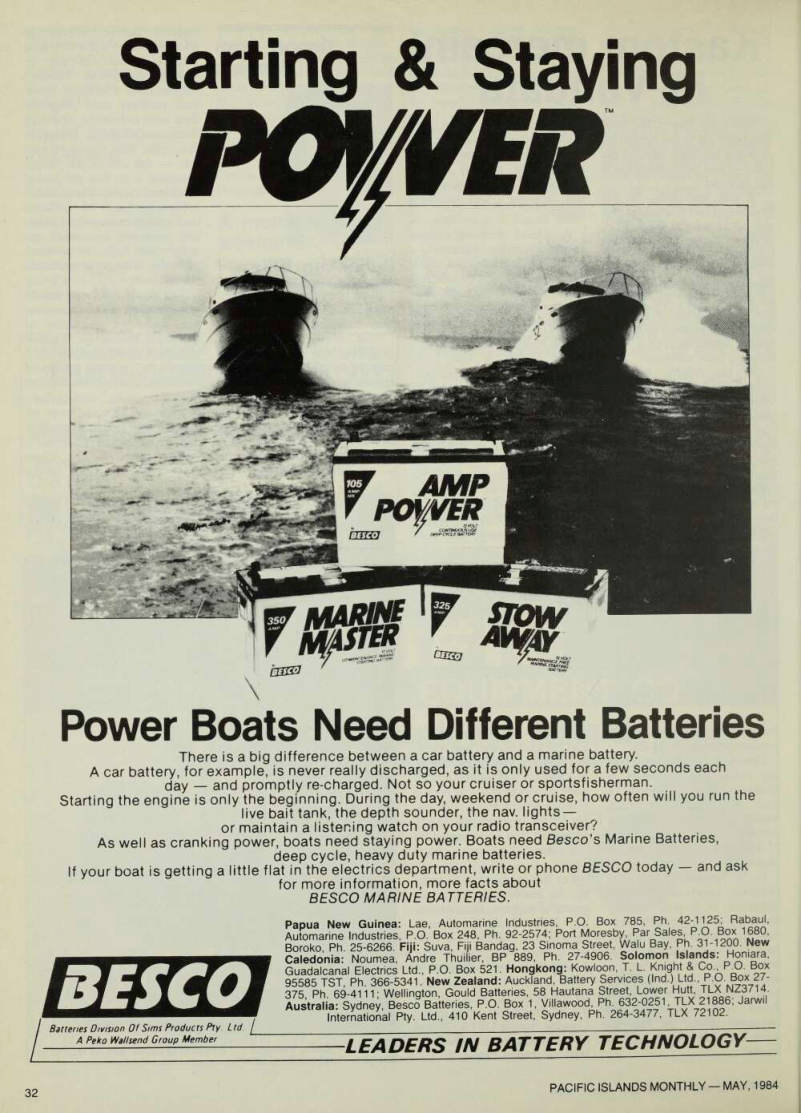
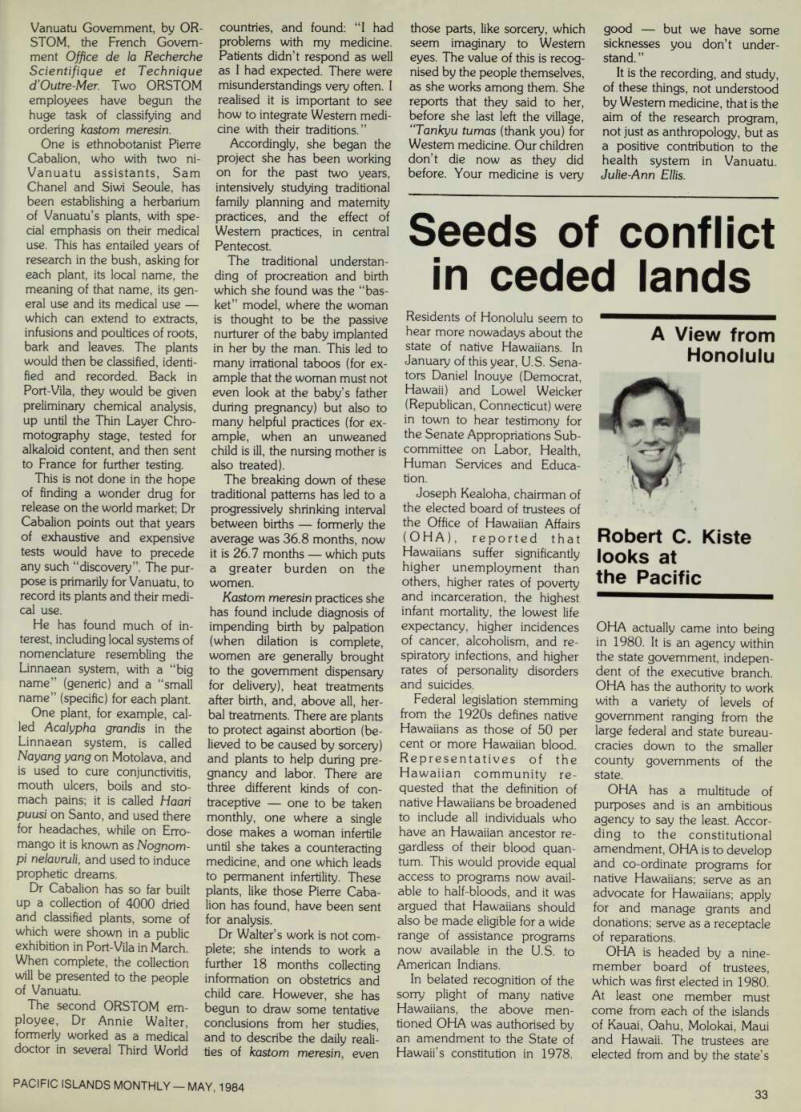
in Vanuatu
“She’s got fingers like steel, She came up to the house, felt all along my back, around my spine and nearly killed me in the process!
“It was fascinating. By the time Mabol had finished feeling, she could tell me what $l2O worth of X-rays and diagnosis had told me ”
The speaker is David Aitchison, Vanuatu’s Canadian auditor-general. Early this year he flew to Australia in a vain attempt to find some relief for a sudden aggravation of a longstanding back condition.
On his return, he was approached by some ni- Vanuatu friends, who suggested that he might like to consult a traditional healer Mabol, from Pentecost, who specialises in massage and manipulation techniques, “After everything I’ve done, I’ll try anything,” he replied, and thus became part of Mabol’s regular practice, which includes six other expatriates and many ni-Vanuatu.
He finds her therapy, which is still continuing, hard work, but worthwhile. “I’m screaming, ? yelling, biting the pillow; she s digging like hell. She’s got
good, strong hands and a good
understanding of anatomy . . .
She’s definitely started to get results. The pain is not as severe as it was previously this morning I was relatively upright. ” .i a , L As Da " d Aitchison s story shows, kastom meresin 1 medicine - is a I,ve y ? n info ™ a part ’ of Vanuatu s medlc f l P ra <*ce, tmd many peopte hope “ wlll contmue t 0 flourish - The Malvatumauri, or Coun cil of Chiefs, is one body committed to its continuance, not only for its value as health care, but because it is part of the living culture of Vanuatu, However the chiefs are aware, also, of some of its limitations and dangers. The body of knowledge gathered under the name of kastom meresin is amorphous, beginning, but not ending, with herbal knowledge, embracing massage and heat treatments and stretching as far as sorcery and poisoning. The Malvatumauri is adamant that malpractices must stop, and suggests that traditional healers should attend only to those in their own communities, so that
some check can be kept on their activities.
The Malvatumauri also points out that kastom meresin cannot heal all the illnesses now known in Vanuatu. Chief Willie Bongmatur, chairman of the Malvatumauri, believes that this is in part because new diseases not known before European contact are now in the islands new strains of malaria, for
instance. But he believes that another reason is the changing physical nature of the ni- Vanuatu themselves. “People’s bodies have changed. When their mothers were pregnant, they went to hospital, and took European medicine. They ate rice, milk, Milo, butter, tinned fish this affects the blood, changing it so that the herbal medicines can’t work as well. ”
Nevertheless, he believes that kastom meresin and West ern medicine can work to gether, and hopes for research to make clear their respective strengths.
The Vanuaaku Party, now in government, also recognises the value of centuries of traditional knowledge. It stated in its most recent platform that it intends to “promote traditional medicine use in modem ni- Vanuatu society” and to “en courage and promote more re search into practical medical uses of traditional medicine.”
This research has been undertaken, on behalf of the
Report from Vanuatu
Julie-Ann Ellis
Old man of Aoba, Vanuatu ... an effort is under way to record and analyse “custom Medicine”.
Vanuatu Government, by OR STOM, the French Govern ment Office de la Recherche Scientifique et Technique d’Outre-Mer. Two ORSTOM employees have begun the huge task of classifying and ordering kastom meresin.
One is ethnobotanist Pierre Cabalion, who with two ni- Vanuatu assistants, Sam Chanel and Siwi Seoule, has been establishing a herbarium of Vanuatu’s plants, with spe cial emphasis on their medical use. This has entailed years of research in the bush, asking for each plant, its local name, the meaning of that name, its gen eral use and its medical use which can extend to extracts, infusions and poultices of roots, bark and leaves. The plants would then be classified, identi fied and recorded. Back in Port-Vila, they would be given preliminary chemical analysis, up until the Thin Layer Chro motography stage, tested for alkaloid content, and then sent to France for further testing.
This is not done in the hope of finding a wonder drug for release on the world market; Dr Cabalion points out that years of exhaustive and expensive tests would have to precede any such “discovery”. The pur pose is primarily for Vanuatu, to record its plants and their medi cal use.
He has found much of in terest, including local systems of nomenclature resembling the Linnaean system, with a “big name” (generic) and a “small name” (specific) for each plant.
One plant, for example, cal led Acalypha grandis in the Linnaean system, is called Nayang yang on Motolava, and is used to cure conjunctivitis, mouth ulcers, boils and sto mach pains; it is called Haari puusi on Santo, and used there for headaches, while on Erro mango it is known as Nognom pi nelavruli, and used to induce prophetic dreams.
Dr Cabalion has so far built up a collection of 4000 dried and classified plants, some of which were shown in a public exhibition in Port-Vila in March.
When complete, the collection will be presented to the people of Vanuatu.
The second ORSTOM em ployee, Dr Annie Walter, formerly worked as a medical doctor in several Third World
countries, and found; “I had problems with my medicine.
Patients didn’t respond as well as I had expected. There were misunderstandings very often. I realised it is important to see how to integrate Western medi cine with their traditions.”
Accordingly, she began the project she has been working on for the past two years, intensively studying traditional family planning and maternity practices, and the effect of Western practices, in central Pentecost.
The traditional understan ding of procreation and birth which she found was the “bas ket” model, where the woman is thought to be the passive nurturer of the baby implanted in her by the man. This led to many irrational taboos (for ex ample that the woman must not even look at the baby’s father during pregnancy) but also to many helpful practices (for ex ample, when an unweaned child is ill, the nursing mother is also treated).
The breaking down of these traditional patterns has led to a progressively shrinking interval between births formerly the average was 36.8 months, now it is 26.7 months which puts a greater burden on the women.
Kastom meresin practices she has found include diagnosis of impending birth by palpation (when dilation is complete, women are generally brought to the government dispensary for delivery), heat treatments after birth, and, above all, her bal treatments. There are plants to protect against abortion (be lieved to be caused by sorcery) and plants to help during pre gnancy and labor. There are three different kinds of con traceptive one to be taken monthly, one where a single dose makes a woman infertile until she takes a counteracting medicine, and one which leads to permanent infertility. These plants, like those Pierre Caba lion has found, have been sent for analysis.
Dr Walter’s work is not com plete; she intends to work a further 18 months collecting information on obstetrics and child care. However, she has begun to draw some tentative conclusions from her studies, and to describe the daily reali ties of kastom meresin, even
those parts, like sorcery, which seem imaginary to Western eyes. The value of this is recog nised by the people themselves, as she works among them. She reports that they said to her, before she last left the village, “Tankyu tumas (thank you) for Western medicine. Our children don’t die now as they did before. Your medicine is very
good but we have some sicknesses you don’t under stand. ”
It is the recording, and study, of these things, not understood by Western medicine, that is the aim of the research program, not just as anthropology, but as a positive contribution to the health system in Vanuatu.
Julie-Ann Ellis.
Vanuatu on Show
ned in New Caledonia for the weekend of March 24-25.
However, the weekend pas sed calmy and the fears of violence were unfounded. Of the 15 properties occupied, mostly on the west coast, the owners of several laid charges of trespass and applied for the expulsion of the “occupiers”.
In a special sitting the Noumea court delivered its judgment at 6 p.m. on the Saturday evening ordering im mediate expulsion of the tres passers and destruction of the huts. However, by Sunday morning, all properties had been vacated except for one at Kone (290 km north of Noumea) where the Melane sians left after they’d finished lunch.
land.
The Republican Party, which had decided against any repris als after the high commission er’s speech, warned the IF they were considering laying private charges against those responsi ble for the occupations. The IF requested that any charges be laid against them as a political party.
For the weekend of IF activ ity, the front received 15 tele grams of support, from Austra lia, New Zealand, Japan, Hawaii and Tahiti. The land occupations were also accom panied by IF demonstrations in other areas of the territory and by the symbolic occupation of the administrative centre of the Loyality Islands (at Lifou) and of the gendarmerie at Ouveals-
Helen Fraser.
Advertisements & other items, p. 32 (1 item)
Starting & Staying
VER
m W. jr f.
AMP
fflgm
7 y
stow
OHS
OJB3
Power Boats Need Different Batteries
There is a big difference between a car battery and a marine battery.
A car battery, for example, is never really discharged, as it is only used for a few seconds each day a nd promptly re-charged. Not so your cruiser or sportsfisherman.
Starting the engine is only the beginning. During the day, weekend or cruise, how often will you run the live bait tank, the depth sounder, the nav. lights or maintain a listening watch on your radio transceiver?
As well as cranking power, boats need staying power. Boats need Besco's Marine Batteries, deep cycle, heavy duty marine batteries.
If your boat is getting a little flat in the electrics department, write or phone BESCO today and ask for more information, more facts about
BESCO MARINE BATTERIES.
BESCO
Batteries Division Of Sims Products Pty Ltd j_ A Peko Wa/lsend Group Member Papua New Guinea: Lae, Automarine Industries, P.O. Box 785, Ph. 42-1125, Ftabaul, Automarine Industries, P.O. Box 248, Ph. 92-2574; Port Moresby Par Sales PXD Box 168 a Boroko, Ph. 25-6266. Fiji: Suva, Fiji Bandag, 23 Sinoma Street, Walu Bay, Ph. 31-1200. New Caledonia: Noumea, Andre Thuilier, BP 889, Ph. 27-4906. Solomon Islands: Honiara, Guadalcanal Electrics Ltd., P.O. Box 521. Hongkong: Kowloon, T. L. Knight & c O-P_O- Box 95585 IST, Ph. 366-5341. New Zealand: Auckland, Battery Services (Ind.) Ltd., P-O- 80x_27- 375 Ph 69-4111; Wellington, Gould Batteries, 58 Hautana Street, Lower Hutt, TLX NZ3714 Australia: Sydney, Besco Batteries, P.O. Box 1, Villawood, Ph. 632-0251 TLX 21886, Jarwil International Pty. Ltd., 410 Kent Street, Sydney, Ph. 264-3477, TLX 72102.
LEADERS IN BATTERY TECHNOLOGY
Seeds of conflict

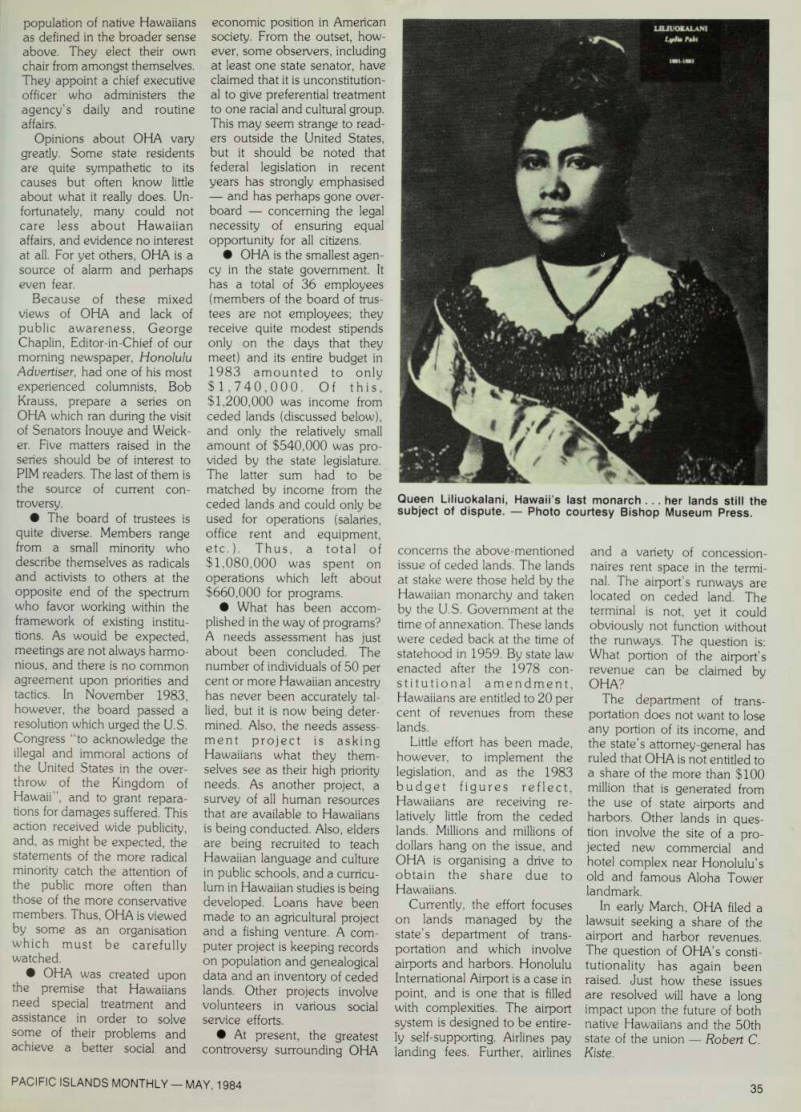
in ceded lands
Residents of Honolulu seem to hear more nowadays about the state of native Hawaiians. In January of this year, U.S. Sena tors Daniel Inouye (Democrat, Hawaii) and Lowel Weicker (Republican, Connecticut) were in town to hear testimony for the Senate Appropriations Sub committee on Labor, Health, Human Services and Educa tion.
Joseph Kealoha, chairman of the elected board of trustees of the Office of Hawaiian Affairs (OHA), reported that Hawaiians suffer significantly higher unemployment than others, higher rates of poverty and incarceration, the highest infant mortality, the lowest life expectancy, higher incidences of cancer, alcoholism, and re spiratory infections, and higher rates of personality disorders and suicides.
Federal legislation stemming from the 1920 s defines native Hawaiians as those of 50 per cent or more Hawaiian blood.
Representatives of the Hawaiian community re quested that the definition of native Hawaiians be broadened to include all individuals who have an Hawaiian ancestor re gardless of their blood quan tum. This would provide equal access to programs now avail able to half-bloods, and it was argued that Hawaiians should also be made eligible for a wide range of assistance programs now available in the U.S. to American Indians.
In belated recognition of the sorry plight of many native Hawaiians, the above men tioned OHA was authorised by an amendment to the State of Hawaii’s constitution in 1978.
OHA actually came into being in 1980. It is an agency within the state government, indepen dent of the executive branch, OHA has the authority to work with a variety of levels of government ranging from the large federal and state bureau cracies down to the smaller county governments of the state.
OHA has a multitude of purposes and is an ambitious agency to say the least. Accor ding to the constitutional amendment, OHA is to develop and co-ordinate programs for native Hawaiians; serve as an advocate for Hawaiians; apply for and manage grants and donations; serve as a receptacle of reparations, OHA is headed by a nine member board of trustees, which was first elected in 1980.
At least one member must come from each of the islands of Kauai, Oahu, Molokai, Maui and Hawaii. The trustees are elected from and by the state’s
A View from Honolulu
Robert C. Kiste looks at the Pacific
population of native Hawaiians as defined in the broader sense above. They elect their own chair from amongst themselves.
They appoint a chief executive officer who administers the agency’s daily and routine affairs.
Opinions about OHA vary greatly. Some state residents are quite sympathetic to its causes but often know little about what it really does. Un fortunately, many could not care less about Hawaiian affairs, and evidence no interest at all. For yet others, OHA is a source of alarm and perhaps even fear.
Because of these mixed views of OHA and lack of public awareness, George Chaplin, Editor-in-Chief of our morning newspaper, Honolulu Advertiser, had one of his most experienced columnists, Bob Krauss, prepare a series on OHA which ran during the visit of Senators Inouye and Weick er. Five matters raised in the series should be of interest to PIM readers. The last of them is the source of current con troversy. • The board of trustees is quite diverse. Members range from a small minority who describe themselves as radicals and activists to others at the opposite end of the spectrum who favor working within the framework of existing institu tions. As would be expected, meetings are not always harmo nious, and there is no common agreement upon priorities and tactics. In November 1983, however, the board passed a resolution which urged the U.S.
Congress “to acknowledge the illegal and immoral actions of the United States in the over throw of the Kingdom of Hawaii”, and to grant repara tions for damages suffered. This action received wide publicity, and, as might be expected, the statements of the more radical minority catch the attention of the public more often than those of the more conservative members. Thus, OHA is viewed by some as an organisation which must be carefully watched. • OHA was created upon the premise that Hawaiians need special treatment and assistance in order to solve some of their problems and achieve a better social and
economic position in American society. From the outset, how ever, some observers, including at least one state senator, have claimed that it is unconstitution al to give preferential treatment to one racial and cultural group.
This may seem strange to read ers outside the United States, but it should be noted that federal legislation in recent years has strongly emphasised and has perhaps gone over board concerning the legal necessity of ensuring equal opportunity for all citizens. • OHA is the smallest agen cy in the state government. It has a total of 36 employees (members of the board of trus tees are not employees; they receive quite modest stipends only on the days that they meet) and its entire budget in 1983 amounted to only $1,740,000. Of this, $1,200,000 was income from ceded lands (discussed below), and only the relatively small amount of $540,000 was pro vided by the state legislature.
The latter sum had to be matched by income from the ceded lands and could only be used for operations (salaries, office rent and equipment, etc.). Thus, a total of $1,080,000 was spent on operations which left about $660,000 for programs. • What has been accom plished in the way of programs?
A needs assessment has just about been concluded. The number of individuals of 50 per cent or more Hawaiian ancestry has never been accurately tal lied, but it is now being deter mined. Also, the needs assess ment project is asking Hawaiians what they them selves see as their high priority needs. As another project, a survey of all human resources that are available to Hawaiians is being conducted. Also, elders are being recruited to teach Hawaiian language and culture in public schools, and a curricu lum in Hawaiian studies is being developed. Loans have been made to an agricultural project and a fishing venture. A com puter project is keeping records on population and genealogical data and an inventory of ceded lands. Other projects involve volunteers in various social service efforts. • At present, the greatest controversy surrounding OHA
concerns the above-mentioned issue of ceded lands. The lands at stake were those held by the Hawaiian monarchy and taken by the U.S. Government at the time of annexation. These lands were ceded back at the time of statehood in 1959. By state law enacted after the 1978 con stitutional amendment, Hawaiians are entitled to 20 per cent of revenues from these lands.
Little effort has been made, however, to implement the legislation, and as the 1983 budget figures reflect, Hawaiians are receiving re latively little from the ceded lands. Millions and millions of dollars hang on the issue, and OHA is organising a drive to obtain the share due to Hawaiians.
Currently, the effort focuses on lands managed by the state’s department of trans portation and which involve airports and harbors. Honolulu International Airport is a case in point, and is one that is filled with complexities. The airport system is designed to be entire ly self-supporting. Airlines pay landing fees. Further, airlines
and a variety of concession naires rent space in the termi nal. The airport’s runways are located on ceded land. The terminal is not, yet it could obviously not function without the runways. The question is: What portion of the airport’s revenue can be claimed by
Oha?
The department of trans portation does not want to lose any portion of its income, and the state’s attorney-general has ruled that OHA is not entitled to a share of the more than $lOO million that is generated from the use of state airports and harbors. Other lands in ques tion involve the site of a pro jected new commercial and hotel complex near Honolulu’s old and famous Aloha Tower landmark.
In early March, OHA filed a lawsuit seeking a share of the airport and harbor revenues.
The question of OHA’s consti tutionality has again been raised. Just how these issues are resolved will have a long impact upon the future of both native Hawaiians and the 50th state of the union Robert C.
Kiste.
Queen Liliuokalani, Hawaii’s last monarch ... her lands still the subject of dispute. Photo courtesy Bishop Museum Press.
Advertisements & other items, pp. 34-36 (1 item)
Aiwa 8
The Million Dollar Look in Stylish Sound This year’s top-of-the-line AIWA system is designed to stay in style next year, and the year after too. With high-power component separates designed to be “Digital ready”.
In fact, with such features as a dedicated CD function selector and Dolby HX Professional* equipped auto-reverse cassette deck, the V-1100 is an 85 watt-per-channel system ready to deliver better performance from any music source—digital or analog.
Want to put your records onto tape? AIWA makes it easier than you ever believed. A microprocessorcontrolled “Auto Editing” facility lets you dub automatically from the programmable turntable to the cassette deck, even in random track order.
V-1100—Sophisticated separates with totally automated integration. It’s AlWA’s new concept in audio that sets the trend for sound in the 80s! •Dolby and the double-D symbol are trademarks of Dolby Laboratories Licensing Corporation. *HX PROFESSIONAL ORIGINATED BY BANG & OLUFSEN
AIWA 8
AIWA Australia Pty., Ltd 14 Gertrude St., Arnoliffe, N.S.W. Australia 2205 AUSTRALIA PHONE; (597) 2388/Oceania Indent Agency (P.N.G.) Pty., Ltd Ago St., Gordon Box 5518, Boroko, Papua New Guinea PHONE; 256411/The Sound Centre Ltd P.O. Box 434 Port Vila, Vanuatu PHONE- 2035/P. Hargovind Bros 190 Renwick Road P.O. Box 490 Suva Fiji PHONE; 24350/Makanjee & Sons Limited P.O. Box 91 Sigatoka Fiji PHONE; 50158/Milaw Trading Co., Ltd 36 Airedale St. Auckland, New Zealand PHONE; (09) 399175/hifivox 7^ K^ e H d o e i( ebas l \?P? 1 ’
Noumea, New Caledonia PHONE; 27.24.66/Harvest Pacific Limited P.O. Box 517, Honiara, Solomon Islands PHONE; 131/Fare Hi-Fi Stereo Rue du Marechal Foch, Papeete, Tahiti PHONE; 2-4814/Micropac Audio, Inc. Agana, Guam 96910 PHONE; 472-8091/Cook Island Trading Corp Ltd P.O. Box 92, Rarotonga, Cook Island/Naum Co-Operative Society Republic of Nauru
You were looking for the perfect fit. Uncompromising sound quality. As beautiful to look at as it is to listen to. Advanced electronics. A choice of sophisticated features that are easy to use. Reliability that’s no fairy tale. Clarion makes a wide selection of models, with one Isw'/’vtf-h that’s just your size. Clarion Car Stereo. Listen, and drive happily ever after. Vs ICI MOM
THE SEARCH IS OVER
ft ; . ■■■ ■ ■ ■ IwlHHi mm 900 E Ml in n o □□ Mil b IU i.-J
LID lAPC
Ar For further information - Australia: Amalgamated Wireless (Australasia) Ltd., 554 Parramatta Road, Ashfield, N.S.W., 2131 1 New Zealand: AWA New Zealand Limited Suva / Tahiti: HI-FI Shangrila, B.P. 200, Papeete / New Caledonia: Caldis, 8.P.M1, Noumea Cedex / Guam: Micropac Audio Inc P.O. Box 3478. Agana Guam 969 J * 72 * n C f' e 9 o° d ßnrn ' pT Moresby!
Vanuatu: The Sound Centre, P.O. Box 434, Vila I Cook Islands: South Seas International Ltd., P.O. Box 49, Rarotonga / Papua New Guinea: Hagemeyer (P.N.G.) Pty. Ltd., P.O. Box 1428, Boroko, Port Moresby
High-fliers of Pacific Flying
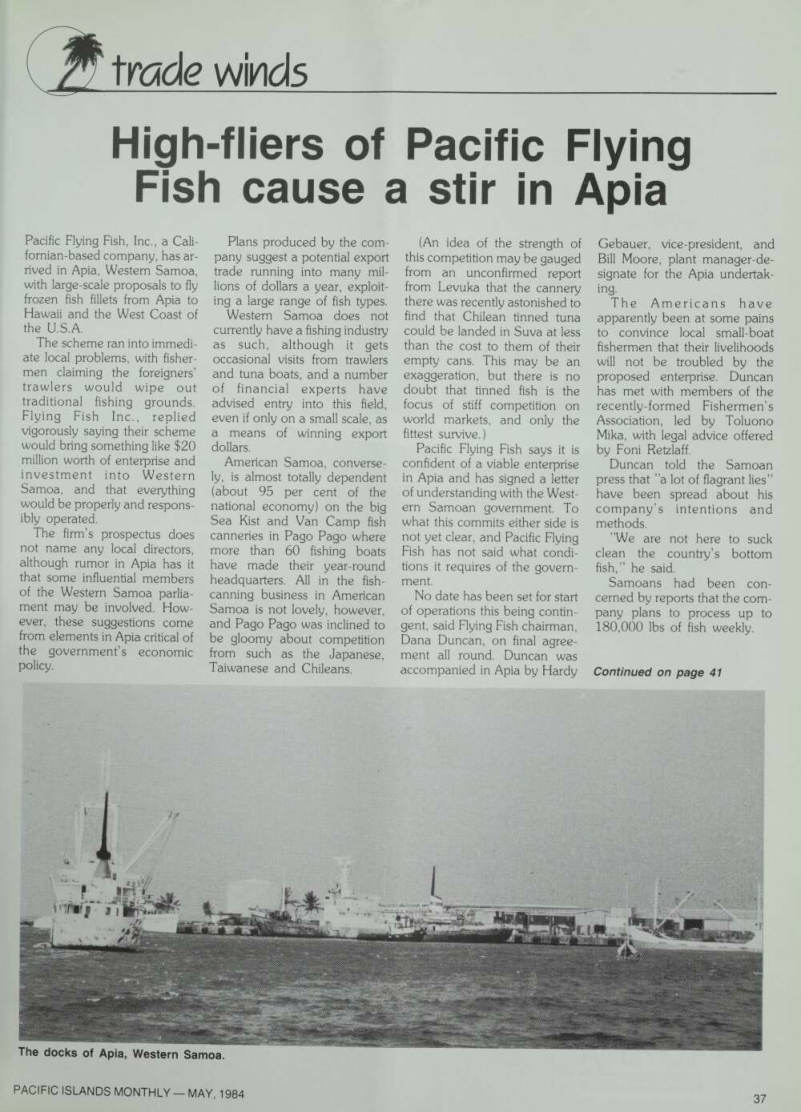



trade winds
High-fliers of Pacific Flying Fish cause a stir in Apia
Pacific Flying Fish, Inc., a Cali fornian-based company, has ar rived in Apia, Western Samoa, with large-scale proposals to fly frozen fish fillets from Apia to Hawaii and the West Coast of the U.S.A.
The scheme ran into immedi ate local problems, with fisher men claiming the foreigners’ trawlers would wipe out traditional fishing grounds.
Flying Fish Inc., replied vigorously saying their scheme would bring something like $2O million worth of enterprise and investment into Western Samoa, and that everything would be properly and respons ibly operated.
The firm’s prospectus does not name any local directors, although rumor in Apia has it that some influential members of the Western Samoa parlia ment may be involved. How ever, these suggestions come from elements in Apia critical of the government’s economic policy.
Plans produced by the com pany suggest a potential export trade running into many mil lions of dollars a year, exploit ing a large range of fish types.
Western Samoa does not currently have a fishing industry as such, although it gets occasional visits from trawlers and tuna boats, and a number of financial experts have advised entry into this field, even if only on a small scale, as a means of winning export dollars.
American Samoa, converse ly, is almost totally dependent (about 95 per cent of the national economy) on the big Sea Kist and Van Camp fish canneries in Pago Pago where more than 60 fishing boats have made their year-round headquarters. All in the fish canning business in American Samoa is not lovely, however, and Pago Pago was inclined to be gloomy about competition from such as the Japanese, Taiwanese and Chileans.
(An idea of the strength of this competition may be gauged from an unconfirmed report from Levuka that the cannery there was recently astonished to find that Chilean tinned tuna could be landed in Suva at less than the cost to them of their empty cans. This may be an exaggeration, but there is no doubt that tinned fish is the focus of stiff competition on world markets, and only the fittest survive.) Pacific Flying Fish says it is confident of a viable enterprise in Apia and has signed a letter of understanding with the West ern Samoan government. To what this commits either side is not yet clear, and Pacific Flying Fish has not said what condi tions it requires of the govern ment.
No date has been set for start of operations this being contin gent, said Flying Fish chairman, Dana Duncan, on final agree ment all round. Duncan was accompanied in Apia by Hardy
Gebauer, vice-president, and Bill Moore, plant manager-de signate for the Apia undertak ing.
The Americans have apparently been at some pains to convince local small-boat fishermen that their livelihoods will not be troubled by the proposed enterprise. Duncan has met with members of the recently-formed Fishermen’s Association, led by Toluono Mika, with legal advice offered by Foni Retzlaff.
Duncan told the Samoan press that ”a lot of flagrant lies” have been spread about his company’s intentions and methods. ”We are not here to suck clean the country’s bottom fish,” he said.
Samoans had been con cerned by reports that the com pany plans to process up to 180,000 lbs of fish weekly.
Continued on page 41
The docks of Apia, Western Samoa.
from page 37
Duncan told the fishermen: ”We are a privately-owned corporation from California that has come to Western Samoa on a cooperative effort with the government to develop, econo mically, its fish resources. The company intends to use its expertise and modern technol ogy in new and improved fishing methods.” These, said Duncan, would be backed up by computer-controlled marketing systems and the company’s own DC-8 jet trans port.
He said the company had noted with disappointment, ’’certain allegations and misrep resentations with regard to our fishing the area clean ...” ’’The management wishes to state unequivocally that we deny this rumor and that it has no basis in truth...,” Duncan said. ’’The presence of Pacific Flying Fish Company repre sents an economic deve lopment program designed to promote a viable fish proces sing operation, utilising current idle facilities, creating badly needed employment for a great number of people, teaching new skills, and encouraging the private sector especially in agri culture, through modern jet transportation to the U.S. and other world markets.”
Duncan’s view was that a local fishing industry was the business of local fishermen.
Pacific Flying Fish would not interfere in, or impede, that.
However, his company did in tend-to offer its cooperation to local people by making avail able better facilities and also teaching of modern handling and storage methods.
They would also offer advice on improvements in the design of local fishing vessels, he said, aiming at improving their safety and pay-load.
All of this would be included in the investment program which, he said, would amount to $2O million over the next three years, through goods, services, equipment and direct aid to local industry.
As part of this they had arranged to lease the fish mar ket built with Japanese aid money and which, as it was currently operated, was ”a use less facility,” Duncan said.
Advertisements & other items, pp. 38-40 (1 item)
Introducing Perfof
' -"W'
NEW *B4 TOYOTA HILU>
Performance p comfort.
Performance plus durability.
Performance plus variety.
Advanced, powerful new engines put you in command with higher torque, better efficiency. Inside, more driving comfort than ever before with a roomier cabin, bigger windscreens, and lean, clean instrumentation. Newly designed suspension gives you big carrying capability, yet carries you in comfort. HILUX is one tough truck with a suspension you can count on. Choose from a wide variety, including 4WD regular or double cab and two new additions 2WD extra cab and flatdeck. The all-new Toyota HILUX. Add it all up, and you have performance plus!
TOYOTA
QUALITY SERVICE
AMERICAN SAMOA: BURNS PHILP (SOUTH SEA)
CO., LTD., P.O. Box 129, Pago Pago.
COOK ISLANDS: COOK ISLANDS TRADING
CORPORATION LTD., Private Bag, Rarotonga.
FUI: AUTOMOTIVE SUPPLIES COMPANY, G.P.O.
Box 355, Suva.
GUAM & MICRONESIA: ATKINS, KROLL (GUAM) LTD., 443 South Marine Drive, Tamuning.
KIRIBATI: TARAWA MOTORS, P.O. Box 36, Bairiki, Tarawa, Kiribati.
NAURU: NAURU COOPERATIVE SOCIETY.
NEW CALEDONIA: SERVICE IMPORTATION
AUTOMOBILE DU PACIFIQUE, Rond-Point du Pacifiqw (Station Total) B.P. 438, Noumea.
WANCE PLUS!
4WD Double Cab >RFOLK ISLAND: SORRY’S LIMITED, P.O. Box 169 NEW GUINEA: ELA MOTORS, A Division of ' rns Philp (PNG) Ltd., P.O. Box 75, Port Moresby.
UPAN: MICROL CORPORATION, P.O. Box 267
ipan.
>LOMON: MENDANA ENTERPRISES (5.1.) LTD.
5 0. Box 174, Honiara.
TAHITI: NIPPON AUTOMOTO, P.O. Box 342, Papeete.
TONGA: BURNS PHILP (SOUTH SEA) CO., LTD., P.O. Box 55, Nukualofa.
VANUATU: VANUATU MOTORS, P.O. Box 18,
Port Vila.
WESTERN SAMOA: BURNS PHILP (SOUTH SEA)
CO., LTD., P.O. Box 188, Apia.
TOYOTA
New Kenwood stereo component systems
Your "window” to the world’s
infinite store of music.
i i o
audio
TrrrTspocialists, Kenwood stereosystems
offer you more than pleasing
exlbility aqd easy operation. They
goffer youjhe best-possible ih audio
sound that’s as ru
as the world arouni . ■7l 65W/cfHSMS Stereo Integrated Amplij • KT-51 Quartz Syhtbesizer
•KX-71R Cassett>Qeck
and DPSS Quartz PLL DirecbQrive Full-Auto Turntable" •SAQ-51W Audio System Rac* TM Dolby Corp.
KENWOOD
★ New corporate symbol
TRIO-KENWOOD CORPORATION
Shionogi Shibuya Building, 17-5, 2-chome, Shibuya, Shibuya-ku, Tokyo 150, Japan TRIO-KENWOOD (AUSTRALIA) PTY. LTD. (incorporated in nsw» NEW ZEALAND JOHN GILBERT & CO., LTD. Auckland Tel.ooll-64-9-30839 FIJI PEPE’S DUTY FREE CENTRE LTD. Tel. 25496, 25497 PAPUA NEW GUINEA S.O. SVENSSON (N.G.) LTD. Port Moresby Tel. 212158, 212111 SOLOMON ISLANDS TECHNIQUE RADIOS CENTRE LTD. Honiara Tel. 416 NEW CALEDONIA HI-FI VOX Noumea Tel. 27-2466, 28-2931 VANUATU FUNG CHOI LUEN. Port-Vila Tel. 2556
TAHITI MAISON AURORE Papeete Tel. 29703
AMERICAN SAMOA ISLAND PACIFIC AGENCIES, INC. Pago Pago Tel. 633-4687
REPUBLIC OF NAURU NAURU CO-OPERATIVE SOCIETY
MARIANA ISLANDS J.C. TENORIO ENTERPRISES Saipan Tel. 6445
‘Melisa’, PNG’s
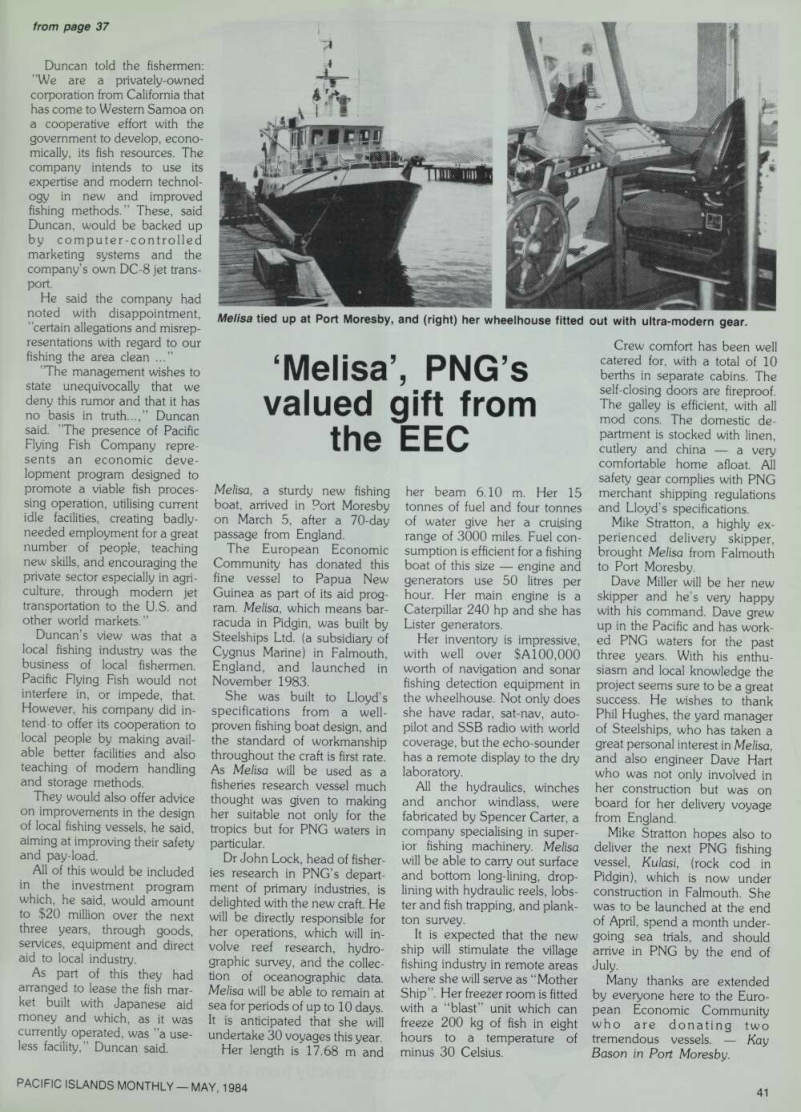
valued gift from the EEC
Melisa, a sturdy new fishing boat, arrived in Port Moresby on March 5, after a 70-day passage from England.
The European Economic Community has donated this fine vessel to Papua New Guinea as part of its aid program. Melisa, which means barracuda in Pidgin, was built by Steelships Ltd. (a subsidiary of Cygnus Marine) in Falmouth, England, and launched in November 1983.
She was built to Lloyd’s specifications from a wellproven fishing boat design, and the standard of workmanship throughout the craft is first rate, As Melisa will be used as a fisheries research vessel much thought was given to making her suitable not only for the tropics but for PNG waters in particular.
Dr John Lock, head of fisheries research in PNG’s department of primary industries, is delighted with the new craft. He will be directly responsible for her operations, which will involve reef research, hydrographic survey, and the collection of oceanographic data, Melisa will be able to remain at sea for periods of up to 10 days.
It is anticipated that she will undertake 30 voyages this year, Her length is 17.68 m and
her beam 6.10 m. Her 15 tonnes of fuel and four tonnes of water give her a cruising range of 3000 miles. Fuel con sumption is efficient for a fishing boat of this size engine and generators use 50 litres per hour. Her main engine is a Caterpillar 240 hp and she has Lister generators.
Her inventory is impressive, with well over SAIOO,OOO worth of navigation and sonar fishing detection equipment in the wheelhouse. Not only does she have radar, sat-nav, auto pilot and SSB radio with world coverage, but the echo-sounder has a remote display to the dry
laboratory.
All the hydraulics, winches and anchor windlass, were fabricated by Spencer Carter, a company specialising in super ior fishing machinery. Melisa will be able to carry out surface and bottom long-lining, drop lining with hydraulic reels, lobs ter and fish trapping, and plank ton survey.
It is expected that the new ship will stimulate the village fishing industry in remote areas where she will serve as “Mother Ship”. Her freezer room is fitted with a “blast” unit which can freeze 200 kg of fish in eight hours to a temperature of minus 30 Celsius.
Crew comfort has been well catered for, with a total of 10 berths in separate cabins. The self-closing doors are fireproof.
The galley is efficient, with all mod cons. The domestic de partment is stocked with linen, cutlery and china a very comfortable home afloat. All safety gear complies with PNG merchant shipping regulations and Lloyd’s specifications.
Mike Stratton, a highly ex perienced delivery skipper, brought Melisa from Falmouth to Port Moresby.
Dave Miller will be her new skipper and he’s very happy with his command. Dave grew up in the Pacific and has work ed PNG waters for the past three years. With his enthu siasm and local knowledge the project seems sure to be a great success. He wishes to thank Phil Hughes, the yard manager of Steelships, who has taken a great personal interest in Melisa, and also engineer Dave Hart who was not only involved in her construction but was on board for her delivery voyage
from England.
Mike Stratton hopes also to deliver the next PNG fishing vessel, Kulasi, (rock cod in Pidgin), which is now under construction in Falmouth. She was to be launched at the end of April, spend a month under going sea trials, and should arrive in PNG by the end of July.
Many thanks are extended by everyone here to the Euro pean Economic Community who are donating two
tremendous vessels.
Kay
Bason in Port Moresby.
Melisa tied up at Port Moresby, and (right) her wheelhouse fitted out with ultra-modern gear.
Advertisements & other items, p. 42 (1 item)
Teacake
..-Uhl pm;
GOLD
CREST
W&*
’"NT SAU<
,n i eedy to freeze v® »1 V» ►
SOLD
=*» \CHtBT
GOLD
CREST
ENGLISH
TEACAKE
t'aktmiv y^?/u Sio 9P
GOLD
V\ith cmnamon topping s&
CREST
m E
RJJT MCE CORDIAL 2 Litre
i m Mil OM ’O w- *C*€o*«Tl hiCM O«A*C4 '*** AiCi Mini ctxa*
MKtfVMIIVf tMJMAOOCO
W« * OW • » LTO
aDOjNET
7*
A selection of
Quality Australian Products
manufactured by R.M. Gow & Co Ltd 30 Gow Street, Moorooka, Queensland. Postal address; PO Box 111, Moorooka, Queensland 4105, Australia. Cables: GOWCO Telex GOWCO AA42839 Phone: (07) 48 5061 Order from your local wholesaler, export merchant or directly from R.M. Gow & Co Ltd.
TCAI£
SUKUNA: “Only a couple
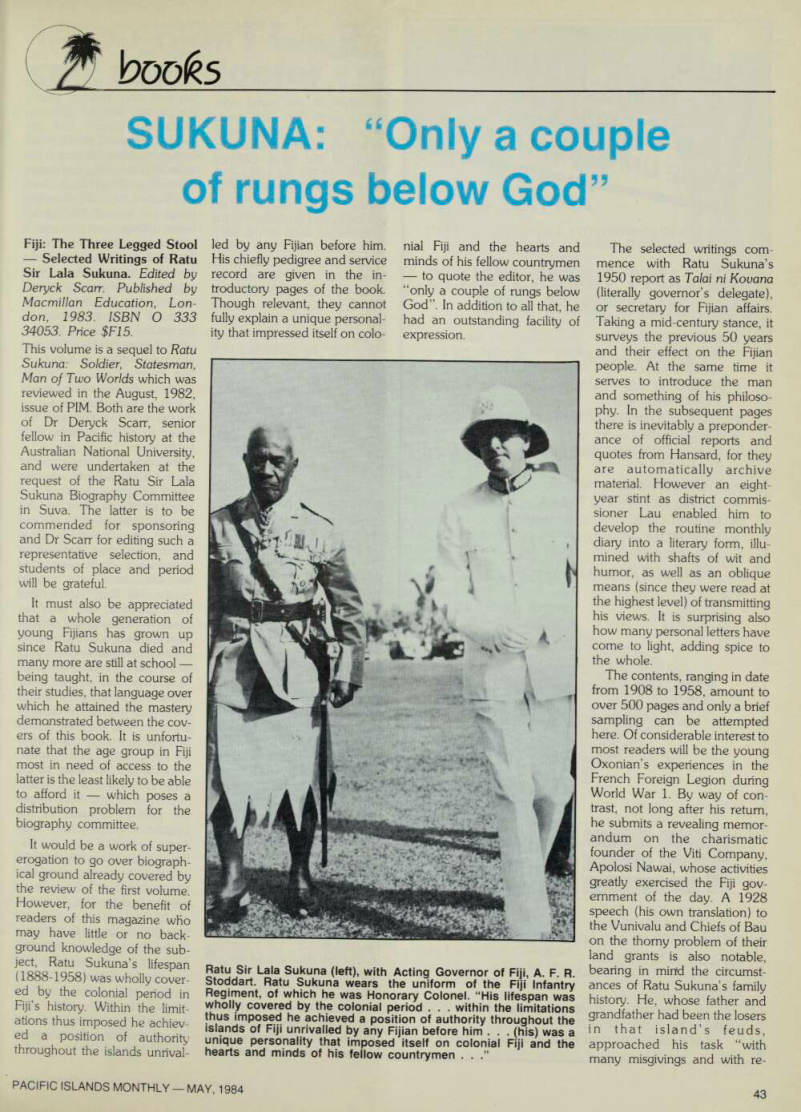

books
SUKUNA: “Only a couple of rungs below God”
Fiji: The Three Legged Stool Selected Writings of Ratu Sir Lala Sukuna. Edited by Deryck Scan. Published by Macmillan Education, Lon don, 1983. ISBN O 333 34053. Price SFIS.
This volume is a sequel to Ratu Sukuna: Soldier, Statesman, Man of Two Worlds which was reviewed in the August, 1982, issue of PIM. Both are the work of Dr Deryck Scarr, senior fellow in Pacific history at the Australian National University, and were undertaken at the request of the Ratu Sir Lala Sukuna Biography Committee in Suva. The latter is to be commended for sponsoring and Dr Scarr for editing such a representative selection, and students of place and period will be grateful.
It must also be appreciated that a whole generation of young Fijians has grown up since Ratu Sukuna died and many more are still at school being taught, in the course of their studies, that language over which he attained the mastery demonstrated between the cov ers of this book. It is unfortu nate that the age group in Fiji most in need of access to the latter is the least likely to be able to afford it which poses a distribution problem for the biography committee.
It would be a work of super erogation to go over biograph ical ground already covered by the review of the first volume.
However, for the benefit of readers of this magazine who may have little or no back ground knowledge of the sub ject, Ratu Sukuna’s lifespan (1888-1958) was wholly cover ed by the colonial period in Fiji’s history. Within the limit ations thus imposed he achiev ed a position of authority throughout the islands unrival
led by any Fijian before him.
His chiefly pedigree and service record are given in the in troductory pages of the book.
Though relevant, they cannot fully explain a unique personal ity that impressed itself on colo
nial Fiji and the hearts and minds of his fellow countrymen to quote the editor, he was “only a couple of rungs below God”. In addition to all that, he had an outstanding facility of expression.
The selected writings com mence with Ratu Sukuna’s 1950 report as Talai ni Kouana (literally governor’s delegate), or secretary for Fijian affairs.
Taking a mid-century stance, it surveys the previous 50 years and their effect on the Fijian people. At the same time it serves to introduce the man and something of his philoso phy. In the subsequent pages there is inevitably a preponder ance of official reports and quotes from Hansard, for they are automatically archive material. However an eight year stint as district commis sioner Lau enabled him to develop the routine monthly diary into a literary form, illu mined with shafts of wit and humor, as well as an oblique means (since they were read at the highest level) of transmitting his views. It is surprising also how many personal letters have come to light, adding spice to the whole.
The contents, ranging in date from 1908 to 1958, amount to over 500 pages and only a brief sampling can be attempted here. Of considerable interest to most readers will be the young Oxonian’s experiences in the French Foreign Legion during World War 1. By way of con trast, not long after his return, he submits a revealing memor andum on the charismatic founder of the Viti Company, Apolosi Nawai, whose activities greatly exercised the Fiji gov ernment of the day. A 1928 speech (his own translation) to the Vunivalu and Chiefs of Bau on the thorny problem of their land grants is also notable, bearing in mirtd the circumst ances of Ratu Sukuna’s family history. He, whose father and grandfather had been the losers in that island’s feuds, approached his task “with many misgivings and with re
Ratu Sir Lala Sukuna (left), with Acting Governor of Fiji, A. F. R.
Stoddart. Ratu Sukuna wears the uniform of the Fiji Infantry Regiment, of which he was Honorary Colonel. “His lifespan was wholly covered by the colonial period ... within the limitations thus imposed he achieved a position of authority throughout the islands of Fiji unrivalled by any Fijian before him ... (his) was a unique personality that imposed itself on colonial Fiji and the hearts and minds of his fellow countrymen ..."
luctance”, but nevertheless faithfully discharged his re sponsibility.
His gift for conveying un palatable truths sugaring the pill while at the same time poking gentle fun is never more clearly illustrated than in an address during a social oc casion at the Suva Defence Club in 1938. His subject what the Fijians thought of Europeans! A promoter of ra cial harmony (symbolised in the three-legged stool of the title), his efforts as a mediator appear in a frustrating exchange of letters with A. D. Patel over the 1943-44 cane strike. By then the Pacific war was at its height and for him the path was plain.
“Duty is the one thing worth living for,” he declaimed in a poetic envoi to the troops embarking for the Solomons.
He was to refer again to the path of duty in an unusually blunt and somewhat bitter con tribution to a post-war debate in the Legislative Council on agricultural policy.
That there should have been a possibility of Ratu Sukuna’s devoted services being diverted elsewhere seems strange now.
His family tree, as published in this volume, confines itself to descent from three great Fiji lineages those of the Vuniva lu of Bau. the Tui Cakau of Taveuni and the Tui Nayau of Lakeba. If the latter had been taken a couple of generations further back, it would have extended to Tonga a re lationship he clearly valued and kept in repair throughout his life. Apart from that, for a much travelled and experienced man approaching middle age, pros pects in the kingdom may well have compared favorably with those in a crown colony. In a personal letter, dated January 27, 1922, he reveals the offer of a post from the premier of Tonga and indicates his own keenness to accept, “but it does not seem quite the thing to do”.
Besides, a move was already afoot to appoint him to the Native Lands Commission. In his own words “it is a roaming sort of job that should suit my turn of mind”. In ensnared him for the rest of his days.
Although he undertook other and more senior functions of government, it was as Turaga ni Veitarogi Vanua (chief of the
lands commission) that he be came personally known and respected the length and breadth of Fiji. Here was no remote figure in an ivory tower but one who, moving among the people, listened patiently, counselled quietly and de livered decisions which were comprehensible. He was at the same time acquiring an intimate knowledge of their lands, reefs and waters that only travelling rough can impart. Throughout these writings we can sense a tremendous feeling for his na tive land. This is reflected in the foreword to Moturiki: a pilot project in community devel opment. In a memorable pas sage of luminous prose he depicts the main scenic features viewed from the Bau Channel between Naigani in the north and the reef entrance in the south the legendary Daveta Levu or Great Passage, sacred to the rulers of Bau and be lieved to be haunted by their spirits.
Sophisticated cosmopolitan though Ratu Sukuna was, the blood of generations of sea kings ran in his veins and he was not unmindful of the old beliefs. He observed, albeit without comment, the natural phenomena which seemed to be associated with chiefly deaths. His diary for October 1936 describes one such oc casion a day at sea of eerie calm and heat, with the unusual appearance all around of sharks and other fish, one hammer head even allowing itself to be patted and pulled. On arrival at Lomaloma next day he receives the news that the Vunivalu of Bau has gone to join his ancest ors through the Great Passage.
In the last sad letter of the collection Ratu Sukuna writes: “lam not sorry to have to quit the post of Speaker of the Legislative Council but I truly regret having to leave the Na tive Lands Commission.” So ended a love affair that had begun 36 years before. Three months later he died at sea.
A. C. Reid* * A. C. Reid served for 33 years in the Pacific Islands, including 25 years in Fiji, where he was the last European to hold the position of Secretary for Fijian Affairs. He also spent eight years in Tonga on two separate “tours” as British Commission er and Consul.
Advertisements & other items, p. 44 (1 item)
•g&gsr
THE
UNI
ygRSAL
pallet
APPROX. 20 KG
DESIGNED TO CONFORM TO A.S.A 1899-1976, 2068-1977
AND 1.5.0. SERIES 1 STANDARDS.
OUTLASTS TIMBER PALLETS
MANY TIMES OVER
• STEEL CONSTRUCTION Stronger, longer life, no fire risk, no splinters, no rotting, no termites, reduced operational quantities, increased R. 0.1. • APPROX. 20 KG One man handling, reduced transportation costs. • REVERSIBLE (ON REQUEST) - Use both sides
• H.D. GALVANISED -No rust
• OWNER S PERMANENT IDENTIFICATION - Security and control • STEAM CLEANABLE - Hygienic • LOADING TESTS PASSED TO A.S.A. - Proven • NO POINT LOADS - Multiple stacking • ECONOMICAL - Affordable • TWO TONNE CAPACITY - Wider usage
• SPECIAL SIZES AVAILABLE - Versatile
National Materials Handling Bureau Prototype Test Certificate P C 603 Registered Design Patents Pending
PALMET
ENGINEERING
PTY.LTD.
POSTAL ADDRESS:
PO Box 398 Wyong NSW 2259 Australia
SALES AUSTRALIA:
Telephone (046) 66-8455
WORKS:
Lot 50 Newbridge Rd Berkeley Vale NSW 2259 Telephone (043) 88-2011
AGENT DISTRIBUTION ENQUIRIES WELCOMED
If you didn’t laugh,
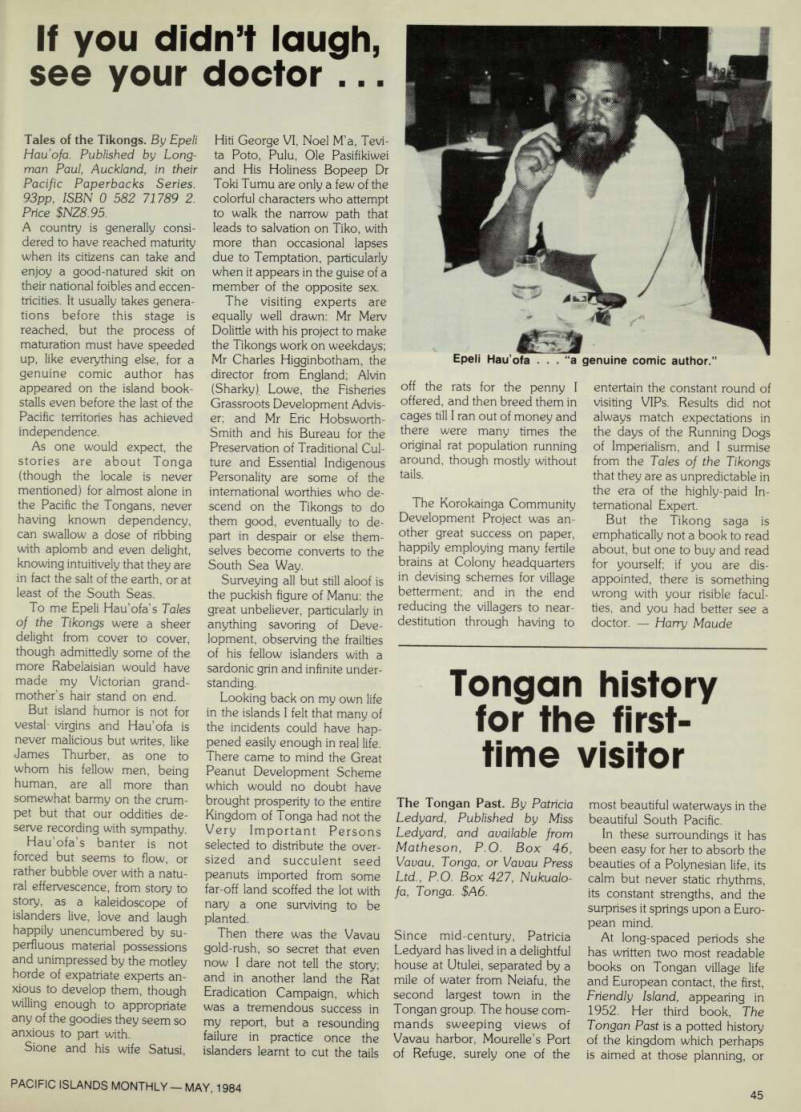
see your doctor...
Tales of the Tikongs. By Epeli Hau’ofa. Published by Long man Paul, Auckland, in their Pacific Paperbacks Series. 93pp, ISBN 0 582 71789 2.
Price SNZB.9S.
A country is generally consi dered to have reached maturity when its citizens can take and enjoy a good-natured skit on their national foibles and eccen tricities. It usually takes genera tions before this stage is reached, but the process of maturation must have speeded up, like everything else, for a genuine comic author has appeared on the island book stalls even before the last of the Pacific territories has achieved independence.
As one would expect, the stories are about Tonga (though the locale is never mentioned) for almost alone in the Pacific the Tongans, never having known dependency, can swallow a dose of ribbing with aplomb and even delight, knowing intuitively that they are in fact the salt of the earth, or at least of the South Seas.
To me Epeli Hau’ofa’s Tales of the Tikongs were a sheer delight from cover to cover, though admittedly some of the more Rabelaisian would have made my Victorian grand mother’s hair stand on end.
But island humor is not for vestal- virgins and Hau’ofa is never malicious but writes, like James Thurber, as one to whom his fellow men, being human, are all more than somewhat barmy on the crum pet but that our oddities de serve recording with sympathy.
Hau’ofa’s banter is not forced but seems to flow, or rather bubble over with a natu ral effervescence, from story to story, as a kaleidoscope of islanders live, love and laugh happily unencumbered by su perfluous material possessions and unimpressed by the motley horde of expatriate experts an xious to develop them, though willing enough to appropriate any of the goodies they seem so anxious to part with.
Sione and his wife Satusi,
Hiti George VI, Noel M’a, Tevi ta Poto, Pulu, Ole Pasifikiwei and His Holiness Bopeep Dr Toki Tumu are only a few of the colorful characters who attempt to walk the narrow path that leads to salvation on Tiko, with more than occasional lapses due to Temptation, particularly when it appears in the guise of a member of the opposite sex.
The visiting experts are equally well drawn: Mr Merv Dolittle with his project to make the Tikongs work on weekdays; Mr Charles Higginbotham, the director from England; Alvin (Sharky) Lowe, the Fisheries Grassroots Development Advis er; and Mr Eric Hobsworth- Smith and his Bureau for the Preservation of Traditional Cul ture and Essential Indigenous Personality are some of the international worthies who de scend on the Tikongs to do them good, eventually to de part in despair or else them selves become converts to the South Sea Way.
Surveying all but still aloof is the puckish figure of Manu; the great unbeliever, particularly in anything savoring of Deve lopment, observing the frailties of his fellow islanders with a sardonic grin and infinite under standing.
Looking back on my own life in the islands I felt that many of the incidents could have hap pened easily enough in real life.
There came to mind the Great Peanut Development Scheme which would no doubt have brought prosperity to the entire Kingdom of Tonga had not the Very Important Persons selected to distribute the over sized and succulent seed peanuts imported from some far-off land scoffed the lot with nary a one surviving to be planted.
Then there was the Vavau gold-rush, so secret that even now I dare not tell the story; and in another land the Rat Eradication Campaign, which was a tremendous success in my report, but a resounding failure in practice once the islanders learnt to cut the tails
off the rats for the penny I offered, and then breed them in cages till I ran out of money and there were many times the original rat population running around, though mostly without tails.
The Korokainga Community Development Project was an other great success on paper, happily employing many fertile brains at Colony headquarters in devising schemes for village betterment; and in the end reducing the villagers to near destitution through having to
entertain the constant round of visiting VIPs. Results did not always match expectations in the days of the Running Dogs of Imperialism, and I surmise from the Tales of the Tikongs that they are as unpredictable in the era of the highly-paid In ternational Expert.
But the Tikong saga is emphatically not a book to read about, but one to buy and read for yourself; if you are dis appointed, there is something wrong with your risible facul ties, and you had better see a
doctor.
Harry Maude
Epeli Hau’ofa ... “a genuine comic author.”
Tongan history
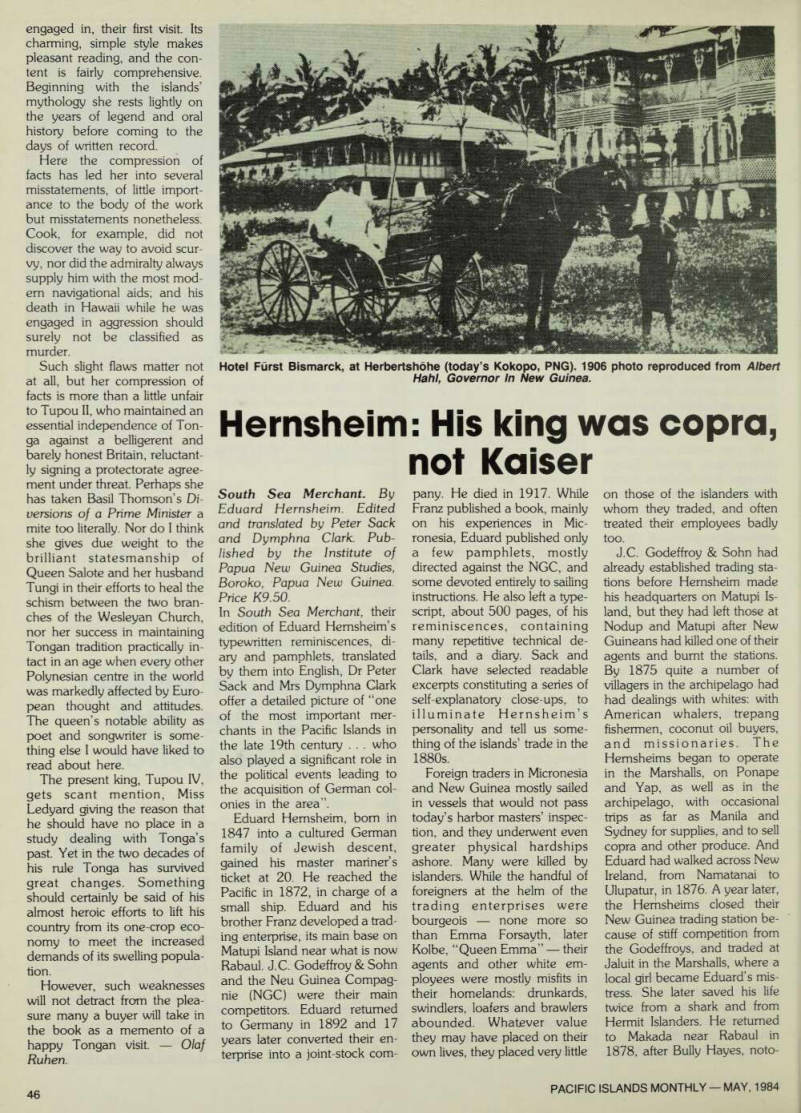
for the first time visitor
The Tongan Past. By Patricia Ledyard, Published by Miss Ledyard, and available from Matheson, P.O. Box 46, Vavau, Tonga, or Vauau Press Ltd., P.O. Box 427, Nukualo fa, Tonga. SA6.
Since mid-century, Patricia Ledyard has lived in a delightful house at Utulei, separated by a mile of water from Neiafu, the second largest town in the Tongan group. The house com mands sweeping views of Vavau harbor, Mourelle’s Port of Refuge, surely one of the
most beautiful waterways in the beautiful South Pacific.
In these surroundings it has been easy for her to absorb the beauties of a Polynesian life, its calm but never static rhythms, its constant strengths, and the surprises it springs upon a Euro pean mind.
At long-spaced periods she has written two most readable books on Tongan village life and European contact, the first, Friendly Island, appearing in 1952. Her third book, The Tongan Past is a potted history of the kingdom which perhaps is aimed at those planning, or
engaged in, their first visit. Its charming, simple style makes pleasant reading, and the con tent is fairly comprehensive.
Beginning with the islands’ mythology she rests lightly on the years of legend and oral history before coming to the days of written record.
Here the compression of facts has led her into several misstatements, of little import ance to the body of the work but misstatements nonetheless.
Cook, for example, did not discover the way to avoid scur vy, nor did the admiralty always supply him with the most mod em navigational aids; and his death in Hawaii while he was engaged in aggression should surely not be classified as murder.
Such slight flaws matter not at all, but her compression of facts is more than a little unfair to Tupou 11, who maintained an essential independence of Ton ga against a belligerent and barely honest Britain, reluctant ly signing a protectorate agree ment under threat. Perhaps she has taken Basil Thomson’s Di versions of a Prime Minister a mite too literally. Nor do I think she gives due weight to the brilliant statesmanship of Queen Salote and her husband Tungi in their efforts to heal the schism between the two bran ches of the Wesleyan Church, nor her success in maintaining Tongan tradition practically in tact in an age when every other Polynesian centre in the world was markedly affected by Euro pean thought and attitudes.
The queen’s notable ability as poet and songwriter is some thing else I would have liked to read about here.
The present king, Tupou IV, gets scant mention, Miss Ledyard giving the reason that he should have no place in a study dealing with Tonga’s past Yet in the two decades of his mle Tonga has survived great changes. Something should certainly be said of his almost heroic efforts to lift his country from its one-crop eco nomy to meet the increased demands of its swelling popula tion.
However, such weaknesses will not detract from the plea sure many a buyer will take in the book as a memento of a
happy Tongan visit.
Olaf
Ruhen.
Hernsheim: His king was copra,
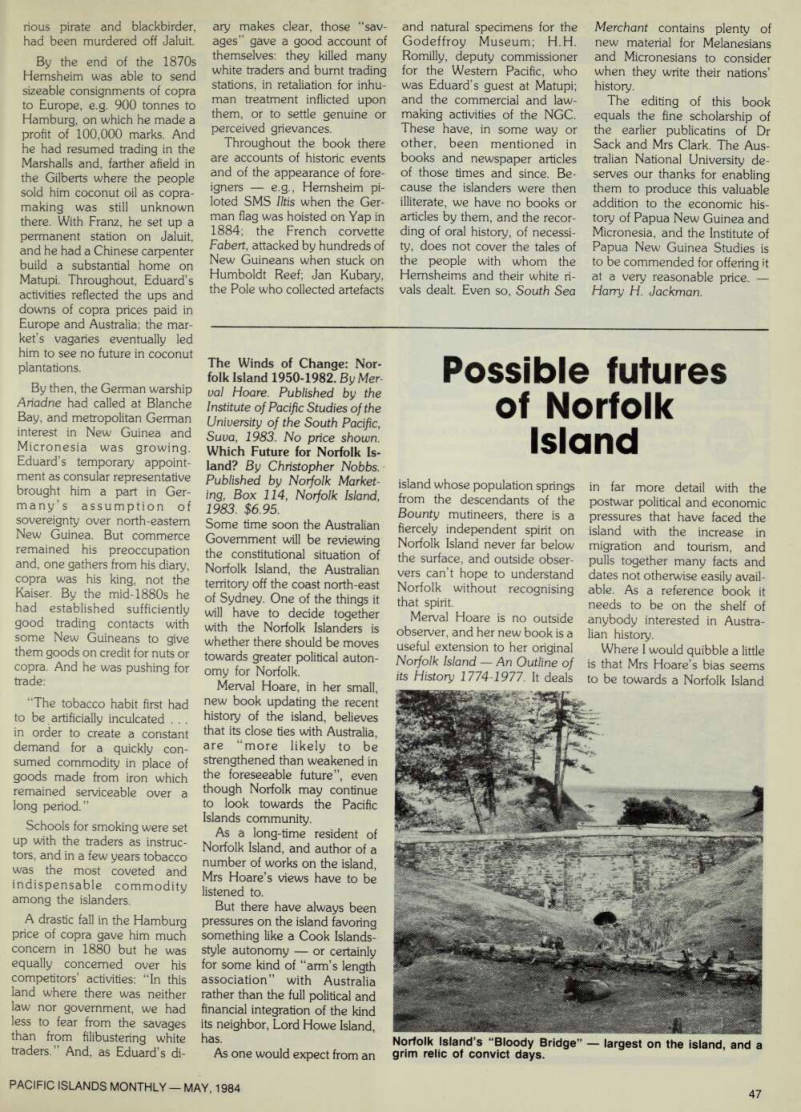
not Kaiser
South Sea Merchant. By Eduard Hernsheim. Edited and translated by Peter Sack and Dymphna Clark. Pub lished by the Institute of Papua New Guinea Studies, Boroko, Papua New Guinea.
Price K 9.50.
In South Sea Merchant, their edition of Eduard Hemsheim’s typewritten reminiscences, di ary and pamphlets, translated by them into English, Dr Peter Sack and Mrs Dymphna Clark offer a detailed picture of “one of the most important mer chants in the Pacific Islands in the late 19th century . . . who also played a significant role in the political events leading to the acquisition of German col onies in the area”.
Eduard Hemsheim, bom in 1847 into a cultured German family of Jewish descent, gained his master mariner’s ticket at 20. He reached the Pacific in 1872, in charge of a small ship. Eduard and his brother Franz developed a trad ing enterprise, its main base on Matupi Island near what is now Rabaul. J.C. Godeffroy & Sohn and the Neu Guinea Compag nie (NGC) were their main competitors. Eduard returned to Germany in 1892 and 17 years later converted their en terprise into a joint-stock com
pany. He died in 1917. While Franz published a book, mainly on his experiences in Mic ronesia, Eduard published only a few pamphlets, mostly directed against the NGC, and some devoted entirely to sailing instructions. He also left a type script, about 500 pages, of his reminiscences, containing many repetitive technical de tails, and a diary. Sack and Clark have selected readable excerpts constituting a series of self-explanatory close-ups, to illuminate Hernsheim’s personality and tell us some thing of the islands’ trade in the 1880 s.
Foreign traders in Micronesia and New Guinea mostly sailed in vessels that would not pass today’s harbor masters’ inspec tion, and they underwent even greater physical hardships ashore. Many were killed by islanders. While the handful of foreigners at the helm of the trading enterprises were bourgeois none more so than Emma Forsayth, later Kolbe, “Queen Emma” their agents and other white em ployees were mostly misfits in their homelands; drunkards, swindlers, loafers and brawlers abounded. Whatever value they may have placed on their own lives, they placed very little
on those of the islanders with whom they traded, and often treated their employees badly too.
J.C. Godeffroy & Sohn had already established trading sta tions before Hemsheim made his headquarters on Matupi Is land, but they had left those at Nodup and Matupi after New Guineans had killed one of their agents and burnt the stations.
By 1875 quite a number of villagers in the archipelago had had dealings with whites: with American whalers, trepang fishermen, coconut oil buyers, and missionaries. The Hemsheims began to operate in the Marshalls, on Ponape and Yap, as well as in the archipelago, with occasional trips as far as Manila and Sydney for supplies, and to sell copra and other produce. And Eduard had walked across New Ireland, from Namatanai to Ulupatur, in 1876. A year later, the Hemsheims closed their New Guinea trading station be cause of stiff competition from the Godeffroys, and traded at Jaluit in the Marshalls, where a local girl became Eduard’s mis tress. She later saved his life twice from a shark and from Hermit Islanders. He returned to Makada near Rabaul in 1878, after Bully Hayes, noto
Hotel Furst Bismarck, at Herbertshbhe (today’s Kokopo, PNG). 1906 photo reproduced from Albert Hahl, Governor In New Guinea.
rious pirate and blackbirder, had been murdered off Jaluit.
By the end of the 1870 s Hemsheim was able to send sizeable consignments of copra to Europe, e.g. 900 tonnes to Hamburg, on which he made a profit of 100,000 marks. And he had resumed trading in the Marshalls and, farther afield in the Gilberts where the people sold him coconut oil as copra making was still unknown there. With Franz, he set up a permanent station on Jaluit, and he had a Chinese carpenter build a substantial home on Matupi. Throughout, Eduard’s activities reflected the ups and downs of copra prices paid in Europe and Australia; the mar ket’s vagaries eventually led him to see no future in coconut plantations.
By then, the German warship Ariadne had called at Blanche Bay, and metropolitan German interest in New Guinea and Micronesia was growing.
Eduard’s temporary appoint ment as consular representative brought him a part in Ger many’s assumption of sovereignty over north-eastern New Guinea. But commerce remained his preoccupation and, one gathers from his diary, copra was his king, not the Kaiser. By the mid-1880s he had established sufficiently good trading contacts with some New Guineans to give them goods on credit for nuts or copra. And he was pushing for trade: “The tobacco habit first had to be artificially inculcated . . . in order to create a constant demand for a quickly con sumed commodity in place of goods made from iron which remained serviceable over a long period.”
Schools for smoking were set up with the traders as instruc tors, and in a few years tobacco was the most coveted and indispensable commodity among the islanders.
A drastic fall in the Hamburg price of copra gave him much concern in 1880 but he was equally concerned over his competitors’ activities; “In this land where there was neither law nor government, we had less to fear from the savages than from filibustering white traders.” And, as Eduard’s di
ary makes clear, those “sav ages” gave a good account of themselves: they killed many white traders and burnt trading stations, in retaliation for inhu man treatment inflicted upon them, or to settle genuine or perceived grievances.
Throughout the book there are accounts of historic events and of the appearance of fore igners e.g., Hemsheim pi loted SMS litis when the Ger man flag was hoisted on Yap in 1884; the French corvette Fabert, attacked by hundreds of New Guineans when stuck on Humboldt Reef; Jan Kubary, the Pole who collected artefacts
and natural specimens for the Godeffroy Museum; H.H.
Romilly, deputy commissioner for the Western Pacific, who was Eduard’s guest at Matupi; and the commercial and law making activities of the NGC.
These have, in some way or other, been mentioned in books and newspaper articles of those times and since. Be cause the islanders were then illiterate, we have no books or articles by them, and the recor ding of oral history, of necessi ty, does not cover the tales of the people with whom the Hemsheims and their white ri vals dealt. Even so, South Sea
Merchant contains plenty of new material for Melanesians and Micronesians to consider when they write their nations’ history.
The editing of this book equals the fine scholarship of the earlier publicatins of Dr Sack and Mrs Clark. The Aus tralian National University de serves our thanks for enabling them to produce this valuable addition to the economic his tory of Papua New Guinea and Micronesia, and the Institute of Papua New Guinea Studies is to be commended for offering it at a very reasonable price.
Harry H. Jackman.
Possible futures
of Norfolk Island
The Winds of Change: Nor folk Island 1950-1982. ByMer val Hoare. Published by the Institute of Pacific Studies of the University of the South Pacific, Suva, 1983. No price shown.
Which Future for Norfolk Is land? By Christopher Nobbs.
Published by Norfolk Market ing, Box 114, Norfolk Island, 1983. $6.95.
Some time soon the Australian Government will be reviewing the constitutional situation of Norfolk Island, the Australian territory off the coast north-east of Sydney. One of the things it will have to decide together with the Norfolk Islanders is whether there should be moves towards greater political auton omy for Norfolk.
Merval Hoare, in her small, new book updating the recent history of the island, believes that its close ties with Australia, are “more likely to be strengthened than weakened in the foreseeable future”, even though Norfolk may continue to look towards the Pacific Islands community.
As a long-time resident of Norfolk Island, and author of a number of works on the island, Mrs Hoare’s views have to be listened to.
But there have always been pressures on the island favoring something like a Cook Islands style autonomy or certainly for some kind of “arm’s length association” with Australia rather than the full political and financial integration of the kind its neighbor, Lord Howe Island, has.
As one would expect from an
island whose population springs from the descendants of the Bounty mutineers, there is a fiercely independent spirit on Norfolk Island never far below the surface, and outside observers can’t hope to understand Norfolk without recognising that spirit.
Merval Hoare is no outside observer, and her new book is a useful extension to her original Norfolk Island An Outline of its History 1774-1977. It deals
in far more detail with the postwar political and economic pressures that have faced the island with the increase in migration and tourism, and pulls together many facts and dates not otherwise easily avail able. As a reference book it needs to be on the shelf of anybody interested in Austra lian history, Where I would quibble a little is that Mrs Hoare’s bias seems to be towards a Norfolk Island
Norfolk Island’s “Bloody Bridge” - largest on the island, and a grim relic of convict days.
integrated with Australia with “goodies” and “baddies” the baddies being those who see an alternative.
Nobody should object to her taking a stand as an historian she has that privilege but nowhere in her book that I can see is there any real study of the reasons why there has always been this strong alternative view; why, for instance, there was such a fierce groundswell of opinion against the findings of the Nimmo royal commis sion, which proposed that Nor folk should be integrated into Australia, with the island be coming part of the Canberra electorate.
Norfolk’s independent state of mind is part of the very soul of the island and simply can’t be explained as being due to the machinations of occasional “mainlanders” who from time to time exert an influence on local politics.
I would have liked to have seen Mrs Hoare provide more insight into this aspect of island character, so that we could better understand the thinking behind some of the close in fighting that has gone on in Norfolk Island in the 30 years covered by her book.
Although brief, Christopher Nobbs’ 33-page thesis adds something to the Norfolk de bate. Nobbs was bom on the island and describes his booklet as “an essay to open informed discussion on the sort of future that the people of Norfolk Is land want for themselves.”
In fact he concentrates on economic issues, not social or constitutional ones, and he doesn’t pretend that it is a well-rounded study of the prob lems that face the island.
Some of it gets unnecessarily technical and rather pompously academic, but there is nevertheless some useful in formation on the economy.
Generally the author’s argu ment is that there is an un satisfactory absence of any long-term plan for the island.
The emphasis to date has been on short-term profit, and little legislation exists to ensure orderly land use or commercial development. Immigration con trol “remains unsatisfactory”.
He presses for public discus sion that could lead to an overall plan of development.
Stuart Inder
Books received
The Garia An Ethnography of a Traditional Cosmic System in Papua New Guinea. By Peter Lawrence. Pub lished 1984 by Melbourne University Press, P.O. Box 278, Carlton South, Victoria 3053. ISBN 0 522 84261 5.
Price $27.50 Tuvalu: A History. Written by a number of authors and published jointly by the Institute of Pacific Studies and Extension Services, University of the South Pacific, Suva, and the Ministry of Social Services, Government of Tuvalu, 1983.
No price or ISBN provided.
Atlas of Hawaii, Second Edition. By the department of Geography, Univer sity of Hawaii. Published by University of Hawaii Press, 2840 Kolowalu St, Hon olulu, Hawaii 96822, 1983. ISBN 0 8248 0837 1. Price $U529.95.
Environmental Education Series No. 1. Talks presented at public seminars on environmental sciences at the University of Papua New Guinea in 1980 and 1981. Published 1982 by the Environ mental Sciences Committee, UPNG, Box 320, University P. 0., Papua New Guinea. No price or ISBN given.
Uniting a Nation: The Posted and Telecommunication Services of Papua New Guinea. By James Sinclair. Pub lished 1984 by Oxford University Press, 7 Bowen Crescent, Melbourne. ISBN 0 1955 4437 4. Price $20.00 Handbook of Tropical Foods. Edited by Harvey T. Chan. Published 1983 by Marcel Dekker, Inc., 270 Madison Ave nue, New York, N.Y., 10016, USA.
ISBN 0 8247 1880 1. Price SUS7S.
The Samoan Journals of John Wil liams 1830 and 1832. Edited by Rich ard M. Moyle. Published 1984 by Aus tralian National University Press, P.O.
Box 4, Canberra, 2600. ISBN 0 7081 1621 3. Price $29.95.
Pacific Power Maps: An Analysis of the Constitutions of Pacific Island Polities. By Stephen Levine. Published 1983 by the Center for Asian and Pacific Studies in collaboration with the Social Science Research Institute, University of Hawaii at Manoa, Honolulu, Hawaii. No ISBN or price provided.
La Terre est le Sang des Morts. By Jean Guiart. Published 1983 by Editions Anthropos, 15 rue Lacepede, 75005 Paris, France. ISBN 2 7157 1075 5. No price given.
Pacific Island Construction and Deve lopment: Economic Prospects for 1984. Prepared and Published by Pacific Economics Pty. Ltd., P.O. Box A 771, Sydney South, NSW. 2000. ISSN 0813 0817. No price given.
Made In Hawaii. By Jane Fulton Aber nethy and Suelyn Ching Tune. Pub lished 1983 by University of Hawaii Press, 2840 Kolowalu Street, Honolulu, Hawaii. ISBN 0 8248 0870 3. Price $U55.95, paperback.
Whales and Dolphins of New Zealand and Australia. An Identification Guide.
By Alan N. Baker. Published 1983 by Victoria University Press, Victoria Uni versity of Wellington, Private Bag, Wel lington, New Zealand. Distributed by Australia and New Zealand Book Co.
Pty. Ltd., P.O. Box 459, Brookvale, NSW 2100. ISBN 0 86473 002 0. Price $12.95.
Hawaii Under The Rising Sun: Japan’s Plans for Conquest After Pearl Harbor.
By John J. Stephan. Published 1983 by University of Hawaii Press, Kolowalu Street, Honolulu, Hawaii 96822. Price U 5516.95. ISBN 0 8248 0872 X.
Advertisements & other items, p. 48 (1 item)
Houses’
INSTANT
and Commercial Buildings with Therma-Panel, R the
fully insulated inter-locking
Building System
Cyclone rated George Hudson Homes (Aust.) pty. ud. 186 Hume Highway Cabramatta NSW 2166 Australia. Tel: (02) 727 9066. Telex: AA25800 Post coupon for details and prices.
Tel;
NORTH QUEENSLAND ENGINEERS
& AGENTS PTY. LTD.
.fMKi
Shipbuilding and Repair are our Business We have full facilities for repair or refitting SLIPPING to 750 tonne DOCKING to 200 feet The shipbuilding division can construct a vessel to your design, or design one to suit your needs.
Barges, Tugs, Workboats, Catamarans, Landing Craft and Patrol Boats are all within our scope.
CALL US TODAY
N.Q.E.A.
36 Buchan Street, Cairns 4870 P.O. Box 1105, Cairns Telephone (070) 51 6600. Telex 48087
CONTRACTORS TO THE ROYAL AUSTRALIAN NAVY
Abraham longs for a "knife
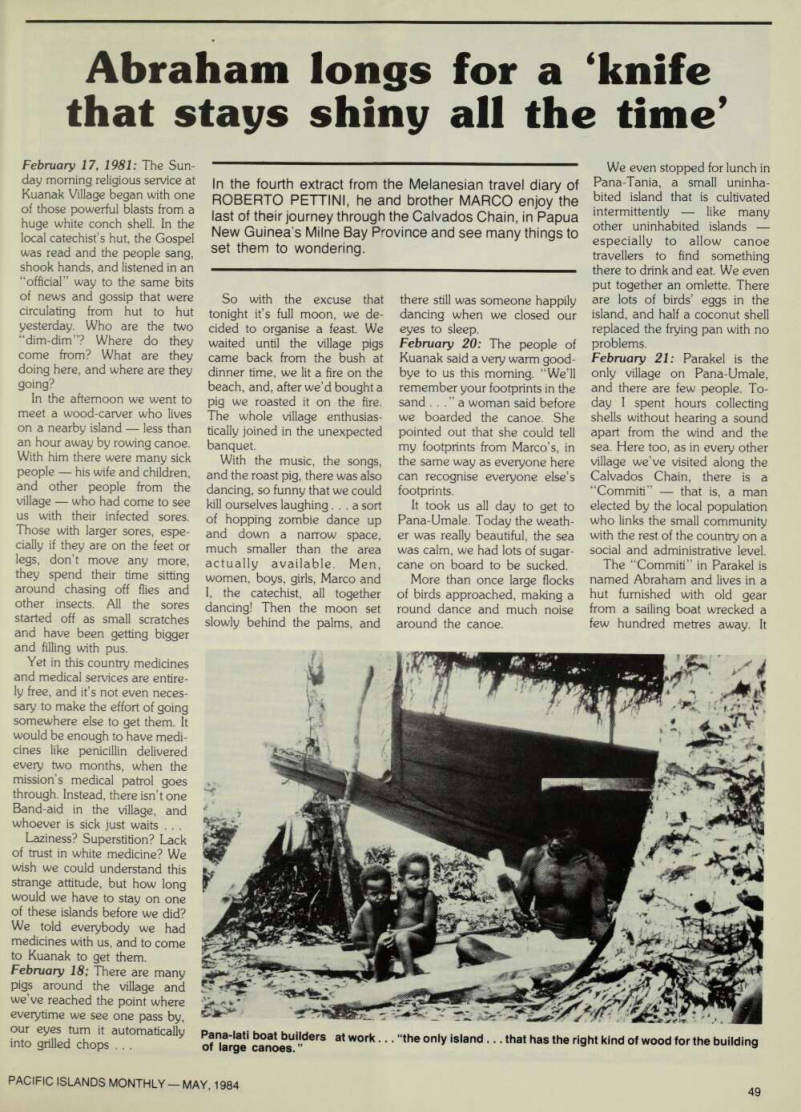
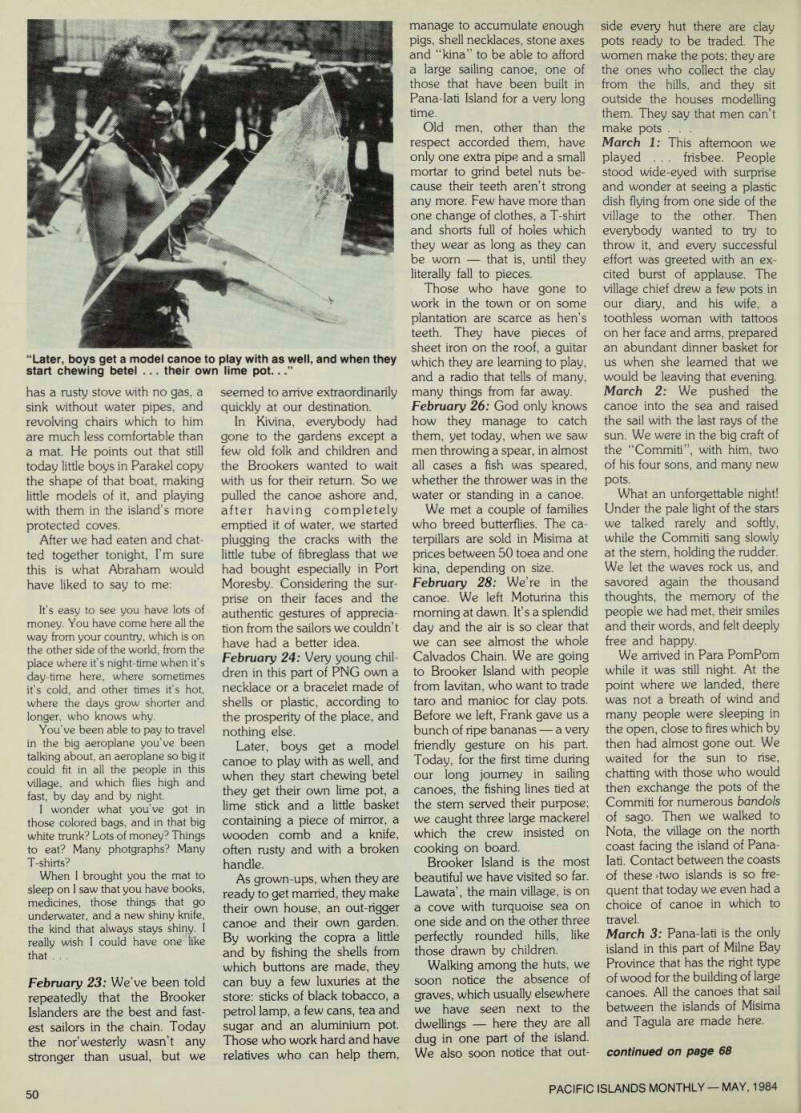
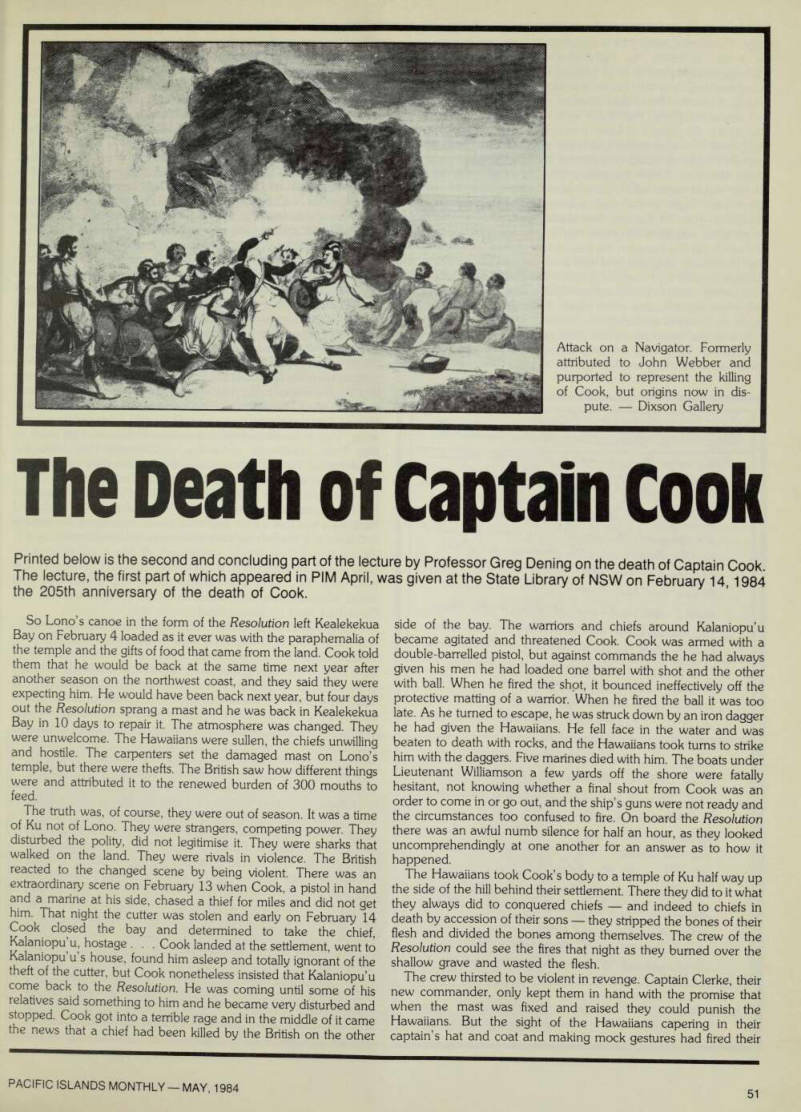
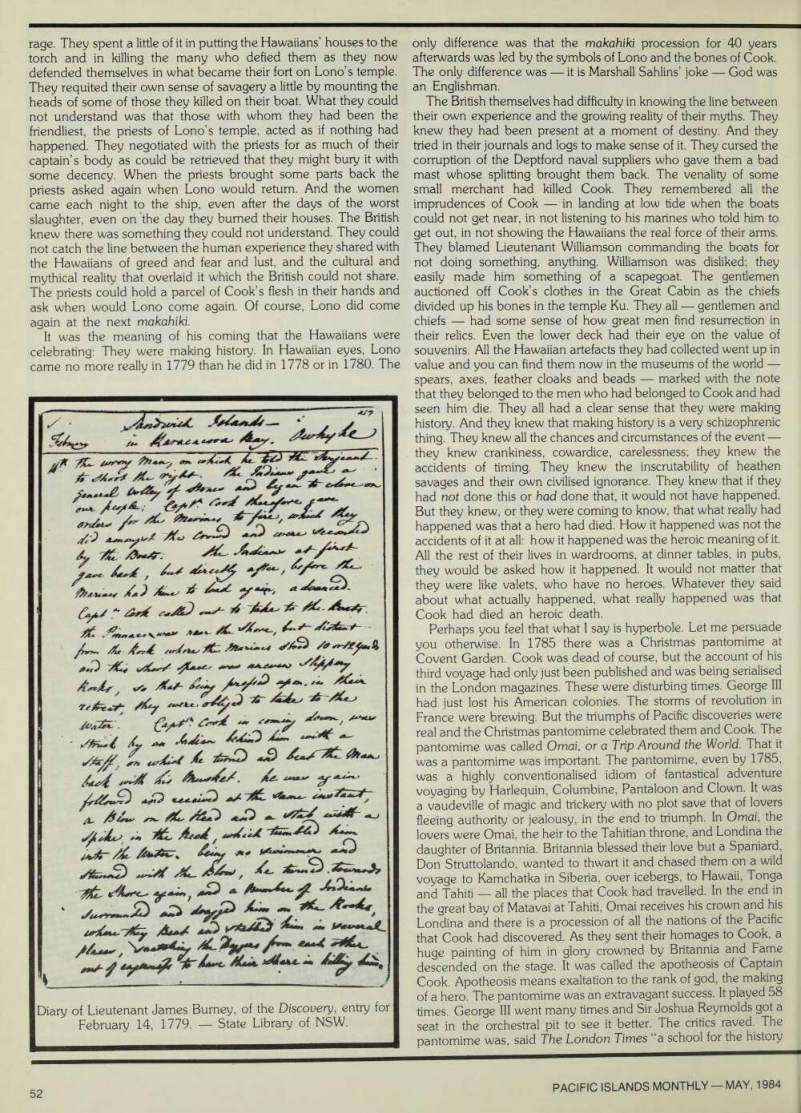
that stays shiny all the time’
In the fourth extract from the Melanesian travel diary of ROBERTO PETTINI, he and brother MARCO enjoy the last of their journey through the Calvados Chain, in Papua New Guinea’s Milne Bay Province and see many things to set them to wondering.
February 17, 1981: The Sun day morning religious service at Kuanak Village began with one of those powerful blasts from a huge white conch shell. In the local catechist’s hut, the Gospel was read and the people sang, shook hands, and listened in an “official” way to the same bits of news and gossip that were circulating from hut to hut yesterday. Who are the two “dim-dim”? Where do they come from? What are they doing here, and where are they going?
In the afternoon we went to meet a wood-carver who lives on a nearby island less than an hour away by rowing canoe.
With him there were many sick people his wife and children, and other people from the village who had come to see us with their infected sores.
Those with larger sores, espe cially if they are on the feet or legs, don’t move any more, they spend their time sitting around chasing off flies and other insects. All the sores started off as small scratches and have been getting bigger and filling with pus.
Yet in this country medicines and medical services are entire ly free, and it’s not even neces sary to make the effort of going somewhere else to get them. It would be enough to have medi cines like penicillin delivered every two months, when the mission’s medical patrol goes through. Instead, there isn’t one Band-aid in the village, and whoever is sick just waits . . .
Laziness? Superstition? Lack of trust in white medicine? We wish we could understand this strange attitude, but how long would we have to stay on one of these islands before we did?
We told everybody we had medicines with us, and to come to Kuanak to get them.
February 18: There are many pigs around the village and we’ve reached the point where everytime we see one pass by, our eyes turn it automatically
into grilled chops . . .
So with the excuse that tonight it’s full moon, we de cided to organise a feast. We waited until the village pigs came back from the bush at dinner time, we lit a fire on the beach, and, after we’d bought a pig we roasted it on the fire.
The whole village enthusias tically joined in the unexpected banquet.
With the music, the songs, and the roast pig, there was also dancing, so funny that we could kill ourselves laughing... a sort of hopping zombie dance up and down a narrow space, much smaller than the area actually available. Men, women, boys, girls, Marco and I, the catechist, all together dancing! Then the moon set slowly behind the palms, and
there still was someone happily dancing when we closed our eyes to sleep.
February 20: The people of Kuanak said a very warm good bye to us this morning. “We’ll remember your footprints in the sand . . . ” a woman said before we boarded the canoe. She pointed out that she could tell my footprints from Marco’s, in the same way as everyone here can recognise everyone else’s footprints.
It took us all day to get to Pana-Umale. Today the weath er was really beautiful, the sea was calm, we had lots of sugar cane on board to be sucked.
More than once large flocks of birds approached, making a round dance and much noise around the canoe.
We even stopped for lunch in Pana-Tania, a small uninha bited island that is cultivated intermittently like many other uninhabited islands especially to allow canoe travellers to find something there to drink and eat. We even put together an omlette. There are lots of birds’ eggs in the island, and half a coconut shell replaced the frying pan with no problems.
February 21: Parakel is the only village on Pana-Umale, and there are few people. To day I spent hours collecting shells without hearing a sound apart from the wind and the sea. Here too, as in every other village we’ve visited along the Calvados Chain, there is a “Commiti” that is, a man elected by the local population who links the small community with the rest of the country on a social and administrative level.
The “Commiti” in Parakel is named Abraham and lives in a hut furnished with old gear from a sailing boat wrecked a few hundred metres away. It
Pana-lati boat builders at work... "the only island ... that has the right kind of wood for the building of large canoes."
has a rusty stove with no gas, a sink without water pipes, and revolving chairs which to him are much less comfortable than a mat. He points out that still today little boys in Parakel copy the shape of that boat, making little models of it, and playing with them in the island’s more protected coves.
After we had eaten and chatted together tonight, I’m sure this is what Abraham would have liked to say to me: It’s easy to see you have lots of money. You have come here all the way from your country, which is on the other side of the world, from the place where it's night-time when it's day-time here, where sometimes it’s cold, and other times it’s hot, where the days grow shorter and longer, who knows why.
You’ve been able to pay to travel in the big aeroplane you’ve been talking about, an aeroplane so big it cou d fit in all the people in this village, and which flies high and fast, by day and by night.
I wonder what you’ve got in those colored bags, and in that big white trunk? Lots of money? Things to eat? Many photgraphs? Many T-shirts?
When I brought you the mat to sleep on I saw that you have books, medicines, those things that go underwater, and a new shiny knife, the kind that always stays shiny, 1 really wish I could have one like that February 23: We’ve been told repeatedly that the Brooker Islanders are the best and fastest sailors in the chain. Today the nor’westerly wasn’t any stronger than usual, but we
seemed to arrive extraordinarily quickly at our destination, In Kivina, everybody had gone to the gardens except a few old folk and children and the Brookers wanted to wait with us for their return. So we pulled the canoe ashore and, after having completely emptied it of water, we started plugging the cracks with the little tube of fibreglass that we had bought especially in Port Moresby. Considering the sur prise on their faces and the aut hentic gestures of apprecia tion from the sailors we cou l dn ’ t h had a better idea . , nA .. ...
February 24: Very young chil dren in this part of PNG own a necklace or a bracelet made of shells or plastic, according to the prosperity of the place, and nothing else, Later boys get a model canoe (o , as well> and , . nii . 1.1 hen start ch< r w,n S b f tel the Y S«* their own lime pot a lime stick and a little basket containing a piece of mirror, a wooden comb and a knife, often rusty and with a broken handle.
A s grow n-ups, when they are reac [y to get married, they make Qwn h an out . ri ger , T„ canoe and their own garden, By working the copra a little and by fishing the shells from which buttons are made, they can buy a few luxuries at the store: sticks of black tobacco, a petrol lamp, a few cans, tea and sugar and an aluminium pot.
Those who work hard and have relatives who can help them,
manage to accumulate enough pigs, shell necklaces, stone axes and “kina” to be able to afford a large sailing canoe, one of those that have been built in Pana-lati Island for a very long time.
Old men, other than the respect accorded them, have only one extra pipe and a small mortar to grind betel nuts be cause their teeth aren’t strong any more. Few have more than one change of clothes, a T-shirt and shorts full of holes which they wear as long as they can be worn that is, until they literally fall to pieces.
Those who have gone to work in the town or on some plantation are scarce as hen’s teeth. They have pieces of sheet iron on the roof, a guitar which they are learning to play, and a radio that tells of many, many things from far away.
February 26: God only knows how they manage to catch them, yet today, when we saw men throwing a spear, in almost all cases a fish was speared, whether the thrower was in the water or standing in a canoe.
We met a couple of families who breed butterflies. The ca terpillars are sold in Misima at prices between 50 toea and one kina, depending on size.
February 28: We’re in the canoe. We left Moturina this morning at dawn. It’s a splendid day and the air is so clear that we can see almost the whole Calvados Chain. We are going to Brooker Island with people from lavitan, who want to trade taro and manioc for clay pots.
Before we left, Frank gave us a bunch of ripe bananas a very friendly gesture on his part.
Today, for the first time during our long journey in sailing canoes, the fishing lines tied at the stern served their purpose; we caught three large mackerel which the crew insisted on cooking on board.
Brooker Island is the most beautiful we have visited so far.
Lawata’, the main village, is on a cove with turquoise sea on one side and on the other three perfectly rounded hills, like those drawn by children.
Walking among the huts, we soon notice the absence of graves, which usually elsewhere we have seen next to the dwellings here they are all dug in one part of the island.
We also soon notice that out
side every hut there are clay pots ready to be traded. The women make the pots; they are the ones who collect the clay from the hills, and they sit outside the houses modelling them. They say that men can’t make pots . . .
March 1: This afternoon we played .. . frisbee. People stood wide-eyed with surprise and wonder at seeing a plastic dish flying from one side of the village to the other. Then everybody wanted to try to throw it, and every successful effort was greeted with an ex cited burst of applause. The village chief drew a few pots in our diary, and his wife, a toothless woman with tattoos on her face and arms, prepared an abundant dinner basket for us when she learned that we would be leaving that evening.
March 2: We pushed the canoe into the sea and raised the sail with the last rays of the sun. We were in the big craft of the “Commiti”, with him, two of his four sons, and many new pots.
What an unforgettable night!
Under the pale light of the stars we talked rarely and softly, while the Commiti sang slowly at the stem, holding the rudder.
We let the waves rock us, and savored again the thousand thoughts, the memory of the people we had met, their smiles and their words, and felt deeply free and happy.
We arrived in Para PomPom while it was still night. At the point where we landed, there was not a breath of wind and many people were sleeping in the open, close to fires which by then had almost gone out. We waited for the sun to rise, chatting with those who would then exchange the pots of the Commiti for numerous bandols of sago. Then we walked to Nota, the village on the north coast facing the island of Pana lati. Contact between the coasts of these ‘two islands is so fre quent that today we even had a choice of canoe in which to travel.
March 3: Pana-lati is the only island in this part of Milne Bay Province that has the right type of wood for the building of large canoes. All the canoes that sail between the islands of Misima and Tagula are made here.
continued on page 68
“Later, boys get a model canoe to play with as well, and when they start chewing betel ... their own lime pot..
There are many canoes under construction in Pana-lati there is no common ship yard but many private yards.
Whoever decides to build a canoe must first of all gather enough provisions to feed the people who will work with him; so for about a year he must prepare a good garden of pota toes and banana palms.
Apart from using a handful of copper nails, and sails made of cloth rather than woven leaves, all craft are built in the traditio nal manner: every piece of wood is cut and shaped by axe, fastened with vegetable fibres, and then finished with resin and cloth.
What’s the price of a com plete canoe? It depends ... It depends on the person who has organised its construction, on the number of those who have helped him, on the wealth of the person buying it, and, obviously, on its size. Someone paid 200 pigs for an 11-metre canoe just last week, and the guy from Para PomPom who brought us here told me that for his canoe he had to pay 100
pigs, 500 kina and 20 stone axes, besides plenty of shell money.
March 5: Never before have we travelled as fast in a canoe as we did this morning. We had been told that tomorrow a small plane would come from Alotau and so today we looked for a lift to get us to the landing strip in Misima on time. In the canoe this time there were at least 20 of us, including a number of children, yet we had to lower the sails twice, to ease the pressure of the wind on the stern.
March 6: Alotau Misurina Lodge. A hot shower, a dinner worthy of the “Thousand and One Nights,” a room with a floor, and beds with perfumed sheets . . .
Tonight ended the first chap ter of our journey. Tomorrow we’ll fly to Port Moresby, to apply for an extension to our visitors’ visas. We don’t know if we’ll get it. So we don’t know where our next story will begin.
Next month: To the Trob rionds.
The Death of Captain Cook
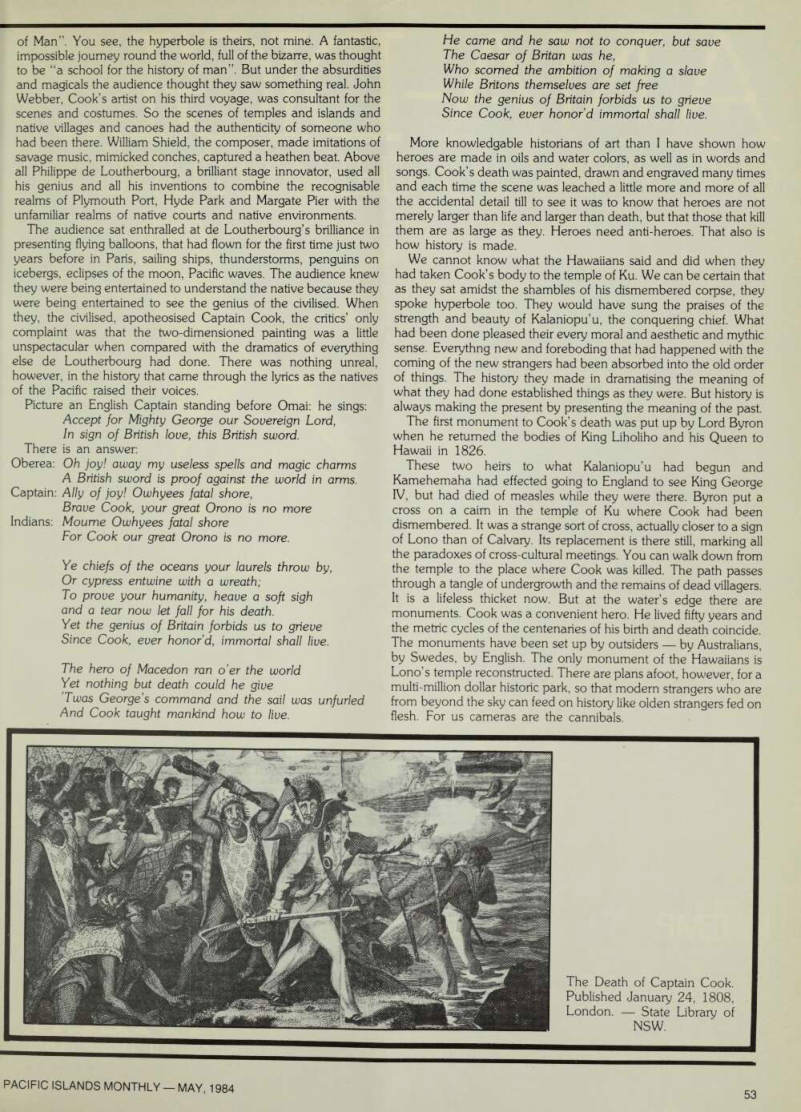
Printed below is the second and concluding part of the lecture by Professor Greg Dening on the death of Captain Cook The lecture, the first part of which appeared in PIM April, was given at the State Library of NSW on February 14 1984 the 205th anniversary of the death of Cook.
So Lono’s canoe in the form of the Resolution left Kealekekua Bay on February 4 loaded as it ever was with the paraphernalia of the temple and the gifts of food that came from the land. Cook told them that he would be back at the same time next year after another season on the northwest coast, and they said they were expecting him. He would have been back next year, but four days out the Resolution sprang a mast and he was back in Kealekekua Bay in 10 days to repair it. The atmosphere was changed. They were unwelcome. The Hawaiians were sullen, the chiefs unwilling and hostile. The carpenters set the damaged mast on Lono’s temple, but there were thefts. The British saw how different things were and attributed it to the renewed burden of 300 mouths to feed.
The truth was, of course, they were out of season. It was a time of Ku not of Lono. They were strangers, competing power. They disturbed the polity, did not legitimise it. They were sharks that walked on the land. They were rivals in violence. The British reacted to the changed scene by being violent. There was an extraordinary scene on February 13 when Cook, a pistol in hand and a marine at his side, chased a thief for miles and did not get him. That night the cutter was stolen and early on February 14 Cook closed the bay and determined to take the chief, Kalaniopu u, hostage . . . Cook landed at the settlement, went to Kalaniopu’u’s house, found him asleep and totally ignorant of the theft of the cutter, but Cook nonetheless insisted that Kalaniopu’u come back to the Resolution. He was coming until some of his relatives said something to him and he became very disturbed and stopped. Cook got into a terrible rage and in the middle of it came the news that a chief had been killed by the British on the other
side of the bay. The warriors and chiefs around Kalaniopu’u became agitated and threatened Cook. Cook was armed with a double-barrelled pistol, but against commands the he had always given his men he had loaded one barrel with shot and the other with ball. When he fired the shot, it bounced ineffectively off the protective matting of a warrior. When he fired the ball it was too late. As he turned to escape, he was struck down by an iron dagger he had given the Hawaiians. He fell face in the water and was beaten to death with rocks, and the Hawaiians took turns to strike him with the daggers. Five marines died with him. The boats under Lieutenant Williamson a few yards off the shore were fatally hesitant, not knowing whether a final shout from Cook was an order to come in or go out, and the ship’s guns were not ready and the circumstances too confused to fire. On board the Resolution there was an awful numb silence for half an hour, as they looked uncomprehendingly at one another for an answer as to how it happened.
The Hawaiians took Cook’s body to a temple of Ku half way up the side of the hill behind their settlement. There they did to it what they always did to conquered chiefs and indeed to chiefs in death by accession of their sons they stripped the bones of their flesh and divided the bones among themselves. The crew of the Resolution could see the fires that night as they burned over the shallow grave and wasted the flesh.
The crew thirsted to be violent in revenge. Captain Clerke, their new commander, only kept them in hand with the promise that when the mast was fixed and raised they could punish the Hawaiians. But the sight of the Hawaiians capering in their captain’s hat and coat and making mock gestures had fired their
Attack on a Navigator. Formerly attributed to John Webber and purported to represent the killing of Cook, but origins now in dis pute. - Dixson Gallery
rage. They spent a little of it in putting the Hawaiians’ houses to the torch and in killing the many who defied them as they now defended themselves in what became their fort on Lono’s temple.
They requited their own sense of savagery a little by mounting the heads of some of those they killed on their boat. What they could not understand was that those with whom they had been the friendliest, the priests of Lono’s temple, acted as if nothing had happened. They negotiated with the priests for as much of their captain’s body as could be retrieved that they might bury it with some decency. When the priests brought some parts back the priests asked again when Lono would return. And the women came each night to the ship, even after the days of the worst slaughter, even on the day they burned their houses. The British knew there was something they could not understand. They could not catch the line between the human experience they shared with the Hawaiians of greed and fear and lust, and the cultural and mythical reality that overlaid it which the British could not share.
The priests could hold a parcel of Cook’s flesh in their hands and ask when would Lono come again. Of course, Lono did come again at the next makahiki.
It was the meaning of his coming that the Hawaiians were celebrating: They were making history. In Hawaiian eyes, Lono came no more really in 1779 than he did in 1778 or in 1780. The
only difference was that the makahiki procession for 40 years afterwards was led by the symbols of Lono and the bones of Cook.
The only difference was it is Marshall Sahlins’ joke God was an Englishman.
The British themselves had difficulty in knowing the line between their own experience and the growing reality of their myths. They knew they had been present at a moment of destiny. And they tried in their journals and logs to make sense of it. They cursed the corruption of the Deptford naval suppliers who gave them a bad mast whose splitting brought them back. The venality of some small merchant had killed Cook. They remembered all the imprudences of Cook in landing at low tide when the boats could not get near, in not listening to his marines who told him to get out, in not showing the Hawaiians the real force of their arms.
They blamed Lieutenant Williamson commanding the boats for not doing something, anything. Williamson was disliked; they easily made him something of a scapegoat. The gentlemen auctioned off Cook’s clothes in the Great Cabin as the chiefs divided up his bones in the temple Ku. They all gentlemen and chiefs had some sense of how great men find resurrection in their relics. Even the lower deck had their eye on the value of souvenirs. All the Hawaiian artefacts they had collected went up in value and you can find them now in the museums of the world spears, axes, feather cloaks and beads marked with the note that they belonged to the men who had belonged to Cook and had seen him die. They all had a clear sense that they were making history. And they knew that making history is a very schizophrenic thing. They knew all the chances and circumstances of the event they knew crankiness, cowardice, carelessness; they knew the accidents of timing. They knew the inscrutability of heathen savages and their own civilised ignorance. They knew that if they had not done this or had done that, it would not have happened.
But they knew, or they were coming to know, that what really had happened was that a hero had died. How it happened was not the accidents of it at all: how it happened was the heroic meaning of it.
All the rest of their lives in wardrooms, at dinner tables, in pubs, they would be asked how it happened. It would not matter that they were like valets, who have no heroes. Whatever they said about what actually happened, what really happened was that Cook had died an heroic death.
Perhaps you feel that what I say is hyperbole. Let me persuade you otherwise. In 1785 there was a Christmas pantomime at Covent Garden. Cook was dead of course, but the account of his third voyage had only just been published and was being serialised in the London magazines. These were disturbing times. George 111 had just lost his American colonies. The storms of revolution in France were brewing. But the triumphs of Pacific discoveries were real and the Christmas pantomime celebrated them and Cook. The pantomime was called Omai, or a Trip Around the World. That it was a pantomime was important. The pantomime, even by 1785, was a highly conventionalised idiom of fantastical adventure voyaging by Harlequin, Columbine, Pantaloon and Clown. It was a vaudeville of magic and trickery with no plot save that of lovers fleeing authority or jealousy, in the end to triumph. In Omai, the lovers were Omai, the heir to the Tahitian throne, and Londina the daughter of Britannia. Britannia blessed their love but a Spaniard, Don Struttolando, wanted to thwart it and chased them on a wild voyage to Kamchatka in Siberia, over icebergs, to Hawaii, Tonga and Tahiti all the places that Cook had travelled. In the end in the great bay of Matavai at Tahiti, Omai receives his crown and his Londina and there is a procession of all the nations of the Pacific that Cook had discovered. As they sent their homages to Cook, a huge painting of him in glory crowned by Britannia and Fame descended on the stage. It was called the apotheosis of Captain Cook. Apotheosis means exaltation to the rank of god, the making of a hero. The pantomime was an extravagant success. It played 58 times. George 111 went many times and Sir Joshua Reymolds got a seat in the orchestral pit to see it better. The critics raved. The pantomime was, said The London Times “a school for the history
Diary of Lieutenant James Burney, of the Discovery, entry for February 14, 1779. State Library of NSW.
of Man”. You see, the hyperbole is theirs, not mine. A fantastic, impossible journey round the world, full of the bizarre, was thought to be “a school for the history of man”. But under the absurdities and magicals the audience thought they saw something real. John Webber, Cook’s artist on his third voyage, was consultant for the scenes and costumes. So the scenes of temples and islands and native villages and canoes had the authenticity of someone who had been there. William Shield, the composer, made imitations of savage music, mimicked conches, captured a heathen beat. Above all Philippe de Loutherbourg, a brilliant stage innovator, used all his genius and all his inventions to combine the recognisable realms of Plymouth Port, Hyde Park and Margate Pier with the unfamiliar realms of native courts and native environments.
The audience sat enthralled at de Loutherbourg’s brilliance in presenting flying balloons, that had flown for the first time just two years before in Paris, sailing ships, thunderstorms, penguins on icebergs, eclipses of the moon, Pacific waves. The audience knew they were being entertained to understand the native because they were being entertained to see the genius of the civilised. When they, the civilised, apotheosised Captain Cook, the critics’ only complaint was that the two-dimensioned painting was a little unspectacular when compared with the dramatics of everything else de Loutherbourg had done. There was nothing unreal, however, in the history that came through the lyrics as the natives of the Pacific raised their voices.
Picture an English Captain standing before Omai: he sings: Accept for Mighty George our Sovereign Lord, In sign of British love, this British sword.
There is an answer: Oberea: Oh joy! away my useless spells and magic charms A British sword is proof against the world in arms.
Captain: Ally of joy! Owhyees fatal shore, Brave Cook, your great Orono is no more Indians: Moume Owhyees fatal shore For Cook our great Orono is no more.
Ye chiefs of the oceans your laurels throw by, Or cypress entwine with a wreath; To prove your humanity, heave a soft sigh and a tear now let fall for his death.
Yet the genius of Britain forbids us to grieve Since Cook, ever honor’d, immortal shall live.
The hero of Macedon ran o’er the world Yet nothing but death could he give ’Twas George’s command and the sail was unfurled And Cook taught mankind how to live.
He came and he saw not to conquer, but save The Caesar of Britan was he, Who scorned the ambition of making a slave While Britons themselves are set free Now the genius of Britain forbids us to grieve Since Cook, ever honor’d immortal shall live.
More knowledgable historians of art than I have shown how heroes are made in oils and water colors, as well as in words and songs. Cook’s death was painted, drawn and engraved many times and each time the scene was leached a little more and more of all the accidental detail till to see it was to know that heroes are not merely larger than life and larger than death, but that those that kill them are as large as they. Heroes need anti-heroes. That also is how history is made.
We cannot know what the Hawaiians said and did when they had taken Cook’s body to the temple of Ku. We can be certain that as they sat amidst the shambles of his dismembered corpse, they spoke hyperbole too. They would have sung the praises of the strength and beauty of Kalaniopu’u, the conquering chief. What had been done pleased their every moral and aesthetic and mythic sense. Everything new and foreboding that had happened with the coming of the new strangers had been absorbed into the old order of things. The history they made in dramatising the meaning of what they had done established things as they were. But history is always making the present by presenting the meaning of the past.
The first monument to Cook’s death was put up by Lord Byron when he returned the bodies of King Liholiho and his Queen to Hawaii in 1826.
These two heirs to what Kalaniopu’u had begun and Kamehemaha had effected going to England to see King George IV, but had died of measles while they were there. Byron put a cross on a caim in the temple of Ku where Cook had been dismembered. It was a strange sort of cross, actually closer to a sign of Lono than of Calvary. Its replacement is there still, marking all the paradoxes of cross-cultural meetings. You can walk down from the temple to the place where Cook was killed. The path passes through a tangle of undergrowth and the remains of dead villagers.
It is a lifeless thicket now. But at the water’s edge there are monuments. Cook was a convenient hero. He lived fifty years and the metric cycles of the centenaries of his birth and death coincide.
The monuments have been set up by outsiders by Australians, by Swedes, by English. The only monument of the Hawaiians is Lono’s temple reconstructed. There are plans afoot, however, for a multi-million dollar historic park, so that modern strangers who are from beyond the sky can feed on history like olden strangers fed on flesh. For us cameras are the cannibals.
The Death of Captain Cook.
Published January 24, 1808, London. - State Library of
Nsw.
Advertisements & other items, p. 54 (1 item)
A-Digi
WAY TO
TH p
Multifunctlor
watchword fc
in this inform
Citizen techr
the challenge
revolutionary
watches.
ism is the
timepieces
ion age. oav meets m - . fp V °0 Wm , v v t
AMA-DIGI
TEMP
Citizen Quartz Ana-Digl Temp. 59,9° to - 9.9°C temperature readout, one-touch Fahrenheit conversion. Analog/Digital time indication with automatic calendar and dual (one other time zone) time. 24-hour alarm, hourly chime. 1/1000-sec. accurate stopwatch.
AMA-DIGI
ComhoFl
Citizen Quartz Ana-Digi Combo FI.
Analog/Digital time indication with 1-sec. and 10-sec. increment LCD trackers. Permanently adjusted monthday-date calendar. 24-hour alarm, 12-hour countdown timer; hourly chime. Dual time. And a 1/100-sec. counter lap-timing stopwatch.
CITIZEN
AHEAD OF THEIR TIME
people
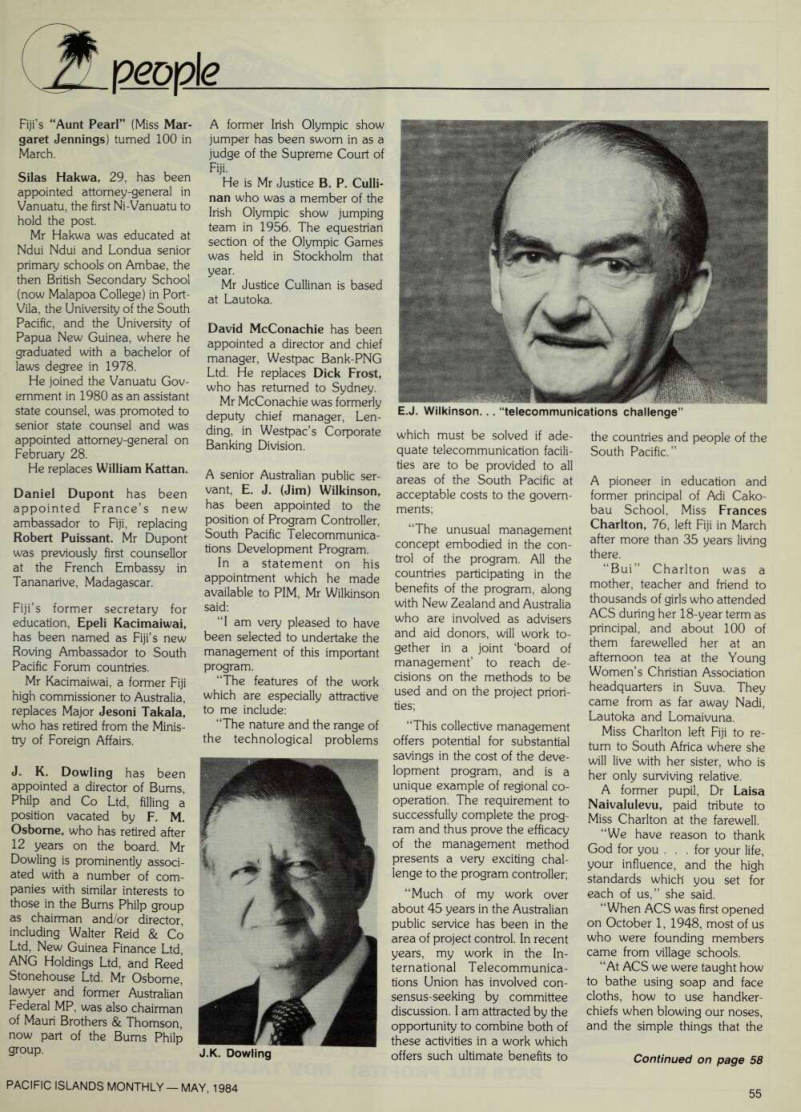
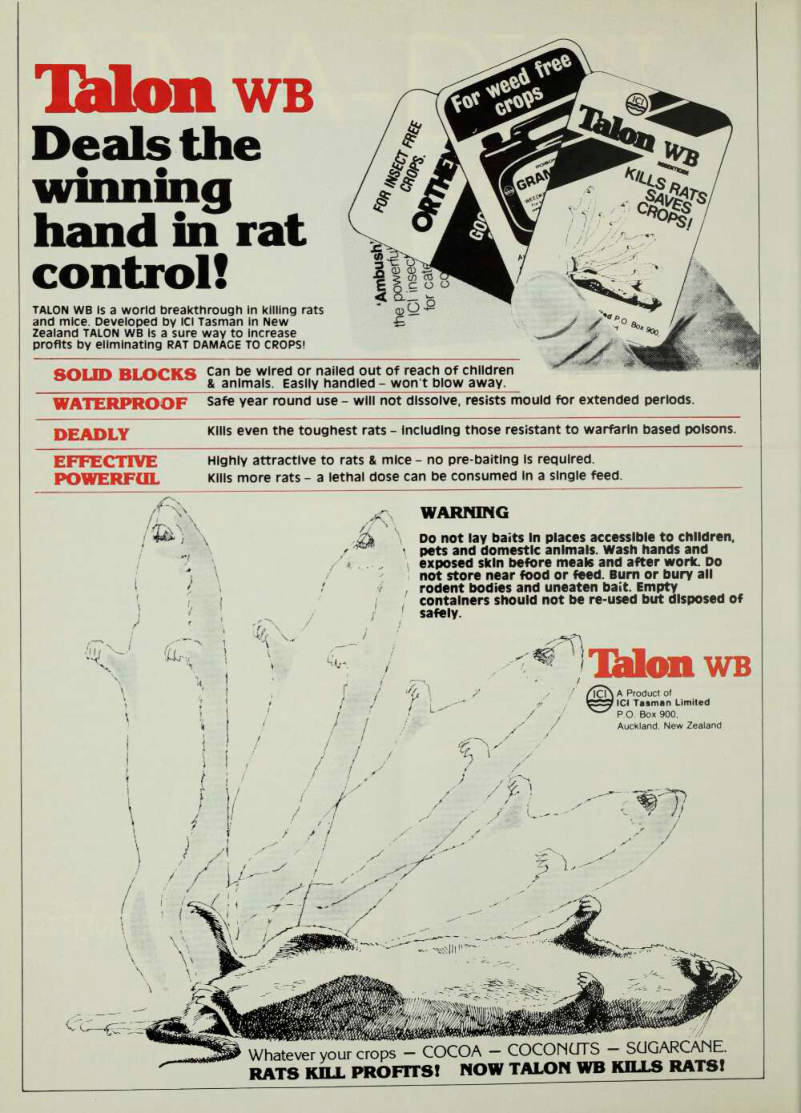
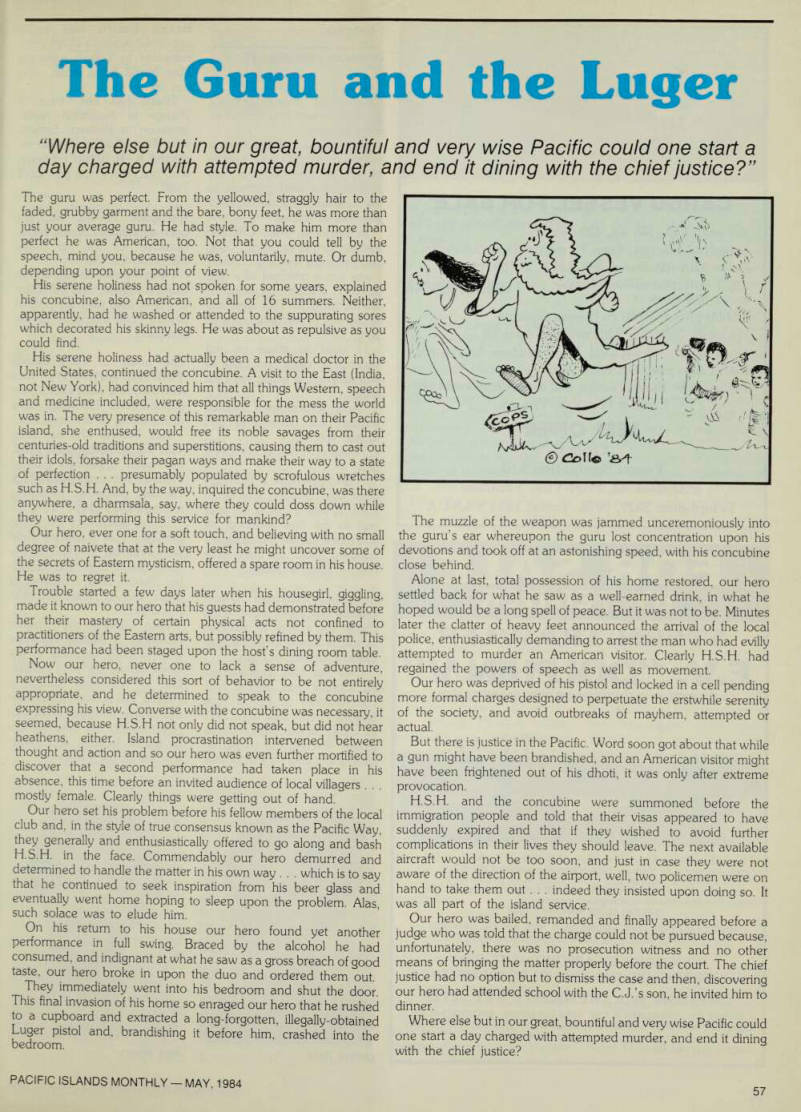
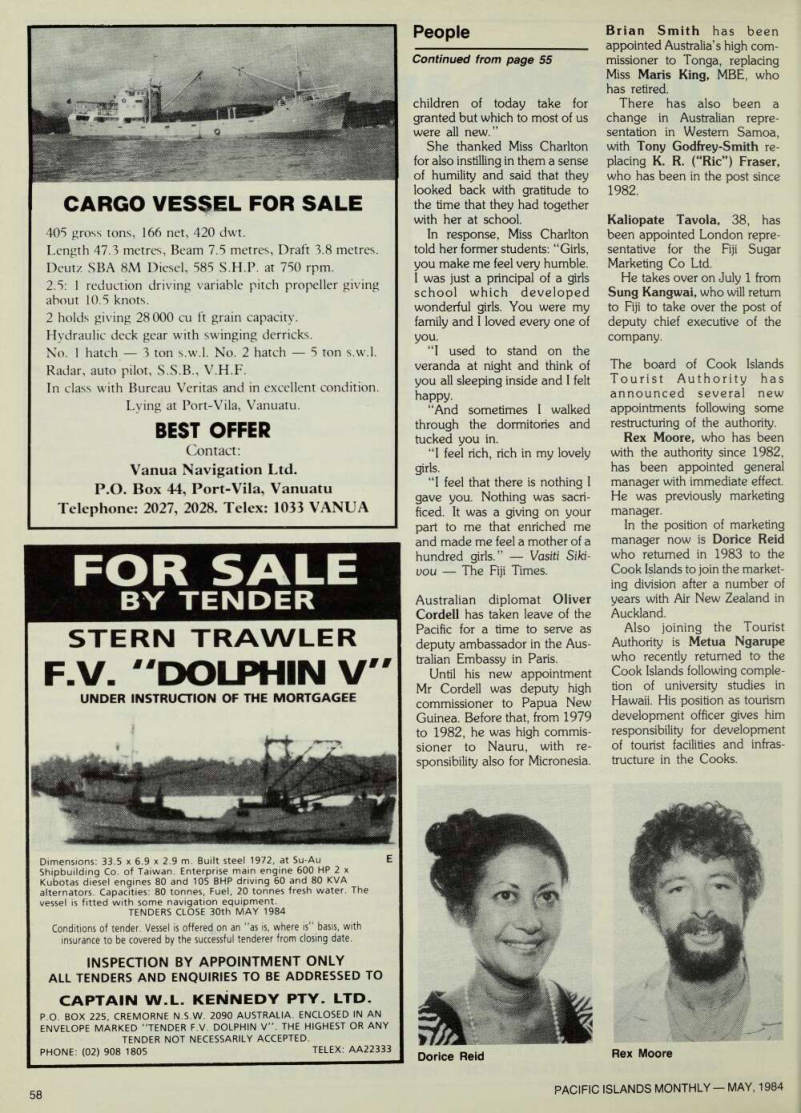
Fiji’s “Aunt Pearl” (Miss Mar garet Jennings) turned 100 in March.
Silas Hakwa, 29, has been appointed attorney-general in Vanuatu, the first Ni-Vanuatu to hold the post.
Mr Hakwa was educated at Ndui Ndui and Londua senior primary schools on Ambae, the then British Secondary School (now Malapoa College) in Port- Vila, the University of the South Pacific, and the University of Papua New Guinea, where he graduated with a bachelor of laws degree in 1978.
He joined the Vanuatu Gov ernment in 1980 as an assistant state counsel, was promoted to senior state counsel and was appointed attorney-general on February 28.
He replaces William Kattan.
Daniel Dupont has been appointed France’s new ambassador to Fiji, replacing Robert Puissant. Mr Dupont was previously first counsellor at the French Embassy in Tananarive, Madagascar.
Fiji’s former secretary for education, Epeli Kacimaiwai, has been named as Fiji’s new Roving Ambassador to South Pacific Forum countries.
Mr Kacimaiwai, a former Fiji high commissioner to Australia, replaces Major Jesoni Takala, who has retired from the Minis try of Foreign Affairs.
J. K. Dowling has been appointed a director of Bums, Philp and Co Ltd, filling a position vacated by F. M.
Osborne, who has retired after 12 years on the board. Mr Dowling is prominently associ ated with a number of com panies with similar interests to those in the Bums Philp group as chairman and/or director, including Walter Reid & Co Ltd, New Guinea Finance Ltd, ANG Holdings Ltd, and Reed Stonehouse Ltd. Mr Osborne, lawyer and former Australian Federal MP, was also chairman of Mauri Brothers & Thomson, now part of the Bums Philp group.
A former Irish Olympic show jumper has been sworn in as a judge of the Supreme Court of Fiji.
He is Mr Justice B. P. Culli nan who was a member of the Irish Olympic show jumping team in 1956. The equestrian section of the Olympic Games was held in Stockholm that year.
Mr Justice Cullinan is based at Lautoka.
David McConachie has been appointed a director and chief manager, Westpac Bank-PNG Ltd. He replaces Dick Frost, who has returned to Sydney.
Mr McConachie was formerly deputy chief manager, Len ding, in Westpac’s Corporate Banking Division.
A senior Australian public ser vant, E. J. (Jim) Wilkinson, has been appointed to the position of Program Controller, South Pacific Telecommunica tions Development Program.
In a statement on his appointment which he made available to PIM, Mr Wilkinson said; “I am very pleased to have been selected to undertake the management of this important program.
“The features of the work which are especially attractive to me include: “The nature and the range of the technological problems
which must be solved if ade quate telecommunication facili ties are to be provided to all areas of the South Pacific at acceptable costs to the govern ments; “The unusual management concept embodied in the con trol of the program. All the countries participating in the benefits of the program, along with New Zealand and Australia who are involved as advisers and aid donors, will work to gether in a joint ‘board of management’ to reach de cisions on the methods to be used and on the project priori ties; “This collective management offers potential for substantial savings in the cost of the deve lopment program, and is a unique example of regional co operation. The requirement to successfully complete the prog ram and thus prove the efficacy of the management method presents a very exciting chal lenge to the program controller; “Much of my work over about 45 years in the Australian public service has been in the area of project control. In recent years, my work in the In ternational Telecommunica tions Union has involved con sensus-seeking by committee discussion. I am attracted by the opportunity to combine both of these activities in a work which offers such ultimate benefits to
the countries and people of the South Pacific.”
A pioneer in education and former principal of Adi Cako bau School, Miss Frances Charlton, 76, left Fiji in March after more than 35 years living there.
“Bui” Charlton was a mother, teacher and friend to thousands of girls who attended ACS during her 18-year term as principal, and about 100 of them farewelled her at an afternoon tea at the Young Women’s Christian Association headquarters in Suva. They came from as far away Nadi, Lautoka and Lomaivuna.
Miss Charlton left Fiji to re turn to South Africa where she will live with her sister, who is her only surviving relative.
A former pupil, Dr Laisa Naivalulevu, paid tribute to Miss Charlton at the farewell.
“We have reason to thank God for you ... for your life, your influence, and the high standards which you set for each of us,” she said.
“When ACS was first opened on October 1, 1948, most of us who were founding members came from village schools.
“At ACS we were taught how to bathe using soap and face cloths, how to use handker chiefs when blowing our noses, and the simple things that the
Continued on page 58
J.K. Dowling
E.J. Wilkinson... “telecommunications challenge”
children of today take for granted but which to most of us were all new.”
She thanked Miss Charlton for also instilling in them a sense of humility and said that they looked back with gratitude to the time that they had together with her at school.
In response, Miss Charlton told her former students; “Girls, you make me feel very humble.
I was just a principal of a girls school which developed wonderful girls. You were my family and 1 loved every one of you.
“I used to stand on the veranda at night and think of you all sleeping inside and I felt happy.
“And sometimes I walked through the dormitories and tucked you in.
“I feel rich, rich in my lovely girls.
“I feel that there is nothing I gave you. Nothing was sacri ficed. It was a giving on your part to me that enriched me and made me feel a mother of a hundred girls.” Vasiti Siki uou The Fiji Times.
Australian diplomat Oliver Cordell has taken leave of the Pacific for a time to serve as deputy ambassador in the Aus tralian Embassy in Paris.
Until his new appointment Mr Cordell was deputy high commissioner to Papua New Guinea. Before that, from 1979 to 1982, he was high commis sioner to Nauru, with re sponsibility also for Micronesia.
Brian Smith has been appointed Australia’s high com missioner to Tonga, replacing Miss Maris King, MBE, who has retired.
There has also been a change in Australian repre sentation in Western Samoa, with Tony Godfrey-Smith re placing K. R. (“Ric”) Fraser, who has been in the post since 1982.
Kaliopate Tavola, 38, has been appointed London repre sentative for the Fiji Sugar Marketing Co Ltd.
He takes over on July 1 from Sung Kangwai, who will return to Fiji to take over the post of deputy chief executive of the company.
The board of Cook Islands Tourist Authority has announced several new appointments following some restructuring of the authority.
Rex Moore, who has been with the authority since 1982, has been appointed general manager with immediate effect.
He was previously marketing manager.
In the position of marketing manager now is Dorice Reid who returned in 1983 to the Cook Islands to join the market ing division after a number of years with Air New Zealand in Auckland.
Also joining the Tourist Authority is Metua Ngarupc who recently returned to the Cook Islands following comple tion of university studies in Hawaii. His position as tourism development officer gives him responsibility for development of tourist facilities and infras tructure in the Cooks.
Dorice Reid
Rex Moore
Advertisements & other items, p. 56 (1 item)
Xdon wb
Deals the
winning
hand In rat
control!
TALON WB Is a world breakthrough in killing rats and mice. Developed by ICI Tasman In New Zealand talon wb is a sure way to Increase profits by eliminating RAT DAMAGE TO CROPS! ft? *6
fM**i
&SS <o ft* so n
CO CO
la 5 O O O cd aa S i **>o. cni in BLOCKS Can be wired or nailed out of reach of children & animals. Easily handled - won t blow away.
WATERPROOF Safe Y ear round use - will not dissolve, resists mould for extended periods.
DEADLY
EFFECTIVE
POWERFUL
Kills even the toughest rats - Including those resistant to warfarin based poisons.
Highly attractive to rats & mice - no pre-baiting Is required.
Kills more rats - a lethal dose can be consumed In a single feed.
Do not lay baits In places accessible to children, pets and domestic animals. Wash hands and exposed skin before meals and after work. Do not store near food or feed. Burn or bury all rodent bodies and uneaten bait. Empty containers should not be re-used but disposed of safely.
Tdonwß
TcCS A Product of ICI Tasman Limited P.O. Box 900, Auckland, New Zealand
WARNING
/m
Whatever your crops COCOA COCONUTS SUGARCANE.
RATS nn.l. PROFITS! NOW TALON WB KILLS RATS!
The Guru and the Luger
“Where else but in our great, bountiful and very wise Pacific could one start a day charged with attempted murder, and end it dining with the chief justice?”
The guru was perfect. From the yellowed, straggly hair to the faded, grubby garment and the bare, bony feet, he was more than just your average guru. He had style. To make him more than perfect he was American, too. Not that you could tell by the speech, mind you, because he was, voluntarily, mute. Or dumb, depending upon your point of view.
His serene holiness had not spoken for some years, explained his concubine, also American, and all of 16 summers. Neither, apparently, had he washed or attended to the suppurating sores which decorated his skinny legs. He was about as repulsive as you could find.
His serene holiness had actually been a medical doctor in the United States, continued the concubine. A visit to the East (India, not New York), had convinced him that all things Western, speech and medicine included, were responsible for the mess the world was in. The very presence of this remarkable man on their Pacific island, she enthused, would free its noble savages from their centuries-old traditions and superstitions, causing them to cast out their idols, forsake their pagan ways and make their way to a state of perfection . . . presumably populated by scrofulous wretches such as H.S.H. And, by the way, inquired the concubine, was there anywhere, a dharmsala, say, where they could doss down while they were performing this service for mankind?
Our hero, ever one for a soft touch, and believing with no small degree of naivete that at the very least he might uncover some of the secrets of Eastern mysticism, offered a spare room in his house.
He was to regret it.
Trouble started a few days later when his housegirl, giggling, made it known to our hero that his guests had demonstrated before her their mastery of certain physical acts not confined to practitioners of the Eastern arts, but possibly refined by them. This performance had been staged upon the host’s dining room table.
Now our hero, never one to lack a sense of adventure, nevertheless considered this sort of behavior to be not entirely appropriate, and he determined to speak to the concubine expressing his view. Converse with the concubine was necessary, it seemed, because H.S.H not only did not speak, but did not hear heathens, either. Island procrastination intervened between thought and action and so our hero was even further mortified to discover that a second performance had taken place in his absence, this time before an invited audience of local villagers . mostly female. Clearly things were getting out of hand.
Our hero set his problem before his fellow members of the local club and, in the style of true consensus known as the Pacific Way, they generally and enthusiastically offered to go along and bash H.S.H. in the face. Commendably our hero demurred and determined to handle the matter in his own way . . . which is to say that he continued to seek inspiration from his beer glass and eventually went home hoping to sleep upon the problem. Alas, such solace was to elude him.
On his return to his house our hero found yet another performance in full swing. Braced by the alcohol he had consumed, and indignant at what he saw as a gross breach of good taste, our hero broke in upon the duo and ordered them out.
They immediately went into his bedroom and shut the door.
This final invasion of his home so enraged our hero that he rushed to a cupboard and extracted a long-forgotten, illegally-obtained Luger pistol and, brandishing it before him, crashed into the bedroom.
The muzzle of the weapon was jammed unceremoniously into the guru’s ear whereupon the guru lost concentration upon his devotions and took off at an astonishing speed, with his concubine close behind.
Alone at last, total possession of his home restored, our hero settled back for what he saw as a well-earned drink, in what he hoped would be a long spell of peace. But it was not to be. Minutes later the clatter of heavy feet announced the arrival of the local police, enthusiastically demanding to arrest the man who had evilly attempted to murder an American visitor. Clearly H.S.H. had regained the powers of speech as well as movement.
Our hero was deprived of his pistol and locked in a cell pending more formal charges designed to perpetuate the erstwhile serenity of the society, and avoid outbreaks of mayhem, attempted or actual.
But there is justice in the Pacific. Word soon got about that while a gun might have been brandished, and an American visitor might have been frightened out of his dhoti, it was only after extreme provocation.
H.S.H. and the concubine were summoned before the immigration people and told that their visas appeared to have suddenly expired and that if they wished to avoid further complications in their lives they should leave. The next available aircraft would not be too soon, and just in case they were not aware of the direction of the airport, well, two policemen were on hand to take them out . . . indeed they insisted upon doing so. It was all part of the island service.
Our hero was bailed, remanded and finally appeared before a judge who was told that the charge could not be pursued because, unfortunately, there was no prosecution witness and no other means of bringing the matter properly before the court. The chief justice had no option but to dismiss the case and then, discovering our hero had attended school with the C.J.’s son, he invited him to dinner.
Where else but in our great, bountiful and very wise Pacific could one start a day charged with attempted murder, and end it dining with the chief justice?
Advertisements & other items, pp. 58-60 (3 items)
People
Continued from page 55
For Sale
CARGO VESSEL FOR SALE
405 gross tons, 166 net, 420 dwt.
Length 47.3 metres, Beam 7.5 metres, Draft 3.8 metres.
Dcutz SBA 8M Diesel, 585 S.H.P. at 750 rpm. 2.5: 1 reduction driving variable pitch propeller giving about 10.5 knots. 2 holds giving 28000 cu ft grain capacity.
Hydraulic deck gear with swinging derricks.
No. 1 hatch 3 ton s.w.l. No. 2 hatch 5 ton s.w.l.
Radar, auto pilot, 5.5.8., V.H.F.
In class with Bureau Veritas and in excellent condition.
Lying at Port-Vila, Vanuatu.
BEST OFFER
Contact: Vanua Navigation Ltd.
P.O. Box 44, Port-Vila, Vanuatu Telephone: 2027, 2028. Telex: 1033 VANUA
FOR SALE
BY TENDER
STERN TRAWLER
F-V. "DOLPHIN V"
UNDER INSTRUCTION OF THE MORTGAGEE
Dimensions: 33.5 x 6.9 x 2.9 m. Built steel 1972, at Su-Au E Shipbuilding Co. of Taiwan. Enterprise main engine 600 HP 2 x Kubotas diesel engines 80 and 105 BHP driving 60 and 80 KVA alternators. Capacities: 80 tonnes, Fuel, 20 tonnes fresh water. The vessel is fitted with some navigation equipment.
TENDERS CLOSE 30th MAY 1984
Conditions of tender. Vessel is offered on an "as is, where is" basis, with insurance to be covered by the successful tenderer from closing date.
INSPECTION BY APPOINTMENT ONLY
ALL TENDERS AND ENQUIRIES TO BE ADDRESSED TO
CAPTAIN W.L. KENNEDY PTY. LTD.
P.O. BOX 225, CREMORNE N.S.W. 2090 AUSTRALIA. ENCLOSED IN AN ENVELOPE MARKED "TENDER F.V. DOLPHIN V". THE HIGHEST OR ANY
TENDER NOT NECESSARILY ACCEPTED.
PHONE: (02) 908 1805 TELEX: AA22333
20
Benson a*d Hedges
WARNING-SMOKING IS A HEALTH HAZARD
ONLY THE BEST WILL DO.
■Pfhe Benson and Hedges Company Pty. Ltd. 1983 CC1426'83 JWT016.P351
Letters
59
PACIFIC ISLANDS MONTHLY —MAY, 1984
Letters Continued from page 9
tropicatities
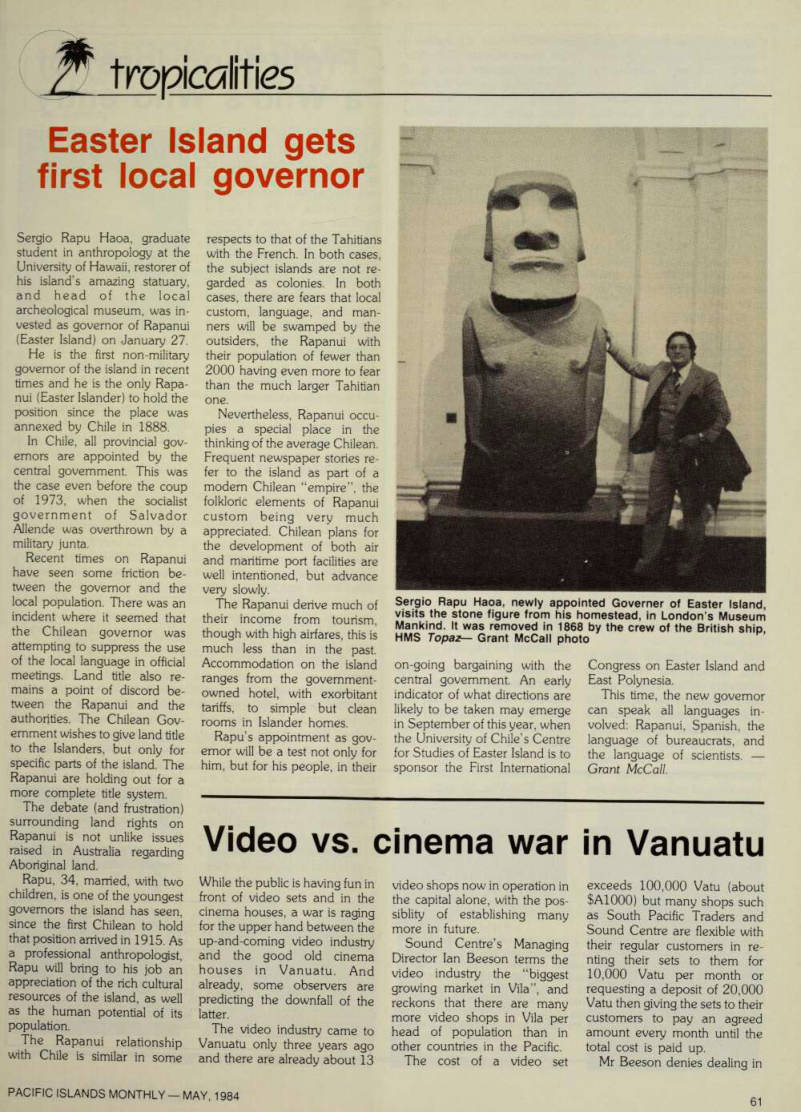
Easter Island gets first local governor
Sergio Rapu Haoa, graduate student in anthropology at the University of Hawaii, restorer of his island’s amazing statuary, and head of the local archeological museum, was in vested as governor of Rapanui (Easter Island) on January 27.
He is the first non-military governor of the island in recent times and he is the only Rapa nui (Easter Islander) to hold the position since the place was annexed by Chile in 1888.
In Chile, all provincial gov ernors are appointed by the central government. This was the case even before the coup of 1973, when the socialist government of Salvador Allende was overthrown by a military junta.
Recent times on Rapanui have seen some friction be tween the governor and the local population. There was an incident where it seemed that the Chilean governor was attempting to suppress the use of the local language in official meetings. Land title also re mains a point of discord be tween the Rapanui and the authorities. The Chilean Gov ernment wishes to give land title to the Islanders, but only for specific parts of the island. The Rapanui are holding out for a more complete title system.
The debate (and frustration) surrounding land rights on Rapanui is not unlike issues raised in Australia regarding Aboriginal land.
Rapu, 34, married, with two children, is one of the youngest governors the island has seen, since the first Chilean to hold that position arrived in 1915. As a professional anthropologist, Rapu will bring to his job an appreciation of the rich cultural resources of the island, as well as the human potential of its population.
The Rapanui relationship with Chile is similar in some
respects to that of the Tahitians with the French. In both cases, the subject islands are not re garded as colonies. In both cases, there are fears that local custom, language, and man ners will be swamped by the outsiders, the Rapanui with their population of fewer than 2000 having even more to fear than the much larger Tahitian one.
Nevertheless, Rapanui occu pies a special place in the thinking of the average Chilean, Frequent newspaper stories re fer to the island as part of a modem Chilean “empire”, the folkloric elements of Rapanui custom being very much appreciated. Chilean plans for the development of both air and maritime port facilities are well intentioned, but advance very slowly, The Rapanui derive much of their income from tourism, though with high airfares, this is much less than in the past, Accommodation on the island ranges from the government owned hotel, with exorbitant tariffs, to simple but clean rooms in Islander homes, Rapu’s appointment as gov ernor will be a test not only for him, but for his people, in their
on-going bargaining with the central government. An early indicator of what directions are likely to be taken may emerge in September of this year, when the University of Chile s Centre for Studies of Easter Island is to sponsor the First International
Congress on Easter Island and East Polynesia, This time, the new governor can speak all languages in volved: Rapanui, Spanish, the language of bureaucrats, and the language of scientists.
Grant McCall.
Sergio Rapu Haoa, newly appointed Governer of Easter Island, visits the stone figure from his homestead, in London’s Museum Mankind. It was removed in 1868 by the crew of the British ship HMS Topaz — Grant McCall photo
Video vs. cinema war in Vanuatu
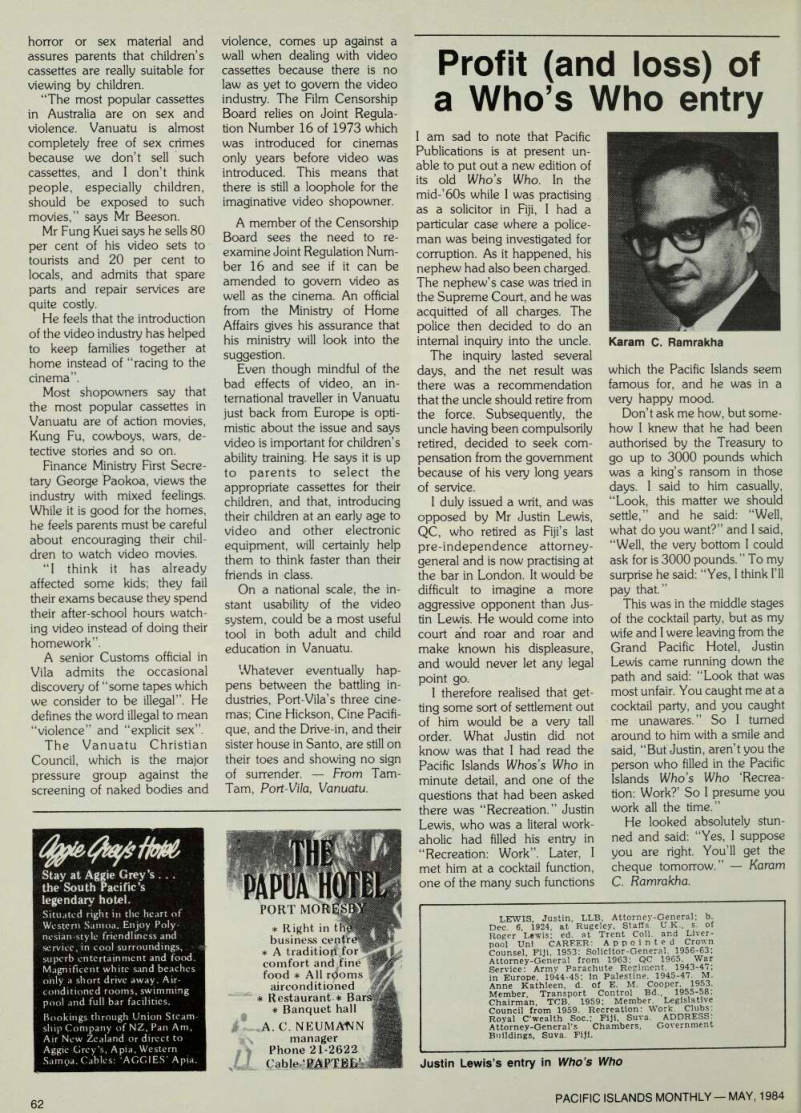
While the public is having fun in front of video sets and in the cinema houses, a war is raging for the upper hand between the up-and-coming video industry and the good old cinema houses in Vanuatu. And already, some observers are predicting the downfall of the latter.
The video industry came to Vanuatu only three years ago and there are already about 13
video shops now in operation in the capital alone, with the pos siblity of establishing many more in future.
Sound Centre’s Managing Director lan Beeson terms the video industry the “biggest growing market in Vila”, and reckons that there are many more video shops in Vila per head of population than in other countries in the Pacific.
The cost of a video set
exceeds 100,000 Vatu (about $A1000) but many shops such as South Pacific Traders and Sound Centre are flexible with their regular customers in re nting their sets to them for 10,000 Vatu per month or requesting a deposit of 20,000 Vatu then giving the sets to their customers to pay an agreed amount every month until the total cost is paid up.
Mr Beeson denies dealing in
horror or sex material and assures parents that children’s cassettes are really suitable for viewing by children.
“The most popular cassettes in Australia are on sex and violence. Vanuatu is almost completely free of sex crimes because we don’t sell such cassettes, and I don’t think people, especially children, should be exposed to such movies,” says Mr Beeson.
Mr Fung Kuei says he sells 80 per cent of his video sets to tourists and 20 per cent to locals, and admits that spare parts and repair services are quite costly.
He feels that the introduction of the video industry has helped to keep families together at home instead of “racing to the cinema”.
Most shopowners say that the most popular cassettes in Vanuatu are of action movies, Kung Fu, cowboys, wars, de tective stories and so on.
Finance Ministry First Secre tary George Paokoa, views the industry with mixed feelings.
While it is good for the homes, he feels parents must be careful about encouraging their chil dren to watch video movies.
“1 think it has already affected some kids; they fail their exams because they spend their after-school hours watch ing video instead of doing their homework”.
A senior Customs official in Vila admits the occasional discovery of “some tapes which we consider to be illegal”. He defines the word illegal to mean “violence” and “explicit sex”.
The Vanuatu Christian Council, which is the major pressure group against the screening of naked bodies and
violence, comes up against a wall when dealing with video cassettes because there is no law as yet to govern the video industry. The Film Censorship Board relies on Joint Regula tion Number 16 of 1973 which was introduced for cinemas only years before video was introduced. This means that there is still a loophole for the imaginative video shopowner.
A member of the Censorship Board sees the need to re examine Joint Regulation Num ber 16 and see if it can be amended to govern video as well as the cinema. An official from the Ministry of Home Affairs gives his assurance that his ministry will look into the suggestion.
Even though mindful of the bad effects of video, an in ternational traveller in Vanuatu just back from Europe is opti mistic about the issue and says video is important for children’s ability training. He says it is up to parents to select the appropriate cassettes for their children, and that, introducing their children at an early age to video and other electronic equipment, will certainly help them to think faster than their friends in class.
On a national scale, the in stant usability of the video system, could be a most useful tool in both adult and child education in Vanuatu.
Whatever eventually hap pens between the battling in dustries, Port-Vila’s three cine mas; Cine Hickson, Cine Pacifi que, and the Drive-in, and their sister house in Santo, are still on their toes and showing no sign of surrender. From Tam- Tam, Port-Vila, Vanuatu.
Profit (and loss) of
a Who’s Who entry
I am sad to note that Pacific Publications is at present un able to put out a new edition of its old Who’s Who. In the mid-’6os while I was practising as a solicitor in Fiji, I had a particular case where a police man was being investigated for corruption. As it happened, his nephew had also been charged.
The nephew’s case was tried in the Supreme Court, and he was acquitted of all charges. The police then decided to do an internal inquiry into the uncle.
The inquiry lasted several days, and the net result was there was a recommendation that the uncle should retire from the force. Subsequently, the uncle having been compulsorily retired, decided to seek com pensation from the government because of his very long years of service.
I duly issued a writ, and was opposed by Mr Justin Lewis, QC, who retired as Fiji’s last pre-independence attorney general and is now practising at the bar in London. It would be difficult to imagine a more aggressive opponent than Jus tin Lewis. He would come into court and roar and roar and make known his displeasure, and would never let any legal point go.
I therefore realised that get ting some sort of settlement out of him would be a very tall order. What Justin did not know was that I had read the Pacific Islands Whos’s Who in minute detail, and one of the questions that had been asked there was “Recreation.” Justin Lewis, who was a literal work aholic had filled his entry in “Recreation: Work”. Later, I met him at a cocktail function, one of the many such functions
which the Pacific Islands seem famous for, and he was in a very happy mood.
Don’t ask me how, but some how 1 knew that he had been authorised by the Treasury to go up to 3000 pounds which was a king’s ransom in those days. I said to him casually, “Look, this matter we should settle,” and he said: “Well, what do you want?” and I said, “Well, the very bottom I could ask for is 3000 pounds. ” To my surprise he said: “Yes, I think I’ll pay that.”
This was in the middle stages of the cocktail party, but as my wife and I were leaving from the Grand Pacific Hotel, Justin Lewis came running down the path and said: “Look that was most unfair. You caught me at a cocktail party, and you caught me unawares.” So I turned around to him with a smile and said, “But Justin, aren’t you the person who filled in the Pacific Islands Who’s Who ‘Recrea tion: Work?’ So 1 presume you work all the time.”
He looked absolutely stun ned and said: “Yes, I suppose you are right. You’ll get the
cheque tomorrow.”
Karam
C. Ramrakha.
Karam C. Ramrakha
Advertisements & other items, pp. 62-63 (2 items)
Stay at Aggie Grey’s . . .
the South Pacific’s
legendary hotel.
Situated right in the heart of Western Samoa. Enjoy Polynesian-stylc friendliness and service, in cool surroundings, superb entertainment and food.
Magnificent white sand beaches only a short drive away. Airconditioned rooms, swimming pool and full bar facilities.
Bookings through Union Steamship Company of NZ, Pan Am, Air New Zealand or direct to Aggie Grey’s, Apia, Western Samoa. Cables: ‘AGGIES’ Apia.
PORT MOR
for * Right in business cep ♦ A traditio|f comfort and tme food * All rqoms airconditioned * Restaurant * Ba ♦ Banquet hall
A. C. NEUMANN
manager Phone 21-2622 „ Cable*‘MFXM
LEWIS, Justin. LLB, Attorney-General; b.
Dec 6, 1924, at Rugeley. Staffs. U.K., s. of Roger Lewis; ed. at Trent Coll, and Liverpool Uni CAREER: Appointed Crown Counsel, Fiji, 1953: Solicitor-General. 1956-63; Attorney-General from 1963; QC 1965. War Service; Armv Parachute Regiment. 1943-47; in Europe. 1944-45; in Palestine. 1945-47. M.
Anne Kathleen, d. of E. M. Cooper 1953.
Member, Transport Control Bd., 1955-58; Chairman. TCB. 1959; Member. Legislative Council from 1959. Recreation: Work. Clubs; Royal C’wealth Soc.; Fiji, Suva. ADDRESS; Attorney-General’s Chambers, Government Buildings, Suva. Fiji.
Justin Lewis’s entry in Who’s Who
POSITION VACANT
The South Pacific Forum Fisheries (FFA) invites applications for the position of PROJECT ECONOMIST.
The Agency The Agency was established to encourage regional cooperation in fisheries development and management among independent South Pacific States. It is based in Honiara in the Solomon Islands; has a small professional staff with economic, legal, computing and technical expertise and serves the 14-member nations of the South Pacific Forum.
The Position The Project Economist has primary responsibility for the undertaking of economic evaluations of proposals for commercial fishing, fish processing and fish marketing at the request of member governments. The position also involves background studies on current trends in relevant fisheries technologies, markets and industries, notably tuna.
The Person The attributes sought in applicants for the position include: * at least two years experience in economic/commercial project evaluation: * preferably, some experience in fisheries; * an ability to work in a small inter-disciplinary team and to supervise consultants: * a capacity to work without detailed supervision, and to meet project deadlines, at times under difficult circumstances; * freedom to undertake substantial international travel.
Applicants should have a degree in commerce or economics, preferably with some mathematics or statistics and be able to demonstrate a high level of personal initiative. Preference will be given to applicants from countries of the South Pacific Forum.
Terms and Conditions of Employment A tax free salary at a regional level applies, with attractive transportation, housing, child and educational allowances, recreation leave and superannuation provisions.
Applications and enquiries should be addressed to:
DIRECTOR, FORUM FISHERIES AGENCY
P.O. BOX 629, Honiara, Solomon Islands.
Applicants should detail education and employment background, expected availability together with particulars of three referees with whom the applicant has been associated in a professional capacity.
Closing Date: 30th June, 1984
Tonga’s King takes
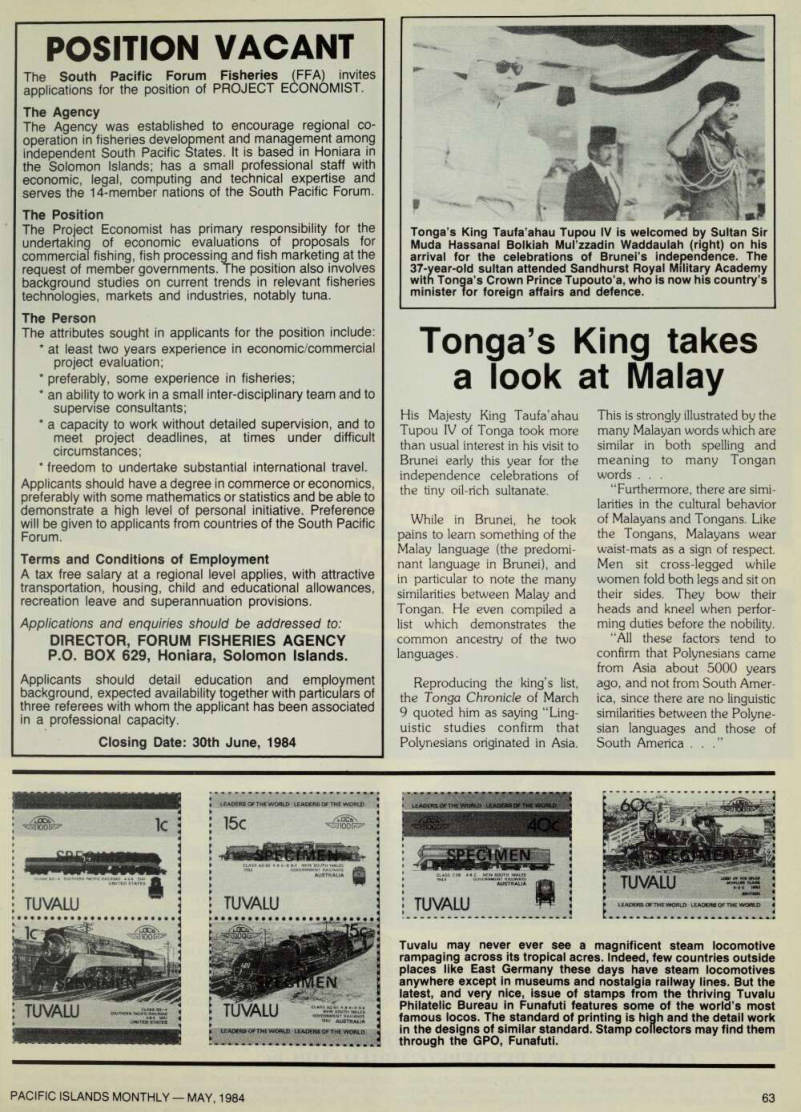
a look at Malay
His Majesty King Taufa’ahau Tupou IV of Tonga took more than usual interest in his visit to Brunei early this year for the independence celebrations of the tiny oil-rich sultanate.
While in Brunei, he took pains to learn something of the Malay language (the predomi nant language in Brunei), and in particular to note the many similarities between Malay and Tongan. He even compiled a list which demonstrates the common ancestry of the two languages.
Reproducing the king’s list, the Tonga Chronicle of March 9 quoted him as saying “Ling uistic studies confirm that Polynesians originated in Asia.
This is strongly illustrated by the many Malayan words which are similar in both spelling and meaning to many Tongan words . . .
“Furthermore, there are simi larities in the cultural behavior of Malayans and Tongans. Like the Tongans, Malayans wear waist-mats as a sign of respect.
Men sit cross-legged while women fold both legs and sit on their sides. They bow their heads and kneel when perfor ming duties before the nobility.
“All these factors tend to confirm that Polynesians came from Asia about 5000 years ago, and not from South Amer ica, since there are no linguistic similarities between the Polyne sian languages and those of South America . . .”
Tonga’s King Taufa’ahau Tupou IV is welcomed by Sultan Sir Muda Hassanal Bolkiah Mul’zzadin Waddaulah (right) on his arrival for the celebrations of Brunei’s independence. The 37-year-old sultan attended Sandhurst Royal Military Academy with Tonga’s Crown Prince Tupouto’a, who is now his country’s minister for foreign affairs and defence.
Tuvalu may never ever see a magnificent steam locomotive rampaging across its tropical acres. Indeed, few countries outside places like East Germany these days have steam locomotives anywhere except in museums and nostalgia railway lines. But the latest, and very nice, issue of stamps from the thriving Tuvalu Philatelic Bureau in Funafuti features some of the world’s most famous locos. The standard of printing is high and the detail work in the designs of similar standard. Stamp collectors may find them through the GPO, Funafuti.
Advertisements & other items, pp. 64-66 (1 item)
Europe-South Pacific Joint Service
The South Pacific Specialists offer facilities for shipment of: Containers (FCL/LCL) and Breakbulk Cargo plus reefer space and deeptanks for carriage of vegetable oils and other liquid bulk cargo.
Carriers also accept heavy lifts, overlength and cumbersome parcels.
Ports of Service: Please contact our regional offices for Loading: Papeete, Apia, Suva, further information: Lautoka, Noumea, Port Vila, Santo, The Bank Line (Australasia) Pty. Ltd.
Honiara, Port Moresby, Lae,Madang, Suite 801,51 Pitt Street Kimbe, Rabaul, Kieta, Darwin. Sydney N. SW. 2000 For: Rotterdam, Antwerp, Phone: 272041 Telex: 24063 Hamburg, Hull, Dunkirk, Le Havre.
Additional ports on enquiry.
ROUND THE WORLD SERVICE
Columbus Line Reederei GmbH P.O. Box 1667 Lae/Papua New Guinea Phone: 423 466/423 487 A.H. 422481 Telex: Colline NE 44171
THE BANK LINE LTD LONDON
COLUMBUS LINE REEDEREI GMBH HAMBURG
C0L1433
Toughness.
Nissan Cabstar
LV] Ni
Nissan Sunny Nissan Vanette n Nissan Urvan
PATROL
Nissan Patrol Datsun Pickup 4WD That’s why Nissan means higher performance. Toughness is total. Every member of the widerange lineup has extra strength and durability built-in along with superior maneuverability. These high performers deliver penny-pinching fuel economy and tough reliability. Once you discover how great the ride and handling ease are, you will understand what makes Nissan commercial and passenger vehicles worldwide favorites.
There’s more to a Nissan than meets the eye.
NISSAN
Ba!Nkf NauoTjaK:otf Enternil?®*? 0 CO f lsland A s , Cook Islands Motor Centre Ltd., Rarotonga Fiji Carpenters Motors, Suva Kiribati Atoll Auto Stores, Solomon IsLdsUnited i?h 2 0 n ,a Ag T en /rf A'ma S.A., Noumea Norfolk Island Sirius Motors Papua New Guinea Boroko Motors, Port Moresby Samoa Ud Aplf ’ TahltibuM SARL ’ Papeete Vanuatu Pentecost Vanua Trading Ltd., Port Vila Western Samoa
PACIFIC ISLANDS
TRANSPORT LINE
M.V. SIRIUS
and I vq
TAHITI SAMOA sir-
XU.
Qeqeral Steamship (Corpora tiori m General Agents 400 California Street, San Francisco, CA. USA PAPEETE: Agence Maritime Internationale, Tahiti PAGO PAGO: Polynesia Shipping Services, Inc.
APIA: Burns Philp (South Sea) Company. Ltd,
jmsmsmns
JWjSJIPBd
LOCAL AGENTS AND PAPUA NEW GUINEA
REPRESENTATION RABAUL: M. & C. Seeto,
P.O. Box 131, Rabaul.
Telephone 92 2919. 428 George St., Sydney.
Cables: Henco Sydney.
G.P.O. Box 3949.
MADANG; W. Double, P.O. Box 22, Madang.
Telephone 82 2696.
Telephone: 232 5377.
FIJI
K. Witherington Ltd., P.O. Box 293, Suva.
Telephone 22 356.
For specialised and
personalised buying
service throughout the Pacific Islands and the East.
VANUATU
John Lum & Associates, P.O. Box 65, Santo.
Telephone 329.
SOLOMON ISLANDS
Mr. Tom Lo, P.O. Box 327, Honiara.
Resident Agents in other Pacific Territories. Telephone 399 ill
from the islands press
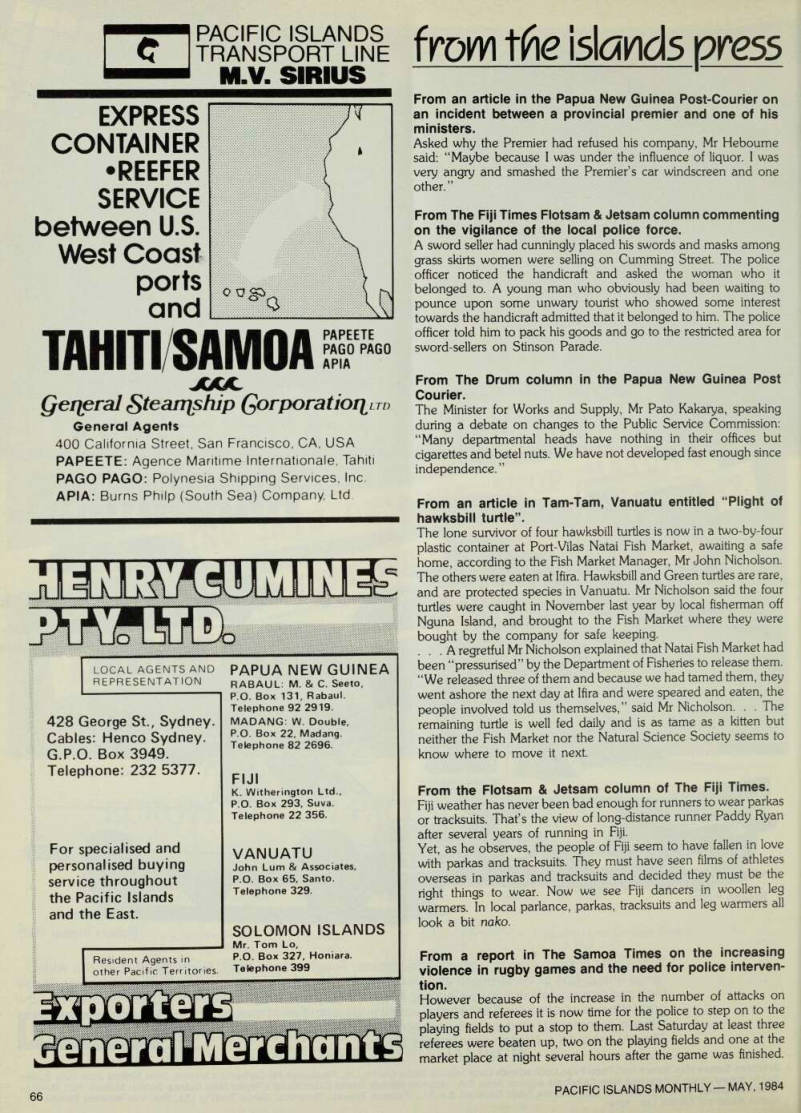
From an article in the Papua New Guinea Post-Courier on an incident between a provincial premier and one of his ministers.
Asked why the Premier had refused his company, Mr Heboume said; “Maybe because I was under the influence of liquor. I was very angry and smashed the Premier’s car windscreen and one other.”
From The Fiji Times Flotsam & Jetsam column commenting on the vigilance of the local police force.
A sword seller had cunningly placed his swords and masks among grass skirts women were selling on Gumming Street. The police officer noticed the handicraft and asked the woman who it belonged to. A young man who obviously had been waiting to pounce upon some unwary tourist who showed some interest towards the handicraft admitted that it belonged to him. The police officer told him to pack his goods and go to the restricted area for sword-sellers on Stinson Parade.
From The Drum column in the Papua New Guinea Post Courier.
The Minister for Works and Supply, Mr Pato Kakarya, speaking during a debate on changes to the Public Service Commission: “Many departmental heads have nothing in their offices but cigarettes and betel nuts. We have not developed fast enough since independence.”
From an article in Tam-Tam, Vanuatu entitled “Plight of hawksbill turtle”.
The lone survivor of four hawksbill turtles is now in a two-by-four plastic container at Port-Vilas Natai Fish Market, awaiting a safe home, according to the Fish Market Manager, Mr John Nicholson.
The others were eaten at Ifira. Hawksbill and Green turtles are rare, and are protected species in Vanuatu. Mr Nicholson said the four turtles were caught in November last year by local fisherman off Nguna Island, and brought to the Fish Market where they were bought by the company for safe keeping. ... A regretful Mr Nicholson explained that Natai Fish Market had been “pressurised” by the Department of Fisheries to release them.
“We released three of them and because we had tamed them, they went ashore the next day at Ifira and were speared and eaten, the people involved told us themselves,” said Mr Nicholson. . . The remaining turtle is well fed daily and is as tame as a kitten but neither the Fish Market nor the Natural Science Society seems to know where to move it next.
From the Flotsam & Jetsam column of The Fiji Times.
Fiji weather has never been bad enough for runners to wear parkas or tracksuits. That’s the view of long-distance runner Paddy Ryan after several years of running in Fiji.
Yet, as he observes, the people of Fiji seem to have fallen in love with parkas and tracksuits. They must have seen films of athletes overseas in parkas and tracksuits and decided they must be the right things to wear. Now we see Fiji dancers in woollen leg warmers. In local parlance, parkas, tracksuits and leg warmers all look a bit nako.
From a report in The Samoa Times on the increasing violence in rugby games and the need for police interven tion.
However because of the increase in the number of attacks on players and referees it is now time for the police to step on to the playing fields to put a stop to them. Last Saturday at least three referees were beaten up, two on the playing fields and one at the market place at night several hours after the game was finished.
yachts
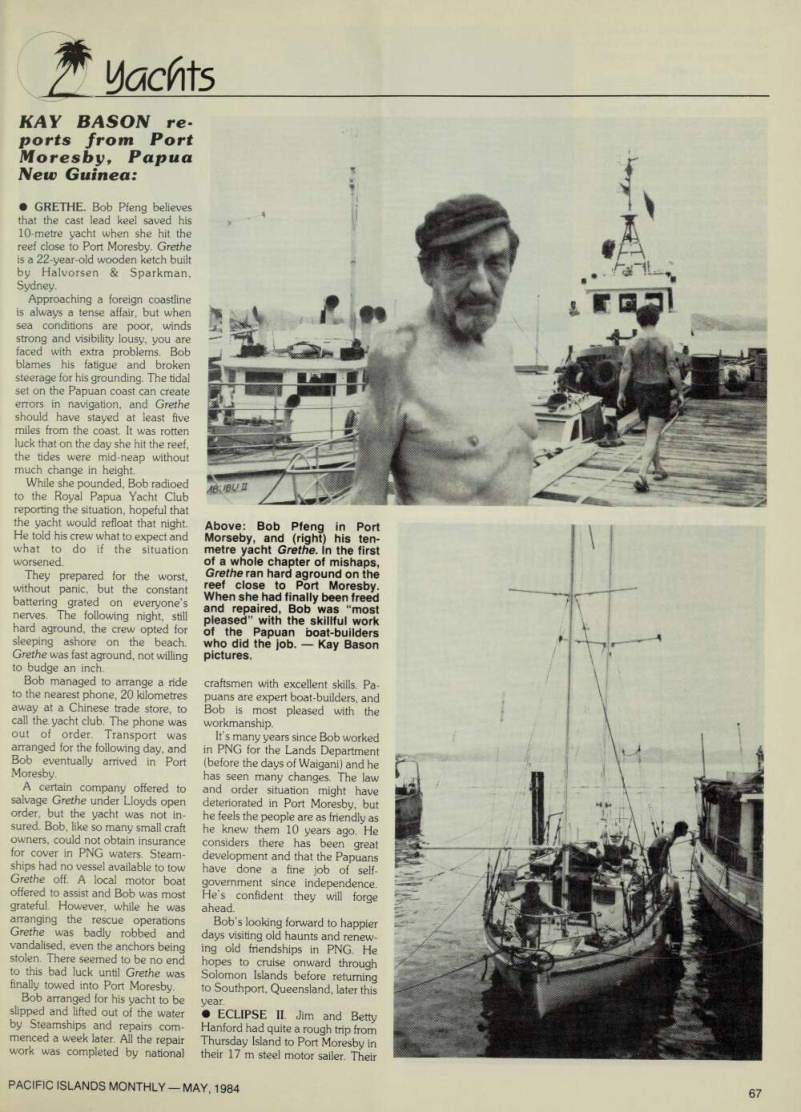
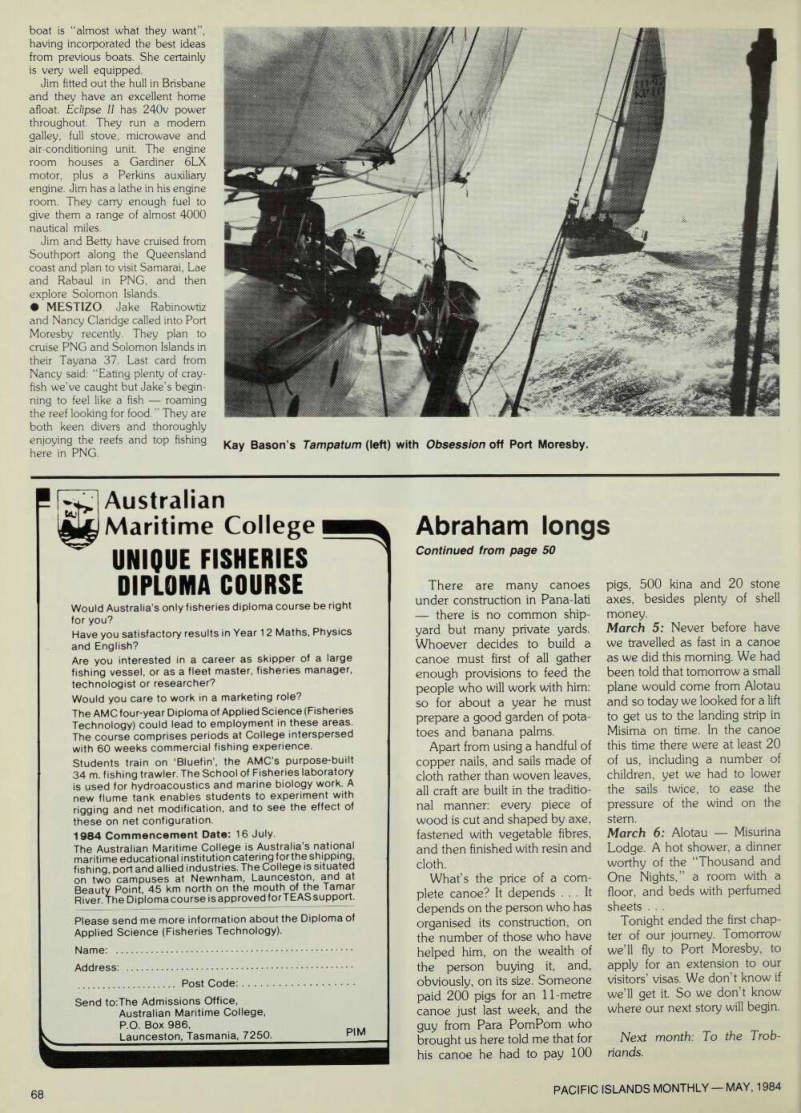
Kay Bason Re
ports from Port Moresby , Papua New Guinea:
• GRETHE. Bob Pfeng believes that the cast lead keel saved his 10-metre yacht when she hit the reef close to Port Moresby. Grethe is a 22-year-old wooden ketch built by Halvorsen & Sparkman, Sydney.
Approaching a foreign coastline is always a tense affair, but when sea conditions are poor, winds strong and visibility lousy, you are faced with extra problems. Bob blames his fatigue and broken steerage for his grounding. The tidal set on the Papuan coast can create errors in navigation, and Grethe should have stayed at least five miles from the coast. It was rotten luck that on the day she hit the reef, the tides were mid-neap without much change in height.
While she pounded, Bob radioed to the Royal Papua Yacht Club reporting the situation, hopeful that the yacht would refloat that night.
He told his crew what to expect and what to do if the situation worsened.
They prepared for the worst, without panic, but the constant battering grated on everyone’s nerves. The following night, still hard aground, the crew opted for sleeping ashore on the beach.
Grethe was fast aground, not willing to budge an inch.
Bob managed to arrange a ride to the nearest phone, 20 kilometres away at a Chinese trade store, to call the yacht club. The phone was out of order. Transport was arranged for the following day, and Bob eventually arrived in Port Moresby.
A certain company offered to salvage Grethe under Lloyds open order, but the yacht was not in sured. Bob, like so many small craft owners, could not obtain insurance for cover in PNG waters. Steam ships had no vessel available to tow Grethe off. A local motor boat offered to assist and Bob was most grateful. However, while he was arranging the rescue operations Grethe was badly robbed and vandalised, even the anchors being stolen. There seemed to be no end to this bad luck until Grethe was finally towed into Port Moresby.
Bob arranged for his yacht to be slipped and lifted out of the water by Steamships and repairs com menced a week later. All the repair work was completed by national
craftsmen with excellent skills. Pa puans are expert boat-builders, and Bob is most pleased with the workmanship.
It’s many years since Bob worked in PNG for the Lands Department (before the days of Waigani) and he has seen many changes. The law and order situation might have deteriorated in Port Moresby, but he feels the people are as friendly as he knew them 10 years ago. He considers there has been great development and that the Papuans have done a fine job of self government since independence.
He’s confident they will forge ahead.
Bob’s looking forward to happier days visiting old haunts and renew ing old friendships in PNG. He hopes to cruise onward through Solomon Islands before returning to Southport, Queensland, later this year. • ECLIPSE 11, Jim and Betty Hanford had quite a rough trip from Thursday Island to Port Moresby in their 17 m steel motor sailer. Their
Above: Bob Pfeng in Port Morseby, and (right) his ten metre yacht Grethe. In the first of a whole chapter of mishaps, Grethe ran hard aground on the reef close to Port Moresby.
When she had finally been freed and repaired, Bob was “most pleased” with the skillful work of the Papuan boat-builders who did the job. - Kay Bason pictures.
boat is “almost what they want”, having incorporated the best ideas from previous boats. She certainly is very well equipped.
Jim fitted out the hull in Brisbane and they have an excellent home afloat. Eclipse II has 240 v power throughout. They run a modern galley, full stove, microwave and air-conditioning unit. The engine room houses a Gardiner 6LX motor, plus a Perkins auxiliary engine. Jim has a lathe in his engine room. They carry enough fuel to give them a range of almost 4000 nautical miles.
Jim and Betty have cruised from Southport along the Queensland coast and plan to visit Samarai, Lae and Rabaul in PNG, and then explore Solomon Islands. • MESTIZO. Jake Rabinowtiz and Nancy Claridge called into Port Moresby recently. They plan to cruise PNG and Solomon Islands in their Tayana 37. Last card from Nancy said; “Eating plenty of cray fish we’ve caught but Jake’s begin ning to feel like a fish roaming the reef looking for food. ” They are both keen divers and thoroughly enjoying the reefs and top fishing here in PNG.
Kay Bason’s Tampatum (left) with Obsession off Port Moresby.
Advertisements & other items, p. 68 (2 items)
Abraham longs
Continued from page 50
Maritime College
MJ
Australian
UNIQUE FISHERIES
DIPLOMA COURSE
Would Australia’s only fisheries diploma course be right for you?
Have you satisfactory results in Year 12 Maths, Physics and English?
Are you interested in a career as skipper of a large fishing vessel, or as a fleet master, fisheries manager, technologist or researcher?
Would you care to work in a marketing role?
The AMC four-year Diploma of Applied Science (Fisheries Technology) could lead to employment in these areas.
The course comprises periods at College interspersed with 60 weeks commercial fishing experience.
Students train on ‘Bluefin’, the AMC’s purpose-built 34 m. fishing trawler. The School of Fisheries laboratory is used for hydroacoustics and marine biology work. A new flume tank enables students to experiment with rigging and net modification, and to see the effect of these on net configuration. 1984 Commencement Date; 16 July.
The Australian Maritime College is Australia’s national maritime educational institution catering forthe shipping fishing, port and allied industries. The College is situated on two campuses at Newnham, Launceston, and at Beauty Point, 45 km north on the mouth of the Tamar River. The Diploma course isapprovedforTEAS support.
Please send me more information about the Diploma of Applied Science (Fisheries Technology).
Name: Address: Post Code: Send to:The Admissions Office, Australian Maritime College, P.O. Box 986, Launceston, Tasmania, 7250.
PIM
shipping schedules
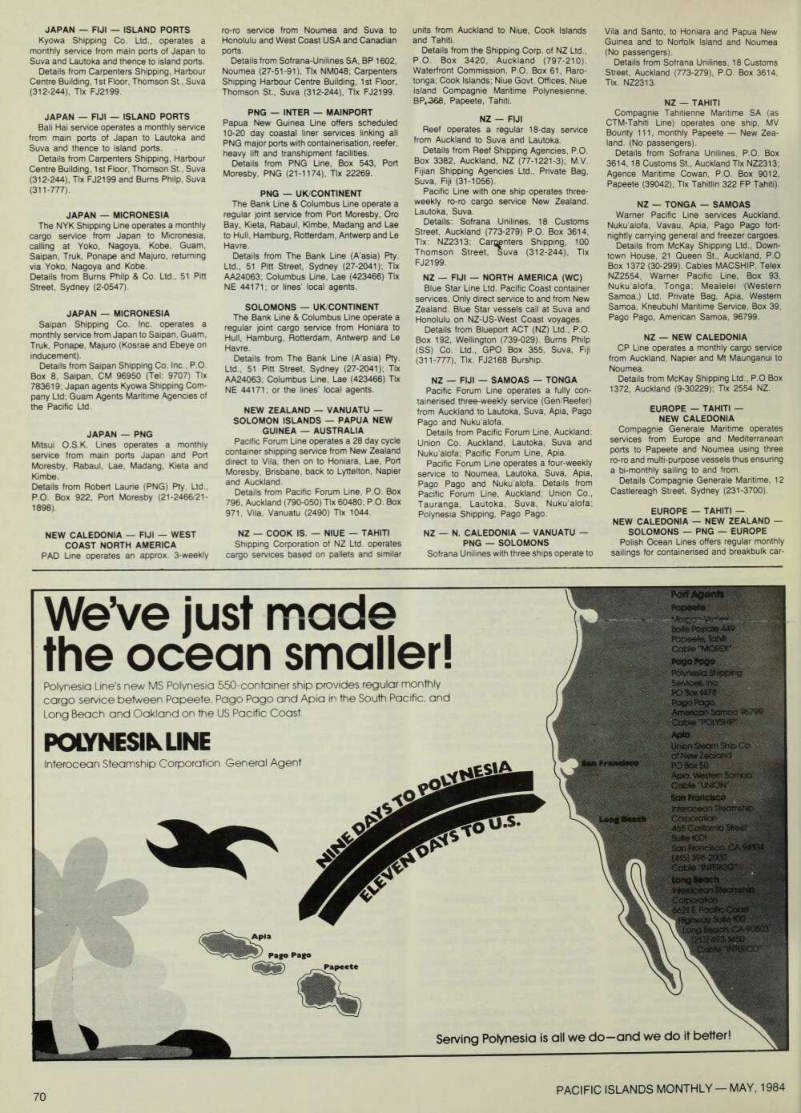
Should any shipping company wish to have its services cargo and passenger included in these listings they should contact
Pim.
Australia - Fiji
KKL (Kangaroo Line) Pty. Ltd., operates a 4/5 weekly cargo service from Sydney and Melbourne to Suva and Lautoka.
Details from KKL (Kangaroo Line) Pty. Ltd., 4th Floor, 19-31 Pitt Street. Sydney (235- 0322), Dalgety Shipping, World Trade Centre, Melbourne (616-6700), Burns Philp (SS) Co.
Ltd., Suva and Lautoka.
Sofrana-Unilines (Fiji Express Line) oper ates to Suva and Lautoka every three weeks from the main ports on the east coast of Australia and monthly to Lautoka from Mel bourne and Sydney.
Details from Sofrana-Unilines, 19 Pitt Street, Sydney (27-9851), Trans-Austral Shipping Pty. Ltd. 570 Bourke Street, Mel bourne (67-9162); ACTA Pty. Ltd., Brisbane (221-3116); Elders-ANL Pty. Ltd. Port Adelaide (47-5688); Newcastle, Sofrana Syd ney (27-9851); Clements and Marshall, Bur nie, Tasmania (31-1833), Carpenters Ship ping, Harbour Centre Building, Ist Floor, Thomson Street, Suva, Fiji (312-244), Tlx FJ2199.
Australia - Samoas - Tonga
Warner Pacific Lines operates a regular cargo service from Sydney, Brisbane and Melbourne to Nukualofa. Pago Pago, Apia and Vavau. Feeder service available from Apia to Cook, Christmas, Fanning and Washington Islands, Details from Hetherington Wesfarmers Shipping Agency, 37-49 Pitt Street, Sydney (27-1671).
Australia - New Caledonia -
Fiji - Samoas - Tonga
Pacific Forum Line operates a fully con tainerised service (general, reefer and ro-ro) from Sydney to Noumea, Lautoka, Suva, Apia, Pago Pago, Nukualofa, Sydney. Cargo centralised from Adelaide, Melbourne, Bris bane.
Details from: Pacific Forum Line, P.O. Box 796 Auckland; Union Bulkships, 333 George Street, Sydney, Brisbane and Melbourne; Union Co., Lautoka, Suva, Nukualofa; Pacific Forum Line Apia; Polynesia Shipping Pago Pago.
Australia - Lord Howe Is -
Norfolk Is
Compagnie des Chargeurs Caledoniens operates four-weekly cargo service Sydney- Lord Howe Island and Norfolk Island.
Details Hetherington Wesfarmers Shipping Agency, 37-49 Pitt Street. Sydney (27-1671).
Australia - Kiribati
KKL operates a 5/6 weekly service from Melbourne and Sydney to Kiribati (Tarawa).
Details: KKL (Kangaroo Line) Pty. Ltd., 4th Floor, 19-31 Pitt Street. Sydney (235-0322) and Dalgety Shipping. World Trade Centre, Melbourne (616-6700).
Australia - New Caledonia
And/Or Vanuatu
Sofrana-Unilines ships serve Noumea every three weeks from the main ports along the east Australian coast.
Details from Sofrana-Unilines, 19 Pitt Street, Sydney (27-9851), Trans-Austral Shipping Pty. Ltd., 570 Bourke Street, Mel bourne (67-9162), ACTA Pty. Ltd., Brisbane (221-3116), Elders-ANL Pty. Ltd., Port Adelaide (47-5688), Newcastle, Sofrana Syd
ney (27-9851); Clements & Marshall, Burnie, Tasmania (31-1833).
Compagnie des Chargeurs Caledoniens operates a three-weekly containerised cargo service from Sydney to Noumea.
Details Hetherington Wesfarmers Shipping Agency, 37-49 Pitt Street, Sydney (27-1671).
Compagnie Generate Maritime operates a monthly service from Sydney to Noumea, Port Vila and Santo, for containerised and break bulk cargo.
Details Compagnie Generate Maritime, 12
Castlereagh Street, Sydney (231-3700).
Australia - Nauru - Marshall
Is - Kiribati
Nauru Pacific Line operates regular cargo service from Melbourne to Nauru, Majuro and Tarawa. Passenger service to Nauru only.
Details; Nauru Pacific Line (Aust.) Pty. Ltd, Nauru House, 80 Collins Street, Melbourne (653-5709). Nedlloyd Swire, 8 Spring Street,
Sydney (2-0522).
Australia - New Zealand
The Australian National Line (ANL) and the Shipping Corporation of New Zealand oper ate a 10-day container service between Sydney and Melbourne to Auckland, Welling ton, Lyttelton and Port Chalmers.
Details from ANL, 20 Bond Street, Sydney (232-0444) and Shipping Corporation of New Zealand Ltd., P.O. Box 3420, Auckland, (797-210).
Australia - Nz - Fiji -
Hawaii - Us
P&O liners call at Auckland. Suva, Pago Pago and Honolulu on eastbound and west bound voyages between Sydney and the US.
Details from P&O Booking Centre, World Travel Headquarters Pty. Ltd., 33 Bligh
Street, Sydney (237-0333).
AUSTRALIA - NZ - FIJI - TONGA -
Vanuatu - New Caledonia -
Solomons - New Guinea
Sitmar Cruises operates a year-round cruise program to include the above coun tries.
Details from Sitmar Cruises, 39 Martin Place, Sydney (239-9000); NSW, reserva tions & enquiries (008 42-2277); Rest of Australia, reservations & enquiries (008 22- 2277).
AUSTRALIA - NZ - FIJI - TONGA -
Vanuatu - New Caledonia -
Solomons - Samoas - Tahiti
P&O liners call at Auckland, Bay of Islands, Honiara, Lautoka, Noumea, Nukualofa, Pago Pago. Papeete, Port Mores by, Santo, Savusavu, Suva, Vavau and Vila on cruises from Australia.
Details from P&O Booking Centre, World Travel Headquarters Pty. Ltd., 33 Bligh Street, Sydney (237-0333).
Australia - Nz - Solomons -
Png
Pacific Forum Line operates containerised and general cargo service from Lyttleton, Napier and Auckland to Honiara, Lae, Port Moresby, Brisbane.
Details from: Pacific Forum Line, Auckland; Steamships Shipping, Port Moresby; Sulli vans Ltd., Honiara; Union Bulkships, Bris bane.
Australia - Micronesia
Nauru Pacific Line operates a regular container service from Melbourne to Ponape, Truk, Guam and Saipan.
Details: N.P.L. (Australia) Pty. Ltd. Nauru
House, 80 Collins Street, Melbourne (653- 5709). Nedlloyd Swire, 8 Spring Street.
Sydney (2-0522).
Australia - Tuvalu
KKL operates a 3 monthly service from Sydney and Melbourne to Tuvalu (Funafuti).
Subject inducement.
Details from KKL (Kangaroo Line) Pty. Ltd., 4th Floor, 19-31 Pitt Street, Sydney (235- 0322).
Australia - Png
KAP New Guinea Lines cargo vessels call at Melbourne, Sydney, Port Moresby, Lae, Madang, Wewak, Manus, Kimbe, Rabaul, Popondetta.
Details from K. Asia Pacific Pty. Ltd., 19-31 Pitt Street, Sydney (232-2277), Dalgety Ship ping, World Trade Centre, Melbourne (616- 6700).
Australia - Png - Solomons -
Vanuatu
A consortium of NGAUPNGL and CON PAC/NEL have four vessels operating a joint service from east coast Australian ports to Port Moresby, Lae, Alotau, Madang, Wewak, Rabaul, Kavieng-Kimbe, Kieta, Honiara, Vila, Santo.
Details from Burns, Philp & Co. Ltd., 51 Pitt Street, Sydney, (2-0547); Interocean Swire, 8 Spring Street, Sydney, (2-0522); New Guinea Express Lines, 37 Pitt Street, Sydney, (241- 3991); Vila Agents, PO Box 971, Port-Vila (2490) Tlx. NH1044.
New Guinea Express Lines operates a weekly container service from Melbourne, Sydney, Brisbane to Port Moresby, Lae, Alotau, Kimbe, Rabaul. Kieta, Honiara, Kavieng, Madang, Wewak, Santo, Vila.
Details from New Guinea Express Lines, PO Box R 73, Royal Exchange, Sydney (241-3991); New Guinea Express Lines, 127 Creek Street, Brisbane (221-9333); New Guinea Express Lines, 327 Collins Street, Melbourne (61-3053); Niugini Express Lines.
Port Moresby (21-4572); Lae (42-1536); Niugini Island Cargo Services Pty. Ltd., Rabaul (922-467); Bougainville Agencies Pty.
Ltd., Kieta (956-089); Alotau Stevedoring & Transport. Alotau (61-1318); Ngatia Wholesalers Pty. Ltd., Kimbe (93-5102); and Trading Company, Mendana Avenue, Hon iara (22588); Vila Agencies Ltd., PO Box 971, Vila, Vanuatu (2490), John Lum & Associ ates, PO Box 65, Santo, Vanuatu (329),
Australia - Tahiti
Compagnie Generate Maritime operates a monthly service from Sydney to Papeete, for containerised and break bulk cargo.
Details Compagnie Generate Maritime, 12 Castlereagh Street, Sydney (231-3700).
Australia - Tahiti - Us
KKL operates a 4/5 weekly cargo service from Melbourne and Sydney to Papeete, and a fortnightly service to US west coast.
Details: KKL (Kangaroo Line) Pty. Ltd., 4th Floor, 19-31 Pitt Street, Sydney (235-0322) and Dalgety Shipping, World Trade Centre, Melbourne (616-6700).
Australia - Nz - West Coast
South America
South Pacific Seaboard Service offers a regular cargo service from Brisbane, Sydney, Adelaide and Melbourne to New Zealand ports Lyttelton and Tauranga and to the west coast of South America, calling at Beu'ven tura, Guayaquil, Cailao and other ports on inducement.
Details from South Pacific Seaboard
Service agents. Meridian Shipping & Trans port Agencies, 50 Clarence Street, Sydney (290-1633), Tlx 25970; Melbourne (67-5907); Brisbane (267-6355); Adelaide (47-6600); Oceanbridge Shipping Ltd., 22 Emily Place, Auckland (33-279). Tlx 60523; lan Taylor Y Cia Ltda, Prat 827 Of. 301, Valparaiso, Chile (59096), Tlx. 30331.
SINGAPORE - HONG KONG - FIJI -
Islands Ports
Kyowa Shipping Co. Ltd. operates a month ly service from Singapore, Hongkong to Lautoka, Suva and then to island ports.
Details from Carpenters Shipping, Harbour Centre Building, Ist Floor, Thomson Street, Suva. (312-244), Tlx FJ2199.
Far East - Fiji - New
Zealand
New Zealand Unit Express (NZUE) oper ates a monthly palletised cargo service from Manila, Keelung, Kashiung and Hongkong to Lautoka, Suva and thence to NZ.
Details from Carpenters Shipping, Harbour Centre Building, Ist Floor, Thomson Street.
Suva (312-244), Tlx FJ2199, Burns Philp, Suva (311-777) P&O S.N. Co. Wellington (736-477) or Nedlloyd Swire Pty. Ltd., Sydney (20-522).
Nedlloyd operates bi-weekly cargo service with four ships from Sourabaya, Jakarta, Bangkok, Port Kelang and Singapore to Suva, Lautoka and NZ ports Details from Nedlloyd (Aust.) Pty. Ltd., 8 Spring St., Sydney (27-3801). Burns Philp (SS) Co. Ltd., Suva and Lautoka.
Far East - Mid-S. Pacific
China Navigations New Guinea Pacific Line operates a regular container service from Hongkong, Taiwan, Manila, Port Kelang and Singapore to Port Moresby, Lae, Rabaul and Honiara monthly and to Wewak, Madang and Kieta every three months. Cargo from the same Far Eastern ports to the South Pacific ports of Noumea, Santo, Vila, Papeete, Pago Pago, Apia, Raratonga and Tarawa will be shipped via Japan on the monthly Bali Hai service.
Details from Steamships Trading Co. Ltd., PO Box 1, Port Moresby (22-0222).
Kyowa Shipping Ltd. operates monthly services from Japan to Guam, Saipan, Solo mons, New Caledonia, Fiji, Western and American Samoa, Tahiti, Cook Is., Tonga and Vanuatu.
Details: Hetherington Wesfarmers Shipping Agency, 37-49 Pitt Street, Sydney (27-1671); Carpenters Shipping, Suva (312-244), Tlx FJ2199.
Guam - Northern Marianas
Saipan Shipping Co. Inc. operate a weekly service via barge carrying containers and conventional cargo between Guam and Saipan and Tinian.
Details from Saipan Shipping Co. Inc., PO Box 8, Saipan. CM 96950 (Tel: 9707) Tlx 783619; Guam agents Maritime Agencies of the Pacific Ltd.
Inter Pacific Islands
South West Pacific Containers offers a scheduled container service with 23 day frequency between Apia, Honiara. Lae, Noumea, Nukualofa, Pago Pago, Port Moresby, Santo, Suva and Lautoka, Vila.
Trans-shipment to overseas markets can be arranged. Breakbulk cargo, heavy lifts and refrigerated accepted.
Details from Burns Philp and Co., 7 Bridge Street, Sydney (20-547) Tlx AA20290.
Japan Fiji Island Ports
Kyowa Shipping Co. Ltd., operates a monthly service from main ports of Japan to Suva and Lautoka and thence to island ports.
Details from Carpenters Shipping, Harbour Centre Building, Ist Floor, Thomson St., Suva (312-244), Tlx FJ2199.
Japan Fiji Island Ports
Bali Hai service operates a monthly service from main ports of Japan to Lautoka and Suva and thence to island ports.
Details from Carpenters Shipping, Harbour Centre Building, Ist Floor, Thomson St., Suva (312-244), Tlx FJ2199 and Burns Philp, Suva (311-777).
Japan Micronesia
The NYK Shipping Line operates a monthly cargo service from Japan to Micronesia, calling at Yoko, Nagoya, Kobe, Guam, Saipan, Truk, Ponape and Majuro, returning via Yoko, Nagoya and Kobe.
Details from Burns Philp & Co. Ltd., 51 Pitt Street, Sydney (2-0547).
Japan Micronesia
Saipan Shipping Co. Inc. operates a monthly service from Japan to Saipan, Guam, Truk, Ponape, Majuro (Kosrae and Ebeye on inducement).
Details from Saipan Shipping Co. Inc., P.O.
Box 8, Saipan, CM 96950 (Tel: 9707) Tlx 783619; Japan agents Kyowa Shipping Com pany Ltd; Guam Agents Maritime Agencies of the Pacific Ltd.
Japan Png
Mitsui O.S.K. Lines operates a monthly service from main ports Japan and Port Moresby, Rabaul, Lae, Madang, Kieta and Kimbe.
Details from Robert Laurie (PNG) Pty. Ltd., P.O. Box 922, Port Moresby (21-2466/21- 1898).
New Caledonia Fiji West
Coast North America
PAD Line operates an approx. 3-weekly
ro-ro service from Noumea and Suva to Honolulu and West Coast USA and Canadian ports.
Details from Sofrana-Unilines SA, BP 1602, Noumea (27-51-91), Tlx NMO4B; Carpenters Shipping Harbour Centre Building, Ist Floor, Thomson St., Suva (312-244), Tlx FJ2199.
Png Inter Mainport
Papua New Guinea Line offers scheduled 10-20 day coastal liner services linking all PNG major ports with containerisation, reefer, heavy lift and transhipment facilities.
Details from PNG Line, Box 543, Port Moresby, PNG (21-1174), Tlx 22269.
Png Uk/Continent
The Bank Line & Columbus Line operate a regular joint service from Port Moresby, Oro Bay, Kieta, Rabaul, Kimbe, Madang and Lae to Hull, Hamburg, Rotterdam, Antwerp and Le Havre.
Details from The Bank Line (A’asia) Pty.
Ltd., 51 Pitt Street, Sydney (27-2041); Tlx AA24063; Columbus Line, Lae (423466) Tlx NE 44171; or lines’ local agents.
Solomons Uk/Continent
The Bank Line & Columbus Line operate a regular joint cargo service from Honiara to Hull, Hamburg, Rotterdam, Antwerp and Le Havre.
Details from The Bank Line (A’asia) Pty.
Ltd., 51 Pitt Street, Sydney (27-2041); Tlx AA24063; Columbus Line, Lae (423466) Tlx NE 44171; or the lines’ local agents.
New Zealand Vanuatu
Solomon Islands Papua New
Guinea Australia
Pacific Forum Line operates a 28 day cycle container shipping service from New Zealand direct to Vila, then on to Honiara, Lae, Port Moresby, Brisbane, back to Lyttelton, Napier and Auckland.
Details from Pacific Forum Line, P.O. Box 796, Auckland (790-050) Tlx 60480; P.O. Box 971, Vila, Vanuatu (2490) Tlx 1044.
Nz Cook Is. Niue Tahiti
Shipping Corporation of NZ Ltd. operates cargo services based on pallets and similar
units from Auckland to Niue, Cook Islands and Tahiti.
Details from the Shipping Corp. of NZ Ltd., P.O. Box 3420, Auckland (797-210).
Waterfront Commission, P.O. Box 61, Raro tonga; Cook Islands; Niue Govt. Offices, Niue Island Compagnie Maritime Polynesienne, BP,-368, Papeete, Tahiti.
Nz Fiji
Reef operates a regular 18-day service from Auckland to Suva and Lautoka.
Details from Reef Shipping Agencies, P.O.
Box 3382, Auckland, NZ (77-1221-3); M.V.
Fijian Shipping Agencies Ltd., Private Bag, Suva, Fiji (31-1056).
Pacific Line with one ship operates three weekly ro-ro cargo service New Zealand.
Lautoka, Suva.
Details: Sofrana Unilines, 18 Customs Street, Auckland (773-279) P.O. Box 3614, Tlx: NZ2313; Carpenters Shipping, 100 Thomson Street, Suva (312-244), Tlx FJ2199.
Nz Fiji North America (Wc)
Blue Star Line Ltd. Pacific Coast container services. Only direct service to and from New Zealand. Blue Star vessels call at Suva and Honolulu on NZ-US-West Coast voyages.
Details from Blueport ACT (NZ) Ltd., P.O.
Box 192, Wellington (739-029). Burns Philp (SS) Co. Ltd., GPO Box 355, Suva, Fiji (311-777), Tlx. FJ2168 Burship.
Nz Fiji Samoas Tonga
Pacific Forum Line operates a fully con tainerised three-weekly service (Gen/Reefer) from Auckland to Lautoka, Suva, Apia, Pago Pago and Nuku’alofa.
Details from Pacific Forum Line, Auckland; Union Co. Auckland, Lautoka, Suva and Nuku’alofa; Pacific Forum Line, Apia.
Pacific Forum Line operates a four-weekly service to Noumea, Lautoka, Suva, Apia, Pago Pago and Nuku’alofa. Details from Pacific Forum Line, Auckland; Union Co., Tauranga, Lautoka, Suva, Nuku’alofa; Polynesia Shipping, Pago Pago.
Nz N. Caledonia Vanuatu
Png Solomons
Sofrana Unilines with three ships operate to
Vila and Santo, to Honiara and Papua New Guinea and to Norfolk Island and Noumea (No passengers).
Details from Sofrana Unilines, 18 Customs Street, Auckland (773-279), P.O. Box 3614, Tlx. NZ2313.
Nz Tahiti
Compagnie Tahitienne Maritime SA (as CTM-Tahiti Line) operates one ship, MV Bounty 111, monthly Papeete New Zea land. (No passengers).
Details from Sofrana Unilines, P.O. Box 3614,18 Customs St., Auckland Tlx NZ2313; Agence Maritime Cowan, P.O. Box 9012, Papeete (39042), Tlx Tahitlin 322 FP Tahiti).
Nz Tonga Samoas
Warner Pacific Line services Auckland, Nukualofa, Vavau, Apia, Pago Pago fort nightly carrying general and freezer cargoes.
Details from McKay Shipping Ltd., Down town House, 21 Queen St., Auckland, P.O Box 1372 (30-299). Cables MACSHIP, Telex NZ2554, Warner Pacific Line, Box 93, Nuku’alofa, Tonga; Mealelei {Western Samoa,) Ltd. Private Bag, Apia, Western Samoa, Kneubuhl Maritime Service, Box 39.
Pago Pago, American Samoa, 96799.
Nz New Caledonia
CP Line operates a monthly cargo service from Auckland, Napier and Mt Maunganui to Noumea.
Details from McKay Shipping Ltd., P.O Box 1372, Auckland (9-30229); Tlx 2554 NZ.
Europe Tahiti
New Caledonia
Compagnie Generate Maritime operates services from Europe and Mediterranean ports to Papeete and Noumea using three ro-ro and multi-purpose vessels thus ensuring a bi-monthly sailing to and from.
Details Compagnie Generate Maritime, 12 Castlereagh Street, Sydney (231-3700).
Europe Tahiti
New Caledonia New Zealand
Solomons Png Europe
Polish Ocean Lines offers regular monthly sailings for containerised and breakbulk car
go and reefer space, conventional and in reefer containers, from Hamburg, Antwerp, Dunkirk and Rouen to Papeete, Noumea, New Zealand, Honiara, Lae, Manila and Singapore, returning to Europe via Suez.
Other ports in the South Pacific can be served with inducement.
Details from Sotama, BP 9170, Papeete (27805), Tlx. 296: SATO, BP C 2, Noumea (272094), Tlx. 163 NM SATO: Union Steam ship Co of NZ, P.O Box 50, Apia, Tlx. 25; Williams and Gosling, P.O Box 79, Suva (312633), Tlx. 2163; Warner Pacific Line, P.O. Box 93 Nukualofa (21089), Tlx. 66219; Universal Shipping Agencies, P.O Box 2282, Auckland (30930), Tlx. 21517.
Europe Tahiti —W. Samoa
Fiji N. Caledonia
Nedlloyd offers regular cargo services from Northern Europe and U.K. to Papeete, Apia, Fiji and New Caledonia.
Details Nedlloyd (Aust.) Pty. Ltd., 8 Spring Street, Sydney (27-3801); Carpenters Ship ping, 100 Thomson St., Suva (312-244), Tlx. 2199 FJ and Vetari Street, Lautoka (63988), Tlx. 5215FJ.
Uk N. Continent W. Samoa
Tonga, Fiji
The Bank Line & Columbus Line operate a regular joint cargo service from Hull, Ham burg, Bremen, Antwerp, Rotterdam and le Havre to Apia, Nukualofa, Suva and Lautoka.
Detalis from The Bank Line (A'asia) Pty.
Ltd., 51 Pitt Street, Sydney (27-2041); Tlx AA 24063; Columbus Line, Lae (423-466) Tlx NE 44171; or lines' local agents.
Uk N. Continent Png
Solomons
The Bank Line & Columbus Line operate a regular joint cargo service from Hull, Ham burg, Bremen, Antwerp, Rotterdam and Le Havre to Port Moresby, Lae, Madang, Kimbe, Rabaul, Kieta and Honiara and on induce ment to Yandina.
Details from The Bank Line (A'asia) Pty.
Ltd., 51 Pitt Street, Sydney (27-2041) Tlx AA 24063; Columbus Line, Lae (42-3466) Tlx NE 44171; or lines’ local agents.
Uk/N. Continent Tahiti
N. Caledonia Vanuatu
The Bank Line & Columbus Line operate a regular joint cargo service from Hull, Ham burg, Bremen, Antwerp, Rotterdam and Le Havre to Papeete, Noumea, Port-Vila and Santo.
Details from The Bank Line (A’asia) Pty.
Ltd., 51 Pitt Street, Sydney (27-2041) Tlx AA 24063; Columbus Line. Lae (42-3466) Tlx NE 44171; Ets. A M. Fare UTE, Papeete; Ets.
Ballande, Noumea and other local agents.
Us Fiji Tahiti Nz
Australia
The Bank Savill Line Ltd. operates regular cargo services from U.S. Gulf ports to Australia and N.Z. Calls at Suva, Lautoka and Papeete on demand.
Details from The Bank and Savill Line Ltd., 51 Pitt Street, Sydney (27-2041) or Orient Shipping Services. 32 Bridge Street, Sydney (241-2753)
Us Hawaii Micronesia
E. Malaysia Brunei
PM & O Lines operates three fully self sustained container vessels every 21 days from San Francisco, Los Angeles and Hon olulu (via transhipment at Majuro) to Majuro, Ebeye, Kosrae, Ponape, Tauk, Saipan and Yap, Koror, Kota Kinabalu, Labuan and Brunei. Note; service to Majuro from Hawaii is not offered.
Details; PM & O Lines, 181 Fremont Street, San Francisco, California 94-105, USA. (415) 543-7430, Tlx 278016, Cable PMONAV. PM & O Owner’s Rep. P.O. Box 803, Saipan,
N.M.I. 96950, Cable Commontime
Saipan. Tlx 78-3605.
Us Hawaii Nauru
Micronesia
Nauru Pacific Line operates regular con
ventional and container services from San Francisco and Honolulu to Majuro, Ponape, Truk and Saipan. Cargo is accepted for Nauru and Kosrae with transhipment at Majuro and Ponape.
Details from N.P.O. (Australia) Pty. Ltd., Nauru House, 80 Collins Street, Melbourne (653-5709); Nauru Air and Shipping Agency, Suite 2803, 185 Berry Street, San Francisco, California 94107 (415-543-1737); Nauru Air and Shipping Agency, Suite 506, 841 Bishop St.. Honolulu. HI 96813 (808-523-0441).
Hawaii Tahitii Samoas
Marshall Islands Maritime Co-operates a service every 32 days between Honolulu, Papeete, Pago Pago and Apia.
Details from the Maritime Co. of the Pacific, 567 South King Street, Suite 310, Honolulu, Hawaii, Morris Hedstrom, Box 189, Apia, Western Samoa and the Marshall Islands Maritime Co., Box 679, Majuro, Marshall Islands.
Us. Noumea Fiji
PAD Line operates an approx. 3-weekly ro-ro service from West coast USA and Canada to Noumea, Suva and Lautoka.
Details from Trans-Austral Shipping BP 1602, Noumea (27-51-91), Tlx. NMO4B; Carpenters Shipping, Harbour Centre Buil ding, Ist Floor, Thomson Street, Suva (312- 244), Tlx. FJ2199; Trans-Austral Shipping Pty. Ltd., P.O. Box R 232, Royal Exchange, 2000 (231-8411), Tlx AA21204.
Us Tahiti Samoa
Pacific Islands Transport operates a five weekly cargo service from North America west coast ports to Papeete, Pago Pago, Apia.
Details from Polynesia Shipping Services Inc. P.O. Box 1478, Pago Pago 96799.
Polynesia Line operates container and general cargo service from US west coast ports to Papeete and Pago Pago.
Details from Polynesia Shipping Services Inc., P.O. Box 1478, Pago Pago 96799.
Advertisements & other items, pp. 70-72 (1 item)
WeVe just made
the ocean smaller!
Polynesia Line's new MS Polynesia 550-container ship provides regular monthly cargo service between Papeete, Pago Pago and Apia in the South Pacific, and Long Beach and Oakland on the US Pacific Coast.
POLYNESIMINE
Interocean Steamship Corporation General Agent Port qC& <2 & a o.
Q =PO £ 3 5* V •V Suits 100 Long Beach. CA Cable m WL Apia Pago Pago Serving Polynesia is all we do-and we do it better!
POLISH OCEAN IMS
General Management, 10 Lutego 24,81-364 GDYNIA, POLAND, Phone; 20-19-01, Cables; POLOCEAN Telex: 054-231 & Q & I •*5 $ TT vs * r< w>-* m
SOUTH PACIFIC SERVICE
fl^™p rno ™^fSD' iC |A?.^ r l d , f . r ?[ n /. GDYNIA ' HAMBURG, ROTTERDAM, MIDDLESBOROUGH/IMMINGHAM, c^H^p C D^ NKRK V ROUEN ’ PAPEETE (via PANAMA), NOUMEA, AUCKLAND, HONIARA, RABAUL. LAE, SINGAPORE, by our multipurpose vessels carrying diy and reefer containers, reefer chambers, heavy lifts, breakbulk or palletized, bulk liquids. .. POLISH OCEAN LINES Representatives AUCKLAND T.B.A. Telex 21517 M 2 “UNISHIP". SYDNEY Mr Walendak Telex 20428 AA “SLEIGH"
TAum cot*... -r . POLISH OCEAN LINES Agents A^NC^S T rfn SATO Tetex 163 NM “ SATO ” AUCKLAND UNIVERSAL SHIPPING AGENCIES LTD., Telex 21517 NZ UNISHIP”. SOLOMONS MELAN CHINE SHIPPING CO.. LTD Tetex 66335 HO “SYMECO". PNG
ALL THE
NEWS
IN A
FLASH
The South Sea Digest tells you what you want to know about the Pacific Islands in a tew words. All the leading firms and diplomatic missions read it. You can ’phone or write or call for a follow up.
See insert for subscription details:
THE SOUTH SEA DIGEST
YOUR BUSINESS PARTNER
Japan S. Korea Taiwan Singapore Hong Kong To: Solomon Is., New Caledonia, Fiji, W. Samoa, A. Samoa, Tahiti, Cook Is., Tonga, Vanuatu, Tuvalu. Nauru To; Guam, Saipan, Truk, Ponape, Majuro, Yap, Koror •* , **
Taiwan Hong Kong Singapore Philippines
To: Papua New Guinea, Pacific Islands.
Jt-f
i i rr m
KYOWA
KYOWA SHIPPING CO., LTD.
HEAD OFFICE OSAKA OFFICE;
5.h FI., Suzumaru Bldg 39 8, 2-Coma, Nishi-Sblnbashi, Minato-ku, Tokyo, Japan Oka„ma Bldg. 7th Floor *■'»• Ss,osa J Phone: 03 (437)2885 (Rep.) Cables : "MARIQUEEN” Tokyo. Telex : 242-4651 Kyowa J. Phone: 06(533)5821 (Rep , Cables. MARIQUEE
deaths
Sir Jacob Vouza At his home on Guadacanal in March, aged 83.
Sir Jacob was probably the most famous Pacific Islander participant in World War 11.
Reporting an interview given in New Zealand by Sir Philip Mitchell, then governor of Fiji and high commissioner for the Western Pacific, PIM of Decem ber 1942 carried the following account of the events on which Sir Jacob’s fame principally rests: Referring to the battles in the Solomons, Sir Philip said that the loyalty of the Solomon Islanders to the British and the Americans had been a prominent factor in the success of the Allied cause. He quoted, as an example of native heroism, the recent case of a retired sergeant-major of native police, who had come back into the service to do intelligence work for the Americans. On one of many trips through Japanese-occupied areas he had been caught and his small American flag of identification disc overed. He was tied to a tree and, to make him divulge the size and disposition of the US force, he was bayoneted first in the shoulder, then in the stomach, arm, face, and throat. Still not giving the required information, he was thrown aside as dead. Nevertheless, he recovered sufficiently to crawl to the American lines, and there he gave invaluable information concerning the Japan ese forces before he was taken to hospital.
For his wartime exploits, Sir Jacob was awarded the George Medal by the British, and the Silver Star by the Americans.
Born at Tasiboko, Guadalca nal, Sir Jacob joined the Solo mon Islands Armed Constabul ary in 1916. He retired as sergeant-major in 1940.
His postwar career was no less distinguished than his doings in war.
He was appointed district headman in 1949, was presi dent of the Gaudalcanal Coun cil from 1952 to 1958, and served on the British Solomon Islands Protectorate Council from 1950 to 1960.
He was awarded the MBE for government service in 1958, and was knighted in the Queen’s Birthday Honors of 1979.
American war veterans in particular never forgot their debt to Sir Jacob, and he was active over many years in keep ing alive the spirit of friendship with the veterans, especially on their pilgrimages to the 7 old Gaudalcanal battlefields.
Bishop Alfred Stemper In New Ireland, Papua New Guinea, in February, aged 71.
An American Sacred Heart missionary, Bishop Stemper worked as a pilot when he first arrived in PNG 38 years ago.
He worked in New Britain before moving to New Ireland, where he became the first bishop of Kavieng.
He retired as bishop in 1980 through ill health, and was replaced by another Sacred Heart missionary, Bishop Carl Hesse.
In a tribute to the late Bishop Stemper, Namatanai (New Ire land) MP and former PNG prime minister, Sir Julius Chan, said; “We have lost a personal friend, New Ireland has lost a leader, and the Catholic Church has lost a missionary statesman. ”
Adi Lady Davila Ganilau In Suva on March 2, aged 61.
The wife of Fiji’s Governor- General, Ratu Sir Penaia Gani lau, Adi Lady Davila was a woman of many parts and a tireless worker for her people and the country.
A descendant of Ratu Seru (king) Cakobau, she was born in Bau on November 11, 1922 to Kitione Lalakoma-coi and Adi Kacaraini, the sister of the late Ratu Sir Lai Sukuna.
She attended Ballantine Methodist School and qualified as a teacher from Teachers’
Training School.
Adi Lady Davila taught for 20 years in various primary schools throughout the country and her last teaching post was the Le lean Memorial School.
Apart from numerous other commitments, Adi Lady Davila was appointed the first educa tion officer for the Fiji Visitors Bureau, in 1971, and served for five years travelling extensively and giving talks about the role of tourism in Fiji.
She was a member of Fiji’s censorship committee, and of a special committee appointed by the Ministry of Fijian Affairs to look into ways of preserving Fijian culture and tradition.
Adi Lady Davila was also a national vice-president of the YWCA and in 1982 was appointed a member of the Fiji Broadcasting Commission and of the Housing Authority.
A close friend remembers her in the following words: “If one had to choose a single word to describe her, it would be ‘duty’. Not duty in the arid, burdensome sense of chores to be endured; rather in the sense of obligation cheerfully per
formed. ”■
Vasiti Sikivou in
The Fiji Times.
Vivian Edward Forbes At Toowoon Bay, New South Wales, on January 5.
Viv Forbes was a well known planter and businessman in Solomon Islands for nearly 30 years.
Born and educated in Syd ney, he served as a signalman in the Australian military forces in New Guinea and Bougainvil le in World War 11.
An uncle, C. H. V. Hodgess, who had operated several plantations in the islands since 1930, offered him a job after the war. He accepted and with his wife Joy took up the posi tion as plantation manager at Marau Sound in September 1949.
He moved to Joroveto in the Western District in 1954, then to Liapari the following year where he proceeded to establ ish a successful trading opera tion, finally taking over the company of C. H. V. Hodgess Pty Ltd in 1959. He remained at Liapari until he retired to Australia in 1977.
He was appointed a founda tion member of the Legislative Council, serving one term only, and for many years was the president of the Vella local council. He also served as a member of the Copra Board from 1960, and was involved in several agricultural schemes, mainly coconut replanting.
He was highly respected by
both islanders and expatriates for his integrity and fairness in business. He assisted local co operatives and small businesses whenever asked, and was the driving force behind local re covery following the devastat ing cyclone of November
1977.-
Ian D. Forbes.
Monseigneur Louis Julliard In Noumea, on Februray 13, aged 71.
Fere Louis Julliard was the first Catholic Bishop of Vanuatu. He was bom of a peasant family in Coubon in the Haute Loire, France, in 1912, and joined the Marist order in 1929.
He was ordained in 1936.
During his nearly 44 years in the country he worked in seve ral regions. His longest period spent away from Port-Vila was 12 years at Melsisi, in Pente cost.
This work was broken off by a call for Pere Julliard to be come apostolic vicar in 1955, and later Bishop, when Vanuatu became a separate diocese in 1966. During his time as bishop he ordained the first ni-Vanuatu priests Frs Cyriaquo- Aden, Gerard Leymang and Noel Vutial and oversaw the building of many schools and churches, including Port-Vila’s cathedral.
His colleagues found him “a truly very humble man”, and a down-to-earth and encouraging bishop. The French Republic decorated him with the Legion d’Honneur in acknowledgment of his work.
In 1975 he asked to be relieved of his duties and re turned to a simpler life of missionary activity at St. Michel in Santo. “I am the fifth wheel in the cart,” he would say, refusing any pomp or cere mony.
In 1981 he retired to Mont martre on Efate, where he stayed until his last illness forced an evacuation for surgery to Noumea. This was unsuccessful, and a fortnight later he died. His body was returned to Vanuatu for a fune ral mass and burial at Montmar
tre.
Julie-Anne Ellis.
Advertising
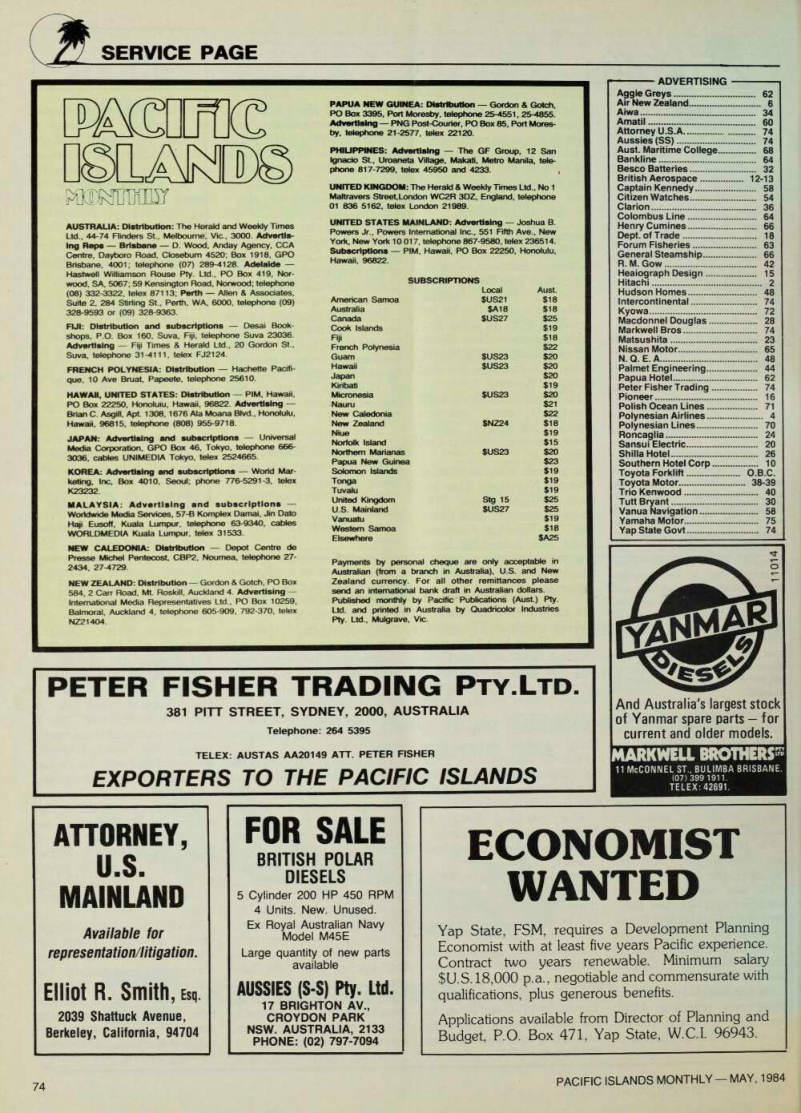
Aggie Greys 62 Air New Zealand 6 Aiwa 34 Amatil 60 Attorney U.S.A 74 Aussies(SS) 74 Aust. Maritime College 68 Bankline 64 Besco Batteries 32 British Aerospace 12-13 Captain Kennedy 58 Citizen Watches 54 Clarion 36 Colombus Line 64 Henry Cumines 66 Dept, of Trade 18 Forum Fisheries 63 General Steamship 66 R. M. Gow 42 Heaiograph Design 15 Hitachi 2 Hudson Homes 48 Intercontinental 74 Kyowa 72 Macdonnel Douglas 28 Markwell Bros 74 Matsushita 23 Nissan Motor 65
N.Q.E.A 48
Palmet Engineering 44 Papua Hotel 62 Peter Fisher Trading 74 Pioneer 16 Polish Ocean Lines 71 Polynesian Airlines 4 Polynesian Lines 70 Roncaglia 24 Sansui Electric 20 Shilla Hotel 26 Southern Hotel Corp 10 Toyota Forklift O.B.C.
Toyota Motor 38-39 Trio Kenwood 40 Tutt Bryant 30 Vanua Navigation 58 Yamaha Motor 75 Yap State Govt 74
Advertisements & other items, pp. 74-76 (2 items)
[mcGTOE
SERVICE PAGE
DSOAKI
f®*T AUSTRALIA: Distribution: The Herald and Weekly Times Ltd., 44-74 Flinders St. Melbourne, Vic., 3000. Advertising Reps Brisbane D. Wood. Anday Agency, CCA Centre. Dayboro Road, Closebum 4520; Box 1918, GPO Brisbane. 4001; telephone (07) 289-4128. Adelaide Hastwell Williamson Rouse Pty. Ltd., PO Box 419, Norwood. SA, 5067; 59 Kensington Road, Norwood; telephone (08) 332-3322, telex 87113; Perth Allen & Associates.
Suite 2, 284 Stirling St.. Perth, WA, 6000, telephone (09) 328-9593 or (09) 328-9363.
FUI; Distribution and subscriptions Desai Bookshops, P O. Box 160, Suva, Fiji, telephone Suva 23036.
Advertising Fiji Times & Herald Ltd., 20 Gordon St., Suva, telephone 31-4111, telex FJ2124.
FRENCH POLYNESIA: Distribution Hachette Pacifique, 10 Ave Bruat, Papeete, telephone 25610.
HAWAII, UNITED STATES: Distribution PIM, Hawaii.
PO Box 22250, Honolulu. Hawaii. 96822 Advertising Brian C. Asgill, Apt 1308,1676 Ala Moana Blvd., Honolulu, Hawaii. 96815, telephone (808) 955-9718.
JAPAN: Advertising and subscriptions Universal Media Corporation, GPO Box 46. Tokyo, telephone 666- 3036, cables UNIMEDIA Tokyo, telex 2524665.
KOREA: Advertising and subscriptions World Marketing, Inc. Box 4010, Seoul; phone 776-5291-3, telex K 23232.
MALAYSIA: Advertising and subscriptions Worldwide Media Services. 57-B Kornplex Damai, Jin Dato Haji Eusoff, Kuala Lumpur, telephone 63-9340, cables WORLDMEDIA Kuala Lumpur, telex 31533.
NEW CALEDONIA; Distribution Depot Centre de Presse Michel Pentecost, CBF*2, Noumea, telephone 27- 2434. 27-4729.
NEW ZEALAND: Distribution Gordon & Gotch, PO Box 584, 2 Carr Road. Mt. Roskill, Auckland 4 Advertising International Media Representatives Ltd., PO Box 10259, Balmoral, Auckland 4, telephone 605-909, 792-370, telex NZ21404
PAPUA NEW GUINEA: Distribution Gordon & Gotch, PO Box 3395, Port Moresby, telephone 25-4551.25-4855.
Advertising PNG Post-Courier, PO Box 85, Port Moresby, telephone 21-2577, telex 22120.
PHILIPPINES: Advertising The GF Group, 12 San Ignacio St, Uroaneta Village, Makati. Metro Manila, telephone 817-7299, telex 45950 and 4233.
UNITED KINGDOM: The Herald & Weekly Times Ltd., No 1 Maltravers Street,London WC2R 3DZ, England, telephone 01 836 5162, telex London 21989.
UNITED STATES MAINLAND: Advertising Joshua B.
Powers Jr., Powers International Inc., 551 Fifth Ave., New York, New York 10 017, telephone 867-9580, telex 236514.
Subscriptions PIM, Hawaii, PO Box 22250, Honolulu, Hawaii. 96822.
SUBSCRIPTIONS
Payments by personal cheque are only acceptable in Australian (from a branch in Australia), U.S. and New Zealand currency. For all other remittances please send an international bank draft in Australian dollars.
Published monthly by Pacific Publications (Aust) Pty.
Itd and printed in Australia by Quadricolor Industries Pty. Ltd., Mulgrave, Vic.
PETER FISHER TRADING Pty.Ltd.
381 PITT STREET, SYDNEY, 2000, AUSTRALIA
Telephone: 264 5395
TELEX: AUSTAS AA20149 ATT. PETER FISHER
EXPORTERS TO THE PACIFIC ISLANDS
FOR SALE
BRITISH POLAR
DIESELS
5 Cylinder 200 HP 450 RPM 4 Units. New. Unused.
Ex Royal Australian Navy Model M4SE Large quantity of new parts available
AUSSIES (S-S) Pty. Ltd.
17 BRIGHTON AV.,
CROYDON PARK
NSW. AUSTRALIA, 2133
PHONE: (02) 797-7094
ATTORNEY,
U.S.
MAINLAND
Available for representation/litigation.
Elliot R. Smith, Esq. 2039 Shattuck Avenue, Berkeley, California, 94704
saSBM
V And Australia's largest stock of Yanmar spare parts - for current and older models.
MARKWELL BROTHERS"
11 McCONNEL ST., BULIMBA BRISBANE.
(07)399 1911.
TELEX: 42691.
ECONOMIST
WANTED
Yap State, FSM, requires a Development Planning Economist with at least five years Pacific experience.
Contract two years renewable. Minimum salary SU.S. 18,000 p.a., negotiable and commensurate with qualifications, plus generous benefits.
Applications available from Director of Planning and Budget, P.O. Box 471, Yap State, W.C.I. 96943.
L , 1 1 *
GO ern
l et y ah ®
f ace
foa^’
, "^S^ hr0 Ye h d one
wSlsS 5 "
' V X *■ A *# >4 fa fa SN r >• AH i' <■ «A
YAMAHA
YAMAHA
V
YAMAHA
am £ , :*-«&■
iipl'
NNBMbI/tI
>APUA HEW GUINEA
iLA MOTORS
\ DIVISION OF BURNS PHILP (PNG) LTD. >O. BOX 7s, POST MORESBY TEL: 25 4088 21 7036 ; W1
AUTOMOTIVE SUPPLIES COMPANY
I DIVISIOB OF BURNS PHILP (SOUTH SEA) CO. LTD • PO. BOX 355. SUVA TEL: 383444
RUK
iUSUMU’S ENTERPRISES
’O. BOX 100 TEL: 445
PONAPE
PONAPE ISLAND TRANSPORTATION CORP.
P.O. BOX 75 0. KOLONIA TEL: 409
SOLOMON
Y. SATO (ROVIANA) ft CO.
P.O. BOX 163. HONIARA
GUAM
PACIFIC CYCLE CO.
AGANA TEL: 477-1277
KIRIBATI
THE TEIKARAOI FISHING CO., LTD.
P.O. BOX 450, BETIO, TARAWA TEL: 639
TAHITI
CIDA INTERNATIONAL TAHITI
P.O. BOX 154, PAPEETE TEL: 28219
NEW CALEDONIA
ROYAL MOTORS
B P. 2548, NOUMEA TEL: 28, 59, 12
VANUATU
VANUATU MOTORS
A MEMBER OF THE BURNS PHILP GROUP P.O BOX 18, PORT VILA TEL: 2341
AMERICAN SAMOA
BURNS PHILP (SOUTH SEA) CO., LTD.
P.O. BOX 1057, PAGO PAGO
WESTERN SAMOA
BURNS PHILP (SOUTH SEA) CO., LTD.
MOTOR DIVISION, G P.O. BOX 188. APIA TEL: 22611
KINGDOM OF TONGA
E.M. JONES LTD.
P.O. BOX 34, NUKU ALOFA TEL: 21-421, 21-422
REPUBLIC OF NAURU
JACOB ENTERPRISES
P.O. BOX 4
PALAU
BEACH SAND COMPANY
P.O. BOX 12-KOROR
ENGINEERED TO BE BEST
TOYOTA
FORKLIFT
|,. ■ I/)"
L ■ - ” ' I rw TECHNOLOGY Toyota Forklifts are built to last over the long haul, utilizing a Central Hydraulic ower System (C.H.P.S.) that not only speeds maintenance but also increases operator efficiency through power assistance. Only Toyota offers C.H.P.S. in the 1-3 ton range. HUMAN ENGINEERING Down the road, Toyotas stay as reliable as ever because they're built solid. A standard reinforced Wide Visible mast for both durability and safety is just one example. Toyota's design thinks beyond the machine itself to the operator for more comfort with a lower noise level, assist grips and bucket seat.
THE CHOICE We also take your individual business into account with a wide selection of models, options and attachments to suit you best.
This kind of thinking has made Toyota forklifts the choice of more businesses around the world than any other forklift. Because, if you're thinking ahead,
TOYOTA
you're thinking Toyota.
1,000-3,000 kg SERIES PNEUMATIC-TYRED/ENGINE-POWERED
Take the lead with
TOYOTA
■ AMERICAN SAMOA: BURNS PHILP (S.S.) CO., LTD. TEL: 633-4281 ■ AUSTRALIA: THIESS TOYOTA PTY, LTD. TEL: 526-0333
i FIJI: AUTOMOTIVE SUPPLIES CO.,
A DIVISION OF BURNS PHILP (S.S.) CO., LTD. TEL: 383444 ■ GUAM; ATKINS, KROLL (GUAM) LTD. TEL: 646-1876 i NEW CALEDONIA; SERVICE IMPORTATION AUTOMOBILE DU PACIFIQUE
TEL: 27-41-44
■ NEW ZEALAND: ANDREWS & BEAVEN INDUSTRIAL EQUIPMENT LTD. TEL: 2780940
« PAPUA NEW GUINEA: ELA MOTORS,
A DIVISION OF BURNS PHILP (P.N.G.), LTD. TEL: 217036 « VANUATU: VANUATU MOTORS, A DIVISION OF BURNS PHILP (VANUATU) LTD.
TEL: VILA 2341
« WESTERN SAMOA: BURNS PHILP (S.S.) CO., LTD. TEL: 22611 And distributors around the world.