j k orm

Pacific
Islands
Monthly
Ishil, 1984
j k orm
American Samoa US$l 75 Australia *A$l.5O Cook Islands NZ$l 50
SI-- Fslso
Hawaii US$l.95 Kinbati a 51.75 Nauru 75 New Caledonia ” CFPI9O
New Zealand NZ$2.OO Niue NZ$l.75 Norfolk Island A 51.50 Papua New Guinea K 51.50 Solomon Islands 551.50 Tahiti CFP22O Tonga PI .50 Tuvalu A 51.75
Usa U 552.25
USTT and Guam US$l.95 Vanuatu VT1.50 Western Samoa T 2.10 •Recommended retail price only Registered by Australia Post Publication No. NBPI2IO
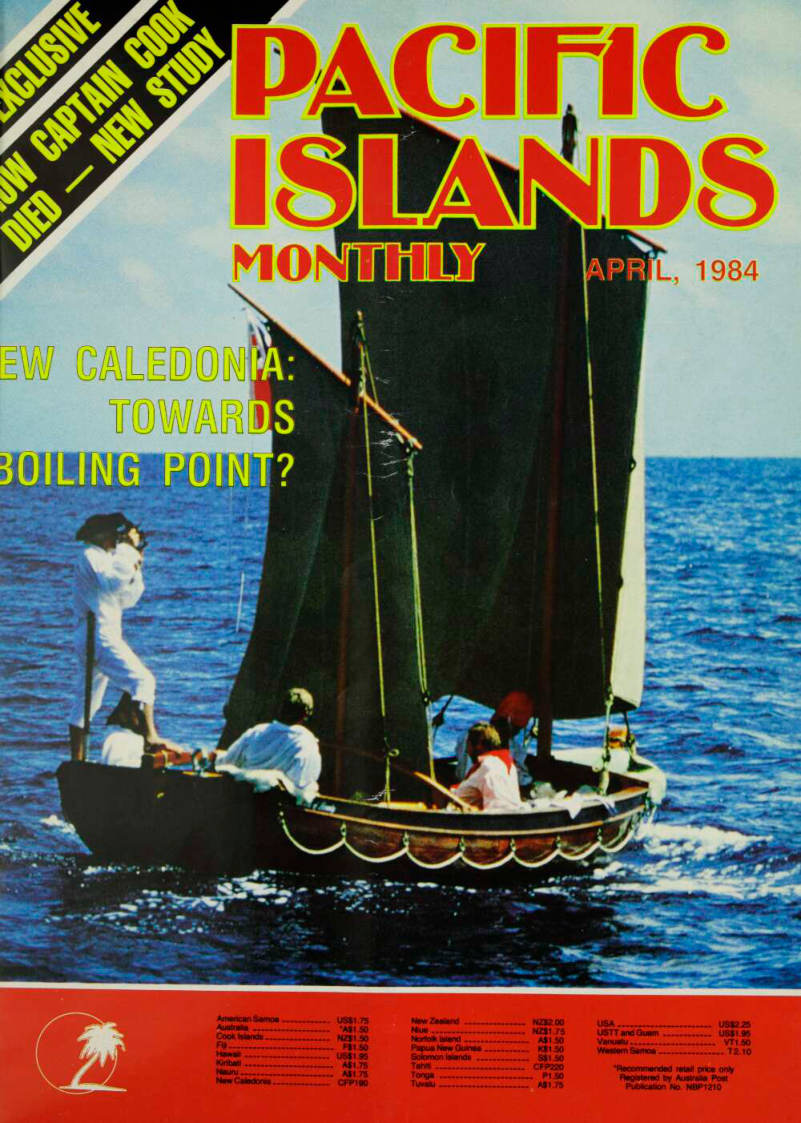
The Cover
A still from the film The Voyage of Bounty’s Child (see story, “Pacific Report”). Look Films photo.
Advertisements & other items, pp. 2-3 (2 items)
A new legend begins.
S ,v - . . , - * - ,4 4 v»-. ■a • ■ *
Photo: Equipment may vary in some countries.
The 1984 Civic 2-door Hatchback, combining innovative technologies with the great Civic tradition, is a very special car. For this new Civic is destined to become the model on which other cars in this class will be based.
Distinguished by a long roofline and rear appearance, the 2-door Hatchback’s flush-surface aerodynamic design gives superb stability at high speeds, improves fuel economy, and provides a truly spacious interior.
Interior space is also expanded by the Honda concept of making all mechanical parts as small as possible, leaving more room for people. High-tech components include an ultra-compact, economical-yet-powerful OHC, 12-valve engine, and space-saving Sportec suspension that really
smooths out the road.
The Civic 2-door Hatchback. Its new technology confirms that a new legend has begun. g l ’
II ¥/
2-door Hatchback
HONDA MOTOR CO.. LTD. TOKYO, JAPAN
AUSTRALIA; Honda Australia Pty., Ltd. Lot 95 Sharps Road, TuHamanne. Victoria 3043: Bennett Honda Pty.. Ltd. 250 Victoria Road. Wetherift Park, N S.W 2164 NEW ZEALAND: NZMC Limited Manners Plaza, 57-65 Manners St., Wellington /PAPUA NEW GUINEA: Toba Pty., Ltd. P.O Box 503, Port Moresby /TAHITI: Honda Distribution S.A.R.L. B P. 1665. Papeete/ , KIRIBATI: Atoll Motor & Marino Services PO, Box 49. Bairiki Tarawa, Republic of Kiribafi/U.S. TRUST TERRITORY; United Micronesia Development Association PO. Box 235. CURB Saipan CM 96950/COOK ISLANDS: Cook Islands Motor Centre Ltd. P.O Box 74. Rarotonga/GUAM: Mark s Motor Co , Inc. PO Sox DV. Agana/ WESTERN SAMOA: Motor Distributors (Samoa) Ltd. PO. Sox 576. Apia/ SOLOMON ISLANDS: Guadalcanal Garage Limited PO Box 537, Homara/NEW CALEDONIA: Societe Du Chalandage 8. Rue de la B 97 Noumea/NAURU: Nauru Cooperation Republic of Nauru/FIJI: Carpenters Motors Private Mail Bag, Suva. Fiji •'AMERICAN SAMOA: Holiday Motors, Parts and Service PO Box Pago Pago, American Samoa 96799: Haleck s Service Center Ltd. P.O Box 1138, Pago Pago, American Samoa 96799/TONGA; Tonga Industrial Traders PO. Box 1035, Nukualofa. Tonga ■
Islands
PACIFIC
MONTHLY
Vol. 55 No. 4 April 1984
Noumea ’s Roynette 9
Death of Cook 15
Honolulu ’s KEEP 21
Solomons Hydropower 26
In This Issue
• TENSIONS FLARE IN NEW CALEDONIA. PIM Q Editor and Publisher Garry Barker writes on his recent visit to New Caledonia, where he found that voices of reason and moderation are increasingly being drowned out by the clamor from extremists on both sides of the vexed issue of independence.
• Cross-Purposes Communications.— -1-1
Telecommunications writer Liz Fell reports on a certain 1 1 lack of communication among various participants at the 1984 conference of the Pacific Telecommunica tions Council in Honolulu. • THE DEATH OF CAPTAIN COOK. —By arrange- 1 5 ment with The Library Society (of the State Library of ** New South Wales) PIM has secured exclusive
publication rights to the text of a remarkable lecture given by Professor Greg Dening of the department of history, University of Melbourne, at the library on February 14. • HYDRO POWER IN A SOLOMONS VILLAGE. OR Denis Fisk tells the encouraging story of a successful co-operative effort between Sydney-based scientists and villagers in Solomon Islands which has brought a revolutionary new micro-hydroelectricity scheme to the village. • PROBLEMATICAL FUTURE OF THE S.P.C. A 7 Donald Stewart looks at the future of the revamped South Pacific Commission and sees plenty of problems ahead.
Contents
Australia 33
Books "37
Canada ~""‘53
Cook Islands "”^5l Death of Captain Cook "!is Deaths 65 Fiji 29,43,53 Hawaii 15 Islands Press ""54 Japan 11,33 Letters 53 Marshall Islands 37
Micro-hydroelectricity ...25
Nauru New Caledonia 5, 9 Northern Marianas 55 Pacific Report 5
Papua New Guinea 26, 31, 45, 49, 52, 53 PIM Opinion 5 Political Currents 47 Shipping schedules 61 Solomon Islands 25 South Pacific Commission 47 Tahiti
Telecommunications !!.11
The Month 19 Tonga 60 Tradewinds 25 Tropicalities 51 United States 11 Vanuatu 31,33 Yachts 60 PIM subscription rates and agents ..66
Australian cover price is recommended retail only. Registered by Australia Post, publication No. NBPI2IO. Second class postage paid at Honolulu, Hawaii. Copyright Pacific Publications (Aust.) Pty. Ltd. Postmaster Hon olulu; Send address changes to PIM Hawaii, PO Box 22250 Honolulu Hawaii, 96822.
Advertisements & other items, pp. 3-4 (2 items)
Pacific Islands Monthly —April, 1984
3
Founded 1930 by R. W. Robson
(USPS 952480)
Editor and Publisher Garry Barker Associate Editor Malcolm Salmon Advertising Manager Stephen Brandon Layout & Design Barry Badger Editorial Adviser John Carter A Pacific Publications production 76 Clarence Street, Sydney, 2000, GPO Box 3408, Sydney, 2001.
Cables; PACPUB Sydney.
Telex; 21242 (answers INTARAD).
Telephone: Sydney 20-231. Melbourne 63-0211.
Manager: John Berry (03) 63-0211 Ext. 1860.
Expert
Insurance Service
throughout the islands
Queensland Insurance (Fiji) Limited
Head Office; Queensland Insurance Centre, Victoria Parade SUVA. General Manager: R. Jackson Assistant Manager: Vijay Lai. Phone 23 851.
LAUTOKA OFFICE: Burns Philp Bldg., Naviti St. District Manager: R. Sharma. Phone 60 642 LABASA OFFICE: Burns Philp Bldg. Phone; 8 2139
Queensland Insurance (PNG) Limited
PAPUA NEW GUINEA
Head Office. B N.G Building, Musgrave St..PORT MORESBY. General Manager T. H. Sarti Phone 212144 LAE 4th St & Coronation Drive. District Manager: C. D Hillier Phone: 423873, MOUNT HAGEN Hagen Drive District Manager: R. Shelbourn Phone: 521002.
ARAWA; Chebu St., District Manager; B. Bowers Phone: 95 1555 MADANG: Kasagten St., District Manager: J. Longbut Phone: 82 2020 RABAUL Wirraway St. District Managerß. McManus Phone: 921014.
QBE Insurance (International) Limited
VANUATU PORT VILA Rue de Pans, Suite 19, Oceania Bldg. Manager: I R Martin.
Phone: 2299.
SANTO: Burns Philp ( Vanuatu) Ltd Phone: 230.
PACIFIC AGENCIES
NEW CALEDONIA Ste. W A. Johnston, S.A.R.L. 5 Rue Anatole France, NOUMEA Phone: 272083.
TAHITI Arthur Chung. Immeuble BIS.. Front de Mer, PAPEETE Phone: 2.86 19 NIUE Burns Philp (South Sea) Company Ltd NORFOLK ISLAND: Burns Philp ('N I ) Company Ltd Phone: 2191 SAMOA APIA, Burns Philp (South Sea) Company Ltd. Phone: 22611 TONGA Burns Philp (South Sea) Company Ltd NUKU ALOFA Phone 21500 HAAPAI, VAVAU X
MEMBERS OF THE
QBE INSURANCE GROUP LIMITED
Pim Opinion
Why must it always be true that the only lesson of history is that men never learn from history? Even in an idyllic little country like New Caledonia the same weary old mistakes are being made in the run up to independence from the French.
The voices of moderation are being drowned out as hard-liners of both sides respond to impatience, fear and prejudice.
The French themselves do not wish to remain the colonial masters.
These days it is an expensive, thankless, and unfashionable task incompatible with their position in the world. But the predominant ly French-origin farmers and businessmen who form what is known as the right-wing in New Caledonia think they can hold back the clock, if necessary by creating a situation in which the French will have to intervene.
The left-wing is equally difficult, demanding greater speed than cooler minds feel is wise for so small and vulnerable a nation. They justify their stand by pointing to the 131 years the French have ruled their lovely islands, and say they should not have to wait another half decade for what is rightfully theirs.
In the middle is the peaceable majority, of all races and groups, filled increasingly with doubts and fears and feeling itself forced to choose between the extremists of left and right.
It is a classic tragedy, seen so many times before in so many other places. On the face of it there should not be an argument, let alone any violence. There is economic imbalance but no bitter racism, as there was, and remains, in Africa.
New Caledonia is not ready for total and immediate independ ence. The French Government’s program, providing for a steady progression up to 1989, is probably the most sensible available.
But practice is one thing, and principle quite another.
Without the $230 million which annually pours into the country from the pockets of French taxpayers who probably don’t know where New Caledonia is, nor could care less... without steady, and large, investment in tourism, like the stunning $lOO million Tiare
project now under way, the place could become just another tropical doldrum.
Of course, that is not the point that impresses the speech makers, and, as usual, rhetoric has now very nearly replaced sense in the politics of independence.
There is a regrettable tendency on both sides of the argument to say that anyone not 100 per cent for, must be 100 per cent against.
Australia is not popular with either faction for pretty much that reason.
There is a curious, and naive, belief that Australia is poised, panting, to scoop up New Caledonia, and hand out lashings of aid money the moment the French disappear.
There is an equally erroneous expectation that if the situation really heats up the French will send their army to protect everyone from everyone else.
Melanesian impatience can be understood. New Caledonia is not even on the United Nations list of colonised countries ... a difficult matter for the cynical bureaucrats of that international talk factory because New Caledonia is, technically, part of France.
New Caledonia must have its independence. But it has to be achieved with justice for all people of all races who, by accidents of history, acts of hope, efforts of ambition, decisions of 19th-century French courts or whatever other means, today find themselves with all they possess, and all they desire, caught up on the tiny speck of Pacific rock which Captain Cook felt reminded him so much of Scotland.
The Melanesians, who have victory inevitably within their reach, must somehow convince the French colonials, and those who side with them for financial or political reasons, that they are not about to be dispossessed and tossed out, as happened in Africa.
In turn the colons must listen to the Melanesians, and co-operate with them.
Extremism must be rejected so that all may meet reasonably on the middle ground. Sadly,the prospects are not good.
Pacific Report


Revolt Put Down In Irian Java
A revolt by Irian Jaya-bom soliders serving in the Indonesian army m the province was put down with reported loss of life in February. 1 he rebels had planned a take-over of the capital, Jayapura, but Indonesian intelligence got wind of the plot. In the wake of the revolt more than 250 refugees fled across the Papua New Guinea Porder to Vammo The events created new strains in the already difficult relations between PNG and Indonesia. PNG Prime Minister Michael Somare early in March offered his government’s services as an “honest broker” between Irian Jayan rebels and the Indonesian authorities. Mr Somare said the OPM (Free West Papua) movement did not have a direct dialogue with Indonesian officials, and we are prepared to act as honest brokers.”
Indonesian reaction to the offer was not known at press time.
Vanuatu’S President Resigns
Vanuatu s President Ati George Sokomanu resigned in February following a court appearance at which he pleaded guilty to the late payment of road taxes. In admitting the offence, the president said
the law must be upheld. He said that the conviction for late payment was only a contributory factor in his decision to resign another major factor was the lack of constitutional provision to protect the president or government ministers from prosecution in such cases. In accordance with Vanuatu’s constitution, Speaker j r imakata of the Representative Assembly took over the duties and functions of the presidency. An emergency meeting of the executive council of the ruling Vanuaaku Party called on the government to hold an immediate presidential election, and to take appropriate steps to give greater security to the position. A statement released after the meeting said that while it regretted the president s decision, it felt strongly that the integrity of the office had to be upheld. The council said it believed the president’s decision had been politically motivated, ” but did not elaborate A new election was scheduled for March 6, with three candidates ex-president Sokomanu, George Kalsakau, and Harry Collins.
There was no quorum for a vote on March 6 due to an opposition boycott, but President Sokomanu easily won a vote held on March
Parliamentary Stand Off In Fiji
Fiji’s parliamentary opposition National Federation Party was persisting at press time in its boycott of parliamentary proceedings (PIM Feb. p 5). The Opposition walked out of parliament just before Christmas last year when Speaker Tomasi Vakatora ordered Opposition Leader Jai Ram Reddy to leave the House for refusing to stand while addressing the chair. The NFP and its partner, the Western United Front, at a meeting on February 12 decided to continue the boycott. It is understood that, before the meeting, Mr Reddy had urged that all members should return to the House except himself, as the row was between him and Mr Vakatora. However, with only one dissentient, the meeting voted to continue to boycott parliamentary sittings so long as Mr Vakatora remained as speaker. Those present were apparently swayed by the argument that Mr Vakatora had insulted the whole party by his action, and not just Mr Reddy. According to the constitution, any member who misses three consecutive sessions of the House loses his seat. Fiji’s Parliamentary arrangements for 1984 provide for the third session of parliament to begin on September 3.
IF DESTROYED , RABAUL HAS HAD ITS DAY Rabaul will not be rebuilt in the event of its destruction by the anticipated volcanic blast, Papua New Guinea Prime Minister Michael Somare has announced. While the decision awaited final Cabinet approval, Mr Somare said the township of Kokopo, about 30 km south of Rabaul, would be the new administrative and commercial centre for East New Britain. He said Kokopo had been chosen because, unlike Rabaul, it had sufficient flat land for expansion. While Mr Somare was moving to ginger-up disaster relief preparations by local provincial authorities, it was announced by his office that the national government had asked Australia to send army engineers to build a new emergency airstrip for Rabaul.
The statement from the PM’s office said both Australia and New Zealand had been asked for help in the face of the expected eruption. Australia would be asked to build the strip at Tokua, well outside the danger zone. The existing airport is in the zone of highest risk from an eruption.
N-Protests Revived In Tahiti
After gathering dust for nearly 11 years, Tahiti’s old protest movement against France s nuclear testing in French Polynesia has been reactivated. Two rival committees recently formed have duo the old nuclear protest effort out of the closet, dusted it off, and put it back in the public limelight. The effort is the biggest and most senous since 1973, when 5000 marched through the streets of downtown Papeete in protest against the tests. Of the two committees one the Peace Committee, which is headed by PIM columnist Mane-Therese Danielsson claims to be non-political.
It embraces two opposition political parties, a women’s group and a conservationist group. Its February 25 march was reported to have mustered 1000 protesters. The second group claims to be purely political. It groups four small pro-independence parties without representation in the Territorial Assembly. It planned its demonstration for March 3. The committees have two common goals. Both want an end to the French tests, and the withdrawal from Polynesia of the Centre d’Experimentations du aafique (CEP) Jean Juventin, Papeete’s mayor and one of the territory s two deputies to the National Assembly in Paris, is a member of the Peace Committee. The present vice-president of the territory s Government Council, Gaston Flosse, has no personal history of opposition to the CEP, but he said in a press interview on February 13; “I would be slightly in favor of a referendum in the temtory Let the Polynesians decide the future of the CEP in Polynesia. —AI Prince in Papeete.
"Colons Refuse Dialogue" N.C. Tribe
M™ 9 , the la m d ° c c u P at ion at Voh and its repercussions in Noumea (see p 9), Independence Front leaders told newsmen S'Tr farmers war ? ted to settle lan d claims with the Kaneiks, but were prevented from doing so by the hardline antj-mdeiDencfence leaders. The events at Voh began when in mid-February Kanaks of the Oundjo tribe entered the property of il? sMnn'^ an t N !t! rtm f ? ml y and constructed a symbolic case (hut) f he,r dalm to the lanA Several hundred anti he d /^ Ce su PP° rte '?> man y o f ‘hem armed, had assembled at *stanre SmT 3 i he occu P afion - The hut was built at some distance from the gathenng, and was burnt down during the following night. Members of the Martin family had unsuccessfully
called for the Garde Mobile to be sent in to expel the Melanesian “occupiers”. A spokesman for the Oundjo council of elders, Joseph Diela, said they regretted the burning of their hut, and that the Martin family had refused their offers of dialogue which had preceded the land occupation. Mr Diela said the Oundjo people were not looking for provocation, and were sorry the Martins had preferred to listen to hardline anti-independence leaders rather than negotiate with the tribe. Leaders of the main anti independence party, RFCR, denounced what they called the “usual back-pedalling of the French administration”, and also denounced extremism, whether from Melanesian independentists or the far-right Caledonian Front. Independence Front leader Eloi Machoro said Kanak independence was on the way, but many French nationals had not learnt the lessons of French colonial experiences in Vietnam and Algeria, and were continuing to refuse discussion with the Kanaks. Helen Fraser in Noumea.
Mamalonfs Major Reshuffle
Solomon Islands Prime Minister Solomon Mamaloni in February announced a Cabinet reshuffle involving not only ministerial posts, but reorganisation in some ministries. This is the second major reshuffle since Mr Mamaloni came to power about three years ago.
Under the new arrangements, Deputy PM and Minister for Home Affairs and National Development, Kamilo Teke, will relinquish his post and take charge of his home provincial ministry of Guadalcanal. He has been told he will remain as deputy PM.
Minister for Foreign Affairs and International Trade Dennis Lulei will take over the ministry for home affairs and national development, and George Talasasa, present minister for employ ment, youth, and social development, will be the new foreign minister. A total of seven ministries in the 15-member Cabinet were affected by the reshuffle. Mr Mamaloni said the changes had become necessary “because of the individual performances of his ministers”.
American Samoa Presents Its Constitution
Governor of American Samoa, Peter Tali Coleman, has submitted the territory’s new constitution to the United States Congress.
American Samoa is an unorganised, unincorporated territory of the United States. The Samoans, at a constitutional conference in January and February, spent much time on defining an “American Samoan citizen and, eventually, defined a citizen as “a person bom in American Samoa of American Somoan ancestry or who was born in the United States, or any of its territories or possessions, of American Samoan ancestry. ” The proposed constitution also requires that all candidates for public office must be of American Samoan ancestry instead of, as at present, being United States nationals. Another important amendment is that “No organic act or similar legislation alienating Samoan communal land or destroying the Samoan way of life, including its customs and traditions, shall be enacted by the Congress of the United States or any federal agency without the expressed consent and approval of the traditional leaders and people of American Samoa.”
World Premiere For Bounty’S Child
April 28 in Sydney will see the world premiere of the film The bounty s Child The film tells the story of the 1983 4UOU-mile open-boat journey of Captain R. W. Bligh-Ware and crew from Tonga to Timor, which was a re-enactment of the 1789 longboat voyage by Bligh-Ware’s ancestor, Captain William Bliqh following the mutiny on the Bounty. The 96-minute, 16 mm color film is a distillation of 30 hours of film shot during the voyage by cameraman Rory McGuinness and John Scott (who made the journey in the boat) and Wayne Taylor. Produced by Will Davies and Greeted by Michael Edols, the film boasts some of the most celebrated names in the modem Australian film industry. Editing of the film was done by Richard Francis-Bruce, who edited the highly successful feature film, Careful He Might Hear You. The script was written by veteran film-maker and author, Cecil Holmes. Narration is done by Leo McKern, of Rumpole of the Bailey TV film fame. 1 he nlm was made by Look Film Productions Pty. Ltd., Sydney.
POPE'S LARGE FLOCKS IN PNG , SOLOMONS Commenting on preparations in Southeast Asian and Pacific countries for the visit of Pope John Paul II in May (PIM Mar p 5) the Sydney-based newspaper. The Catholic Weekly, reports that official church estimates are that in the two Pacific Island countries to be visited Papua New Guinea and Solomon Islands the
numbers of Catholics are 913,000 in PNG, and 40,000 in the Solomons. The figures represent about one-third and one-fifth of the countries’ respective populations. Reporter Frank O’Connell writes: "Pope John Paul will find a Church in PNG where Catholics are probably the largest Christian denomination.” Prime Minister Michael Somare has declared a public holiday in the National Capital District in honor of the Pontiffs visit.
Tonga Extends $Lo,Ooo Passport Scheme
Tonga is to extend its Passport Act amendment of 1982, which allows sale of passports to nationals of other countries who qualify as "Tonga-protected persons”. The extension offers passports to entrepreneurs who have invested at least STIO,OOO in the kingdom and who have sufficient expertise in their fields to become advisers to the Tonga Government. Parliament voted 10-4 to accept late last year after the bill introduced by the Minister of Police, the Hon. ‘Akau’ola, had received the prior approval of the Privy Council.
The extension eases earlier requirements on the leasing or sub-leasing of land, and people with STIO,OOO to invest in a project that assists the economy of the country become eligible.
But such people will not automatically receive the "protected persons” status and get passports. ‘Akau’ola said it would be easy for any member of the mafia, drug dealers, and criminals to produce the money, so they would first go carefully into an applicant’s background. They expect the new extension to appeal to people who find difficulty in travelling because of political circumstances, or because their own passports are not widely recognised. ‘Akau’ ola said the Republic of China (Taiwan) is one such case. Pesi Fonua in Nukualofa.
Solomons Wants Us. Embassy
The Solomon Islands Government is pressing the United States to establish an embassy in Honiara. On a recent visit to Honiara U.S.
Ambassador Virginia Schafer based in Port Moresby, she is also ambassador to Papua New Guinea suggested that the U.S. would comply, but wouldn’t say when. The Solomons also wants direct govemment-to-govemment aid from the U.S. At present, the country receives indirect assistance from such bodies as the International Human Assistance Program (IHAP), the Foundation for the Peoples of the South Pacific (FSP), and the Peace Corps.
While this is appreciated, direct assistance with the granting of scholarships for study in the U.S., and U.S. Government assistance in finding markets for Solomon Islands products would be greatly prized. George Atkin in Honiara.
Islands Business Changes Hands
The Fiji magazine. Islands Business, has been sold by the Stinson Pearce Group of Fiji to a group of Fiji journalists headed by Robert Keith-Reid, a freelance journalist who began his career in the early 1960 s with the Fiji Broadcasting Commission and was later with The Fiji Times, first as a reporter and then as news editor.
Vanuatu's Paruament House China Deal
China will pay the costs of constructing Vanuatu’s new Parliament House. Vanuatu’s Secretary for Foreign Affairs, Nikenike Vurobar avu, was quoted in the country’s official government newspaper Tam-Tam in February as saying the Peking government has agreed to fund the new building. According to Radio Australia’s South Pacific correspondent, Sean Domey, a site near Independ ence Park in Port-Vila has been selected for the new parliament. A seven-man Chinese study team has been visiting Port-Vila doing a feasibility study. Last year, China built a stadium in Apia which enabled Western Samoa to host the South Pacific Games.
Png Film For New York Festival
A Papua New Guinea feature film in Pidgin will be screened at a major film festival in April in New York. The organisers of a festival called "New Directors/New Films”, selected the film Tukana for showing at the festival. Tukana tells the story of a young Buka Island man’s problems in dealing with the clash between Western and traditional values when he goes to work for the Bougainville copper mine. New York film critic Joseph Hurley, who submitted Tukana to the festival’s selection committee after seeing it last year in Honolulu, reports that people in New York have been keenly interested in the film. Tukana was produced by Chris Owen from the Institute of PNG Studies. The North Solomons Provincial Government provided some of the finance for the film.
Advertisements & other items, pp. 6-8 (1 item)
Skip into Video
Hitachi’s front-loading VT-33E(AU) makes video viewing more enjoyable without making operation more complex. Besides bidirectional Visual Search at 4 times normal speed and a convenient Freeze Frame function during playback, it incorporates a very special Skip Search feature which automatically alternates between Visual Search and Fast Forward at 10-second intervals to get to the desired scene faster than ever before. What’s more, this model comes with a handy, wired remote control unit, a
3-program/2-week
preset recording timer, large multifunctional selector switches, and an Instant Recording Timer (IRT) for fuss-free programming.
Video couldn’t be more simple or more fun than the VT-33E(AU) from Hitachi. i o^ e ° Skip Search available by remote control aO se c AO
vhs
PAL
s e c AO se c AO
VHS
jn• n n •u• u u < >
0 HITACHI
•AUSTRALIA: Hitachi Sales Australia Pty., Ltd., 153 Keys Road, Moorabbin, Victoria 3189; Phone: (555) 8722 •NEW ZEALAND: AWA New Zealand Limited, Wi-neera Drive, P.O. Box 50-248, Porirua;Phone; PRO 75-069 •PAPUA NEW GUINEA: S.O. Svensson (N.G.) Ltd., P.O. Box 705, Port Moresby; Phone: 21-2111 •FIJI ISLANDS: AWA New Zealand Limited, 47 Foster Road (P.O. Box 858),Suva,Fiji; Phone; 312070 •NEW CALEDONIA: Caldis, B.P. Ml, Noumea; Phone: 26.23.50 •TAHITI: Ets Chene Alain, P.O. Box 272, Papeete; Phone: 2.88.68 •SOLOMON ISLANDS: Technique Radios Centre Ltd., P.O. Box 465, Honiara; Phone: 416
fee*
ggS*
THE u UNDER 20 KG
DESIGNED TO CONFORM TO A.S.A. 1899-1976,
2068-1977 AND 1.5.0. SERIES 1 STANDARDS.
OUTLASTS TIMBER PALLETS
MANY TIMES OVER
• STEEL CONSTRUCTION Stronger, longer life, no fire risk, no splinters, no rotting, increased R. 0.1. • UNDER 20 KG One man handling • REVERSIBLE Use both sides
• H.D. GALVANISED - No rust
• OWNERS PERMANENT IDENTIFICATION - Security
and control • STEAM CLEANABLE - Hygienic • LOADING TESTS PASSED TO A.S.A. - Proven • NO POINT LOADS Multiple stacking • ECONOMICAL - Affordable National Materials Handling Bureau Test Certificate P.C. 603 Registered Design Patents Pending
Kpalmet
ENGINEERING
PTY. LTD.
POSTAL ADDRESS:
PO Box 398 Wyong NSW 2259 Australia
SALES AUSTRALIA:
Telephone (046) 668455, (02) 5257671
WORKS:
Lot 50 Newbridge Rd Berkeley Vale NSW 2259 Telephone (043) 88 2011
AGENT/DISTRIBUTION ENQUIRIES WELCOMED
New Caledonia:
the gulf widens
of W ®h d - t 0 P ubllsh f r GARRY BARKER was in New Caledonia at the time of a February land occupation fnH he « or J h w est of tha ™ am lsland - Here he looks at both sides of the argument in New Caledonia sat^sf^d 8 vvhate 88 and d l, ff,cult t,me for everyone” in the territory, predicting that “nobody will be totally
Another tense chapter in the long story of New Caledonian independence from France is now being written in Noumea against a background of hardening positions, declining pahence, and rising anxieties. 1 he five Melanesian political parties making up the Independence Front have begun to respond to their own hardmers who themselves are makng poetical capital out of the ncreasingly shrill reactions of
>o-called nght-wing extremists
>n the “French settlers’” side.
The right-wing groups, corn posed of Europeans, many of them farmers, do not see how they can give up that which they have created, and wish to remain “French” forevermore, They are not French now, any more than South Africa’s Afrikaaners are Dutch and would not be either welcome or happy, in France if they turned up as a 50,000-strong group of refugees. Which is not the present point, but part of their dilemma The “left” is predominantly
Melanesian, although liberalminded Europeans have joined with them, convinced that noone. whatever his political hue, has any chance of a future here unless independence is embraced, and made to work.
Each side is now beginning to frighten the other.
In mid-February right-wing stalwarts issued an aggressive statement demanding continuation of the status quo, virtually without end.
The left, represented by the Independence Front, a very
loose collection of five political parties, immediately countered by sending a telex to France’s President Mitterrand deman ding that all here who did not accept independence should be repatriated to France im mediately, They alleged that the “malcontents” were mostly ex- Algerian colons, former para troopers and “other fascists” who ought to be heaved out, anyway but, as usual in these affairs, the truth is a good deal more complicated than that.
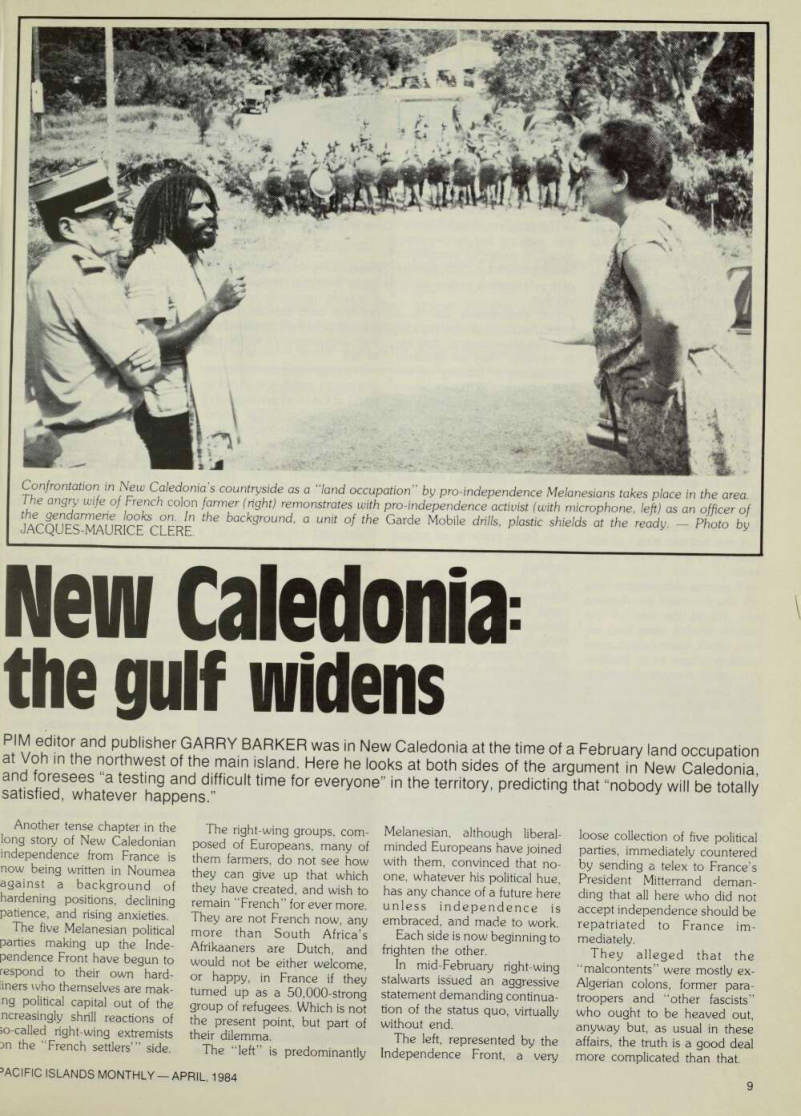
Confrontation in New Caledonia's countryside as a "land occupation" by pro-independence Melanesians takes place in the area, the angry wife of French colon farmer (right) remonstrates with pro-independence activist (with microphone, left) as an officer of the gendarmerie looks on. In the backgroud, a unit of the Garde Mobile drills, plastic shields at the ready.- Photo by
Jacques-Maurice Clere.
It all adds up to the virtual sinking of the moderate major ity of the middle ground. In creasingly those who are wor ried about the complications of independence . . . and they in clude people of all races, indi genous, immigrant and mixed .. . are finding themselves forced to take one side or the other.
I spoke to a pleasant woman with a middle-management job in a busy Noumea office. “ I am not French,” she said, “although my father was. I went to Paris on holiday last year. I was a stranger.
“New Caledonia is my home.
I was bom here. My children were bom here. If they throw us out, where will we go?
Where to go?
“It is difficult to get into Australia or New Zealand these days, since they changed the immigration laws.
“But we don’t want to leave.
All we have in the world is here.
Why should we leave? Why should we be pushed out?”
“I am not yet afraid of vio lence but I am worried it will come. ”
Of course this woman was not like the hard-line farmers who are at the seat of the present trouble over land re form which, essentially, means handing it back to its Melane sian tribal owners. Inevitably they have a different outlook and, being in the country, do not have the feeling of com munity enjoyed by the people of Noumea.
The capital is, in fact, not a Pacific city at all but a very French enclave of 60,000 souls, of whom only about 7000 are Melanesian. The architecture, the gardens, streets, shops and cafes could have been plucked ready-made out of the South of France.
In some respects it is this very cosiness which causes part of the problem.
In the last French general election about 80 per cent of New Caledonians voted for the conservative Giscard d’Estaing.
That the socialist Mitterrand won was regarded as a disaster for their interests.
Cooler heads reject this no tion, saying that whoever has
power in France must proceed as fast as possible with Melane sian independence.
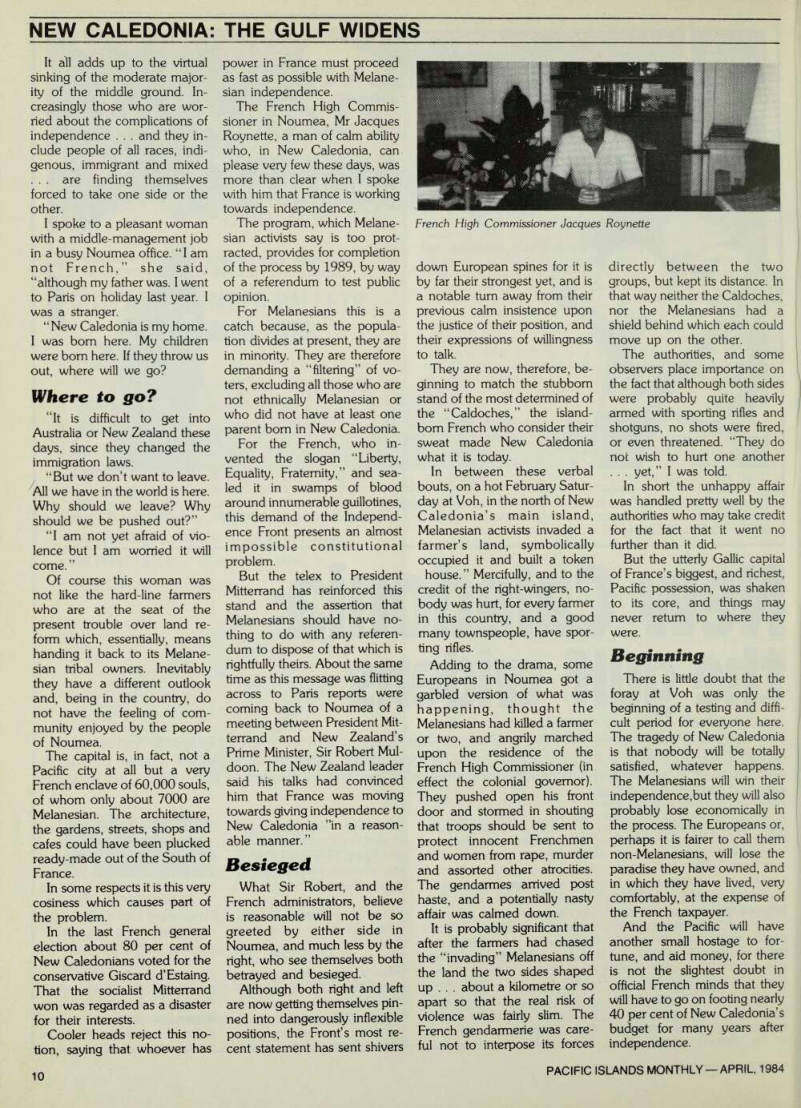
The French High Commis sioner in Noumea, Mr Jacques Roynette, a man of calm ability who, in New Caledonia, can please very few these days, was more than clear when I spoke with him that France is working towards independence.
The program, which Melane sian activists say is too prot racted, provides for completion of the process by 1989, by way of a referendum to test public opinion.
For Melanesians this is a catch because, as the popula tion divides at present, they are in minority. They are therefore demanding a “filtering” of vo ters, excluding all those who are not ethnically Melanesian or who did not have at least one parent bom in New Caledonia.
For the French, who in vented the slogan “Liberty, Equality, Fraternity,” and sea led it in swamps of blood around innumerable guillotines, this demand of the Independ ence Front presents an almost impossible constitutional problem.
But the telex to President Mitterrand has reinforced this stand and the assertion that Melanesians should have no thing to do with any referen dum to dispose of that which is rightfully theirs. About the same time as this message was flitting across to Paris reports were coming back to Noumea of a meeting between President Mit terrand and New Zealand’s Prime Minister, Sir Robert Mul doon. The New Zealand leader said his talks had convinced him that France was moving towards giving independence to New Caledonia ”in a reason able manner.”
Besieged
What Sir Robert, and the French administrators, believe is reasonable will not be so greeted by either side in Noumea, and much less by the right, who see themselves both betrayed and besieged.
Although both right and left are now getting themselves pin ned into dangerously inflexible positions, the Front’s most re cent statement has sent shivers
down European spines for it is by far their strongest yet, and is a notable turn away from their previous calm insistence upon the justice of their position, and their expressions of willingness to talk.
They are now, therefore, be ginning to match the stubborn stand of the most determined of the “Caldoches,” the island bom French who consider their sweat made New Caledonia what it is today.
In between these verbal bouts, on a hot February Satur day at Voh, in the north of New Caledonia’s main island, Melanesian activists invaded a farmer’s land, symbolically occupied it and built a token house. ” Mercifully, and to the credit of the right-wingers, no body was hurt, for every farmer in this country, and a good many townspeople, have spor ting rifles.
Adding to the drama, some Europeans in Noumea got a garbled version of what was happening, thought the Melanesians had killed a farmer or two, and angrily marched upon the residence of the French High Commissioner (in effect the colonial governor).
They pushed open his front door and stormed in shouting that troops should be sent to protect innocent Frenchmen and women from rape, murder and assorted other atrocities.
The gendarmes arrived post haste, and a potentially nasty affair was calmed down.
It is probably significant that after the farmers had chased the “invading” Melanesians off the land the two sides shaped up . . . about a kilometre or so apart so that the real risk of violence was fairly slim. The French gendarmerie was care ful not to interpose its forces
directly between the two groups, but kept its distance. In that way neither the Caldoches, nor the Melanesians had a shield behind which each could move up on the other.
The authorities, and some observers place importance on the fact that although both sides were probably quite heavily armed with sporting rifles and shotguns, no shots were fired, or even threatened. “They do not wish to hurt one another . . . yet,” I was told.
In short the unhappy affair was handled pretty well by the authorities who may take credit for the fact that it went no further than it did.
But the utterly Gallic capital of France’s biggest, and richest, Pacific possession, was shaken to its core, and things may never return to where they were.
Beginning
There is little doubt that the foray at Voh was only the beginning of a testing and diffi cult period for everyone here.
The tragedy of New Caledonia is that nobody will be totally satisfied, whatever happens.
The Melanesians will win their independence,but they will also probably lose economically in the process. The Europeans or, perhaps it is fairer to call them non-Melanesians, will lose the paradise they have owned, and in which they have lived, very comfortably, at the expense of the French taxpayer.
And the Pacific will have another small hostage to for tune, and aid money, for there is not the slightest doubt in official French minds that they will have to go on footing nearly 40 per cent of New Caledonia’s budget for many years after independence.
French High Commissioner Jacques Roynette
Advertisements & other items, p. 10 (1 item)
New Caledonia: The Gulf Widens
10
PACIFIC ISLANDS MONTHLY —APRIL, 1984
on telecommunications

Some lack of communication on telecommunications
Telecommunications writer LIZ FELL reports on the 1984 conference of the Pacific Telecom munications Council (PTC). She writes of frictions between representatives of small Paci fic Island nations and the giants of the Pacific Rim, but also notes that some of the giants, notably the U.S. and Japan, didn’t seem to be getting along all that well together either.
The weather is always an im portant attraction for those attending the annual confer ence of the Pacific Telecom munications Council (PTC) at the lavish Sheraton Hotel over looking Waikiki beach in Hawaii.
This year both the weather outside and the temperature inside were constant topics for discussion. It was sunny and warm in Waikiki in January but freezing inside the over-air conditioned hotel. There was more than a sneaking suspicion that the temperature had been lowered for the benefit of the high-technology which was being exhibited in the confer ence area. It was also snowing in New York and Washington as American Government and industry leaders at the conference never tired of ex plaining.
While most conferees came from the U.S. there was also a sizeable contingent from Pacific Rim nations such as Japan, Canada, Australia and South America, with several people coming from as far afield as Russia, China, the U.K. and France.
Also this year, financial assist ance to the amount of SUS6O,OOO was provided by the United States Information Service (USIS). This allowed the participation of a small group from Western Samoa, Fiji, Palau, Ponape, Tonga, Cook Islands, and the Mar shalls, as well as people from Indonesia, Malaysia and Thai land. PTC President Joseph Gancie expressed his commit ment to extending this repre sentation next year.
Despite the South Pacific is lands presence, their concerns were only really expressed in one major plenary session on the last day. This session drew together representatives from disparate parts of the Pacific to discuss ways in which their governments could co-operate and take advantage of the
growth in telecommunications services.
The speakers were all high level officials from the U.S., Peru, Chile and Japan. The respondents came from In donesia, Fiji and Western Samoa. Taking the lead, the U.S. speaker outlined some recent initiatives to assist under resourced and under-de veloped nations. These in cluded the National Aeronau tics and Space Administration (NASA) study of South Pacific needs, the development of a low-cost, low-power earth sta tion for satellite links in rural areas, and the formation of the
U.S. Telecommunications Training Institute.
The institute is a co-operative venture between many of the large U.S. telecommunictions corporations and the U.S. Gov ernment. It offers technical and management training to people from developing nations at va rious sites in the U.S. One international telecommunica tions consultant put its aims very succintly when she said that it was an attempt to get people to “Buy American”. It is clearly hoped that institute graduates will think of U.S. products when (and if) they are eventually in a position to influ
ence purchasing decisions.
The Japanese Government representative at the session also spoke of the various types of co-operation and assistance offered by his country to less developed nations. These in volve acceptance of trainees, despatch of experts for on-the spot training, and surveys and technological co-operation cen tres in places such as Thailand, Indonesia and the Philippines.
Japan also provides substantial financial assistance to organisa tions such as the International Telecommunications Union, which remains the primary tele communications training pro vider in this area.
Respondents were all quick to criticise the U.S. training initiative. Emori Naqova from Fiji pointed out that South Pacific nations have a low eco nomic base which means they simply can’t afford to send skilled technicians or engineers away to be further trained in high technology without creat ing hardship. Inevitably they leave gaps behind.
“It is more practical if the
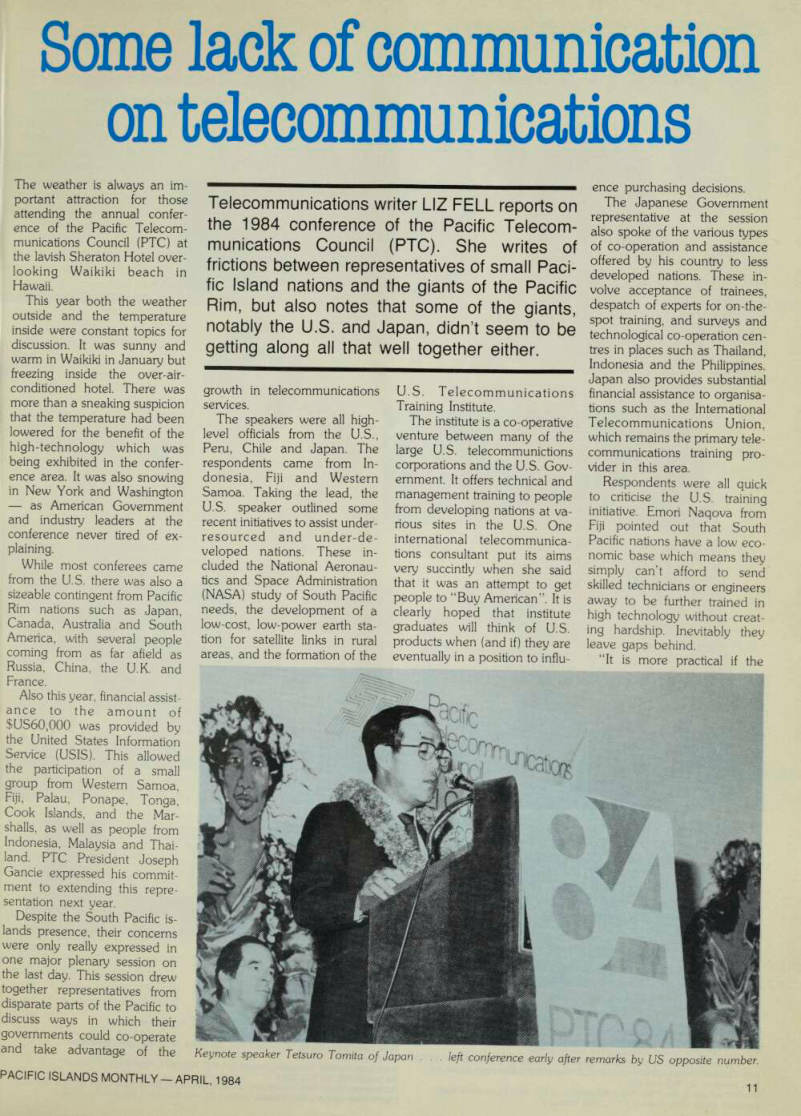
Keynote speaker Tetsuro Tomita of Japan ... left conference early after remarks by US opposite number.
expertise comes to us and sets up high-level courses. At least our skilled staff can be called out to assist if there are prob lems with the network,” he said.
Naqova went on to praise a Japanese initiative of 1983: A six-week course was organised and conducted in Fiji for South Pacific engineers and technical officers to be trained in satellite technology, fibre optics, and other advanced systems. He expressed gratitude to the Japanese Government, and the hope that this was only the start of a series of similar courses to be conducted within the South Pacific region. If such courses were to be conducted away from the region, scholarships at least would be necessary, he said.
Western Samoa’s respon dent, J. W. Moore, was also critical of the “well-meaning offers” from developed coun tries. He pointed out that, leav ing aside those countries chich have a per capita income within the range of $4OOO-$ 10,000, there were still 45 other coun tries in the Pacific Basin with per capita incomes between 1 $lOO-$3OO per annum. He suggested that the audience should look at telecommunica tions development in this con text, recognising that it was often a low financial and politi cal priority for developing na tions.
Despite the friction between developed and developing countries at this one session, it was tensions generated be tween the Americans and Japanese that really dominated the conference.
Keynote speakers Tetsuro Tomita, deputy director-general of the policy bureau in the Japanese ministry of posts and
telecommunications, and
Lionel Olmer, U.S. under-sec retary of commerce for in ternational trade, used the opening session as a stage to rehearse some of the argu ments being used in the on going telecommunications trade talks between these two nations.
In fact, in response to some of the criticisms levelled by Olmer, Tomita cut short his stay at the conference and returned to Japan.
Over the past couple of years, the U.S. has been ex-
erting pressure on the Japanese Government to open up its lucrative telecommunications market to U.S. suppliers. Olmer noted certain “deregulatory” moves of the Japanese with approval, and went on to dis cuss a new proposal which may go before the Japanese Diet in the course of 1984.
This proposal will open up the Japanese monopoly, the Nippon Telegraph and Tele phone public company (NTT), to competition. However, it may also restrict U.S. com panies from competing by fore ign-ownership and domestic content requirements.
Olmer departed from his pre pared speech with words of criticism of this possibility. He said: “We view with concern any provisions of this character, and have so informed the Japanese Government. We hope that Japan continues a process of opening up its mar ket to competition by accelerat ing not discouraging foreign participation.”
Mr Tomita returned to Japan the next day.
One of the areas of negotia tion between the Japanese and Americans is the regional satel lite system which Japan has proposed for the Pacific. This proposal, first outlined at the PTC conference last year, in volves the provision of high speed links between the nations
of the Pacific Rim, and tele phone links for remote areas in the Pacific islands.
At a press briefing during the conference, Dr Saburo Okita, former foreign minister of Japan, and now chairman of the Institute for Domestic and International Policy Studies, confirmed reports that the U.S. and Japan were discussing this satellite proposal as a co-opera tive venture.
Okita stated that the Japanese were feeling pressure to purchase U.S. satellites. If this regional proposal were im plemented, it would involve the two countries pooling their re sources. The production of the satellites would be commis sioned to the U.S., and the Japanese would lease out trans ponders on the satellite if they wished.
The Japanese proposal still requires consensus among leaders in Japan. If it were to become a reality, the Japanese believe it could be integrated with the existing global satellite service provided by Intelsat, the international satellite organisa tion to which most developed nations are signatories.
Joseph Pelton from Intelsat is not so certain. He announced Intelsat’s approval of a new service called VISTA at the conference. This service was designed with South Pacific ru ral needs in mind, and while it is
still far from ideal, Felton is obviously hoping it will be used for the planned South Pacific domestic telephone links.
Smaller sessions and work shops provided a wealth of information in other areas. The communication needs of expor ters, health workers, scientists and those involved in long distance learning were on the agenda. There were also special sessions covering the use of ATS-1 social service satellite networks in the South Pacific, and the A.I.D. rural satellite projects in Indonesia, Peru and the Caribbean.
Many of these smaller ses sions were marred by the fact that so many speakers had evidently failed to master the simplest techniques of speaking into a microphone. Such wide spread incapacity was all the more extraordinary in a gather ing in which most participants were inolved in manufacturing, buying, selling and distributing the technology of the com munications industry.
The organisers have been watching this annual event grow larger over the last six years. Next year they anticipate that participants will break the 500 limit, the number re garded as the maximum if effective, informal contacts and formal discussions are to re main the conference goals.
Liz Fell.
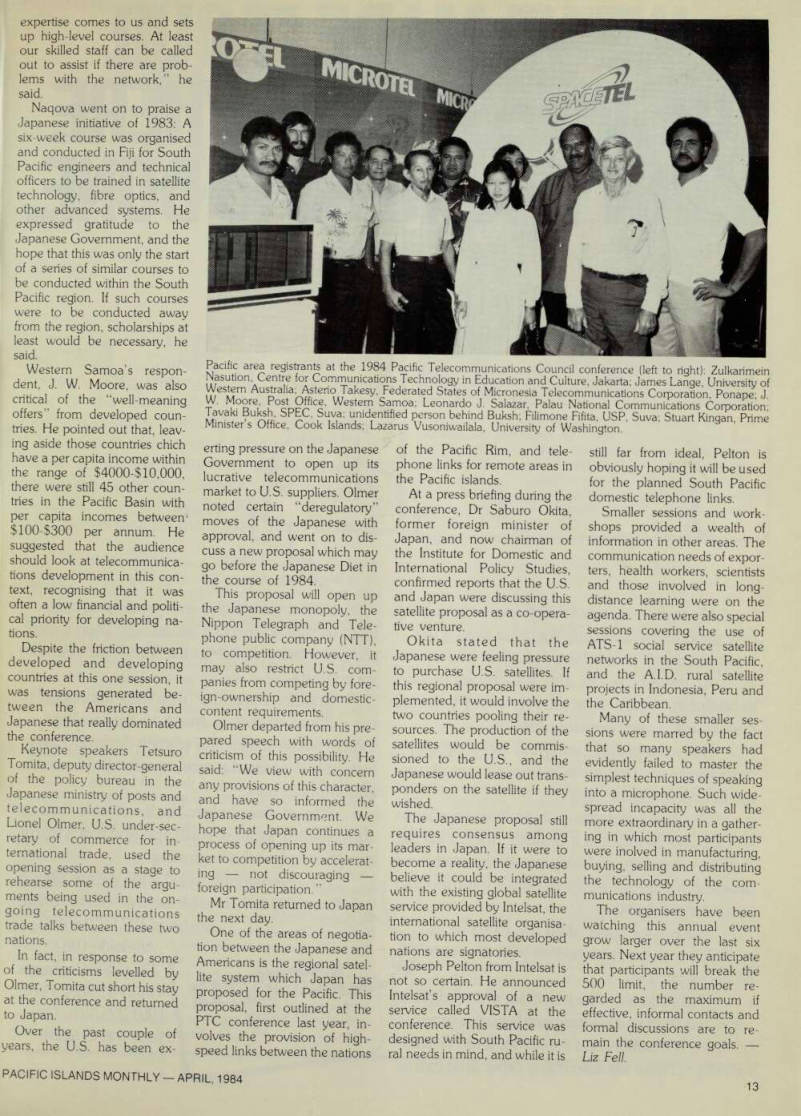
Pacific area registrants at the 1984 Pacific Telecommunications Council conference (left to right): Zulkarimein Nasution, Centre for Communications Technology in Education and Culture, Jakarta; James Lange, University of Western Australia; Asterio Takesy, Federated States of Micronesia Telecommunications Corporation, Ponape; J.
W. Moore, Post Office, Western Samoa; Leonardo J. Salazar, Palau National Communications Corporation; Tavaki Buksh, SPEC, Suva; unidentified person behind Buksh; Fifimone Fifita, USP, Suva; Stuart Kingan, Prime Minister's Office, Cook Islands; Lazarus Vusoniwailala, University of Washington.
Advertisements & other items, pp. 12-14 (1 item)
Grwi
Three great ways
to play it your way.
rw#'"*® 1 "
Grwi
Portable Component System 1 i * CK-3 e
play •*
CK-W 3
it am
CK-Rll a : V 9 Pioneer’s Carry Com™ portable component systems now come with a choice of decks. Go for auto-reverse and get two-way REC/PLAY convenience. Or get synchronized double-speed dubbing and relay play with the double model. Naturally, there’s a “straight” deck, too, with Dolby* noise reduction and all the extras. Add the essential Carry Com™ tuner/amp and the sized-tomatch speakers and you’re on your way to more musical pleasure, from Pioneer. * ‘Dolby’ and the double-D symbol are trademarks of Dolby Laboratories Licensing Corporation. lIS CK-Rll
C j) PIONEER
For further information, please contact: Australia: Pioneer Electronics Australia Pty. Ltd. (Incorporated in Victoria), P.O. Box 295, Mordialloc, Victoria, 3195 Tel: 580-9911 Fiji Islands: Brijlal & Company, G.P.O. Box No. 362, Suva, Fiji Islands Tel: 22258 New Zealand: Monaco Distributors Ltd., 2 Poland Road, Glenfield, Auckland, New Zealand Tel: (09) 444-9144 Norfolk Island: Burns Philp (Norfolk Island) Ltd., P.O. Box 21, Norfolk Island Vanuatu: Burns Philp (Vanuatu) Ltd., Vila, Vanuatu Nauru Island: Jacob Enterprises, P.O. Box No. 4, Republic of Nauru Tahiti: Tahiti Hi-Fi, P.O. Box 848, Papeete, Tahiti New Caledonia: Menard Pacifique Sari, B.P. 3899, Noumea, New Caledonia Tel: 27*62.23 . , American Samoa: Transpac Corporation, P.O. Box 1477, Pago Pago, American Samoa 96799 Tel: 633-5224 . Tq .. 0 0-j 7 Rarotonga: South Seas International Ltd., P.O. Box 49, Rarotonga, Cook Islands Tel. 2327 Papua New Guinea; Bali Merchants Pty. Ltd., P.O. Box 6103, Boroko Tel: 254887
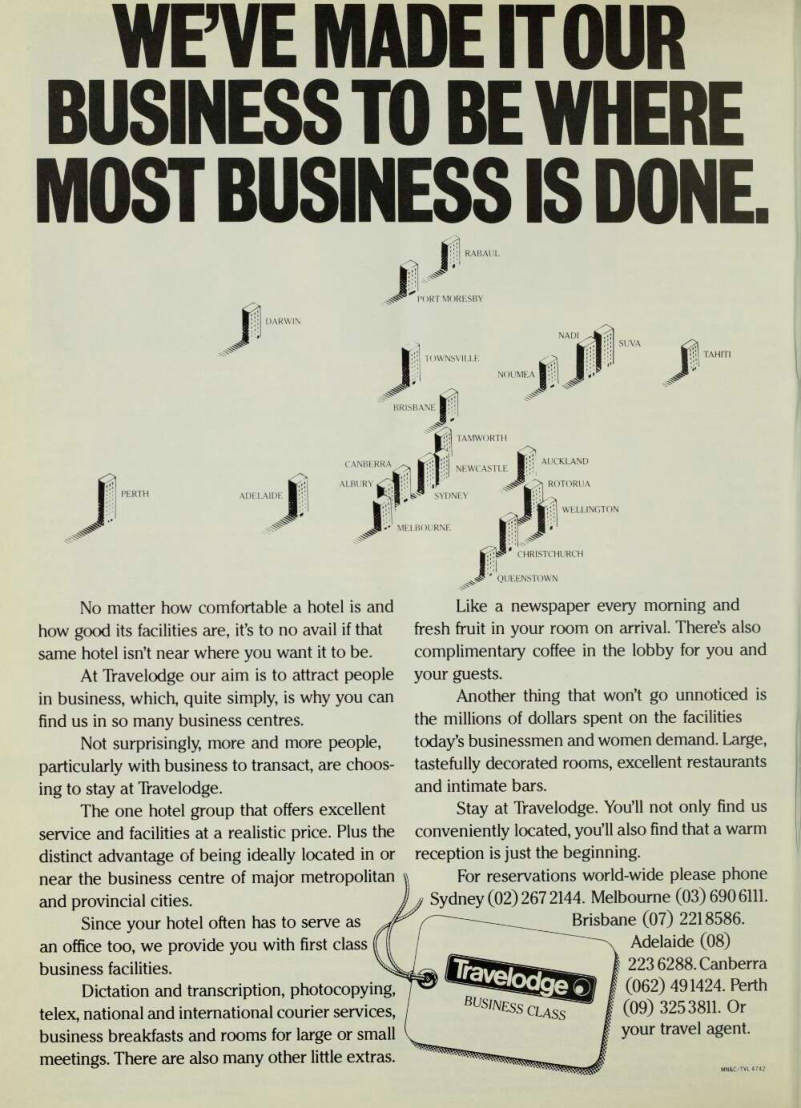
WE’VE MADE IT OUR
BUSINESS TO BE WHERE
MOST BUSINESS IS DONE.
PERTH
I
DARWIN
ADELAIDE
I I I
RABAUL
PORT MORESBY
I P s
PUD IL'Tn
SUVA
J
WELLINGTON
CHRISTCHURCH
QUEENSTOWN
No matter how comfortable a hotel is and how good its facilities are, it’s to no avail if that same hotel isn’t near where you want it to be.
At Travelodge our aim is to attract people in business, which, quite simply, is why you can find us in so many business centres.
Not surprisingly, more and more people, particularly with business to transact, are choosing to stay at Travelodge.
The one hotel group that offers excellent service and facilities at a realistic price. Plus the distinct advantage of being ideally located in or near the business centre of major metropolitan and provincial cities.
Since your hotel often has to serve as an office too, we provide you with first class business facilities.
Dictation and transcription, photocopying, telex, national and international courier services, business breakfasts and rooms for large or small meetings. There are also many other little extras.
Like a newspaper every morning and fresh fruit in your room on arrival. There’s also complimentary coffee in the lobby for you and your guests.
Another thing that won’t go unnoticed is the millions of dollars spent on the facilities today’s businessmen and women demand. Large, tastefully decorated rooms, excellent restaurants and intimate bars.
Stay at Travelodge. You’ll not only find us conveniently located, you’ll also find that a warm reception is just the beginning.
For reservations world-wide please phone Sydney (02) 267 2144. Melbourne (03)6906111.
Brisbane (07) 2218586.
Adelaide (08)
223 6288. Canberra (062) 491424. Perth (09) 3253811. Or your travel agent.
MN&C/TVL4742
a • *
BUSINESS
CLASS
of Captain
The Death of Captain Cook
Printed here is the first of two parts of a lecture, “The Death of Captain Cook”, delivered by Professor Greg Dening of the History Depart ment of the University of Melbourne, to an audience of more than 300 at the State Library of New South Wales on February 14.
The lecture inaugurated a series known as the Dulcie Stretton Lectures, and was spon sored by The Library Society, a friends’ or ganisation based on the State Library of NSW.
You will know that the Hawaiian islands are a chain of islands stretching 500 kilometres on a northwest line, from Kauai in the north to Oahu, Molokai, Maui and Hawaii in the southeast. And you will know that James Cook in 1778 on his third voyage of exploration in the Resolution and Discovery, having mapped all the southern seas in his previous voyages, was sailing north from Tahiti to discover if there were a northwest passage between the Pacific and the Atlantic. Cook was pleased to come upon the island of Kauai. The islanders were recognisably Polynesian and he had experience of their ways and their language in all parts of the Pacific from Tonga to New Zealand to Easter Island. Most of all he knew he had a place of refreshment and retirement when the northern winter made passage too dangerous. So he provisioned himself quickly at Kauai, named the islands the Sandwich Islands, and went on with nothing remarkable to note save the warm welcome he and his men had been given, especially by the women, who sought intercourse with the sailors almost frenetically.
The sailors were flattered, of course, and willing to oblige, even though Cook had strictly forbidden all contact with women because he did not want to be first to bring them “the venereals”, but the sailors were also a little puzzled by behavior that seemed extravagantly lubricious even for Polynesians. They would know 13 months later when they returned that things are never what they seem in contact between cultures. The women came back to the ships then to secrete in the decking the umbilical cords of the children they had conceived. They had borne the children of gods and men, just as they bore and were eager to bear, out of marriage, the children of their chiefs who were also gods and men.
Historians in hindsight, and indeed Cook’s colleagues in reflection on what happened on this third voyage, have agreed that even at this stage all was not well. Cook’s temper, never good, was less in control, and he flogged more than 45 per cent of his crew, and many of them more than once. Poor Bligh, who wanted so
much to be a hero like Cook, has been thought to be a violent man for flogging only nine per cent of his crew. Cook’s cool judgment with native peoples seems awry, and patience thin. He was sick with eight years of the strain of leadership in dangerous places and the horrendous food of voyaging. His poor stomach, kidneys, bowels and lungs would offer a grim picture for any “Body Program”. Sir James Watts, a medical historian, has played on the irony that in saving himself from scurvy and a Vitamin C deficiency, Cook lost out on Vitamin B, and he may have had worms which deprived him of niacin and thiamine. For those who do not read boxes of breakfast cereals seriously, Sir James has a grim warning as to what a lack of niacin and thiamin can bring: fatigue, headache and insomnia, breathlessness, irritability and depression, painful mouth and tongue, digestive disturbances, loss of interest and initiative, constipation or diarrhoea, loss of concentration and memory, psycho-neurotic personality change, sensitivity to sun light . . . “Historians,” Sir James warns, “have ignored for too long the serious effects on decision-making from Vitamin B deficiences, which could help to explain some otherwise inexplicable actions of the great naval commanders.” Be that as it may, the Resolution’s men went to the northwest coast murmuring among themselves at their commander’s ill temper, and wondering at his imprudences.
The Hawaiian chain which they now left had been settled some 1500 years before by the same Polynesian people that had been blown or had sailed to every island in the vast Pacific. In their isolation on their different islands the Polynesians developed variations on the different themes of their culture. But they all, being islanders, were preoccupied with the history of where they had come from and the prospects of where they might go. Their myths told them they came from a distant place and they would go to a far-off land. Tahiti in all its dialectal differences is the Polynesian word for a “distant place. ” Hawaii with all its dialectal differences is a “far-off land.” Life, the Polynesians knew, both as
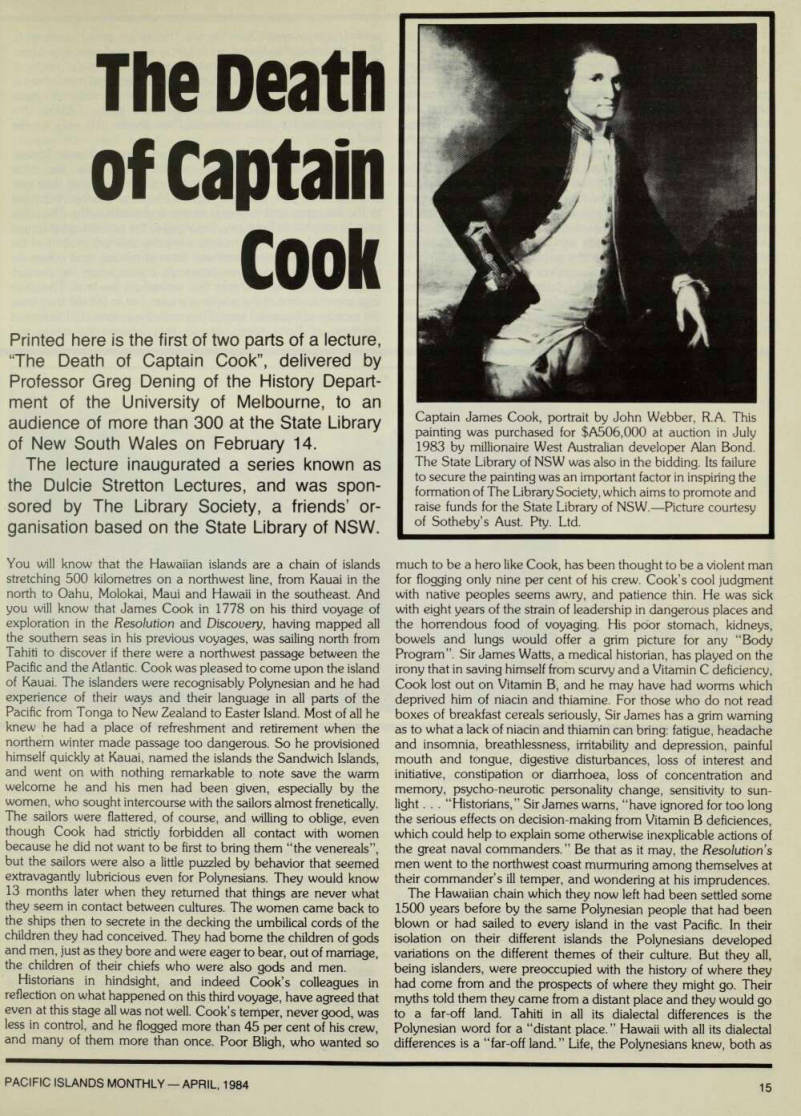
Captain James Cook, portrait by John Webber, R.A. This painting was purchased for $A506,000 at auction in July 1983 by millionaire West Australian developer Alan Bond.
The State Library of NSW was also in the bidding. Its failure to secure the painting was an important factor in inspiring the formation of The Library Society, which aims to promote and raise funds for the State Library of NSW.—Picture courtesy of Sotheby’s Aust. Pty. Ltd.
individuals and as groups, both now and in the past, was a journey from Tahiti to Hawaii.
The Polynesians had another puzzle about themselves. They puzzled how to describe, how to act out, how to establish the proper relationship between the raw violence of power and the controlled violence of authority. Think for a moment of our own political system: think of the distinction we make of the legal authority of the crown and the power of politicians. Think of the etiquette, the protocols, the rituals by which we divorce authority of the crown and political power and the ramifications of that distinction through all of our social and legal life. Mr Hawke said recently that the world would be a better place if Soviet Russia and Communist China played cricket. I heard him say in that that he saw in cricket something he valued in culture the subtlety of the balance of rule and custom, the thin line that could be walked between competitive hostility and acceptable sportsmanship. We would be hard put to describe ourselves, whether republican or monarchist, without pointing to the balances we make between power and authority in our courts, parliaments and in government at all levels. And if we were asked to explain it, we would talk history Magna Carta, Long Parliament, Common Law. We put
accession were about how the son had taken power, usurped it, killed his father. He buried his father as if he had conquered him.
Then he gained authority by marrying into the people of the land.
Indeed the women of the land, not just his wife, gave themselves to the chiefs, as they had given themselves to the Resolution’s men, for the sake of the children they would bear. “Chiefs,” the Hawaiians said in their proverbs, “are sharks that walk on the land.”
The Hawaiians played out these oppositions of stranger/Native, Sea/Land, Death/Life in innumerable ways. But the most important was in the seasons of their year. They divided their year into two. One part, the eight months March to October, belonged to the strangers and their god of war and sacrifice, Ku. The other part, November to February, belonged to the natives and their god of the land, Lono. Eight months were the ordinary months of the year, time of war and sacrifices, time of taboos, time when the chiefs demanded awesome protocols, a time when the proverb rang true: chiefs were sharks that walked on the land. The other four months were of the northern winter, but in Hawaii they were the months of bountiful food. They were the season of thunder and lightning, of Kona winds, of rain that scoured the creeks and
enormous social, educational and mythical energy into making the distinction and keeping it real.
The Polynesians had some sense of the same opposition between power and authority. Their rulers, their chiefs, had both power and authority, but the Polynesians understood that the two came from different sources. They understood that power, always violent, always usurping, came from outside, belonged to strangers. But authority was always legitimate, always came from within, belonged to those born with it, belonged to natives. They set up their understanding in myths about the past, but also the present. At some time strangers had come from a distant place, Tahiti; they came with war, with human sacrifice. They came as man-eaters, cannibals. They came with their god of war and sacrifice Ku. Strangers came from the sea, “from beyond the sky.”
When the strangers came to the Hawaiian Islands, they found natives there, born of the land, belonging to the productive land.
The strangers conquered the natives, took power but gained authority by marrying the women of the land, by marrying into lines that were native. These myths were stories about the past but they were also cosmologies about the present. So when a chief died and his first-bom son came to power the ceremonies of
brought the fish. They called it makahiki ma-tahiti, a voyage from a distant place. It celebrated the voyage of the god of the natives, Lono, to Hawaii. He came every year with the rising of the Pleiades and left with their setting. Makahiki was a carnival season in which there was no war or sacrifice, in which there were games, in which there were no taboos that if broken would bring death.
The productivity of the land was celebrated in gifts to the chiefs in their role as legitimate authority over the land. Makahiki began with a procession, early in November. The symbols of Lono were taken around the island in a right-handed procession. Clockwise, land to the right, sea to the left: land, life, right; sea, death, left. The chiefs retired to their own properties around which left-handed processions were made in sign of dispossession of their violent power. The symbols of Lono were a wooden crosspiece from which hung strips of white bark cloth and the skins of a bird, the albatross. At each district boundary which the Lono procession crossed there were ceremonies of gift-giving of food in extravagant abundance. The procession having circuited the island ended in Lono’s temple. When the makahiki season was finished Lono’s temple was dismantled. In the last days of the season the chiefs landed on the beach before the temple and as strangers in
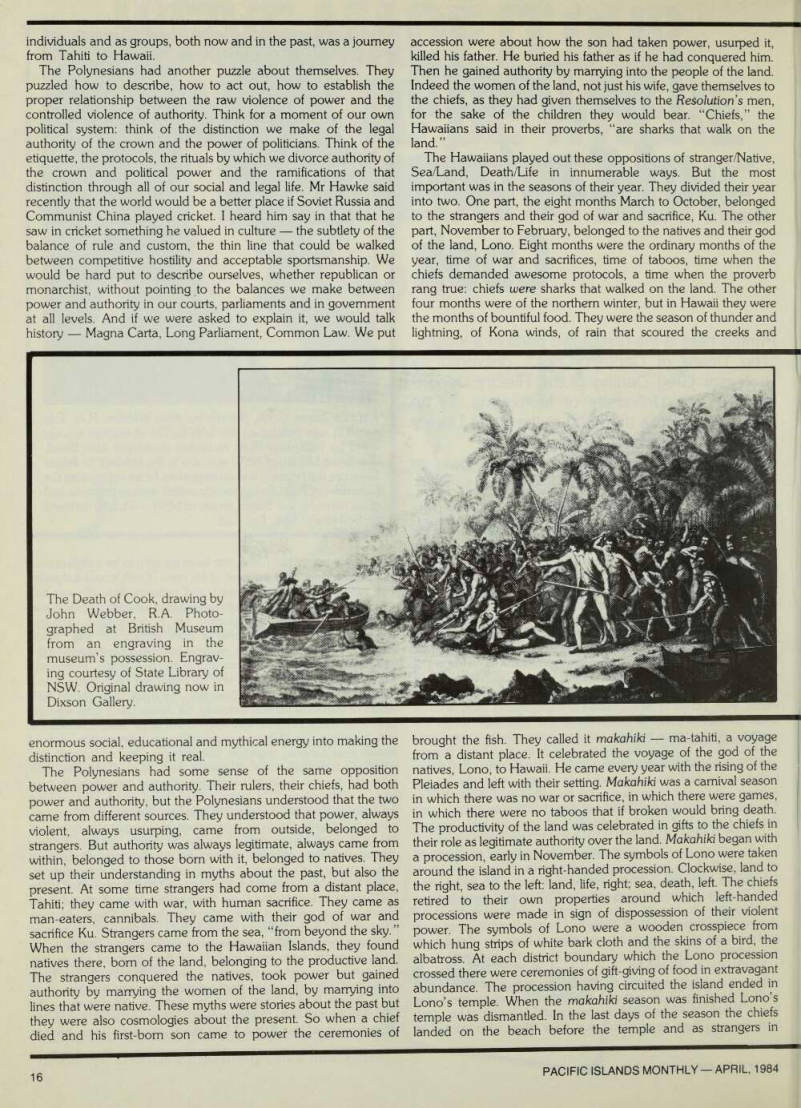
The Death of Cook, drawing by John Webber, R.A. Photo graphed at British Museum from an engraving in the museum’s possession. Engrav ing courtesy of State Library of NSW. Original drawing now in Dixson Gallery.
ceremonial battle defeated Lono and the natives again. They began the new year with a human sacrifice to Ku. A canoe was launched filled with food and gifts and Lono’s symbols and set adrift in the expectation that it would return again with Lono at makahiki.
With the coming of the northern cold and autumn fogs Cook turned south. He arrived off Maui on Novenber 26, 1778. He was crankier than ever and his crew were cranky at him. He was making them drink spruce beer instead of their grog and they murmured as the phrase went, mutinously. No use telling them that their grog was deficient in both Vitamin C and Vitamin B, they liked it. What was worse, Cook told them they were not going to winter in an island haven, they were going to keep at sea the whole winter long. He was still angry that he had not been able to keep his men from the women on his earlier visit to Kauai, and it was soon clear from the women who now came off to the ships, that the “venereals” had spread very quickly indeed. He had obviously decided that three months in one spot in the Hawaiian islands would not do his crew or the islanders any good. And he thought he would be better supplied with frequent visits to new places. So he began a long punishing voyage in huge winter seas, tacking and
black stone with huts and statues and altars of wood or matting.
The priests of the temple came to the Resolution and were importunate that Cook land. When he did the people had melted away or covered their faces and bent to the ground as a crier went before Cook crying Lono, and warned them to make obeisance.
The priests led Cook around the pantheon of their gods in the temple. He was extraordinarily malleable to their wishes, prostrating himself at the statues, kissing them. The priests installed him on a sort of platform, anointed him, fed him, extended his arms like a cross of makahiki , wrapped him in a red tapa cloth, and began a litany that ended in a chant of Lono, Lono, Lono.
When they were finished with him, Cook asked if he could have a small enclosure beside the temple for his use as an observatory.
The priests were delighted to accommodate the tents and all the paraphernalia for observing the stars. The Pleiades were about to set and they were watching the stars as well. They kept asking when Lono would go. Kalaniopu’u, the chief of Hawaii, came with all the majesty of Hawaiian high chiefs. He would not meet Cook on the Resolution. He met Cook on the beach near Lono’s temple.
He did not challenge him, it is true: he honored Cook with the great feather capes, the Hawaiian’s richest possession. The British
tacking again around the island of Hawaii. He would come to shore to trade and provision, then continue on his clockwise voyage around the island. Each time they came near to shore they noticed that the people were extraordinarily generous with their gifts of food from their land: they also noticed there were no chiefs among them. And all the people called Cook Lono. His own officers gave up trying to tell them that his name was Kuki or Tuti and began to refer to him as Lono too. And so under their white sails hanging from the cross of their masts and yards they made a right-handed procession around the island. On January 17, they arrived at Kealekekua Bay. They were astounded at the welcome they received. There were a thousand canoes in the bay, 10,000 islanders in them. They did not know that Lono’s makahiki The path of the god they called it procession began and ended every year at Kealekekua Bay, and that they were expected.
Kealekekua Bay is a half-moon bay with high cliffs in the centre, flattening to plains on both horns. In 1779 there was a large cluster of houses, almost a village, at the north-western comer and on the south-eastern corner there was a temple, or heiau. For the season of makahiki this heiau was Lono’s temple where the procession began and ended. In the Hawaiian style it was a raised platform of
Museum has it still. And he too kept asking when Lono would go.
They went on February 4, the day the Pleiades set in 1779, the precise day makahiki ended. Before they went they needed firewood and they asked the priests if they could have the fencing and even the statues of Lono’s temple. The priests were not offended. They said they might have it all, save one statue of Ku.
His season was about to begin. They happily helped dismantle the temple, as they always did.
The season of Ku would ordinarily begin with a human sacrifice.
Two days before the Resolution left, William Watman, a much loved older seaman, died of a stroke. Cook’s crew were pleased that the chiefs asked them to bury Watman in the stone pavement of the temple. But they were a little mystified at the extravagant ceremony that accompanied the burial. All night the Hawiians chanted and prayed around the grave. They piled sacrifices of their own, pigs and food, around the cross that marked it. There is a plaque there now commemorating William Watman’s burial as the first Christian service in Hawaii. That may be so. No doubt the priests of Lono and Ku thought it more ecumenical than that, and the chiefs had made their sacrifice. • Next Month: Death, and a double apotheosis.
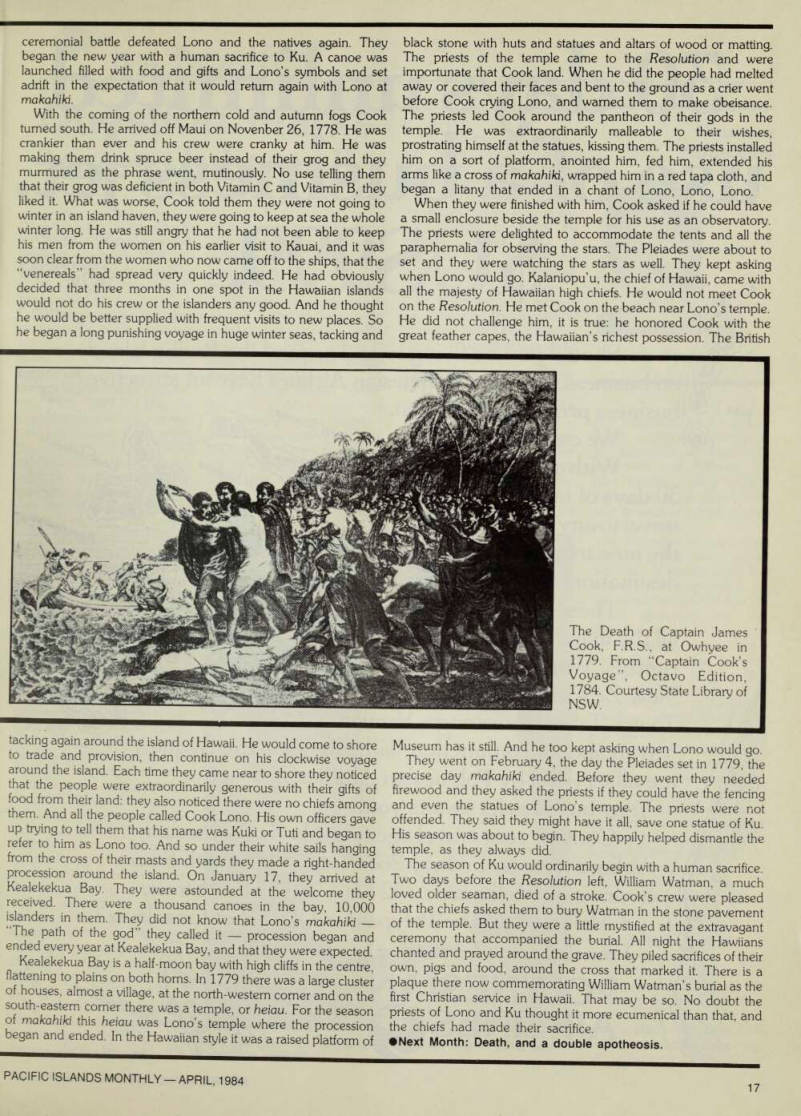
The Death of Captain James Cook, F.R.S., at Owhyee in 1779. From “Captain Cook’s Voyage”, Octavo Edition, 1784. Courtesy State Library of
Nsw.
Advertisements & other items, p. 18 (1 item)
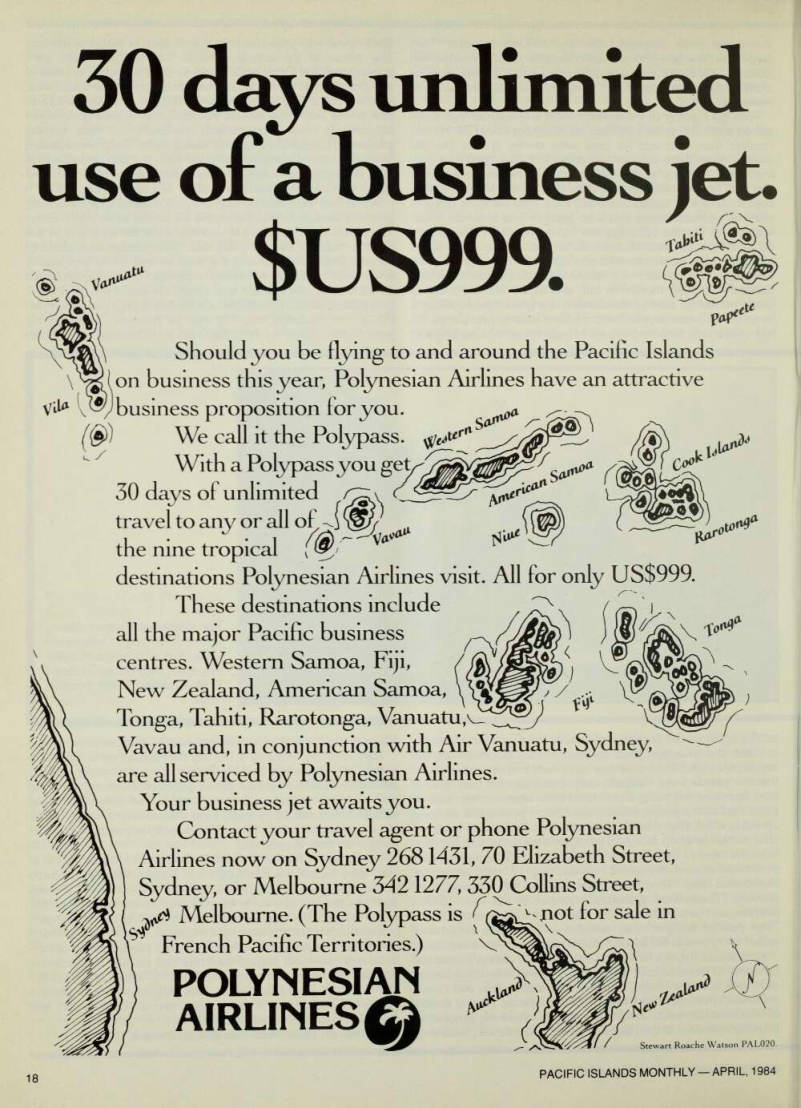
use of a business jet.
30 days unlimited
SUS 999.
m I 4>e«<? & Should you be flying to and around the Pacific Islands on business this year, Polynesian Airlines have an attractive business proposition For you.
We call it the Polypass. //V) j With a Polypass you 30 days ol unlimited C^r=£> travel to any or all of,4®/ . \m i • -i 7(0) the nine tropical ; destinations Polynesian Airlines visit. All for only US$999.
These destinations Include 7^. all the major Pacific business n//M) centres. Western Samoa, Fiji, (I -(• New Zealand, American Samoa, Vy Tonga, Tahiti, Rarotonga, Vanuatu V: Vavau and, in conjunction with Air Vanuatu, Sydney, are all serviced by Polynesian Airlines.
Your business jet awaits you.
Contact your travel agent or phone Polynesian Airlines now on Sydney 2681431, 70 Elizabeth Street, Sydney, or Melbourne 3421277,330C011ins Street, y* Melbourne. (The Polypass is f(fefcVJ r,ot f° r sa^e in French Pacific Territories.)
POLYNESIAN JyjMf
8 t ort 0$ / \ Stewart Roache Watson PALO2O
over July poll

the month
Question marks over July poll
Once more the “to be or not to be” of the Territorial Assembly elections due in July (PIM Jan. p 26) is at the forefront of New Caledonia’s political preoccupations.
France plans that the elec tions should usher in a five year autonomy period, to be fol lowed by a vote on self-de termination in 1989. Leaders of the anti-independence Republi can Party (RPCR) plan to triumphantly resume the power they lost in June 1982, when the centrists of the FNSC switched sides, under French guidance, and went into the coalition government council with the Independence Front (IF).
The Republicans have waited for these elections to prove that the socialist experiment has not worked, and that the majority of the territory’s population are still fiercely opposed to inde pendence.
Recently the IF gave France notice that they won’t partic pate in any future elections except a vote on self-de termination “for the Kanak people alone”. The territory has been .given no clues as to the plans of the French Govern ment to accommodate the IF demands for electoral reform.
But it would be strange for the ruling French Socialist Par ty, which supported the IF before they came to power, and steered them into local power 18 months ago, to stand back and hand the Republicans an election victory on a plate.
If the elections do not take place as scheduled, or if there is electoral reform, the Republi cans have threatened they will physically prevent both the South Pacific Conference and the Festival of Pacific Arts from being held in Noumea in Octo ber and December respectively.
The leader of the RPCR, Jac ques Lafleur, has said the
35,000 supporters of his party, plus their cattle, pigs and bulldozers will prevent these events from being held. This threat led the LKS, one of the five IF parties, to decide at their annual party conference to mobilise their members in the event of an RPCR attempt to disrupt Oceanians from holding their arts festival.
LKS leader Nidoish Naisseline told a news conference after their conference that while they did not support the festival because the Kanak people did not yet have the right to welcome their Pacific neighbors, they would not tolerate any disruption of it “We’ll be
there if Mr Lafleur tries to block it,” he said.
The LKS have also said they will block entry to polling booths if the assembly elections go ahead without electoral re form. “We have not decided on the means but we’ll do every thing possible to ensure the elections are not held,” Mr Naisseline said. “We’ll use de monstrations, even violence, depending on the situation.”
Mr Naisseline also accused the Mitterrand government of hypocrisy, saying that while the French Government is ready to recognise the rights of self determination of the Palesti nians, for example, they don’t concede the same rights to the Kanak people.
Speaking at the closing ses sion of his party’s conference Mr Naisseline called for an awareness of the contradictions existing in the Kanak independ ence movement. He told the
Noumea Notebook
200 delegates that for a party which envisages government an awareness of these con tradictions was essential. He cited possible conflicts between the interests of the state and the maintenance of Kanak custom as an example.
Mr Naisseline, who is a great chief from Mare Island, added that while all Kanaks agree that custom must be respected, this was often only at the level of verbal agreement and that often the wishes of chiefs were not adhered to. He said that a contradiction existed between the LKS policy of promoting local, traditional foods (yams, taro, manioc, etc) in the econo mic development of the country and the fact that the experience of their co-operatives showed an increasing trend to the con sumption of Western foods.
“We must recognise that our populations are alienated from traditions by the propaganda of TV, radio and newspapers in favor of Western products. ” He cited the case of an old man on New Caledonia’s east coast who killed one of his chickens in order to sell it to the local store and buy an imported frozen chicken, and of villagers who sell their fresh fish only to go and buy cans of sardines. A third contradiction cited by Mr Naisseline concerned the pre servation of Kanak culture. He said the elders who possess the richness of this culture are dying off without imparting their
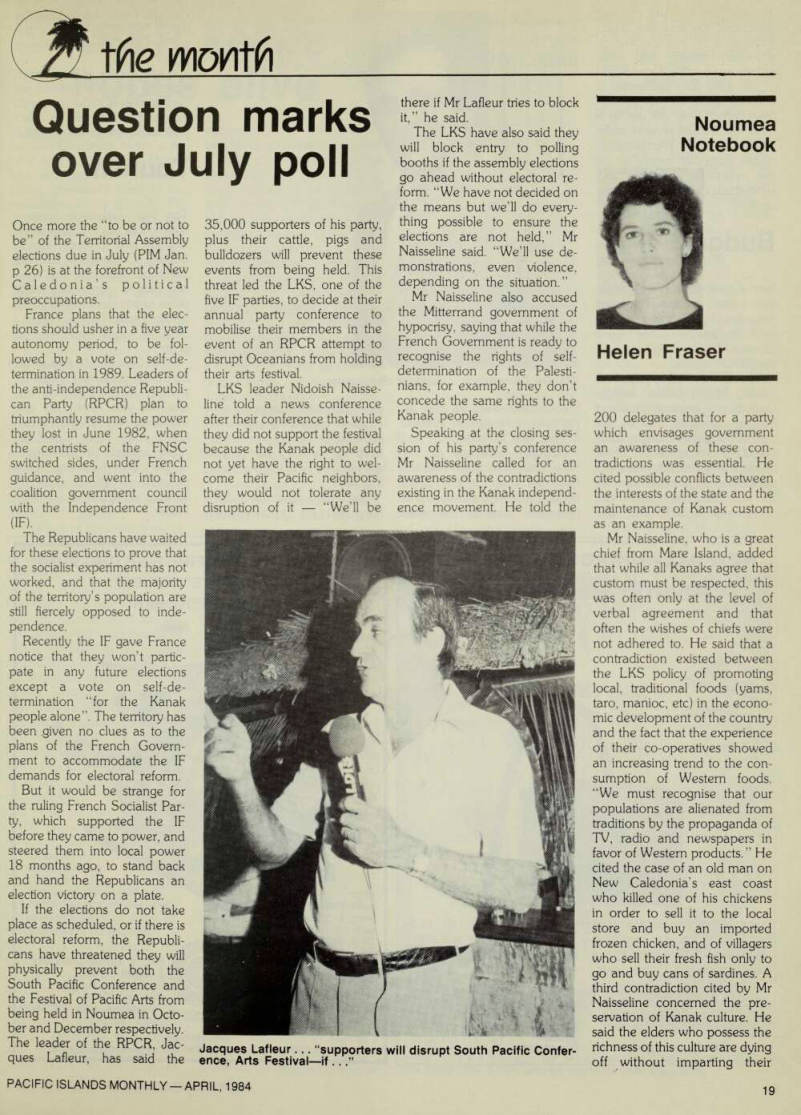
Jacques Lafleur. .. “supporters will disrupt South Pacific Confer ence, Arts Festival—if..
Helen Fraser
knowledge to the young generation because the youth have gone off into the French schooling system, and have grown apart from the elders.
The LKS also elaborated a detailed program of govern ment which they will use as a basis of discussion with other political parties. The program places particular emphasis on the economic, industrial and agricultural development of the territory.
Budget
New Caledonia’s 1984 budget was passed in the Territorial Assembly by 19 votes to 11, with the Independence Front and the FNSC voting for it and the RPCR against.
The CFP3I billion (approx imately $A223 million) budget features an increase in direct taxation, bringing it to 24 per cent of budgetary receipts com pared with 16 per cent in 1980.
Indirect taxes, which were 37 per cent in 1982 have fallen to 31 per cent this year. Also decreasing is aid from the
French state which fell from 30 per cent of receipts in 1980 to 27 per cent in 1984.
Running expenses of the New Caledonia administration have decreased in this year’s budget, as have the expenses of personnel. One of the main
expenditure features of the gov ernment council’s budget is an increase in public works pro jects, up from 11 per cent of spending in 1980 to 13 per cent this year.
Speaking against the budget, Republican spokesman
Georges Faure, warned that the RPCR would re-examine the tax structure when they regain power.
A new feature of the taxation structure is taxes'of up to 60 per cent on people in the super-rich income bracket, said to affect 140 taxpayers in the territory.
Tourism
The New Caledonia govern ment councillor in charge of the tourism and transport sectors Stanley Camerlynck told the Territorial Assembly that tour ism here is expanding, while other tourist destinations in the South Pacific had recorded a drop in tourist numbers last year.
New Caledonia’s figures are up by 5.4 per cent. He said the territory received 87,000 visi tors last year, a 40 per cent increse since 1978. Mr Camer lynck said New Caledonia hoped to attain 109,000 visitors in 1984 with the aid of a large promotional effort, especially focused on Australia. Helen Fraser.
Stanley Camerlynck ... upbeat on tourism.
Advertisements & other items, p. 20 (1 item)
Pacific Multi-Pump
NEW ALL-PURPOSE HAND PUMP
Capable of handling a wide variety of liquids, including petroleum-based products, a wide variety of chemicals, and salt water.
Double-acting lever action capable of pumping one litre per cycle.
Complete with Bft of PVC discharge hose, nozzle, twopiece suction tube and bung adaptor for operation with 44-gallon drums.
■ PACIRC PUMP
■ company Pacific Pump Co., 2 South Street, Rydalmere, NSW, Australia, 2116.
Tel: (02) 638-5600.
Telex: AA24319.
NEW LIGHTWEIGHT FIRE FIGHTING PUMP
PACIFIC “S” SERIES
FIRE QUENCHER
I ar High performance weighs 39.8 lb with 5 h.p. Briggs & Stratton engine.
Available in a standard 2" configuration and features a number of refinements and added extras.
Used for pumping some fire retardant chemicals, fertilizers, etc. without causing corrosion.
Flows of up to 140 gallons per minute.
Pacific Pump Company 2 South Street, Rydalmere, N.S.W.
Australia 2116. ipacrcpump Telephone: (02) 638 5600 (company Telex: AA24319 Also available THE PACIFIC MULTI PUMP The new all-purpose hand pump
KEEP keeps
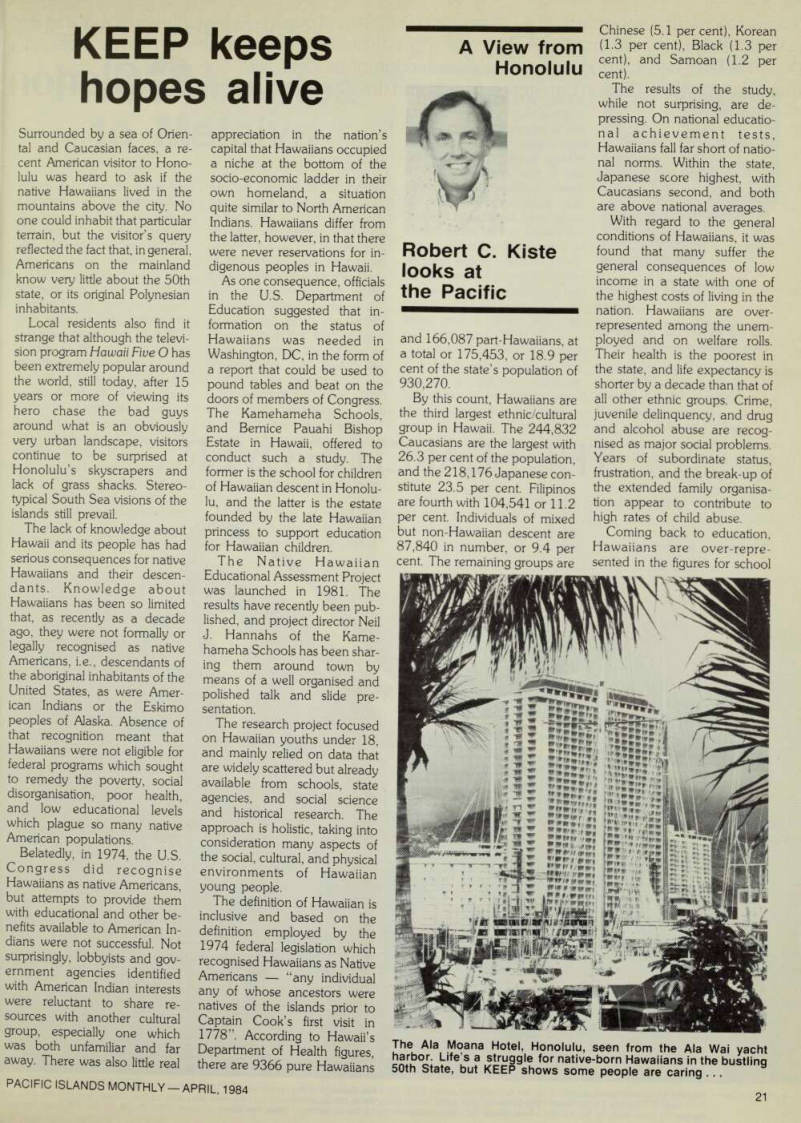

hopes alive
Surrounded by a sea of Orien tal and Caucasian faces, a re cent American visitor to Hono lulu was heard to ask if the native Hawaiians lived in the mountains above the city. No one could inhabit that particular terrain, but the visitor’s query reflected the fact that, in general, Americans on the mainland know very little about the 50th state, or its original Polynesian inhabitants.
Local residents also find it strange that although the televi sion program Hawaii Five O has been extremely popular around the world, still today, after 15 years or more of viewing its hero chase the bad guys around what is an obviously very urban landscape, visitors continue to be surprised at Honolulu’s skyscrapers and lack of grass shacks. Stereo typical South Sea visions of the islands still prevail.
The lack of knowledge about Hawaii and its people has had serious consequences for native Hawaiians and their descen dants. Knowledge about Hawaiians has been so limited that, as recently as a decade ago, they were not formally or legally recognised as native Americans, i.e., descendants of the aboriginal inhabitants of the United States, as were Amer ican Indians or the Eskimo peoples of Alaska. Absence of that recognition meant that Hawaiians were not eligible for federal programs which sought to remedy the poverty, social disorganisation, poor health, and low educational levels which plague so many native American populations.
Belatedly, in 1974, the U.S.
Congress did recognise Hawaiians as native Americans, but attempts to provide them with educational and other be nefits available to American In dians were not successful. Not surprisingly, lobbyists and gov ernment agencies identified with American Indian interests were reluctant to share re sources with another cultural group, especially one which was both unfamiliar and far away. There was also little real
appreciation in the nation’s capital that Hawaiians occupied a niche at the bottom of the socio-economic ladder in their own homeland, a situation quite similar to North American Indians. Hawaiians differ from the latter, however, in that there were never reservations for in digenous peoples in Hawaii.
As one consequence, officials in the U.S. Department of Education suggested that in formation on the status of Hawaiians was needed in Washington, DC, in the form of a report that could be used to pound tables and beat on the doors of members of Congress.
The Kamehameha Schools, and Bernice Pauahi Bishop Estate in Hawaii, offered to conduct such a study. The former is the school for children of Hawaiian descent in Honolu lu, and the latter is the estate founded by the late Hawaiian princess to support education for Hawaiian children.
The Native Hawaiian Educational Assessment Project was launched in 1981. The results have recently been pub lished, and project director Neil J. Hannahs of the Kame hameha Schools has been shar ing them around town by means of a well organised and polished talk and slide pre sentation.
The research project focused on Hawaiian youths under 18, and mainly relied on data that are widely scattered but already available from schools, state agencies, and social science and historical research. The approach is holistic, taking into consideration many aspects of the social, cultural, and physical environments of Hawaiian young people.
The definition of Hawaiian is inclusive and based on the definition employed by the 1974 federal legislation which recognised Hawaiians as Native Americans “any individual any of whose ancestors were natives of the islands prior to Captain Cook’s first visit in 1778”. According to Hawaii’s Department of Health figures, there are 9366 pure Hawaiians
A View from Honolulu
and 166,087 part-Hawaiians, at a total or 175,453, or 18.9 per cent of the state’s population of 930,270.
By this count, Hawaiians are the third largest ethnic/cultural group in Hawaii. The 244,832 Caucasians are the largest with 26.3 per cent of the population, and the 218,176 Japanese constitute 23.5 per cent. Filipinos are fourth with 104,541 or 11.2 per cent. Individuals of mixed but non-Hawaiian descent are 87,840 in number, or 9.4 per cent. The remaining groups are
Chinese (5.1 per cent), Korean (1.3 per cent), Black (1.3 per cent), and Samoan (1.2 per cent).
The results of the study, while not surprising, are de pressing. On national educatio nal achievement tests, Hawaiians fall far short of natio nal norms. Within the state, Japanese score highest, with Caucasians second, and both are above national averages.
With regard to the general conditions of Hawaiians, it was found that many suffer the general consequences of low income in a state with one of the highest costs of living in the nation. Hawaiians are over represented among the unem ployed and on welfare rolls.
Their health is the poorest in the state, and life expectancy is shorter by a decade than that of all other ethnic groups. Crime, juvenile delinquency, and drug and alcohol abuse are recog nised as major social problems.
Years of subordinate status, frustration, and the break-up of the extended family organisa tion appear to contribute to high rates of child abuse.
Coming back to education, Hawaiians are over-repre sented in the figures for school
Robert C. Kiste looks at the Pacific
The Ala Moana Hotel, Honolulu, seen from the Ala Wai yacht harbor. Life's a struggle for native-born Hawaiians in the bustling 50th State, but KEEP shows some people are caring...
drop-outs, absenteeism, and truancy. Many miss as much as one-fourth of each school year, With a history of low academic success, and faced with the over-achieving Japanese and Caucasians, Hawaiians expect to do poorly and the prophecy
becomes self-fulfilling,
Hawaiian children begin school with performances equal to others, but fall behind within the first few years.
In addition to collecting data on the status of Hawaiians today, the study was also to determine if there were any special or alternative educational programs for Native Americans that might raise their achievement levels. A number of programs were surveyed, but none seemed particularly relevant to Hawaiians. Reflecting the general neglect of the welfare of Hawaiians within the State of Hawaii itself, only one such program was identified.
That effort is the Kamehameha Early Education Program, or KEEP, which was laun-
ched in the early 1970 s by Kamehameha Schools. Here we have the potentially awk ward situation of a Kame hameha project being reported upon by a study team from the same institution. However, KEEP has been continually re searched and monitored by professional social scientists since its inception, and there is no reason to doubt the success of the program.
KEEP is described as a “mar riage involving anthropology and educational research”, i.e., anthropologists and educators have teamed up to design, monitor, and continually mod ify the program. The major goal of KEEP has been to create a reading curriculum that raises reading comprehension. It en rols children from kindergarten through the third grade.
The basic proposition behind KEEP is that traditional educational approaches are in compatible with some fun damental aspects of Hawaiian cultural values and behavioral
patterns. The stance that has traditionally been taken by the schools is that children must change their ways of doing things to fit the culture of the school. KEEP reverses this position and attempts to make the school compatible with Hawaiian modes of doing inqs 3 Only a few examples can be given. Hawaiians prefer cooperative group efforts and group achievement to the competitive individualism of Westem society. Hawaiians prefer “learning by doing” to instruction by verbal directions and abstract rules and principles.
Much of growing-up for Hawaiian children occurs in the context of sibling and peergroup relations, rather than the more Western style of adult/ parental direction.
Learning groups in the KEEP effort are small and employ those styles of inter-action and learning that are familiar to and comfortable for Hawaiian children. Teachers and students
both participate in common tasks. Children learn in informal ways, “talk story” as an infor mal communication style is an integral part of the program, and they literally learn to do by doing together.
KEEP students achieve well above national levels in reading comprehension tests, and there is no doubt about its success.
Such achievement for Hawaiian children raises their own self-esteem, and, at the same time, Hawaiians have not had to make more comprom ises and deny their Hawaiian ways.
The program and Kame hameha’s sponsorship of it are surely to be lauded. It is un fortunate, however, that it stands alone as an educational effort that has achieved some compatibility with Hawaiian ways. Considering the overall status of Hawaiians in the state, it would seem that KEEP is only a small beginning of what needs
to be done.
Robert C. Kiste.
Advertisements & other items, p. 22 (1 item)
The Search Is Over
You were looking for the perfect fit. Uncompromising sound quality. As beautiful to look at as it is to listen to. Advanced electronics. A choice of sophisticated features that are easy to use. Reliability that's no fairy tale. Clarion makes a wide selection of models, with one • that's just your size. Clarion Car Stereo. Listen, and drive happily ever after. 1011011
& ◄HI ►► model 900 E sTtBtO I
I ON I
® i
LD APC h IU
m\\ ! < > For further information Australia: Amalgamated Wireless (Australasia) Ltd,, 554 Parramatta Road, Ashfield, N.S.W., 2131 I New Zealand: AWA New Zealand Limited RO. Box 50-248 Suva / Tahiti: HI-FI Shangnla, B.P. 200, Papeete / New Caledonia: Caldis, 8.P.M1, Noumea Cedex / Guam: Micropac Audio Inc P.O, Box 3478, Agana Guam 969 °' U^, A p f 428 Boro o Port Moresby Vanuatu- The Sound Centre PO Box 434, Vila / Cook Islands: South Seas International Ltd., RO. Box 49, Rarotonga / Papua New Guinea: Hagemeyer (P.N.G.) Pty. Ltd., P.O. Box 1428, Boroko. Port Moreshy
to Mataiva

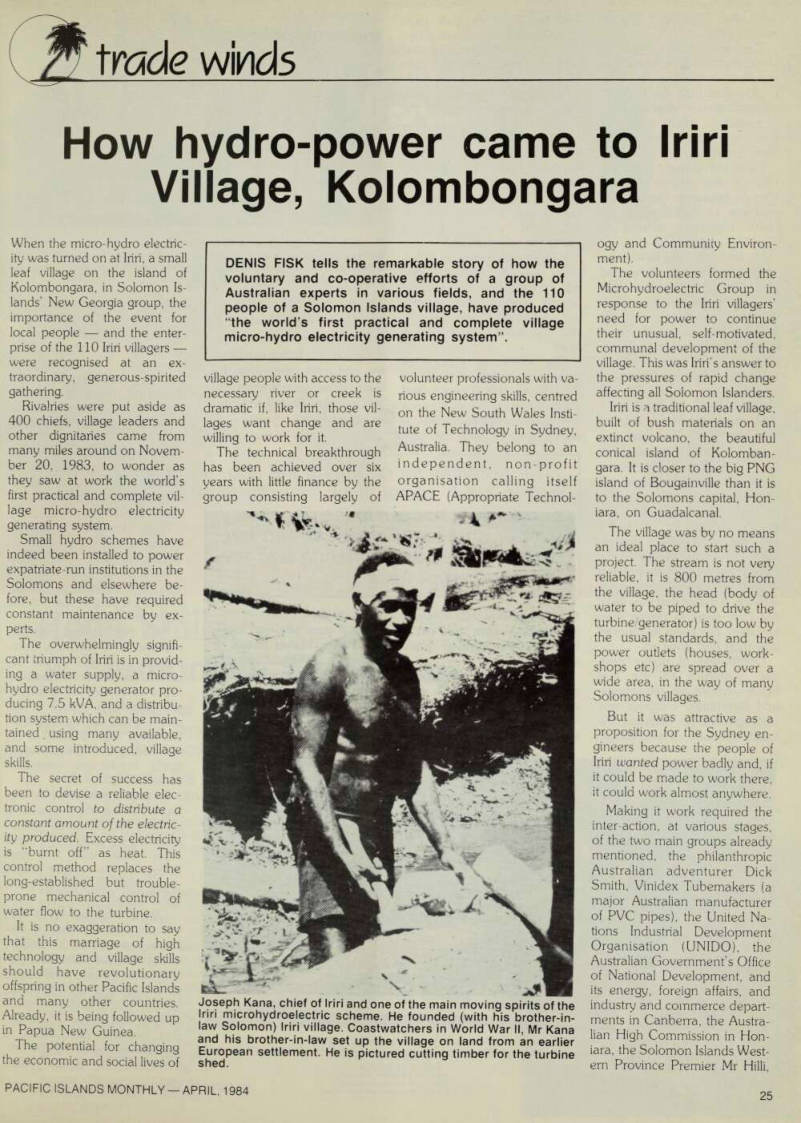
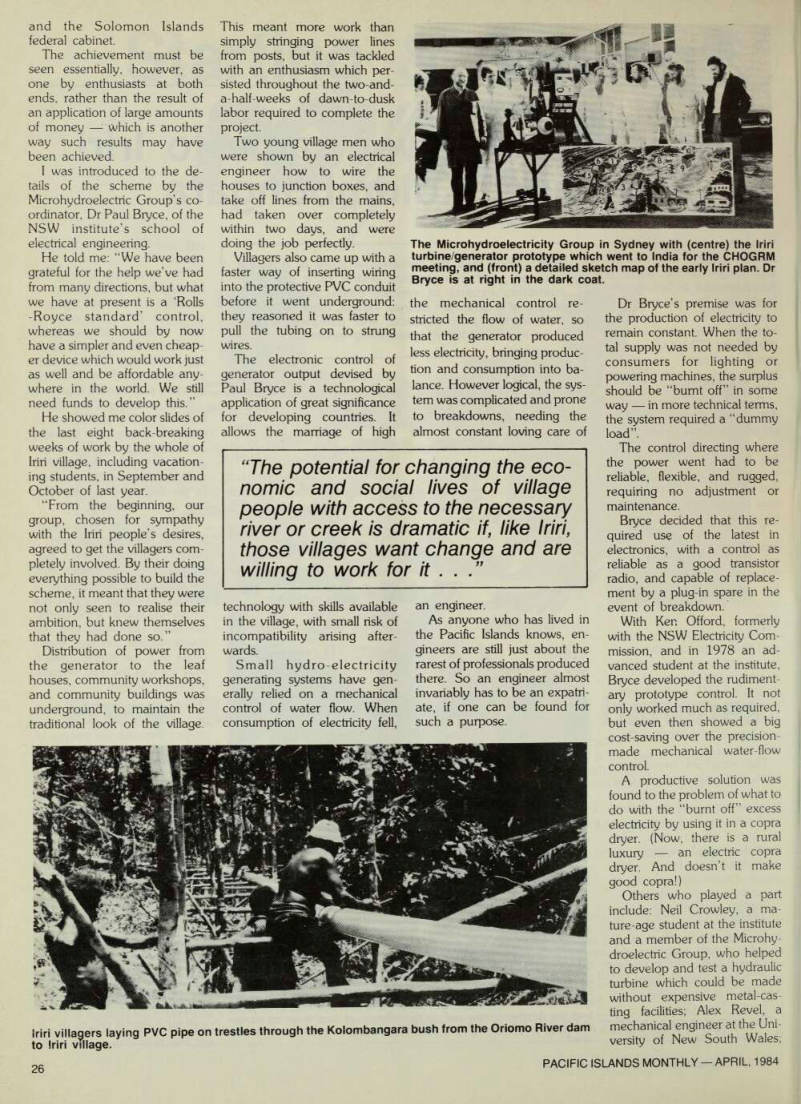
The Lure Of Phosphate
From Makatea to Mataiva
When the French Phosphate Company of Oceania ceased mining activities in French Polynesia in 1966 it seemed like the end of an old-style colonial rip-off operation.
Over a period of more than 50 years this company, a large proportion of whose sharehol ders were actually British, had extracted more than 11 million tonnes of high-grade phosphate imbedded in the dead coral on the top of Makatea atoll in the north-western Tuamotus.
Methods of extraction were of the most primitive, with shovels and wheelbarrows the main implements.
It was not until almost the end of this long period that the local Territorial Assembly ac quired sufficient power to slap a modest 20 per cent export tax on the precious fertilising stuff
for the benefit of its rightful owners, the Polynesian people.
But now a new phosphate mining operation is being undertaken on the nearby atoll of Mataiva and once more the benefits to the hapless islan ders seem ridiculously small, especially when the huge en vironmental risks are consi dered, since the Mataiva de posits are not on the surface, as at Makatea, but under the waters of the lagoon.
Existence of these and other underwater deposits in the Tuamotus has been known of since the turn of the century, but nothing has ever been done about them because of the prohibitive costs of getting them out Nothing, that is, until the mid-1970s when, as a result of prolonged drought and exten
sive crop failures on a world scale the demand for phos phate rose steadily, and the price reached about SUS7O a tonne.
The first person to act on the idea that the submerged Tuamotu deposits might at last be commercially viable was Jean Breaud, a French tycoon who since World War II has been investing heavily in Tahiti in practically everything you can lay a name to. (His great wealth made his son Olivier the victim of the first kidnapping in Tahitian history when, in 1980, he was seized by French gangs ters and brutally murdered be fore the $2 million ransom had been paid (PIM May ’BO pi 7, and June ’BO pl 9).
In July 1976 Breaud formed a Tahiti-based company “for mineral prospection and par ticipation in mining opera tions”. Among the shareholders were a number of his closest business associates, and a French-bom American expert on ocean mining, Andre Ross felder.
Breaud then signed up seve ral very large companies who were willing to put up the big money needed to get the pro-
Postmark Papeete
ject under way. The consortium thus formed comprised the French Societe Pechiney, the Canadian mining giant Comin con, and American Union Oil.
The last two companies each held 24.5 per cent of the shares, while Pechiney held 26 per cent and Breaud’s own small company 25 per cent.
Continued on page 55
Marie-Thérèse and Bengt Danielsson
from page 23
The arrangement thus met offi cial requirements that majority shareholders must be French.
The registered name of the company spelled out its prog ram; Raro Moana, or “Under the Sea”.
By 1978 a team headed by Rossfelder had surveyed the whole Tuamotu archipelago and taken hundreds of core samples from the bottom of 30 atolls. Analyses carried out con currently in French and Amer ican laboratories over the next two years showed that there were indeed important deposits of high-grade phosphate under the shallow lagoons of three atolls Pukapuka, Mataiva, and Niau. Pukapuka was deemed too distant and iso lated, so it was decided to undertake more thorough in vestigations of Mataiva and Niau to determine the precise extent and volume of their deposits.
Like all promoters Breaud and company were at pains to spread the idea that the revival of phosphate mining would usher in an era of general prosperity. The bait was eagerly taken by the new Autonomist majority led by Vice-President Francis Sanford, who was faced with a steadily worsening eco nomic situation and rising un employment. Every new inves tor was given a warm welcome, without too many questions asked.
The only people not jumping for joy were the 174 inhabitants of Mataiva, and the 152 who lived on Niau. They protested that the prospecting, and even more the actual mining, would pollute the lagoon and kill the fish on which they depended for their livelihood.
When told of the fabulous wealth coming their way, they replied that the money they made by producing 500 tonnes of copra a year was sufficient for their needs. And the lagoon was theirs. So, please, keep out.
But, unfortunately for them, French law does not recognise individual or communal owner ship of lagoons in the territory.
So the Raro Moana people could go ahead unhindered in 1979-80 making 400 test pits in the lagoon of Mataiva, which they had chosen as their first
target, its phosphate being of a better quality than that of Niau.
Sure enough, the disturbed environment reacted in the most unpleasant manner by poisoning the fish, which, when eaten by the islanders produced the typical ciguatera symptoms of paralysis, vomiting, joint pains, respiratory disorders, and so on.
To combat the ensuing animosity and criticism the Raro Moana people in April 1981 offered to pay for an environmental impact study. It was carried out by French army doctors from the Moruroa nuc lear testing site, and, to no body’s surprise, they found no cause for alarm at Mataiva.
The consortium might just as well have saved its money, for by now it was quite clear that the Mataiva project had the full backing of the French Govern ment one of Jean Breaud’s great strengths is his extensive network of political and busi ness contacts in Paris where all important decisions affecting French Polynesia are still made.
The fact that the project was indeed destined to go ahead was signalled when parts of a giant dredge began to arrive for assembly at Mataiva even be fore the “environmental impact study” had been completed.
With the monster dredge assembled, the local people were told that it would be scraping off the “useless” seven metres of sand which overlay the estimated 20 million tonnes of phosphate under the lagoon.
Where would they be putting the sand? Back into the big hole there will be in the bottom of the lagoon after the phosphate is taken out.
This revelation made the Mataiva people, if possible, even more opposed to the mining plans, and, in a dramatic turn-about, Vice-President San ford assured them that nothing
would be done against their will.
But it was too late. Two months later Sanford was swept from office by the most pro- French and pro-business of all the local leaders, Gaston Flos se. The Raro Moana technicians were thus able to carry out their next step undisturbed: they ex tracted 900 tonnes of phos phate from Mataiva which was to be subjected to industrial trial treatment in US plants.
Then nature itself took a hand: between December 1982 and April 1983 six cyclones came literally out of the blue to revage French Polynesia, and the last two passed directly over Mataiva, destroying all houses and coconut plantations.
Those who stayed behind, resisting the temptation to flee to Tahiti, benefited from the emergency aid in food, building materials and money quickly provided by the local govem
ment. It also occurred to them (after some prompting from Raro Moana officials) that a new prosperity might be just around the corner if they changed their minds and went to work for the phosphate consortium.
Raro Moana quickly pro duced a splendid blueprint for a huge mining complex, to be operational by 1986. It would be extracting a million tonnes of phosphate a year, mainly for export to Japan and New Zea land. It would comprise wharves, living quarters for at least 300 workers and their families, and a rinsing plant.
As for the financial benefits to the territory, Raro Moana offi cials have tried hard to make us believe that their offer of CFPIOOO million a year paid to the government is a generous one. But considering that they will be taking out a million tonnes a year, this corresponds only to CFPIOOO (SUS 6) a tonne, which, expressed as a percentage of total value, is even less than the old Makatea company paid.
It’s being suggested here that local politicians should visit Nauru and leam from crafty President Hammer Deßoburt how to handle these problems.
But people who have this idea forget one thing: Nauruans nev er got a fair deal on their phosphate until their island be
came independent.
Marie-
Thérèse and Bengt Danielsson.
One of the phosphate prospecting sites in Mataiva.
Advertisements & other items, p. 24 (1 item)
power
Starting & Staying
m m.
AMP
Xlar nvß‘i '>3
MARINE
sow
Amor
C 253 •>««ass \ as&
Power Boats Need Different Batteries
There is a big difference between a car battery and a marine battery.
A car battery, for example, is never really discharged, as it is only used for a few seconds each day a nd promptly re-charged. Not so your cruiser or sportsfisherman.
Starting the engine is only the beginning. During the day, weekend or cruise, how often will you run the live bait tank, the depth sounder, the nav. lights or maintain a listening watch on your radio transceiver?
As well as cranking power, boats need staying power. Boats need Besco's Marine Batteries, deep cycle, heavy duty marine batteries.
If your boat is getting a little flat in the electrics department, write or phone BESCO today and ask for more information, more facts about
BESCO MARINE BATTERIES.
Papua New Guinea: Lae, Automarine Industries, P.O. Box 785, Ph. 42-1125, Rabaul, Automarine Industries, P.O. Box 248, Ph. 92-2574; Port Moresby, Par Sales P.o.Boxt 1680.
Boroko Ph 25-6266. Fiji: Suva, Fiji Bandag, 23 Sinoma Street, Walu Bay, Ph. 31-1200. New Caledonia: Noumea, Andre Thuilier, BP 889, Ph. 27-4906. Solomon Islands: Honiara, Guadalcanal Electrics Ltd. P.O. Box 521. Hongkong: Kowloon, T. L. Knight &Co P_o. Box 95585 IST, Ph. 366-5341. New Zealand: Auckland, Battery Services (Ind.) Dd., P.O. Box 27f 375 Ph. 69-4111; Wellington, Gould Batteries, 58 Hautana Street, Lower Hutt, TLX NZ3714 1 Australia: Sydney, Besco Batteries, P.O. Box 1, Villawood, Ph. 632-0251, TLX 21886; Jarwil International Pty. Ltd., 410 Kent Street, Sydney, Ph. 264-3477, TLX 72102.
BESCO
Batteries Division Of Sims Products Pty. Ltd.
A Peko Wall send Group Member
Teaders In battery technology
Village, Kolombongara
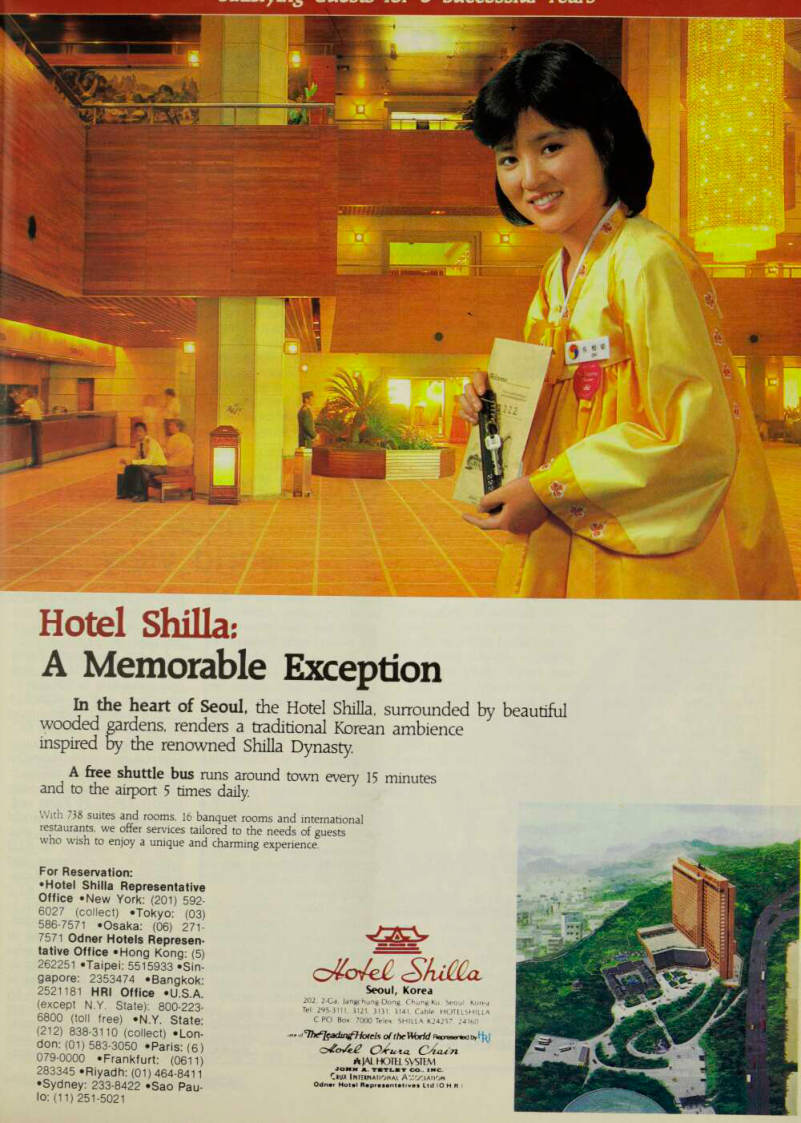
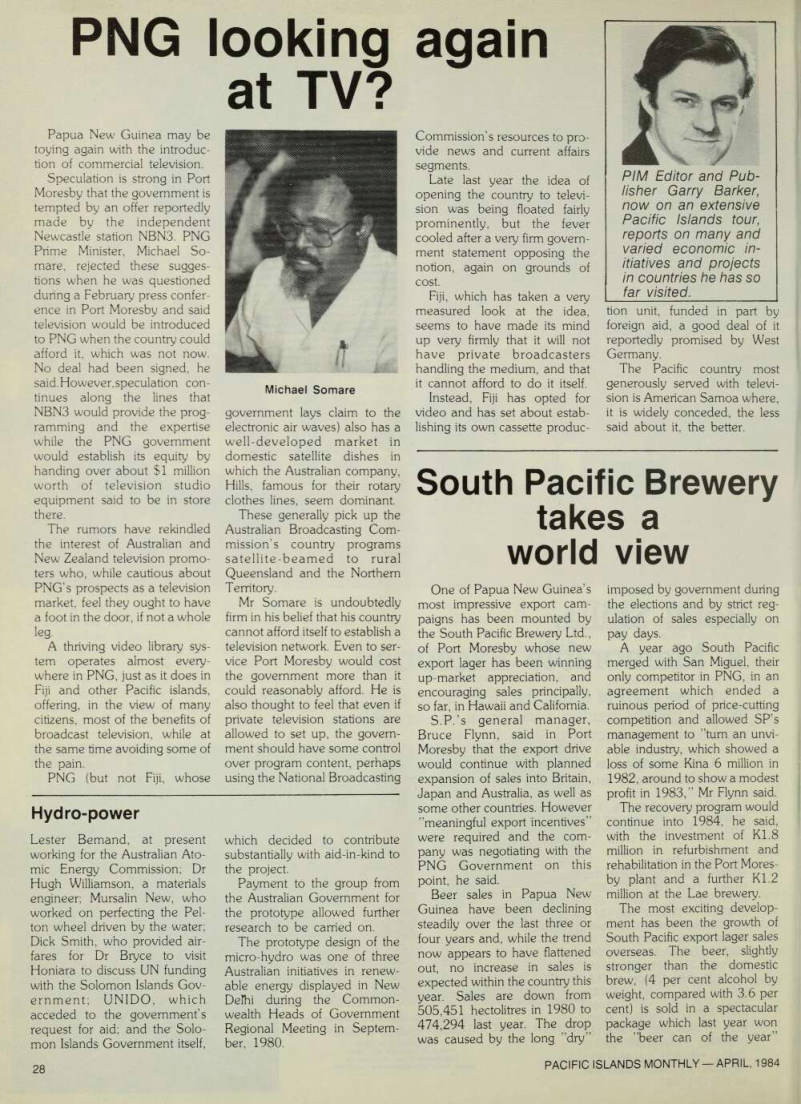
trade winds
How hydro-power came to Iriri Village, Kolombongara
DENIS FISK tells the remarkable story of how the voluntary and co-operative efforts of a group of Australian experts in various fields, and the 110 people of a Solomon Islands village, have produced “the world’s first practical and complete village micro-hydro electricity generating system ”.
When the micro-hydro electric ity was turned on at Iriri. a small leaf village on the island of Kolombongara, in Solomon Is lands’ New Georgia group, the importance of the event for local people and the enter prise of the 110 Iriri villagers were recognised at an ex traordinary, generous-spirited gathering.
Rivalries were put aside as 400 chiefs, village leaders and other dignitaries came from many miles around on Novem ber 20, 1983, to wonder as they saw at work the world’s first practical and complete vil lage micro-hydro electricity generating system.
Small hydro schemes have indeed been installed to power expatriate-run institutions in the Solomons and elsewhere be fore, but these have required constant maintenance by ex perts.
The overwhelmingly signifi cant triumph of Iriri is in provid ing a water supply, a micro hydro electricity generator pro ducing 7.5 kVA, and a distribu tion system which can be main tained . using many available, and some introduced, village skills.
The secret of success has been to devise a reliable elec tronic control to distribute a constant amount of the electric ity produced. Excess electricity is “burnt off” as heat. This control method replaces the long-established but trouble prone mechanical control of water flow to the turbine.
It is no exaggeration to say that this marriage of high technology and village skills should have revolutionary offspring in other Pacific Islands and many other countries.
Already, it is being followed up in Papua New Guinea.
The potential for changing the economic and social lives of
village people with access to the necessary river or creek is dramatic if, like Iriri, those vil lages want change and are willing to work for it.
The technical breakthrough has been achieved over six years with little finance by the group consisting largely of
volunteer professionals with va rious engineering skills, centred on the New South Wales Insti tute of Technology in Sydney, Australia. They belong to an independent, non-profit organisation calling itself APACE (Appropriate Technol-
ogy and Community Environ ment).
The volunteers formed the Microhydroelectric Group in response to the Iriri villagers’ need for power to continue their unusual, self-motivated, communal development of the village. This was Iriri’s answer to the pressures of rapid change affecting all Solomon Islanders.
Iriri is a traditional leaf village, built of bush materials on an extinct volcano, the beautiful conical island of Kolomban gara. It is closer to the big PNG island of Bougainville than it is to the Solomons capital, Hon iara, on Guadalcanal.
The village was by no means an ideal place to start such a project. The stream is not very reliable, it is 800 metres from the village, the head (body of water to be piped to drive the turbine/generator) is too low by the usual standards, and the power outlets (houses, work shops etc) are spread over a wide area, in the way of many Solomons villages.
But it was attractive as a proposition for the Sydney en gineers because the people of Iriri wanted power badly and, if it could be made to work there, it could work almost anywhere.
Making it work required the inter-action, at various stages, of the two main groups already mentioned, the philanthropic Australian adventurer Dick Smith, Vinidex Tubemakers (a major Australian manufacturer of PVC pipes), the United Na tions Industrial Development Organisation (UNIDO), the Australian Government’s Office of National Development, and its energy, foreign affairs, and industry and commerce depart ments in Canberra, the Austra lian High Commission in Hon iara, the Solomon Islands West ern Province Premier Mr Hilli,
Joseph Kana, chief of Iriri and one of the main moving spirits of the Iriri microhydroelectric scheme. He founded (with his brother-in law Solomon) Iriri village. Coastwatchers in World War II, Mr Kana and his brother-in-law set up the village on land from an earlier European settlement. He is pictured cutting timber for the turbine shed.
and the Solomon Islands federal cabinet.
The achievement must be seen essentially, however, as one by enthusiasts at both ends, rather than the result of an application of large amounts of money which is another way such results may have been achieved.
I was introduced to the de tails of the scheme by the Microhydroelectric Group’s co ordinator, Dr Paul Bryce, of the NSW institute’s school of electrical engineering.
He told me: “We have been grateful for the help we’ve had from many directions, but what we have at present is a ‘Rolls -Royce standard’ control, whereas we should by now have a simpler and even cheap er device which would work just as well and be affordable any where in the world. We still need funds to develop this.”
He showed me color slides of the last eight back-breaking weeks of work by the whole of Iriri village, including vacation ing students, in September and October of last year.
“From the beginning, our group, chosen for sympathy with the Iriri people’s desires, agreed to get the villagers com pletely involved. By their doing everything possible to build the scheme, it meant that they were not only seen to realise their ambition, but knew themselves that they had done so.”
Distribution of power from the generator to the leaf houses, community workshops, and community buildings was underground, to maintain the traditional look of the village.
This meant more work than simply stringing power lines from posts, but it was tackled with an enthusiasm which per sisted throughout the two-and a-half-weeks of dawn-to-dusk labor required to complete the project.
Two young village men who were shown by an electrical engineer how to wire the houses to junction boxes, and take off lines from the mains, had taken over completely within two days, and were doing the job perfectly.
Villagers also came up with a faster way of inserting wiring into the protective PVC conduit before it went underground: they reasoned it was faster to pull the tubing on to strung wires.
The electronic control of generator output devised by Paul Bryce is a technological application of great significance for developing countries. It allows the marriage of high
“The potential for changing the eco nomic and social lives of village people with access to the necessary river or creek is dramatic if, like Iriri, those villages want change and are willing to work for it ...”
technology with skills available in the village, with small risk of incompatibility arising after wards.
Small hydro-electricity generating systems have gen erally relied on a mechanical control of water flow. When consumption of electricity fell,
the mechanical control re stricted the flow of water, so that the generator produced less electricity, bringing produc tion and consumption into ba lance. However logical, the sys tem was complicated and prone to breakdowns, needing the almost constant loving care of
an engineer.
As anyone who has lived in the Pacific Islands knows, en gineers are still just about the rarest of professionals produced there. So an engineer almost invariably has to be an expatri ate, if one can be found for such a purpose.
Dr Bryce’s premise was for the production of electricity to remain constant. When the to tal supply was not needed by consumers for lighting or powering machines, the surplus should be “burnt off” in some way in more technical terms, the system required a “dummy load”.
The control directing where the power went had to be reliable, flexible, and rugged, requiring no adjustment or maintenance.
Bryce decided that this re quired use of the latest in electronics, with a control as reliable as a good transistor radio, and capable of replace ment by a plug-in spare in the event of breakdown.
With Ken Offord, formerly with the NSW Electricity Com mission, and in 1978 an ad vanced student at the institute, Bryce developed the rudiment ary prototype control. It not only worked much as required, but even then showed a big cost-saving over the precision made mechanical water-flow control.
A productive solution was found to the problem of what to do with the “burnt off” excess electricity by using it in a copra dryer. (Now, there is a rural luxury an electric copra dryer. And doesn’t it make good copra!) Others who played a part include: Neil Crowley, a ma ture-age student at the institute and a member of the Microhy droelectric Group, who helped to develop and test a hydraulic turbine which could be made without expensive metal-cas ting facilities; Alex Revel, a mechanical engineer at the Uni versity of New South Wales;
Iriri villagers laying PVC pipe on trestles through the Kolombangara bush from the Oriomo River dam to Iriri village.
The Microhydroelectricity Group in Sydney with (centre) the Iriri turbine/generator prototype which went to India for the CHOGRM meeting, and (front) a detailed sketch map of the early Iriri plan. Dr Bryce is at right in the dark coat.
Lester Bemand, at present working for the Australian Ato mic Energy Commission; Dr Hugh Williamson, a materials engineer; Mursalin New, who worked on perfecting the Pel ton wheel driven by the water; Dick Smith, who provided air fares for Dr Bryce to visit Honiara to discuss UN funding with the Solomon Islands Gov ernment; UNIDO, which acceded to the government’s request for aid; and the Solo mon Islands Government itself,
which decided to contribute substantially with aid-in-kind to the project.
Payment to the group from the Australian Government for the prototype allowed further research to be carried on.
The prototype design of the micro-hydro was one of three Australian initiatives in renew able energy displayed in New Delhi during the Common wealth Heads of Government Regional Meeting in Septem ber, 1980.
Advertisements & other items, p. 27 (1 item)
Hotel Shilla;
n % * U A ft, ‘ -rv d g 1 ■ K
A Memorable Exception
bi the heart of Seoul, the Hotel Shilla, surrounded by beautiful wooded gardens, renders a traditional Korean ambience
inspired by the renowned Shilla Dynasty.
A free shuttle bus runs around town every 15 minutes and to the airport 5 times daily.
With 738 suites and rooms, 16 banquet rooms and international restaurants, we offer services tailored to the needs of guests who wish to enjoy a unique and charming experience.
For Reservation: •Hotel Shilla Representative Office -New York: (201) 592- 6027 (collect) •Tokyo: (03) 586-7571 -Osaka: (06) 271- 7571 Odner Hotels Representative Office -Hong Kong: (5) 262251 -Taipei: 5515933 -Singapore: 2353474 -Bangkok - -2521181 HRI Office -U.S.A. (except N.Y. State): 800-223- 6800 (toll free) -N.Y. State: (212) 838-3110 (collect) -London: (01) 583-3050 -Paris: (6) 079-0000 -Frankfurt: (0611) 283345 -Riyadh: (01) 464-8411 •Sydney: 233-8422 -Sao Paulo: (11) 251-5021 Seoul, Korea 202, 2-Ca, jangchung-Dong, Chung-Ku, Seoul. Korea Tel: 295-3111, 3121, 3131, 3141, Cable HOTELSHILLA C.PO Box: 7000 Telex SHILLA K 24257, 24160 of (hcWorid Represented O^ov^i 7 OAIdXL CAtUn
A [At HOTEL SYSTEM
j O"H ». TITLIT CO.. INC.
Crux International Association Odner Hotel Representatives Ltd (OMR) . »
PNG looking again
at TV?
Papua New Guinea may be toying again with the introduc tion of commercial television.
Speculation is strong in Port Moresby that the government is tempted by an offer reportedly made by the independent Newcastle station NBN3. PNG Prime Minister, Michael So mare. rejected these sugges tions when he was questioned during a February press confer ence in Port Moresby and said television would be introduced to PNG when the country could afford it, which was not now.
No deal had been signed, he said. However,speculation con tinues along the lines that NBN3 would provide the prog ramming and the expertise while the PNG government would establish its equity by handing over about $1 million worth of television studio equipment said to be in store there.
The rumors have rekindled the interest of Australian and New Zealand television promo ters who, while cautious about PNG’s prospects as a television market, feel they ought to have a foot in the door, if not a whole leg.
A thriving video library sys tem operates almost every where in PNG, just as it does in Fiji and other Pacific islands, offering, in the view of many citizens, most of the benefits of broadcast television, while at the same time avoiding some of the pain.
PNG (but not Fiji, whose
government lays claim to the electronic air waves) also has a well-developed market in domestic satellite dishes in which the Australian company, Hills, famous for their rotary clothes lines, seem dominant.
These generally pick up the Australian Broadcasting Com mission’s country programs satellite-beamed to rural Queensland and the Northern Territory.
Mr Somare is undoubtedly firm in his belief that his country cannot afford itself to establish a television network. Even to ser vice Port Moresby would cost the government more than it could reasonably afford. He is also thought to feel that even if private television stations are allowed to set up, the govern ment should have some control over program content, perhaps using the National Broadcasting
Commission’s resources to pro vide news and current affairs segments.
Late last year the idea of opening the country to televi sion was being floated fairly prominently, but the fever cooled after a very firm govern ment statement opposing the notion, again on grounds of cost.
Fiji, which has taken a very measured look at the idea, seems to have made its mind up very firmly that it will not have private broadcasters handling the medium, and that it cannot afford to do it itself.
Instead, Fiji has opted for video and has set about estab lishing its own cassette produc-
tion unit, funded in part by foreign aid, a good deal of it reportedly promised by West Germany.
The Pacific country most generously served with televi sion is American Samoa where, it is widely conceded, the less said about it, the better.
Michael Somare
PIM Editor and Pub lisher Garry Barker, now on an extensive Pacific Islands tour, reports on many and varied economic in itiatives and projects in countries he has so far visited.
South Pacific Brewery
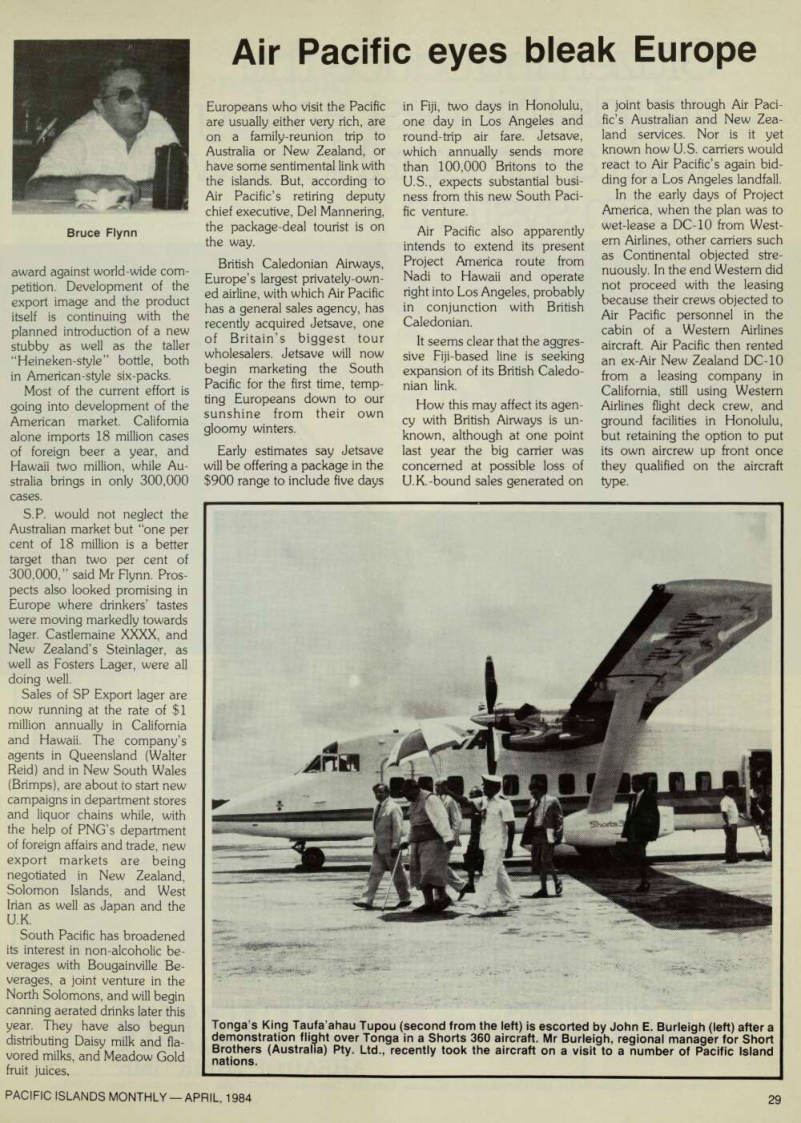
takes a world view
One of Papua New Guinea’s most impressive export cam paigns has been mounted by the South Pacific Brewery Ltd., of Port Moresby whose new export lager has been winning up-market appreciation, and encouraging sales principally, so far, in Hawaii and California.
S.P.’s general manager, Bruce Flynn, said in Port Moresby that the export drive would continue with planned expansion of sales into Britain, Japan and Australia, as well as some other countries. However ’’meaningful export incentives” were required and the com pany was negotiating with the PNG Government on this point, he said.
Beer sales in Papua New Guinea have been declining steadily over the last three or four years and, while the trend now appears to have flattened out, no increase in sales is expected within the country this year. Sales are down from 505,451 hectolitres in 1980 to 474,294 last year. The drop was caused by the long ’’dry”
imposed by government during the elections and by strict reg ulation of sales especially on pay days.
A year ago South Pacific merged with San Miguel, their only competitor in PNG, in an agreement which ended a ruinous period of price-cutting competition and allowed SP’s management to ’’turn an unvi able industry, which showed a loss of some Kina 6 million in 1982, around to show a modest profit in 1983," Mr Flynn said.
The recovery program would continue into 1984, he said, with the investment of Kl.B million in refurbishment and rehabilitation in the Port Mores by plant and a further K 1.2 million at the Lae brewery.
The most exciting develop ment has been the growth of South Pacific export lager sales overseas. The beer, slightly stronger than the domestic brew, (4 per cent alcohol by weight, compared with 3.6 per cent) is sold in a spectacular package which last year won the ’’beer can of the year”
award against world-wide com petition. Development of the export image and the product itself is continuing with the planned introduction of a new stubby as well as the taller “Heineken-style” bottle, both in American-style six-packs.
Most of the current effort is going into development of the American market. California alone imports 18 million cases of foreign beer a year, and Hawaii two million, while Au stralia brings in only 300,000 cases.
S.P. would not neglect the Australian market but “one per cent of 18 million is a better target than two per cent of 300,000,” said Mr Flynn. Pros pects also looked promising in Europe where drinkers’ tastes were moving markedly towards lager. Castlemaine XXXX, and New Zealand’s Steinlager, as well as Fosters Lager, were all doing well.
Sales of SP Export lager are now running at the rate of $1 million annually in California and Hawaii. The company’s agents in Queensland (Walter Reid) and in New South Wales (Brimps), are about to start new campaigns in department stores and liquor chains while, with the help of PNG’s department of foreign affairs and trade, new export markets are being negotiated in New Zealand, Solomon Islands, and West Irian as well as Japan and the U.K.
South Pacific has broadened its interest in non-alcoholic be verages with Bougainville Be verages, a joint venture in the North Solomons, and will begin canning aerated drinks later this year. They have also begun distributing Daisy milk and fla vored milks, and Meadow Gold fruit juices.
Bruce Flynn
Air Pacific eyes bleak Europe
Europeans who visit the Pacific are usually either very rich, are on a family-reunion trip to Australia or New Zealand, or have some sentimental link with the islands. But, according to Air Pacific’s retiring deputy chief executive, Del Mannering, the package-deal tourist is on the way.
British Caledonian Airways, Europe’s largest privately-own ed airline, with which Air Pacific has a general sales agency, has recently acquired Jetsave, one of Britain’s biggest tour wholesalers. Jetsave will now begin marketing the South Pacific for the first time, temp ting Europeans down to our sunshine from their own gloomy winters.
Early estimates say Jetsave will be offering a package in the $9OO range to include five days
in Fiji, two days in Honolulu, one day in Los Angeles and round-trip air fare. Jetsave, which annually sends more than 100,000 Britons to the U.S., expects substantial busi ness from this new South Paci fic venture.
Air Pacific also apparently intends to extend its present Project America route from Nadi to Hawaii and operate right into Los Angeles, probably in conjunction with British Caledonian.
It seems clear that the aggres sive Fiji-based line is seeking expansion of its British Caledo nian link.
How this may affect its agen cy with British Airways is un known, although at one point last year the big carrier was concerned at possible loss of U.K.-bound sales generated on
a joint basis through Air Paci fic’s Australian and New Zea land services. Nor is it yet known how U.S. carriers would react to Air Pacific’s again bid ding for a Los Angeles landfall.
In the early days of Project America, when the plan was to wet-lease a DC-10 from West ern Airlines, other carriers such as Continental objected stre nuously. In the end Western did not proceed with the leasing because their crews objected to Air Pacific personnel in the cabin of a Western Airlines aircraft. Air Pacific then rented an ex-Air New Zealand DC-10 from a leasing company in California, still using Western Airlines flight deck crew, and ground facilities in Honolulu, but retaining the option to put its own aircrew up front once they qualified on the aircraft type.
Tonga's King Taufa’ahau Tupou (second from the left) is escorted by John E. Burleigh (left) after a demonstration flight over Tonga in a Shorts 360 aircraft. Mr Burleigh, regional manager for Short Brothers (Australia) Pty. Ltd., recently took the aircraft on a visit to a number of Pacific Island nations.
Advertisements & other items, p. 30 (1 item)
Citizen
introduce the
worlds thinnest analog alarm
with a remarkable new
alarm system
9 iC
i~iO
TJ
TIME
Pull the crown out two notches and set as you would any watch
ALARM
Pull the crown out one notch Hands automatically move to the last alarm setting, and a Chime tells you that the alarm is ready to be reset.
W ET
Pushing the crown back in automatically returns the hands to the correct time with another beep to tell you that ordinary operation has resumed ON/OFF alarm button Pull to set, push to stop.
The Citizen Quartz Analog Alarm Watch, the World’s slimmest and
smallest Analog Alarm.
Its alarm is music. A soft harmonious melody that perfectly matches the slim and tasteful design of this timepiece.
There is no alarm-setting pointer. The hour and minute hands are used for alarm setting. Citizen Quartz technology makes the Analog Alarm
accurate to within seconds per month.
CITIZEN QUARTZ (ft
IANALOG-ALARMIIIIIIIII
CITIZEN
AHEAD OF THEIR TIME
Citizen Watches Australia Pty Ltd. 122 Old Pittwater Rd, Brookvale. NSW 2100, Telephone: 9397077. Cable: Citizen Sydney. Telex. AA26633
Optimism on New Ireland gold
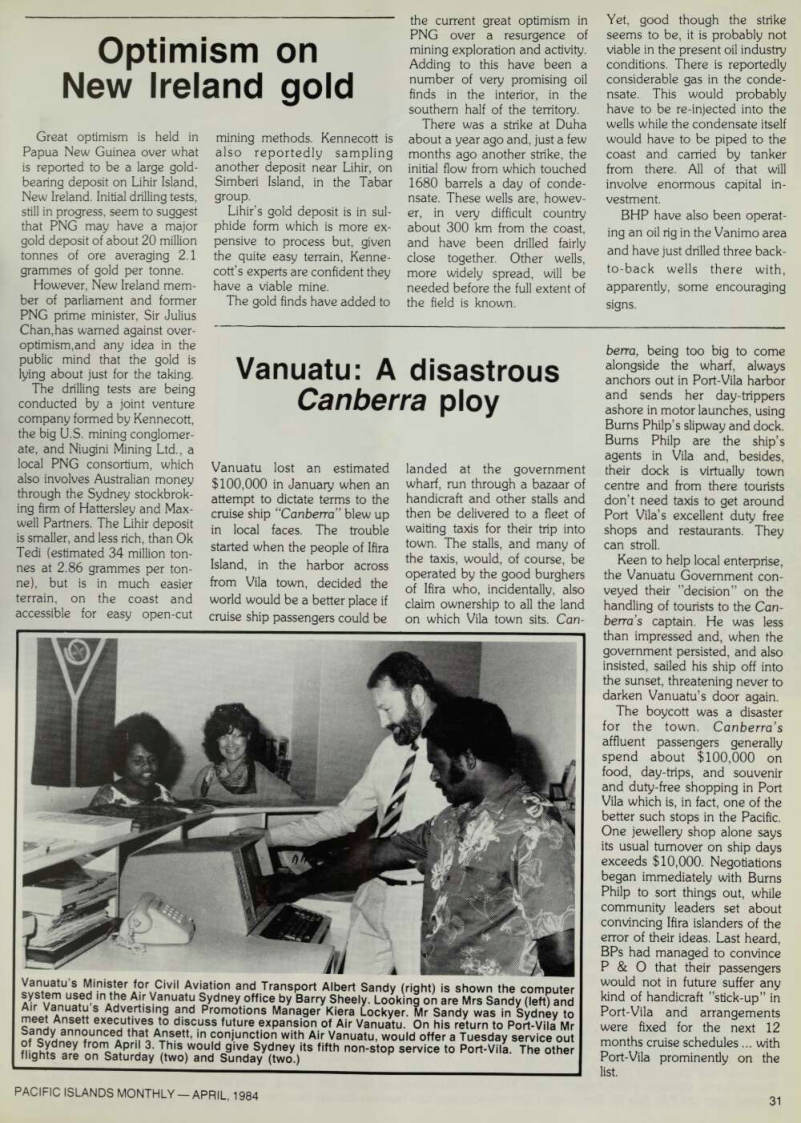
New Ireland gold
Great optimism is held in Papua New Guinea over what is reported to be a large gold bearing deposit on Lihir Island, New Ireland. Initial drilling tests, still in progress, seem to suggest that PNG may have a major gold deposit of about 20 million tonnes of ore averaging 2.1 grammes of gold per tonne.
However, New Ireland mem ber of parliament and former PNG prime minister, Sir Julius Chan, has warned against over optimism,and any idea in the public mind that the gold is lying about just for the taking.
The drilling tests are being conducted by a joint venture company formed by Kennecott, the big U.S. mining conglomer ate, and Niugini Mining Ltd., a local PNG consortium, which also involves Australian money through the Sydney stockbrok ing firm of Hattersley and Max well Partners. The Lihir deposit is smaller, and less rich, than Ok Tedi (estimated 34 million ton nes at 2.86 grammes per ton ne), but is in much easier terrain, on the coast and accessible for easy open-cut
mining methods. Kennecott is also reportedly sampling another deposit near Lihir, on Simberi Island, in the Tabar group.
Lihir’s gold deposit is in sul phide form which is more ex pensive to process but, given the quite easy terrain, Kenne cott’s experts are confident they have a viable mine, The gold finds have added to
the current great optimism in PNG over a resurgence of mining exploration and activity.
Adding to this have been a number of very promising oil finds in the interior, in the southern half of the territory.
There was a strike at Duha about a year ago and, just a few months ago another strike, the initial flow from which touched 1680 barrels a day of conde nsate. These wells are, howev er, in very difficult country about 300 km from the coast, and have been drilled fairly close together. Other wells, more widely spread, will be needed before the full extent of the field is known.
Yet, good though the strike seems to be, it is probably not viable in the present oil industry conditions. There is reportedly considerable gas in the conde nsate. This would probably have to be re-injected into the wells while the condensate itself would have to be piped to the coast and carried by tanker from there. All of that will involve enormous capital in vestment.
BHP have also been operat ing an oil rig in the Vanimo area and have just drilled three back to-back wells there with, apparently, some encouraging signs.
Canberra ploy
Vanuatu: A disastrous Canberra ploy
Vanuatu lost an estimated $lOO,OOO in January when an attempt to dictate terms to the cruise ship “Canberra” blew up in local faces. The trouble started when the people of Ifira Island, in the harbor across from Vila town, decided the world would be a better place if cruise ship passengers could be
landed at the government wharf, run through a bazaar of handicraft and other stalls and then be delivered to a fleet of waiting taxis for their trip into town. The stalls, and many of the taxis, would, of course, be operated by the good burghers of Ifira who, incidentally, also claim ownership to all the land on which Vila town sits. Can-
berra, being too big to come alongside the wharf, always anchors out in Fort-Vila harbor and sends her day-trippers ashore in motor launches, using Burns Philp’s slipway and dock.
Bums Philp are the ship’s agents in Vila and, besides, their dock is virtually town centre and from there tourists don’t need taxis to get around Port Vila’s excellent duty free shops and restaurants. They can stroll.
Keen to help local enterprise, the Vanuatu Government con veyed their ’’decision” on the handling of tourists to the Can berra’s captain. He was less than impressed and, when the government persisted, and also insisted, sailed his ship off into the sunset, threatening never to darken Vanuatu’s door again.
The boycott was a disaster for the town. Canberra’s affluent passengers generally spend about $lOO,OOO on food, day-trips, and souvenir and duty-free shopping in Port Vila which is, in fact, one of the better such stops in the Pacific.
One jewellery shop alone says its usual turnover on ship days exceeds $lO,OOO. Negotiations began immediately with Burns Philp to sort things out, while community leaders set about convincing Ifira islanders of the error of their ideas. Last heard, BPs had managed to convince P & O that their passengers would not in future suffer any kind of handicraft ”stick-up” in Port-Vila and arrangements were fixed for the next 12 months cruise schedules... with Port-Vila prominently on the list.
Vanuatu's Minister for Civil Aviation and Transport Albert Sandy (right) is shown the computer system used in the Air Vanuatu Sydney office by Barry Sheely. Looking on are Mrs Sandy (left) and Air vanuatu's Advertising and Promotions Manager Kiera Lockyer. Mr Sandy was in Sydney to meet Ansett executives to discuss future expansion of Air Vanuatu. On his return to Port-Vila Mr Sandy announced that Ansett, in con junction with Air Vanuatu, would offer a Tuesday service out of Sydney from April 3. This would give Sydney its fifth non-stop service to Port-Vila. The other flights are on Saturday (two) and Sunday (two.)
Advertisements & other items, p. 32 (1 item)
Aiwa
The Million Dollar Look in Stylish Sound This year’s top-of-the-line AIWA system is designed to stay in style next year, and the year after too. With high-power component separates designed to be “Digital ready”.
In fact, with such features as a dedicated CD function selector and Dolby HX Professional* equipped auto-reverse cassette deck, the V-1100 is an 85 watt-per-channel system ready to deliver better performance from any music source—digital or analog.
Want to put your records onto tape? AIWA makes it easier than you ever believed. A microprocessorcontrolled “Auto Editing” facility lets you dub automatically from the programmable turntable to the cassette deck, even in random track order.
V-1100—Sophisticated separates with totally automated integration. It’s AlWA’s new concept in audio that sets the trend for sound in the 80s! •Dolby and the double-D symbol are trademarks of Dolby Laboratories Licensing Corporation, *HX PROFESSIONAL ORIGINATED BY BANG & OLUFSEN
AIWA
IWA Australia Pty., Ltd 14 Gertrude St., Arnolitfe, N.S.W. Australia 2205 AUSTRALIA PHONE; (597) 2388/Oceania Inden'AgencyjP-N-Q.) ty„ Ltd Ago St., Gordon Box 5518, Boroko, Papua New Guinea PHONE; 2564117786 Sound Centre Ltd p O-_ B o x 4M Port Vila, Vanua HONE; 2035/P. Hargovind Bros 190 Renwick Road P.O. Box 490 Suva Fiji PHONE; 24350/Makanjee & Sons Limited P.O. Box 91 Sigato iji PHONE; 50158/Milaw Trading Co., Ltd 36 Airedale St. Auckland, New Zealand PHONE; (09) 3991 75/hifi»ox 79, rue deSebastop , loumea, New Caledonia PHONE; 27.24.66/Harvest Pacific Limited P.O. Box 517, Honiara, Solomonlslands.PHONE, mFareH -Fi tereo Rue du Marechal Foch, Papeete, Tahiti PHONE; 2-4814/Micropac Audio, Inc. Agana, Guam 96910 PHONE, 472-8091/Cook Island rading Corp Ltd P.O. Box 92, Rarotonga, Cook Island/Naum Co-Operative Society Republic of Nauru
company
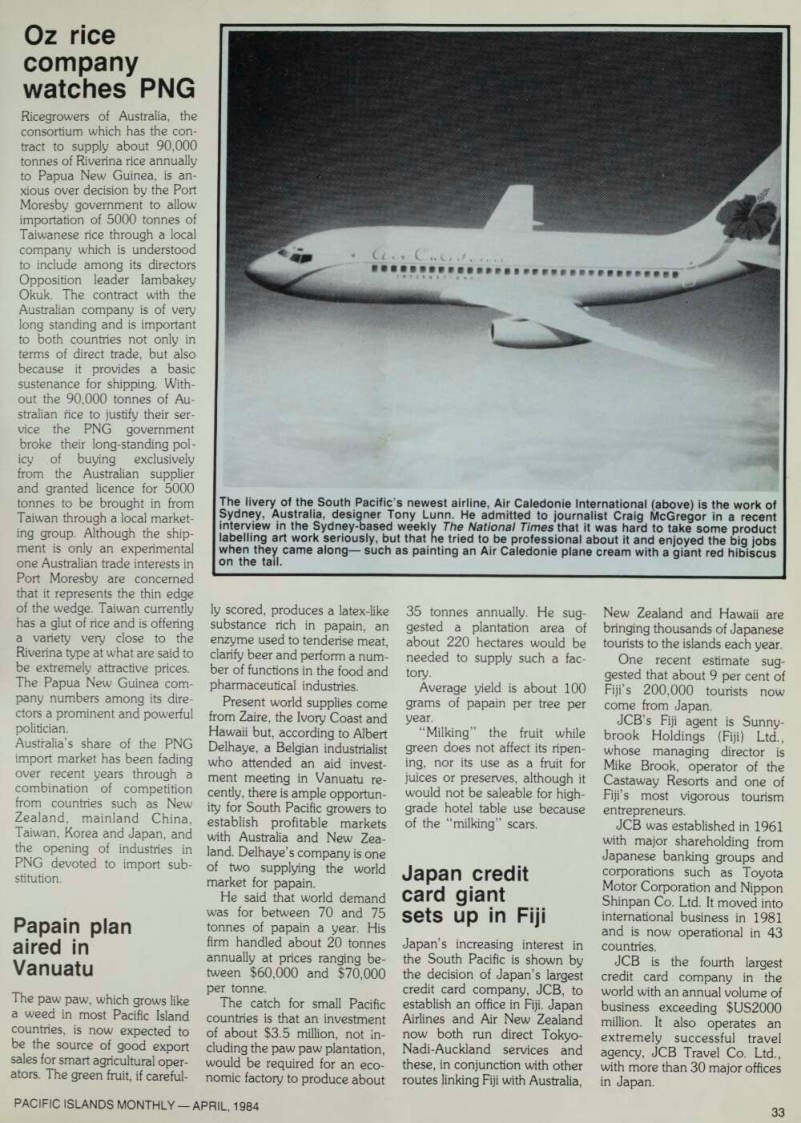
Oz rice company watches PNG
Ricegrowers of Australia, the consortium which has the con tract to supply about 90,000 tonnes of Riverina rice annually to Papua New Guinea, is an xious over decision by the Port Moresby government to allow importation of 5000 tonnes of Taiwanese rice through a local company which is understood to include among its directors Opposition leader lambakey Okuk. The contract with the Australian company is of very long standing and is important to both countries not only in terms of direct trade, but also because it provides a basic sustenance for shipping. With out the 90,000 tonnes of Au stralian rice to justify their ser vice the PNG government broke their long-standing pol icy of buying exclusively from the Australian supplier and granted licence for 5000 tonnes to be brought in from Taiwan through a local market ing group. Although the ship ment is only an experimental one Australian trade interests in Port Moresby are concerned that it represents the thin edge of the wedge. Taiwan currently has a glut of rice and is offering a variety very close to the Riverina type at what are said to be extremely attractive prices.
The Papua New Guinea com pany numbers among its dire ctors a prominent and powerful politician.
Australia’s share of the PNG import market has been fading over recent years through a combination of competition from countries such as New Zealand, mainland China, Taiwan, Korea and Japan, and the opening of industries in PNG devoted to import sub stitution.
Papain plan
aired in
Vanuatu
The paw paw, which grows like a weed in most Pacific Island countries, is now expected to be the source of good export sales for smart agricultural oper ators. The green fruit, if careful-
ly scored, produces a latex-like substance rich in papain, an enzyme used to tenderise meat, clarify beer and perform a num ber of functions in the food and pharmaceutical industries.
Present world supplies come from Zaire, the Ivory Coast and Hawaii but, according to Albert Delhaye, a Belgian industrialist who attended an aid invest ment meeting in Vanuatu re cently, there is ample opportun ity for South Pacific growers to establish profitable markets with Australia and New Zea land. Delhaye’s company is one of two supplying the world market for papain.
He said that world demand was for between 70 and 75 tonnes of papain a year. His firm handled about 20 tonnes annually at prices ranging be tween $60,000 and $70,000 per tonne.
The catch for small Pacific countries is that an investment of about $3.5 million, not in cluding the paw paw plantation, would be required for an eco nomic factory to produce about
35 tonnes annually. He sug gested a plantation area of about 220 hectares would be needed to supply such a fac tory.
Average yield is about 100 grams of papain per tree per year.
“Milking” the fruit while green does not affect its ripen ing, nor its use as a fruit for juices or preserves, although it would not be saleable for high grade hotel table use because of the “milking” scars.
Japan credit
card giant
sets up in Fiji
Japan’s increasing interest in the South Pacific is shown by the decision of Japan’s largest credit card company, JCB, to establish an office in Fiji. Japan Airlines and Air New Zealand now both run direct Tokyo- Nadi-Auckland services and these, in conjunction with other routes linking Fiji with Australia,
New Zealand and Hawaii are bringing thousands of Japanese tourists to the islands each year.
One recent estimate sug gested that about 9 per cent of Fiji’s 200,000 tourists now come from Japan.
JCB’s Fiji agent is Sunny brook Holdings (Fiji) Ltd., whose managing director is Mike Brook, operator of the Castaway Resorts and one of Fiji’s most vigorous tourism entrepreneurs.
JOB was established in 1961 with major shareholding from Japanese banking groups and corporations such as Toyota Motor Corporation and Nippon Shinpan Co. Ltd. It moved into international business in 1981 and is now operational in 43 countries.
JCB is the fourth largest credit card company in the world with an annual volume of business exceeding SUS2OOO million. It also operates an extremely successful travel agency, JCB Travel Co. Ltd., with more than 30 major offices in Japan.
The livery of the South Pacific’s newest airline, Air Caledonie International (above) is the work of Sydney, Australia, designer Tony Lunn. He admitted to journalist Craig McGregor in a recent interview in the Sydney-based weekly The National Times that it was hard to take some product labelling art work seriously, but that he tried to be professional about it and enjoyed the big jobs when they came along— such as painting an Air Caledonie plane cream with a giant red hibiscus on the tail.
Advertisements & other items, pp. 34-36 (1 item)
Introducing Perfofi
NEW ’B4 TOYOTA HILUX
Performance p comfort.
Performance plus durability.
Performance plus variety.
Advanced, powerful new engines put you in command with higher torque, better efficiency. Inside, more driving comfort than ever before - with a roomier cabin, bigger windscreens, and lean, clean instrumentation. Newly designed suspension gives you big carrying capability, yet carries you in comfort. HILUX is one tough truck with a suspension you can count on. Choose from a wide variety, including 4WD regular or double cab - and two new additions - 2WD extra cab and flatdeck. The all-new Toyota HILUX. Add it all up, and you have performance plus! m
TOYOTA
QUALITY SERVICE
AMERICAN SAMOA: BURNS PHILP (SOUTH SEA)
CO., LTD., P.O. Box 129, Pago Pago.
COOK ISLANDS: COOK ISLANDS TRADING
CORPORATION LTD., Private Bag, Rarotonga.
FIJI: AUTOMOTIVE SUPPLIES COMPANY, G.P.O.
Box 355, Suva.
GUAM & MICRONESIA: ATKINS, KROLL (GUAM) LTD., 443 South Marine Drive, Tamuning.
KIRIBATI: TARAWA MOTORS, P.O. Box 36, Bairiki, I Tarawa, Kiribati.
NAURU: NAURU COOPERATIVE SOCIETY.
NEW CALEDONIA: SERVICE IMPORTATION
AUTOMOBILE DU PACIFIQUE, Rond-Point du Pacifiqii (Station Total) B.P. 438, Noumea.
AANCE PLUS!
\\ § 4WD Double Cab SRFOLK ISLAND: SORRY’S LIMITED, P.O. Box 169.
PUA NEW GUINEA: ELA MOTORS, A Division of ms Philp (PNG) Ltd., P.O. Box 75, Port Moresby.
JPAN: MICROL CORPORATION, P.O. Box 267,
ipan.
LOMON: MENDANA ENTERPRISES (S I.) LTD.,
3 .0. Box 174, Honiara.
TAHITI: NIPPON AUTOMOTO, P.O. Box 342, Papeete.
TONGA: BURNS PHILP (SOUTH SEA) CO., LTD., P.O. Box 55, Nukualofa.
VANUATU: VANUATU MOTORS, P.O. Box 18,
Port Vila.
WESTERN SAMOA: BURNS PHILP (SOUTH SEA)
CO., LTD., P.O. Box 188, Apia.
YOTA
Australian building fittings and hardware
wnrk well tn make you profit
Australia has the biggest building industry of countries nearest the Pacific Islands. It uses a great variety of Australian made building materials that give high standards of performance in all conditions. Products such as solar hot water systems, insulation materials, window and door fittings, floor tiles, bathroom and laundry fittings, hardware, adhesives and sealants, light fittings, electrical and security equipment.
And there are many more. You get quick delivery and service from Australia. Check out Australian suppliers for your requirements.
LLjJ
For information Ask the Australian Trade Commissioner Port Moresby: Phone 25 9333 Telex NE22109.
Honolulu: Phone (808) 524 5050 Telex 633128.
Suva: Phone 31 2844 Telex FJ2126.
Noumea: Phone 27 2414 Telex 087. (0 (T 0 <r> 0 O o &
Where publishing presents a
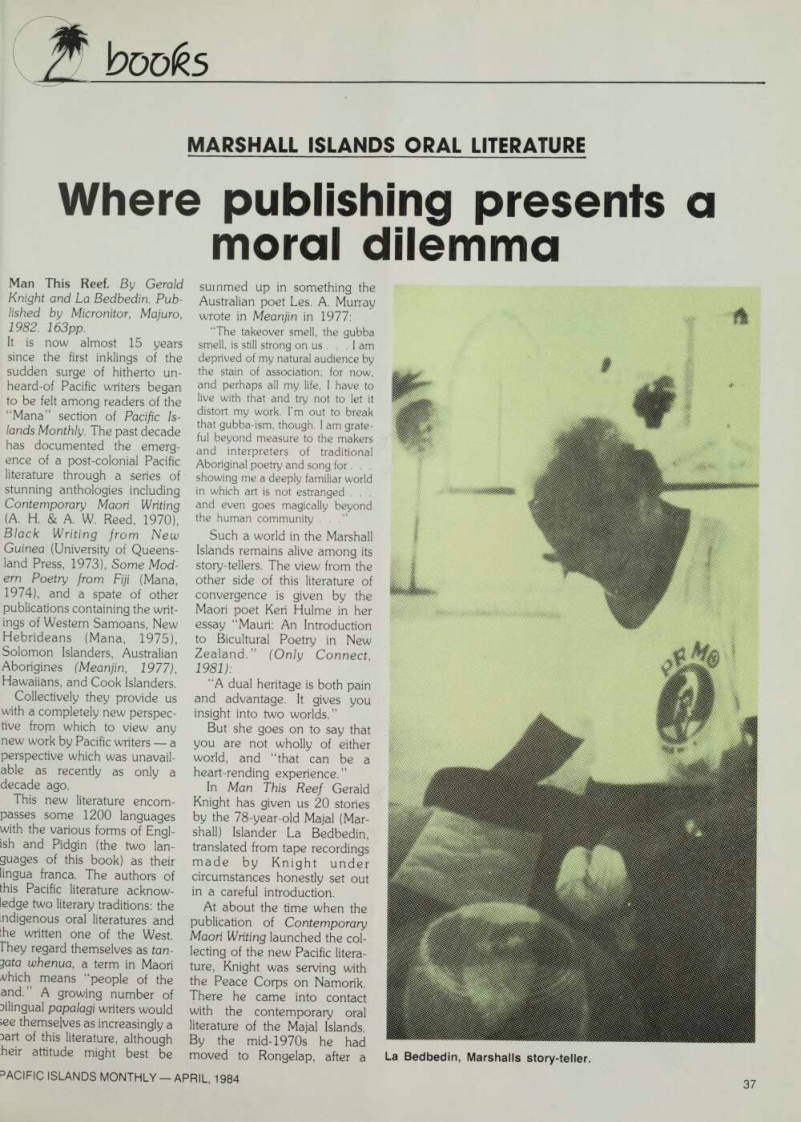
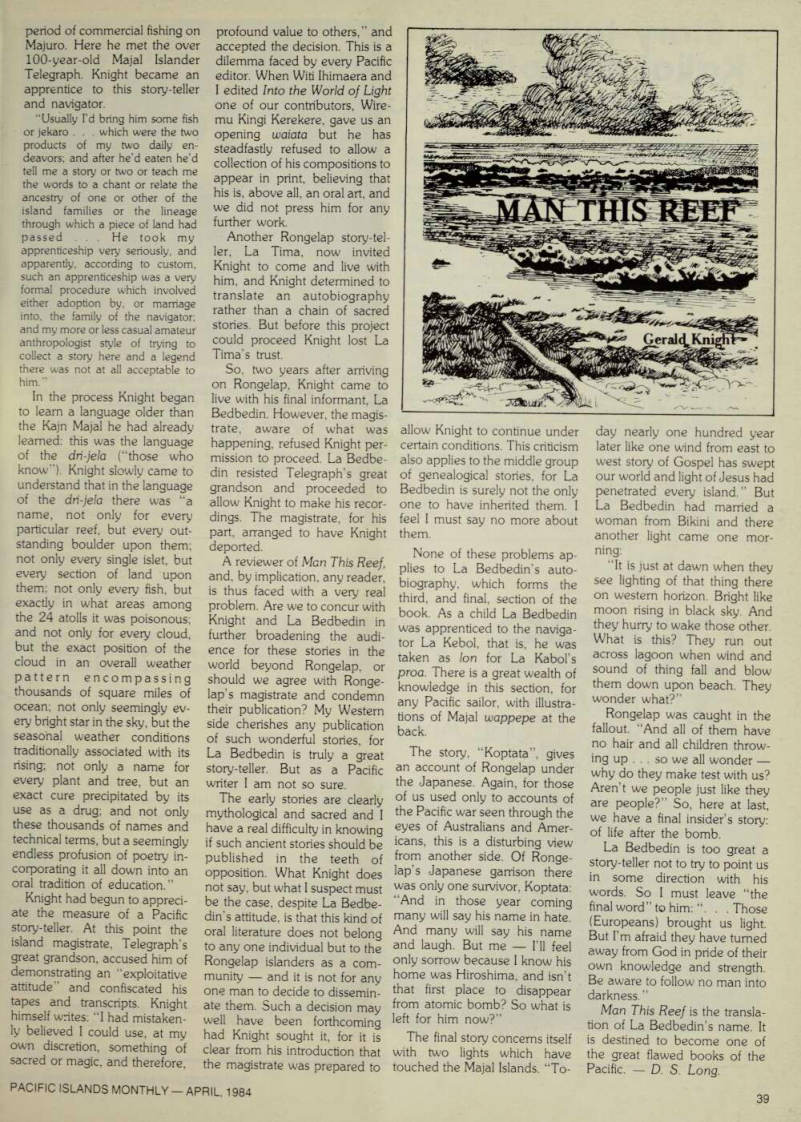
books
Marshall Islands Oral Literature
Where publishing presents a moral dilemma
Man This Reef. By Gerald Knight and La Bedbedin. Pub lished by Micronitor, Majuro, 1982. 163 pp.
It is now almost 15 years since the first inklings of the sudden surge of hitherto un heard-of Pacific writers began to be felt among readers of the “Mana” section of Pacific Is lands Monthly. The past decade has documented the emerg ence of a post-colonial Pacific literature through a series of stunning anthologies including Contemporary Maori Writing (A. H. & A. W. Reed, 1970), Black Writing from New Guinea (University of Queens land Press, 1973), Some Mod ern Poetry from Fiji (Mana, 1974), and a spate of other publications containing the writ ings of Western Samoans, New Hebrideans (Mana, 1975), Solomon Islanders, Australian Aborigines ( Meanjin, 1977), Hawaiians, and Cook Islanders.
Collectively they provide us with a completely new perspec tive from which to view any new work by Pacific writers a perspective which was unavail able as recently as only a decade ago.
This new literature encom passes some 1200 languages with the various forms of Engl ish and Pidgin (the two lan guages of this book) as their lingua franca. The authors of this Pacific literature acknow ledge two literary traditions: the ndigenous oral literatures and the written one of the West.
Ehey regard themselves as tan jata whenua, a term in Maori A/hich means “people of the and.” A growing number of bilingual papalagi writers would ;ee themselves as increasingly a :>art of this literature, although heir attitude might best be
summed up in something the Australian poet Les. A. Murray wrote in Meanjin in 1977: “The takeover smell, the gubba smell, is still strong on us . . .lam deprived of my natural audience by the stain of association; for now, and perhaps all my life, I have to live with that and try not to let it distort my work. I'm out to break that gubba-ism, though. I am grate ful beyond measure to the makers and interpreters of traditional Aboriginal poetry and song for. . . showing me a deeply familiar world in which art is not estranged . . . and even goes magically beyond the human community ..."
Such a world in the Marshall Islands remains alive among its story-tellers. The view from the other side of this literature of convergence is given by the Maori poet Keri Hulme in her essay “Mauri: An Introduction to Bicultural Poetry in New Zealand.” (Only Connect , 1981): “A dual heritage is both pain and advantage. It gives you insight into two worlds.”
But she goes on to say that you are not wholly of either world, and “that can be a heart-rending experience.”
In Man This Reef Gerald Knight has given us 20 stories by the 78-year-old Majal (Mar shall) Islander La Bedbedin, translated from tape recordings made by Knight under circumstances honestly set out in a careful introduction.
At about the time when the publication of Contemporary Maori Writing launched the col lecting of the new Pacific litera ture, Knight was serving with the Peace Corps on Namorik.
There he came into contact with the contemporary oral literature of the Majal Islands.
By the mid-1970s he had moved to Rongelap, after a
La Bedbedin, Marshalls story-teller.
period of commercial fishing on Majuro. Here he met the over 100-year-old Majal Islander Telegraph. Knight became an apprentice to this story-teller and navigator.
“Usually I’d bring him some fish or jekaro . . . which were the two products of my two daily en deavors; and after he’d eaten he’d tell me a story or two or teach me the words to a chant or relate the ancestry of one or other of the island families or the lineage through which a piece of land had passed ... He took my apprenticeship very seriously, and apparently, according to custom, such an apprenticeship was a very formal procedure which involved either adoption by, or marriage into, the family of the navigator; and my more or less casual amateur anthropologist style of trying to collect a story here and a legend there was not at all acceptable to him.”
In the process Knight began to learn a language older than the Kajn Majal he had already learned; this was the language of the dri-jela (“those who know”). Knight slowly came to understand that in the language of the dri-jela there was “a name, not only for every particular reef, but every out standing boulder upon them; not only every single islet, but every section of land upon them; not only every fish, but exactly in what areas among the 24 atolls it was poisonous; and not only for every cloud, but the exact position of the cloud in an overall weather pattern encompassing thousands of square miles of ocean; not only seemingly ev ery bright star in the sky, but the seasonal weather conditions traditionally associated with its rising; not only a name for every plant and tree, but an exact cure precipitated by its use as a drug; and not only these thousands of names and technical terms, but a seemingly endless profusion of poetry in corporating it all down into an oral tradition of education.”
Knight had begun to appreci ate the measure of a Pacific story-teller. At this point the island magistrate, Telegraph’s great grandson, accused him of demonstrating an “exploitative attitude" and confiscated his tapes and transcripts. Knight himself writes; “1 had mistaken ly believed I could use, at my own discretion, something of sacred or magic, and therefore,
profound value to others,” and accepted the decision. This is a dilemma faced by every Pacific editor. When Witi Ihimaera and I edited Into the World of Light one of our contributors, Wire mu Kingi Kerekere, gave us an opening waiata but he has steadfastly refused to allow a collection of his compositions to appear in print, believing that his is, above all, an oral art, and we did not press him for any further work.
Another Rongelap story-tel ler, La Tima, now invited Knight to come and live with him, and Knight determined to translate an autobiography rather than a chain of sacred stories. But before this project could proceed Knight lost La Tima’s trust.
So, two years after arriving on Rongelap, Knight came to live with his final informant, La Bedbedin. However, the magis trate, aware of what was happening, refused Knight per mission to proceed. La Bedbe din resisted Telegraph’s great grandson and proceeded to allow Knight to make his recor dings. The magistrate, for his part, arranged to have Knight deported.
A reviewer of Man This Reef, and, by implication, any reader, is thus faced with a very real problem. Are we to concur with Knight and La Bedbedin in further broadening the audi ence for these stories in the world beyond Rongelap, or should we agree with Ronge lap’s magistrate and condemn their publication? My Western side cherishes any publication of such wonderful stories, for La Bedbedin is truly a great story-teller. But as a Pacific writer I am not so sure.
The early stories are clearly mythological and sacred and I have a real difficulty in knowing if such ancient stories should be published in the teeth of opposition. What Knight does not say, but what I suspect must be the case, despite La Bedbe din’s attitude, is that this kind of oral literature does not belong to any one individual but to the Rongelap islanders as a com munity and it is not for any one man to decide to dissemin ate them. Such a decision may well have been forthcoming had Knight sought it, for it is clear from his introduction that the magistrate was prepared to
allow Knight to continue under certain conditions. This criticism also applies to the middle group of genealogical stories, for La Bedbedin is surely not the only one to have inherited them. I feel I must say no more about them.
None of these problems ap plies to La Bedbedin’s auto biography, which forms the third, and final, section of the book. As a child La Bedbedin was apprenticed to the naviga tor La Kebol, that is, he was taken as lon for La Kabol’s proa. There is a great wealth of knowledge in this section, for any Pacific sailor, with illustra tions of Majal wappepe at the back.
The story, “Koptata”, gives an account of Rongelap under the Japanese. Again, for those of us used only to accounts of the Pacific war seen through the eyes of Australians and Amer icans, this is a disturbing view from another side. Of Ronge lap’s Japanese garrison there was only one survivor, Koptata: “And in those year coming many will say his name in hate.
And many will say his name and laugh. But me I’ll feel only sorrow because I know his home was Hiroshima, and isn’t that first place to disappear from atomic bomb? So what is left for him now?”
The final story concerns itself with two lights which have touched the Majal Islands. “To
day nearly one hundred year later like one wind from east to west story of Gospel has swept our world and light of Jesus had penetrated every island.” But La Bedbedin had married a woman from Bikini and there another light came one mor ning; “It is just at dawn when they see lighting of that thing there on western horizon. Bright like moon rising in black sky. And they hurry to wake those other.
What is this? They run out across lagoon when wind and sound of thing fall and blow them down upon beach. They wonder what?”
Rongelap was caught in the fallout. “And all of them have no hair and all children throw ing up ... so we all wonder why do they make test with us?
Aren’t we people just like they are people?” So, here at last, we have a final insider’s story: of life after the bomb.
La Bedbedin is too great a story-teller not to try to point us in some direction with his words. So I must leave “the final word” to him: “. . . Those (Europeans) brought us light.
But I’m afraid they have turned away from God in pride of their own knowledge and strength.
Be aware to follow no man into darkness.”
Man This Reef is the transla tion of La Bedbedin’s name. It is destined to become one of the great flawed books of the
Pacific.
D. S. Long.
Advertisements & other items, p. 38 (1 item)
When only the best Will do.
\ m p m i ,1 m % i H!»'< . ,* > . lift r* 3 I Ipy SM : > %
xA*ii\ I
** ,ir '- ■u. - -k m »
When only the best Will do.
>c; ! he Benson and Hedges Company Pty. Ltd. 1980
CC46I/80 016.R184D.6.80
Story-tellers of Kaliai show their paces
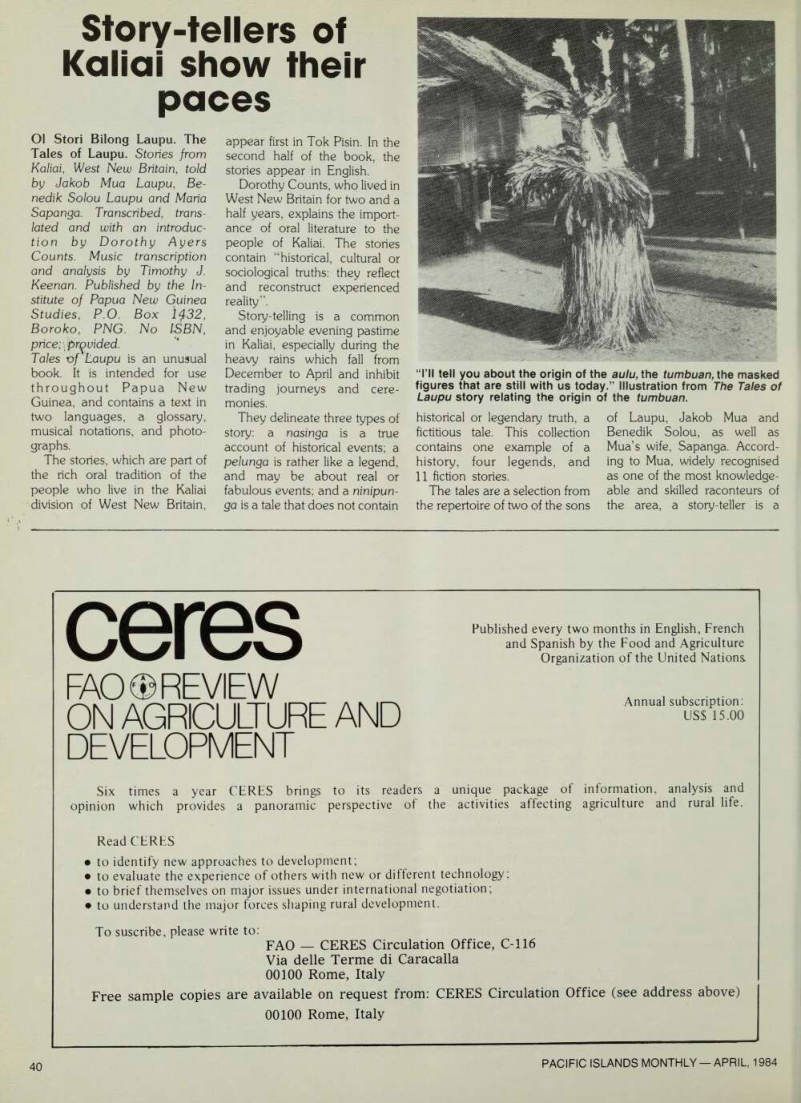
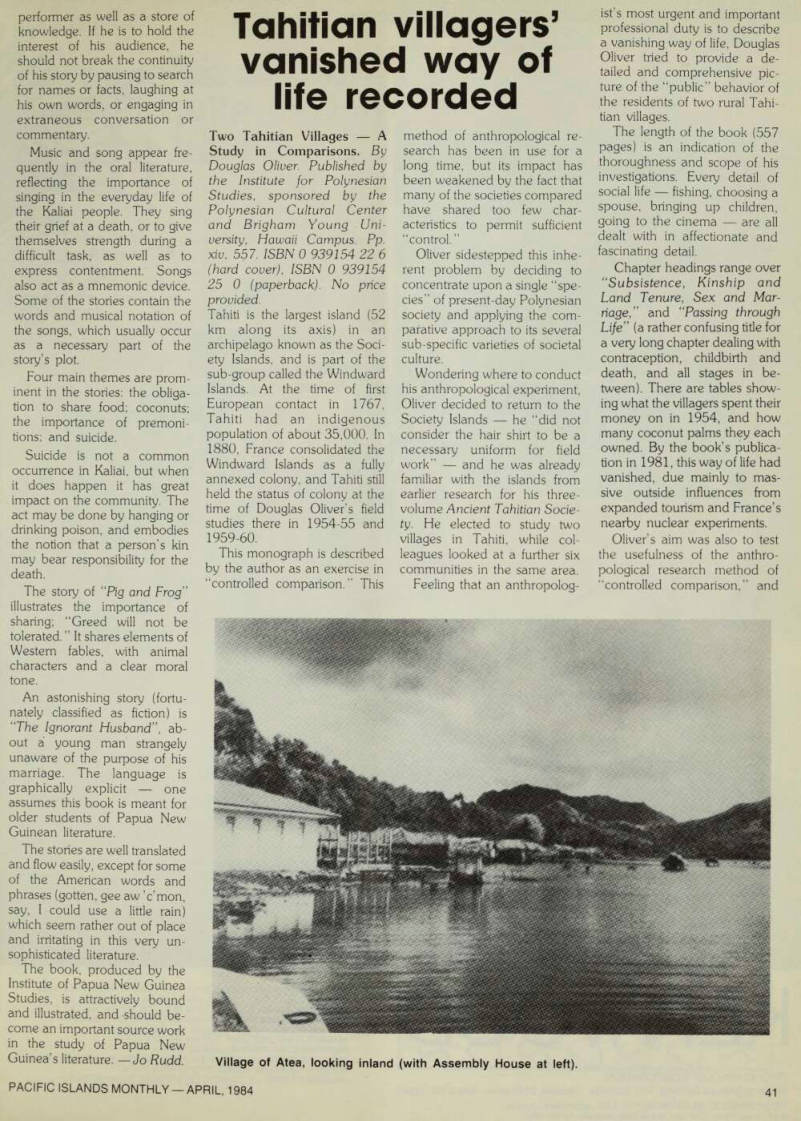
Kaliai show their paces
Ol Stori Bilong Laupu. The Tales of Laupu. Stories from Kaliai, West New Britain, told by Jakob Mua Laupu, Benedik Solou Laupu and Maria Sapanga. Transcribed, translated and with an introduction by Dorothy Ayers Counts. Music transcription and analysis by Timothy J.
Keenan. Published by the Institute of Papua New Guinea Studies, P.O. Box 1Q32, Boroko, PNG. No I-SBN, price; .provided. '* Tales of Laupu is an unusual book. It is intended for use throughout Papua New Guinea, and contains a text in two languages, a glossary, musical notations, and photographs.
The stories, which are part of the rich oral tradition of the people who live in the Kaliai division of West New Britain,
appear first in Tok Pisin. In the second half of the book, the stories appear in English, Dorothy Counts, who lived in West New Britain for two and a half years, explains the import ance of oral literature to the people of Kaliai. The stories contain “historical, cultural or sociological truths: they reflect and reconstruct experienced reality”.
Story-telling is a common and enjoyable evening pastime in Kaliai, especially during the heavy rains which fall from December to April and inhibit trading journeys and cere monies.
They delineate three types of story: a nasinga is a true account of historical events; a pelunga is rather like a legend, and may be about real or fabulous events; and a ninipun ga is a tale that does not contain
historical or legendary truth, a fictitious tale. This collection contains one example of a history, four legends, and 11 fiction stories.
The tales are a selection from the repertoire of two of the sons
of Laupu, Jakob Mua and Benedik Solou, as well as Mua’s wife, Sapanga. Accord ing to Mua, widely recognised as one of the most knowledge able and skilled raconteurs of the area, a story-teller is a
“I’ll tell you about the origin of the aulu, the tumbuan, the masked figures that are still with us today.”Illustration from The Tales of Laupu story relating the origin of the tumbuan.
performer as well as a store of knowledge. If he is to hold the interest of his audience, he should not break the continuity of his story by pausing to search for names or facts, laughing at his own words, or engaging in extraneous conversation or commentary.
Music and song appear fre quently in the oral literature, reflecting the importance of singing in the everyday life of the Kaliai people. They sing their grief at a death, or to give themselves strength during a difficult task, as well as to express contentment. Songs also act as a mnemonic device.
Some of the stories contain the words and musical notation of the songs, which usually occur as a necessary part of the story’s plot.
Four main themes are prom inent in the stories; the obliga tion to share food; coconuts; the importance of premoni tions; and suicide.
Suicide is not a common occurrence in Kaliai, but when it does happen it has great impact on the community. The act may be done by hanging or drinking poison, and embodies the notion that a person’s kin may bear responsibility for the death.
The story of “Pig and Frog” illustrates the importance of sharing; “Greed will not be tolerated. ” It shares elements of Western fables, with animal characters and a clear moral tone.
An astonishing story (fortu nately classified as fiction) is “The Ignorant Husband”, ab out a young man strangely unaware of the purpose of his marriage. The language is graphically explicit one assumes this book is meant for older students of Papua New Guinean literature.
The stories are well translated and flow easily, except for some of the American words and phrases (gotten, gee aw ’c’mon, say, I could use a little rain) which seem rather out of place and irritating in this very un sophisticated literature.
The book, produced by the Institute of Papua New Guinea Studies, is attractively bound and illustrated, and -should be come an important source work in the study of Papua New
Guinea’s literature.
Jo Rudd.
Advertisements & other items, p. 40 (1 item)
ceres
FAO ©REVIEW
ON AGRICULTURE AND
DEVELOPMENT
Published every two months in English, French and Spanish by the Food and Agriculture Organization of the United Nations.
Annual subscription: US$ 15.00 Six times a year CERES brings to its readers a unique package of information, analysis and opinion which provides a panoramic perspective of the activities affecting agriculture and rural life.
Read CERES • to identify new approaches to development; • to evaluate the experience of others with new or different technology; • to brief themselves on major issues under international negotiation; • to understand the major forces shaping rural development.
To suscribe, please write to; FAO CERES Circulation Office, C-116 Via delle Terme di Caracalla 00100 Rome, Italy Free sample copies are available on request from; CERES Circulation Office (see address above) 00100 Rome, Italy
Tahitian villagers’
vanished way of life recorded
Two Tahitian Villages A Study in Comparisons. By Douglas Oliver. Published by the Institute for Polynesian Studies, sponsored by the Polynesian Cultural Center and Brigham Young Uni versity, Hawaii Campus. Pp. xiv, 557. ISBN 0 939154 22 6 (hard cover), ISBN 0 939154 25 0 (paperback). No price provided.
Tahiti is the largest island (52 km along its axis) in an archipelago known as the Soci ety Islands, and is part of the sub-group called the Windward Islands. At the time of first European contact in 1767, Tahiti had an indigenous population of about 35,000. In 1880, France consolidated the Windward Islands as a fully annexed colony, and Tahiti still held the status of colony at the time of Douglas Oliver’s field studies there in 1954-55 and 1959-60.
This monograph is described by the author as an exercise in “controlled comparison.” This
method of anthropological re search has been in use for a long time, but its impact has been weakened by the fact that many of the societies compared have shared too few char acteristics to permit sufficient “control.”
Oliver sidestepped this inhe rent problem by deciding to concentrate upon a single “spe cies” of present-day Polynesian society and applying the com parative approach to its several sub-specific varieties of societal culture.
Wondering where to conduct his anthropological experiment, Oliver decided to return to the Society Islands he “did not consider the hair shirt to be a necessary uniform for field work” and he was already familiar with the islands from earlier research for his three volume Ancient Tahitian Socie ty. He elected to study two villages in Tahiti, while col leagues looked at a further six communities in the same area.
Feeling that an anthropolog
ist’s most urgent and important professional duty is to describe a vanishing way of life, Douglas Oliver tried to provide a de tailed and comprehensive pic ture of the “public” behavior of the residents of two rural Tahi tian villages.
The length of the book (557 pages) is an indication of the thoroughness and scope of his investigations. Every detail of social life fishing, choosing a spouse, bringing up children, going to the cinema are all dealt with in affectionate and fascinating detail.
Chapter headings range over “ Subsistence, Kinship and Land Tenure, Sex and Mar riage/’ and “ Passing through Life” (a rather confusing title for a very long chapter dealing with contraception, childbirth and death, and all stages in be tween). There are tables show ing what the villagers spent their money on in 1954, and how many coconut palms they each owned. By the book’s publica tion in 1981, this way of life had vanished, due mainly to mas sive outside influences from expanded tourism and France’s nearby nuclear experiments.
Oliver’s aim was also to test the usefulness of the anthro pological research method of “controlled comparison,” and
Village of Atea, looking inland (with Assembly House at left).
Advertisements & other items, p. 42 (1 item)
Kenwood
New Kenwood stereo component systems
r window” to the world s
infinite store of music.
\ \ x Sarajevo 'B4 idio
(esisofiO-ey-wricFleading
'specialists, Kenwood
desig
fexlbiiity acid easy
.pffer you the'best possible ifvaudio
[3TsgyAnd Sound that’s as
as the world aroun
ms •KT-51 Quartz SyrHbesizer •KX-71R Auto- Cassett>Qeck )y* B-SsNR and DPSS Quartz PLL DlrechQrlve Full-Auto •SRC-51 W Audio System Rad 'TM Dolby Corp.
KENWOOD
TRIO-KENWOOD CORPORATION
Shionogi Shibuya Building, 17-5, 2-chome, Shibuya, Shibuya-ku, Tokyo 150, Japan TRIO-KENWOOD (AUSTRALIA) PTY. LTD (incorporated in nswi 4E Woodcock Place, Lane Cove, N.S.W. 2066, Australia. Tel: 428-1455 NEW ZEALAND JOHN GILBERT & CO., LTD. Auckland Tel.ooll-64-9-30839 FIJI PEPE’S DUTY FREE CENTRE LTD, Tel. 25496, 25497 PAPUA NEW GUINEA S.O. SVENSSON (N.G.) LTD. Port Moresby Tel. 212158, 212111 SOLOMON ISLANDS TECHNIQUE RADIOS CENTRE LTD. Honiara Tel. 416 NEW CALEDONIA HI-FI VOX Noumea Tel. 27-2466, 28-2931 VANUATU FUNG CHOI LUEN. Port-Vila Tel. 2556
TAHITI MAISON AURORE Papeete Tel. 29703
AMERICAN SAMOA ISLAND PACIFIC AGENCIES, INC. Pago Pago Tel. 633-4687
REPUBLIC OF NAURU NAURU CO-OPERATIVE SOCIETY
MARIANA ISLANDS J.C. TENORIO ENTERPRISES Saipan Tel. 6445
the figures

Fiji Tourism
A conclusion that doesn’t quite match the figures
Tourism and Underdevelop ment in Fiji. By S. G. Britton.
Australian National Universi ty Development Studies Cen tre Monograph No. 31, 1983. 232 pp. SAI2.
Attitudes towards tourism in the South Pacific tend to be pola rised: there are those who re gard the negative ecological and cultural impacts of tourism as out-weighing any economic benefits; and there are those who argue, often with some uneasiness, that the economic benefits of tourism in terms of foreign exchange and employ ment are vital to the health of some island economies.
Part of the reserve about tourism relates to the fact that it is a service and as such is less tangible than traditional exports
of, say, sugar and copra.
Economists, of which the re viewer is one, are normally indifferent as to how foreign exchange is earned or employ ment generated, but is this attitude right? That is, is there any difference between a dollar earned from sugar exports and one earned from tourism?
There could be, and so economists are particularly in terested in the answers to two questions: • What is the net impact of tourism on such measures as the balance of payments, eco nomic growth, equity, poverty and employment? • How stable are the earn ings from tourism? That is, is it wise for a country to become
too dependent on an industry which is subject to substantial fluctuations for reasons outside its control?
This should not be taken to suggest that economists are in different to social and cultural disruption. But since these effects are almost impossible to quantify, economists put them aside in the hope that the issue can be settled by considering more easily quantifiable factors (e.g. the costs of tourism may exceed benefits without con sidering social and cultural effects, or the benefits may exceed the costs by such an enormous amount that nega tive cultural effects can be toler ated). And, without intruding into other people’s area of competence, are there no posi tive effects from the interaction of tourists with local cultures?
All this is by way of introduc tion to a consideration of Stephen Britton’s monograph on tourism in Fiji. The book aims “to investigate the political economy of tourism develop ment in a small Pacific Island state”, and concludes that “the industry is not considered to be an inherently appropriate de
velopment sector for the third world countries”.
Britton’s investigation is based on six “working hypoth eses” (p. 7) which can be summarised as follows: the tourist industry is owned and operated by companies based in developed countries; and this shapes the way the industry operates. The book then pre sents an historical background to the Fijian economy (Ch. 2), and a description of the present tourist industry and tourist flows to Fiji (Ch. 3). One of the important points raised in this context is the “vulnerability of third-world-destined tourist flows to economic downturns in Western countries” (p. 58). An important issue here is the relative instability of tourism (which makes up about a third of Fiji’s exports) in comparison with other exports.
Avarind Rao, a Fiji scholar completing post-graduate stu dies in economics at the Uni versity of New England, has recently calculated that, in fact, Fiji’s earnings from tourism have been a good deal more stable than earnings for virtually all other exports. The
vulnerability argument against tourism, at least for Fiji, appears to be based on shaky empirical foundations. Further, on this point, it could be argued that for traditional exports, market ing bodies can act to reduce fluctuations in income to pro ducers by, for example, mini mum price schemes. This sug gests that such exports may be more desirable than tourism, as regards the effects of fluctua tions on the economy. Howev er, given the high degree of foreign ownership in tourism, the expenditure and earnings remaining in Fiji will be much more stable than total tourism earnings. That is. at least some components of the industry have substantial proportions of fixed costs; as long as hotels, for example, are kept open, certain costs (e.g. wages of basic staff) have to be paid irrespective of the number of tourists arriving.
Of particular interest is the chapter on tourism and the Fiji economy. Using multiplier co efficients. Britton estimates the impact of changes in expendi ture on tourism on magnitudes such as Gross Domestic Fro
duct, imports and demand for labor. He specifically considers net foreign exchange earnings from tourism. These amount to well under half the gross ear nings, given the industry’s heavy dependence on imports (around 17 per cent of imports in the early 1970 s were for the tourist industry), salary pay ments to foreigners, and re patriation of profits. The link ages of tourism to other sectors of the economy are estimated to be relatively low, given high import requirements. Further sections consider government income and expenditure with respect to tourism, and the distribution (both international and local) of tourism receipts.
There is, unfortunately, no rigorous attempt to add up and compare the positive and nega tive magnitudes of these fac tors. Despite this, the chapter concludes with the remark that “in purely economic terms, the industry probably brings with it as many advantages as it does disadvantages” (p. 197). This does not square up with the facts presented earlier in the chapter, i.e., net foreign ex
change earnings, employment generation, and net govern ment receipts, are all positive and substantial.
Britton’s principal reason for this conclusion is that he con siders the industry “has im posed on Fiji a development mode that (has) exacerbated those adverse conditions typical of a dependent capitalist social formation” (p. 198). In other words, the worsened distribu tion and political-social costs are assessed as exceeding the net economic benefits. He is entitled to his opinion but, as mentioned above, the data he presents does not obviously support this conclusion.
To be fair to Britton, he does not set out specifically to answer the questions outlined at the start of this review. His is a wider concern, moving into areas such as appropriateness and dependency. Nonetheless, if non-economists (Britton is a geographer at the University of Auckland) are going to venture into areas like the “political economy of tourism,” they must expect economists to scrutinise their findings. The
latters’ strength in this sort of exercise, incidentally, is to answer such questions as “how much is it-costing us, in dollar terms, to follow a policy of self-reliance?”
Finally, there is little discus sion of policy, although Britton does suggest that the Fiji Gov ernment is developing a more consistent stance towards tourism.
It is important to recognise that host governments do have ultimate control over multi national corporations. They can impose the terms and condi tions under which these corporations must operate. And if they won’t toe the line, they can (quite easily) be encour aged to leave, as IBM and Coca-Cola have left India. De veloping countries in general seem to have been quite successful in imposing their will on multi-nationals. The only problem has been sorting out what their will is.
In summary, Britton’s book is a useful compilation of data on tourism in Fiji, and a valuable contribution to the tourism de
bate.
Geoff Harris.
Tahitian villagers’
vanished way of life
to focus on the “economic” aspects of the communities stu died, to add a little ethno graphic learning to the hard discipline of economics. As Oliver says, however, it is prob able that his account of a unique and vanished way of life will prove to be the most useful part of his monograph.
There are certainly some de lightful descriptions. Speaking of preliminary courtship be havior, Oliver says, “To my age-jaundiced eye, there was nothing more comical than a young male in courting posture: wandering along the road or sitting beside it with others like himself; his fine physique hid den in poor fitting garments decorated with Hong Kong ver sions of Polynesian designs; his great spreading feet painfully inserted into unaccustomed and unlaced shoes; his head brilliantined with oily scent and
crowned with flowers: and his heavy-browed and usually handsome face drawn up into a sick-cow expression as he sang to the accompaniment of some body’s guitar the latest Papeete inanity about love and moon light and absence.”
An appendix contains a very readable summary of the com parison the author was finally able to make between the societal economies of the vil lages of Atea and Fatata. The study is based on two char acteristics: each village’s widely shared goals, and the extent to which they were actually achieved, and the natural and cultural factors responsible for the gaps between the achiev able goals and their actual attainment.
As an anthropological docu ment, the book is limited by its unfortunate lack of an index, and by language which is at times quite unscientific, though appealingly naive. As an inti mate look at a recently vanished way of life with some excellent photographs
it is well worth reading.
Jo
Rudd.
Advertisements & other items, pp. 43-44 (1 item)
The Ausfrolion Development Studies Centre
Notional University Monograph no. 31 Tourism and
underdevelopment
in Fiji Stephen G. Britton <yo
Check these great tastes
from Edmonds*
Serving the Pacific for over 100 years
Products Available
Baking Powder Custard Jelly Pancake Mix Pikelet Mix Beef Stock Chicken Stock Scone Mix Pastry Mix Donut Mix Sponge Mix Bun Mix Soups Pickles Preserves Pkt Cake Mixes Mixed Fruit for Baking Cheesecake Peanut Butter Sandwich Spreads Rice Risotto Quick Snacks Imitation Cherries Glace Cherries Cocktail Cherries in maraschino oil Canned Mushrooms Curry Powder Breadcrumbs Glucose D Vita Crunch Breakfast Cereals Fla-vor-ice (liquid ice block) Flour Icing Sugar Mix n Bake Pastries Peanuts Coconut Rice packs Sugar Sachets Soya Oil Honey Cordials Cornflour Cut Peel Crystallised Ginger Pet Food Detergent Disinfectant Ant Killer rtVCvIAH viviH'; Our Famous Brands
thro
u9 h ° ut
A^'l^rica^Tong 3
Am 6 '
fllO 3
FM' Sa
We s
ok Ne^ Co
Sa1 ,O f«.NW, e -
l sla ",u
ua tu ’
lomoo
ndS G°m ea Van
paP u !
ied° n Z
Ca Me*
Proudly manufactured in New Zealand by
EDMONDS FOOD INDUSTRIES LTD.
PC Box 27-249 Mt Roskill
AUCKLAND NZ
Brochure Factory 83 Telephone 698-167 Cable Address Sunshine Telex Address 21690
*Ask for our
Illustrated product catalogue
and export price list.
Bankers National Bank Year Established 1881 Export Manager Tony Babbage incl W F Tucker & Company Limited
We dodge death by
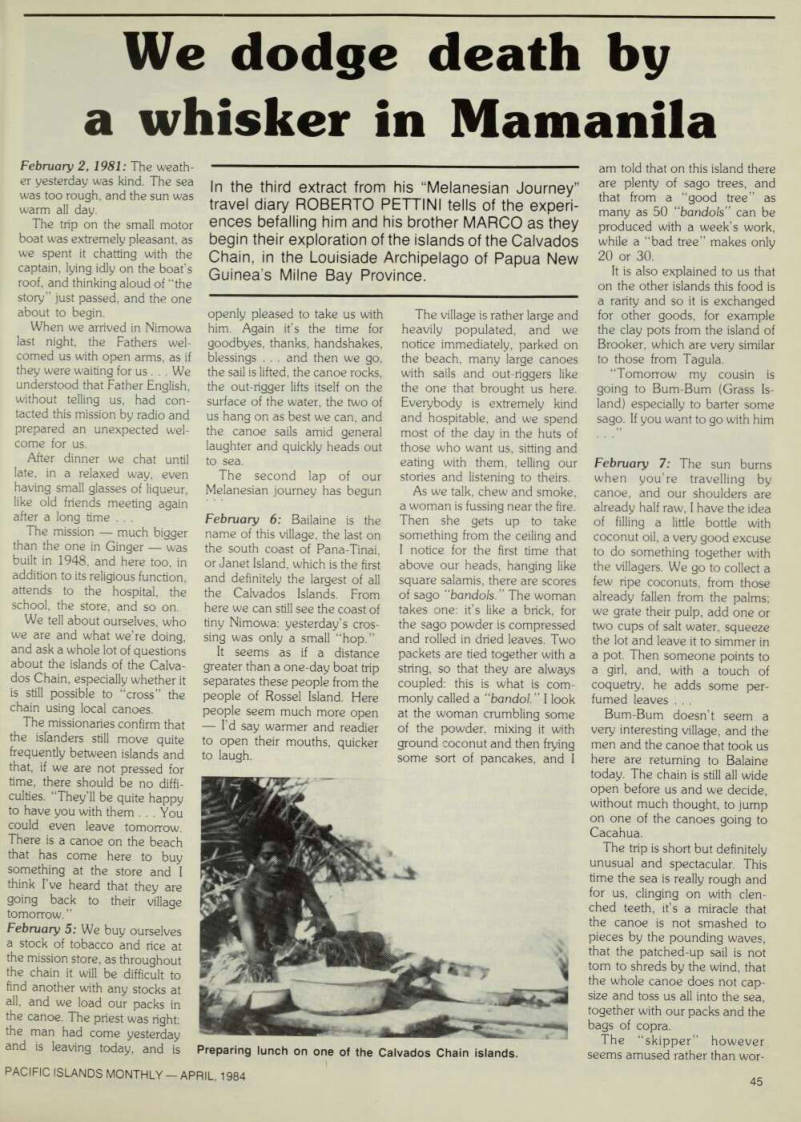
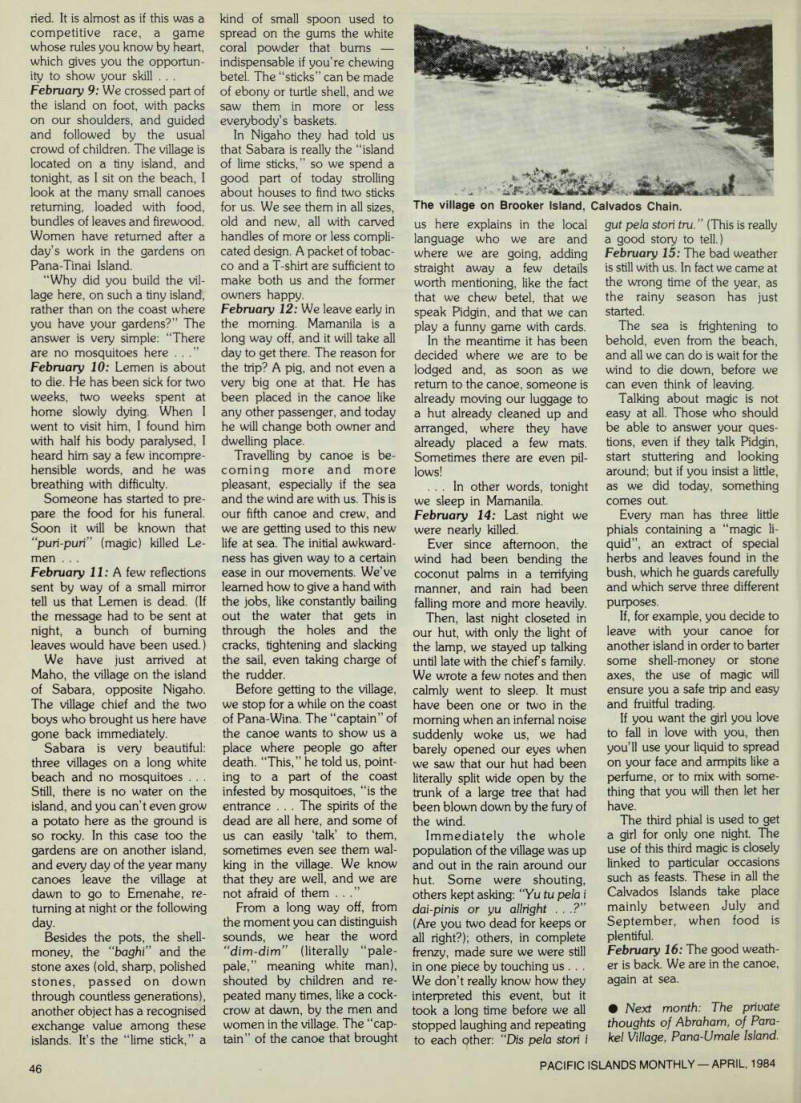
a whisker in Mamanila
In the third extract from his “Melanesian Journey” travel diary ROBERTO PETTINI tells of the experi ences befalling him and his brother MARCO as they begin their exploration of the islands of the Calvados Chain, in the Louisiade Archipelago of Papua New Guinea’s Milne Bay Province.
February 2, 1981: The weath er yesterday was kind. The sea was too rough, and the sun was warm all day.
The trip on the small motor boat was extremely pleasant, as we spent it chatting with the captain, lying idly on the boat’s roof, and thinking aloud of “the story” just passed, and the one about to begin.
When we arrived in Nimowa last night, the Fathers wel comed us with open arms, as if they were waiting for us . . . We understood that Father English, without telling us, had con tacted this mission by radio and prepared an unexpected wel come for us.
After dinner we chat until late, in a relaxed way, even having small glasses of liqueur, like old friends meeting again after a long time . . .
The mission much bigger than the one in Ginger was built in 1948, and here too, in addition to its religious function, attends to the hospital, the school, the store, and so on.
We tell about ourselves, who we are and what we’re doing, and ask a whole lot of questions about the islands of the Calva dos Chain, especially whether it is still possible to “cross” the chain using local canoes.
The missionaries confirm that the islanders still move quite frequently between islands and that, if we are not pressed for time, there should be no diffi culties. “They’ll be quite happy to have you with them . . . You could even leave tomorrow.
There is a canoe on the beach that has come here to buy something at the store and I think I’ve heard that they are going back to their village tomorrow. ”
February 5: We buy ourselves a stock of tobacco and rice at the mission store, as throughout the chain it will be difficult to find another with any stocks at all, and we load our packs in the canoe. The priest was right: the man had come yesterday and is leaving today, and is
openly pleased to take us with him. Again it’s the time for goodbyes, thanks, handshakes, blessings . . . and then we go, the sail is lifted, the canoe rocks, the out-rigger lifts itself on the surface of the water, the two of us hang on as best we can, and the canoe sails amid general laughter and quickly heads out to sea.
The second lap of our Melanesian journey has begun February 6: Bailaine is the name of this village, the last on the south coast of Pana-Tinai, or Janet Island, which is the first and definitely the largest of all the Calvados Islands. From here we can still see the coast of tiny Nimowa; yesterday’s cros sing was only a small “hop.”
It seems as if a distance greater than a one-day boat trip separates these people from the people of Rossel Island. Here people seem much more open I’d say warmer and readier to open their mouths, quicker to laugh.
The village is rather large and heavily populated, and we notice immediately, parked on the beach, many large canoes with sails and out-riggers like the one that brought us here.
Everybody is extremely kind and hospitable, and we spend most of the day in the huts of those who want us, sitting and eating with them, telling our stories and listening to theirs.
As we talk, chew and smoke, a woman is fussing near the fire.
Then she gets up to take something from the ceiling and I notice for the first time that above our heads, hanging like square salamis, there are scores of sago “bandols.” The woman takes one: it’s like a brick, for the sago powder is compressed and rolled in dried leaves. Two packets are tied together with a string, so that they are always coupled: this is what is com monly called a “ bandol l look at the woman crumbling some of the powder, mixing it with ground coconut and then frying some sort of pancakes, and I
am told that on this island there are plenty of sago trees, and that from a “good tree” as many as 50 “bandols” can be produced with a week’s work, while a “bad tree” makes only 20 or 30.
It is also explained to us that on the other islands this food is a rarity and so it is exchanged for other goods, for example the clay pots from the island of Brooker, which are very similar to those from Tagula.
“Tomorrow my cousin is going to Bum-Bum (Grass Is land) especially to barter some sago. If you want to go with him 11 February 7: The sun burns when you’re travelling by canoe, and our shoulders are already half raw, I have the idea of filling a little bottle with coconut oil, a very good excuse to do something together with the villagers. We go to collect a few ripe coconuts, from those already fallen from the palms; we grate their pulp, add one or two cups of salt water, squeeze the lot and leave it to simmer in a pot. Then someone points to a girl, and, with a touch of coquetry, he adds some per fumed leaves . . .
Bum-Bum doesn’t seem a very interesting village, and the men and the canoe that took us here are returning to Balaine today. The chain is still all wide open before us and we decide, without much thought, to jump on one of the canoes going to Cacahua.
The trip is short but definitely unusual and spectacular. This time the sea is really rough and for us, clinging on with clen ched teeth, it’s a miracle that the canoe is not smashed to pieces by the pounding waves, that the patched-up sail is not torn to shreds by the wind, that the whole canoe does not cap size and toss us all into the sea, together with our packs and the bags of copra.
The “skipper” however seems amused rather than wor
Preparing lunch on one of the Calvados Chain islands.
ried. It is almost as if this was a competitive race, a game whose rules you know by heart, which gives you the opportun ity to show your skill . . .
February 9: We crossed part of the island on foot, with packs on our shoulders, and guided and followed by the usual crowd of children. The village is located on a tiny island, and tonight, as I sit on the beach, I look at the many small canoes returning, loaded with food, bundles of leaves and firewood.
Women have returned after a day’s work in the gardens on Pana-Tinai Island.
“Why did you build the vil lage here, on such a tiny island, rather than on the coast where you have your gardens?” The answer is very simple: “There are no mosquitoes here ...”
February 10: Lemen is about to die. He has been sick for two weeks, two weeks spent at home slowly dying. When I went to visit him, I found him with half his body paralysed, I heard him say a few incompre hensible words, and he was breathing with difficulty.
Someone has started to pre pare the food for his funeral.
Soon it will be known that “ puri-puri” (magic) killed Le men . . .
February 11: A few reflections sent by way of a small mirror tell us that Lemen is dead. (If the message had to be sent at night, a bunch of burning leaves would have been used.) We have just arrived at Maho, the village on the island of Sahara, opposite Nigaho.
The village chief and the two boys who brought us here have gone back immediately.
Sahara is very beautiful: three villages on a long white beach and no mosquitoes . . .
Still, there is no water on the island, and you can’t even grow a potato here as the ground is so rocky. In this case too the gardens are on another island, and every day of the year many canoes leave the village at dawn to go to Emenahe, re turning at night or the following day.
Besides the pots, the shell money, the “ baghi” and the stone axes (old, sharp, polished stones, passed on down through countless generations), another object has a recognised exchange value among these islands. It’s the “lime stick,” a
kind of small spoon used to spread on the gums the white coral powder that bums indispensable if you’re chewing betel. The “sticks” can be made of ebony or turtle shell, and we saw them in more or less everybody’s baskets.
In Nigaho they had told us that Sahara is really the “island of lime sticks,” so we spend a good part of today strolling about houses to find two sticks for us. We see them in all sizes, old and new, all with carved handles of more or less compli cated design. A packet of tobac co and a T-shirt are sufficient to make both us and the former owners happy.
February 12: We leave early in the morning. Mamanila is a long way off, and it will take all day to get there. The reason for the trip? A pig, and not even a very big one at that. He has been placed in the canoe like any other passenger, and today he will change both owner and dwelling place.
Travelling by canoe is be coming more and more pleasant, especially if the sea and the wind are with us. This is our fifth canoe and crew, and we are getting used to this new life at sea. The initial awkward ness has given way to a certain ease in our movements. We’ve learned how to give a hand with the jobs, like constantly bailing out the water that gets in through the holes and the cracks, tightening and slacking the sail, even taking charge of the rudder.
Before getting to the village, we stop for a while on the coast of Pana-Wina. The “captain” of the canoe wants to show us a place where people go after death. “This,” he told us, point ing to a part of the coast infested by mosquitoes, “is the entrance . . . The spirits of the dead are all here, and some of us can easily ‘talk’ to them, sometimes even see them wal king in the village. We know that they are well, and we are not afraid of them ...”
From a long way off, from the moment you can distinguish sounds, we hear the word “dim-dim” (literally “pale pale,” meaning white man), shouted by children and re peated many times, like a cock crow at dawn, by the men and women in the village. The “cap tain” of the canoe that brought
us here explains in the local language who we are and where we are going, adding straight away a few details worth mentioning, like the fact that we chew betel, that we speak Pidgin, and that we can play a funny game with cards.
In the meantime it has been decided where we are to be lodged and, as soon as we return to the canoe, someone is already moving our luggage to a hut already cleaned up and arranged, where they have already placed a few mats.
Sometimes there are even pil lows! ... In other words, tonight we sleep in Mamanila.
February 14: Last night we were nearly killed.
Ever since afternoon, the wind had been bending the coconut palms in a terrifying manner, and rain had been falling more and more heavily.
Then, last night closeted in our hut, with only the light of the lamp, we stayed up talking until late with the chief s family.
We wrote a few notes and then calmly went to sleep. It must have been one or two in the morning when an infernal noise suddenly woke us, we had barely opened our eyes when we saw that our hut had been literally split wide open by the trunk of a large tree that had been blown down by the fury of the wind.
Immediately the whole population of the village was up and out in the rain around our hut. Some were shouting, others kept asking: “Yu tu pela i dai-pinis or yu allright . . .?” (Are you two dead for keeps or all right?); others, in complete frenzy, made sure we were still in one piece by touching us . . .
We don’t really know how they interpreted this event, but it took a long time before we all stopped laughing and repeating to each other: “Dis pela stori i
gut pela stori tru. ” (This is really a good story to tell.) February 15: The bad weather is still with us. In fact we came at the wrong time of the year, as the rainy season has just started.
The sea is frightening to behold, even from the beach, and all we can do is wait for the wind to die down, before we can even think of leaving.
Talking about magic is not easy at all. Those who should be able to answer your ques tions, even if they talk Pidgin, start stuttering and looking around; but if you insist a little, as we did today, something comes out.
Every man has three little phials containing a “magic li quid”, an extract of special herbs and leaves found in the bush, which he guards carefully and which serve three different purposes.
If, for example, you decide to leave with your canoe for another island in order to barter some shell-money or stone axes, the use of magic will ensure you a safe trip and easy and fruitful trading.
If you want the girl you love to fall in love with you, then you’ll use your liquid to spread on your face and armpits like a perfume, or to mix with some thing that you will then let her have.
The third phial is used to get a girl for only one night. The use of this third magic is closely linked to particular occasions such as feasts. These in all the Calvados Islands take place mainly between July and September, when food is plentiful.
February 16: The good weath er is back. We are in the canoe, again at sea. • Next month: The private thoughts of Abraham, of Para llel Village, Pana-Umale Island
The village on Brooker Island, Calvados Chain.
political currents

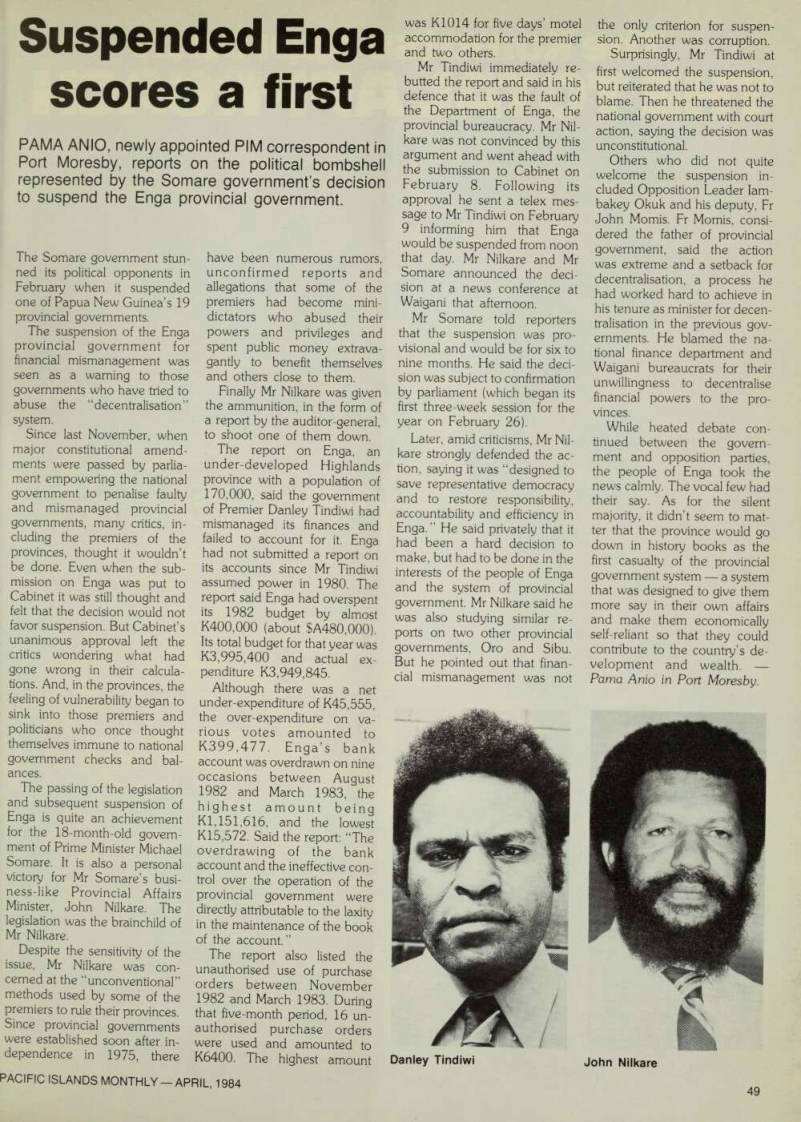
South Pacific Commission faces a problematical future
The South Pacific Commission is “embarking on a path undreamed of by its founders”, according to DONALD STEWART. In the following article he canvasses the pitfalls and the promise held by this new course for the future of the SPC and its now 27 member countries and territories. At different times during the 1970 s Mr Stewart represented Tokelau and Nauru on the SPC, and at South Pacific Conferences. From 1978-81 he was the SPC’s administrative director.
New membership arrange ments for the South Pacific Commission approved in Saipan last October (PIM Nov. ’B3 p. 11) raise as many ques tions about the future of the organisation as they attempt to answer.
Under the new arrangements all 22 countries and territories within the commission’s area, together with the five “metro politan” countries, are full members irrespective of politi cal status or affiliation. This has created an entity whose poten tial political clout is enormous although the commission is specifically precluded by its charter from engaging in poli tics. How will this conflict be handled when it arises, as it is almost certain to do?
The “everyone’s equal” theory was raised by American Samoa at the 1979 South Paci fic Conference in Tahiti and was promptly and vehemently denounced from the floor by Papua New Guinea’s then Minister for Foreign Affairs and Trade, Ebia Olewale. With mighty PNG staring down tiny American Samoa, and in the face of continuing proposals for a single regional organisation (SRO) to supersede the South Pacific Commission (SPC) and the South Pacific Bureau for
Economic Co-operation (SPEC), how did the SPC’s new membership arrangements come to pass in such a short time?
The answer lies partly in the push given by the SPC’s presti gious Secretary-General, Fran cis Bugotu, of Solomon Islands, who presented a paper to the 1983 Saipan conference, enti tied, innocuously enough, “In- House review of the South Pacific Commission by the Secretary-General. ”
Much of this dealt with the nuts and bolts of the secretar iat’s inner workings. But in one respect the expanded membership proposal it was of vast significance. Although the proposal had been pre arranged at a special meeting in Canberra earlier in the year, it found extra and ready acceptance at the Saipan con ference from the French and U.S. territories. PNG, however, this time represented by its respected secretary for Foreign Affairs and Trade, Paulias Matane, remained resolutely, and eloquently, opposed, and finally went along only to avoid destroying consensus.
Until his appointment as secretary-general, Bugotu was the senior diplomat of Solomon Islands, a country not exactly
known for its feelings of tender ness towards the SPC. It was even rumored that his appoint ment would hasten the demise of the SPC by giving impetus to the thrust for an SRO. Why, then, did he take it upon himself to persuade the Saipan conference to adopt expanded membership proposals which, at first glance, appear substan tially to strengthen the SPC’s role in the region?
Funding under the new membership arrangements raises further questions. Who will pay what? Although the metropolitans will almost cer tainly continue to cough up 92 per cent of the commission’s regular budget, the remaining eight per cent, to be split among 22 island governments, could cause problems. Last year’s conference agreed to a three tiered level of contributions from islands governments based on their per capita in comes, but left itself an “out” by making that decision subject to “ratification” by another meeting to be held this year. In other words they weren’t sure enough about the issue to make a final decision.
Why not? The total amount, less than $A300,000, is not large, especially when divided by 22. But funding has always touched a raw nerve among the islands members of the SPC.
Indeed, funding was the issue used to get islands governments into the SPC in the first place when, nearly 20 years ago, Ratu (now Sir) Kamisese Mara pleaded that they be allowed to contribute to the commission’s budget and thereby gain a say in its operations. For years since then islands governments have argued about how much they should contribute, and the per capita income formula, devised
by Australia, is unlikely to put a stop to that.
Again, why not? Well, for a start, the reassessment appears to have been based upon a statistical formula which bears little relation to the islands gov ernments abilities or inabilities to pay. For example, some governments which might be expected to be in a better position than others to contri bute on a weighted basis would actually pay considerably less than at present. Among them are Fiji, Nauru and PNG. A middle group of eight countries would mostly pay quite a bit more, while the bottom group of seven, which includes some of the poorest countries in the world in income terms, would, with the exception of Solomon Islands and Western Samoa, pay substantially more $9OOO-$lO,OOO a year is a lot of money for countries like Tokelau or Tuvalu, and is half of what the islands “big boys” would pay.
This raises more questions because the new membership, and the per capita funding basis, create an Orwellian situa tion whereby although all gov-
Author of this article, Donald Stewart, “wired for sound” at the 1979 South Pacific Confer ence in Papeete.
ernments are equal, some are more equal than others, and this could produce political issues. How, for example, does Western Samoa, which blazed the islands’ path into the SPC in 1965, see itself now at the bottom of the list of contribu tors, while its territorial brother across the water in American Samoa is at the top? Is this the reward of independence? And who has more say, at least behind the the scenes? And so on.
Other political issues may unavoidably follow, touching defence and security matters in the American-dominated North Pacific, nuclear dumping and testing, and New Caledonian independence. How will the SPC, with its formal ban on political issues, deal with these if its new, full members, out weighing the original colonials, insist on bringing them up? And what would this do to the SPC’s relationship with the South Pacific Forum, and SPEC?
The SPC/SPEC issue, which has been studied for years, is not likely to lie down and die.
Under the euphemism “Propo sals for a Single Regional Organisation’’ it is now the subject of review by a commit tee of four foreign ministers due to report to this year’s meeting of the South Pacific Forum in Tuvalu.
This is the most high po wered study yet and there s a good chance that it will, at last, bring some movement on the question. After all, a report from four foreign ministers can’t be just tucked away and ignored as have previous reports. It could be that the expanded SPC will be just the catalyst needed by proponents of an SRO to bring about its creation before the SPC gets any stronger and starts playing politics, which would bring it into conflict with the Forum. On the other hand there may be those who would prefer to see the SPC in conflict with the Forum, because the latter would emerge the winner.
And then there is the school of thought which is happy to see the SPC survive as a conve nient whipping-boy.
None of this touches on what the SPC actually does. Despite talk of overlap, duplication of effort, squandering of re sources, administrative wastefulness and the like, the SPC over the years has done as good a job as could be ex pected in delivering technical assistance to the region, and continues to do so. Whether that will remain the case is really up to the Forum countries for, in the final analysis, it will be
continued on page 52
For the first time in its 37-year history, the South Pacific Com mission has three islanders in its top positions. From left to right they are; Secretary-Gen eral Francis Bugotu (Solomon Islands); Director of Programs Tamarii Pierre (Cook Islands); Deputy Director of Programs Vitolio Lui (Western Samoa).
politics, and not its track record, which will determine the SPC’s future and the Forum is the political master of the region, The question of merging the SRC and SPEC is not one full of administrative complexities but a question of political will. It will be worth noting whether the recently re-constituted SPC gives a shot in the arm to the expression of that will.
Secretary-General Bugotu will not be drawn on these issues which, he told me, are very big questions belonging in
the political field. His member ship proposals had been approved by conference; it was not his job to express views on what had been decided, but to implement those decisions. He did, however, confirm that he is “very happy” with the state of the SPC’s work program.
He may regret at least one effect of the new arrangements.
The old “committee of repre sentatives of participating gov ernments” soon to be re placed by a “committee of the whole” which determined total funds available to the commission, settled the fine points of the administrative budget, dealt with staff matters etc., proved that it could be extraordinarily difficult, even obstructive, with 13 members.
With 27, it is likely to become impossible. Some kind of house-keeping committee may prove to be essential.
Most of this is speculation about the future. Whatever happens it will be interesting to watch the SPC’s course as it embarks on a path undreamed of by its founders.
Advertisements & other items, p. 48 (1 item)
Heating & cooking
Four ways to Better
with
Reliability & savings
SOLAR ENERGY SYSTEMS
ALL PURPOSE BOILERS
v. ©
COMMERCIAL STOVES
DOMESTIC STOVES
Improve your current heating and cooking tacilities now, and save on fuel costs almost immediately.
AtWater Wheel Exports, we're pleased to introduce an exciting range of alternative heating, cooking and solar energy products to suit all domestic, commercial and industrial market requirements.
Naturally, the key advantage of installing a solid fuel stove, boiler or solar energy hot water system, is the fact that you'll never again be totally dependent on gas or electricity for all your heating or cooking requirements.
And, when you consider you're also investing in long-term reliability, it means you'll make substantial savings year after year, after year...
For complete details on our export range of 'Fuel Efficient Money Saving', heating and cooking products, please, fill in the coupon below.
Water Wheel Exports Pty. Ltd. . Exporters of a large and diverse range of products to the Pacific region.
WATER WHEEL EXPORTS PTY. OD.,
53-57 Market Street, South Melbourne, 3205. Victoria, Australia. Telephone: 699 1722, Telex: AA32165.
Telegraphic Address: "Watermill", Melbourne
NAME:
ADDRESS:
COUNTRY: TELEPHONE:
PLEASE SUPPLY INFORMATION ON:
DOMESTIC □ INDUSTRIAL □ COMMERCIAL □
APPLICATIONS OF:
STOVES □ BOILERS □ SOLAR ENERGY SYSTEMS □
Suspended Enga
scores a first
RAMA ANIO, newly appointed RIM correspondent in Port Moresby, reports on the political bombshell represented by the Somare government’s decision to suspend the Enga provincial government.
The Somare government stun ned its political opponents in February when it suspended one of Papua New Guinea’s 19 provincial governments.
The suspension of the Enga provincial government for financial mismanagement was seen as a warning to those governments who have tried to abuse the “decentralisation” system.
Since last November, when major constitutional amend ments were passed by parlia ment empowering the national government to penalise faulty and mismanaged provincial governments, many critics, in cluding the premiers of the provinces, thought it wouldn’t be done. Even when the sub mission on Enga was put to Cabinet it was still thought and felt that the decision would not favor suspension. But Cabinet’s unanimous approval left the critics wondering what had gone wrong in their calcula tions. And, in the provinces, the feeling of vulnerability began to sink into those premiers and politicians who once thought themselves immune to national government checks and bal ances.
The passing of the legislation and subsequent suspension of Enga is quite an achievement for the 18-month-old govern ment of Prime Minister Michael Somare. It is also a personal victory for Mr Somare’s busi ness-like Provincial Affairs Minister, John Nilkare. The legislation was the brainchild of Mr Nilkare.
Despite the sensitivity of the issue, Mr Nilkare was con cerned at the “unconventional” methods used by some of the premiers to rule their provinces.
Since provincial governments were established soon after in dependence in 1975, there
have been numerous rumors, unconfirmed reports and allegations that some of the premiers had become mini dictators who abused their powers and privileges and spent public money extrava gantly to benefit themselves and others close to them.
Finally Mr Nilkare was given the ammunition, in the form of a report by the auditor-general, to shoot one of them down.
The report on Enga, an
under-developed Highlands
province with a population of 170,000, said the government of Premier Danley Tindiwi had mismanaged its finances and failed to account for it. Enga had not submitted a report on its accounts since Mr Tindiwi assumed power in 1980. The report said Enga had overspent its 1982 budget by almost K 400,000 (about $A480,000).
Its total budget for that year was K 3,995,400 and actual ex penditure K 3,949,845.
Although there was a net under-expenditure of K 45,555, the over-expenditure on va rious votes amounted to K 399,477. Enga’s bank account was overdrawn on nine occasions between August 1982 and March 1983, the highest amount being K 1,151,616, and the lowest K 15,572. Said the report; “The overdrawing of the bank account and the ineffective con trol over the operation of the provincial government were directly attributable to the laxity in the maintenance of the book of the account.”
The report also listed the unauthorised use of purchase orders between November 1982 and March 1983. During that five-month period, 16 un authorised purchase orders were used and amounted to K 6400. The highest amount
was KlOl4 for five days’ motel accommodation for the premier and two others.
Mr Tindiwi immediately re butted the report and said in his defence that it was the fault of the Department of Enga, the provincial bureaucracy. Mr Nil kare was not convinced by this argument and went ahead with the submission to Cabinet on
February 8. Following its
approval he sent a telex mes sage to Mr Tindiwi on February 9 informing him that Enga would be suspended from noon that day. Mr Nilkare and Mr Somare announced the deci sion at a news conference at Waigani that afternoon.
Mr Somare told reporters that the suspension was pro visional and would be for six to nine months. He said the deci sion was subject to confirmation by parliament (which began its first three-week session for the year on February 26).
Later, amid criticisms, Mr Nil kare strongly defended the ac tion, saying it was “designed to save representative democracy and to restore responsibility, accountability and efficiency in Enga.’’ He said privately that it had been a hard decision to make, but had to be done in the interests of the people of Enga and the system of provincial government. Mr Nilkare said he was also studying similar re ports on two other provincial governments, Oro and Sibu.
But he pointed out that finan cial mismanagement was not
the only criterion for suspen sion. Another was corruption.
Surprisingly, Mr Tindiwi at first welcomed the suspension, but reiterated that he was not to blame. Then he threatened the national government with court action, saying the decision was unconstitutional.
Others who did not quite welcome the suspension in cluded Opposition Leader lam bakey Okuk and his deputy, Fr John Momis. Fr Momis, consi dered the father of provincial government, said the action was extreme and a setback for decentralisation, a process he had worked hard to achieve in his tenure as minister for decen tralisation in the previous gov ernments. He blamed the na tional finance department and Waigani bureaucrats for their unwillingness to decentralise financial powers to the pro vinces.
While heated debate con tinued between the govern ment and opposition parties, the people of Enga took the news calmly. The vocal few had their say. As for the silent majority, it didn’t seem to mat ter that the province would go down in history books as the first casualty of the provincial government system a system that was designed to give them more say in their own affairs and make them economically self-reliant so that they could contribute to the country’s de velopment and wealth.
Pama Anio in Port Moresby.
Danley Tindiwi
John Nilkare
Advertisements & other items, p. 50 (1 item)
•H Komatsu
: ''2m I ,v' aS&r--m lit* % ss c f>A wc - Our primary concern at Komatsu is to keep the customer satisfied. For us, it's a company-wide endeavor—from management to rank and file. And it's ultimately what enables us to approach problems from all angles.
To assure total quality control, we've adopted The Total Approach': we actively engage in research and development activities, we manufacture, we distribute. This is why we can create products that meet the needs of the market head on, and why we can control the quality of everything we make— from bulldozers, dump trucks and hydraulic excavators to diesel engines, diesel generator sets, presses, machine tools, even industrial robots. All available in a wide range to suit every conceivable application. And all backed by Komatsu's worldwide service network.
And part of our total approach is keeping an eagle eye on the future. Our pioneering work in the exciting new field of "mechatronics" enables us to respond to the needs of today and anticipate those of tomorrow...
Looking for The Total Approach? Look to Komatsu.
•H KOMATSU
tropicalities
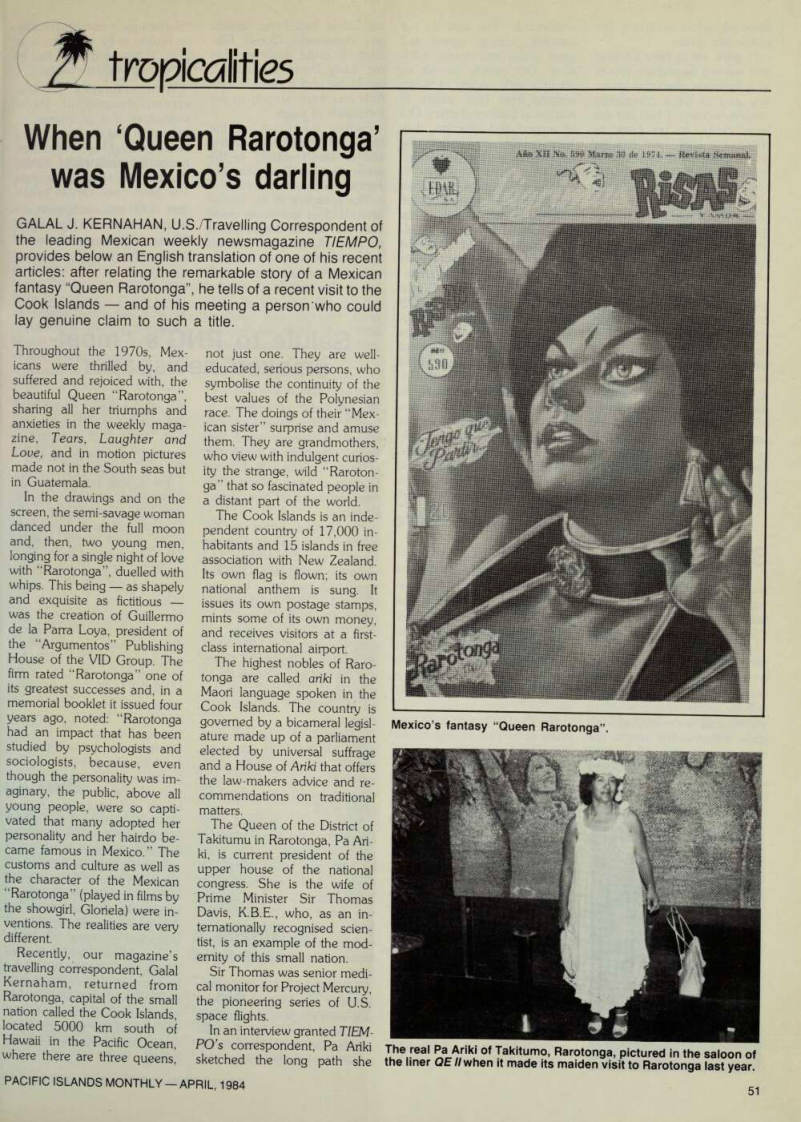
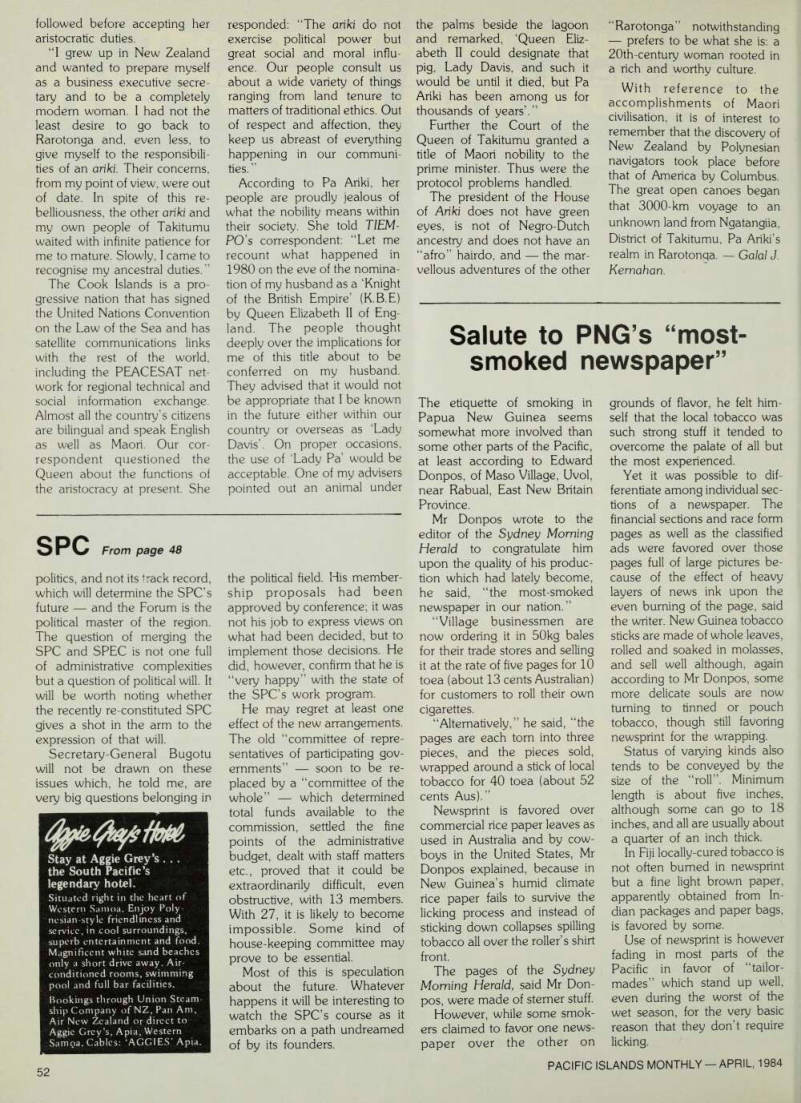
When ‘Queen Rarotonga’ was Mexico’s darling
GALAL J. KERNAHAN, U.S./Travelling Correspondent of the leading Mexican weekly newsmagazine TIEMPO, provides below an English translation of one of his recent articles; after relating the remarkable story of a Mexican fantasy “Queen Rarotonga”, he tells of a recent visit to the Cook Islands and of his meeting a person who could lay genuine claim to such a title.
Throughout the 19705, Mex icans were thrilled by, and suffered and rejoiced with, the beautiful Queen “Rarotonga”, sharing all her triumphs and anxieties in the weekly maga zine, Tears, Laughter and Love, and in motion pictures made not in the South seas but in Guatemala.
In the drawings and on the screen, the semi-savage woman danced under the full moon and, then, two young men, longing for a single night of love with “Rarotonga”, duelled with whips. This being as shapely and exquisite as fictitious was the creation of Guillermo de la Parra Loya, president of the “Argumentos” Publishing House of the VID Group. The firm rated “Rarotonga” one of its greatest successes and, in a memorial booklet it issued four years ago, noted: “Rarotonga had an impact that has been studied by psychologists and sociologists, because, even though the personality was im aginary, the public, above all young people, were so capti vated that many adopted her personality and her hairdo be came famous in Mexico.” The customs and culture as well as the character of the Mexican “Rarotonga” (played in films by the showgirl, Gloriela) were in ventions. The realities are very different.
Recently, our magazine’s travelling correspondent, Galal Kernaham, returned from Rarotonga, capital of the small nation called the Cook Islands, located 5000 km south of Hawaii in the Pacific Ocean, where there are three queensi
not just one. They are well educated, serious persons, who symbolise the continuity of the best values of the Polynesian race. The doings of their “Mex ican sister” surprise and amuse them. They are grandmothers, who view with indulgent curios ity the strange, wild “Raroton ga” that so fascinated people in a distant part of the world, The Cook Islands is an inde pendent country of 17,000 in habitants and 15 islands in free association with New Zealand, Its own flag is flown; its own national anthem is sung. It issues its own postage stamps, mints some of its own money, and receives visitors at a first class international airport.
The highest nobles of Raro tonga are called ariki in the Maori language spoken in the Cook Islands. The country is governed by a bicameral legisl ature made up of a parliament elected by universal suffrage and a House of Ariki that offers the law-makers advice and re commendations on traditional matters, The Queen of the District of Takitumu in Rarotonga, Pa Ari ki, is current president of the upper house of the national congress. She is the wife of Prime Minister Sir Thomas Davis, K.8.E., who, as an in ternationally recognised scien tist, is an example of the mod ernity of this small nation, Sir Thomas was senior medi cal monitor for Project Mercury, the pioneering series of U.S. space flights, In an interview granted TIEM PO’s correspondent, Pa Ariki sketched the long path she
Mexico’s fantasy “Queen Rarotonga”.
The real Pa Ariki of Takitumo, Rarotonga, pictured in the saloon of the liner QE II when it made its maiden visit to Rarotonga last year.
followed before accepting her aristocratic duties.
“I grew up in New Zealand and wanted to prepare myself as a business executive secre tary and to be a completely modern woman. I had not the least desire to go back to Rarotonga and. even less, to give myself to the responsibili ties of an ariki. Their concerns, from my point of view, were out of date. In spite of this re belliousness, the other ariki and my own people of Takitumu waited with infinite patience for me to mature. Slowly, I came to recognise my ancestral duties.”
The Cook Islands is a pro gressive nation that has signed the United Nations Convention on the Law of the Sea and has satellite communications links with the rest of the world, including the PEACESAT net work for regional technical and social information exchange.
Almost all the country’s citizens are bilingual and speak English as well as Maori. Our cor respondent questioned the Queen about the functions of the aristocracy at present. She
responded; “The ariki do not exercise political power but great social and moral influ ence. Our people consult us about a wide variety of things ranging from land tenure to matters of traditional ethics. Out of respect and affection, they keep us abreast of everything happening in our communi ties.”
According to Pa Ariki, her people are proudly jealous of what the nobility means within their society. She told TIEM PO's correspondent: “Let me recount what happened in 1980 on the eve of the nomina tion of my husband as a ‘Knight of the British Empire’ (K.B.E) by Queen Elizabeth II of Eng land. The people thought deeply over the implications for me of this title about to be conferred on my husband.
They advised that it would not be appropriate that I be known in the future either within our country or overseas as ‘Lady Davis’. On proper occasions, the use of ‘Lady Pa’ would be acceptable. One of my advisers pointed out an animal under
the palms beside the lagoon and remarked, ‘Queen Eliz abeth II could designate that pig, Lady Davis, and such it would be until it died, but Pa Ariki has been among us for thousands of years’.”
Further the Court of the Queen of Takitumu granted a title of Maori nobility to the prime minister. Thus were the protocol problems handled.
The president of the House of Ariki does not have green eyes, is not of Negro-Dutch ancestry and does not have an “afro” hairdo, and the mar vellous adventures of the other
“Rarotonga” notwithstanding prefers to be what she is: a 20th-century woman rooted in a rich and worthy culture.
With reference to the accomplishments of Maori civilisation, it is of interest to remember that the discovery of New Zealand by Polynesian navigators took place before that of America by Columbus.
The great open canoes began that 3000-km voyage to an unknown land from Ngatangiia, District of Takitumu, Pa Ariki’s
realm in Rarotonqa.
Galal J.
Kernahan.
smoked newspaper”
Salute to PNG’s “most smoked newspaper”
The etiquette of smoking in Papua New Guinea seems somewhat more involved than some other parts of the Pacific, at least according to Edward Donpos, of Maso Village, Uvol, near Rabual, East New Britain Province.
Mr Donpos wrote to the editor of the Sydney Morning Herald to congratulate him upon the quality of his produc tion which had lately become, he said, “the most-smoked newspaper in our nation.”
“Village businessmen are now ordering it in 50kg bales for their trade stores and selling it at the rate of five pages for 10 toea (about 13 cents Australian) for customers to roll their own cigarettes.
“Alternatively,” he said, “the pages are each tom into three pieces, and the pieces sold, wrapped around a stick of local tobacco for 40 toea (about 52 cents Aus).”
Newsprint is favored over commercial rice paper leaves as used in Australia and by cow boys in the United States, Mr Donpos explained, because in New Guinea’s humid climate rice paper fails to survive the licking process and instead of sticking down collapses spilling tobacco all over the roller’s shirt front.
The pages of the Sydney Morning Herald, said Mr Don pos, were made of sterner stuff.
However, while some smok ers claimed to favor one news paper over the other on
grounds of flavor, he felt him self that the local tobacco was such strong stuff it tended to overcome the palate of all but the most experienced.
Yet it was possible to dif ferentiate among individual sec tions of a newspaper. The financial sections and race form pages as well as the classified ads were favored over those pages full of large pictures be cause of the effect of heavy layers of news ink upon the even burning of the page, said the writer. New Guinea tobacco sticks are made of whole leaves, rolled and soaked in molasses, and sell well although, again according to Mr Donpos, some more delicate souls are now turning to tinned or pouch tobacco, though still favoring newsprint for the wrapping.
Status of varying kinds also tends to be conveyed by the size of the “roll”. Minimum length is about five inches, although some can go to 18 inches, and all are usually about a quarter of an inch thick.
In Fiji locally-cured tobacco is not often burned in newsprint but a fine light brown paper, apparently obtained from In dian packages and paper bags, is favored by some.
Use of newsprint is however fading in most parts of the Pacific in favor of “tailor mades” which stand up well, even during the worst of the wet season, for the very basic reason that they don’t require licking.
Advertisements & other items, p. 52 (1 item)
Stay at Aggie Grey’s . . .
the South Pacific’s
legendary hotel.
Situated right in the heart of Western Samoa. Enjoy Poly nesian-style friendliness and service, in cool surroundings, superb entertainment and food.
Magnificent white sand beaches only a short drive away. Airconditioned rooms, swimming pool and full bar facilities.
Bookings through Union Steamship Company of NZ, Pan Am, Air New Zealand or direct to Aggie Grey’s, Apia, Western Samga. Cables: ‘AGGIES’Apia.
letters
Lament of
two travellers
(1) Nauru
Warning: Travellers from Au stralia and Solomon Islands to Micronesia are now charged $8 an hour, without food, to sleep on Nauru.
Air Nauru no longer flies from Honiara and points south to Ponape in one day. You are required to change planes in Nauru, and use one of the beds in their Hotel Menen. You are supposed to arrive in Nauru at 9 p.m. Tuesday (in my case actually midnight), and the flight to Ponape boards (but doesn’t in my case depart) at 7 a.m. the next morning.
The Nauru Consulate in Mel bourne now demands you obtain a visa for “one day”, and has the audacity to charge $6 for their stamp. The bed at the Menen Hotel is $3O; the airport departure tax $10; so you are charged about $8 an hour to stay on that island.
Air Nauru does give a sand wich to passengers boarding in New Zealand, but “dinner” on the Honiara-Nauru flight is one glass of fruit juice. I don’t know if their hotel has a restaurant, or what the island of Nauru looks like, and never will.
Robert Sperry
Adelaide SA Australia
(2) Png
It has been my good fortune to visit Papua New Guinea several times in the past few years. Is the national government, or the national airline, interested in bringing tourists into the coun try? Evidently not, judging by the airfares charged for the last leg of the journey from New York to Port Moresby.
I recently researched airfares for a possible holiday in PNG, and came up with the following: New York to Honolulu return (approximate one-way mileage 5129) SUS4SO: Honolulu to Port Moresby return (4000
miles) $ U 51350. New York to Manila return (10,335 miles) $US1100; Manila to Port Moresby return (2442 miles) SUSISOO. New York to Bris bane return (11,794 miles) SUSI6OO; Brisbane to Port Moresby return (SUS7OO).
As can be seen from the above, the major cost of going half way round the world to visit PNG is the last leg of the journey. Are the air fares charged for flights into Port Moresby set at an artificial high to protect Air Niugini?
My first stay in the country, 1943-45, was all expenses paid . . . Please, whoever is perpetrating this fare inequity, help us New Guinea buffs. We would like a more affordable holiday in your beautiful country.
Roger F. Sykes
Elmira Heights N.Y.
Usa
Tichborne?
Tlchbourne?
Tui Garnett inquired (FIM Oct. ’B3 p 9) who was “Sundow ner”, author of Rambles in Polynesia, Wild Life in the Pacific, etc. He was, according to our catalogue, one Herbert Tichboume. Regret no further biographical details available here.
Lan Knights
Information Officer Royal Commonwealth Society Information Bureau, London UK Mr Knights’ information gen erally confirms that of reader Rod Ewins (FIM Jan. p 7) ex cept that Mr Ewins replied to Mr Garnett’s inquiry by saying that “Sundowner” was the pen name of “H. C. Tichborne” (without the “u”).
A misplaced
high point
Thank you for the offprints of my brief note on “The First Fijians to Meet Europeans” (FIM Oct. ’B3 p 23), and the most unexpected cheque which I have donated as a subscrip
tion to the Ono-i-Lau school.
Unfortunately, I made a rather serious error in the arti cle: the highest peak of Doi is not Naisoyaga but Naisogovu la. Naisoyaga is a high point on Onolevu but not Doi. Do you think it would be possible to correct his with a brief note?
Incidentally, but of much less consequence, there is a typeset ting error in the next column; “Two sand bays ...” should read “Two sand cays . . .”; there are no bays in this area, sand cays being sandy islets.
With my very best wishes to all who labor at FIM.
Garth Rogers
Department of Anthropology University of Auckland Auckland New Zealand
CUSO by no
other name. . .
Recently your publication printed an article mentioning our organisation. Unfortunate ly, it used our former title instead of the new one. In 1981 we changed our name; CUSO is no longer an acronym but the full title of the organisation.
For years we have fought against an image of a students’ organisation. Oftentimes, our acronym was even wrongly spelled out as Canadian Uni versity Students Overseas rather than Canadian Univer sity Service Overseas. This served to perpetuate the image.
CUSO is not and never was a students’ organisation. Our workers have always been pro fessionals or skilled, qualified people. They have ranged in age from the early 20s to the mid-70s, the average age today being 30. Many are taking a mid-career break or early retire ment to join our organisation for two years’ service in the developing world, and they have years of experience to offer as well as paper qualifica tions.
Because our workers have been known as “volunteers,” this has apparently suggested
that they are unpaid and unskil led. They are neither the overseas government or agen cy requesting CUSO’s services pays their salaries (admittedly lower than in Canada but ade quate for a reasonable lifestyle in the Third World), and our workers are not accepted for placement unless they are qual ified.
Having labored for 20 years under the misconception that we are a students’ organisation, we decided to change our name simply to CUSO in the hopes of setting the record straight in the public mind. The fact that the name-change has not registered with some mem bers of the media is now begin ning to hurt us.
Slater St.,
Barbara Malone
Ottawa, Director Canada Public Affairs
Cuso.
An elusive
broadcaster
I am very taken up with the hobby of shortwave listening.
In March last year a broad casting station calling itself “Radio Tropical, the Voice of the Nuclear-free Pacific” made a very brief appearance on the air. No location of the station was given, and the only clue seemed to be reference to “Pacific Magazine”. I eventually was able to find an address for a Pacific Magazine in Honolulu and wrote to Radio Tropical care of the editor. I have had no response from either the radio station or the magazine.
It has now been suggested to me that the “magazine” men tioned was not a publication but a radio program of that name.
However, I have not been able to discover which if any of the Islands broadcasters carries a program of that title.
I am writing in the hope that perhaps one of your readers will be able to help me.
T. C. L. Symes
Wellington New Zealand
from the islands press

From an advertisement in the Papua New Guinea Post- Courier Would you like to plan your family the family welfare association advises the use of Condoms for men. Condoms are safe and easy to use, and only cost 75t for 10.
From The Fiji Times Twenty-one homes and a community church in Vatulele village, Koro, are now lighted on power from the sun. The solar photovoltaic lighting units were installed by the Vatulele Village Electric Co., a village venture formed to buy, instal and maintain the solar systems . . . The electric company is the brainchild of Peace Corps volunteers Robert and Elizabeth Clarke who live and work in Vatulele. The solar units are the property of the village committee and are sold to homes for $lOO.
From Povai (published by the Vanuatu/Pacific Community Centre) November 2nd elections in the Cook Islands returned Sir Tom Davis to power. That’s a blow for POVAI and the NFIP movement since Sir Tom always does what the white boy from down under, Muldoon, tells him.
From the Home Game (women’s column) by Virginia Truax in the Samoa Times.
Good show! Need lingerie in ecru or skin tone? Save money by dyeing white undies in strong hot tea.
From the Marianas Variety News & Views.
Power bills are not the only ones that haven’t been collected.
According to testimonies presented at budget hearings Tuesday morning before the Senate Fiscal Affairs Committee, less than 10% of the government’s water bills have been paid for fiscal year 1983. The fiscal year ends on Sept. 30. Out of $421,370 in bills mailed to consumers, only $40,101 has been received to date. The Committee told Public Works that their record of collections was unsatisfactory and that efforts should be made to enforce payment.
From The Tonga Chronicle reporting King Taufa’ahau Tupou’s comments on Tonga’s failure to meet New Zealand’s demands for produce.
“. . . Rock melons are fetching good prices in comparison to water melons, but Tonga growers tend to like planting water melons. The types of fruit that receive greater demand on the market are not those that the Tongan growers are planting.”
From a political commentary by Mika in The Samoa Observer.
“Not worth listening to.” “How did these people get into Parliament in the first place?” “Couldn’t the Prime Minister answer questions without dragging debates into those low of low personal attacks?” “Samoa should have a three-member Parliament Tofilau, Tupuola and a clergyman to bury whoever gets strangled first.” These are some of the terms presently being used by some people to describe the near-fracas situation taking place in Parliament. And many seem to agree . . .
From a letter by Listener in The Samoa Observer I must congratulate the Speaker for his superb handling of Parliament. There is a man who knows the standing orders so intimately well that he delivers a ruling quoting from the House’s book of laws so as to make Moses’ ten commandments appear like a child’s story book . . .
From the Police Patrol column in Marianas Variety News & Views.
September 7.5:44 a.m. Moses Pangelinan told police that someone had siphoned gasoline from bus No. 4. September 8.6:18 a.m. Moses Pangelinan reported that someone drained 10 gals, of gasoline from a school bus. September 9.5:58 a.m. Moses Pangelinan reported that someone siphoned gasoline from a school bus. September 11.5:46 a.m. Moses Pangelinan called police and reported that someone drained the gasoline from one of the school buses.
From an editorial in The Times of Papua New Guinea.
Justice for all, is one of the great democratic slogans. And it is an area which can put democracy itself at risk, if it fails to be more than a slogan. In Papua New Guinea today, we are in danger of sliding towards differential access to democracy.
There appears to be emerging, a pattern of three tiers of justice. If you are an expatriate, you can get justice if you pay for it. If you are a politician, you get justice because you are a politician. If you are neither, you get justice if you are lucky An extract from a letter by P. R. Sharp, Rabaul, in the Papua New Guinea Post-Courier. . . . While not agreeing with this (the practice of homosexuality), when observing some females, it’s a wonder a lot more of us aren’t queer . . .
Advertisements & other items, p. 54 (1 item)
Houses’
‘tiSTANT
and Commercial Buildings with Therma-Panel, R the
fully insulated inter-locking
Building System
Cyclone rated George Hudson Homes (Aust.) pt y . Ltd. 186 Hume Highway Cabramatta NSW 2166 Australia. Tel: (02) 727 9066. Telex: AA25800 Post coupon for details and prices.
Name...
Address Tel:
song unheeded
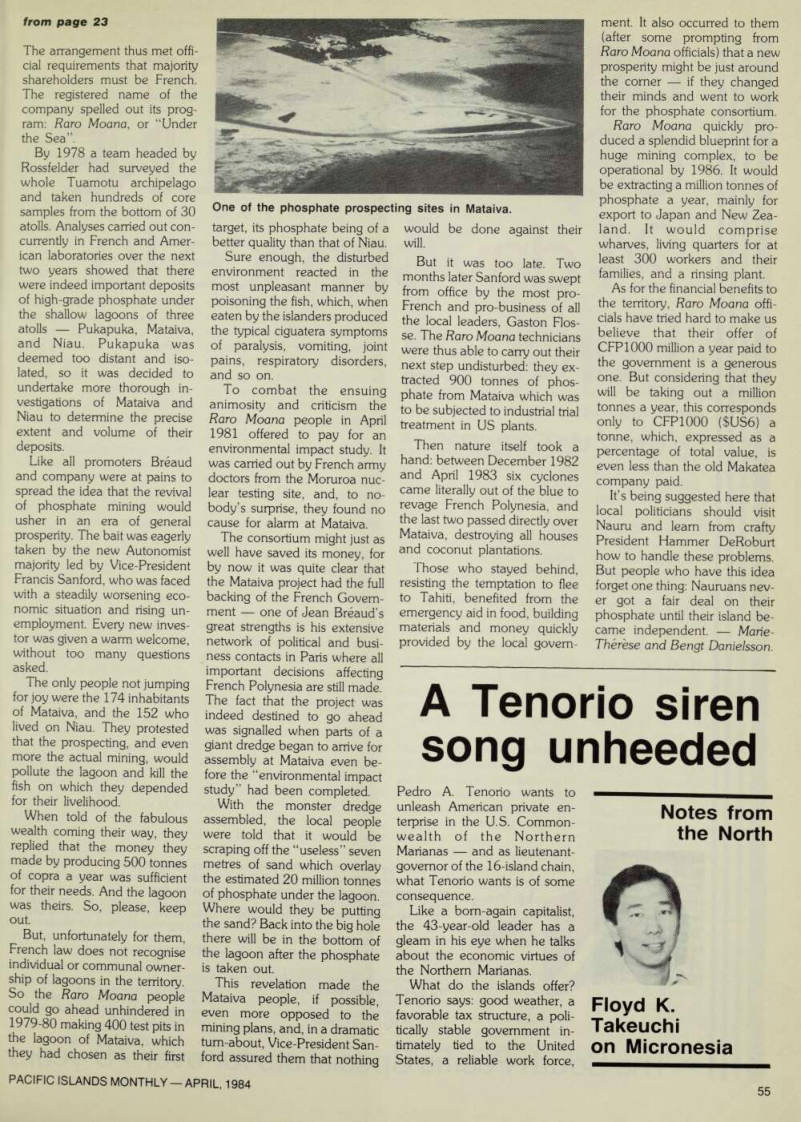

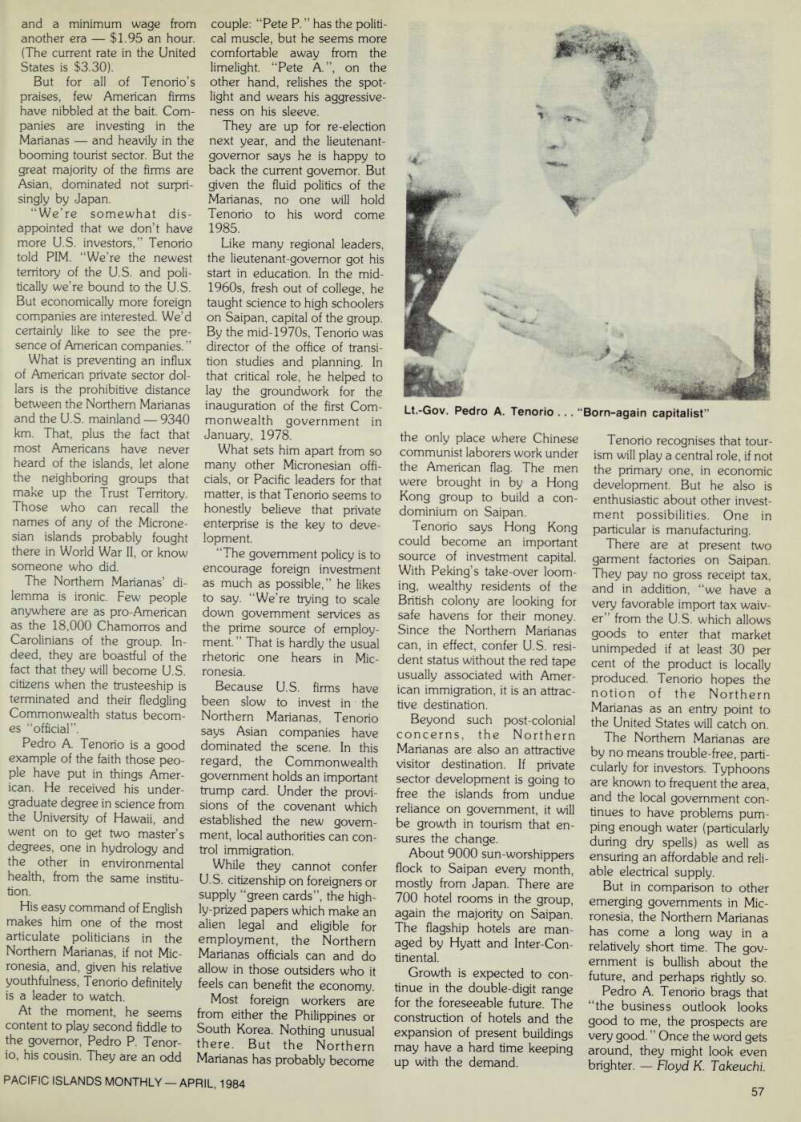
A Tenorio siren song unheeded
Pedro A. Tenorio wants to unleash American private en terprise in the U.S. Common wealth of the Northern Marianas and as lieutenant governor of the 16-island chain, what Tenorio wants is of some consequence.
Like a born-again capitalist, the 43-year-old leader has a gleam in his eye when he talks about the economic virtues of the Northern Marianas.
What do the islands offer?
Tenorio says: good weather, a favorable tax structure, a poli tically stable government in timately tied to the United States, a reliable work force,
Notes from the North
Floyd K.
Takeuchi on Micronesia
and a minimum wage from another era $1.95 an hour. (The current rate in the United States is $3.30).
But for all of Tenorio’s praises, few American firms have nibbled at the bait. Com panies are investing in the Marianas and heavily in the booming tourist sector. But the great majority of the firms are Asian, dominated not surpri singly by Japan.
“We’re somewhat dis appointed that we don’t have more U.S. investors,” Tenorio told PIM. “We’re the newest territory of the U.S. and poli tically we’re bound to the U.S.
But economically more foreign companies are interested. We’d certainly like to see the pre sence of American companies. ”
What is preventing an influx of American private sector dol lars is the prohibitive distance between the Northern Marianas and the U.S. mainland 9340 km. That, plus the fact that most Americans have never heard of the islands, let alone the neighboring groups that make up the Trust Territory.
Those who can recall the names of any of the Microne sian islands probably fought there in World War 11, or know someone who did.
The Northern Marianas’ di lemma is ironic. Few people anywhere are as pro-American as the 18,000 Chamorros and Carolinians of the group. In deed, they are boastful of the fact that they will become U.S. citizens when the trusteeship is terminated and their fledgling Commonwealth status becom es “official”.
Pedro A. Tenorio is a good example of the faith those peo ple have put in things Amer ican. He received his under graduate degree in science from the University of Hawaii, and went on to get two master’s degrees, one in hydrology and the other in environmental health, from the same institu tion.
His easy command of English makes him one of the most articulate politicians in the Northern Marianas, if not Mic ronesia, and, given his relative youthfulness, Tenorio definitely is a leader to watch.
At the moment, he seems content to play second fiddle to : the governor, Pedro P. Tenor io, his cousin. They are an odd
i couple; “Pete P. ” has the politi cal muscle, but he seems more comfortable away from the limelight. “Pete A.”, on the other hand, relishes the spot light and wears his aggressive ness on his sleeve.
They are up for re-election next year, and the lieutenant governor says he is happy to back the current governor. But given the fluid politics of the Marianas, no one will hold Tenorio to his word come 1985.
Like many regional leaders, the lieutenant-governor got his start in education. In the mid -19605, fresh out of college, he taught science to high schoolers on Saipan, capital of the group.
By the mid-19705, Tenorio was director of the office of transi tion studies and planning. In that critical role, he helped to lay the groundwork for the inauguration of the first Com monwealth government in January, 1978.
What sets him apart from so many other Micronesian offi cials, or Pacific leaders for that matter, is that Tenorio seems to honestly believe that private enterprise is the key to deve lopment.
“The government policy is to encourage foreign investment as much as possible,” he likes to say. “We’re trying to scale down government services as the prime source of employ ment.” That is hardly the usual rhetoric one hears in Mic ronesia.
Because U.S. firms have been slow to invest in the Northern Marianas, Tenorio says Asian companies have dominated the scene. In this regard, the Commonwealth government holds an important trump card. Under the provi sions of the covenant which established the new govern ment, local authorities can con trol immigration.
While they cannot confer U.S. citizenship on foreigners or supply “green cards”, the high ly-prized papers which make an alien legal and eligible for employment, the Northern Marianas officials can and do allow in those outsiders who it feels can benefit the economy.
Most foreign workers are from either the Philippines or South Korea. Nothing unusual there. But the Northern Marianas has probably become
the only place where Chinese communist laborers work under the American flag. The men were brought in by a Hong Kong group to build a con dominium on Saipan.
Tenorio says Hong Kong could become an important source of investment capital.
With Peking’s take-over loom ing, wealthy residents of the British colony are looking for safe havens for their money.
Since the Northern Marianas can, in effect, confer U.S. resi dent status without the red tape usually associated with Amer ican immigration, it is an attrac tive destination.
Beyond such post-colonial concerns, the Northern Marianas are also an attractive visitor destination. If private sector development is going to free the islands from undue reliance on government, it will be growth in tourism that en sures the change.
About 9000 sun-worshippers flock to Saipan every month, mostly from Japan. There are 700 hotel rooms in the group, again the majority on Saipan.
The flagship hotels are man aged by Hyatt and Inter-Con tinental.
Growth is expected to con tinue in the double-digit range for the foreseeable future. The construction of hotels and the expansion of present buildings may have a hard time keeping up with the demand.
Tenorio recognises that tour ism will play a central role, if not the primary one, in economic development. But he also is enthusiastic about other invest ment possibilities. One in particular is manufacturing.
There are at present two garment factories on Saipan.
They pay no gross receipt tax, and in addition, “we have a very favorable import tax waiv er” from the U.S. which allows goods to enter that market unimpeded if at least 30 per cent of the product is locally produced. Tenorio hopes the notion of the Northern Marianas as an entry point to the United States will catch on.
The Northern Marianas are by no means trouble-free, parti cularly for investors. Typhoons are known to frequent the area, and the local government con tinues to have problems pum ping enough water (particularly during dry spells) as well as ensuring an affordable and reli able electrical supply.
But in comparison to other emerging governments in Mic ronesia, the Northern Marianas has come a long way in a relatively short time. The gov ernment is bullish about the future, and perhaps rightly so.
Pedro A. Tenorio brags that “the business outlook looks good to me, the prospects are very good. ” Once the word gets around, they might look even
brighter.
Floyd K. Takeuchi.
Lt.-Gov. Pedro A. Tenorio ... “Born-again capitalist”
Advertisements & other items, p. 56 (1 item)
Europe.
BANK LINE and
COLUMBUS LINE
24 day service to
Europe.
Need we say more...
D O The Joint Service Partners offer facilities for shipment of: Containers (FCL/LCL) and Break-bulk Cargo plus reefer space and deeptanks for carriage of vegetable oils and other liquid bulk cargo.
Carriers also accept heavy lifts, overlength and cumbersome parcels.
Ports of Service: Loading: Papeete, Apia, Suva, Lautoka, Noumea, Port Vila, Santo, Honiara, Port Moresby, Lae, Madang, Kimbe, Rabaul, Kieta, Darwin. For: Rotterdam, Antwerp, Hamburg, Hull, Dunkirk, Le Havre.
Additional ports on enquiry.
Please contact our regional offices for further information: The Bank Line (Australasia) Pty Ltd Suite 801,51 Pitt St, Sydney, NSW, Australia 2000 Phone 27 2041 Telex 24063 Columbus Line Reederei GmbH P.O. Box 1 667, Lae/Papua New Guinea.
Phone: 423466/423487/AH. 422481 Telex: Colline NE 441 71 The South Pacific Specialists for over 75 years
people
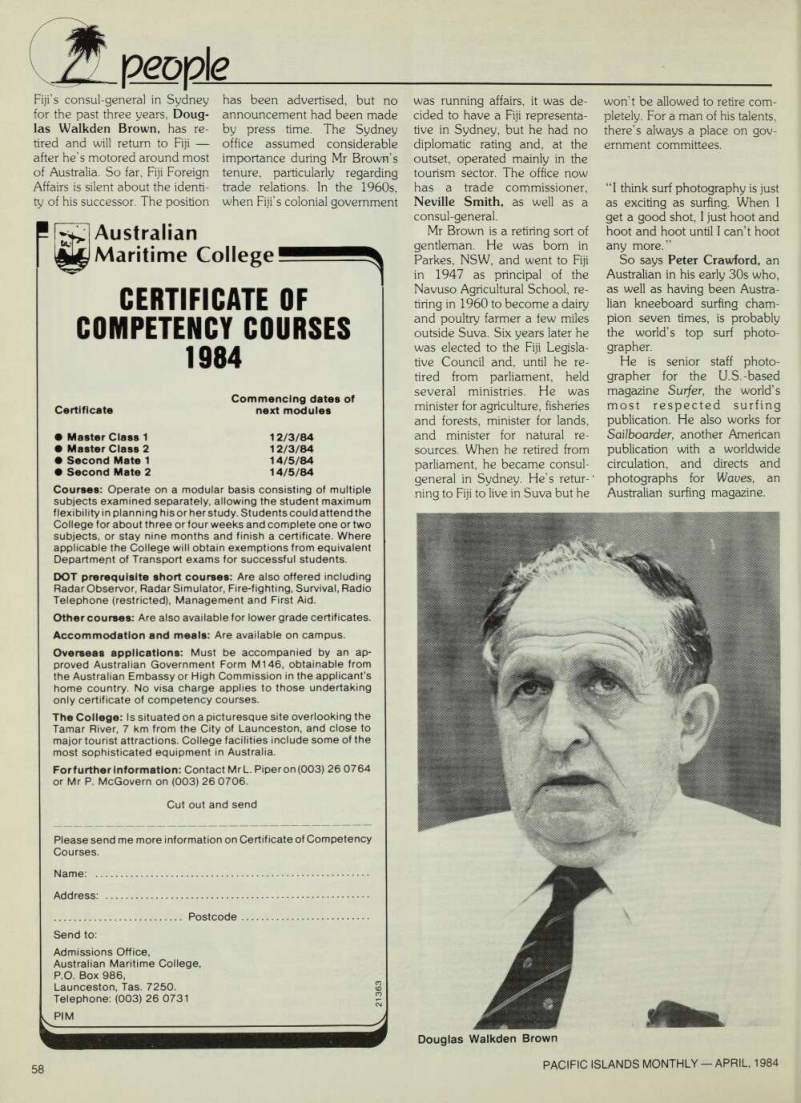
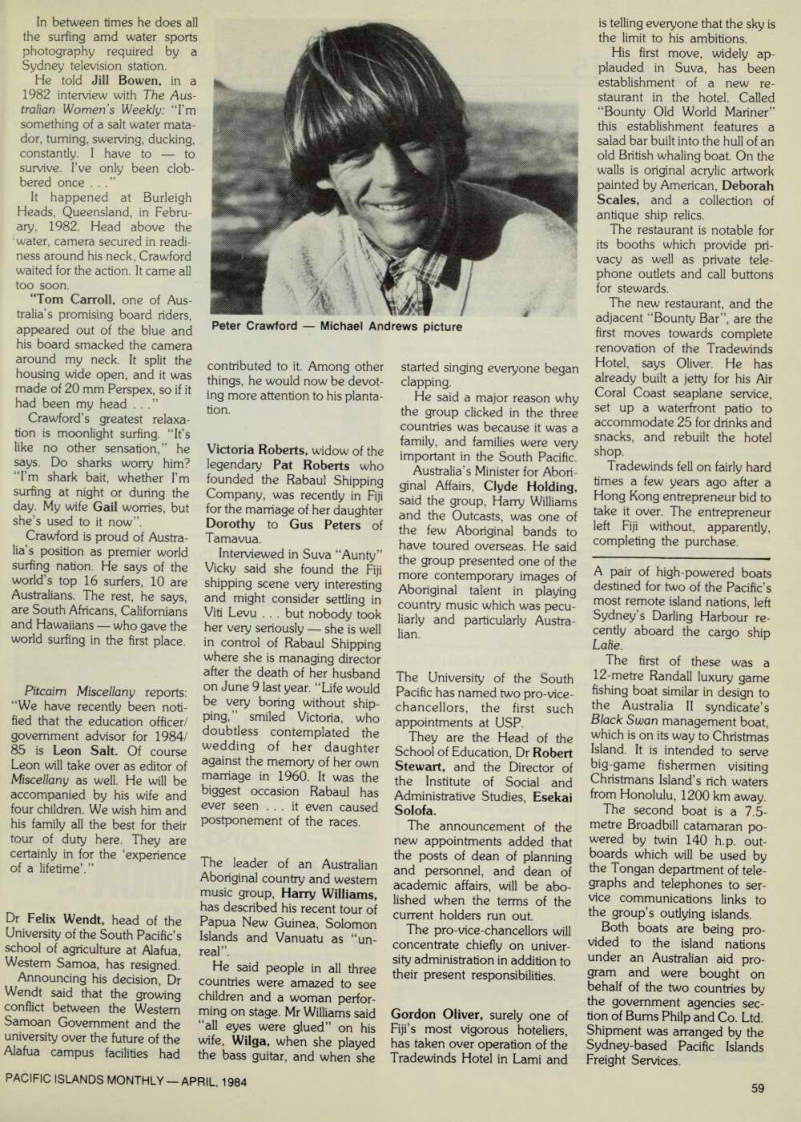
Fiji’s consul-general in Sydney for the past three years, Doug las Walkden Brown, has re tired and will return to Fiji after he’s motored around most of Australia. So far, Fiji Foreign Affairs is silent about the identi ty of his successor. The position
has been advertised, but no announcement had been made by press time. The Sydney office assumed considerable importance during Mr Brown’s tenure, particularly regarding trade relations. In the 19605, when Fiji’s colonial government
was running affairs, it was de cided to have a Fiji representa tive in Sydney, but he had no diplomatic rating and, at the outset, operated mainly in the tourism sector. The office now has a trade commissioner, Neville Smith, as well as a consul-general.
Mr Brown is a retiring sort of gentleman. He was born in Parkes, NSW, and went to Fiji in 1947 as principal of the Navuso Agricultural School, re tiring in 1960 to become a dairy and poultry farmer a few miles outside Suva. Six years later he was elected to the Fiji Legisla tive Council and, until he re tired from parliament, held several ministries. He was minister for agriculture, fisheries and forests, minister for lands, and minister for natural re sources. When he retired from parliament, he became consul general in Sydney. He’s retur-’ ning to Fiji to live in Suva but he
won’t be allowed to retire com pletely. For a man of his talents, there’s always a place on gov ernment committees.
“I think surf photography is just as exciting as surfing. When I get a good shot, I just hoot and hoot and hoot until I can’t hoot any more.”
So says Peter Crawford, an Australian in his early 30s who, as well as having been Austra lian kneeboard surfing cham pion seven times, is probably the world’s top surf photo grapher.
He is senior staff photo grapher for the U.S.-based magazine Surfer, the world’s most respected surfing publication. He also works for Sailboarder, another American publication with a worldwide circulation, and directs and photographs for Waves, an Australian surfing magazine.
Douglas Walkden Brown
In between times he does all the surfing amd water sports photography required by a Sydney television station.
He told Jill Bowen, in a 1982 interview with The Aus tralian Women’s Weekly: “I’m something of a salt water mata dor, turning, swerving, ducking, constantly. I have to to survive. I’ve only been clob bered once ...”
It happened at Burleigh Heads, Queensland, in Febru ary, 1982. Head above the water, camera secured in readi ness around his neck, Crawford waited for the action. It came all too soon.
“Tom Carroll, one of Aus tralia’s promising board riders, appeared out of the blue and his board smacked the camera around my neck. It split the housing wide open, and it was made of 20 mm Perspex, so if it had been my head ...”
Crawford’s greatest relaxa tion is moonlight surfing. “It’s like no other sensation,” he says. Do sharks worry him?
“I’m shark bait, whether I’m surfing at night or during the day. My wife Gail worries, but she’s used to it now”.
Crawford is proud of Austra lia’s position as premier world surfing nation. He says of the world’s top 16 surfers, 10 are Australians. The rest, he says, are South Africans, Californians and Hawaiians who gave the world surfing in the first place.
Pitcairn Miscellany reports: “We have recently been noti fied that the education officer/ government advisor for 1984/ 85 is Leon Salt. Of course Leon will take over as editor of Miscellany as well. He will be accompanied by his wife and four children. We wish him and his family all the best for their tour of duty here. They are certainly in for the ‘experience of a lifetime’.”
Dr Felix Wendt, head of the University of the South Pacific’s school of agriculture at Alafua, Western Samoa, has resigned.
Announcing his decision, Dr Wendt said that the growing conflict between the Western Samoan Government and the university over the future of the Alafua campus facilities had
contributed to it. Among other things, he would now be devot ing more attention to his planta tion.
Victoria Roberts, widow of the legendary Pat Roberts who founded the Rabaul Shipping Company, was recently in Fiji for the marriage of her daughter Dorothy to Gus Peters of Tamavua.
Interviewed in Suva “Aunty”
Vicky said she found the Fiji shipping scene very interesting and might consider settling in Viti Levu . . . but nobody took her very seriously she is well in control of Rabaul Shipping where she is managing director after the death of her husband on June 9 last year. “Life would be very boring without ship ping,” smiled Victoria, who doubtless contemplated the wedding of her daughter against the memory of her own marriage in 1960. It was the biggest occasion Rabaul has ever seen ... it even caused postponement of the races.
The leader of an Australian Aboriginal country and western music group, Harry Williams, has described his recent tour of Papua New Guinea, Solomon Islands and Vanuatu as “un real”.
He said people in all three countries were amazed to see children and a woman perfor ming on stage. Mr Williams said “all eyes were glued” on his wife, Wilga, when she played the bass guitar, and when she
started singing everyone began clapping.
He said a major reason why the group clicked in the three countries was because it was a family, and families were very important in the South Pacific.
Australia’s Minister for Abori ginal Affairs, Clyde Holding, said the group, Harry Williams and the Outcasts, was one of the few Aboriginal bands to have toured overseas. He said the group presented one of the more contemporary images of Aboriginal talent in playing country music which was pecu liarly and particularly Austra lian.
The University of the South Pacific has named two pro-vice chancellors, the first such appointments at USP.
They are the Head of the School of Education, Dr Robert Stewart, and the Director of the Institute of Social and Administrative Studies, Esekai Solofa.
The announcement of the new appointments added that the posts of dean of planning and personnel, and dean of academic affairs, will be abo lished when the terms of the current holders run out.
The pro-vice-chancellors will concentrate chiefly on univer sity administration in addition to their present responsibilities.
Gordon Oliver, surely one of Fiji’s most vigorous hoteliers, has taken over operation of the Tradewinds Hotel in Lami and
is telling everyone that the sky is the limit to his ambitions.
His first move, widely ap plauded in Suva, has been establishment of a new re staurant in the hotel. Called “Bounty Old World Mariner” this establishment features a salad bar built into the hull of an old British whaling boat. On the walls is original acrylic artwork painted by American, Deborah Scales, and a collection of antique ship relics.
The restaurant is notable for its booths which provide pri vacy as well as private tele phone outlets and call buttons for stewards.
The new restaurant, and the adjacent “Bounty Bar”, are the first moves towards complete renovation of the Tradewinds Hotel, says Oliver. He has already built a jetty for his Air Coral Coast seaplane service, set up a waterfront patio to accommodate 25 for drinks and snacks, and rebuilt the hotel shop.
Tradewinds fell on fairly hard times a few years ago after a Hong Kong entrepreneur bid to take it over. The entrepreneur left Fiji without, apparently, completing the purchase.
A pair of high-powered boats destined for two of the Pacific’s most remote island nations, left Sydney’s Darling Harbour re cently aboard the cargo ship Lahe.
The first of these was a 12-metre Randall luxury game fishing boat similar in design to the Australia II syndicate’s Black Swan management boat, which is on its way to Christmas Island. It is intended to serve big-game fishermen visiting Christmans Island’s rich waters from Honolulu, 1200 km away.
The second boat is a 7.5metre Broadbill catamaran po wered by twin 140 h.p. out boards which will be used by the Tongan department of tele graphs and telephones to ser vice communications links to the group’s outlying islands.
Both boats are being pro vided to the island nations under an Australian aid pro gram and were bought on behalf of the two countries by the government agencies sec tion of Bums Philp and Co. Ltd.
Shipment was arranged by the Sydney-based Pacific Islands Freight Services.
Peter Crawford - Michael Andrews picture
Advertisements & other items, p. 58 (1 item)
Certificate Of
Maritime College
COMPETENCY COURSES
1984 Courses: Operate on a modular basis consisting of multiple subjects examined separately, allowing the student maximum flexibility in planning hisor herstudy. Students couldattendthe College for about three or four weeks and complete one or two subjects, or stay nine months and finish a certificate. Where applicable the College will obtain exemptions from equivalent Department of Transport exams for successful students.
DOT prerequisite short courses: Are also offered including Radar Observer, Radar Simulator, Fire-fighting, Survival, Radio Telephone (restricted), Management and First Aid.
Other courses: Are also available for lower grade certificates.
Accommodation and meals: Are available on campus.
Overseas applications: Must be accompanied by an approved Australian Government Form M 146, obtainable from the Australian Embassy or High Commission in the applicant’s home country. No visa charge applies to those undertaking only certificate of competency courses.
The College: Is situated on a picturesque site overlooking the Tamar River, 7 km from the City of Launceston, and close to major tourist attractions. College facilities include some of the most sophisticated equipment in Australia.
Forfurther information: Contact MrL. Piperon(oo3) 26 0764 or Mr P. McGovern on (003) 26 0706.
Please send me more information on Certificate of Competency Courses.
Name: Address: Send to: Admissions Office, Australian Maritime College, P.O. Box 986, Launceston, Tas. 7250.
Telephone: (003) 26 0731
PIM
Certificate Commencing dates of next modules • Master Class 1 • Master Class 2 • Second Mate 1 • Second Mate 2 12/3/84 1 2/3/84 14/5/84 14/5/84 Cut out and send Postcode 21363
yachts
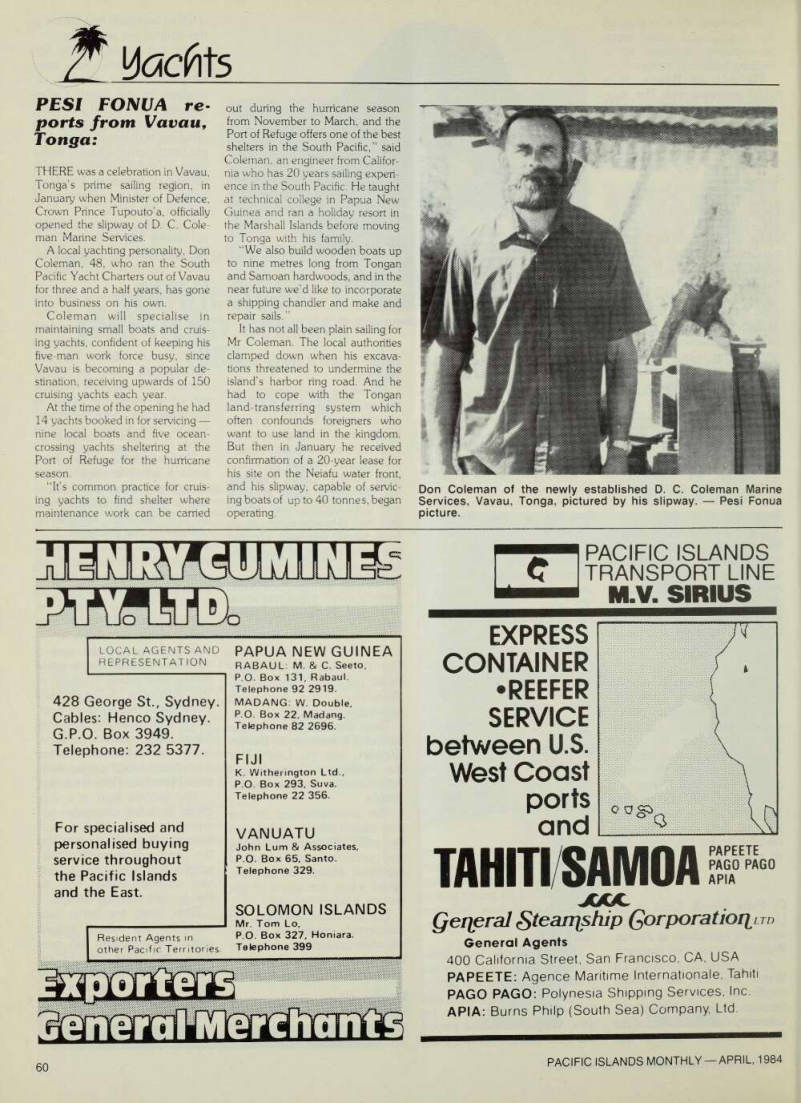
Pesi Fonua Re
ports from Vavau , Tonga:
THERE was a celebration in Vavau, Tonga’s prime sailing region, in January when Minister of Defence, Crown Prince Tupouto’a, officially opened the slipway of D. C. Cole man Marine Services.
A local yachting personality, Don Coleman, 48, who ran the South Pacific Yacht Charters out of Vavau for three and a half years, has gone into business on his own.
Coleman will specialise in maintaining small boats and cruis ing yachts, confident of keeping his five-man work force busy, since Vavau is becoming a popular de stination, receiving upwards of 150 cruising yachts each year.
At the time of the opening he had 14 yachts booked in for servicing nine local boats and five ocean crossing yachts sheltering at the Port of Refuge for the hurricane season.
“It’s common practice for cruis ing yachts to find shelter where maintenance work can be carried
out during the hurricane season from November to March, and the Port of Refuge offers one of the best shelters in the South Pacific,” said Coleman, an engineer from Califor nia who has 20 years sailing experi ence in the South Pacific. He taught at technical college in Papua New Guinea and ran a holiday resort in the Marshall Islands before moving to Tonga with his family.
“We also build wooden boats up to nine metres long from Tongan and Samoan hardwoods, and in the near future we’d like to incorporate a shipping chandler and make and repair sails.”
It has not all been plain sailing for Mr Coleman. The local authorities clamped down when his excava tions threatened to undermine the island’s harbor ring road. And he had to cope with the Tongan land-transferring system which often confounds foreigners who want to use land in the kingdom.
But then in January he received confirmation of a 20-year lease for his site on the Neiafu water front, and his slipway, capable of servic ing boats of up to 40 tonnes, began operating.
Don Coleman of the newly established D. C. Coleman Marine Services, Vavau, Tonga, pictured by his slipway. - Pesi Fonua picture.
Advertisements & other items, p. 60 (1 item)
Tahiti Samoa S"~
LOCAL AGENTS AND PAPUA NEW GUINEA
REPRESENTATION RABAUL: M. & C. Seeto,
P.O. Box 131, Rabaul.
Telephone 92 2919.
MADANG: W. Double, P.O. Box 22, Madang.
Telephone 82 2696.
FIJI
K. Witherington Ltd., P.O. Box 293, Suva.
Telephone 22 356.
428 George St., Sydney.
Cables: Henco Sydney.
G.P.O. Box 3949.
Telephone: 232 5377.
For specialised and
personalised buying
service throughout
the Pacific Islands and the East.
Resident Agents in other Pacific Territories.
VANUATU
John Lum & Associates, P.O. Box 65, Santo.
Telephone 329.
SOLOMON ISLANDS
Mr. Tom Lo, P.O. Box 327, Honiara.
Telephone 399 8 I 8
PACIFIC ISLANDS
TRANSPORT LINE
M.V. SIRIUS
EXPRESS
CONTAINER
•REEFER
SERVICE
between U.S.
West Coast ports and c
TAHITI SAMOA S"~
XAJL
Qeqeral Steamship (Corporatiori General Agents 400 California Street, San Francisco, CA, USA PAPEETE: Agence Maritime Internationale, Tahiti PAGO PAGO: Polynesia Shipping Services, Inc.
APIA: Burns Philp (South Sea) Company, Ltd.
Shipping schedules
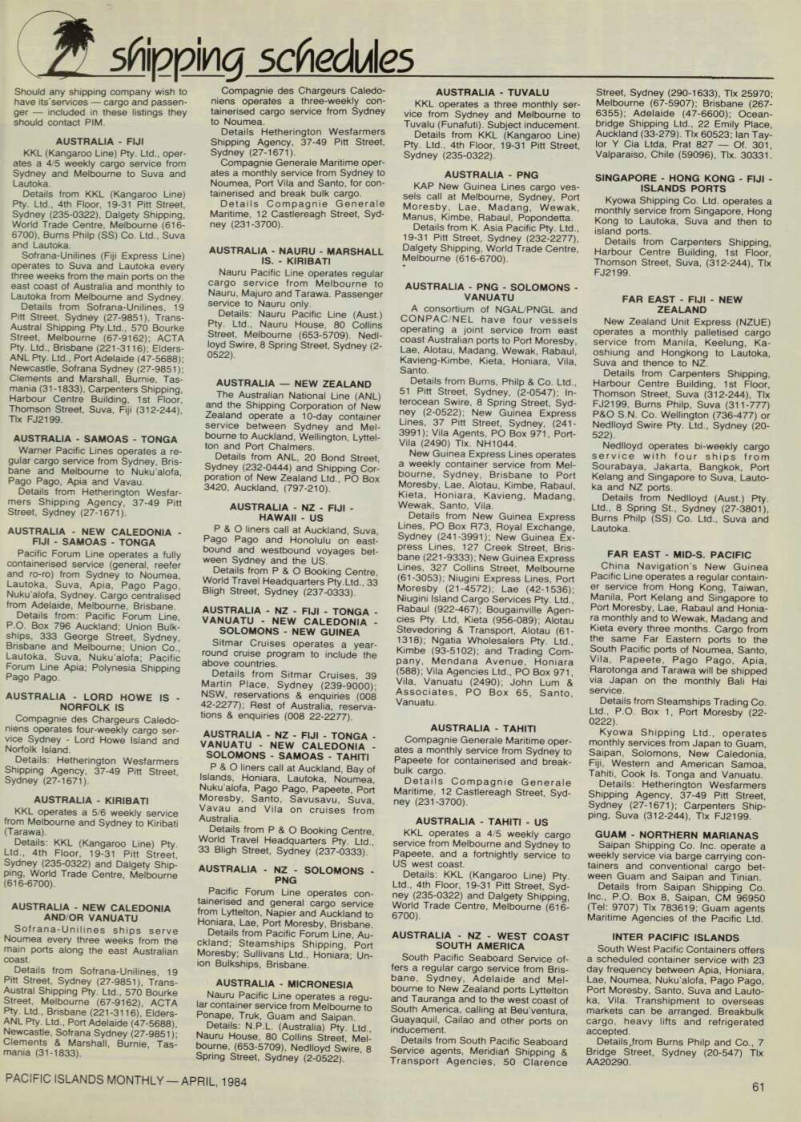
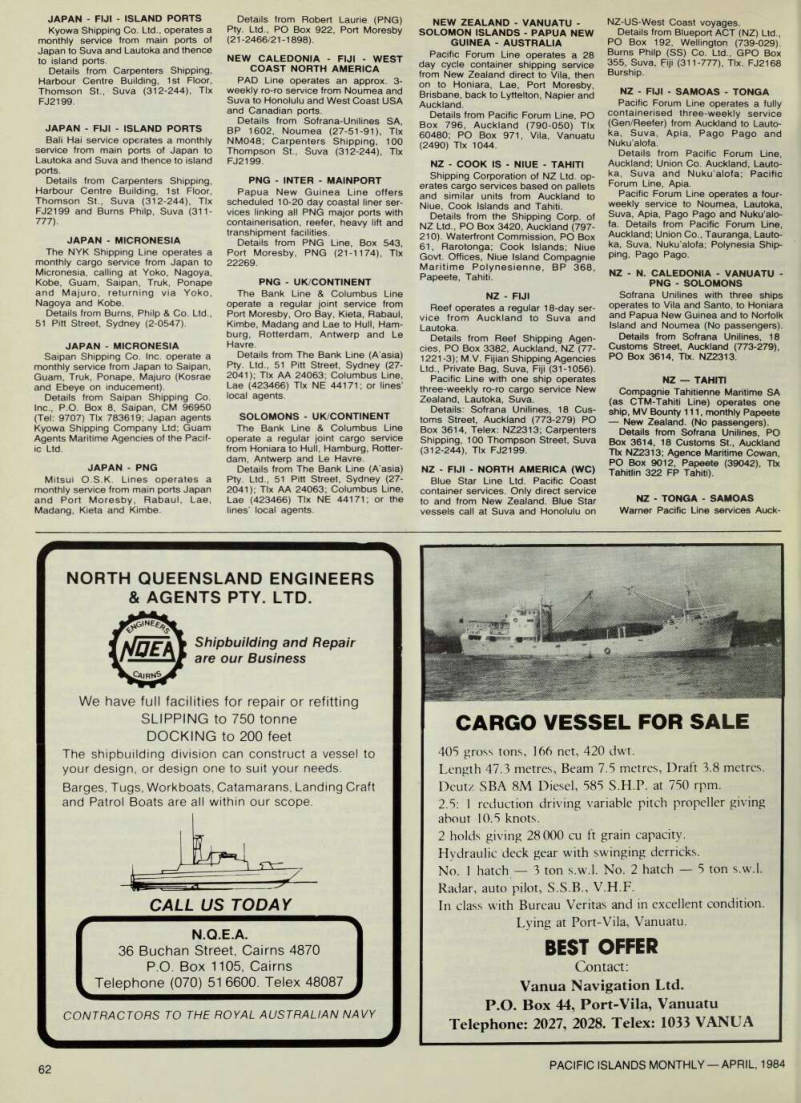
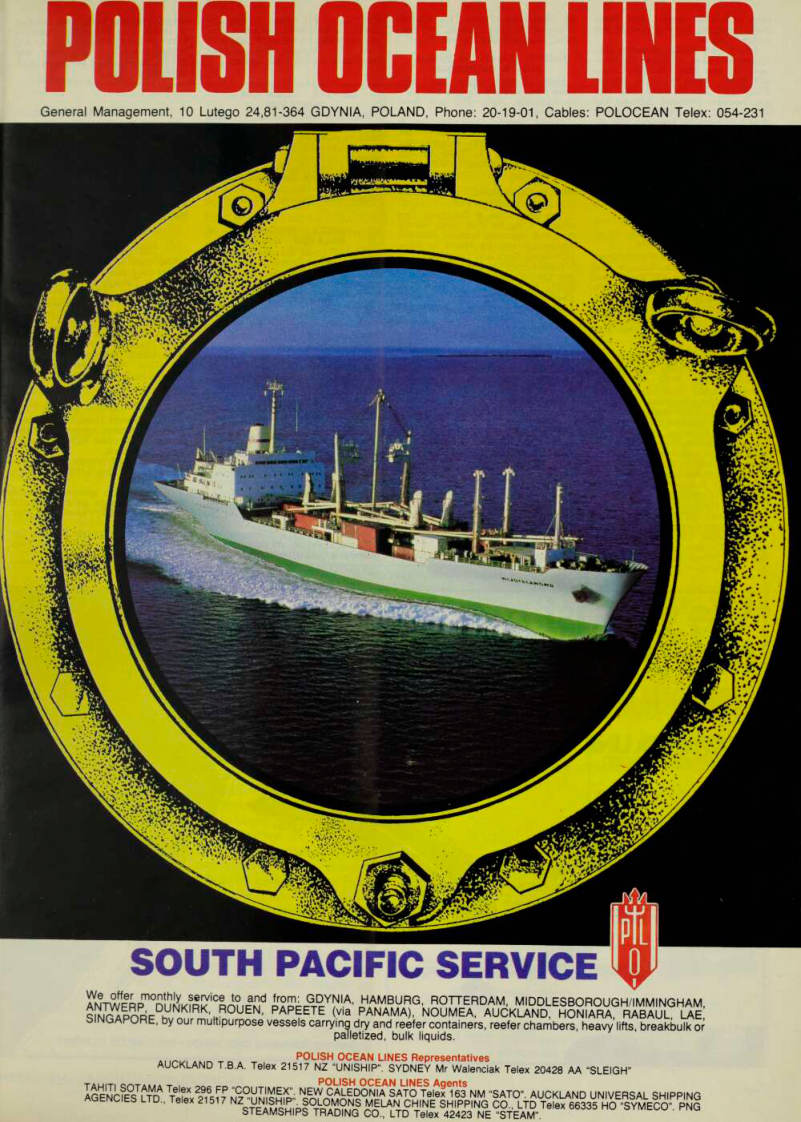
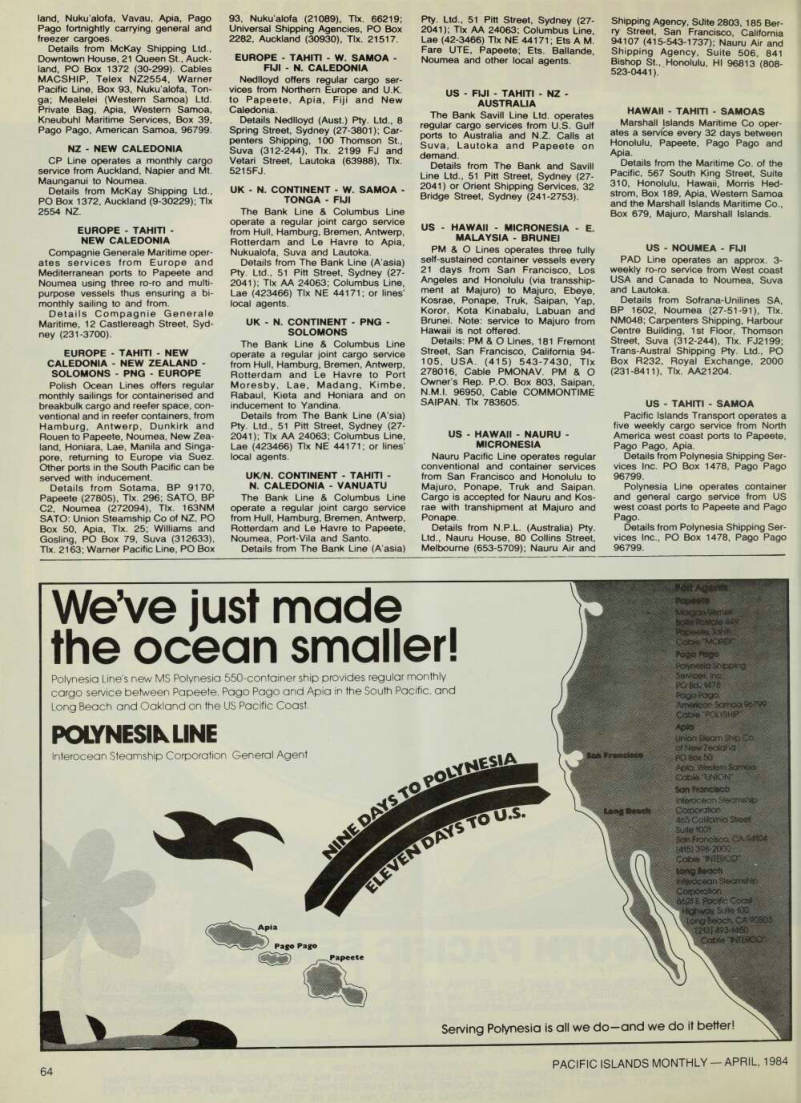
Should any shipping company wish to have its'services cargo and passen ger included in these listings they should contact PIM.
Australia - Fiji
KKL (Kangaroo Line) Pty. Ltd., oper ates a 4/5 weekly cargo service from Sydney and Melbourne to Suva and Lautoka.
Details from KKL (Kangaroo Line) Pty. Ltd., 4th Floor, 19-31 Pitt Street, Sydney (235-0322), Dalgety Shipping, World Trade Centre, Melbourne (616- 6700), Burns Philp (SS) Co. Ltd., Suva and Lautoka.
Sofrana-Unilines (Fiji Express Line) operates to Suva and Lautoka every three weeks from the main ports on the east coast of Australia and monthly to Lautoka from Melbourne and Sydney.
Details from Sofrana-Unilines, 19 Pitt Street, Sydney (27-9851), Trans- Austral Shipping Pty.Ltd., 570 Bourke Street, Melbourne (67-9162); ACTA Pty. Ltd., Brisbane (221-3116); Elders- ANL Pty. Ltd., Port Adelaide (47-5688); Newcastle, Sofrana Sydney (27-9851); Clements and Marshall, Burnie, Tas mania (31-1833), Carpenters Shipping, Harbour Centre Building, Ist Floor, Thomson Street, Suva, Fiji (312-244), Tlx FJ2199.
Australia - Samoas - Tonga
Warner Pacific Lines operates a re gular cargo service from Sydney, Bris bane and Melbourne to Nuku’alofa, Pago Pago, Apia and Vavau.
Details from Hetherington Wesfar mers Shipping Agency, 37-49 Pitt Street, Sydney (27-1671).
Australia - New Caledonia -
Fiji - Samoas - Tonga
Pacific Forum Line operates a fully containerised service (general, reefer and ro-ro) from Sydney to Noumea, Lautoka, Suva, Apia, Pago Pago, Nuku’alofa, Sydney. Cargo centralised from Adelaide, Melbourne, Brisbane.
Details from: Pacific Forum Line, P.O. Box 796 Auckland: Union Bulk ships, 333 George Street, Sydney, Brisbane and Melbourne; Union Co., Lautoka, Suva, Nuku’alofa: Pacific Forum Line Apia; Polynesia Shipping Pago Pago.
Australia - Lord Howe Is -
Norfolk Is
Compagnie des Chargeurs Caledo niens operates four-weekly cargo ser vice Sydney - Lord Howe Island and Norfolk Island.
Details: Hetherington Wesfarmers Shipping Agency, 37-49 Pitt Street, Sydney (27-1671).
Australia - Kiribati
KKL operates a 5/6 weekly service from Melbourne and Sydney to Kiribati (Tarawa).
Details: KKL (Kangaroo Line) Pty.
Ltd.. 4th Floor, 19-31 Pitt Street, Sydney (235-0322) and Dalgety Ship ping, World Trade Centre, Melbourne (616-6700).
Australia - New Caledonia
And/Or Vanuatu
Sofrana-Unilines ships serve Noumea every three weeks from the main ports along the east Australian coast.
Details from Sofrana-Unilines, 19 Pitt Street, Sydney (27-9851), Trans- Austral Shipping Pty. Ltd., 570 Bourke Street, Melbourne (67-9162), ACTA Pty. Ltd., Brisbane (221-3116), Elders- ANL Pty. Ltd., Port Adelaide (47-5688), Newcastle, Sofrana Sydney (27-9851); Clements & Marshall, Burnie, Tas mania (31-1833).
Compagnie des Chargeurs Caledo niens operates a three-weekly con tainerised cargo service from Sydney to Noumea.
Details Hetherington Wesfarmers Shipping Agency, 37-49 Pitt Street, Sydney (27-1671).
Compagnie Generale Maritime oper ates a monthly service from Sydney to Noumea, Port Vila and Santo, for con tainerised and break bulk cargo.
Details Compagnie Generale Maritime, 12 Castlereagh Street, Syd ney (231-3700).
Australia - Nauru - Marshall
Is. - Kiribati
Nauru Pacific Line operates regular cargo service from Melbourne to Nauru, Majuro and Tarawa. Passenger service to Nauru only.
Details: Nauru Pacific Line (Aust.) Pty. Ltd., Nauru House, 80 Collins Street, Melbourne (653-5709). Nedl loyd Swire, 8 Spring Street, Sydney (2- 0522).
Australia New Zealand
The Australian National Line (ANL) and the Shipping Corporation of New Zealand operate a 10-day container service between Sydney and Mel bourne to Auckland, Wellington, Lyttel ton and Port Chalmers.
Details from ANL, 20 Bond Street, Sydney (232-0444) and Shipping Cor poration of New Zealand Ltd., PO Box 3420, Auckland, (797-210).
Australia - Nz - Fiji -
Hawaii - Us
P&O liners call at Auckland, Suva, Pago Pago and Honolulu on east bound and westbound voyages bet ween Sydney and the US.
Details from P&O Booking Centre, World Travel Headquarters Pty.Ltd., 33 Bligh Street, Sydney (237-0333).
AUSTRALIA - NZ - FIJI - TONGA -
Vanuatu - New Caledonia -
Solomons - New Guinea
Sitmar Cruises operates a year round cruise program to include the above countries.
Details from Sitmar Cruises, 39 Martin Place, Sydney (239-9000); NSW, reservations & enquiries (008 42-2277); Rest of Australia, reserva tions & enquiries (008 22-2277).
AUSTRALIA - NZ - FIJI - TONGA -
Vanuatu - New Caledonia -
Solomons - Samoas - Tahiti
P&O liners call at Auckland, Bay of Islands, Honiara, Lautoka, Noumea, Nukualofa, Pago Pago, Papeete, Port Moresby, Santo, Savusavu, Suva, Vavau and Vila on cruises from Australia.
Details from P&O Booking Centre, World Travel Headquarters Pty. Ltd., 33 Bligh Street, Sydney (237-0333).
Australia - Nz - Solomons -
Png
Pacific Forum Line operates con tainerised and general cargo service from Lyttelton, Napier and Auckland to Honiara, Lae, Port Moresby, Brisbane.
Details from Pacific Forum Line, Au ckland: Steamships Shipping, Port Moresby; Sullivans Ltd., Honiara; Un ion Bulkships, Brisbane.
Australia - Micronesia
Nauru Pacific Line operates a regu lar container service from Melbourne to Ponape, Truk, Guam and Saipan.
Details: N.P.L. (Australia) Pty. Ltd.
Nauru House, 80 Collins Street Mel bourne, (653-5709), Nedlloyd Swire, 8 Spring Street, Sydney (2-0522).
Australia - Tuvalu
KKL operates a three monthly ser vice from Sydney and Melbourne to Tuvalu (Funafuti). Subject inducement.
Details from KKL (Kangaroo Line) Pty. Ltd., 4th Floor, 19-31 Pitt Street, Sydney (235-0322).
Australia - Png
KAP New Guinea Lines cargo ves sels call at Melbourne, Sydney, Port Moresby, Lae, Madang, Wewak, Manus, Kimbe, Rabaul, Popondetta.
Details from K. Asia Pacific Pty. Ltd., 19-31 Pitt Street, Sydney (232-2277), Dalgety Shipping, World Trade Centre, Melbourne (616-6700).
Australia - Png - Solomons -
Vanuatu
A consortium of NGAL7PNGL and CONPAC/NEL have four vessels operating a joint service from east coast Australian ports to Port Moresby, Lae, Alotau, Madang, Wewak, Rabaul, Kavieng-Kimbe, Kieta, Honiara, Vila, Santo.
Details from Burns, Philp & Co. Ltd., 51 Pitt Street, Sydney, (2-0547); In terocean Swire, 8 Spring Street, Syd ney (2-0522); New Guinea Express Lines, 37 Pitt Street, Sydney, (241- 3991); Vila Agents, PO Box 971, Port- Vila (2490) Tlx, NH1044.
New Guinea Express Lines operates a weekly container service from Mel bourne, Sydney, Brisbane to Port Moresby, Lae, Alotau, Kimbe, Rabaul, Kieta, Honiara, Kavieng, Madang, Wewak, Santo, Vila.
Details from New Guinea Express Lines, PO Box R 73, Royal Exchange, Sydney (241-3991); New Guinea Ex press Lines, 127 Creek Street, Bris bane (221-9333); New Guinea Express Lines, 327 Collins Street, Melbourne (61-3053); Niugini Express Lines, Port Moresby (21-4572); Lae (42-1536); Niugini Island Cargo Services Pty. Ltd., Rabaul (922-467); Bougainville Agen cies Pty. Ltd, Kieta (956-089); Alotau Stevedoring & Transport, Alotau (61- 1318); Ngatia Wholesalers Pty. Ltd., Kimbe (93-5102); and Trading Com pany, Mendana Avenue, Honiara (588); Vila Agencies Ltd., PO Box 971, Vila, Vanuatu (2490); John Lum & Associates, PO Box 65, Santo, Vanuatu.
Australia - Tahiti
Compagnie Generale Maritime oper ates a monthly service from Sydney to Papeete for containerised and break bulk cargo.
Details Compagnie Generale Maritime, 12 Castlereagh Street, Syd ney (231-3700).
Australia - Tahiti - Us
KKL operates a 4/5 weekly cargo service from Melbourne and Sydney to Papeete, and a fortnightly service to US west coast.
Details: KKL (Kangaroo Line) Pty.
Ltd., 4th Floor, 19-31 Pitt Street, Syd ney (235-0322) and Dalgety Shipping, World Trade Centre, Melbourne (616- 6700).
Australia - Nz - West Coast
South America
South Pacific Seaboard Service of fers a regular cargo service from Bris bane, Sydney, Adelaide and Mel bourne to New Zealand ports Lyttelton and Tauranga and to the west coast of South America, calling at Beu’ventura, Guayaquil, Cailao and other ports ori inducement.
Details from South Pacific Seaboard Service agents, Meridiart Shipping & Transport Agencies, 50 Clarence
Street, Sydney (290-1633), Tlx 25970; Melbourne (67-5907); Brisbane (267- 6355); Adelaide (47-6600); Ocean bridge Shipping Ltd., 22 Emily Place, Auckland (33-279). Tlx 60523; lan Tay lor Y Cia Ltda, Prat 827 Of. 301, Valparaiso, Chile (59096), Tlx. 30331.
SINGAPORE - HONG KONG - FIJI -
Islands Ports
Kyowa Shipping Co. Ltd. operates a monthly service from Singapore, Hong Kong to Lautoka, Suva and then to island ports.
Details from Carpenters Shipping, Harbour Centre Building, Ist Floor, Thomson Street, Suva, (312-244), Tlx FJ2199.
Far East - Fiji - New
Zealand
New Zealand Unit Express (N2UE) operates a monthly palletised cargo service from Manila, Keelung, Ka oshiung and Hongkong to Lautoka, Suva and thence to NZ.
Details from Carpenters Shipping, Harbour Centre Building, Ist Floor, Thomson Street, Suva (312-244), Tlx FJ2199, Burns Philp, Suva (311-777) P&O S.N. Co. Wellington (736-477) or Nedlloyd Swire Pty. Ltd., Sydney (20- 522).
Nedlloyd operates bi-weekly cargo service with four ships from Sourabaya, Jakarta, Bangkok, Port Kelang and Singapore to Suva, Lauto ka and NZ ports.
Details from Nedlloyd (Aust.) Pty.
Ltd., 8 Spring St., Sydney (27-3801).
Burns Philp (SS) Co. Ltd., Suva and Lautoka.
Far East - Mid-S. Pacific
China Navigation’s New Guinea Pacific Line operates a regular contain er service from Hong Kong, Taiwan, Manila, Port Kelang and Singapore to Port Moresby, Lae, Rabaul and Honia ra monthly and to Wewak, Madang and Kieta every three months. Cargo from the same Far Eastern ports to the South Pacific ports of Noumea, Santo, Vila, Papeete, Pago Pago, Apia, Rarotonga and Tarawa will be shipped via Japan on the monthly Bali Hai service.
Details from Steamships Trading Co.
Ltd., P.O. Box 1, Port Moresby (22- 0222).
Kyowa Shipping Ltd., operates monthly services from Japan to Guam, Saipan, Solomons, New Caledonia, Fiji, Western and American Samoa, Tahiti, Cook Is. Tonga and Vanuatu.
Details: Hetherington Wesfarmers Shipping Agency, 37-49 Pitt Street, Sydney (27-1671); Carpenters Ship ping, Suva (312-244), Tlx FJ2199.
Guam - Northern Marianas
Saipan Shipping Co. Inc. operate a weekly service via barge carrying con tainers and conventional cargo bet ween Guam and Saipan and Tinian.
Details from Saipan Shipping Co.
Inc., P.O. Box 8, Saipan, CM 96950 (Tel: 9707) Tlx 783619; Guam agents Maritime Agencies of the Pacific Ltd.
Inter Pacific Islands
South West Pacific Containers offers a scheduled container service with 23 day frequency between Apia, Honiara, Lae, Noumea, Nuku’alofa, Pago Pago, Port Moresby, Santo, Suva and Lauto ka, Vila. Transhipment to overseas markets can be arranged. Breakbulk cargo, heavy lifts and refrigerated accepted.
Burns Philp and Co., 7 Bridge Street, Sydney (20-547) Tlx AA20290.
Japan - Fiji - Island Ports
Kyowa Shipping Co. Ltd., operates a monthly service from main ports of Japan to Suva and Lautoka and thence to island ports.
Details from Carpenters Shipping, Harbour Centre Building, Ist Floor, Thomson St., Suva (312-244), Tlx FJ2199.
Japan - Fiji - Island Ports
Bali Hai service operates a monthly service from main ports of Japan to Lautoka and Suva and thence to island ports.
Details from Carpenters Shipping, Harbour Centre Building, Ist Floor, Thomson St., Suva (312-244), Tlx FJ2199 and Burns Philp, Suva (311- 777).
Japan - Micronesia
The NYK Shipping Line operates a monthly cargo service from Japan to Micronesia, calling at Yoko, Nagoya, Kobe, Guam, Saipan, Truk, Ponape and Majuro, returning via Yoko, Nagoya and Kobe.
Details from Burns, Philp & Co. Ltd., 51 Pitt Street, Sydney (2-0547).
Japan - Micronesia
Saipan Shipping Co. Inc. operate a monthly service from Japan to Saipan, Guam, Truk, Ponape, Majuro (Kosrae and Ebeye on inducement).
Details from Saipan Shipping Co.
Inc., P.O. Box 8, Saipan, CM 96950 (Tel: 9707) Tlx 783619; Japan agents Kyowa Shipping Company Ltd; Guam Agents Maritime Agencies of the Pacif ic Ltd.
Japan - Png
Mitsui O.S.K. Lines operates a monthly service from main ports Japan and Port Moresby, Rabaul, Lae, Madang, Kieta and Kimbe.
Details from Robert Laurie (PNG) Pty. Ltd., PO Box 922, Port Moresby (21-2466/21-1898).
New Caledonia - Fiji - West
Coast North America
PAD Line operates an approx. 3weekly ro-ro service from Noumea and Suva to Honolulu and West Coast USA and Canadian ports.
Details from Sofrana-Unilines SA, BP 1602, Noumea (27-51-91), Tlx NMO4B; Carpenters Shipping, 100 Thompson St., Suva (312-244), Tlx FJ2199.
Png - Inter - Mainport
Papua New Guinea Line offers scheduled 10-20 day coastal liner ser vices linking all PNG major ports with containerisation, reefer, heavy lift and transhipment facilities.
Details from PNG Line, Box 543, Port Moresby, PNG (21-1174), Tlx 22269.
Png - Uk/Continent
The Bank Line & Columbus Line operate a regular joint service from Port Moresby, Oro Bay, Kieta, Rabaul, Kimbe, Madang and Lae to Hull, Ham burg, Rotterdam, Antwerp and Le Havre.
Details from The Bank Line (A’asia) Pty. Ltd., 51 Pitt Street, Sydney (27- 2041); Tlx AA 24063; Columbus Line, Lae (423466) Tlx NE 44171; or lines’ local agents.
Solomons - Uk/Continent
The Bank Line & Columbus Line operate a regular joint cargo service from Honiara to Hull, Hamburg, Rotter dam, Antwerp and Le Havre.
Details from The Bank Line (A'asia) Pty. Ltd., 51 Pitt Street, Sydney (27- 2041); Tlx AA 24063; Columbus Line, Lae (423466) Tlx NE 44171; or the lines’ local agents.
New Zealand - Vanuatu -
Solomon Islands - Papua New
Guinea - Australia
Pacific Forum Line operates a 28 day cycle container shipping service from New Zealand direct to Vila, then on to Honiara, Lae, Port Moresby, Brisbane, back to Lyttelton, Napier and Auckland.
Details from Pacific Forum Line, PO Box 796, Auckland (790-050) Tlx 60480; PO Box 971, Vila, Vanuatu (2490) Tlx 1044.
NZ - COOK IS - NIUE - TAHITI Shipping Corporation of NZ Ltd. op erates cargo services based on pallets and similar units from Auckland to Niue, Cook islands and Tahiti.
Details from the Shipping Corp. of NZ Ltd., PO Box 3420, Auckland (797- 210). Waterfront Commission, PO Box 61, Rarotonga: Cook Islands; Niue Govt. Offices, Niue Island Compagnie Maritime Polynesienne, BP 368, Papeete, Tahiti.
Nz - Fiji
Reef operates a regular 18-day ser vice from Auckland to Suva and Lautoka.
Details from Reef Shipping Agen cies, PO Box 3382, Auckland, NZ (77- 1221-3); M.V. Fijian Shipping Agencies Ltd., Private Bag, Suva, Fiji (31-1056).
Pacific Line with one ship operates three-weekly ro-ro cargo service New Zealand, Lautoka, Suva.
Details: Sofrana Unilines, 18 Cus toms Street, Auckland (773-279) PO Box 3614, Telex: NZ2313; Carpenters Shipping, 100 Thompson Street, Suva (312-244), Tlx FJ2199.
NZ - FIJI - NORTH AMERICA (WC) Blue Star Line Ltd. Pacific Coast container services. Only direct service to and from New Zealand. Blue Star vessels call at Suva and Honolulu on
NZ-US-West Coast voyages.
Details from Blueport ACT (NZ) Ltd., PO Box 192, Wellington (739-029).
Burns Philp (SS) Co. Ltd., GPO Box 355, Suva, Fiji (311-777), Tlx. FJ2168 Burship.
NZ - FIJI - SAMOAS - TONGA Pacific Forum Line operates a fully containerised three-weekly service (Gen/Reefer) from Auckland to Lauto ka, Suva, Apia, Pago Pago and Nuku’alofa.
Details from Pacific Forum Line, Auckland: Union Co. Auckland, Lauto ka, Suva and Nuku’alofa: Pacific Forum Line, Apia.
Pacific Forum Line operates a four weekly service to Noumea, Lautoka, Suva, Apia, Pago Pago and Nuku’alo fa. Details from Pacific Forum Line, Auckland: Union Co., Tauranga, Lauto ka, Suva, Nuku’alofa; Polynesia Ship ping, Pago Pago.
NZ - N. CALEDONIA - VANUATU -
Png - Solomons
Sofrana Unilines with three ships operates to Vila and Santo, to Honiara and Papua New Guinea and to Norfolk Island and Noumea (No passengers).
Details from Sofrana Unilines, 18 Customs Street, Auckland (773-279), PO Box 3614, Tlx. NZ2313.
Nz Tahiti
Compagnie Tahitienne Maritime SA (as CTM-Tahiti Line) operates one ship, MV Bounty 111, monthly Papeete New Zealand. (No passengers).
Details from Sofrana Unilines, PO Box 3614, 18 Customs St., Auckland Tlx NZ2313; Agence Maritime Cowan, PO Box 9012, Papeete (39042), Tlx Tahitlin 322 FP Tahiti).
Nz - Tonga - Samoas
Warner Pacific Line services Auck
land, Nukualofa, Vavau, Apia, Pago Pago fortnightly carrying general and freezer cargoes.
Details from McKay Shipping Ltd., Downtown House, 21 Queen St., Auck land, PO Box 1372 (30-299). Cables MACSHIP, Telex NZ2554, Warner Pacific Line, Box 93, Nukualofa, Ton ga: Mealelei (Western Samoa) Ltd.
Private Bag, Apia, Western Samoa, Kneubuhl Maritime Services, Box 39, Pago Pago, American Samoa, 96799.
Nz - New Caledonia
CP Line operates a monthly cargo service from Auckland, Napier and Mt.
Maunganui to Noumea.
Details from McKay Shipping Ltd., PO Box 1372, Auckland (9-30229); Tlx 2554 NZ.
Europe - Tahiti -
New Caledonia
Compagnie Generale Maritime oper ates services from Europe and Mediterranean ports to Papeete and Noumea using three ro-ro and multi purpose vessels thus ensuring a bi monthly sailing to and from.
Details Compagnie Generale Maritime, 12 Castlereagh Street, Syd ney (231-3700).
Europe - Tahiti - New
Caledonia - New Zealand -
Solomons - Png - Europe
Polish Ocean Lines offers regular monthly sailings for containerised and breakbulk cargo and reefer space, con ventional and in reefer containers, from Hamburg, Antwerp, Dunkirk and Rouen to Papeete, Noumea, New Zea land, Honiara, Lae, Manila and Singa pore, returning to Europe via Suez.
Other ports in the South Pacific can be served with inducement.
Details from Sotama, BP 9170, Papeete (27805), Tlx. 296; SATO, BP C 2, Noumea (272094), Tlx. 163 NM SATO: Union Steamship Co of NZ, PO Box 50, Apia, Tlx. 25; Williams and Gosling, PO Box 79. Suva (312633), Tlx. 2163; Warner Pacific Line, PO Box
93, Nukualofa (21089), Tlx. 66219; Universal Shipping Agencies, PO Box 2282, Auckland (30930), Tlx. 21517.
EUROPE - TAHITI - W. SAMOA -
Fiji - N. Caledonia
Nedlloyd offers regular cargo ser vices from Northern Europe and U K. to Papeete, Apia, Fiji and New Caledonia.
Details Nedlloyd (Aust.) Pty. Ltd., 8 Spring Street, Sydney (27-3801); Car penters Shipping, 100 Thomson St., Suva (312-244), Tlx. 2199 FJ and Vetari Street, Lautoka (63988), Tlx. 5215FJ.
UK - N. CONTINENT - W. SAMOA -
Tonga - Fiji
The Bank Line & Columbus Line operate a regular joint cargo service from Hull, Hamburg, Bremen, Antwerp, Rotterdam and Le Havre to Apia, Nukualofa, Suva and Lautoka.
Details from The Bank Line (A’asia) Pty. Ltd., 51 Pitt Street, Sydney (27- 2041); Tlx AA 24063; Columbus Line, Lae (423466) Tlx NE 44171; or lines’ local agents.
UK - N. CONTINENT - PNG -
Solomons
The Bank Line & Columbus Line operate a regular joint cargo service from Hull, Hamburg, Bremen, Antwerp, Rotterdam and Le Havre to Port Moresby, Lae, Madang, Kimbe, Rabaul, Kieta and Honiara and on inducement to Yandina.
Details from The Bank Line (A sia) Pty. Ltd., 51 Pitt Street, Sydney (27- 2041); Tlx AA 24063; Columbus Line, Lae (423466) Tlx NE 44171; or lines’ local agents.
Uk/N. Continent - Tahiti -
N. Caledonia - Vanuatu
The Bank Line & Columbus Line operate a regular joint cargo service from Hull, Hamburg, Bremen, Antwerp, Rotterdam and Le Havre to Papeete, Noumea, Port-Vila and Santo.
Details from The Bank Line (A’asia)
Pty. Ltd., 51 Pitt Street, Sydney (27- 2041); Tlx AA 24063; Columbus Line, Lae (42-3466) Tlx NE 44171; Ets A M.
Fare UTE, Papeete; Ets. Ballande, Noumea and other local agents.
US - FIJI - TAHITI - NZ -
Australia
The Bank Savill Line Ltd. operates regular cargo services from U.S. Gulf ports to Australia and N.Z. Calls at Suva, Lautoka and Papeete on demand.
Details from The Bank and Savill Line Ltd., 51 Pitt Street, Sydney (27- 2041) or Orient Shipping Services, 32 Bridge Street, Sydney (241-2753).
US - HAWAII - MICRONESIA - E.
Malaysia - Brunei
PM & O Lines operates three fully self-sustained container vessels every 21 days from San Francisco, Los Angeles and Honolulu (via transship ment at Majuro) to Majuro, Ebeye, Kosrae, Ponape, Truk, Saipan, Yap, Koror, Kota Kinabalu, Labuan and Brunei. Note: service to Majuro from Hawaii is not offered.
Details: PM & O Lines, 181 Fremont Street, San Francisco, California 94- 105, USA. (415) 543-7430, Tlx
278016, Cable Pmonav. Pm & O
Owner’s Rep. P.O. Box 803, Saipan,
N.M.I. 96950, Cable Commontime
Saipan. Tlx 783605.
Us - Hawaii - Nauru •
Micronesia
Nauru Pacific Line operates regular conventional and container services from San Francisco and Honolulu to Majuro, Ponape, Truk and Saipan.
Cargo is accepted for Nauru and Kos rae with transhipment at Majuro and Ponape.
Details from N.P.L. (Australia) Pty.
Ltd., Nauru House, 80 Collins Street, Melbourne (653-5709); Nauru Air and
Shipping Agency, SJite 2803, 185 Ber ry Street, San Francisco, California 94107 (415-543-1737); Nauru Air and Shipping Agency, Suite 506, 841 Bishop St., Honolulu, HI 96813 (808- 523-0441).
Hawaii - Tahiti - Samoas
Marshall jslands Maritime Co oper ates a service every 32 days between Honolulu, Papeete, Pago Pago and Apia.
Details from the Maritime Co. of the Pacific, 567 South King Street, Suite 310, Honolulu, Hawaii, Morris Hed strom, Box 189, Apia, Western Samoa and the Marshall Islands Maritime Co., Box 679, Majuro, Marshall Islands.
Us - Noumea - Fiji
PAD Line operates an approx. 3weekly ro-ro service from West coast USA and Canada to Noumea, Suva and Lautoka.
Details from Sofrana-Unilines SA, BP 1602, Noumea (27-51-91), Tlx.
NMO4B; Carpenters Shipping, Harbour Centre Building, Ist Floor, Thomson Street, Suva (312-244), Tlx. FJ2199; Trans-Austral Shipping Pty. Ltd., PO Box R 232, Royal Exchange, 2000 (231-8411), Tlx. AA21204.
Us - Tahiti - Samoa
Pacific Islands Transport operates a five weekly cargo service from North America west coast ports to Papeete, Pago Pago, Apia.
Details from Polynesia Shipping Ser vices Inc. PO Box 1478, Pago Pago 96799.
Polynesia Line operates container and general cargo service from US west coast ports to Papeete and Pago
Pago.
Details from Polynesia Shipping Ser vices Inc., PO Box 1478, Pago Pago 96799.
Advertisements & other items, pp. 62-64 (1 item)
Iltm
mm
CARGO
FOR SALE
405 gross tons, 166 net, 420 dwt.
Length 47.3 metres, Beam 7.5 metres, Draft 3.8 metres.
Dcutz SBA 8M Diesel, 585 S.H.P. at 750 rpm. 2.5: 1 reduction driving variable pitch propeller giving about 10.5 knots. 2 holds giving 28000 cu ft grain capacity.
Hydraulic deck gear with swinging derricks.
No. 1 hatch 3 ton s.w.l. No. 2 hatch 5 ton s.w.l.
Radar, auto pilot, 5.5.8., V.H.F.
In class with Bureau Veritas and in excellent condition.
Lying at Port-Vila, Vanuatu.
BEST OFFER
Contact: Vanua Navigation Ltd.
P.O. Box 44, Port-Vila, Vanuatu Telephone: 2027, 2028. Telex: 1033 VANUA
NORTH QUEENSLAND ENGINEERS
& AGENTS PTY. LTD.
PAIRHP
Shipbuilding and Repair are our Business We have full facilities for repair or refitting SLIPPING to 750 tonne DOCKING to 200 feet The shipbuilding division can construct a vessel to your design, or design one to suit your needs.
Barges, Tugs, Workboats, Catamarans, Landing Craft and Patrol Boats are all within our scope.
ILtM
A
CALL US TODAY
N.Q.E.A.
36 Buchan Street, Cairns 4870 P.O. Box 1105, Cairns Telephone (070) 51 6600. Telex 48087
CONTRACTORS TO THE ROYAL AUSTRALIAN NAVY
ROUSH OtUN IMS
General Management, 10 Lutego 24,81-364 GDYNIA, POLAND, Phone; 20-19-01, Cables: POLOCEAN Telex: 054-231 <P Q J s
anr
S 3 1 '-r 7T Si v> *>l* 2.* •V «■ r‘v? & vw» H M f l Vi f? 3
SOUTH PACIFIC SERVICE
ANTwIRp m °nuXfl^ C Bn?,CM d HAMBURG, ROTTERDAM, MIDDLESBOROUGH/IMMINGHAM, S^^PORF D^nr R r!^’ , t ROUEN ’ PAPEETE (via PANAMA), NOUMEA. AUCKLAND, HONIARA, RABAUL, LAE, oiN(jArURE, by our multipurpose vessels carrying dry and reefer containers, reefer chambers, heavy lifts, breakbulk or palletized, bulk liquids. a i A^TOA POLISH OCEAN LINES Representatives AUCKLAND T.B.A. Telex 21517 NZ “UNISHIP”. SYDNEY Mr Walenciak Telex 20428 AA “SLEIGH"
AGENcfsTITD ?ifex?lsl7NZ°UNlßh£- NM “ SATO ”- AUCKLAND UNIVERSAL SHIPPING ocNCIES LTD., Telex 21517 NZ UNSHIP - SOLOMONS MELAN CHINE SHIPPING CO., LTD Telex 66335 HO “SYMECO”. PNG STEAMSHIPS TRADING CO., LTD Telex 42423 NE “STEAM".
WeVe just made
the ocean smaller!
Polynesia Line's new MS Polynesia 550-container ship provides regular monthly cargo service between Papeete, Pago Pago and Apia in the South Pacific, and Long Beach and Oakland on the US Pacific Coast.
POLYNESIA LINE
Interocean Steamship Corporation General Agent Apia f dk a u Q =to 5* £ 3 * & v Suits 90803 Pago Pago Serving Polynesia is all we do—and we do it better!
deaths
Raphael Karepa In New York on February 7. aged 35.
A senior member of Papua New Guinea’s diplomatic ser vice, Mr Karepa was serving as counsellor to PNG’s permanent mission to the United Nations.
Expressing “shock and sad ness” at the news, PNG Minis ter for Foreign Affairs and Trade Rabbie Namaliu said the cause of Mr Karepa’s death was not immediately known, but that arrangements were being made for his body to be sent back to PNG.
Mr Karepa came from Koiari Village in Erave, southern High lands Province.
Usaia Sotutu In Tavea, Bua, Fiji, on New Year’s Eve, 1983, in his late 80s.
The Rev. Usaia Sotutu was a missionary, soldier, and mem ber of the famous Australian Coastwatchers group who operated behind Japanese lines in the Solomons in World War 11.
Mr Sotutu is best remem bered for leading the Fiji batta lion in the Solomon Islands to safety through jungle tracks un known to the Japanese. His intimate knowledge of the Solo mons and his bravery in the war became a legend.
Mr Sotutu had served as a missionary in the Northern Solomons for about 20 years when the islands were invaded by the Japanese in 1942.
Ex-staff sergeant and a for mer editor of Nai Lalakai, the late Luke Vuidreketi, in a tri bute, said Mr Sotutu decided to stay behind after his family had been taken to safety in a sub marine.
Mr Vuidreketi recalled the fighting in and around the Numa Numa trail at Sisivi, in the Solomons.
The Japanese, outnumber ing the Fijians almost 10 to one, almost encircled the battalion aiming to annihilate it, when Mr Sotutu came on the scene, with a Lt. Keenan, and actually led the battalion to safety through
an unknown track towards the north and down the west coast north of Torokina.
“After this tough battle and a breakthrough in the encircle ment, the Fijians had felt they never had a hope of survival, having been informed from air reconnaissance that the enemy was closing again in greater numbers from all sides.
“Our battalion commander asked the Coastwatchers if they knew a way out.
“Mr Sotutu’s reply that day has been remembered over all these years by the men of the Ist Battalion. It was: ‘lf there are 99 tracks known to the Japanese on Bougainville, I know of the 100th. Follow me’.”
Fila Fae In Newcastle, Australia, on February 10, aged 22.
Samoan-born boxer Fila Fae collapsed in his dressing room on February 7 after a bout in Newcastle. He had fought the major preliminary of the even ing to a draw, and was taken to hospital unconscious.
Dr Norma Ruth McArthur Dr Norma Ruth McArthur, a noted specialist in Pacific stu dies at the Australian National University, “still had a bed full of academic books” up to with in one week of her death on January 17, according to a colleague.
Dr McArthur was bom in Ararat, Victoria, in 1921, and had suffered a relapse of a long terminal illness 18 months ago.
She began her career at ANU in 1952 when she took up a position as research fellow in demography at the research school of social sciences. From 1956 she spent two years as Census Commissioner in Fiji.
Before she left the school in 1970 as professorial fellow, she wrote and had published in 1967 a book entitled Island Populations of the Pacific, an influential work which ques tioned the popular theory that Pacific populations had been decimated soon after the arrival of the Europeans in the 19th
century. This was her major publication.
Reviews praised the book but said she had relied on Euro pean figures to the exclusion of contemporary archaeological finds which had revealed more about very early population trends.
As a result of this criticism Dr McArthur then embarked on her second PhD, in 1970, this time in prehistory. This stage of her work sent her to live on Aneityum, in the New Hebrides group, today’s Vanuatu.
Preparing herself physically for research on the island, which had no roads, included walking up Canberra’s Black Mountain and back every day before she began work. She was then in her early 50s and spent two seasons of several months each on the island, doing research. Other censuses were undertaken in the Solo mon Islands and the Gilbert and Ellice Islands (today’s Kiri bati and Tuvalu).
After Dr McArthur joined the department of Pacific and South-east Asian history in 1975 as a senior research fel low, she undertook further statistical and historical work on populations in New Caledonia and Hawaii. Between 1975 and 1977 she was also a representa tive of the non-professorial staff of the institute of advanced studies of the AND Council.
She became a visiting fellow in the research school of Pacific studies in the department of Pacific and South-East Asian history in 1980.
Gene Lai In a road accident near Navua, Fiji, on January 27, aged 38.
Mr Lai, managing director of the P. A. Lai Company, a bus-building firm in Suva, was killed when the light van he was driving collided head-on with a heavy goods truck.
The speedometer on Mr Lai’s van was stuck at 140 kmh when inspected by police.
Advertisements & other items, pp. 65-66 (1 item)
Attorney,
ALL THE
NEWS IN A
FLASH
The South Sea Digest tells you what you want to know about the Pacific Islands in a few words. All the leading firms and diplomatic missions read it. You can phone or write or call for a follow up.
See insert for subscription details:
THE SOUTH SEA DIGEST
ATTORNEY,
U.S.
MAINLAND
Available for representation/litigation.
Elliot R. Smith, Esq. 2039 Shattuck Avenue, Berkeley, California, 94704
TOYOTA DATSUN MITSUBISHI MAZDA HONDA ISUZU HINO
JAPANESE RECONDITIONED USED CARS
We Export
Top Quality
Quick Delivery
Economical Price Please contact to:
Inter Continental ltd.
P.0.80X 194NAKA TELEPHONE: 052-211 -51 25
2-16-13 SAKAE NAKA-KU TELEX: 0442-4880 INCONT J
NAGOYA 460 JAPAN CABLE: INCONT NAGOYA
SERVICE PAGE
D mm
[LAW
MCMTKmr
AUSTRALIA: Distribution: The Herald and Weekly Times Ltd., 44-74 Flinders St.. Melbourne, Vic., 3000. Advertising Reps Brisbane D. Wood, Anday Agency, CCA Centre. Dayboro Road, Closebum 4520; Box 1918, GPO Brisbane, 4001; telephone (07) 289-4128. Adelaide Hastwell Williamson Rouse Pty. Ltd., PO Box 419, Norwood, SA, 5067; 59 Kensington Road, Norwood; telephone (08) 332-3322, telex 87113; Perth Allen & Associates.
Suite 2, 284 Stirling St., Perth, WA. 6000, telephone (09) 328-9593 or (09) 328-9363.
FIJI: Distribution and subscriptions Desai Bookshops, P.O. Box 160, Suva, Fiji, telephone Suva 23036.
Advertising Fiji Times & Herald Ltd., 20 Gordon St., Suva, telephone 31-4111, telex FJ2124.
FRENCH POLYNESIA: Distribution Hachette Pacifique, 10 Ave Bruat, Papeete, telephone 25610.
HAWAII, UNITED STATES: Distribution PIM, Hawaii.
PO Box 22250, Honolulu. Hawaii. 96822 Advertising Brian C. Asgill, Apt. 1306, 1676 Ala Moana Blvd., Honolulu, Hawaii, 96815, telephone (808) 955-9718.
JAPAN: Advertising and subscriptions Universal Media Corporation, GPO Box 46. Tokyo, telephone 666- 3036, cables UNIMEDIA Tokyo, telex 2524665.
KOREA: Advertising and subscriptions World Marketing, Inc. Box 4010, Seoul; phone 776-5291-3, telex K 23232.
MALAYSIA: Advertising and subscriptions Worldwide Media Services, 57-B Komplex Damai, Jin Dato Haji Eusoff, Kuala Lumpur, telephone 63-9340, cables WORLDMEDIA Kuala Lumpur, telex 31533.
NEW CALEDONIA: Distribution Depot Centre de Presse Michel Pentecost. CBP2, Noumea, telephone 27- 2434. 27-4729.
NEW ZEALAND: Distribution Gordon & Gotch, PO Box 584, 2 Carr Road, Mt. Roskill. Auckland 4 Advertising International Media Representatives Ltd., PO Box 2313, Auckland, telephone 79-5487; 49-3389, cables Intereps, Auckland Subscriptions Ross Haines & Son Ltd., PO Box 1289, Auckland, telephone 76-9042.
PAPUA NEW GUINEA: Distribution Gordon & Gotch, PO Box 3395, Port Moresby, telephone 25-4551,25-4855.
Advertising PNG Post-Courier, PO Box 85, Port Moresby, telephone 21-2577, telex 22120.
PHILIPPINES: Advertising The GF Group, 12 San Ignacio St., Uroaneta Village, Makati, Metro Manila, telephone 817-7299, telex 45950 and 4233.
UNITED KINGDOM: The Herald & Weekly Times Ltd., No 1 Maltravers Street. London WC2R 3DZ, England, telephone 01 836 5162, telex London 21989.
UNITED STATES MAINLAND: Advertising Joshua B.
Powers Jr., Powers International Inc., 551 Fifth Ave., New York. New York 10 017, telephone 867-9580, telex 236514.
Subscriptions PIM, Hawaii, PO Box 22250, Honolulu, Hawaii. 96822.
SUBSCRIPTIONS
Payments by personal cheque are only acceptable in Australian (from a branch in Australia), U.S. and New Zealand currency. For all other remittances please send an international bank draft in Australian dollars.
Published monthly by Pacific Publications (Aust.) Pty.
Ltd. and printed in Australia by Quadricolor Industries Pty. Ltd., Mulgrave, Vic.
PETER FISHER TRADING Pty.Ltd.
381 PITT STREET, SYDNEY, 2000, AUSTRALIA
Telephone: 264 5395
TELEX: AUSTAS AA20149 ATT. PETER FISHER
EXPORTERS TO THE PACIFIC ISLANDS
LANDING BARGE
FOR SALE
All Steel Construction. Twin Screw G.M.
Engines 165 H.P each.
Length 56 ft. (17 metres), beam 14 ft 1 in. (4.3 metres), draft-unladen 2 ft 7 ins approx. (.82 metres). Cargo hold forward 37 ft. 8 ins. (11.48 metres) to lower hinge on bow ramp. Carrying capacity as is approx. 25 tonnes. Would suit new vessel buyer can deliver.
Details available from:
BALLINA SLIPWAY AND ENGINEERING CO.
P.O. BOX 23
Ballina N.S.W. 2478, Australia Phone (066) 86-2577, Telex AA 66222
Advertising
Aggie Greys 52 Awiwa Ltd 32 Amatil 38 Attorney U.S.A 65 Bankline 56 Ballina Slipway 66 Besco Batteries 24 Citizen 30 Clarion 22 Dept, of Trade 36 Edmonds 44 Peter Fisher 66 Fao-Ceres 40 General Steamships 60 Henry Cummines 60 Hitachi Ltd 6 Hudson Homes 54 Honda I.F.C.
Inter Continental 65 Komatsu Ltd 50 K.T.S. Sendirian Berhad... 66 Maritime College 58
N.Q.E.A 62
Palmet Engineering 8 Papua Hotel 66 Pioneer Electric 12 Polish shipping lines 63 Polynesian Airlines 18 Polynesian Lines 64
Q.B.E 4
Remy Martin O.B.C.
Shillia Hotel 27 Southern Pacific Hotel 14 Trio Kenwood 42 Tutt Bryant 20 Toyota Motors 34-35 Toyota Forklift I.B.C.
Vanua Navigation 62 WaterWheel 48
Advertisements & other items, pp. 66-68 (1 item)
Representation
PORT MOR
♦ Right in business ce|i ♦ A traditiorf for comfort food * All airconditioned * Restaurant■ * Ba * Banquet hall
.A. C. NEUMANN
manager Phone 21-2622 Cable gAP'I'EM
COMPANY
REPRESENTATION
INTERESTED IN REPRESENTING YOU THROUGH OUR 17
BRANCH OFFICES IN MALAYSIA, SINGAPORE AND
BRUNEI ON FIBREGLASS BOATS, LAWN MOWERS,
PUMPS, GENERATORS, POWER-BOAT WINDSCREEN
AND ANY STATIONERY ITEMS,
K.T.S. SENDIRIAN BERHAD
Hua Hong Building, 119, Jalan Ipoh, Kuala Lumpur 02-12, West Malaysia.
Tel: 923 133 (5 lines) Cable: GREENHILL, Telex No. KTS MA30653.
ENGHERED TO BE BEST
TOYOTA
FORKLIFT
- > v -overt-' I5 Ct ? N 9 LOG y T ° yota F ° rkliftS dre built to last over the lon 9 haul . utilizing a Central Hydraulic Rawer System (C.H P S at not only speeds maintenance but also increases operator efficiency through power assistance. Only Toyota offers C H P c m the 1-3 ton range. HUMAN ENGINEERING Down the road Toyotas stay as reliable as ever because they're “ built solid A standard reinforced Wide Visible mast for both durability and safety is just one example. Toyota's design thinks beyond the machine itself to the operator for more comfort with a lower noise level, assist grips and bucket seat.
THE CHOICE We also take your individual business into account with a wide selection of models, options and attachments to suit you best.
This kind of thinking has made Toyota forklifts the choice of more businesses around the world than any other forklift. Because, if you're thinking ahead,
you're thinking Toyota.
Take the lead with
TOYOTA
1,000-3,000 kg SERIES PNEUMATIC-TYRED/ENGINE-POWERED
TOYOTA
AMERICAN SAMOA; BURNS PHILP (S.S.) CO.. LTD. TEL: 633-4281 AUSTRALIA: THIESS TOYOTA PTY, LTD. TEL; 526-0333
FIJI: AUTOMOTIVE SUPPLIES CO
A DIVISION OF BURNS PHILP (S.S.) CO., LTD. TEL; 383444 GUAM: ATKINS, KROLL (GUAM) LTD. TEL: 646-1876 2 7 A41 °4° NIA SERV,CE IMPOr ™TION AUTOMOBILE DU PACIFIQUE NEW ZEALAND: ANDREWS & BEAVEN INDUSTRIAL EQUIPMENT LTD TEL 27809
PAPUA NEW GUINEA: ELA MOTORS,
A DIVISION OF BURNS PHILP (P.N.G.), LTD. TEL: 217036 VANUATU; VANUATU MOTORS, A DIVISION OF BURNS PHILP (VANUATU) LTD
TEL: VILA 2341
WESTERN SAMOA: BURNS PHILP (S.S.) CO., LTD. TEL: 22611 And distributors around the world.
N a iq * Ce n r a k: K.I
rAUW
KO UC
I -yc® . :
R ■ * , »r_ 9*V v • i fir 7 ■ Su*.zr • V, . ■
Centaure XO
REMY MARTIN
. i..
K' r
F I N t
CHAMPACNt
COGNAC
* A *. -S'* I few...