High-fliers of Pacific Flying
pp. 37-41 · Read in the full issue


trade winds
High-fliers of Pacific Flying Fish cause a stir in Apia
Pacific Flying Fish, Inc., a Cali fornian-based company, has ar rived in Apia, Western Samoa, with large-scale proposals to fly frozen fish fillets from Apia to Hawaii and the West Coast of the U.S.A.
The scheme ran into immedi ate local problems, with fisher men claiming the foreigners’ trawlers would wipe out traditional fishing grounds.
Flying Fish Inc., replied vigorously saying their scheme would bring something like $2O million worth of enterprise and investment into Western Samoa, and that everything would be properly and respons ibly operated.
The firm’s prospectus does not name any local directors, although rumor in Apia has it that some influential members of the Western Samoa parlia ment may be involved. How ever, these suggestions come from elements in Apia critical of the government’s economic policy.
Plans produced by the com pany suggest a potential export trade running into many mil lions of dollars a year, exploit ing a large range of fish types.
Western Samoa does not currently have a fishing industry as such, although it gets occasional visits from trawlers and tuna boats, and a number of financial experts have advised entry into this field, even if only on a small scale, as a means of winning export dollars.
American Samoa, converse ly, is almost totally dependent (about 95 per cent of the national economy) on the big Sea Kist and Van Camp fish canneries in Pago Pago where more than 60 fishing boats have made their year-round headquarters. All in the fish canning business in American Samoa is not lovely, however, and Pago Pago was inclined to be gloomy about competition from such as the Japanese, Taiwanese and Chileans.
(An idea of the strength of this competition may be gauged from an unconfirmed report from Levuka that the cannery there was recently astonished to find that Chilean tinned tuna could be landed in Suva at less than the cost to them of their empty cans. This may be an exaggeration, but there is no doubt that tinned fish is the focus of stiff competition on world markets, and only the fittest survive.) Pacific Flying Fish says it is confident of a viable enterprise in Apia and has signed a letter of understanding with the West ern Samoan government. To what this commits either side is not yet clear, and Pacific Flying Fish has not said what condi tions it requires of the govern ment.
No date has been set for start of operations this being contin gent, said Flying Fish chairman, Dana Duncan, on final agree ment all round. Duncan was accompanied in Apia by Hardy
Gebauer, vice-president, and Bill Moore, plant manager-de signate for the Apia undertak ing.
The Americans have apparently been at some pains to convince local small-boat fishermen that their livelihoods will not be troubled by the proposed enterprise. Duncan has met with members of the recently-formed Fishermen’s Association, led by Toluono Mika, with legal advice offered by Foni Retzlaff.
Duncan told the Samoan press that ”a lot of flagrant lies” have been spread about his company’s intentions and methods. ”We are not here to suck clean the country’s bottom fish,” he said.
Samoans had been con cerned by reports that the com pany plans to process up to 180,000 lbs of fish weekly.
Continued on page 41
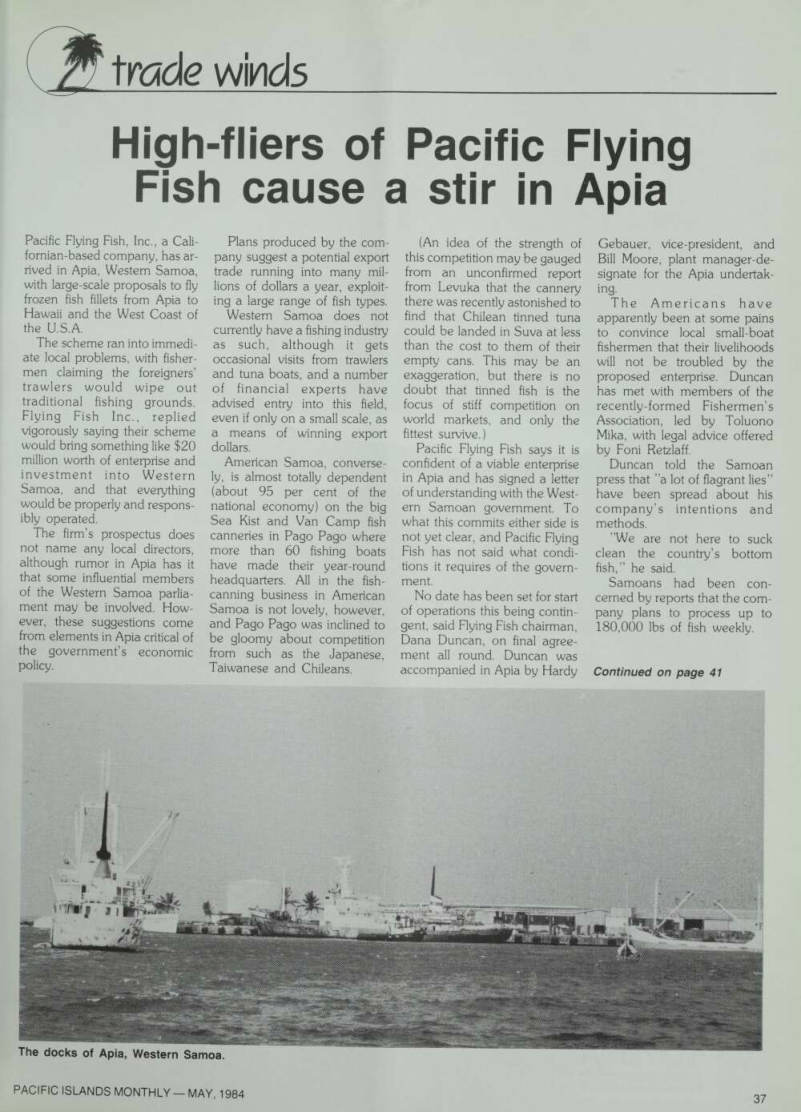
The docks of Apia, Western Samoa.
from page 37
Duncan told the fishermen: ”We are a privately-owned corporation from California that has come to Western Samoa on a cooperative effort with the government to develop, econo mically, its fish resources. The company intends to use its expertise and modern technol ogy in new and improved fishing methods.” These, said Duncan, would be backed up by computer-controlled marketing systems and the company’s own DC-8 jet trans port.
He said the company had noted with disappointment, ’’certain allegations and misrep resentations with regard to our fishing the area clean ...” ’’The management wishes to state unequivocally that we deny this rumor and that it has no basis in truth...,” Duncan said. ’’The presence of Pacific Flying Fish Company repre sents an economic deve lopment program designed to promote a viable fish proces sing operation, utilising current idle facilities, creating badly needed employment for a great number of people, teaching new skills, and encouraging the private sector especially in agri culture, through modern jet transportation to the U.S. and other world markets.”
Duncan’s view was that a local fishing industry was the business of local fishermen.
Pacific Flying Fish would not interfere in, or impede, that.
However, his company did in tend-to offer its cooperation to local people by making avail able better facilities and also teaching of modern handling and storage methods.
They would also offer advice on improvements in the design of local fishing vessels, he said, aiming at improving their safety and pay-load.
All of this would be included in the investment program which, he said, would amount to $2O million over the next three years, through goods, services, equipment and direct aid to local industry.
As part of this they had arranged to lease the fish mar ket built with Japanese aid money and which, as it was currently operated, was ”a use less facility,” Duncan said.