Seeds of conflict
pp. 33-35 · Read in the full issue
in ceded lands
Residents of Honolulu seem to hear more nowadays about the state of native Hawaiians. In January of this year, U.S. Sena tors Daniel Inouye (Democrat, Hawaii) and Lowel Weicker (Republican, Connecticut) were in town to hear testimony for the Senate Appropriations Sub committee on Labor, Health, Human Services and Educa tion.
Joseph Kealoha, chairman of the elected board of trustees of the Office of Hawaiian Affairs (OHA), reported that Hawaiians suffer significantly higher unemployment than others, higher rates of poverty and incarceration, the highest infant mortality, the lowest life expectancy, higher incidences of cancer, alcoholism, and re spiratory infections, and higher rates of personality disorders and suicides.
Federal legislation stemming from the 1920 s defines native Hawaiians as those of 50 per cent or more Hawaiian blood.
Representatives of the Hawaiian community re quested that the definition of native Hawaiians be broadened to include all individuals who have an Hawaiian ancestor re gardless of their blood quan tum. This would provide equal access to programs now avail able to half-bloods, and it was argued that Hawaiians should also be made eligible for a wide range of assistance programs now available in the U.S. to American Indians.
In belated recognition of the sorry plight of many native Hawaiians, the above men tioned OHA was authorised by an amendment to the State of Hawaii’s constitution in 1978.
OHA actually came into being in 1980. It is an agency within the state government, indepen dent of the executive branch, OHA has the authority to work with a variety of levels of government ranging from the large federal and state bureau cracies down to the smaller county governments of the state.
OHA has a multitude of purposes and is an ambitious agency to say the least. Accor ding to the constitutional amendment, OHA is to develop and co-ordinate programs for native Hawaiians; serve as an advocate for Hawaiians; apply for and manage grants and donations; serve as a receptacle of reparations, OHA is headed by a nine member board of trustees, which was first elected in 1980.
At least one member must come from each of the islands of Kauai, Oahu, Molokai, Maui and Hawaii. The trustees are elected from and by the state’s
A View from Honolulu
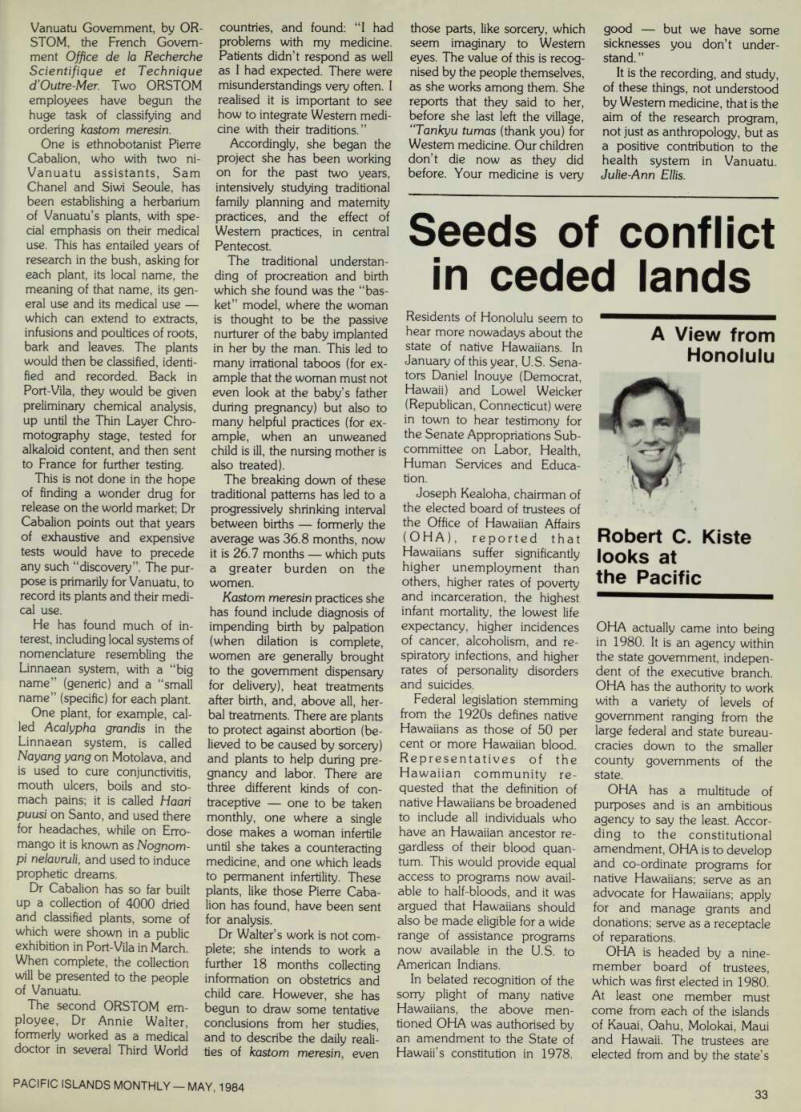
Robert C. Kiste looks at the Pacific
population of native Hawaiians as defined in the broader sense above. They elect their own chair from amongst themselves.
They appoint a chief executive officer who administers the agency’s daily and routine affairs.
Opinions about OHA vary greatly. Some state residents are quite sympathetic to its causes but often know little about what it really does. Un fortunately, many could not care less about Hawaiian affairs, and evidence no interest at all. For yet others, OHA is a source of alarm and perhaps even fear.
Because of these mixed views of OHA and lack of public awareness, George Chaplin, Editor-in-Chief of our morning newspaper, Honolulu Advertiser, had one of his most experienced columnists, Bob Krauss, prepare a series on OHA which ran during the visit of Senators Inouye and Weick er. Five matters raised in the series should be of interest to PIM readers. The last of them is the source of current con troversy. • The board of trustees is quite diverse. Members range from a small minority who describe themselves as radicals and activists to others at the opposite end of the spectrum who favor working within the framework of existing institu tions. As would be expected, meetings are not always harmo nious, and there is no common agreement upon priorities and tactics. In November 1983, however, the board passed a resolution which urged the U.S.
Congress “to acknowledge the illegal and immoral actions of the United States in the over throw of the Kingdom of Hawaii”, and to grant repara tions for damages suffered. This action received wide publicity, and, as might be expected, the statements of the more radical minority catch the attention of the public more often than those of the more conservative members. Thus, OHA is viewed by some as an organisation which must be carefully watched. • OHA was created upon the premise that Hawaiians need special treatment and assistance in order to solve some of their problems and achieve a better social and
economic position in American society. From the outset, how ever, some observers, including at least one state senator, have claimed that it is unconstitution al to give preferential treatment to one racial and cultural group.
This may seem strange to read ers outside the United States, but it should be noted that federal legislation in recent years has strongly emphasised and has perhaps gone over board concerning the legal necessity of ensuring equal opportunity for all citizens. • OHA is the smallest agen cy in the state government. It has a total of 36 employees (members of the board of trus tees are not employees; they receive quite modest stipends only on the days that they meet) and its entire budget in 1983 amounted to only $1,740,000. Of this, $1,200,000 was income from ceded lands (discussed below), and only the relatively small amount of $540,000 was pro vided by the state legislature.
The latter sum had to be matched by income from the ceded lands and could only be used for operations (salaries, office rent and equipment, etc.). Thus, a total of $1,080,000 was spent on operations which left about $660,000 for programs. • What has been accom plished in the way of programs?
A needs assessment has just about been concluded. The number of individuals of 50 per cent or more Hawaiian ancestry has never been accurately tal lied, but it is now being deter mined. Also, the needs assess ment project is asking Hawaiians what they them selves see as their high priority needs. As another project, a survey of all human resources that are available to Hawaiians is being conducted. Also, elders are being recruited to teach Hawaiian language and culture in public schools, and a curricu lum in Hawaiian studies is being developed. Loans have been made to an agricultural project and a fishing venture. A com puter project is keeping records on population and genealogical data and an inventory of ceded lands. Other projects involve volunteers in various social service efforts. • At present, the greatest controversy surrounding OHA
concerns the above-mentioned issue of ceded lands. The lands at stake were those held by the Hawaiian monarchy and taken by the U.S. Government at the time of annexation. These lands were ceded back at the time of statehood in 1959. By state law enacted after the 1978 con stitutional amendment, Hawaiians are entitled to 20 per cent of revenues from these lands.
Little effort has been made, however, to implement the legislation, and as the 1983 budget figures reflect, Hawaiians are receiving re latively little from the ceded lands. Millions and millions of dollars hang on the issue, and OHA is organising a drive to obtain the share due to Hawaiians.
Currently, the effort focuses on lands managed by the state’s department of trans portation and which involve airports and harbors. Honolulu International Airport is a case in point, and is one that is filled with complexities. The airport system is designed to be entire ly self-supporting. Airlines pay landing fees. Further, airlines
and a variety of concession naires rent space in the termi nal. The airport’s runways are located on ceded land. The terminal is not, yet it could obviously not function without the runways. The question is: What portion of the airport’s revenue can be claimed by
Oha?
The department of trans portation does not want to lose any portion of its income, and the state’s attorney-general has ruled that OHA is not entitled to a share of the more than $lOO million that is generated from the use of state airports and harbors. Other lands in ques tion involve the site of a pro jected new commercial and hotel complex near Honolulu’s old and famous Aloha Tower landmark.
In early March, OHA filed a lawsuit seeking a share of the airport and harbor revenues.
The question of OHA’s consti tutionality has again been raised. Just how these issues are resolved will have a long impact upon the future of both native Hawaiians and the 50th state of the union Robert C.
Kiste.
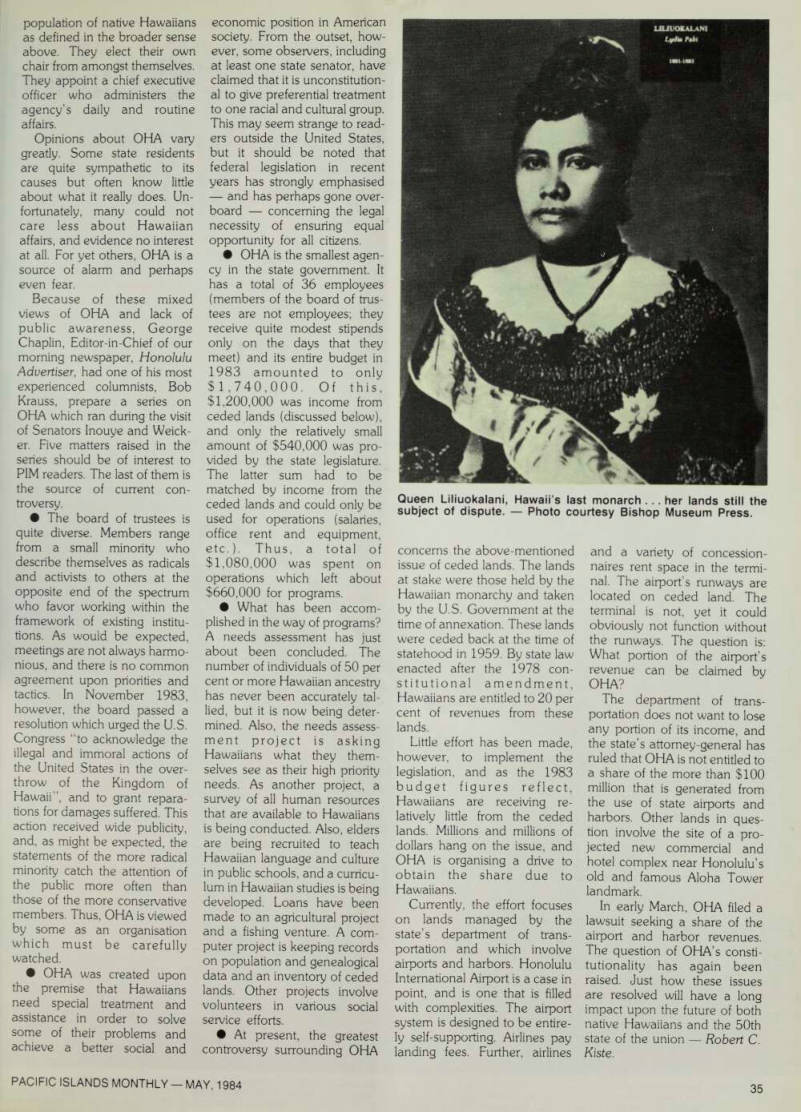
Queen Liliuokalani, Hawaii’s last monarch ... her lands still the subject of dispute. Photo courtesy Bishop Museum Press.