Suspended Enga
p. 49 · Read in the full issue
scores a first
RAMA ANIO, newly appointed RIM correspondent in Port Moresby, reports on the political bombshell represented by the Somare government’s decision to suspend the Enga provincial government.
The Somare government stun ned its political opponents in February when it suspended one of Papua New Guinea’s 19 provincial governments.
The suspension of the Enga provincial government for financial mismanagement was seen as a warning to those governments who have tried to abuse the “decentralisation” system.
Since last November, when major constitutional amend ments were passed by parlia ment empowering the national government to penalise faulty and mismanaged provincial governments, many critics, in cluding the premiers of the provinces, thought it wouldn’t be done. Even when the sub mission on Enga was put to Cabinet it was still thought and felt that the decision would not favor suspension. But Cabinet’s unanimous approval left the critics wondering what had gone wrong in their calcula tions. And, in the provinces, the feeling of vulnerability began to sink into those premiers and politicians who once thought themselves immune to national government checks and bal ances.
The passing of the legislation and subsequent suspension of Enga is quite an achievement for the 18-month-old govern ment of Prime Minister Michael Somare. It is also a personal victory for Mr Somare’s busi ness-like Provincial Affairs Minister, John Nilkare. The legislation was the brainchild of Mr Nilkare.
Despite the sensitivity of the issue, Mr Nilkare was con cerned at the “unconventional” methods used by some of the premiers to rule their provinces.
Since provincial governments were established soon after in dependence in 1975, there
have been numerous rumors, unconfirmed reports and allegations that some of the premiers had become mini dictators who abused their powers and privileges and spent public money extrava gantly to benefit themselves and others close to them.
Finally Mr Nilkare was given the ammunition, in the form of a report by the auditor-general, to shoot one of them down.
The report on Enga, an
under-developed Highlands
province with a population of 170,000, said the government of Premier Danley Tindiwi had mismanaged its finances and failed to account for it. Enga had not submitted a report on its accounts since Mr Tindiwi assumed power in 1980. The report said Enga had overspent its 1982 budget by almost K 400,000 (about $A480,000).
Its total budget for that year was K 3,995,400 and actual ex penditure K 3,949,845.
Although there was a net under-expenditure of K 45,555, the over-expenditure on va rious votes amounted to K 399,477. Enga’s bank account was overdrawn on nine occasions between August 1982 and March 1983, the highest amount being K 1,151,616, and the lowest K 15,572. Said the report; “The overdrawing of the bank account and the ineffective con trol over the operation of the provincial government were directly attributable to the laxity in the maintenance of the book of the account.”
The report also listed the unauthorised use of purchase orders between November 1982 and March 1983. During that five-month period, 16 un authorised purchase orders were used and amounted to K 6400. The highest amount
was KlOl4 for five days’ motel accommodation for the premier and two others.
Mr Tindiwi immediately re butted the report and said in his defence that it was the fault of the Department of Enga, the provincial bureaucracy. Mr Nil kare was not convinced by this argument and went ahead with the submission to Cabinet on
February 8. Following its
approval he sent a telex mes sage to Mr Tindiwi on February 9 informing him that Enga would be suspended from noon that day. Mr Nilkare and Mr Somare announced the deci sion at a news conference at Waigani that afternoon.
Mr Somare told reporters that the suspension was pro visional and would be for six to nine months. He said the deci sion was subject to confirmation by parliament (which began its first three-week session for the year on February 26).
Later, amid criticisms, Mr Nil kare strongly defended the ac tion, saying it was “designed to save representative democracy and to restore responsibility, accountability and efficiency in Enga.’’ He said privately that it had been a hard decision to make, but had to be done in the interests of the people of Enga and the system of provincial government. Mr Nilkare said he was also studying similar re ports on two other provincial governments, Oro and Sibu.
But he pointed out that finan cial mismanagement was not
the only criterion for suspen sion. Another was corruption.
Surprisingly, Mr Tindiwi at first welcomed the suspension, but reiterated that he was not to blame. Then he threatened the national government with court action, saying the decision was unconstitutional.
Others who did not quite welcome the suspension in cluded Opposition Leader lam bakey Okuk and his deputy, Fr John Momis. Fr Momis, consi dered the father of provincial government, said the action was extreme and a setback for decentralisation, a process he had worked hard to achieve in his tenure as minister for decen tralisation in the previous gov ernments. He blamed the na tional finance department and Waigani bureaucrats for their unwillingness to decentralise financial powers to the pro vinces.
While heated debate con tinued between the govern ment and opposition parties, the people of Enga took the news calmly. The vocal few had their say. As for the silent majority, it didn’t seem to mat ter that the province would go down in history books as the first casualty of the provincial government system a system that was designed to give them more say in their own affairs and make them economically self-reliant so that they could contribute to the country’s de velopment and wealth.
Pama Anio in Port Moresby.
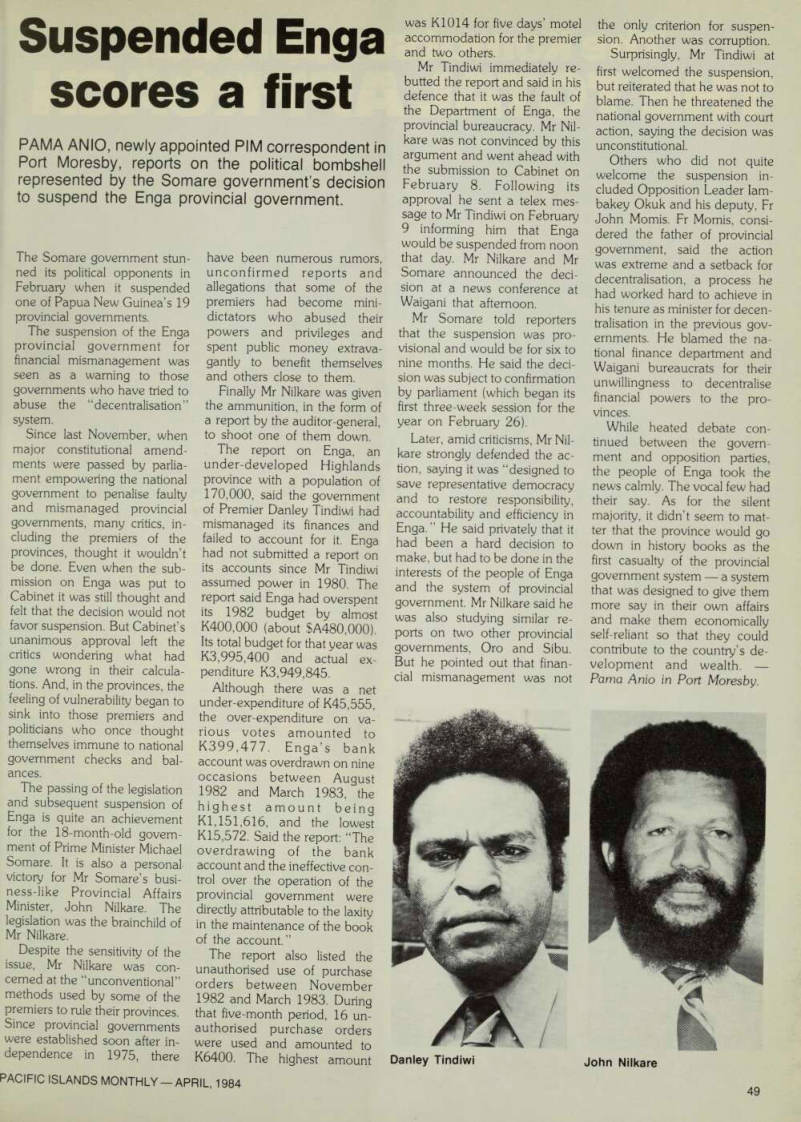
Danley Tindiwi
John Nilkare