tropicalities
pp. 51-52 · Read in the full issue
When ‘Queen Rarotonga’ was Mexico’s darling
GALAL J. KERNAHAN, U.S./Travelling Correspondent of the leading Mexican weekly newsmagazine TIEMPO, provides below an English translation of one of his recent articles; after relating the remarkable story of a Mexican fantasy “Queen Rarotonga”, he tells of a recent visit to the Cook Islands and of his meeting a person who could lay genuine claim to such a title.
Throughout the 19705, Mex icans were thrilled by, and suffered and rejoiced with, the beautiful Queen “Rarotonga”, sharing all her triumphs and anxieties in the weekly maga zine, Tears, Laughter and Love, and in motion pictures made not in the South seas but in Guatemala.
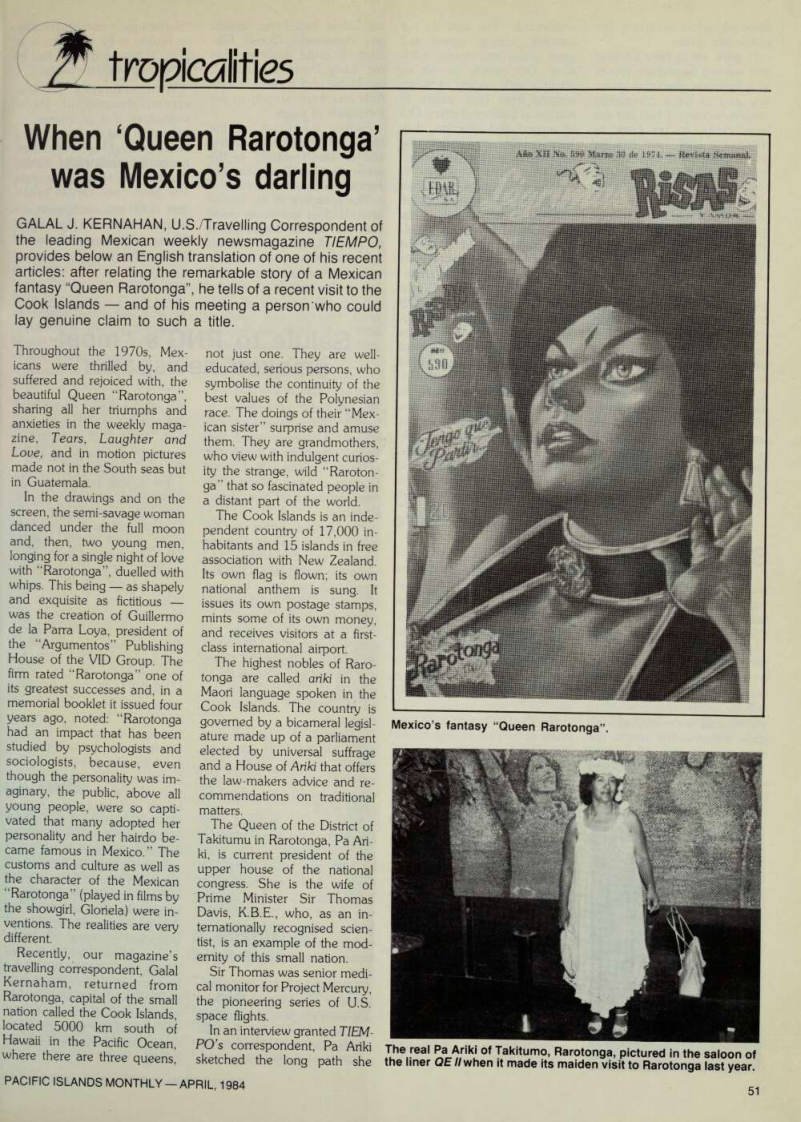
In the drawings and on the screen, the semi-savage woman danced under the full moon and, then, two young men, longing for a single night of love with “Rarotonga”, duelled with whips. This being as shapely and exquisite as fictitious was the creation of Guillermo de la Parra Loya, president of the “Argumentos” Publishing House of the VID Group. The firm rated “Rarotonga” one of its greatest successes and, in a memorial booklet it issued four years ago, noted: “Rarotonga had an impact that has been studied by psychologists and sociologists, because, even though the personality was im aginary, the public, above all young people, were so capti vated that many adopted her personality and her hairdo be came famous in Mexico.” The customs and culture as well as the character of the Mexican “Rarotonga” (played in films by the showgirl, Gloriela) were in ventions. The realities are very different.
Recently, our magazine’s travelling correspondent, Galal Kernaham, returned from Rarotonga, capital of the small nation called the Cook Islands, located 5000 km south of Hawaii in the Pacific Ocean, where there are three queensi
not just one. They are well educated, serious persons, who symbolise the continuity of the best values of the Polynesian race. The doings of their “Mex ican sister” surprise and amuse them. They are grandmothers, who view with indulgent curios ity the strange, wild “Raroton ga” that so fascinated people in a distant part of the world, The Cook Islands is an inde pendent country of 17,000 in habitants and 15 islands in free association with New Zealand, Its own flag is flown; its own national anthem is sung. It issues its own postage stamps, mints some of its own money, and receives visitors at a first class international airport.
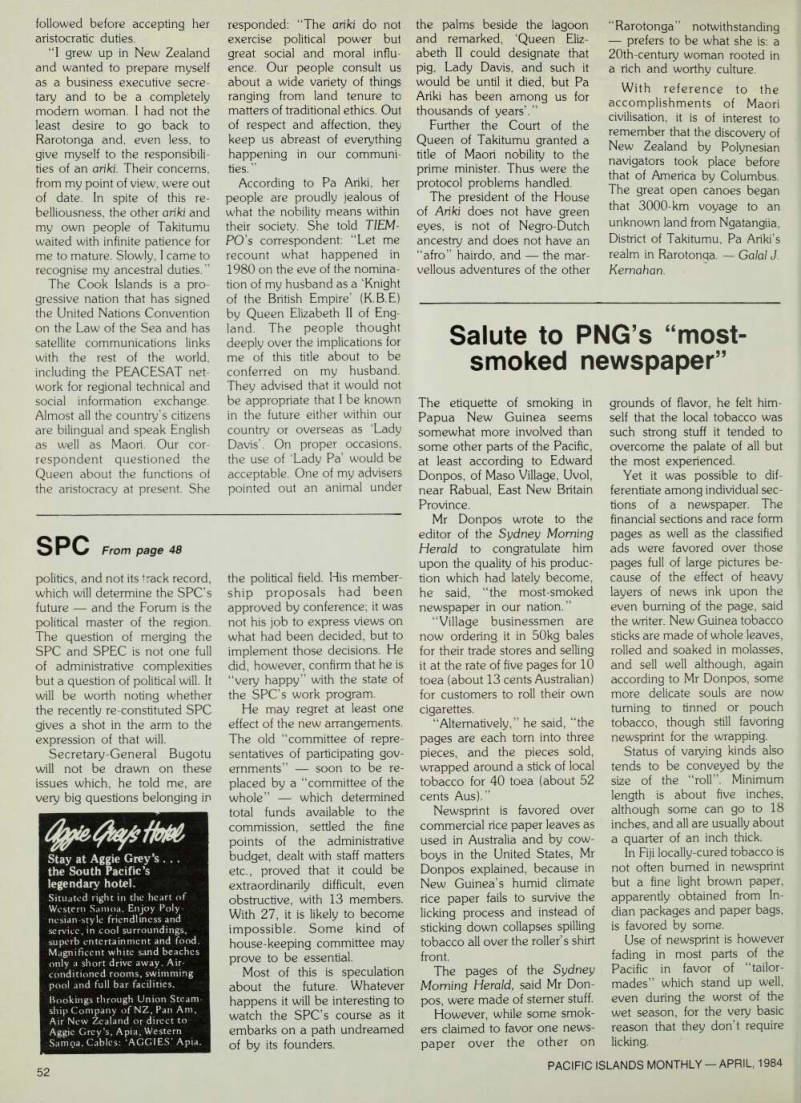
The highest nobles of Raro tonga are called ariki in the Maori language spoken in the Cook Islands. The country is governed by a bicameral legisl ature made up of a parliament elected by universal suffrage and a House of Ariki that offers the law-makers advice and re commendations on traditional matters, The Queen of the District of Takitumu in Rarotonga, Pa Ari ki, is current president of the upper house of the national congress. She is the wife of Prime Minister Sir Thomas Davis, K.8.E., who, as an in ternationally recognised scien tist, is an example of the mod ernity of this small nation, Sir Thomas was senior medi cal monitor for Project Mercury, the pioneering series of U.S. space flights, In an interview granted TIEM PO’s correspondent, Pa Ariki sketched the long path she
Mexico’s fantasy “Queen Rarotonga”.
The real Pa Ariki of Takitumo, Rarotonga, pictured in the saloon of the liner QE II when it made its maiden visit to Rarotonga last year.
followed before accepting her aristocratic duties.
“I grew up in New Zealand and wanted to prepare myself as a business executive secre tary and to be a completely modern woman. I had not the least desire to go back to Rarotonga and. even less, to give myself to the responsibili ties of an ariki. Their concerns, from my point of view, were out of date. In spite of this re belliousness, the other ariki and my own people of Takitumu waited with infinite patience for me to mature. Slowly, I came to recognise my ancestral duties.”
The Cook Islands is a pro gressive nation that has signed the United Nations Convention on the Law of the Sea and has satellite communications links with the rest of the world, including the PEACESAT net work for regional technical and social information exchange.
Almost all the country’s citizens are bilingual and speak English as well as Maori. Our cor respondent questioned the Queen about the functions of the aristocracy at present. She
responded; “The ariki do not exercise political power but great social and moral influ ence. Our people consult us about a wide variety of things ranging from land tenure to matters of traditional ethics. Out of respect and affection, they keep us abreast of everything happening in our communi ties.”
According to Pa Ariki, her people are proudly jealous of what the nobility means within their society. She told TIEM PO's correspondent: “Let me recount what happened in 1980 on the eve of the nomina tion of my husband as a ‘Knight of the British Empire’ (K.B.E) by Queen Elizabeth II of Eng land. The people thought deeply over the implications for me of this title about to be conferred on my husband.
They advised that it would not be appropriate that I be known in the future either within our country or overseas as ‘Lady Davis’. On proper occasions, the use of ‘Lady Pa’ would be acceptable. One of my advisers pointed out an animal under
the palms beside the lagoon and remarked, ‘Queen Eliz abeth II could designate that pig, Lady Davis, and such it would be until it died, but Pa Ariki has been among us for thousands of years’.”
Further the Court of the Queen of Takitumu granted a title of Maori nobility to the prime minister. Thus were the protocol problems handled.
The president of the House of Ariki does not have green eyes, is not of Negro-Dutch ancestry and does not have an “afro” hairdo, and the mar vellous adventures of the other
“Rarotonga” notwithstanding prefers to be what she is: a 20th-century woman rooted in a rich and worthy culture.
With reference to the accomplishments of Maori civilisation, it is of interest to remember that the discovery of New Zealand by Polynesian navigators took place before that of America by Columbus.
The great open canoes began that 3000-km voyage to an unknown land from Ngatangiia, District of Takitumu, Pa Ariki’s
realm in Rarotonqa.
Galal J.
Kernahan.