political currents
pp. 47-52 · Read in the full issue
South Pacific Commission faces a problematical future
The South Pacific Commission is “embarking on a path undreamed of by its founders”, according to DONALD STEWART. In the following article he canvasses the pitfalls and the promise held by this new course for the future of the SPC and its now 27 member countries and territories. At different times during the 1970 s Mr Stewart represented Tokelau and Nauru on the SPC, and at South Pacific Conferences. From 1978-81 he was the SPC’s administrative director.
New membership arrange ments for the South Pacific Commission approved in Saipan last October (PIM Nov. ’B3 p. 11) raise as many ques tions about the future of the organisation as they attempt to answer.
Under the new arrangements all 22 countries and territories within the commission’s area, together with the five “metro politan” countries, are full members irrespective of politi cal status or affiliation. This has created an entity whose poten tial political clout is enormous although the commission is specifically precluded by its charter from engaging in poli tics. How will this conflict be handled when it arises, as it is almost certain to do?
The “everyone’s equal” theory was raised by American Samoa at the 1979 South Paci fic Conference in Tahiti and was promptly and vehemently denounced from the floor by Papua New Guinea’s then Minister for Foreign Affairs and Trade, Ebia Olewale. With mighty PNG staring down tiny American Samoa, and in the face of continuing proposals for a single regional organisation (SRO) to supersede the South Pacific Commission (SPC) and the South Pacific Bureau for
Economic Co-operation (SPEC), how did the SPC’s new membership arrangements come to pass in such a short time?
The answer lies partly in the push given by the SPC’s presti gious Secretary-General, Fran cis Bugotu, of Solomon Islands, who presented a paper to the 1983 Saipan conference, enti tied, innocuously enough, “In- House review of the South Pacific Commission by the Secretary-General. ”
Much of this dealt with the nuts and bolts of the secretar iat’s inner workings. But in one respect the expanded membership proposal it was of vast significance. Although the proposal had been pre arranged at a special meeting in Canberra earlier in the year, it found extra and ready acceptance at the Saipan con ference from the French and U.S. territories. PNG, however, this time represented by its respected secretary for Foreign Affairs and Trade, Paulias Matane, remained resolutely, and eloquently, opposed, and finally went along only to avoid destroying consensus.
Until his appointment as secretary-general, Bugotu was the senior diplomat of Solomon Islands, a country not exactly
known for its feelings of tender ness towards the SPC. It was even rumored that his appoint ment would hasten the demise of the SPC by giving impetus to the thrust for an SRO. Why, then, did he take it upon himself to persuade the Saipan conference to adopt expanded membership proposals which, at first glance, appear substan tially to strengthen the SPC’s role in the region?
Funding under the new membership arrangements raises further questions. Who will pay what? Although the metropolitans will almost cer tainly continue to cough up 92 per cent of the commission’s regular budget, the remaining eight per cent, to be split among 22 island governments, could cause problems. Last year’s conference agreed to a three tiered level of contributions from islands governments based on their per capita in comes, but left itself an “out” by making that decision subject to “ratification” by another meeting to be held this year. In other words they weren’t sure enough about the issue to make a final decision.
Why not? The total amount, less than $A300,000, is not large, especially when divided by 22. But funding has always touched a raw nerve among the islands members of the SPC.
Indeed, funding was the issue used to get islands governments into the SPC in the first place when, nearly 20 years ago, Ratu (now Sir) Kamisese Mara pleaded that they be allowed to contribute to the commission’s budget and thereby gain a say in its operations. For years since then islands governments have argued about how much they should contribute, and the per capita income formula, devised
by Australia, is unlikely to put a stop to that.
Again, why not? Well, for a start, the reassessment appears to have been based upon a statistical formula which bears little relation to the islands gov ernments abilities or inabilities to pay. For example, some governments which might be expected to be in a better position than others to contri bute on a weighted basis would actually pay considerably less than at present. Among them are Fiji, Nauru and PNG. A middle group of eight countries would mostly pay quite a bit more, while the bottom group of seven, which includes some of the poorest countries in the world in income terms, would, with the exception of Solomon Islands and Western Samoa, pay substantially more $9OOO-$lO,OOO a year is a lot of money for countries like Tokelau or Tuvalu, and is half of what the islands “big boys” would pay.
This raises more questions because the new membership, and the per capita funding basis, create an Orwellian situa tion whereby although all gov-
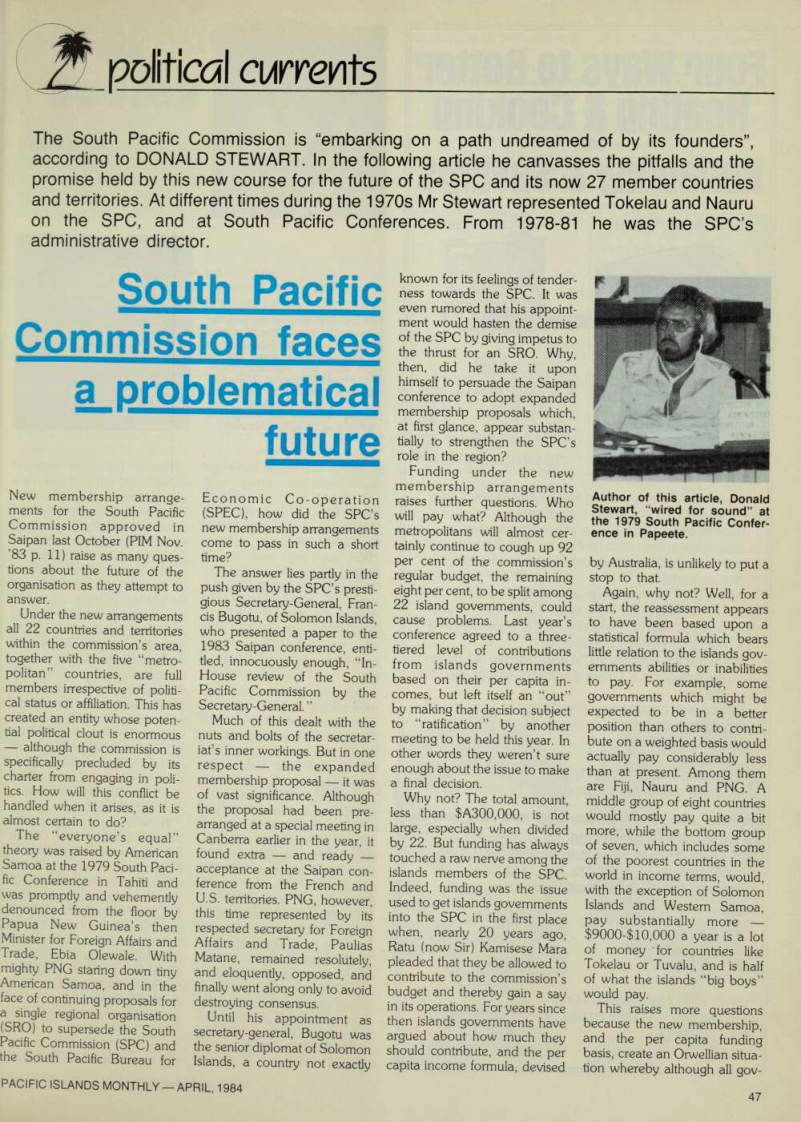
Author of this article, Donald Stewart, “wired for sound” at the 1979 South Pacific Confer ence in Papeete.
ernments are equal, some are more equal than others, and this could produce political issues. How, for example, does Western Samoa, which blazed the islands’ path into the SPC in 1965, see itself now at the bottom of the list of contribu tors, while its territorial brother across the water in American Samoa is at the top? Is this the reward of independence? And who has more say, at least behind the the scenes? And so on.
Other political issues may unavoidably follow, touching defence and security matters in the American-dominated North Pacific, nuclear dumping and testing, and New Caledonian independence. How will the SPC, with its formal ban on political issues, deal with these if its new, full members, out weighing the original colonials, insist on bringing them up? And what would this do to the SPC’s relationship with the South Pacific Forum, and SPEC?
The SPC/SPEC issue, which has been studied for years, is not likely to lie down and die.
Under the euphemism “Propo sals for a Single Regional Organisation’’ it is now the subject of review by a commit tee of four foreign ministers due to report to this year’s meeting of the South Pacific Forum in Tuvalu.
This is the most high po wered study yet and there s a good chance that it will, at last, bring some movement on the question. After all, a report from four foreign ministers can’t be just tucked away and ignored as have previous reports. It could be that the expanded SPC will be just the catalyst needed by proponents of an SRO to bring about its creation before the SPC gets any stronger and starts playing politics, which would bring it into conflict with the Forum. On the other hand there may be those who would prefer to see the SPC in conflict with the Forum, because the latter would emerge the winner.
And then there is the school of thought which is happy to see the SPC survive as a conve nient whipping-boy.
None of this touches on what the SPC actually does. Despite talk of overlap, duplication of effort, squandering of re sources, administrative wastefulness and the like, the SPC over the years has done as good a job as could be ex pected in delivering technical assistance to the region, and continues to do so. Whether that will remain the case is really up to the Forum countries for, in the final analysis, it will be
continued on page 52
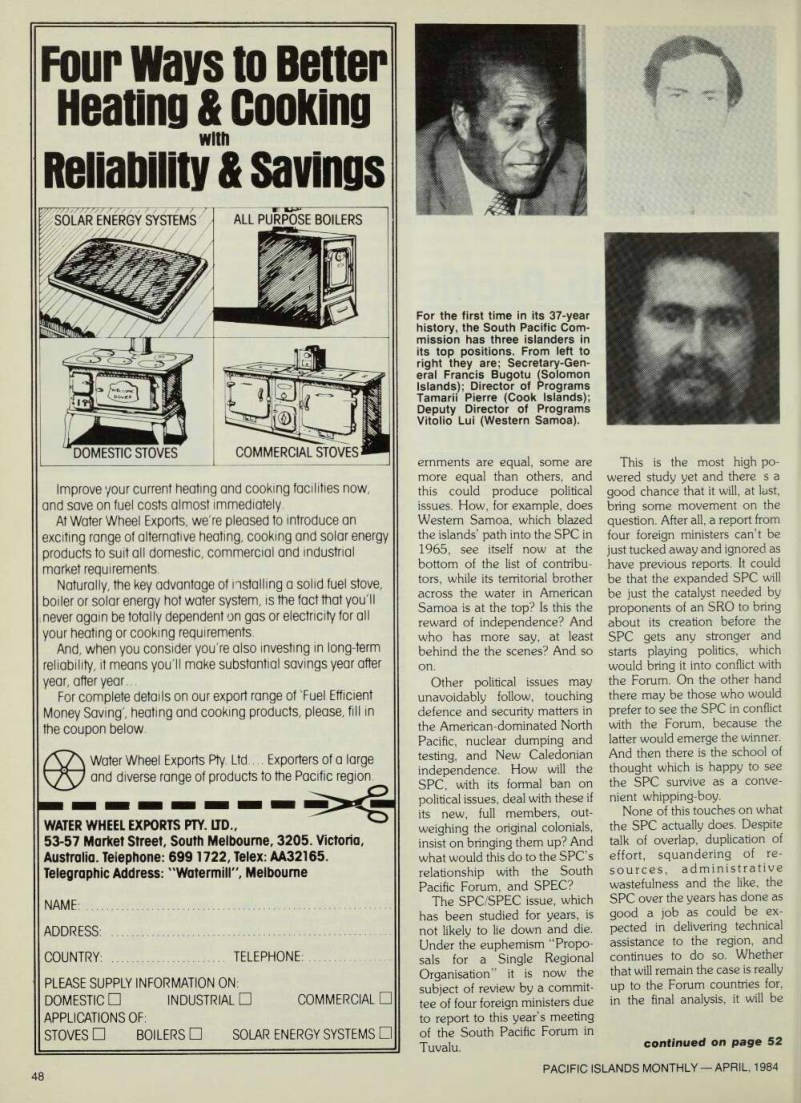
For the first time in its 37-year history, the South Pacific Com mission has three islanders in its top positions. From left to right they are; Secretary-Gen eral Francis Bugotu (Solomon Islands); Director of Programs Tamarii Pierre (Cook Islands); Deputy Director of Programs Vitolio Lui (Western Samoa).
politics, and not its track record, which will determine the SPC’s future and the Forum is the political master of the region, The question of merging the SRC and SPEC is not one full of administrative complexities but a question of political will. It will be worth noting whether the recently re-constituted SPC gives a shot in the arm to the expression of that will.
Secretary-General Bugotu will not be drawn on these issues which, he told me, are very big questions belonging in
the political field. His member ship proposals had been approved by conference; it was not his job to express views on what had been decided, but to implement those decisions. He did, however, confirm that he is “very happy” with the state of the SPC’s work program.
He may regret at least one effect of the new arrangements.
The old “committee of repre sentatives of participating gov ernments” soon to be re placed by a “committee of the whole” which determined total funds available to the commission, settled the fine points of the administrative budget, dealt with staff matters etc., proved that it could be extraordinarily difficult, even obstructive, with 13 members.
With 27, it is likely to become impossible. Some kind of house-keeping committee may prove to be essential.
Most of this is speculation about the future. Whatever happens it will be interesting to watch the SPC’s course as it embarks on a path undreamed of by its founders.