We dodge death by
pp. 45-46 · Read in the full issue
a whisker in Mamanila
In the third extract from his “Melanesian Journey” travel diary ROBERTO PETTINI tells of the experi ences befalling him and his brother MARCO as they begin their exploration of the islands of the Calvados Chain, in the Louisiade Archipelago of Papua New Guinea’s Milne Bay Province.
February 2, 1981: The weath er yesterday was kind. The sea was too rough, and the sun was warm all day.
The trip on the small motor boat was extremely pleasant, as we spent it chatting with the captain, lying idly on the boat’s roof, and thinking aloud of “the story” just passed, and the one about to begin.
When we arrived in Nimowa last night, the Fathers wel comed us with open arms, as if they were waiting for us . . . We understood that Father English, without telling us, had con tacted this mission by radio and prepared an unexpected wel come for us.
After dinner we chat until late, in a relaxed way, even having small glasses of liqueur, like old friends meeting again after a long time . . .
The mission much bigger than the one in Ginger was built in 1948, and here too, in addition to its religious function, attends to the hospital, the school, the store, and so on.
We tell about ourselves, who we are and what we’re doing, and ask a whole lot of questions about the islands of the Calva dos Chain, especially whether it is still possible to “cross” the chain using local canoes.
The missionaries confirm that the islanders still move quite frequently between islands and that, if we are not pressed for time, there should be no diffi culties. “They’ll be quite happy to have you with them . . . You could even leave tomorrow.
There is a canoe on the beach that has come here to buy something at the store and I think I’ve heard that they are going back to their village tomorrow. ”
February 5: We buy ourselves a stock of tobacco and rice at the mission store, as throughout the chain it will be difficult to find another with any stocks at all, and we load our packs in the canoe. The priest was right: the man had come yesterday and is leaving today, and is
openly pleased to take us with him. Again it’s the time for goodbyes, thanks, handshakes, blessings . . . and then we go, the sail is lifted, the canoe rocks, the out-rigger lifts itself on the surface of the water, the two of us hang on as best we can, and the canoe sails amid general laughter and quickly heads out to sea.
The second lap of our Melanesian journey has begun February 6: Bailaine is the name of this village, the last on the south coast of Pana-Tinai, or Janet Island, which is the first and definitely the largest of all the Calvados Islands. From here we can still see the coast of tiny Nimowa; yesterday’s cros sing was only a small “hop.”
It seems as if a distance greater than a one-day boat trip separates these people from the people of Rossel Island. Here people seem much more open I’d say warmer and readier to open their mouths, quicker to laugh.
The village is rather large and heavily populated, and we notice immediately, parked on the beach, many large canoes with sails and out-riggers like the one that brought us here.
Everybody is extremely kind and hospitable, and we spend most of the day in the huts of those who want us, sitting and eating with them, telling our stories and listening to theirs.
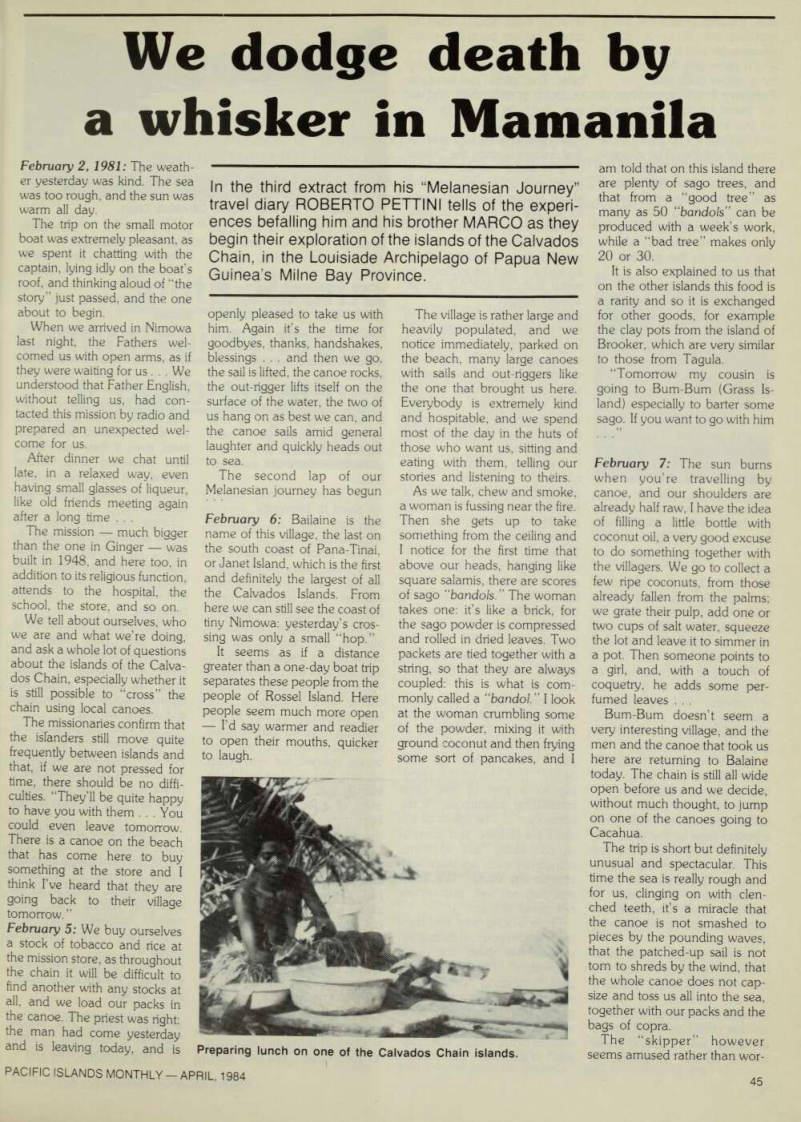
As we talk, chew and smoke, a woman is fussing near the fire.
Then she gets up to take something from the ceiling and I notice for the first time that above our heads, hanging like square salamis, there are scores of sago “bandols.” The woman takes one: it’s like a brick, for the sago powder is compressed and rolled in dried leaves. Two packets are tied together with a string, so that they are always coupled: this is what is com monly called a “ bandol l look at the woman crumbling some of the powder, mixing it with ground coconut and then frying some sort of pancakes, and I
am told that on this island there are plenty of sago trees, and that from a “good tree” as many as 50 “bandols” can be produced with a week’s work, while a “bad tree” makes only 20 or 30.
It is also explained to us that on the other islands this food is a rarity and so it is exchanged for other goods, for example the clay pots from the island of Brooker, which are very similar to those from Tagula.
“Tomorrow my cousin is going to Bum-Bum (Grass Is land) especially to barter some sago. If you want to go with him 11 February 7: The sun burns when you’re travelling by canoe, and our shoulders are already half raw, I have the idea of filling a little bottle with coconut oil, a very good excuse to do something together with the villagers. We go to collect a few ripe coconuts, from those already fallen from the palms; we grate their pulp, add one or two cups of salt water, squeeze the lot and leave it to simmer in a pot. Then someone points to a girl, and, with a touch of coquetry, he adds some per fumed leaves . . .
Bum-Bum doesn’t seem a very interesting village, and the men and the canoe that took us here are returning to Balaine today. The chain is still all wide open before us and we decide, without much thought, to jump on one of the canoes going to Cacahua.
The trip is short but definitely unusual and spectacular. This time the sea is really rough and for us, clinging on with clen ched teeth, it’s a miracle that the canoe is not smashed to pieces by the pounding waves, that the patched-up sail is not torn to shreds by the wind, that the whole canoe does not cap size and toss us all into the sea, together with our packs and the bags of copra.
The “skipper” however seems amused rather than wor
Preparing lunch on one of the Calvados Chain islands.
ried. It is almost as if this was a competitive race, a game whose rules you know by heart, which gives you the opportun ity to show your skill . . .
February 9: We crossed part of the island on foot, with packs on our shoulders, and guided and followed by the usual crowd of children. The village is located on a tiny island, and tonight, as I sit on the beach, I look at the many small canoes returning, loaded with food, bundles of leaves and firewood.
Women have returned after a day’s work in the gardens on Pana-Tinai Island.
“Why did you build the vil lage here, on such a tiny island, rather than on the coast where you have your gardens?” The answer is very simple: “There are no mosquitoes here ...”
February 10: Lemen is about to die. He has been sick for two weeks, two weeks spent at home slowly dying. When I went to visit him, I found him with half his body paralysed, I heard him say a few incompre hensible words, and he was breathing with difficulty.
Someone has started to pre pare the food for his funeral.
Soon it will be known that “ puri-puri” (magic) killed Le men . . .
February 11: A few reflections sent by way of a small mirror tell us that Lemen is dead. (If the message had to be sent at night, a bunch of burning leaves would have been used.) We have just arrived at Maho, the village on the island of Sahara, opposite Nigaho.
The village chief and the two boys who brought us here have gone back immediately.
Sahara is very beautiful: three villages on a long white beach and no mosquitoes . . .
Still, there is no water on the island, and you can’t even grow a potato here as the ground is so rocky. In this case too the gardens are on another island, and every day of the year many canoes leave the village at dawn to go to Emenahe, re turning at night or the following day.
Besides the pots, the shell money, the “ baghi” and the stone axes (old, sharp, polished stones, passed on down through countless generations), another object has a recognised exchange value among these islands. It’s the “lime stick,” a
kind of small spoon used to spread on the gums the white coral powder that bums indispensable if you’re chewing betel. The “sticks” can be made of ebony or turtle shell, and we saw them in more or less everybody’s baskets.
In Nigaho they had told us that Sahara is really the “island of lime sticks,” so we spend a good part of today strolling about houses to find two sticks for us. We see them in all sizes, old and new, all with carved handles of more or less compli cated design. A packet of tobac co and a T-shirt are sufficient to make both us and the former owners happy.
February 12: We leave early in the morning. Mamanila is a long way off, and it will take all day to get there. The reason for the trip? A pig, and not even a very big one at that. He has been placed in the canoe like any other passenger, and today he will change both owner and dwelling place.
Travelling by canoe is be coming more and more pleasant, especially if the sea and the wind are with us. This is our fifth canoe and crew, and we are getting used to this new life at sea. The initial awkward ness has given way to a certain ease in our movements. We’ve learned how to give a hand with the jobs, like constantly bailing out the water that gets in through the holes and the cracks, tightening and slacking the sail, even taking charge of the rudder.
Before getting to the village, we stop for a while on the coast of Pana-Wina. The “captain” of the canoe wants to show us a place where people go after death. “This,” he told us, point ing to a part of the coast infested by mosquitoes, “is the entrance . . . The spirits of the dead are all here, and some of us can easily ‘talk’ to them, sometimes even see them wal king in the village. We know that they are well, and we are not afraid of them ...”
From a long way off, from the moment you can distinguish sounds, we hear the word “dim-dim” (literally “pale pale,” meaning white man), shouted by children and re peated many times, like a cock crow at dawn, by the men and women in the village. The “cap tain” of the canoe that brought
us here explains in the local language who we are and where we are going, adding straight away a few details worth mentioning, like the fact that we chew betel, that we speak Pidgin, and that we can play a funny game with cards.
In the meantime it has been decided where we are to be lodged and, as soon as we return to the canoe, someone is already moving our luggage to a hut already cleaned up and arranged, where they have already placed a few mats.
Sometimes there are even pil lows! ... In other words, tonight we sleep in Mamanila.
February 14: Last night we were nearly killed.
Ever since afternoon, the wind had been bending the coconut palms in a terrifying manner, and rain had been falling more and more heavily.
Then, last night closeted in our hut, with only the light of the lamp, we stayed up talking until late with the chief s family.
We wrote a few notes and then calmly went to sleep. It must have been one or two in the morning when an infernal noise suddenly woke us, we had barely opened our eyes when we saw that our hut had been literally split wide open by the trunk of a large tree that had been blown down by the fury of the wind.
Immediately the whole population of the village was up and out in the rain around our hut. Some were shouting, others kept asking: “Yu tu pela i dai-pinis or yu allright . . .?” (Are you two dead for keeps or all right?); others, in complete frenzy, made sure we were still in one piece by touching us . . .
We don’t really know how they interpreted this event, but it took a long time before we all stopped laughing and repeating to each other: “Dis pela stori i
gut pela stori tru. ” (This is really a good story to tell.) February 15: The bad weather is still with us. In fact we came at the wrong time of the year, as the rainy season has just started.
The sea is frightening to behold, even from the beach, and all we can do is wait for the wind to die down, before we can even think of leaving.
Talking about magic is not easy at all. Those who should be able to answer your ques tions, even if they talk Pidgin, start stuttering and looking around; but if you insist a little, as we did today, something comes out.
Every man has three little phials containing a “magic li quid”, an extract of special herbs and leaves found in the bush, which he guards carefully and which serve three different purposes.
If, for example, you decide to leave with your canoe for another island in order to barter some shell-money or stone axes, the use of magic will ensure you a safe trip and easy and fruitful trading.
If you want the girl you love to fall in love with you, then you’ll use your liquid to spread on your face and armpits like a perfume, or to mix with some thing that you will then let her have.
The third phial is used to get a girl for only one night. The use of this third magic is closely linked to particular occasions such as feasts. These in all the Calvados Islands take place mainly between July and September, when food is plentiful.
February 16: The good weath er is back. We are in the canoe, again at sea. • Next month: The private thoughts of Abraham, of Para llel Village, Pana-Umale Island
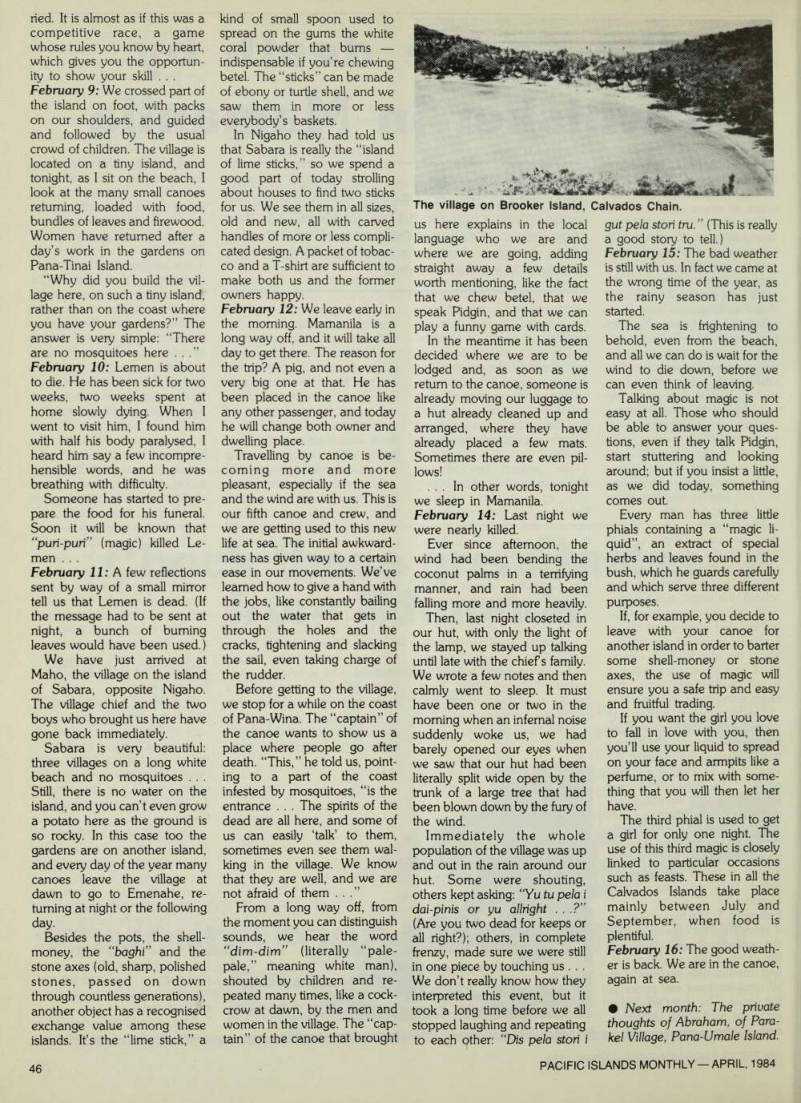
The village on Brooker Island, Calvados Chain.