Tahitian villagers’
p. 41 · Read in the full issue
vanished way of life recorded
Two Tahitian Villages A Study in Comparisons. By Douglas Oliver. Published by the Institute for Polynesian Studies, sponsored by the Polynesian Cultural Center and Brigham Young Uni versity, Hawaii Campus. Pp. xiv, 557. ISBN 0 939154 22 6 (hard cover), ISBN 0 939154 25 0 (paperback). No price provided.
Tahiti is the largest island (52 km along its axis) in an archipelago known as the Soci ety Islands, and is part of the sub-group called the Windward Islands. At the time of first European contact in 1767, Tahiti had an indigenous population of about 35,000. In 1880, France consolidated the Windward Islands as a fully annexed colony, and Tahiti still held the status of colony at the time of Douglas Oliver’s field studies there in 1954-55 and 1959-60.
This monograph is described by the author as an exercise in “controlled comparison.” This
method of anthropological re search has been in use for a long time, but its impact has been weakened by the fact that many of the societies compared have shared too few char acteristics to permit sufficient “control.”
Oliver sidestepped this inhe rent problem by deciding to concentrate upon a single “spe cies” of present-day Polynesian society and applying the com parative approach to its several sub-specific varieties of societal culture.
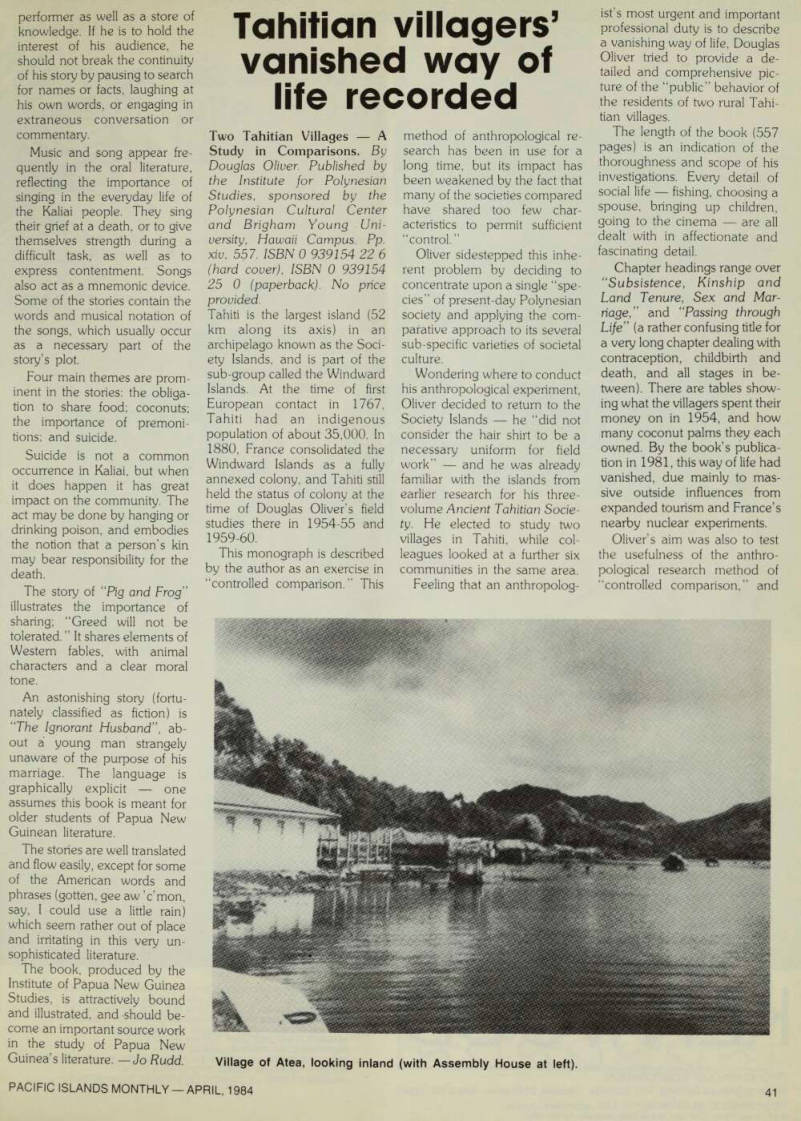
Wondering where to conduct his anthropological experiment, Oliver decided to return to the Society Islands he “did not consider the hair shirt to be a necessary uniform for field work” and he was already familiar with the islands from earlier research for his three volume Ancient Tahitian Socie ty. He elected to study two villages in Tahiti, while col leagues looked at a further six communities in the same area.
Feeling that an anthropolog
ist’s most urgent and important professional duty is to describe a vanishing way of life, Douglas Oliver tried to provide a de tailed and comprehensive pic ture of the “public” behavior of the residents of two rural Tahi tian villages.
The length of the book (557 pages) is an indication of the thoroughness and scope of his investigations. Every detail of social life fishing, choosing a spouse, bringing up children, going to the cinema are all dealt with in affectionate and fascinating detail.
Chapter headings range over “ Subsistence, Kinship and Land Tenure, Sex and Mar riage/’ and “ Passing through Life” (a rather confusing title for a very long chapter dealing with contraception, childbirth and death, and all stages in be tween). There are tables show ing what the villagers spent their money on in 1954, and how many coconut palms they each owned. By the book’s publica tion in 1981, this way of life had vanished, due mainly to mas sive outside influences from expanded tourism and France’s nearby nuclear experiments.
Oliver’s aim was also to test the usefulness of the anthro pological research method of “controlled comparison,” and
Village of Atea, looking inland (with Assembly House at left).