Story-tellers of Kaliai show their paces
pp. 40-41 · Read in the full issue
Kaliai show their paces
Ol Stori Bilong Laupu. The Tales of Laupu. Stories from Kaliai, West New Britain, told by Jakob Mua Laupu, Benedik Solou Laupu and Maria Sapanga. Transcribed, translated and with an introduction by Dorothy Ayers Counts. Music transcription and analysis by Timothy J.
Keenan. Published by the Institute of Papua New Guinea Studies, P.O. Box 1Q32, Boroko, PNG. No I-SBN, price; .provided. '* Tales of Laupu is an unusual book. It is intended for use throughout Papua New Guinea, and contains a text in two languages, a glossary, musical notations, and photographs.
The stories, which are part of the rich oral tradition of the people who live in the Kaliai division of West New Britain,
appear first in Tok Pisin. In the second half of the book, the stories appear in English, Dorothy Counts, who lived in West New Britain for two and a half years, explains the import ance of oral literature to the people of Kaliai. The stories contain “historical, cultural or sociological truths: they reflect and reconstruct experienced reality”.
Story-telling is a common and enjoyable evening pastime in Kaliai, especially during the heavy rains which fall from December to April and inhibit trading journeys and cere monies.
They delineate three types of story: a nasinga is a true account of historical events; a pelunga is rather like a legend, and may be about real or fabulous events; and a ninipun ga is a tale that does not contain
historical or legendary truth, a fictitious tale. This collection contains one example of a history, four legends, and 11 fiction stories.
The tales are a selection from the repertoire of two of the sons
of Laupu, Jakob Mua and Benedik Solou, as well as Mua’s wife, Sapanga. Accord ing to Mua, widely recognised as one of the most knowledge able and skilled raconteurs of the area, a story-teller is a
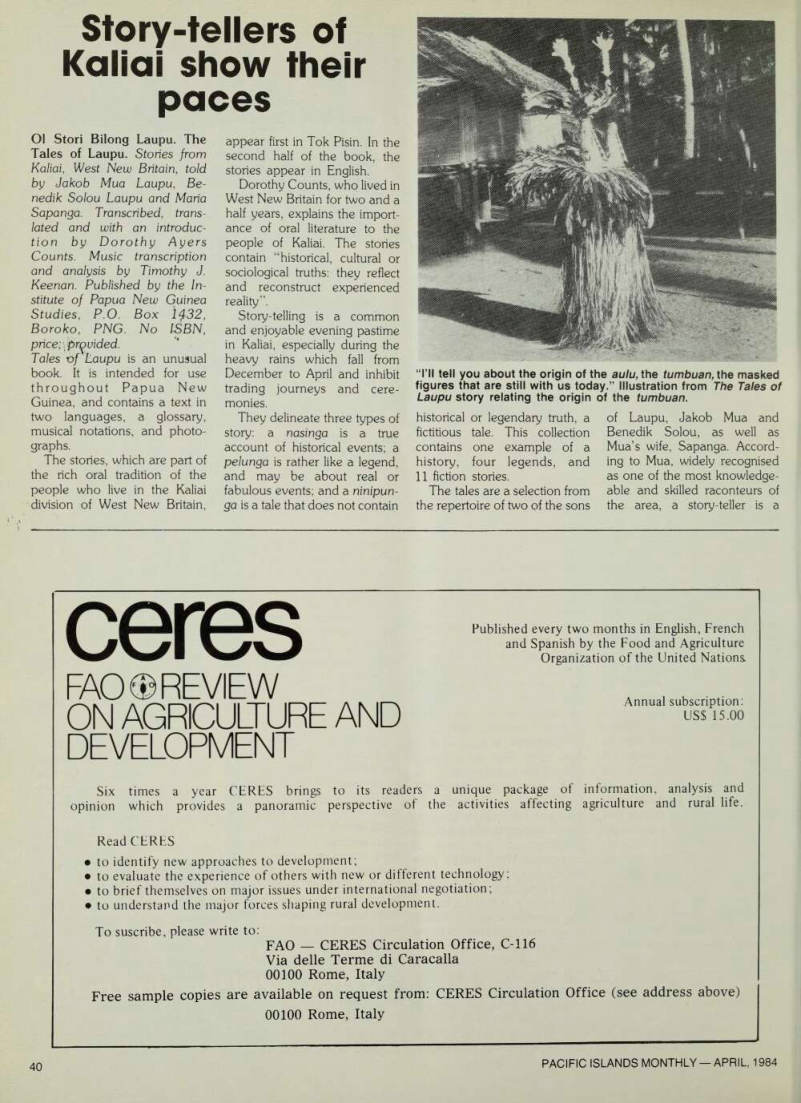
“I’ll tell you about the origin of the aulu, the tumbuan, the masked figures that are still with us today.”Illustration from The Tales of Laupu story relating the origin of the tumbuan.
performer as well as a store of knowledge. If he is to hold the interest of his audience, he should not break the continuity of his story by pausing to search for names or facts, laughing at his own words, or engaging in extraneous conversation or commentary.
Music and song appear fre quently in the oral literature, reflecting the importance of singing in the everyday life of the Kaliai people. They sing their grief at a death, or to give themselves strength during a difficult task, as well as to express contentment. Songs also act as a mnemonic device.
Some of the stories contain the words and musical notation of the songs, which usually occur as a necessary part of the story’s plot.
Four main themes are prom inent in the stories; the obliga tion to share food; coconuts; the importance of premoni tions; and suicide.
Suicide is not a common occurrence in Kaliai, but when it does happen it has great impact on the community. The act may be done by hanging or drinking poison, and embodies the notion that a person’s kin may bear responsibility for the death.
The story of “Pig and Frog” illustrates the importance of sharing; “Greed will not be tolerated. ” It shares elements of Western fables, with animal characters and a clear moral tone.
An astonishing story (fortu nately classified as fiction) is “The Ignorant Husband”, ab out a young man strangely unaware of the purpose of his marriage. The language is graphically explicit one assumes this book is meant for older students of Papua New Guinean literature.
The stories are well translated and flow easily, except for some of the American words and phrases (gotten, gee aw ’c’mon, say, I could use a little rain) which seem rather out of place and irritating in this very un sophisticated literature.
The book, produced by the Institute of Papua New Guinea Studies, is attractively bound and illustrated, and -should be come an important source work in the study of Papua New
Guinea’s literature.
Jo Rudd.