Where publishing presents a
pp. 37-39 · Read in the full issue
books
Marshall Islands Oral Literature
Where publishing presents a moral dilemma
Man This Reef. By Gerald Knight and La Bedbedin. Pub lished by Micronitor, Majuro, 1982. 163 pp.
It is now almost 15 years since the first inklings of the sudden surge of hitherto un heard-of Pacific writers began to be felt among readers of the “Mana” section of Pacific Is lands Monthly. The past decade has documented the emerg ence of a post-colonial Pacific literature through a series of stunning anthologies including Contemporary Maori Writing (A. H. & A. W. Reed, 1970), Black Writing from New Guinea (University of Queens land Press, 1973), Some Mod ern Poetry from Fiji (Mana, 1974), and a spate of other publications containing the writ ings of Western Samoans, New Hebrideans (Mana, 1975), Solomon Islanders, Australian Aborigines ( Meanjin, 1977), Hawaiians, and Cook Islanders.
Collectively they provide us with a completely new perspec tive from which to view any new work by Pacific writers a perspective which was unavail able as recently as only a decade ago.
This new literature encom passes some 1200 languages with the various forms of Engl ish and Pidgin (the two lan guages of this book) as their lingua franca. The authors of this Pacific literature acknow ledge two literary traditions: the ndigenous oral literatures and the written one of the West.
Ehey regard themselves as tan jata whenua, a term in Maori A/hich means “people of the and.” A growing number of bilingual papalagi writers would ;ee themselves as increasingly a :>art of this literature, although heir attitude might best be
summed up in something the Australian poet Les. A. Murray wrote in Meanjin in 1977: “The takeover smell, the gubba smell, is still strong on us . . .lam deprived of my natural audience by the stain of association; for now, and perhaps all my life, I have to live with that and try not to let it distort my work. I'm out to break that gubba-ism, though. I am grate ful beyond measure to the makers and interpreters of traditional Aboriginal poetry and song for. . . showing me a deeply familiar world in which art is not estranged . . . and even goes magically beyond the human community ..."
Such a world in the Marshall Islands remains alive among its story-tellers. The view from the other side of this literature of convergence is given by the Maori poet Keri Hulme in her essay “Mauri: An Introduction to Bicultural Poetry in New Zealand.” (Only Connect , 1981): “A dual heritage is both pain and advantage. It gives you insight into two worlds.”
But she goes on to say that you are not wholly of either world, and “that can be a heart-rending experience.”
In Man This Reef Gerald Knight has given us 20 stories by the 78-year-old Majal (Mar shall) Islander La Bedbedin, translated from tape recordings made by Knight under circumstances honestly set out in a careful introduction.
At about the time when the publication of Contemporary Maori Writing launched the col lecting of the new Pacific litera ture, Knight was serving with the Peace Corps on Namorik.
There he came into contact with the contemporary oral literature of the Majal Islands.
By the mid-1970s he had moved to Rongelap, after a
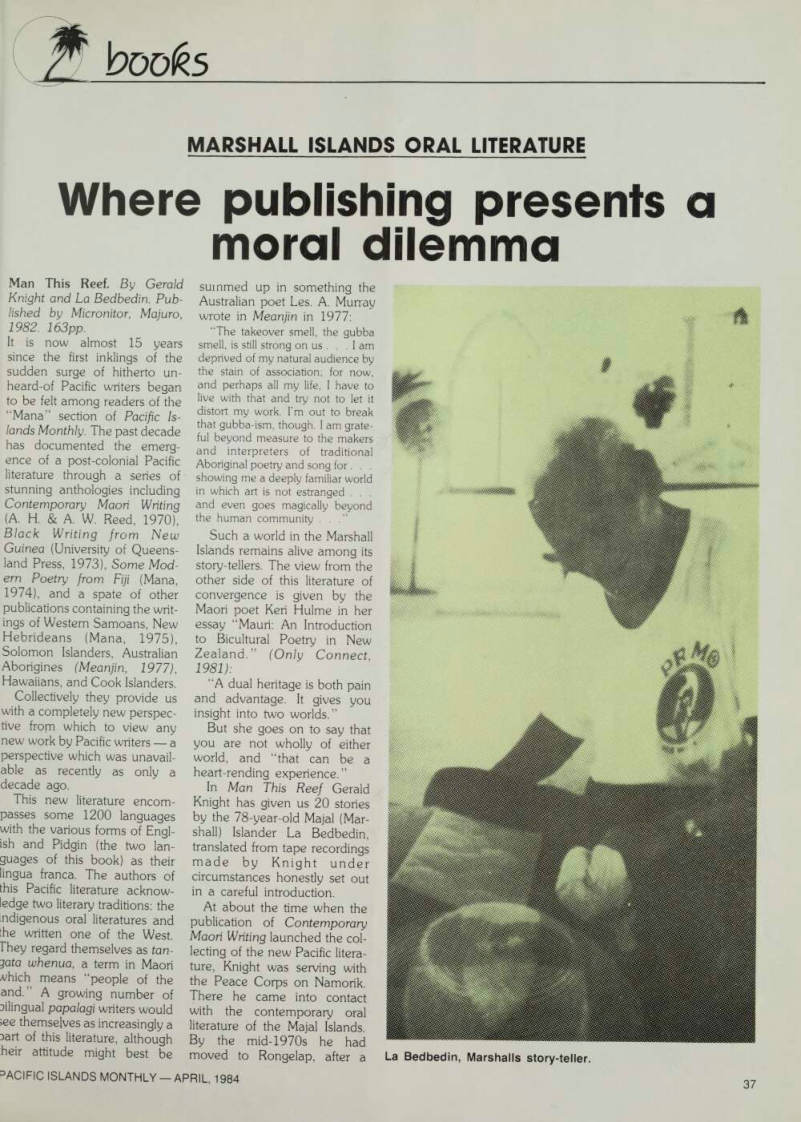
La Bedbedin, Marshalls story-teller.
period of commercial fishing on Majuro. Here he met the over 100-year-old Majal Islander Telegraph. Knight became an apprentice to this story-teller and navigator.
“Usually I’d bring him some fish or jekaro . . . which were the two products of my two daily en deavors; and after he’d eaten he’d tell me a story or two or teach me the words to a chant or relate the ancestry of one or other of the island families or the lineage through which a piece of land had passed ... He took my apprenticeship very seriously, and apparently, according to custom, such an apprenticeship was a very formal procedure which involved either adoption by, or marriage into, the family of the navigator; and my more or less casual amateur anthropologist style of trying to collect a story here and a legend there was not at all acceptable to him.”
In the process Knight began to learn a language older than the Kajn Majal he had already learned; this was the language of the dri-jela (“those who know”). Knight slowly came to understand that in the language of the dri-jela there was “a name, not only for every particular reef, but every out standing boulder upon them; not only every single islet, but every section of land upon them; not only every fish, but exactly in what areas among the 24 atolls it was poisonous; and not only for every cloud, but the exact position of the cloud in an overall weather pattern encompassing thousands of square miles of ocean; not only seemingly ev ery bright star in the sky, but the seasonal weather conditions traditionally associated with its rising; not only a name for every plant and tree, but an exact cure precipitated by its use as a drug; and not only these thousands of names and technical terms, but a seemingly endless profusion of poetry in corporating it all down into an oral tradition of education.”
Knight had begun to appreci ate the measure of a Pacific story-teller. At this point the island magistrate, Telegraph’s great grandson, accused him of demonstrating an “exploitative attitude" and confiscated his tapes and transcripts. Knight himself writes; “1 had mistaken ly believed I could use, at my own discretion, something of sacred or magic, and therefore,
profound value to others,” and accepted the decision. This is a dilemma faced by every Pacific editor. When Witi Ihimaera and I edited Into the World of Light one of our contributors, Wire mu Kingi Kerekere, gave us an opening waiata but he has steadfastly refused to allow a collection of his compositions to appear in print, believing that his is, above all, an oral art, and we did not press him for any further work.
Another Rongelap story-tel ler, La Tima, now invited Knight to come and live with him, and Knight determined to translate an autobiography rather than a chain of sacred stories. But before this project could proceed Knight lost La Tima’s trust.
So, two years after arriving on Rongelap, Knight came to live with his final informant, La Bedbedin. However, the magis trate, aware of what was happening, refused Knight per mission to proceed. La Bedbe din resisted Telegraph’s great grandson and proceeded to allow Knight to make his recor dings. The magistrate, for his part, arranged to have Knight deported.
A reviewer of Man This Reef, and, by implication, any reader, is thus faced with a very real problem. Are we to concur with Knight and La Bedbedin in further broadening the audi ence for these stories in the world beyond Rongelap, or should we agree with Ronge lap’s magistrate and condemn their publication? My Western side cherishes any publication of such wonderful stories, for La Bedbedin is truly a great story-teller. But as a Pacific writer I am not so sure.
The early stories are clearly mythological and sacred and I have a real difficulty in knowing if such ancient stories should be published in the teeth of opposition. What Knight does not say, but what I suspect must be the case, despite La Bedbe din’s attitude, is that this kind of oral literature does not belong to any one individual but to the Rongelap islanders as a com munity and it is not for any one man to decide to dissemin ate them. Such a decision may well have been forthcoming had Knight sought it, for it is clear from his introduction that the magistrate was prepared to
allow Knight to continue under certain conditions. This criticism also applies to the middle group of genealogical stories, for La Bedbedin is surely not the only one to have inherited them. I feel I must say no more about them.
None of these problems ap plies to La Bedbedin’s auto biography, which forms the third, and final, section of the book. As a child La Bedbedin was apprenticed to the naviga tor La Kebol, that is, he was taken as lon for La Kabol’s proa. There is a great wealth of knowledge in this section, for any Pacific sailor, with illustra tions of Majal wappepe at the back.
The story, “Koptata”, gives an account of Rongelap under the Japanese. Again, for those of us used only to accounts of the Pacific war seen through the eyes of Australians and Amer icans, this is a disturbing view from another side. Of Ronge lap’s Japanese garrison there was only one survivor, Koptata: “And in those year coming many will say his name in hate.
And many will say his name and laugh. But me I’ll feel only sorrow because I know his home was Hiroshima, and isn’t that first place to disappear from atomic bomb? So what is left for him now?”
The final story concerns itself with two lights which have touched the Majal Islands. “To
day nearly one hundred year later like one wind from east to west story of Gospel has swept our world and light of Jesus had penetrated every island.” But La Bedbedin had married a woman from Bikini and there another light came one mor ning; “It is just at dawn when they see lighting of that thing there on western horizon. Bright like moon rising in black sky. And they hurry to wake those other.
What is this? They run out across lagoon when wind and sound of thing fall and blow them down upon beach. They wonder what?”
Rongelap was caught in the fallout. “And all of them have no hair and all children throw ing up ... so we all wonder why do they make test with us?
Aren’t we people just like they are people?” So, here at last, we have a final insider’s story: of life after the bomb.
La Bedbedin is too great a story-teller not to try to point us in some direction with his words. So I must leave “the final word” to him: “. . . Those (Europeans) brought us light.
But I’m afraid they have turned away from God in pride of their own knowledge and strength.
Be aware to follow no man into darkness.”
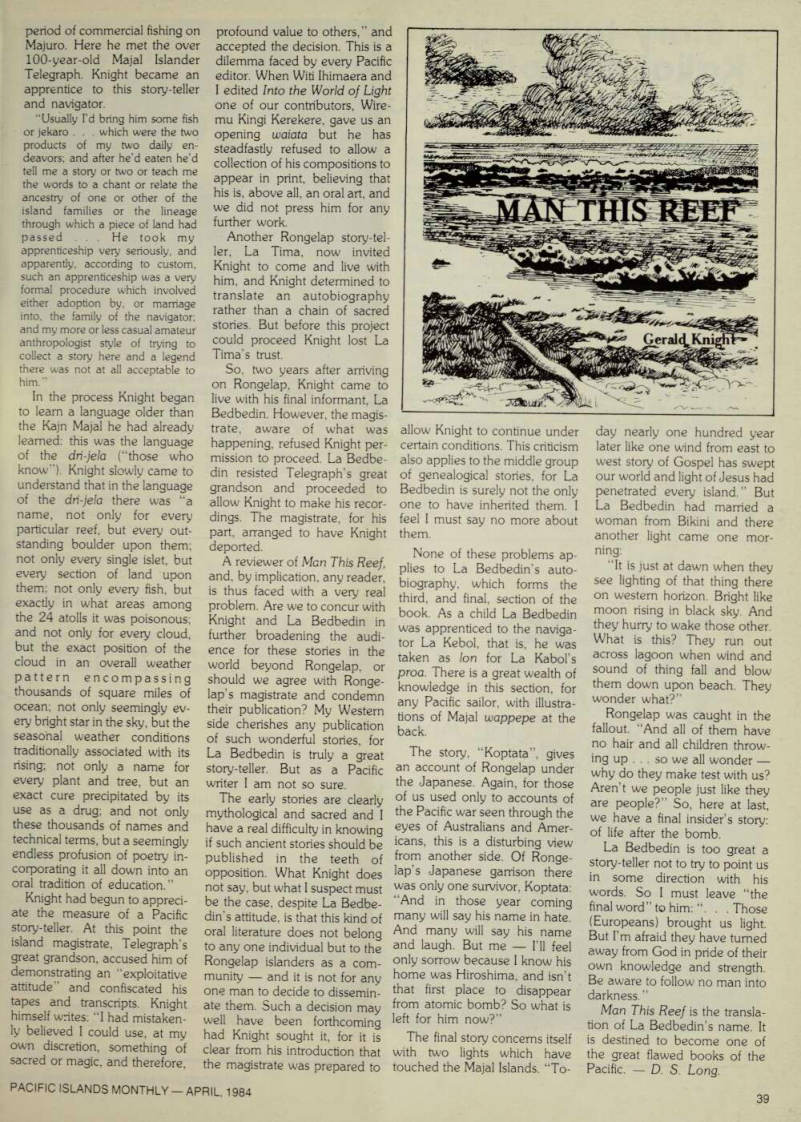
Man This Reef is the transla tion of La Bedbedin’s name. It is destined to become one of the great flawed books of the
Pacific.
D. S. Long.