company
p. 33 · Read in the full issue
Oz rice company watches PNG
Ricegrowers of Australia, the consortium which has the con tract to supply about 90,000 tonnes of Riverina rice annually to Papua New Guinea, is an xious over decision by the Port Moresby government to allow importation of 5000 tonnes of Taiwanese rice through a local company which is understood to include among its directors Opposition leader lambakey Okuk. The contract with the Australian company is of very long standing and is important to both countries not only in terms of direct trade, but also because it provides a basic sustenance for shipping. With out the 90,000 tonnes of Au stralian rice to justify their ser vice the PNG government broke their long-standing pol icy of buying exclusively from the Australian supplier and granted licence for 5000 tonnes to be brought in from Taiwan through a local market ing group. Although the ship ment is only an experimental one Australian trade interests in Port Moresby are concerned that it represents the thin edge of the wedge. Taiwan currently has a glut of rice and is offering a variety very close to the Riverina type at what are said to be extremely attractive prices.
The Papua New Guinea com pany numbers among its dire ctors a prominent and powerful politician.
Australia’s share of the PNG import market has been fading over recent years through a combination of competition from countries such as New Zealand, mainland China, Taiwan, Korea and Japan, and the opening of industries in PNG devoted to import sub stitution.
Papain plan
aired in
Vanuatu
The paw paw, which grows like a weed in most Pacific Island countries, is now expected to be the source of good export sales for smart agricultural oper ators. The green fruit, if careful-
ly scored, produces a latex-like substance rich in papain, an enzyme used to tenderise meat, clarify beer and perform a num ber of functions in the food and pharmaceutical industries.
Present world supplies come from Zaire, the Ivory Coast and Hawaii but, according to Albert Delhaye, a Belgian industrialist who attended an aid invest ment meeting in Vanuatu re cently, there is ample opportun ity for South Pacific growers to establish profitable markets with Australia and New Zea land. Delhaye’s company is one of two supplying the world market for papain.
He said that world demand was for between 70 and 75 tonnes of papain a year. His firm handled about 20 tonnes annually at prices ranging be tween $60,000 and $70,000 per tonne.
The catch for small Pacific countries is that an investment of about $3.5 million, not in cluding the paw paw plantation, would be required for an eco nomic factory to produce about
35 tonnes annually. He sug gested a plantation area of about 220 hectares would be needed to supply such a fac tory.
Average yield is about 100 grams of papain per tree per year.
“Milking” the fruit while green does not affect its ripen ing, nor its use as a fruit for juices or preserves, although it would not be saleable for high grade hotel table use because of the “milking” scars.
Japan credit
card giant
sets up in Fiji
Japan’s increasing interest in the South Pacific is shown by the decision of Japan’s largest credit card company, JCB, to establish an office in Fiji. Japan Airlines and Air New Zealand now both run direct Tokyo- Nadi-Auckland services and these, in conjunction with other routes linking Fiji with Australia,
New Zealand and Hawaii are bringing thousands of Japanese tourists to the islands each year.
One recent estimate sug gested that about 9 per cent of Fiji’s 200,000 tourists now come from Japan.
JCB’s Fiji agent is Sunny brook Holdings (Fiji) Ltd., whose managing director is Mike Brook, operator of the Castaway Resorts and one of Fiji’s most vigorous tourism entrepreneurs.
JOB was established in 1961 with major shareholding from Japanese banking groups and corporations such as Toyota Motor Corporation and Nippon Shinpan Co. Ltd. It moved into international business in 1981 and is now operational in 43 countries.
JCB is the fourth largest credit card company in the world with an annual volume of business exceeding SUS2OOO million. It also operates an extremely successful travel agency, JCB Travel Co. Ltd., with more than 30 major offices in Japan.
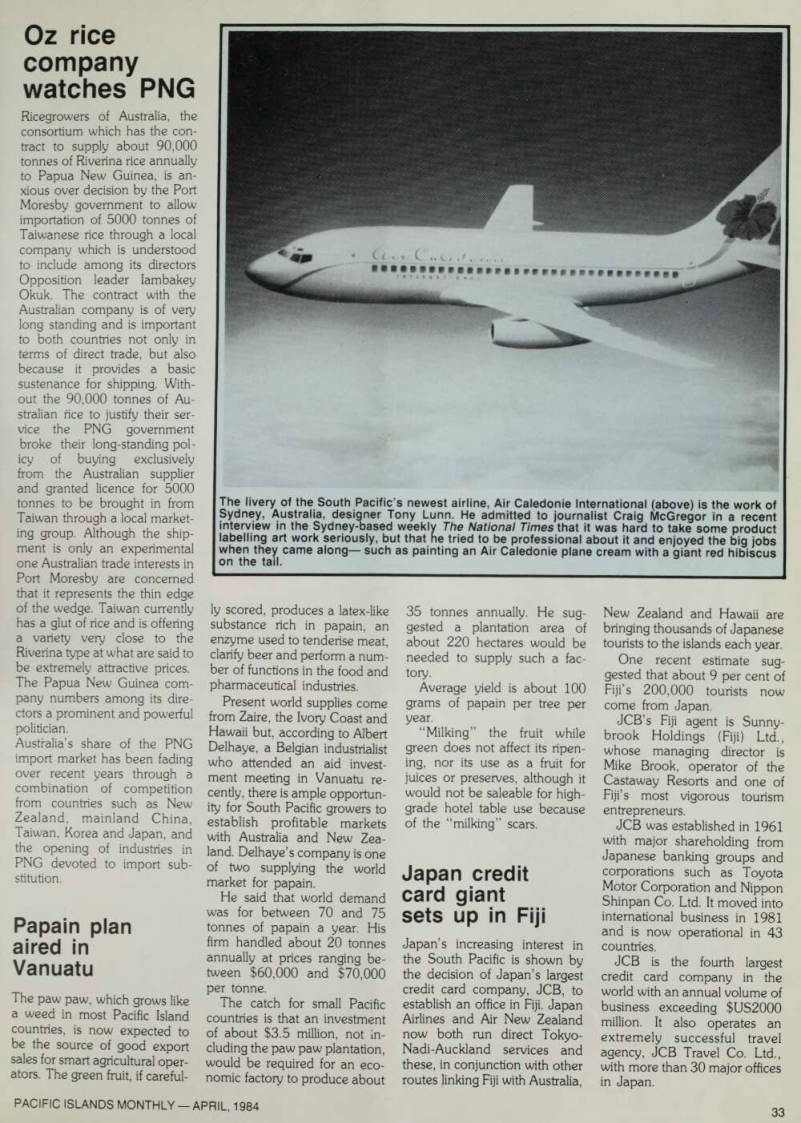
The livery of the South Pacific’s newest airline, Air Caledonie International (above) is the work of Sydney, Australia, designer Tony Lunn. He admitted to journalist Craig McGregor in a recent interview in the Sydney-based weekly The National Times that it was hard to take some product labelling art work seriously, but that he tried to be professional about it and enjoyed the big jobs when they came along— such as painting an Air Caledonie plane cream with a giant red hibiscus on the tail.