the figures
pp. 43-44 · Read in the full issue

Fiji Tourism
A conclusion that doesn’t quite match the figures
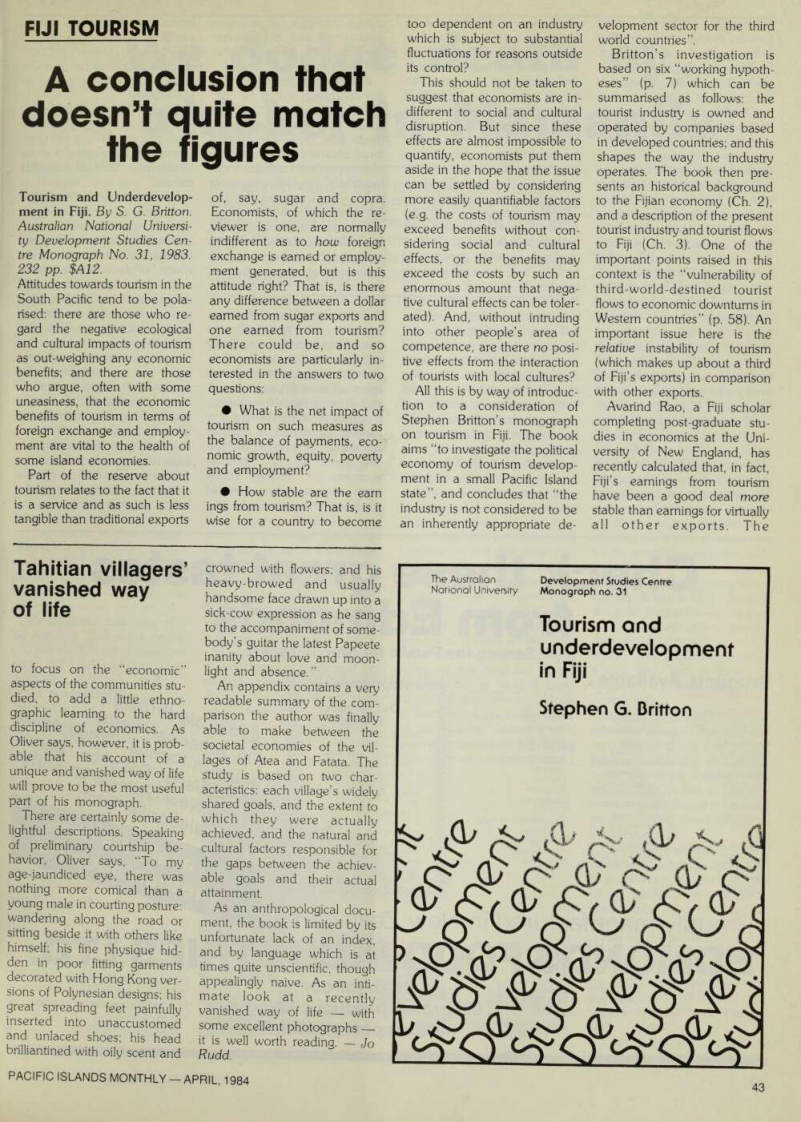
Tourism and Underdevelop ment in Fiji. By S. G. Britton.
Australian National Universi ty Development Studies Cen tre Monograph No. 31, 1983. 232 pp. SAI2.
Attitudes towards tourism in the South Pacific tend to be pola rised: there are those who re gard the negative ecological and cultural impacts of tourism as out-weighing any economic benefits; and there are those who argue, often with some uneasiness, that the economic benefits of tourism in terms of foreign exchange and employ ment are vital to the health of some island economies.
Part of the reserve about tourism relates to the fact that it is a service and as such is less tangible than traditional exports
of, say, sugar and copra.
Economists, of which the re viewer is one, are normally indifferent as to how foreign exchange is earned or employ ment generated, but is this attitude right? That is, is there any difference between a dollar earned from sugar exports and one earned from tourism?
There could be, and so economists are particularly in terested in the answers to two questions: • What is the net impact of tourism on such measures as the balance of payments, eco nomic growth, equity, poverty and employment? • How stable are the earn ings from tourism? That is, is it wise for a country to become
too dependent on an industry which is subject to substantial fluctuations for reasons outside its control?
This should not be taken to suggest that economists are in different to social and cultural disruption. But since these effects are almost impossible to quantify, economists put them aside in the hope that the issue can be settled by considering more easily quantifiable factors (e.g. the costs of tourism may exceed benefits without con sidering social and cultural effects, or the benefits may exceed the costs by such an enormous amount that nega tive cultural effects can be toler ated). And, without intruding into other people’s area of competence, are there no posi tive effects from the interaction of tourists with local cultures?
All this is by way of introduc tion to a consideration of Stephen Britton’s monograph on tourism in Fiji. The book aims “to investigate the political economy of tourism develop ment in a small Pacific Island state”, and concludes that “the industry is not considered to be an inherently appropriate de
velopment sector for the third world countries”.
Britton’s investigation is based on six “working hypoth eses” (p. 7) which can be summarised as follows: the tourist industry is owned and operated by companies based in developed countries; and this shapes the way the industry operates. The book then pre sents an historical background to the Fijian economy (Ch. 2), and a description of the present tourist industry and tourist flows to Fiji (Ch. 3). One of the important points raised in this context is the “vulnerability of third-world-destined tourist flows to economic downturns in Western countries” (p. 58). An important issue here is the relative instability of tourism (which makes up about a third of Fiji’s exports) in comparison with other exports.
Avarind Rao, a Fiji scholar completing post-graduate stu dies in economics at the Uni versity of New England, has recently calculated that, in fact, Fiji’s earnings from tourism have been a good deal more stable than earnings for virtually all other exports. The
vulnerability argument against tourism, at least for Fiji, appears to be based on shaky empirical foundations. Further, on this point, it could be argued that for traditional exports, market ing bodies can act to reduce fluctuations in income to pro ducers by, for example, mini mum price schemes. This sug gests that such exports may be more desirable than tourism, as regards the effects of fluctua tions on the economy. Howev er, given the high degree of foreign ownership in tourism, the expenditure and earnings remaining in Fiji will be much more stable than total tourism earnings. That is. at least some components of the industry have substantial proportions of fixed costs; as long as hotels, for example, are kept open, certain costs (e.g. wages of basic staff) have to be paid irrespective of the number of tourists arriving.
Of particular interest is the chapter on tourism and the Fiji economy. Using multiplier co efficients. Britton estimates the impact of changes in expendi ture on tourism on magnitudes such as Gross Domestic Fro
duct, imports and demand for labor. He specifically considers net foreign exchange earnings from tourism. These amount to well under half the gross ear nings, given the industry’s heavy dependence on imports (around 17 per cent of imports in the early 1970 s were for the tourist industry), salary pay ments to foreigners, and re patriation of profits. The link ages of tourism to other sectors of the economy are estimated to be relatively low, given high import requirements. Further sections consider government income and expenditure with respect to tourism, and the distribution (both international and local) of tourism receipts.
There is, unfortunately, no rigorous attempt to add up and compare the positive and nega tive magnitudes of these fac tors. Despite this, the chapter concludes with the remark that “in purely economic terms, the industry probably brings with it as many advantages as it does disadvantages” (p. 197). This does not square up with the facts presented earlier in the chapter, i.e., net foreign ex
change earnings, employment generation, and net govern ment receipts, are all positive and substantial.
Britton’s principal reason for this conclusion is that he con siders the industry “has im posed on Fiji a development mode that (has) exacerbated those adverse conditions typical of a dependent capitalist social formation” (p. 198). In other words, the worsened distribu tion and political-social costs are assessed as exceeding the net economic benefits. He is entitled to his opinion but, as mentioned above, the data he presents does not obviously support this conclusion.
To be fair to Britton, he does not set out specifically to answer the questions outlined at the start of this review. His is a wider concern, moving into areas such as appropriateness and dependency. Nonetheless, if non-economists (Britton is a geographer at the University of Auckland) are going to venture into areas like the “political economy of tourism,” they must expect economists to scrutinise their findings. The
latters’ strength in this sort of exercise, incidentally, is to answer such questions as “how much is it-costing us, in dollar terms, to follow a policy of self-reliance?”
Finally, there is little discus sion of policy, although Britton does suggest that the Fiji Gov ernment is developing a more consistent stance towards tourism.
It is important to recognise that host governments do have ultimate control over multi national corporations. They can impose the terms and condi tions under which these corporations must operate. And if they won’t toe the line, they can (quite easily) be encour aged to leave, as IBM and Coca-Cola have left India. De veloping countries in general seem to have been quite successful in imposing their will on multi-nationals. The only problem has been sorting out what their will is.
In summary, Britton’s book is a useful compilation of data on tourism in Fiji, and a valuable contribution to the tourism de
bate.
Geoff Harris.