Village, Kolombongara
pp. 25-28 · Read in the full issue

trade winds
How hydro-power came to Iriri Village, Kolombongara
DENIS FISK tells the remarkable story of how the voluntary and co-operative efforts of a group of Australian experts in various fields, and the 110 people of a Solomon Islands village, have produced “the world’s first practical and complete village micro-hydro electricity generating system ”.
When the micro-hydro electric ity was turned on at Iriri. a small leaf village on the island of Kolombongara, in Solomon Is lands’ New Georgia group, the importance of the event for local people and the enter prise of the 110 Iriri villagers were recognised at an ex traordinary, generous-spirited gathering.
Rivalries were put aside as 400 chiefs, village leaders and other dignitaries came from many miles around on Novem ber 20, 1983, to wonder as they saw at work the world’s first practical and complete vil lage micro-hydro electricity generating system.
Small hydro schemes have indeed been installed to power expatriate-run institutions in the Solomons and elsewhere be fore, but these have required constant maintenance by ex perts.
The overwhelmingly signifi cant triumph of Iriri is in provid ing a water supply, a micro hydro electricity generator pro ducing 7.5 kVA, and a distribu tion system which can be main tained . using many available, and some introduced, village skills.
The secret of success has been to devise a reliable elec tronic control to distribute a constant amount of the electric ity produced. Excess electricity is “burnt off” as heat. This control method replaces the long-established but trouble prone mechanical control of water flow to the turbine.
It is no exaggeration to say that this marriage of high technology and village skills should have revolutionary offspring in other Pacific Islands and many other countries.
Already, it is being followed up in Papua New Guinea.
The potential for changing the economic and social lives of
village people with access to the necessary river or creek is dramatic if, like Iriri, those vil lages want change and are willing to work for it.
The technical breakthrough has been achieved over six years with little finance by the group consisting largely of
volunteer professionals with va rious engineering skills, centred on the New South Wales Insti tute of Technology in Sydney, Australia. They belong to an independent, non-profit organisation calling itself APACE (Appropriate Technol-
ogy and Community Environ ment).
The volunteers formed the Microhydroelectric Group in response to the Iriri villagers’ need for power to continue their unusual, self-motivated, communal development of the village. This was Iriri’s answer to the pressures of rapid change affecting all Solomon Islanders.
Iriri is a traditional leaf village, built of bush materials on an extinct volcano, the beautiful conical island of Kolomban gara. It is closer to the big PNG island of Bougainville than it is to the Solomons capital, Hon iara, on Guadalcanal.
The village was by no means an ideal place to start such a project. The stream is not very reliable, it is 800 metres from the village, the head (body of water to be piped to drive the turbine/generator) is too low by the usual standards, and the power outlets (houses, work shops etc) are spread over a wide area, in the way of many Solomons villages.
But it was attractive as a proposition for the Sydney en gineers because the people of Iriri wanted power badly and, if it could be made to work there, it could work almost anywhere.
Making it work required the inter-action, at various stages, of the two main groups already mentioned, the philanthropic Australian adventurer Dick Smith, Vinidex Tubemakers (a major Australian manufacturer of PVC pipes), the United Na tions Industrial Development Organisation (UNIDO), the Australian Government’s Office of National Development, and its energy, foreign affairs, and industry and commerce depart ments in Canberra, the Austra lian High Commission in Hon iara, the Solomon Islands West ern Province Premier Mr Hilli,
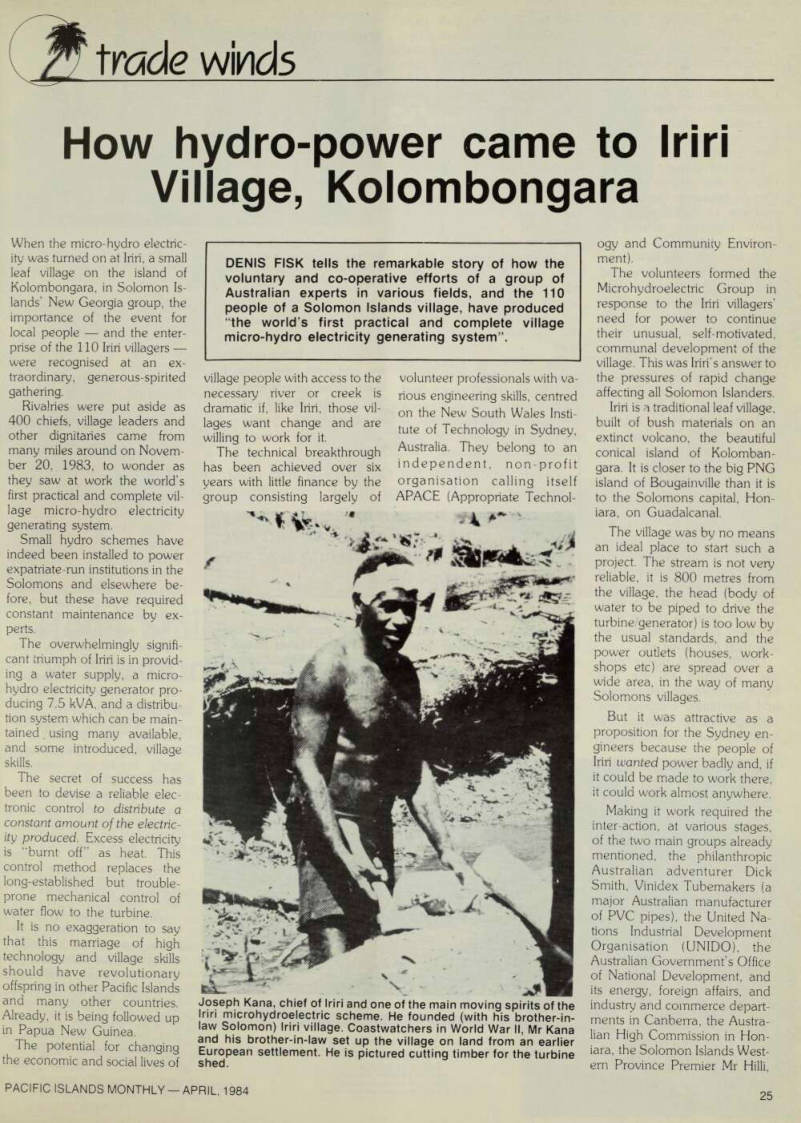
Joseph Kana, chief of Iriri and one of the main moving spirits of the Iriri microhydroelectric scheme. He founded (with his brother-in law Solomon) Iriri village. Coastwatchers in World War II, Mr Kana and his brother-in-law set up the village on land from an earlier European settlement. He is pictured cutting timber for the turbine shed.
and the Solomon Islands federal cabinet.
The achievement must be seen essentially, however, as one by enthusiasts at both ends, rather than the result of an application of large amounts of money which is another way such results may have been achieved.
I was introduced to the de tails of the scheme by the Microhydroelectric Group’s co ordinator, Dr Paul Bryce, of the NSW institute’s school of electrical engineering.
He told me: “We have been grateful for the help we’ve had from many directions, but what we have at present is a ‘Rolls -Royce standard’ control, whereas we should by now have a simpler and even cheap er device which would work just as well and be affordable any where in the world. We still need funds to develop this.”
He showed me color slides of the last eight back-breaking weeks of work by the whole of Iriri village, including vacation ing students, in September and October of last year.
“From the beginning, our group, chosen for sympathy with the Iriri people’s desires, agreed to get the villagers com pletely involved. By their doing everything possible to build the scheme, it meant that they were not only seen to realise their ambition, but knew themselves that they had done so.”
Distribution of power from the generator to the leaf houses, community workshops, and community buildings was underground, to maintain the traditional look of the village.
This meant more work than simply stringing power lines from posts, but it was tackled with an enthusiasm which per sisted throughout the two-and a-half-weeks of dawn-to-dusk labor required to complete the project.
Two young village men who were shown by an electrical engineer how to wire the houses to junction boxes, and take off lines from the mains, had taken over completely within two days, and were doing the job perfectly.
Villagers also came up with a faster way of inserting wiring into the protective PVC conduit before it went underground: they reasoned it was faster to pull the tubing on to strung wires.
The electronic control of generator output devised by Paul Bryce is a technological application of great significance for developing countries. It allows the marriage of high
“The potential for changing the eco nomic and social lives of village people with access to the necessary river or creek is dramatic if, like Iriri, those villages want change and are willing to work for it ...”
technology with skills available in the village, with small risk of incompatibility arising after wards.
Small hydro-electricity generating systems have gen erally relied on a mechanical control of water flow. When consumption of electricity fell,
the mechanical control re stricted the flow of water, so that the generator produced less electricity, bringing produc tion and consumption into ba lance. However logical, the sys tem was complicated and prone to breakdowns, needing the almost constant loving care of
an engineer.
As anyone who has lived in the Pacific Islands knows, en gineers are still just about the rarest of professionals produced there. So an engineer almost invariably has to be an expatri ate, if one can be found for such a purpose.
Dr Bryce’s premise was for the production of electricity to remain constant. When the to tal supply was not needed by consumers for lighting or powering machines, the surplus should be “burnt off” in some way in more technical terms, the system required a “dummy load”.
The control directing where the power went had to be reliable, flexible, and rugged, requiring no adjustment or maintenance.
Bryce decided that this re quired use of the latest in electronics, with a control as reliable as a good transistor radio, and capable of replace ment by a plug-in spare in the event of breakdown.
With Ken Offord, formerly with the NSW Electricity Com mission, and in 1978 an ad vanced student at the institute, Bryce developed the rudiment ary prototype control. It not only worked much as required, but even then showed a big cost-saving over the precision made mechanical water-flow control.
A productive solution was found to the problem of what to do with the “burnt off” excess electricity by using it in a copra dryer. (Now, there is a rural luxury an electric copra dryer. And doesn’t it make good copra!) Others who played a part include: Neil Crowley, a ma ture-age student at the institute and a member of the Microhy droelectric Group, who helped to develop and test a hydraulic turbine which could be made without expensive metal-cas ting facilities; Alex Revel, a mechanical engineer at the Uni versity of New South Wales;
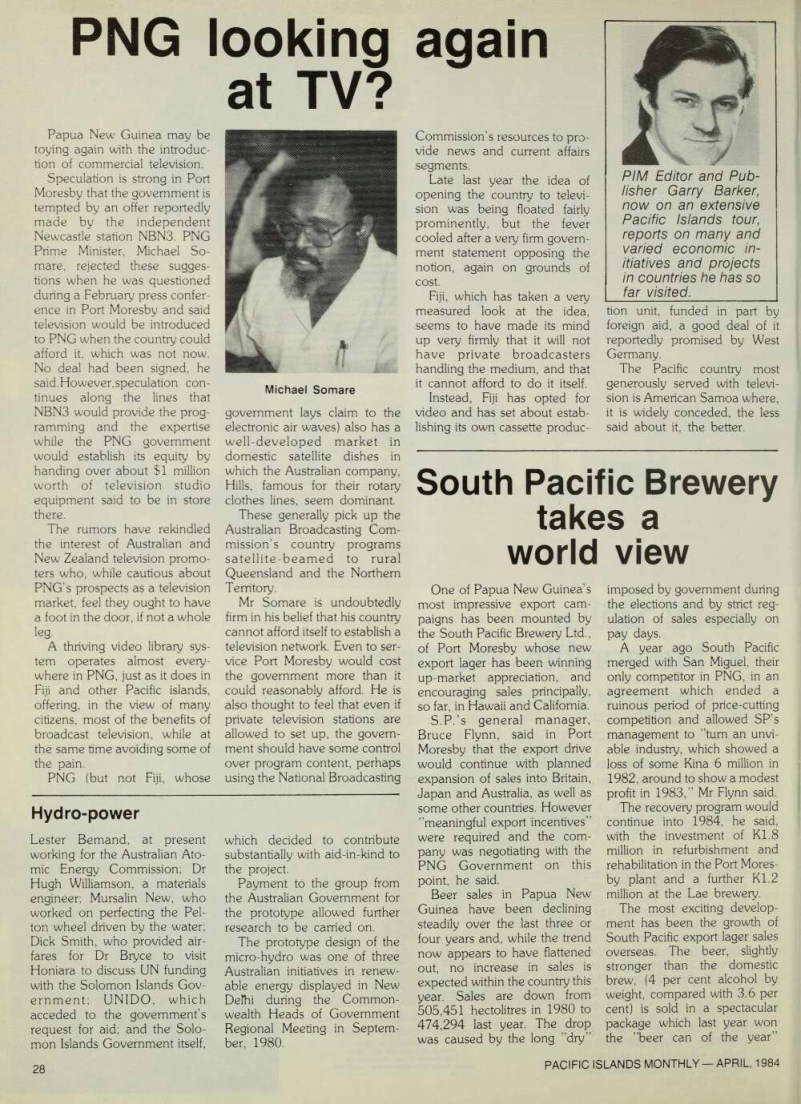
Iriri villagers laying PVC pipe on trestles through the Kolombangara bush from the Oriomo River dam to Iriri village.
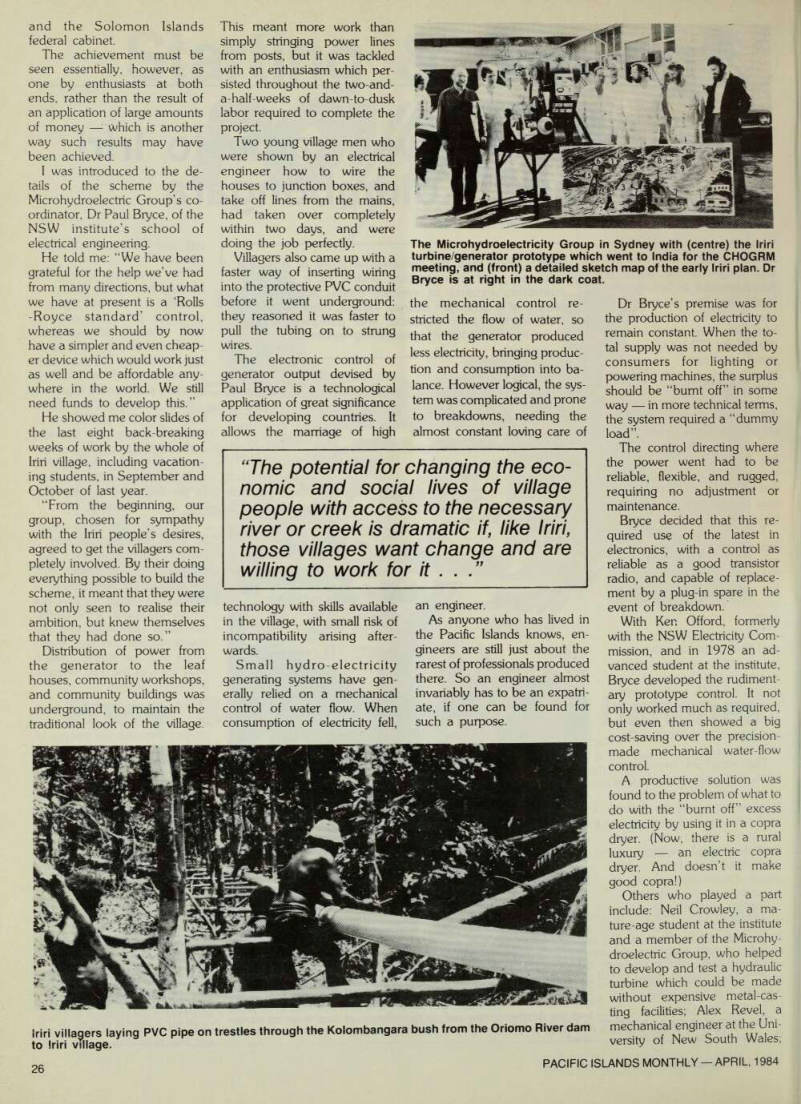
The Microhydroelectricity Group in Sydney with (centre) the Iriri turbine/generator prototype which went to India for the CHOGRM meeting, and (front) a detailed sketch map of the early Iriri plan. Dr Bryce is at right in the dark coat.
Lester Bemand, at present working for the Australian Ato mic Energy Commission; Dr Hugh Williamson, a materials engineer; Mursalin New, who worked on perfecting the Pel ton wheel driven by the water; Dick Smith, who provided air fares for Dr Bryce to visit Honiara to discuss UN funding with the Solomon Islands Gov ernment; UNIDO, which acceded to the government’s request for aid; and the Solo mon Islands Government itself,
which decided to contribute substantially with aid-in-kind to the project.
Payment to the group from the Australian Government for the prototype allowed further research to be carried on.
The prototype design of the micro-hydro was one of three Australian initiatives in renew able energy displayed in New Delhi during the Common wealth Heads of Government Regional Meeting in Septem ber, 1980.