to Mataiva
pp. 23-55 · Read in the full issue
The Lure Of Phosphate
From Makatea to Mataiva
When the French Phosphate Company of Oceania ceased mining activities in French Polynesia in 1966 it seemed like the end of an old-style colonial rip-off operation.
Over a period of more than 50 years this company, a large proportion of whose sharehol ders were actually British, had extracted more than 11 million tonnes of high-grade phosphate imbedded in the dead coral on the top of Makatea atoll in the north-western Tuamotus.
Methods of extraction were of the most primitive, with shovels and wheelbarrows the main implements.
It was not until almost the end of this long period that the local Territorial Assembly ac quired sufficient power to slap a modest 20 per cent export tax on the precious fertilising stuff
for the benefit of its rightful owners, the Polynesian people.
But now a new phosphate mining operation is being undertaken on the nearby atoll of Mataiva and once more the benefits to the hapless islan ders seem ridiculously small, especially when the huge en vironmental risks are consi dered, since the Mataiva de posits are not on the surface, as at Makatea, but under the waters of the lagoon.
Existence of these and other underwater deposits in the Tuamotus has been known of since the turn of the century, but nothing has ever been done about them because of the prohibitive costs of getting them out Nothing, that is, until the mid-1970s when, as a result of prolonged drought and exten
sive crop failures on a world scale the demand for phos phate rose steadily, and the price reached about SUS7O a tonne.
The first person to act on the idea that the submerged Tuamotu deposits might at last be commercially viable was Jean Breaud, a French tycoon who since World War II has been investing heavily in Tahiti in practically everything you can lay a name to. (His great wealth made his son Olivier the victim of the first kidnapping in Tahitian history when, in 1980, he was seized by French gangs ters and brutally murdered be fore the $2 million ransom had been paid (PIM May ’BO pi 7, and June ’BO pl 9).
In July 1976 Breaud formed a Tahiti-based company “for mineral prospection and par ticipation in mining opera tions”. Among the shareholders were a number of his closest business associates, and a French-bom American expert on ocean mining, Andre Ross felder.
Breaud then signed up seve ral very large companies who were willing to put up the big money needed to get the pro-
Postmark Papeete
ject under way. The consortium thus formed comprised the French Societe Pechiney, the Canadian mining giant Comin con, and American Union Oil.
The last two companies each held 24.5 per cent of the shares, while Pechiney held 26 per cent and Breaud’s own small company 25 per cent.
Continued on page 55
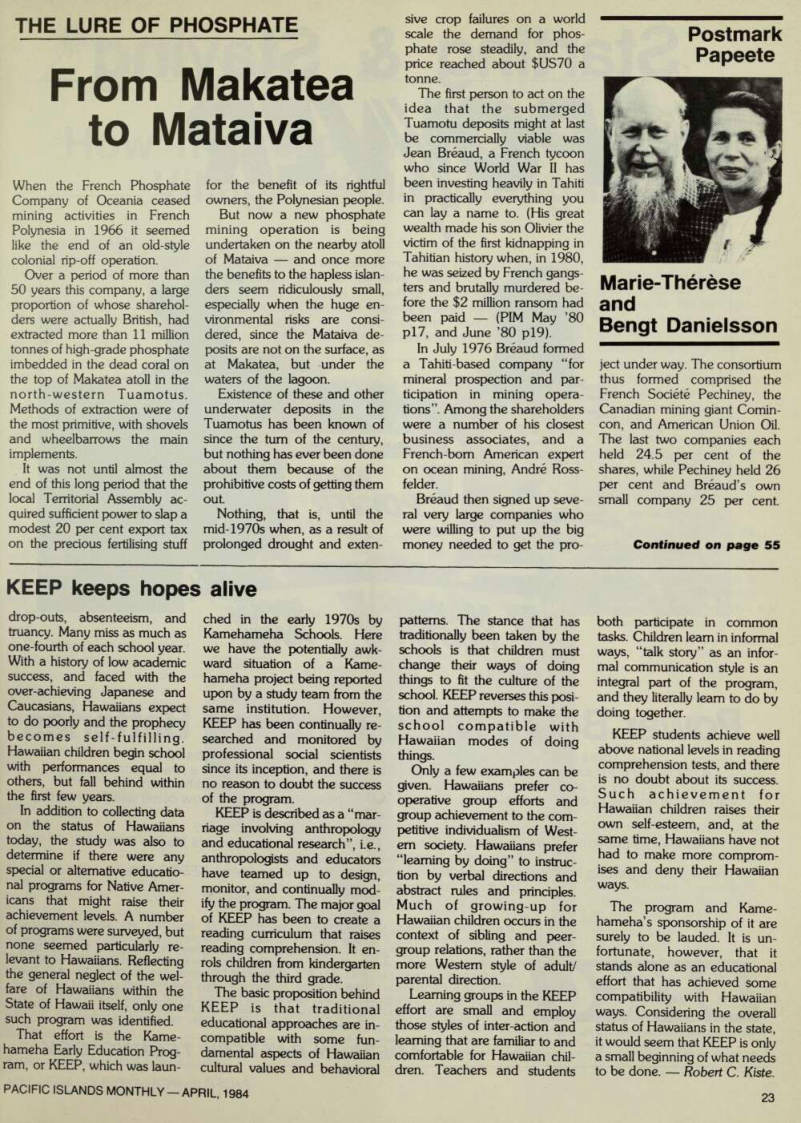
Marie-Thérèse and Bengt Danielsson
from page 23
The arrangement thus met offi cial requirements that majority shareholders must be French.
The registered name of the company spelled out its prog ram; Raro Moana, or “Under the Sea”.
By 1978 a team headed by Rossfelder had surveyed the whole Tuamotu archipelago and taken hundreds of core samples from the bottom of 30 atolls. Analyses carried out con currently in French and Amer ican laboratories over the next two years showed that there were indeed important deposits of high-grade phosphate under the shallow lagoons of three atolls Pukapuka, Mataiva, and Niau. Pukapuka was deemed too distant and iso lated, so it was decided to undertake more thorough in vestigations of Mataiva and Niau to determine the precise extent and volume of their deposits.
Like all promoters Breaud and company were at pains to spread the idea that the revival of phosphate mining would usher in an era of general prosperity. The bait was eagerly taken by the new Autonomist majority led by Vice-President Francis Sanford, who was faced with a steadily worsening eco nomic situation and rising un employment. Every new inves tor was given a warm welcome, without too many questions asked.
The only people not jumping for joy were the 174 inhabitants of Mataiva, and the 152 who lived on Niau. They protested that the prospecting, and even more the actual mining, would pollute the lagoon and kill the fish on which they depended for their livelihood.
When told of the fabulous wealth coming their way, they replied that the money they made by producing 500 tonnes of copra a year was sufficient for their needs. And the lagoon was theirs. So, please, keep out.
But, unfortunately for them, French law does not recognise individual or communal owner ship of lagoons in the territory.
So the Raro Moana people could go ahead unhindered in 1979-80 making 400 test pits in the lagoon of Mataiva, which they had chosen as their first
target, its phosphate being of a better quality than that of Niau.
Sure enough, the disturbed environment reacted in the most unpleasant manner by poisoning the fish, which, when eaten by the islanders produced the typical ciguatera symptoms of paralysis, vomiting, joint pains, respiratory disorders, and so on.
To combat the ensuing animosity and criticism the Raro Moana people in April 1981 offered to pay for an environmental impact study. It was carried out by French army doctors from the Moruroa nuc lear testing site, and, to no body’s surprise, they found no cause for alarm at Mataiva.
The consortium might just as well have saved its money, for by now it was quite clear that the Mataiva project had the full backing of the French Govern ment one of Jean Breaud’s great strengths is his extensive network of political and busi ness contacts in Paris where all important decisions affecting French Polynesia are still made.
The fact that the project was indeed destined to go ahead was signalled when parts of a giant dredge began to arrive for assembly at Mataiva even be fore the “environmental impact study” had been completed.
With the monster dredge assembled, the local people were told that it would be scraping off the “useless” seven metres of sand which overlay the estimated 20 million tonnes of phosphate under the lagoon.
Where would they be putting the sand? Back into the big hole there will be in the bottom of the lagoon after the phosphate is taken out.
This revelation made the Mataiva people, if possible, even more opposed to the mining plans, and, in a dramatic turn-about, Vice-President San ford assured them that nothing
would be done against their will.
But it was too late. Two months later Sanford was swept from office by the most pro- French and pro-business of all the local leaders, Gaston Flos se. The Raro Moana technicians were thus able to carry out their next step undisturbed: they ex tracted 900 tonnes of phos phate from Mataiva which was to be subjected to industrial trial treatment in US plants.
Then nature itself took a hand: between December 1982 and April 1983 six cyclones came literally out of the blue to revage French Polynesia, and the last two passed directly over Mataiva, destroying all houses and coconut plantations.
Those who stayed behind, resisting the temptation to flee to Tahiti, benefited from the emergency aid in food, building materials and money quickly provided by the local govem
ment. It also occurred to them (after some prompting from Raro Moana officials) that a new prosperity might be just around the corner if they changed their minds and went to work for the phosphate consortium.
Raro Moana quickly pro duced a splendid blueprint for a huge mining complex, to be operational by 1986. It would be extracting a million tonnes of phosphate a year, mainly for export to Japan and New Zea land. It would comprise wharves, living quarters for at least 300 workers and their families, and a rinsing plant.
As for the financial benefits to the territory, Raro Moana offi cials have tried hard to make us believe that their offer of CFPIOOO million a year paid to the government is a generous one. But considering that they will be taking out a million tonnes a year, this corresponds only to CFPIOOO (SUS 6) a tonne, which, expressed as a percentage of total value, is even less than the old Makatea company paid.
It’s being suggested here that local politicians should visit Nauru and leam from crafty President Hammer Deßoburt how to handle these problems.
But people who have this idea forget one thing: Nauruans nev er got a fair deal on their phosphate until their island be
came independent.
Marie-
Thérèse and Bengt Danielsson.
One of the phosphate prospecting sites in Mataiva.