KEEP keeps
pp. 21-23 · Read in the full issue
hopes alive
Surrounded by a sea of Orien tal and Caucasian faces, a re cent American visitor to Hono lulu was heard to ask if the native Hawaiians lived in the mountains above the city. No one could inhabit that particular terrain, but the visitor’s query reflected the fact that, in general, Americans on the mainland know very little about the 50th state, or its original Polynesian inhabitants.
Local residents also find it strange that although the televi sion program Hawaii Five O has been extremely popular around the world, still today, after 15 years or more of viewing its hero chase the bad guys around what is an obviously very urban landscape, visitors continue to be surprised at Honolulu’s skyscrapers and lack of grass shacks. Stereo typical South Sea visions of the islands still prevail.
The lack of knowledge about Hawaii and its people has had serious consequences for native Hawaiians and their descen dants. Knowledge about Hawaiians has been so limited that, as recently as a decade ago, they were not formally or legally recognised as native Americans, i.e., descendants of the aboriginal inhabitants of the United States, as were Amer ican Indians or the Eskimo peoples of Alaska. Absence of that recognition meant that Hawaiians were not eligible for federal programs which sought to remedy the poverty, social disorganisation, poor health, and low educational levels which plague so many native American populations.
Belatedly, in 1974, the U.S.
Congress did recognise Hawaiians as native Americans, but attempts to provide them with educational and other be nefits available to American In dians were not successful. Not surprisingly, lobbyists and gov ernment agencies identified with American Indian interests were reluctant to share re sources with another cultural group, especially one which was both unfamiliar and far away. There was also little real
appreciation in the nation’s capital that Hawaiians occupied a niche at the bottom of the socio-economic ladder in their own homeland, a situation quite similar to North American Indians. Hawaiians differ from the latter, however, in that there were never reservations for in digenous peoples in Hawaii.
As one consequence, officials in the U.S. Department of Education suggested that in formation on the status of Hawaiians was needed in Washington, DC, in the form of a report that could be used to pound tables and beat on the doors of members of Congress.
The Kamehameha Schools, and Bernice Pauahi Bishop Estate in Hawaii, offered to conduct such a study. The former is the school for children of Hawaiian descent in Honolu lu, and the latter is the estate founded by the late Hawaiian princess to support education for Hawaiian children.
The Native Hawaiian Educational Assessment Project was launched in 1981. The results have recently been pub lished, and project director Neil J. Hannahs of the Kame hameha Schools has been shar ing them around town by means of a well organised and polished talk and slide pre sentation.
The research project focused on Hawaiian youths under 18, and mainly relied on data that are widely scattered but already available from schools, state agencies, and social science and historical research. The approach is holistic, taking into consideration many aspects of the social, cultural, and physical environments of Hawaiian young people.
The definition of Hawaiian is inclusive and based on the definition employed by the 1974 federal legislation which recognised Hawaiians as Native Americans “any individual any of whose ancestors were natives of the islands prior to Captain Cook’s first visit in 1778”. According to Hawaii’s Department of Health figures, there are 9366 pure Hawaiians
A View from Honolulu
and 166,087 part-Hawaiians, at a total or 175,453, or 18.9 per cent of the state’s population of 930,270.
By this count, Hawaiians are the third largest ethnic/cultural group in Hawaii. The 244,832 Caucasians are the largest with 26.3 per cent of the population, and the 218,176 Japanese constitute 23.5 per cent. Filipinos are fourth with 104,541 or 11.2 per cent. Individuals of mixed but non-Hawaiian descent are 87,840 in number, or 9.4 per cent. The remaining groups are
Chinese (5.1 per cent), Korean (1.3 per cent), Black (1.3 per cent), and Samoan (1.2 per cent).
The results of the study, while not surprising, are de pressing. On national educatio nal achievement tests, Hawaiians fall far short of natio nal norms. Within the state, Japanese score highest, with Caucasians second, and both are above national averages.
With regard to the general conditions of Hawaiians, it was found that many suffer the general consequences of low income in a state with one of the highest costs of living in the nation. Hawaiians are over represented among the unem ployed and on welfare rolls.
Their health is the poorest in the state, and life expectancy is shorter by a decade than that of all other ethnic groups. Crime, juvenile delinquency, and drug and alcohol abuse are recog nised as major social problems.
Years of subordinate status, frustration, and the break-up of the extended family organisa tion appear to contribute to high rates of child abuse.
Coming back to education, Hawaiians are over-repre sented in the figures for school
Robert C. Kiste looks at the Pacific
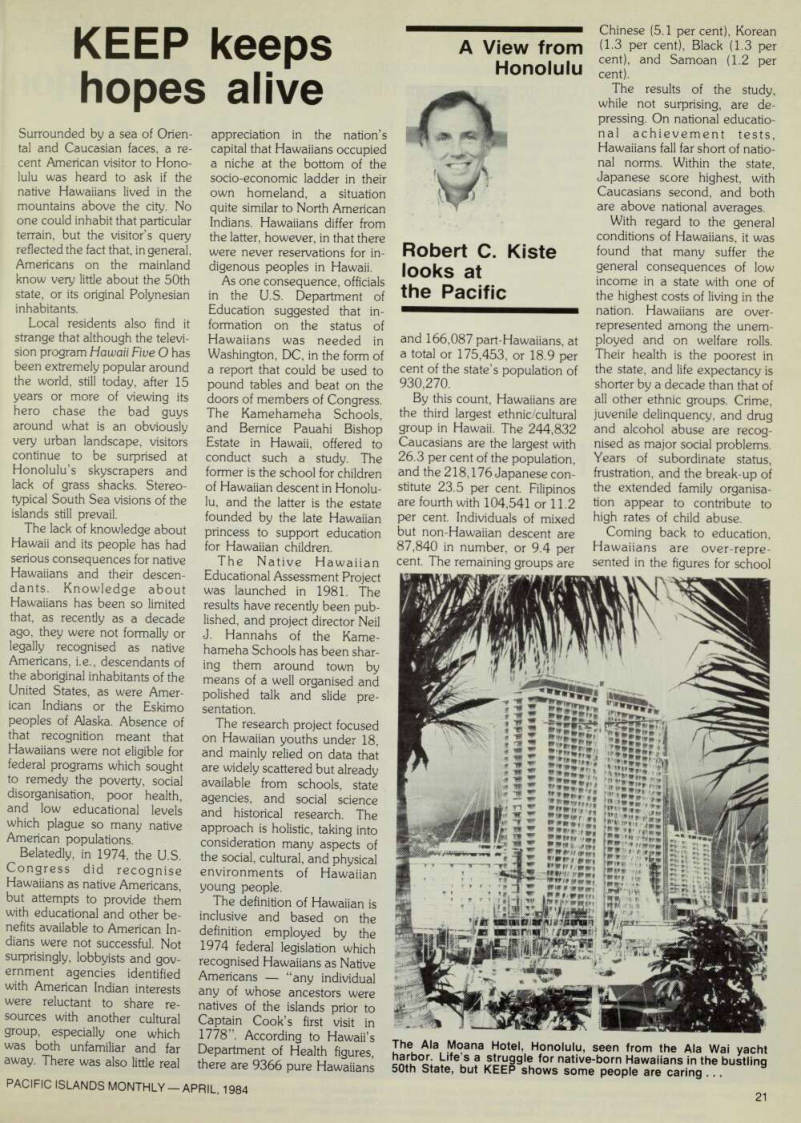
The Ala Moana Hotel, Honolulu, seen from the Ala Wai yacht harbor. Life's a struggle for native-born Hawaiians in the bustling 50th State, but KEEP shows some people are caring...
drop-outs, absenteeism, and truancy. Many miss as much as one-fourth of each school year, With a history of low academic success, and faced with the over-achieving Japanese and Caucasians, Hawaiians expect to do poorly and the prophecy
becomes self-fulfilling,
Hawaiian children begin school with performances equal to others, but fall behind within the first few years.
In addition to collecting data on the status of Hawaiians today, the study was also to determine if there were any special or alternative educational programs for Native Americans that might raise their achievement levels. A number of programs were surveyed, but none seemed particularly relevant to Hawaiians. Reflecting the general neglect of the welfare of Hawaiians within the State of Hawaii itself, only one such program was identified.
That effort is the Kamehameha Early Education Program, or KEEP, which was laun-
ched in the early 1970 s by Kamehameha Schools. Here we have the potentially awk ward situation of a Kame hameha project being reported upon by a study team from the same institution. However, KEEP has been continually re searched and monitored by professional social scientists since its inception, and there is no reason to doubt the success of the program.
KEEP is described as a “mar riage involving anthropology and educational research”, i.e., anthropologists and educators have teamed up to design, monitor, and continually mod ify the program. The major goal of KEEP has been to create a reading curriculum that raises reading comprehension. It en rols children from kindergarten through the third grade.
The basic proposition behind KEEP is that traditional educational approaches are in compatible with some fun damental aspects of Hawaiian cultural values and behavioral
patterns. The stance that has traditionally been taken by the schools is that children must change their ways of doing things to fit the culture of the school. KEEP reverses this position and attempts to make the school compatible with Hawaiian modes of doing inqs 3 Only a few examples can be given. Hawaiians prefer cooperative group efforts and group achievement to the competitive individualism of Westem society. Hawaiians prefer “learning by doing” to instruction by verbal directions and abstract rules and principles.
Much of growing-up for Hawaiian children occurs in the context of sibling and peergroup relations, rather than the more Western style of adult/ parental direction.
Learning groups in the KEEP effort are small and employ those styles of inter-action and learning that are familiar to and comfortable for Hawaiian children. Teachers and students
both participate in common tasks. Children learn in informal ways, “talk story” as an infor mal communication style is an integral part of the program, and they literally learn to do by doing together.
KEEP students achieve well above national levels in reading comprehension tests, and there is no doubt about its success.
Such achievement for Hawaiian children raises their own self-esteem, and, at the same time, Hawaiians have not had to make more comprom ises and deny their Hawaiian ways.
The program and Kame hameha’s sponsorship of it are surely to be lauded. It is un fortunate, however, that it stands alone as an educational effort that has achieved some compatibility with Hawaiian ways. Considering the overall status of Hawaiians in the state, it would seem that KEEP is only a small beginning of what needs
to be done.
Robert C. Kiste.